IISPPR

International Relations
PRIYANSHU KESHRI

A GEOPOLITICAL AND STRUCTURAL ANALYSIS OF THE IRAN–ISRAEL–UNITED STATES CONFLICT AND ITS IMPACT ON INDIA’S ENERGY SECURITY

This paper examines the causal architecture of the ongoing West Asia conflict involving the United States, Israel, and Iran, and its cascading effects on global energy markets and India’s energy security. With crude oil import dependency reaching nearly 89 percent in FY 2023–24, India remains acutely vulnerable to disruptions along the Strait of Hormuz. The paper argues that the resulting LPG supply shock stems from calculated escalation rooted in four interlocking causes: Iran’s contested nuclear ambitions, the collapse of the JCPOA, militarization dynamics seen in the Twelve-Day War, and the theoretical relationship between petrostates and militarized interstate disputes — situating India’s predicament within a condition of “dual energy dependency.”

Read More »
International Relations (I.R.) ( Book Review)
Kriti Pandey

The 2026 West Asia Crisis: Chokepoint Politics and Architectural Constraints on Global South Strategic Autonomy

The 2026 West Asia crisis exposed the structural limits of strategic autonomy in a formally multipolar world. Through the lens of energy dependence, chokepoint politics and financial hegemony, this paper argues that Global South vulnerabilities stem not from policy failures but from the architecture of the international energy order.

Read More »
International Relations
Tavishi Jasaiwal

India’s Export Potential in a Post-China Global Economy

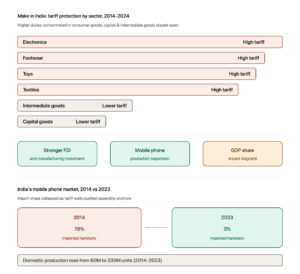
This paper examines India’s export potential in the context of the changing global trade landscape shaped by the “China Plus One” strategy and global supply chain diversification. It aims to evaluate whether India possesses the structural, institutional, and policy capacity to emerge as a competitive manufacturing alternative to China by analysing export trends, policy initiatives, logistics, and integration into global value chains. Using a mixed-method approach and a comparative case study of Vietnam, the study finds that while India has made sector-specific gains, particularly in electronics and pharmaceuticals, persistent structural constraints continue to limit broad-based manufacturing competitiveness and export-led growth.

Read More »

Sustainability Adoption Among Informal Waste Workers in India Economic Barriers, Incentive Structures, and Policy Gaps

Author: Sujal Kumar Poddar, Aasvi Kedia, Ditti Baid, Suryansh Pratap Singh ABSTRACT This study investigates the structural and economic disconnect between India’s municipal waste management ambitions and the lived realities of the informal waste workers who form the actual backbone of the country’s recycling ecosystem. While modern policy frameworks, exemplified by the Extended Producer Responsibility (EPR) guidelines of 2022 and urban clean-city campaigns, promote a highly formalized, capital-intensive vision of the circular economy, they systematically marginalize the informal sector, which handles 60% to 70% of urban recyclable waste. Utilizing primary survey data collected from 110 informal waste workers across Indian urban clusters, this paper analyzes the micro-economic constraints, behavioral realities, and institutional dynamics that govern waste worker decision-making. The empirical findings indicate that waste workers are not inherently unaligned with environmental sustainability; rather, their practices are strictly bounded by severe financial precarity, high transaction costs, and systemic institutional exclusion. Descriptive and cross-tabulation analyses demonstrate that over 57% of surveyed workers earn less than ₹10,000 per month, and 81.8% experience high financial instability, leaving them with zero economic margin to absorb the costs of enhanced segregation or safety compliance. Furthermore, the existing fiscal framework, such as an 18% Goods and Services Tax (GST) on recyclable scrap, drives transactions into untaxed, informal cash networks, penalizing formalization. This paper argues that India’s circular economy cannot succeed through top-down corporate monopolization. Instead, sustainable waste management requires an incentive-compatible policy framework that restructures fiscal policies, enforces informal cooperative sourcing quotas within EPR, provides micro-level neighborhood infrastructure, and leverages municipal co-management models to elevate informal workers into recognized green-collar professionals.

Read More »

CONTEMPORARY MANIFESTATIONS OF PATRIARCHY AND THE ROLE OF SOCIAL MEDIA

Authors: Dhriti Jade¹ ,Rajni Kumari² , Kiya Kamdar³  ABSTRACT This study delves into the contemporary workings of patriarchy, and exposes how dynamic and resilient it continues to be as it navigates through social and cultural contexts today. Patriarchy has diversified into countless social structures, cultural environments, and individual encounters. The patriarchal order not only perpetuates a division between the genders based on claimed superiority and hierarchy, fostering inequality in our private and public lives but is also constantly reinvented through everyday actions, cultural norms and institutional practices which allow it to remain prominent within our modern lives. It explores how patriarchal notions are entrenched, subtly reproduced, and negotiated on an everyday basis within society. We contest that the traditional yardstick to measure patriarchy has become archaic.  Within this larger context, the study will also explore the manifestation of this system via social media as a contemporary space where patriarchal notions are reproduced and simultaneously challenged. While such platforms do provide avenues for feminist conversations, organizing, and representation of minority narratives, it is also true that dissemination of gender stereotypes, discriminatory attitudes and harassment continue to be facilitated on the internet through algorithms and digital practices. Using established theoretical frameworks we analyse data and provide critical insights. Ultimately, the need for digital literacy and a greater degree of accountability on the part of the institutions will be discussed in order to effectively confront the complex workings of patriarchy.

Read More »

⁠How Does an Oil Price Shock Reach the Poor? Fuel Subsidy Pass-Through, Household Consumption Adjustment, and Distributional Consequences in India

Authors: Ankit Raj , Japho Esther Rani ABSTRACT India is heavily dependent on energy imports, leaving its macroeconomic stability sensitive to global fuel supply shocks and price volatility. The analysis of this paper explains the impact of international oil price fluctuations in low-income households through direct price pass-through, fiscal policy interventions, and indirect inflationary trends. Incorporating unit-level data from the Household Consumption Expenditure Survey (HCES) 2022–23 and the Periodic Labour Force Survey (PLFS) 2022–23, this study analyzes household consumption adjustments and the distributional incidence of fuel subsidies across rural and urban income cohorts between 2019 and 2023. Bivariate and descriptive analysis reveal an extreme spending polarization: while fuel budget shares remain rigid across all income levels, the poorest rural households devote nearly 60% of their monthly budgets to food security, leaving them zero financial buffer during oil shocks. Furthermore, the findings expose a distinct pro-rich bias in the absolute delivery of fuel interventions, where wealthy urban households capture up to ₹2,540.8 in annual subsidy benefits compared to just ₹635.2 captured by the rural poor. that universal fuel subsidies are failing to protect vulnerable populations and recommend transitioning toward targeted Direct Benefit Transfers (DBT) and progressive subsidy reduction mechanisms.

Read More »

The Rising Cost of Learning: Privatization,Affordability, and Economic Outcomes of Education in India

Author: Keertana Deepak | St. Xavier’s College, Mumbai | Email: keertanadeepak@gmail.comABSTRACT This research examines the structural transformation of India’s education sector from 1999 to 2025, focusing on the nexus between privatization, escalating costs, and labor market outcomes. Using a mixed-methods approach, the study finds a significant paradox: while primary private enrollment tripled to 45% and gender parity was achieved in secondary schooling, the qualitative dividend remains constrained. Econometric analysis reveals that while privatization correlates with higher test scores, it imposes severe affordability thresholds that limit advanced attainment for low-income households. Furthermore, a persistent education-employment mismatch results in high unemployment and a 7% wage penalty for overeducated workers, particularly women. The findings suggest that unchecked marketization has transitioned the system from an engine of mobility into a mechanism for reproducing privilege. We advocate for a shift toward outcome-oriented policies, rigorous private sector regulation, and reaching the 6% GDP public spending benchmark to secure India’s demographic dividend.

Read More »

RIGHT TO DIE WITH DIGNITY: A CONSTITUTIONAL ANALYSIS OF EUTHANASIA AND SANTHARA

Authors: Shanmukha Priya, K.Susanth, Palak, Ivan Thakur, Kemaya ABSTRACT This research examined the constitutional analysis of Euthanasia and Santhra. We aim to understand whether Santhra comes under the ambit of the right to die with dignity, as Euthanasia does. Currently, Santhra’s legal status is debated and not explicitly settled in constitutional law or court decisions. Our methodology includes legal foundations, such as constitutional law and court decisions, as primary sources. Secondary sources include law books, scholarly writings, and research papers, to analyse constitutional doctrines such as essential religious practices. Our main research is based on laws and past court decisions on euthanasia. We conducted a survey to understand people’s discernment on euthanasia, santhara, dignity, autonomy, and religious freedom to ensure unbiased results. Our key findings include the evolution of the right to die through landmark cases. As well as people’s responses in the form. A comparative case study approach was used to examine different perspectives on euthanasia and Santhra. We have used a comparative analysis approach to analyse the legal and constitutional distinction between Enthanasia and Santhra within the broader framework of fundamental rights and Judicial reasoning.

Read More »

Power, Politics, and Production: How WTO Bargaining Shapes Global Development Outcomes

Authors: Devine Odiley, Kushaal Kackar, Palak Since its establishment in 1995, the World Trade Organization (WTO) has functioned as the central institutional pillar of the multilateral trading system, tasked with promoting trade liberalisation, reducing uncertainty in international commerce, and supporting economic development. The organisation’s institutional framework is formally grounded in the principles of sovereign equality and consensus-based decision-making, suggesting a rules-based system in which all member states participate on equal footing (Maswood, 2005). In practice, however, scholars in international political economy have long questioned whether this formal equality translates into substantive equality in influence and outcomes. A substantial body of literature argues that the WTO operates within broader global power hierarchies that privilege economically dominant states. These hierarchies manifest in agenda-setting practices, technical capacity disparities, and informal negotiating procedures that allow powerful members to shape outcomes in ways that align with their domestic economic interests (Wolfe, 2007; Kahler, 2013). As a result, the WTO has often been characterised less as a neutral arbiter of trade rules and more as a site of strategic bargaining in which structural power is reproduced through institutional processes (Balaam & Dillman, 2019). This paper examines how power relations within the WTO influence global development outcomes, with particular attention to industrialisation and export diversification in developing and least-developed countries. By combining institutional analysis with comparative economic indicators, the study seeks to connect the politics of trade governance with observable patterns of structural transformation. The central argument is that although the WTO has contributed to the expansion of global trade and the consolidation of a predictable legal framework, its institutional practices and rule structures continue to reflect asymmetries that constrain the development strategies of weaker members.

Read More »

Gig Work and the Illusion of Flexibility

Author: Sauhardi Uniyal Abstract While the gig economy appears to offer flexibility, autonomy, and economic liberation, the reality for many workers is the opposite; gig workers are subjected to insecure jobs, algorithmic manipulation, and continued deprivation of basic worker rights. This article details how gig employers used misclassification and algorithmic control to create new forms of job exploitation disguised as new technologies. It draws on various sources of government statistics and compares the gig economy to other labor markets to show that the gig economy was not a true source of flexibility, but instead has been an instrument of labor casualization and erosion of workers’ most fundamental rights. This evolving trend requires immediate regulatory attention.

Read More »