

IISPPR

Gender Equality
Anshu A

Echoes of the Attic: Contemporary Analysis of the History of Pathologisation of Female Distress

This study traces the historical pathologisation of female distress, revealing how androcentric frameworks persist beneath evolving clinical terminology. Using Qualitative Content Analysis alongside Feminist Standpoint and Epistemic Injustice theories, findings demonstrate that gendered pathologisation and systemic bias continue to marginalise women’s health, urging a paradigm shift toward gender-sensitive and experience-centered care.

Read More »

WHAT IMPACT WILL IT MAKE ON JUSTICE AND ENVIRONMENTAL ACCOUNTABILITY IF ECOCIDE IS CRIMINALIZED?

AUTHOR CREDENTIALS ABSTRACT With the increasing environmental crisis across the globe, ecocide has achieved more widespread recognition and broader awareness. It is high time we recognised ecocide as 5th International Crime under the Rome Statute (International Criminal Court,1998) since the existing legal provisions lack regulations or frameworks. The focus is to solve the paradox of how can destruction of the environment during a war is crime, and the same destruction in peacetime is not considered a crime. The individuals or corporations must be held accountable for the collapse of biodiversity and the displacement of communities. There is a need for the creation of new justice mechanisms like national laws, an environmental tribunal or a special court dedicated just to ecological justice. This paper aims to examine the potential impact of criminalisation of ecocide and establish criminal liability for environmental harm by imposing sanctions and reinforcing justice. The cooperation between international organisations can help the authority to prosecute individuals, corporate leaders, and state actors responsible for large-scale environmental harm. We require political commitment and global cooperation for implementing ecocide laws and effective enforcement. Ecocide laws will drive the corporations and individuals into adapting new and healthier ways that can hold polluters accountable. Also, the government can take significant steps towards protecting the environment and promoting sustainability. It will support in achieving the sustainable development goals 13, 14 and 15 by compelling environmental stewardship across all sectors. Finally, the paper affirms a widespread support is needed to ensure that environmental havoc is no longer met with impunity but with justice. KEYWORDS: Ecocide, Criminalisation, Environment SDGs, Liability.

Read More »

Implementation Gaps in Urban Solid Waste Management: Evidence from Ward-Level Capacity and Coordination Across Indian Cities

Authors: Milan Suryadipta Das, Kohana Singh, Lohitha Hamu Banothu, Arvind Kumar Mahto, and Varadharajulu Gayathri ABSTRACT Urban solid waste management in India operates under a formal regulatory framework mandating segregation at source and its preservation through collection. Yet segregation outcomes remain inconsistent despite widespread door-to-door collection coverage. This study examines why such implementation gaps persist at the ward level. Existing literature largely focuses on financial and governance constraints at national or city scales, with limited attention to operational dynamics during primary collection. Using a multi-city exploratory approach based on primary survey responses collected through a structured questionnaire (Google Form), the study analyses the segregation–collection interface where household practices intersect with municipal systems. Findings indicate that while segregation at source exists, it remains fragile and is frequently undermined during collection due to infrastructural gaps, limited supervision, and coordination challenges among actors. Mixing during collection further generates behavioural feedback that weakens sustained compliance. The study demonstrates that implementation failure is reproduced through routine interactions between institutional capacity constraints and coordination gaps at the frontline of service delivery. Strengthening segregation preservation at the ward level is therefore critical to translating regulatory intent into sustained practice.

Read More »

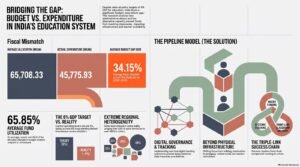
INDIA’S EDUCATION SECTOR EXPENDITURE : BUDGET PRIORITIES AND HUMAN DEVELOPMENT OUTCOMES

Authors: Ishika Singh, Sadhika Sunil, Ashina Sharma, and Manaal Farooqui ABSTRACT Education plays a crucial role in the social and economic development of a country. In recent years, India has introduced several educational policy reforms and increased its focus on improving the quality and accessibility of education. This study examines educational policy reforms and budget priorities in India since 2014 and analyses their relationship with human development outcomes. The study is based on secondary data collected from government reports, research articles, and published sources. The research explores major educational policy reforms, trends in the education sector, and government budget allocation for education. It also examines the relationship between education and human development by analysing indicators such as education expenditure and educational attainment. The study highlights the importance of government investment in education for improving literacy, skills, and overall development. The findings suggest that educational reforms and increased government attention towards education have contributed to improvements in access to education and learning opportunities. However, challenges such as limited financial resources and inequalities in educational access still remain. The study concludes that effective educational policies and adequate budget allocation are essential for improving human development outcomes in India.

Read More »

Psychological Implications of Precarity among University Students in India: A Quantitative Inquiry

Authors: Ishita Kumar & Kritvi Dutta ABSTRACT Precarity among university students represents a structurally produced condition of instability that shapes academic engagement, financial security, and psychological well-being. This quantitative study examines how financial and academic experiences influence well-being and perceived support among 209 undergraduate and postgraduate students in India. Using a cross-sectional survey design, the study employed descriptive statistics and multiple regression analysis to assess relationships between key variables. Results indicate that academic experiences emerged as a significant positive predictor of well-being and support (p<.001), while financial experiences did not demonstrate a statistically significant direct effect. Qualitative responses, however, reveal that financial precarity operates subtly constraining career choices, intensifying academic stress, and shaping students’ emotional experiences. The findings suggest that well-being is determined by the interplay of academic demands, structural constraints, and institutional responses, rather than isolated events. Addressing student precarity requires moving beyond individualised resilience frameworks toward structural reforms that integrate well-being into academic environments, recognise the diverse realities of student populations, and embed support systems within institutional practice rather than leaving students to navigate instability alone.

Read More »

The Grassroots Finance a Socio Legal Analysis of the DAY-NRLM Framework and its impact on Women’s Financial Autonomy

Authors: Harsh Agarwal, Lekshmy Iyer, Thakur Diksha, Sakshi Singh, Aman Sharma, Srishti Yadav ABSTRACT This paper provides a socio-legal evaluation of the Deendayal Antyodaya Yojana-National Rural Livelihoods Mission (DAY-NRLM) and its direct impact on the financial autonomy of rural women in India. Moving beyond standard metrics of basic financial inclusion, such as the mere opening of bank accounts, this study defines true financial autonomy through measurable indicators: subjective control over loan expenditure, influence in household financial decision-making, and the successful graduation to sustainable micro-enterprise management. Central to this evaluation is a comparative methodology analyzing two divergent state-level frameworks: Bihar’s “Mass Saturation” model, which prioritizes broad social mobilization, and Madhya Pradesh’s “Economic Intensity” model, which focuses on deeper capital investment. By evaluating empirical data on Self Help Group (SHG) outcomes, the study demonstrates that while Bihar has successfully mobilized over 1.48 crore women, its low average loan disbursement of ₹0.93 Lakh per SHG limits women’s capacity to scale their businesses. In contrast, Madhya Pradesh’s higher average loan disbursement of ₹1.62 Lakh and intensive digital tracking have yielded a higher entrepreneurial success rate, converting 37.7% of its SHG members into “Lakhpati Didis” (women earning over ₹1,00,000 annually) compared to Bihar’s 28.6%. Ultimately, this research argues that overcoming deeply entrenched socio-legal and patriarchal barriers requires transitioning policy focus from mass SHG formation to ensuring deeper credit linkage and genuine financial decision-making power for rural women.

Read More »

Assigning Liability for AI Misconduct

Author: Vanshika Shukla ABSTRACT Modern tort doctrines such as negligence, strict liability, and vicarious liability provide foundational tools for addressing harms caused by artificial intelligence (AI), yet they struggle to accommodate the unique features of autonomous, opaque, and continuously evolving systems. This paper employs a combined doctrinal, comparative, and normative methodology to argue that a hybrid liability architecture is the most appropriate pathway for India. Specifically, this paper advocates for: (i) strict liability for physical, safety-critical harms caused by autonomous AI systems; (ii) a calibrated fault-based regime for informational and reputational harms; and (iii) statutory algorithmic duties supported by procedural and institutional reforms. Drawing on Indian constitutional principles, landmark domestic and international jurisprudence, and the EU Artificial Intelligence Act (EU AI Act), the paper identifies structural doctrinal failures in existing law, critically evaluates the applicability of European regulatory models to the Indian legal context, and proposes concrete legislative provisions tailored to India’s socio-legal environment.

Read More »

Shifting Narratives under India’s Act East Policy: Northeast India as a Connective Bridge in South-South Connectivity

Author: Anusha Garg and Glory Saikia ABSTRACT India’s Act East Policy has increasingly repositioned Northeast India from a peripheral frontier into a strategic gateway linking India to Southeast Asia. This paper argues that this transformation is best understood as a narrative shift with uneven material consequences. Rather than treating Act East as a straightforward success story of connectivity-led regional integration, the paper examines the gap between policy rhetoric and actual outcomes. It develops a causal argument linking policy narrative, infrastructure strategy and regional integration outcomes. The central claim is that the gateway narrative has legitimised infrastructure-led initiatives such as the India-Myanmar-Thailand Trilateral Highway, the Kaladan Multimodal Transit Transport Project and BIMSTEC connectivity frameworks, but these initiatives remain constrained by domestic political economy conditions, governance fragmentation, conflict legacies and regional instability. The paper therefore situates India’s Act East Policy within a hybrid model of South-South regional integration, where the language of partnership and mutual benefit coexists with India’s leadership role and uneven implementation. Northeast India emerges as both the symbolic anchor of India’s eastward strategy and the site where the limits of infrastructure-led regionalism become most visible.

Read More »