IISPPR

Category: Blog

Public Policies
Krishnan Anicode

The Gap between Budget Allocation & Actual Expenditure in Indian Schooling System

**Excerpt:**
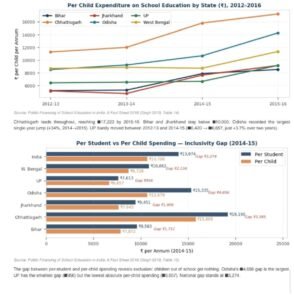
India’s education challenge is not merely about how much we spend, but how effectively and equitably we spend it. This study examines the gap between budget allocation and actual expenditure in education, highlighting chronic underinvestment, inter-state disparities and fund utilisation failures. Drawing on primary surveys and interviews alongside government reports and comparative data, the study finds that improving education outcomes requires more than higher allocations—it demands equitable resource distribution, effective utilisation, better infrastructure, skill-based learning and stronger governance.

Read More »
International Relations
Kaushal Pallai

IDENTIFYING EMERGING GEOPOLITICAL ALLIANCES THROUGH NETWORK ANALYSIS OF UN VOTING PATTERNS

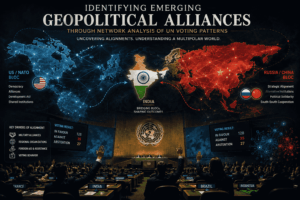
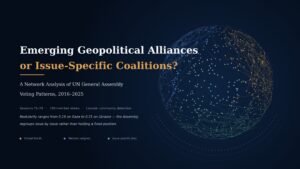
The study examines how changing UN voting patterns reveal the emergence of flexible, issue-based diplomatic alignments in an increasingly multipolar world. Focusing on the growing diplomatic agency of the Global South, it uses social network theory, neorealism, and constructivism to understand patterns of voting cohesion, coalition formation, and evolving international partnerships. The study argues that contemporary alliances are increasingly shaped by shared interests and common challenges rather than rigid ideological or military blocs, highlighting the Global South’s growing role in shaping global governance.

Read More »
Public Policies
Subhash Gill

DIGITAL REMAINS, POST-MORTEM PRIVACY, AND THE COMMERCIAL EXPLOITATION OF A DECEASED PERSON’S LIKENESS.

Rapid advancements in generative AI enable the precise recreation of deceased individuals’ digital identities, exposing a critical regulatory void in Indian jurisprudence. Because traditional doctrines extinguish privacy rights upon death, domestic laws currently fail to address the commercial weaponization of digital remains. To resolve this, this study proposes the Unified Digital Afterlife Framework—a sui generis model that formally recognizes transmissible post-mortem personality rights and establishes a centralized licensing registry to preserve human dignity in a synthetic media landscape.

Read More »
International Relations
Prachi Chauhan

Identifying Emerging Geopolitical Alliances through network analysis of UN Voting Patterns

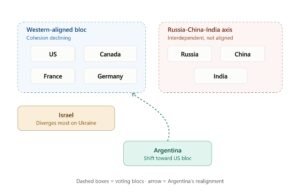
This study applies Louvain community detection to UN General Assembly voting data (2020 to 2023), showing how the Russia Ukraine War reduced overall voting cohesion while strengthening the US/NATO bloc relative to Russia China. It examines how alliances, regional organizations, and foreign aid shape alignment, finding aid origin matters more than aid amount, and India remains aligned with Russia China despite Quad membership.

Read More »
Public Policies
Pranati Singh

From Allocation to Impact: A Comparative Study of Public Educational Expenditure and Students Lived Experiences in Delhi and Maharashtra

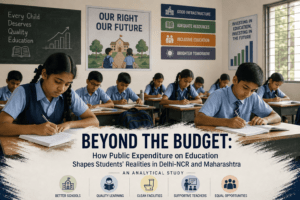
Public expenditure has improved educational infrastructure and welfare provisions, but student experiences reveal gaps in maintenance, teacher engagement, welfare delivery, and digital access. The study finds that effective implementation, rather than investment alone, shapes meaningful educational outcomes.

Read More »
Public Policies
Saniya Mansoory

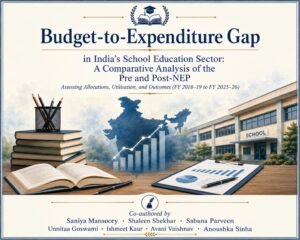
Budget-to-Expenditure Gap in India’s School Education Sector: A Comparative Analysis of the Pre and Post-NEP

Despite significant increases in education budget allocations following the introduction of the National Education Policy (NEP) 2020, India continues to face a persistent gap between allocated funds and actual expenditure. This paper examines the budget-to-expenditure gap in the education sector by comparing the pre-NEP (FY 2018–19 to FY 2019–20) and post-NEP (FY 2021–22 to FY 2025–26) periods. Drawing exclusively on official sources, including Union Budget documents, Parliamentary Standing Committee reports, CAG audits, and PRS Legislative Research, the study analyzes national spending trends and compares implementation outcomes in Kerala and Jharkhand. The findings show that although Ministry of Education allocations increased by 29.5%, public expenditure on education remains around 4.1% of GDP, well below the NEP target of 6%. Scheme-level analysis reveals an average utilization rate of 86% under Samagra Shiksha, but this masks substantial interstate disparities, delayed fund releases, and uneven implementation. The study identifies governance weaknesses, administrative delays, and inadequate monitoring as the primary drivers of the budget-to-expenditure gap. It concludes that higher budget allocations alone cannot improve educational outcomes unless accompanied by timely fund releases, efficient utilization, stronger accountability mechanisms, and outcome-oriented financial governance.

Read More »
SOCIOLOGY
Sejal Sarna

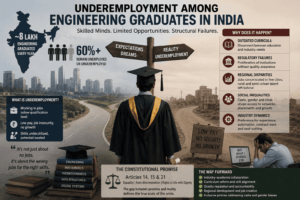
Underemployment among Engineering Graduates in India

India’s engineering underemployment crisis reflects not individual unemployability but deeper structural failures in education, regulation, regional opportunity, and social inequality, exposing a persistent gap between India’s development ambitions and its constitutional promise of equal, dignified, and secure livelihoods.

Read More »