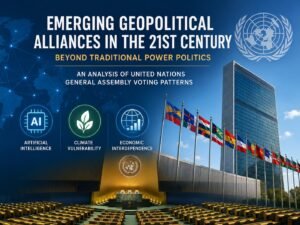
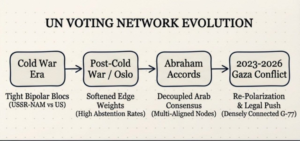
Authors: Boluwatife Osanyibi, Bhavya Anand, Diksha Chopra Abstract The United Nations General Assembly (UNGA) serves as a key multilateral forum where member states articulate their foreign policy preferences through voting behavior, offering valuable insights into the evolving structure of international politics. Among the issues debated within the UN, the Israel–Palestine conflict remains one of the most enduring and politically contested, making it an appropriate case for examining contemporary geopolitical alignments. This study investigates emerging geopolitical alliances by analyzing UNGA voting behavior on Israel–Palestine-related resolutions using Social Network Analysis (SNA). The theoretical foundation integrates Structural Realism, Defensive Realism, Constructivism, Postcolonial Theory, Liberal Institutionalism, and Complex Interdependence Theory which collectively demonstrates that state behavior within multilateral institutions is shaped by the interaction of strategic interests, power configurations, institutional linkages, and shared historical and normative identities. The research adopts a quantitative design using official voting records obtained from the United Nations Digital Library (UNDL) and the United Nations Information System on the Question of Palestine (UNISPAL). Voting data for General Assembly resolutions are coded numerically and analyzed using Social Network Analysis in Girvan–Newman community detection algorithms, together with centrality measures, were employed to identify voting communities, influential states, and bridging actors. The findings reveal the three major geopolitical voting blocs: a highly cohesive Global South–BRICS coalition, an isolated United States–Israel bloc, and a European intermediary group characterized by strategic abstentions and variable voting behavior The analysis also identifies bridge states that connect polarized communities and highlights a transition towards a more fragmented and multipolar international order. Overall, the study demonstrates that UNGA voting patterns serves as a robust indicator of evolving geopolitical alliances and offers important insights into contemporary patterns of international cooperation and diplomatic alignment. Keywords: United Nations General Assembly, geopolitical alliances, network analysis, voting patterns, Israel –Palestine Issue. 1. Introduction The United Nations General Assembly (UNGA) serves as one of the most significant multilateral forums on which countries publicly express their foreign policy preference on political, security and humanitarian matters that have global ramifications. The voting behavior of member states in the United Nations General Assembly represents one of the most observable manifestations of foreign policy in practice. Although General Assembly resolutions are not legally enforceable, Votes cast in favor, against, or through abstention is not merely a procedural exercise but a reflection of broader geopolitical dynamics. States often vote in accordance with their strategic interests, regional affiliations, ideological commitments, historical relationships, economic partnerships, and domestic political considerations. Consequently, similarities in voting behavior may indicate the existence of diplomatic coalitions or emerging geopolitical alliances and the evolving dynamics of global politics. UNGA vote records, in contrast to bilateral diplomatic pronouncements, offer standardized, publicly accessible, and longitudinal data that allow for the methodical analysis of foreign policy behavior across time and among nations. In order to study ideological proximity, alliance formation, regional cooperation, and shifts in global political alignments, international relations research has made considerable use of UN vote statistics. Among numerous issues debated within the United Nations, Israel- Palestine conflict is one of the most deeply entrenched and contentious conflict in contemporary international relations. For decades, protracted conflict has influenced global diplomacy, international laws, humanitarian policies and the foreign policy orientation of states across international relations. The root cause of conflict lies in competing historical narratives, territorial disputes, security concerns, religious significance, and the emergence of both Zionist and Palestinian nationalist movements during the late nineteenth and early twentieth centuries. The conflict has evolved through several defining events, including the British Mandate for Palestine, the adoption of the United Nations Partition Plan (1947), the establishment of the State of Israel in 1948, the Arab–Israeli wars, the displacement of Palestinian refugees (Nakba), the Israeli occupation of the West Bank, East Jerusalem, and Gaza following the Six-Day War of 1967, the Oslo Peace Process, and the Hamas attack of October 2023. These events have made conflict exceptionally resistant to peaceful resolution despite numerous diplomatic negotiations longstanding issues such as the status of Jerusalem, Israeli settlements, Palestinian refugees, security, and the right to self-determination remain unsettled (Gelvin, 2021; Pappé, 2006). United Nations have played a fundamental role in addressing intractable conflict. United Nations have attempted to provide a legal framework, humanitarian assistance, peacekeeping efforts and diplomatic mechanism though adoption of UNGA and UNSC resolutions aimed at resolving dispute. The Israel–Palestine conflict serves as an excellent example for exploring geopolitical alignments, as it has consistently featured in the agenda of the United Nations General Assembly for many years and has led to repeated resolutions garnering significant involvement from member states. This issue often goes beyond regional politics and highlights larger divisions within the international framework, which makes it especially relevant for examining trends in diplomatic collaboration and alliance building. Voting behavior on Israel–Palestine-related resolutions extend beyond the immediate issues under consideration and often reflects broader geopolitical realities. States frequently vote in accordance with strategic partnerships, regional alliances, ideological commitments, historical ties, security interests, and evolving diplomatic priorities. While some countries have demonstrated remarkable consistency in their voting behavior, others have altered their positions in response to domestic political changes, leadership transitions, regional developments, or shifts in the international balance of power. Analyzing these patterns provides an opportunity to understand the evolution of international alliances beyond traditional military or regional blocs and offers valuable insights into changing patterns of global diplomacy. The growing availability of United Nations voting data has enabled researchers to employ quantitative approaches for analyzing interstate behavior. Among the various analytical approaches, Wasserman and Faust (1994) argue that network analysis offers a systematic framework for examining relationships among actors based on their interactions. Applied to UN voting, this approach conceptualises states as interconnected actors whose voting similarities reveal patterns of cooperation, coalition formation, and geopolitical alignment. Newman (2010) further explains that network analysis enables researchers to identify clusters of closely connected actors, measure the relative importance of individual actors within a network, and examine changes in network structures over time. a powerful methodology to represent the relationship among different entities and to