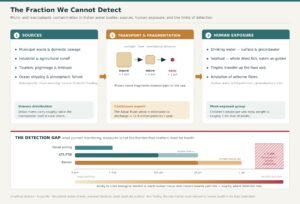
Authors: Aryan, Yash, Pooja, Vasu, Parth, Ayetri, Lavanya, Kanak, Priyal, Srija ABSTRACT This study evaluates plastic pollution present in water bodies worldwide. The impact and the negative nature of microplastics on Mother Nature and human lives make this thing that needs to be tackled like an emergency. These larger sizes of plastics, which go into the water bodies, tend to become smaller and smaller pieces, which are called microplastics, through various kinds of natural and human-made things like sunlight, chemicals released in water bodies, etc. This process leads these big amount of plastics to become smaller and smaller ones, which tends to become the cause of infertility in both men and women and sometimes cancer in people. Both these categories of plastic pose serious risks to aquatic organisms and can also enter human food and water systems. In this study, the occurrence, transport pathways, detection technologies, and research gaps associated with plastic contamination in aquatic environments are examined. This is conducted through a comprehensive review of recent literature and secondary analysis of 4 major global datasets. A secondary data analytical approach is used following these recognised databases: the United Nations Environment Programme (UNEP) global marine litter model, the Atlas of Ocean Microplastics (AOMI), the Organisation for Economic Co-operation and Development (OECD) Global Plastics Outlook dataset, and the National Oceanic and Atmospheric Administration (NOAA) National Centres for Environmental Information marine microplastics database. These long-term trends in plastic production and waste generation were analysed. It was also used to identify the global hotspots of plastic contamination. Further, transboundary transport pathways for plastic pollutants were mapped, and modelled pollution distributions were compared with real field-based observations. Findings of this study also account for anthropogenic factors such as urbanisation, industrial discharge, agricultural runoff, and improper waste disposal. While technologies like the Fourier transform infrared spectroscopy, deep learning detection systems and automated monitoring systems have improved the detection of plastics more smoothly, there are still a few methodologies that are not able to compare between the studies. Due to dissimilarity between the mesh sizes, digestion protocols and other techniques, the results are not reliable. This can easily complicate the policy formulation. It is seen that the main reason behind the pollution in water bodies is the unstandardized methods used for monitoring the pollution in water. INTRODUCTION Plastics are made by humans, produced with the help of petroleum-based chemicals, which is why they are so stretchable and durable, making them a daily used product. The same properties that make them useful (they don’t break down easily) make them a serious environmental hazard (Barnes et al., 2009). When plastics enter water bodies, they don’t disappear. Sunlight (UV radiation), physical friction, wave action, and microbial activity break them into smaller and smaller pieces – but the plastic molecules remain intact, potentially for hundreds to thousands of years. A single plastic bottle can eventually fragment into millions of microplastic particles, each capable of being ingested by tiny organisms (Peters and Bratton, 2016, Sanchez et al., 2014; Silva-Cavalcanti et al., 2017). Plastic debris is generally assessed according to size, like macro-plastics, i.e., plastic items larger than 5mm. Bigger than a grain of rice, and microplastics – 1um, i.e., plastic items smaller than a sesame seed, down to invisible (Arthur et al., 2008; Barnes et al., 2009; Thompson et al., 2009). Microplastics can be classified as (i) primary microplastics which are intentionally manufactured to be tiny, example – microbeads used in facial scrubs, cosmetic glitter, and industrial plastic pellets (nurdles), and as (ii) secondary microplastics that are created when larger macro-plastic break down, example – sunlight (UV rays), waves, and weathering degrade larger plastic items over time, breaking them into specks (Cooper and Corcoran et al., 2010, Derraik et al., 2002, Napper et al., 2015, Williams and Simmons et al., 1996). Macro-plastics directly cause physical damage to wildlife, such as birds, turtles, and marine life. The animals usually get trapped in them or accidentally ingest them, filling their stomachs, which leads to starvation. Microplastics are small enough to be eaten by the smallest marine creatures (like plankton) and work their way up the food chain. Microplastics have also been found in human organs, placentas, and bloodstreams, and studies are underway to explore their links to inflammation, cancer and cell damage (Jabeen et al., 2017; Jemec et al., 2016). Both the detection and categorisation of plastic contamination are still technical challenges. Visual representation, pyrolysis-gas chromatography-mass spectrometry, scanning electron microscopy and many more techniques are used for identifying the microplastics in the water bodies. There are alternative methods for monitoring the macro-plastics. There has been a reallife field deployment, which is cost-efficient and scalable to an extent, including the UAV-based platforms, which are used for spatial coverage of the large water bodies. Helping with on-site assessment. In addition, some architectures have demonstrated considerable automation in identifying and classifying the microplastics, with the help of methods like the Canny edge detection algorithm and Nile red fluorescent, substantially increasing the detection process across difficult-to-understand environmental matrices. There are many ways by which the water gets contaminated by the plastics, these are municipal waste, uncleaned drainage systems in regions (area-wise), littering of plastic waste by street shops and throwing them into the pipelines, which ultimately goes inside the larger water bodies. (Andrady, 2011; Cole et al., 2011). The plastic waste, which is increasing day by day due to the fast urbanisation, gets collected in one place, which chokes the flow of the river and other smaller water bodies inside the city region, helping various diseases to grow. Here, the important role is played by the water drainage pipelines that flow inside the cities and are the ones needed to be assessed in regular intervals. (Wagner et al., 2014). This is a big concern for all of us that plastic, which was once a part of human settlements, can now be seen far beyond the regions where there are no human traces found, for miles away all thanks to the ships and the water bodies which