
Authors:
Mitali Garg, Sandeepan Choudhury, Nivedita Jha, Gayathri Jayachandran, Hyerin KIM, Anandi Banerjee, Azeeta Gandhi, Divyanka Belwa
ABSTRACT
This study seeks to understand how the new power distribution in the international system is shaping geopolitical alliances in terms of how non-Western countries influence of UN General Assembly (UNGA) voting and decision-making during the period leading towards increasing multipolarity. This research employs the Structural Dependency Theory and Coalition Formation Theory to measure the long-run voting behavior of states as reflected in the analysis of 738,764 votes that were recorded at the UNGA across 70 sessions (1946 – 2025) and through 5,270 resolutions, to ascertain changes in country-level voting behavior and coalition dynamics. A quantitative descriptive-explanatory methodology is utilized, with an analysis of voting outcomes, participation rates, country-level voting behavior, and support for majority positions at the UNGA within the time frame suggest that consensus is still the critical mechanism of the UNGA’s decision-making process; however, the way consensus can now be produced has greatly changed. Following decolonization, the rapid increase in developing country and regional grouping composition of the UN membership has significantly increased the ability of non-Western countries to influence UNGA decision-making. Moreover, the current voting alignments at the UNGA demonstrate an emergence of common ground between countries based on shared developmental objectives, regional collaboration, and the formation of coalitions rather than being ideologically based, as was earlier the case. Although UNGA voting behavior cannot fully explain interstate relations or formal alliances, it provides a valuable empirical indicator of broader geopolitical transformations. The study concludes that UNGA voting patterns offer important insight into the emergence of a more multipolar international order and contribute to a deeper understanding of evolving patterns of global governance and multilateral cooperation.
Keywords: United Nations General Assembly, UNGA, Voting Patterns, Multipolarity, Non-Western States, Coalition Formation, Global Governance
1. INTRODUCTION
Examining how nation states voted at the UN General Assembly is one way that researchers and analysts can see how international relationships have changed since the end of World War II. Voting records provide official records of countries’ positions on international issues. Analysts can use these voting records to identify the political rivalries that exist between countries and how countries have established political and ideological alliances with one another and developed new methods of international cooperation. Voting on issues in the UNGA was significantly influenced by the political and ideological rivalry between the US and the Soviet Union during the Cold War. Specifically, countries within either bloc tended to have very similar voting patterns in the UNGA. The voting behaviour between the West and East clearly represented their ideological and geopolitical differences. All the issues that created tensions during the Cold War such as security issues, decolonization, human rights and arms control all served to expose the differences between the two sides at the UNGA. The collapse of the Soviet Union in 1991 transformed the overall landscape of international relations while signalling the end of the East-West conflict, and coincidentally gave rise to new global issues. Global inequality, international trade, globalization and economic development became some of the more important issues on the agenda of the international community. As a consequence, countries’ voting patterns at the UNGA started to show a disparity between rich or first-world countries versus poor or third-world countries. In addition, economic concerns and the need for economic growth started to become the most common factor for shaping diplomatic decisions. An example of developing countries working together would be the Group of 77. These countries may have a variety of differences in culture, geography and government but they all tend to come together on issues related to funding for development, trade, greenhouse gases, and access to technology. This shows that developing countries are increasingly cooperating on common economic and developmental goals rather than cooperating with each other on traditional military or ideological bases. It can thus be concluded that the focus of today’s international alliances is more likely based on issues of mutual interest than on rigid ideological affinity. Much of the literature on international relations has traditionally been produced from Western theoretical perspectives and has largely focused on great-power politics. The existing body of research has primarily dealt with East-West ideological differences, superpower competition, or the behaviour of the world’s leading Western nations, very little has been done to explore how the collective power of all the non-Western states are affecting today’s United Nations General Assembly (UNGA) voting.
The transformation from a predominantly unipolar world that was run by the U.S. to a much more complex multipolar order defines the present-day geopolitical environment. The emergence of new powers, the rise of regional conflicts, the creation of economic interdependence and the development of strategic rivalries has reshaped international order. In this context, new political coalitions and organizations have also come to play an important role in shaping international governance, security, and economic cooperation in order to assert their authority over other countries. One example of this new form of international relations is the BRICS group (Brazil, Russia, India, China, and South Africa). BRICS is a coalition of very large developing countries that have aimed to create a greater presence in and have more of an impact on what traditionally has been a West-dominated set of global governance institutions. These changes can help us understand how power and influence are distributed within contemporary international institutions.
This study is guided by four key objectives: I) Examine long term trends in UNGA voting behaviour between 1946 and 2025. II) Assess whether increased participation of Non-Western states altered majority voting outcomes. III) Analyse the evolution of coalition building and voting alignments in the UNGA. IV) Evaluate whether observed voting patterns reflect the emergence of a more multipolar global order. In pursuit of these objectives this study seeks to answer the following research question: To what degree have non-Western nations been able to shape voting patterns in the UNGA in the contemporary multipolar international system? We hypothesize that non-Western nations have increasingly influenced voting patterns and coalition-building within the UNGA reflecting the emergence of a more multipolar international system. To address this research question the study employs two complementary theoretical frameworks. Structural Dependency Theory examines how economic and material relationships between states influence their diplomatic positioning within multilateral institutions. Coalition Formation Theory examines how states collectively coordinate their voting behaviour to maximize political influence within the General Assembly. Together these frameworks provide a comprehensive lens through which to interpret the observed voting patterns The remainder of this paper is structured as follows.
Section 2 reviews the existing literature on UNGA voting patterns and geopolitical alignments. Section 3 outlines the research methodology and dataset. Section 4 presents the empirical findings. Section 5 discusses the implications of these findings and Section 6 concludes with suggestions for future research.
2. LITERATURE REVIEW
A wide variety of literature has been developed that analyses how countries cluster together, why they align and support larger countries or regions and what material, or diplomatic influences guide those decisions regarding these classifications of alignment. One of the most useful places to begin this analysis empirically is by examining the structure of the voting pattern itself at the UNGA.
2.1 Understanding the Power Dynamics in the UNGA
Despite the overall tendency toward consensus within the UNGA, significant differences continue to exist between major groups of states when their voting behavior is compared. A large majority of smaller or developing nations vote with the majority of votes cast during the voting process of the UNGA, while a number of larger, more developed nations, primarily Western nations led by the United States of America do not support the majority voting trends in the UNGA.Previous studies of UNGA voting have identified persistent differences between developing countries and Western powers particularly on issues related to development, global governance and Middle East policy (Bailey & Voeten, 2018; Kim & Russett, 1996) , particularly on issues related to development, global governance, and Middle East policy. The relationship between the larger coalition of developing states and the smaller group of predominantly Western states constitutes the alignment structure that much of the existing scholarly literature seeks to explain.
2.2 Understanding the Great Powers and Non – Western Alliances
One of the most comprehensive evaluations of great-power voting behavior in the UNGA from 1991–2020 is provided by Nurullayev and Papa (2023). Based on their empirical analysis (through more than 219,000 vote state observations) they find “the Sino-Russian positions are well supported globally much more than the U.S. positions,” and “states in the Group of 77 and soft-balancing institutions such as the Shanghai Cooperation Organization or BRICS, tend to align themselves with China and Russia.” Most importantly, “the effect of states’ membership in soft-balancing institutions on their tendency to align themselves with China and Russia has been increasing over time,” affirming that the non-Western alliance is getting stronger rather than weaker. The work of Steinert and Weyrauch (2024) continues providing this empirical picture by evaluating the ability of China’s Belt and Road (BRI) initiative to facilitate political alignment from economic dependencies. They determine that, BRI membership has had a varied (heterogeneous) impact across different global regions. European nations that are members of the BRI became less aligned in their voting with China This finding suggests that economic dependency alone does not guarantee diplomatic loyalty, indicating that Coalition Formation Theory may better explain voting alignment in cases where structural dependencies are weak or contested, in other words, economic dependency does not guarantee diplomatic loyalty.
2.3 Conclusion and Gaps in Literature
While existing scholarship has made significant progress in understanding UNGA voting alignment two critical gaps remain. First most studies focus on bilateral relationships between specific states or great power competition rather than examining the collective voting behavior of non-Western states as a unified analytical category. Second existing research rarely extends beyond 2020 and therefore does not capture voting patterns across the most recent UNGA sessions. This study addresses both gaps through a comprehensive longitudinal analysis of 738,764 votes across 70 UNGA sessions from 1946 to 2025 interpreted through the combined theoretical lens of Structural Dependency Theory and Coalition Formation Theory.
3. RESEARCH METHODOLOGY
3.1 Research Design
Using a quantitative, descriptive-explanatory research design, this study examines whether observed voting patterns reflect emerging geopolitical alignments between states affect how they vote in the United Nations General Assembly (UNGA). UNGA voting records are used to show political alignment between states and enable the identification of patterns in how states cooperate or diverge from each other over time. Descriptive statistical analyses are used to describe contemporary voting alignments and identify emerging geopolitical communities/alliances within the international system.
3.2 Dataset Overview
The dataset for this study includes data from 193 active member states and additional historical entities and territories from 70 UNGA sessions between the first session (1946) and 70th session (2025). The study analyzed the overall voting outcomes of all members, changes over time in state participation, and support for/opposition to majority voting positions of all members of the UNGA. Historical country names and political entities that no longer exist or have significantly changed were left in their original form so as to preserve historical accuracy and consistency with official UN records.
3.3 Instruments and Measures
The study utilized the United Nations General Assembly Voting Dataset as its primary source of data (UN general Assembly Voting Dataset, 2025). The dataset was organized into an analysis-ready format containing the variables Assembly Session, Resolution ID, Country, and Voting Outcome (Yes, No, or Abstain). To improve reliability in comparative vote-share analysis, countries with fewer than 1,000 recorded votes were excluded this threshold was established to ensure sufficient data points for meaningful comparative analysis and to minimize distortion from states with limited or inconsistent participation records from country-level vote-share comparisons.
3.4 Procedure
The dataset consisted of 738,764 individual votes cast on 5,270 resolutions across 70 UNGA sessions. The analysis focused on four descriptive indicators which were selected to capture distinct dimensions of voting behavior as established in prior UNGA voting research :
- Distribution of voting outcomes (Yes, No, and Abstain)
- Changes in voting participation across Assembly sessions
- Country-level Yes-vote shares
- Comparative patterns of support for majority voting outcomes
These indicators were used to identify long-term trends in voting behavior and assess the extent to which emerging geopolitical alignments may be reflected in UNGA voting patterns.
3.5 Analytical Justification
The analytical measures selected for this study were chosen to capture different dimensions of voting behaviour within the United Nations General Assembly. The distribution of voting outcomes (Yes, No, and Abstain) was examined to provide an overall measure of consensus and disagreement across the Assembly. Previous research has shown that the relative frequency of affirmative, negative, and abstention votes provides valuable insight into the degree of cooperation and polarization among member states (Bailey & Voeten, 2018; Pomeroy et al., 2019).
Trends in voting participation across Assembly sessions were analysed because changes in UN membership directly influence the composition of voting coalitions and the numerical balance of power within the General Assembly. Examining participation over time therefore provides an indication of how decolonization and the admission of newly independent states altered the institutional environment in which voting occurs.
Country-level Yes-vote shares were calculated to assess the extent to which individual states support resolutions adopted by the Assembly. Although Yes-vote shares do not directly measure political influence or alliance formation, they provide a useful descriptive indicator of a state’s tendency to align with majority-supported outcomes.
Finally, support for majority voting positions was examined to identify long-term patterns of convergence and divergence among member states. This measure allows comparison of how frequently countries vote with the Assembly majority and serves as an empirical indicator of broader voting alignment within the UNGA. Consistent with established UN voting research these descriptive indicators are interpreted as empirical proxies of political alignment and geopolitical positioning rather than direct evidence of causal relationships or formal alliance formation (Bailey et al., 2017; Bailey & Voeten, 2018). This interpretive boundary is maintained throughout the analysis.
3.6 Limitations
While UNGA voting records provide valuable insights into international alignments, voting behavior does not fully capture all dimensions of interstate relations. Countries may vote similarly for strategic, economic, regional, or diplomatic reasons that are not directly observable within the dataset. Therefore, voting alignment should be interpreted as an indicator of political affinity rather than definitive evidence of formal alliances.
Having established the dataset, variables and analytical framework, the following section would present the empirical findings. The analysis first examines aggregate voting behavior after which it would explore changes in participation, coalition dynamics and country level voting patterns across the decades. Second the study employs descriptive statistical measures which identify patterns and trends in voting behavior but cannot establish causal relationships between geopolitical factors and voting outcomes. Future research incorporating regression analysis or network analysis would provide stronger causal inference. Third the exclusion of states with fewer than 1,000 recorded votes may limit the representativeness of country-level comparisons particularly for smaller or newer member states whose voting behavior may reflect distinct geopolitical pressures not captured in this analysis
4. An Empirical Analysis of UNGA Voting Patterns, Coalition Dynamics, and the Rise of the Non-Western Bloc
For decades, the UN General Assembly (UNGA) has served as an important barometer of geopolitical trends in the international arena. Unlike the UN Security Council, where permanent members have disproportionate influence over decision-making, the UNGA operates on a one-state, one-vote basis. With this in mind, following the methodology described above, this research will now proceed to analyze the voting patterns of 738,764 votes cast at the 70-some sessions of the UNGA. The findings will be grouped according to the following sub-sections:
4.1 Consensus, Alliances, and Strategic Abstentions
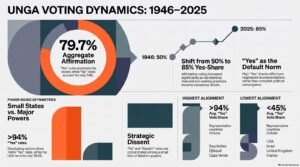
The most evident finding from the historical trends identified above is that overwhelming majorities of UNGA resolutions have been approved by votes cast in favour of them. Compared to 79.7% (588,800) of “Yes” votes, only 12.9% (95,099) of all votes cast in UNGA history have been abstentions, while only 7.4% (54,865) of votes have been “No.” These findings align with the results of prior studies, which found that the UNGA is characterised by a “preponderance of consent over contention” as resolutions are voted on and accepted by a large margin of votes cast, with “Yes” votes overwhelmingly dominating over “No” votes across a variety of issues (Bailey & Voeten, 2018; Pomeroy et al., 2019). In turn, this trend implies that the UNGA is not a forum of constant and uncompromising opposition, but rather a deliberative diplomatic body for negotiating international agreements. The relative absence of “No” votes suggests that contentious issues are rarely brought to a formal and binding vote within the UNGA.
Indeed, when a member state has an incentive to formally oppose a resolution, it is usually not inclined to do so, due to the potentially adverse diplomatic fallout. One notable example of this phenomenon is the 2030 Agenda for Sustainable Development, which was formally endorsed by all 193 member states of the United Nations, including those that would have arguably opposed the adoption of the resolution had it been put to a vote. Prior studies similarly note that “abstentions should be understood as a strategic diplomatic tool rather than expressions of political neutrality,” as member states utilise them to “balance different political options” and “avoid overt opposition to the status quo” (Bailey et al., 2017; Pomeroy et al., 2019).

Geopolitical Alignments and Voting Behavior
In turn, these findings illustrate the extent to which the voting behaviour of states within the UNGA their geopolitical alliances and strategic interests. However, it is noteworthy that the phenomenon of geopolitical alignment within the UNGA encompasses at least two distinct categories of behaviour. Specifically, states tend to vote similarly on resolutions either (1) due to the convergence of their material interests or (2) due to the existence of formal alliances between them. The two categories can be differentiated using the following criteria:
Shared national interests: Similarity in voting behaviour reflects the extent to which states’ material interests are intertwined. For instance, oil-producing states such as Saudi Arabia and Iraq are likely to vote in a similar manner on energy-related resolutions.
Formal alliances: Similar voting patterns can also be the result of there being an alliance between states, which causes its members to vote consistently with one another. For instance, the EU is known to have a strongly cohesive voting record in the UNGA due to its close institutional ties with the United States and its general opposition to revisionist policies advanced by China and Russia.
Geopolitical alignments within the UNGA are typically difficult to discern, due to the fact that “Abstention” is the default option for many states, which prefer to avoid the overt opposition that would have been entailed by a “No” vote. As noted by scholars, “Indifference is rarely indicated by an abstention,” which means that “explicit opposition to a resolution can be costly and diplomatically damaging” for states, as they risk alienating themselves from their geopolitical allies and partners (Bailey et al., 2017; Pomeroy et al., 2019). Therefore, while states tend to vote “No” when they have sufficiently strong opposition to a resolution, in most cases, especially in cases of “Abstention,” opposition is tempered and not explicitly expressed.
4.2 Decolonization and the Demographic Expansion of the Assembly
The trends identified in the graphs above demonstrate that the voting patterns of UNGA members changed dramatically throughout the second half of the 20th century, as the number of member states rose sharply. When it was originally formed in 1946, the United Nations had barely exceeded 50 member states, most of which were former European colonial powers or their African and Asian dependencies, as the independence movements on the latter two continents had yet to gain substantial traction. Throughout the 1960s and 1970s, a wave of decolonization swept through Africa and Asia, and another wave followed in the 1990s after the dissolution of the Soviet Union. As a result, the number of states voting at the UNGA rose from roughly 5,000 to just over 20,000.
This increase in participation has had profound geopolitical consequences, due to the shift in the numerical balance of power in the UNGA. Prior to the 1960s, the United States, the United Kingdom, and other Western states dominated the UNGA, as there were barely more than 50 states voting at each session. This meant that any resolution needed the support of the great powers and the majority of the developing world to be passed, which made diplomacy within the UNGA exceptionally challenging (Kim & Russett, 1996; Lees, 2023). However, following the rapid rise in the number of participating states, the relative influence of the Western Bloc declined, as did its ability to advance its geopolitical interests through the UN. In particular, dozens of new states gaining independence in post-war Africa and Asia were broadly united in their opposition to the foreign policy positions of the United States and other Western countries. The new states also possessed a numerical advantage, which enabled them to dominate the UNGA when it came to voting on resolution proposals introduced by the West. This development fits within the overarching phenomenon of “the expansion of diplomatic influence and political authority” attributed by Acharya to the emergence of a “more multiplex world international system” (Acharya, 2017).

Geopolitical Alignments and Voting Behavior
The explosion of participation was the birth of the non-Western bloc as a decisive legislative force. Developing countries learned that they could vote as a bloc to pass resolutions that the world’s two biggest economic and military powers didn’t want.
This shift changed coalition-building strategies entirely. Western states could no longer depend upon a default majority. Instead, they had to negotiate complicated deals with different regional blocs to avoid diplomatic isolation. The UNGA grew in participation, and became a space where legitimacy is earned through numbers, which paved the way for the contemporary global-south alignments we see today.
4.3 Institutional Stabilization and the Rise of Bloc Representation
The trends identified in the graphs above clearly demonstrate that the number of votes cast at the UNGA began to decrease following the peak of the 1990s. Furthermore, this trend does not apply to the number of resolutions introduced by member states, which has remained largely stable throughout the years. Taken together, these trends suggest that the UNGA undergoes a transition from a phase of expansion to a phase of stabilisation, which is reflected in the decreased number of votes cast per session.
Geopolitical Alignments and Voting Behaviour
As noted by scholars, the observed reduction in the number of individual votes reflects the transition to “more consensus-driven decision making” in the UNGA, as states adopt voting behaviours that do not require overt opposition or agreement with each resolution introduced by the body. Furthermore, the growing role of regional alliances has led to a situation where, rather than being used to advance the immediate geopolitical interests of individual states, voting in the UNGA is undertaken collectively by entire regional blocs (Hafner-Burton et al., 2009; Magu & Mateos, 2024). This development fits within the broader trend of “networked international relations,” which entails states coordinating their diplomatic behaviour at the level of regional alliances rather than engaging in direct negotiations.
Prominent regional alliances and blocs include the following:
The African Union: The regional bloc promotes a coordinated diplomatic stance on important international issues, which members pursue when interacting with international organisations such as the UN. Specifically, the African Union uses Common African Positions (CAPs) to advance the collective interests of its members in the UNGA. Thus, when voting on resolutions within the UNGA, the members of the African Union act collectively rather than pursuing individual agendas. The organisational capacity of the bloc enables it to promote its collective diplomatic interests effectively (African Union, n.d.).
The European Union: The regional bloc adopts a unified voting position in the UNGA to maximise the diplomatic impact of its actions and to advance the bloc’s collective interests within the international organisation. The EU is exceptionally cohesive in its voting behaviour, which makes it extremely difficult to oppose its initiatives within the UNGA.
The increasing role of regional blocs within the UNGA has significantly simplified its functioning, particularly for individual states, which now operate within a system of bloc diplomacy. While this phenomenon has reduced the overall number of votes cast individually by states at the UNGA, it has also fundamentally changed the geopolitical balance within the organisation, as regional blocs have gained greater diplomatic clout.
4.4 Divergent Voting Strategies: Small-State Consensus vs. Great-Power Independence
The trends identified in the graphs demonstrate that the voting behaviour of states differs greatly depending on their status in the international system. Most evidently, the share of “Yes” votes among small and developing states significantly exceeds that of great powers, which in turn greatly exceed in their share of “No” votes. Seychelles, Cape Verde, Djibouti are developing countries that consistently vote “Yes” in support of most resolutions passed by the UNGA. By contrast, Israel, the UK, France, and the US, the permanent members of the UN Security Council, are among the largest revisionist powers that pursue a more independent voting strategy, which often sees them voting “No” against resolutions that seek to constrain their foreign policy and strategic behaviour. These observations are consistent with prior findings in the literature, which note that great powers possess stronger incentives to defy international opinion, as they are capable of pursuing their strategic interests effectively, even if it entails diplomatic costs (“Power politics and international law,” n.d.).

Geopolitical Alignments and Voting Behavior
The difference in voting strategies between small and great powers is instructive, as it demonstrates that states have divergent strategic preferences within the UNGA. Great powers such as the US, Russia, and China rarely oppose international opinion, as they possess the resources and influence to pursue their geopolitical goals regardless of the opposition of the international community. By contrast, small and developing states such as Seychelles, Cape Verde, and Djibouti rely on the international organisation to advance their narrow national interests, which makes them consistently supportive of international law and institutions such as the UNGA. In essence, the revisionist intentions of great powers are limited by their recognition of their own strategic capabilities, while the foreign policy preferences of developing states are informed by their material dependence on the international system.
Consequently, international negotiations and diplomacy are conducted on two fundamentally different levels, where the outcomes are determined by the relative power of states or their ability to rely on the support of their allies. In the UNGA, great powers are often opposed to resolutions that seek to restrict their strategic autonomy, while small powers tend to align themselves with the majority to advance their policy positions with the backing of the international community. The revisionist tendencies of great powers have been most evident in their competition and strategic rivalry with their geopolitical counterparts, particularly with regard to opposing the expansion of the influence of the opposing bloc within the UNGA. In particular, while the US dominates the UNGA as the sole superpower following the end of the Cold War, the foreign policy positions it advances are increasingly challenged by a rising number of states that have joined together to oppose its leadership in international affairs.
5. DISCUSSION
The findings presented above can be interpreted in broader literature on multipolarity, coalition formation and global governance. This section discusses how the observed voting patterns contribute to the existing debate. Over time, affirmative votes have risen, suggesting that states are becoming better at building stable and lasting voting blocs to push their agendas. These findings broadly support recent scholarship arguing that the international system is gradually evolving toward a more multipolar distribution of influence, in which emerging economies and regional organizations play increasingly important roles in shaping international governance and diplomatic outcomes (Acharya, 2017; Stuenkel, 2016).
The modern General Assembly is no longer so easy for a few traditional superpowers to steer. Instead, it has developed into a sophisticated legislative forum based on collective action, were regional unions combine state voices and non-Western coalitions increasingly shape the global consensus. Monitoring these evolving networks of consensus, alliance and strategic abstention offers analysts and policy makers a clear, data-based vision of the future of global governance.
6. CONCLUSION
Building upon the empirical findings presented in the preceding section this conclusion summarizes the key contributions of the study and outlines directions for future research.
This study examined the extent to which non-Western states influenced the UNGA voting process as the international system evolved towards greater multipolarity. The research analyzed 738,764 recorded votes across 5,270 resolutions and 70 UNGA sessions spanning 1946 to 2025 to provide a framework for understanding changes in political influence, coalition formation and international cooperation as captured by the UNGA voting record over time.
The analysis shows that the UNGA has consensus as a fundamental characteristic of its operation; however, the way in which consensus has been achieved has changed over time. The increase in UN members post-decolonization, combined with the rising numbers of developing countries and regional groupings in the organization has fundamentally reshaped voting dynamics within the UNGA. Consequently, non-Western countries now demonstrate significantly higher rates of alignment with majority voting positions reflecting a shift in the numerical balance of voting power within the General Assembly than they once did during the early decades of the United Nations, marking a significant shifting of the global center of gravity from predominantly western countries to an increasingly multipolar international structure.
While this study provides a comprehensive empirical account of UNGA voting patterns it is important to acknowledge that voting behavior represents only one dimension of interstate relations. Diplomatic agreements, economic relationships, and strategic interests all shape state behavior in ways that extend beyond what voting records alone can capture. The findings of this study should therefore be interpreted as empirical indicators of political alignment rather than definitive evidence of formal alliance formation or causal geopolitical influence.
The results of this study suggest that the UNGA provides a valuable source for examining changes in the contemporary international system over time. The numerical strength and voting cohesion of non-Western countries and regional coalitions has grown considerably over the seven decades examined in this study, as such, the analysis of voting patterns in the UNGA provides important data that can be used to develop an understanding of how emerging geopolitical alignments are developing and how global governance will evolve. Future research that examines the trade patterns of states, their investment patterns, their foreign (development) assistance, and their level of diplomatic engagement, in conjunction with their voting behavior will result in a more complete understanding of how geopolitical alignments are continuing to develop within an increasingly international system.
The original contribution of this study lies in its comprehensive longitudinal analysis of UNGA voting patterns spanning 1946 to 2025. Unlike prior studies that focused on specific time periods bilateral relationships or individual geopolitical events this research examines the full arc of non-Western voting behavior across the complete history of the United Nations. By interpreting these patterns through the combined theoretical lens of Structural Dependency Theory and Coalition Formation Theory the study provides a dual framework for understanding how material conditions and institutional mechanisms together shape multilateral voting outcomes. These findings advance scholarly understanding of how geopolitical transformations are reflected in multilateral institutions over time.
References
Bailey, M. A., Strezhnev, A., & Voeten, E. (2017). Estimating dynamic state preferences from United Nations voting data. Journal of Conflict Resolution, 61(2), 430–456. https://doi.org/10.1177/0022002715595700
Bailey, M. A., & Voeten, E. (2018). A two-dimensional analysis of seventy years of United Nations voting. Public Choice, 176(1–2), 33–55. https://doi.org/10.1007/s11127-018-0550-4
Brusco, M. J., Doreian, P., Lloyd, P., & Steinley, D. (2013). Using tabular rearrangement in blockmodeling. Network Science, 1(3), 307–332. https://doi.org/10.1017/nws.2013.5
Capurri, A. (2026). The alignment index and its application to voting at the United Nations General Assembly. Quality & Quantity. Advance online publication. https://doi.org/10.1007/s11135-026-02814-x
Graubart, J., & Jimenez-Bacardi, A. (2016). David in Goliath’s citadel: Mobilizing the Security Council’s normative power for Palestine. European Journal of International Relations, 22(1), 24–48. https://doi.org/10.1177/1354066115571762
Gülay, K. (2026). Creeping alliances in foreign policy choices: A world of clusters and the outline of a fragmented world order. Case Western Reserve Journal of International Law, 58(1). https://scholarlycommons.law.case.edu/jil/vol58/iss1/13
Hafner-Burton, E. M., Kahler, M., & Montgomery, A. H. (2009). Network analysis for international relations. International Organization, 63(3), 559–592. https://doi.org/10.1017/S0020818309090195
Kim, B., Niu, X., Hunter, D. R., & Cao, X. (2023). A dynamic additive and multiplicative effects network model with application to the United Nations voting behaviors. The Annals of Applied Statistics, 17(4), 3283–3299. https://doi.org/10.1214/23-AOAS1762
Kim, S. Y., & Russett, B. (1996). The new politics of voting alignments in the United Nations General Assembly. International Organization, 50(4), 629–652. https://doi.org/10.1017/S0020818300033531
Le, M.-T., Lawlor, M., Russett, B. M., Sweeney, J., & Zucker, S. W. (2013). Detecting alliances from United Nations voting data. In 2013 IEEE International Conference on Data Mining Workshops (pp. 1094–1101). IEEE. https://doi.org/10.1109/ICDMW.2013.81
Lees, N. (2023). The endurance of the G77 in international relations: South–South ideology and voting at the United Nations, 1970–2015. Japanese Journal of Political Science, 24(3), 310–330. https://doi.org/10.1017/S1468109923000105
Macon, K. T., Mucha, P. J., & Porter, M. A. (2012). Community structure in the United Nations General Assembly. Physica A: Statistical Mechanics and Its Applications, 391(1–2), 343–361. https://doi.org/10.1016/j.physa.2011.06.030
Magu, S., & Mateos, A. (2024). United Nations General Assembly vote similarity networks. In D. A. Ostrowski (Ed.), The Palgrave handbook on the United Nations (pp. 1–21). Palgrave Macmillan. https://doi.org/10.1007/978-3-031-42295-5_65-1
Nurullayev, N., & Papa, M. (2023). Voting alignment and coalition dynamics in the United Nations General Assembly. Global Studies Quarterly, 3(4). https://doi.org/10.1093/isagsq/ksad034
Pomeroy, C., Dasandi, N., & Mikhaylov, S. J. (2019). Voting behavior in the United Nations General Assembly: Examining patterns of international alignment. PLOS ONE, 14(10), e0223040. https://doi.org/10.1371/journal.pone.0223040
Steinert, J. I., & Weyrauch, V. (2024). International alignment and voting patterns in multilateral institutions. Research & Politics, 11(1). https://doi.org/10.1177/20531680241233784
Voeten, E. (n.d.). United Nations General Assembly voting data. Harvard Dataverse. https://dataverse.harvard.edu/dataverse/UNVotes
Acharya, A. (2017). After liberal hegemony: The advent of a multiplex world order. Ethics & International Affairs, 31(3), 271–285. https://doi.org/10.1017/S089267941700020X
African Union. (n.d.). Common African Position. https://au.int
Council of the European Union. (n.d.). EU coordination at the United Nations. https://www.consilium.europa.eu
Stuenkel, O. (2016). Post-Western world: How emerging powers are remaking global order. Polity Press.https://www.academia.edu/37713644/Post_Western_World