Authors:
Bojja Kruparani, Kiruthiga A., Manan Mehra, Manushri Muthukrishnan, Nikita Tiwari, Prajnaparimita Panda, Raja Zainab Gulammoinuddin.
Abstract:
The growing importance of Environmental, Social, and Governance (ESG) reporting has increased the need to assess the credibility and transparency of corporate sustainability disclosures. However, selective disclosure, overly positive sustainability narratives, and unsupported claims may create opportunities for greenwashing, making it difficult for stakeholders to distinguish genuine sustainability performance from symbolic commitments. This study examines how Natural Language Processing (NLP) and Artificial Intelligence (AI)-based text analysis can help identify potential indicators of greenwashing by evaluating the alignment of corporate ESG disclosures with the United Nations Sustainable Development Goals (SDGs) and analyzing the sentiment of sustainability-related statements. The study adopts a quantitative, computational research design using secondary data from 12 ESG and sustainability reports published between 2023–24 and 2025–26 by four companies: Wipro and Infosys from the technology sector, and ICICI Bank and Yes Bank from the banking sector. Python-based text processing, semantic similarity analysis using a pre-trained MiniLM model, and sentiment analysis using DistilBERT were employed to examine patterns in corporate sustainability communication across companies and reporting years. The analysis covered 28,842 extracted sentences. The overall mean similarity score was 40.51 on a rescaled 0–100 scale, indicating moderate alignment with SDG reference statements. Infosys demonstrated an increase in similarity scores across the six SDG categories examined, while ICICI Bank recorded comparatively high and stable scores. Sentiment analysis revealed predominantly positive language across the reports, with variations in positive-to-negative sentiment ratios among the selected companies. The findings indicate that combining semantic similarity and sentiment analysis can provide a scalable approach to identifying ESG disclosures that may warrant further scrutiny. However, these indicators do not independently establish greenwashing and require validation against independent sustainability performance data. The study contributes to the emerging application of AI-assisted analysis in corporate sustainability reporting and highlights the importance of transparent, evidence-based, and verifiable ESG disclosures.
Keywords:
Greenwashing, ESG Reporting, Artificial Intelligence, Natural Language Processing, Machine Learning, Sentiment Analysis, Semantic Similarity, Sustainable Development Goals.
1. Introduction
Environmental, Social, and Governance (ESG) reporting has become an important mechanism through which organizations communicate their sustainability goals, strategies, and performance to stakeholders. Understanding how accurately these reports reflect really environmental and social performance is important not only for investors and regulators, but also for the public, since misleading claims can affect trust, policy decisions, and resource allocation toward genuinely sustainable practices.
However, corporate sustainability reports are often extensive and contain complex textual information, making manual analysis difficult and time-consuming. Kang and Kim (2022) demonstrated how Natural Language Processing (NLP) methods can be applied to corporate sustainability reports to extract, analyses, and visualize relevant sustainability information, using pre-trained models to measure how closely report sentences relate to specific SDGs and to classify their sentiment. Their study shows the potential of computational text analysis for making large-scale sustainability disclosures more accessible and systematically analyzable.
Despite this progress, existing NLP-based approaches to sustainability reporting have mainly focused on measuring topical relevance and sentiment, while it remains unclear how these computational signals can be systematically linked to the actual verification of ESG claims across different companies and reporting periods. In other words, although similarity and sentiment scores can indicate what a report discusses and in what tone, it is still insufficiently studied how such scores can be compared, over time and across companies, to flag potentially misleading or unsubstantiated claims.
This study is guided by the central research question: How can NLP-based similarity and sentiment analysis of ESG reports be used to identify patterns that may indicate greenwashing across companies and reporting years? To address this question, the study examines the extent to which selected companies’ ESG reports align with specific Sustainable Development Goals (SDGs) using sentence-level similarity analysis, Analyses the sentiment of ESG report language to identify patterns of selective positivity across companies and reporting years, and compares these computational indicators across companies and reporting periods to identify patterns that may warrant further scrutiny as possible signs of greenwashing.
This study is significant as it contributes to the growing body of research on AI-assisted ESG analysis by applying and comparing NLP-based similarity and sentiment measures across multiple companies and reporting years, rather than relying on a single case. The findings may benefit researchers studying corporate sustainability communication, as well as regulators and stakeholders seeking scalable methods to flag disclosures that warrant closer, evidence-based review.
2. Literature Review
Greenwashing has been widely discussed in sustainability research although it does not have a single universal definition due to its multidisciplinary nature. De Freitas Netto et al.(2020) examined the concept of greenwashing through a systematic literature review and identified four major forms , including firm-level and product-level environmental claims and executional practices [3].Delmas and Burbano (2011) examined the external, organizational and individual factors that encourage greenwashing , highlighting the influence of institutional pressures , market conditions , and organizational characteristics on misleading environmental communication [5]. Similarly, Marquis et al. (2016) investigated selective environmental disclosure and demonstrated how organizations may disclose relatively favorable environmental performance [12].
Previous studies have examined corporate sustainability reports to identify major sustainability themes and compare disclosure practices across companies. Traditional text-mining techniques, such as keyword frequency analysis, have been used to identify recurring themes although they may not fully capture the contextual meaning and semantic relationships between sentences .Kang and Kim (2022) addressed this limitation by applying sentence similarity techniques to analyze corporate sustainability reports in relation to United Nations Sustainable Development Goals(SDGs) [8]. They employed the pretrained MiniLM model and cosine similarity to measure the relationship between sentences in sustainability reports and representative information associated with the 17 SDGs [20]. Additionally, their study used sentiment analysis to examine the balance between positive and negative information in corporate sustainability reports, demonstrating how these patterns can help identify selective reporting tendencies [20]. Zhao et al.(2023) explored NLP-based greenwashing detection by comparing sentiment in internal corporate ESG documents with public sentiment expressed on social media across 12 pharmaceutical companies. Their findings showed no significant correlation between internal and external sentiment scores, suggesting that differences in corporate communication and public perceptions may serve as potential warning signals of greenwashing [21].
Desspite these contributions, semantic similarity and sentiment analysis cannot independently establish whether sustainability claims correspond to actual corporate performance. Marquis et al.(2016) demonstrated how selective environmental disclosure can create an impression of transparency while masking actual environmental impacts, highlighting the limitations of relying exclusively on corporate-reported information [15].Zhao et al.(2023) also highlighted the importance of comparing internal corporate ESG communication with external public perceptions when investigating possible greenwashing [21]. Furthermore, differences in reporting formats, document length, and disclosure completeness may complicate comparisons across companies and reporting years .Therefore, comparative analysis is useful for examining how SDG and sentiment patterns vary across organizations and over time, while recognizing the need for independent evidence to assess potential greenwashing.
This study applies MiniLM-based semantic similarity and DistilBERT-based sentiment analysis to ESG reports from Infosys ,Wipro,ICIC Bank and Yes Bank across three reporting years. Drawing on the methodology presented by Kang and Kim (2022) , this study uses semantic similarity to examine the alignment of corporate sustainability disclosures with the SDGs . It also applies sentiment analysis to examine positive and negative patterns in corporate sustainability communication , building on the approaches explored by Kang and Kim (2022) and Zhao et al. (2023).This study compares SDG-related similarity scores and positive to negative sentiment ratios to examine differences in corporate sustainability communication across the technology and banking sectors . this study applies established NLP techniques in a comparative framework to identify disclosure patterns that may warrant further investigation. These patterns are treated as preliminary indicators of potential greenwashing rather than definitive evidence , as verification requires independent sustainability performance data
3. Material and Methods
3.1.1Research Design & Nature of Research
The study will adopt a computational research design based on Natural Language Processing (NLP) and Artificial Intelligence to analyses Environment sustainability reports and assess their alignment with the United Nations Sustainable Development Goals (SDGs). The proposed methodology combines the text-analysis approach with an AI-based credibility assessment framework. First, sustainability reports will be converted into structured textual data. NLP techniques will then be used to identify and map sustainability-related claims to the relevant SDGs and SDG targets. For instance, claims concerning greenhouse gas emissions reduction may be linked to SDG 13 and its relevant targets. Subsequently, the identified claims can be assessed based on their level of credibility using predefined criteria.
The overall research workflow will consist of:
Analyis Process
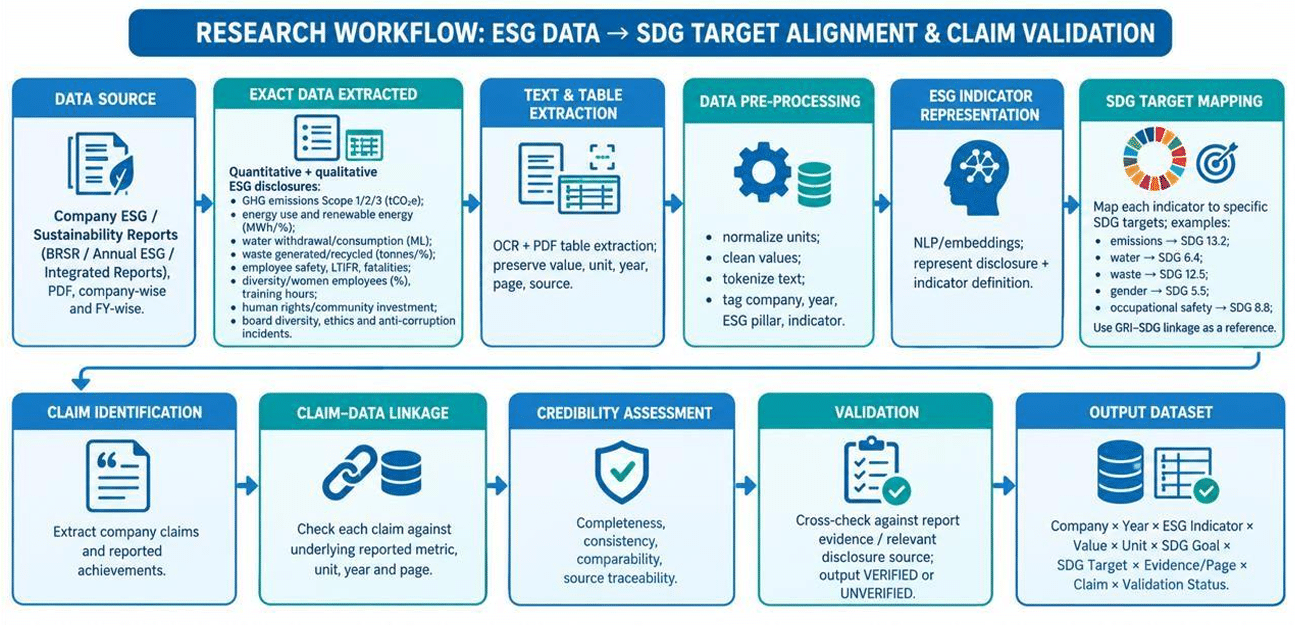
The research workflow begins with collecting company-specific ESG and sustainability reports, including BRSR, annual ESG and integrated reports. Quantitative and qualitative information, such as greenhouse gas emissions, energy consumption, water usage, waste management, employee safety, diversity and corporate governance disclosures, is extracted using OCR and PDF extraction techniques. The extracted data retains its original values, units, reporting years, page numbers and source references to ensure accuracy and traceability.
The extracted information is then cleaned, standardised and pre-processed by normalising measurement units, removing inconsistencies, tokenising text and categorising data according to company, financial year, ESG pillar and indicator. Natural Language Processing (NLP) and text embeddings are used to represent ESG disclosures and identify relevant indicators. These indicators are subsequently mapped to specific United Nations Sustainable Development Goals (SDGs) and their corresponding targets, using GRI-SDG linkages as a reference. Corporate sustainability claims and reported achievements are also identified during this stage.
Finally, each corporate claim is linked to its underlying ESG data and assessed based on completeness, consistency, comparability and source traceability. The claims are cross-checked against available report evidence and relevant disclosure sources before being classified as VERIFIED or UNVERIFIED. The final output is a structured dataset containing company details, financial year, ESG indicators, reported values, measurement units, SDG goals and targets, evidence references, corporate claims and validation status.
The design is selected because corporate sustainability reports contain large volumes of unstructured textual information that are difficult to analyses manually. Therefore, NLP techniques are used to analyses ESG-related sentences and disclosures, identify underlying thematic patterns, and determine their semantic similarity with relevant SDG targets. Sentiment analysis is additionally employed to assess the sentiment orientation of sustainability-related statements. This enables systematic interpretation of ESG disclosures and assessment of their alignment with specific SDG targets.
Thus, the study will use a quantitative method based computational analysis which will generate measurable results from corporate sustainability reports through thematic analysis and sentiment analysis. A variety of Python libraries were used throughout the analysis for text processing and visual presentation of the results. We used Python because the latest NLP techniques can be easily implemented with the libraries offered by the open-source community.
3.1.2 Sample Selection :
To analyze the Environmental, Social, and Governance (ESG) landscape using rigorous academic grounding, we look at empirical frameworks establishing the structural divergence between the Banking and Technology (Digital/IT) sectors. Two major companies are selected from each sector, namely Wipro and Infosys from the Digital/IT sector, and ICICI Bank and Yes Bank from the Banking sector. Thus, the final sample consists of four companies. According to peer-reviewed datasets and meta-analyzes, the two sectors handle entirely different ESG risk exposures. While Digital/IT sectors lead with higher aggregate ESG ratings (averaging scores around 75+ out of 100 due to lower raw manufacturing footprints), Banking sectors are more heavily impacted by external assurance mandates to validate their systemic macroeconomic risks.
Comparison of 2 Sectors Companies
-
Banking Sector: The core environmental narrative revolves around green According to Mordor Intelligence’s ESG Finance Market Size Report, the ESG finance market expanded to USD 9.69 trillion. The primary hurdle for banks is measuring the environmental footprint of the entities they finance rather than their physical office branches.
-
Technology Sector: Tech companies face immediate, massive operational impacts due to the boom in generative AI. Leading reports like Microsoft’s Environmental Sustainability Report highlight a massive push toward real-time grid tracking to handle data center electricity
Comparative Analysis
|
ESG Dimension |
Banking Sector (Financially Intensive) |
Tech / IT Sector (Operationally Intensive) |
|
Materiality Focus |
Financed Emissions & Systematic Climate Risk Stress-Testing. |
Grid Energy Consumption driven by generative AI & data centers. |
|
Environmental (E) |
Reallocating capital via Green Finance ($9.69T market size by 2026). High underwriting exposure. |
Aggressive acquisition of Virtual Power Purchase Agreements (VPPAs); hardware circularity. |
|
Social (S) |
Financial inclusion, consumer data privacy, and fair lending practices. |
Supply chain human rights (conflict mineral sourcing) and algorithmic/AI bias tracking. |
|
Governance (G) |
Heavy reliance on External Assurance Services; anti-money laundering (AML) controls. |
Ethical AI board frameworks, copyright/IP governance, and digital security mandates. |
In academic studies evaluating cross-sector ESG compliance (e.g., matching models utilized across global repository studies), research projects apply standard data parameters.
3.1.3 Data collection Tools and Techniques :
The study uses secondary data obtained from the publicly available ESG/Sustainability Reports of four selected companies from the Technology and Finance sectors, with two companies selected from each sector. For each company, three years of ESG/Sustainability Reports were collected, resulting in a total sample of 12 reports. The reports were retrieved from the respective companies’ official corporate websites for the selected study period.
The collected reports were compared with the United Nations Sustainable Development Goals (SDGs), particularly the relevant SDG targets, to identify the alignment between corporate sustainability disclosures and specific SDG targets. Python-based text-processing libraries were used to extract and preprocess textual information from the PDF reports. NLP techniques were then applied to identify ESG-related disclosures and corporate sustainability claims. Semantic similarity/mapping techniques were used to assess whether the identified claims and disclosures correspond to specific SDG targets, while sentiment analysis was used to examine the sentiment orientation of sustainability-related statements.
3.2. Thematic Analysis
3.2.1 Variables Used
Input (Raw) Variables :
ESG report sentences: Text extracted from companies’ ESG/sustainability reports, split into individual sentences after pre-processing (removing text blocks under 10 words, splitting into sentences).
SDG reference sentences: A set of representative sentences describing each of the 17 Sustainable Development Goals (drawn from the SDG Compass framework), used as the benchmark for comparison.
Derived (Measured) Variables :
Similarity Score: Computed using the pre-trained MiniLM model and cosine similarity, indicating how closely each report sentence relates to each SDG reference sentence. Scaled to a 0–100 range using min-max scaling.
Sentiment Score: Computed using the pre-trained DistilBERT model (fine-tuned on SST-2), ranging from 0 to 1. Scores ≥ 0.5 are classified as positive; scores < 0.5 are classified as negative.
Internal–External Sentiment Consistency (supporting variable): Comparison between sentiment expressed in a company’s own ESG report and sentiment expressed about the company in public/external sources. A large mismatch is treated as a possible greenwashing indicator.
Grouping (Categorical) Variables
-
Company: The organization whose ESG report is being analyzed
-
Year: The year of the report, allowing comparison of patterns over
-
Theme Category: The 17 SDGs grouped into broader thematic categories (e.g., Environment, Social Development, Resources) to identify a company’s area of focus.
Outcome Variable
Positive-to-Negative Sentiment Ratio: The ratio of positive to negative sentiment across a report’s sentences, used as a possible indicator of selective positivity — an early signal that may point toward greenwashing when checked alongside real-world events or performance data
Cross-Reference with Other Studies
The choice of similarity and sentiment as core variables is supported by more than one study, not a single source. Kang and Kim (2022) use SDG-similarity and sentiment scores derived from pre-trained models. Zhao et al. (2023) independently use sentiment as a central variable as well, but compare internal (company-reported) sentiment with external (public/social media) sentiment — a large mismatch between the two is treated as a possible greenwashing signal. Using both perspectives strengthens the justification for treating sentiment and similarity as valid, recurring variables in greenwashing-detection research.
Note on Interpretation
Similarity and sentiment scores are indicators, not proof. A high similarity score only shows that a sentence is topically related to an SDG; a sentiment score only shows tone. Neither variable, on its own, confirms or disproves a greenwashing claim — actual verification requires comparing these scores with independent, real-world performance data.
3.2.2 Ethical Considerations
The study will use only publicly available ESG/sustainability reports and other publicly reachable sources. No personal or confidential details will be collected. The reports and external data used in the study will be properly cited to keep academic sincerity. AI and NLP tools will
be used only for research analysis, and their results will be explained precisely. A high similarity or sentiment score will not be express as direct evidence of greenwashing without assisting proof. The study will avert making unsupported or misleading allegation about the selected companies.
3.2.3 Limitations
-
Limited Sample Size: Only selected companies and sectors will be studied. Therefore, the findings may not speak for all industries or companies.
-
Data Availability: Analysis depends on publicly available ESG data. Missing or incomplete instruction may affect the analysis.
-
Difference in ESG Reporting: Companies may pursue different reporting formats, standards and levels of disclosure, making direct connection difficult.
-
NLP Limitations: AI models may not fully understand ESG-specific
-
Sentiment Analysis Limitation: A positive sentiment score does not automatically mean that a company is greenwashing. Positive language can also perform certain sustainability
-
Greenwashing cannot be confirmed by AI alone: AI and NLP results can analyze possible greenwashing indicators, but they cannot independently confirm that a company has engaged in greenwashing.
-
External Data Bais: External source used for comparison may involve their own biases, differences in reporting quality or incomplete information.
4. Results and Discussion
4.1.1 SDG Similarity Analysis
The analysis covered 28,842 sentences extracted from 12 sustainability reports of four companies across the reporting years 2023-24 to 2025-26. Raw cosine similarity scores between report sentences and SDG reference statements were rescaled to a 0-100 range using min-max normalization. The resulting scores followed an approximately normal, slightly right-skewed distribution (M = 40.51, SD = 11.33), which suggests that most sentences show moderate alignment with SDG reference statements, while only a few show very high alignment.
At the company level, Infosys showed a consistent increase across all six SDG categories over the three years; for example, the Economic category rose from 41.97 to 44.92 and the Equity category from 41.40 to 44.66. ICICI Bank recorded consistently high and stable scores (roughly 43-47), with the Social and Economic categories scoring highest. Wipro’s scores fluctuated, with some categories declining in 2024-25 and others rising. Yes Bank remained the lowest and nearly flat (roughly 37-41). Across most companies, the Resources category recorded the lowest similarity.
4.1.2. Sentiment Analysis
Sentiment scores clustered close to 1.0, and most sentences were classified as Positive, indicating that the reports predominantly use positive language. The positive-to-negative sentence ratio (Table 1) was highest for Infosys, rising from 3.97 in 2023-24 to 6.66 in 2025-26, followed by ICICI Bank (3.46 to 4.76). Yes Bank had the lowest ratio throughout (1.39 to 1.64).
Table 1: Positive-to-negative sentence ratio by company and year
|
Company |
2023-24 |
2024-25 |
2025-26 |
|
Infosys |
3.97 |
6.77 |
6.66 |
|
ICICI Bank |
3.46 |
4.08 |
4.76 |
|
Wipro* |
3.15 |
1.37 |
0.94 |
|
Yes Bank |
1.39 |
1.46 |
1.64 |
*Wipro’s 2024-25 and 2025-26 documents contained only 90 and 68 sentences respectively (against 1,666 in 2023-24), so these ratios are not directly comparable.
Wipro’s ratio appears to fall from 3.15 to 0.94. However, this should be read with caution, because the 2024-25 and 2025-26 files are dashboard-format documents with very few sentences compared with the full 2023-24 sustainability report.
5. Discussion :
The results suggest that companies differ both in the extent to which their reports align with SDG-related language and in how positively they communicate their sustainability activities. A
high similarity score combined with a strongly positive tone may indicate strong SDG-oriented messaging; however, these indicators alone cannot establish whether a company is engaging in greenwashing or demonstrate its actual sustainability performance. This finding is consistent with previous research by Kang and Kim (2022), which highlights the importance of examining corporate sustainability communication critically. One possible explanation is that companies may adopt SDG vocabulary and optimistic language to enhance their public image and respond to regulatory and stakeholder expectations, which may reflect elements of symbolic compliance rather than necessarily indicating corresponding operational change. Because voluntary sustainability reporting may not always be subject to rigorous independent verification, high text alignment and positive tone may reflect aspects of corporate communication strategy rather than actual environmental impact. These findings are significant for governments, consumers, investors, and businesses because NLP-based indicators can provide a scalable approach for identifying ESG disclosures that may require closer examination, thereby support more transparent sustainability communication and contribute to more informed stakeholder decision-making.
6. Conclusion
Corporate ESG Reporting is Increasingly exposed to Greenwashing, where Companies present selective accounts, carefully chosen information or strategic language to portray environmentally harmful efforts as sustainable. Traditional manual analysis is difficult to apply to large volumes of unstructured ESG files, while keyword-based approaches may fail to capture contextual meaning and semantic relationships. Therefore, this project adapts an NLP-based sustainability -report approach to ESG reports using semantic similarity and sentiment analysis to examine ESG disclosures in relation to the SDGs and identify patterns that may serve as potential indicators of greenwashing
This study provides an automated NLP pipeline for analyzing corporate ESG disclosures and identifying potential indicators of green washing. It extends Kang’s(2022) framework by shifting its application from general Corporate Sustainability reporting to ESG disclosures , with a focus on analyzing semantic relationships and sentiment patterns that may indicate potentially misleading sustainability communication
The findings have practical implications for ESG reporting, as they can support investors analysts’ auditors and regulators in evaluating the consistency, credibility , comparability of corporate ESG disclosures. For companies, they emphasize the importance of transparent, consistent and well-substantiated sustainability communication
This paper , However , has several limitations .First, the similarity scores are relative indicators, since they were rescaled to the observed minimum and maximum, and a score of 40 does not mean a 40% match. Second, the sentiment score reflects the model’s classification confidence rather than the intensity of sentiment. Third, differences in document type and length across companies and years, particularly for Wipro, limit direct comparison. These findings should therefore be treated as indicators that warrant further qualitative verification.
Future research can extend the proposed NLP based framework by incorporating a larger and more diverse set of ESG reports across companies, industries and reporting years , Domain specific models such as ESG-Berth can also be evaluated against general-purpose models to determine whether they provide improved semantic understanding of ESG disclosures . Furthermore, quantitative ESG performance indicators and external ESG ratings could be integrated with textual analysis to provide stronger evidence for assessing potential greenwashing.
References
-
Climate Social Science Network. (2021). CSSN working paper 2021:1: An integrated framework to assess greenwashing. https://cssn.org/wp-content/uploads/2021/09/CSSN-Working-Paper-2021-on-Assessing-Greenwashing-1.pdf
-
Bibri, S. E. (2021). Data-driven smart sustainable cities of the future: An evidence synthesis approach to a comprehensive state-of-the-art literature review. Sustainable Futures, 3, 100047. https://doi.org/10.1016/j.sftr.2021.100047
-
de Freitas Netto, S. V., Sobral, M. F. F., Ribeiro, A. R. B., & Soares, G. R. da L. (2020). Concepts and forms of greenwashing: A systematic review. Environmental Sciences Europe, 32(1), 19. https://doi.org/10.1186/s12302-020-0300-3
-
del Río, C., González-Álvarez, K., & López-Arceiz, F. J. (2024). Examining greenwashing and SDG-washing: An analysis of corporate engagement with the SDGs. Sustainability Accounting, Management and Policy Journal, 15(2), 412–456. https://doi.org/10.1108/SAMPJ-02-2023-0080
-
Delmas, M. A., & Burbano, V. C. (2011). The drivers of greenwashing. California Management Review, 54(1), 64–87. https://doi.org/10.1525/cmr.2011.54.1.64
-
Gohr, C., Rodríguez, G., Belomestnykh, S., Berg-Moelleken, D., Chauhan, N., Engler, J.-O., Heydebreck, L. V., Hintz, M. J., Kretschmer, M., Krügermeier, C., et al. (2025). Artificial intelligence in sustainable development research. Nature Sustainability, 8(8), 970–978. https://doi.org/10.1038/s41893-025-01598-6
-
Hassani, H., Huang, X., MacFeely, S., & Entezarian, M. R. (2021). Big data and the United Nations Sustainable Development Goals (UN SDGs) at a glance. Big Data and Cognitive Computing, 5(3), 28. https://doi.org/10.3390/bdcc5030028
-
Kang, H., & Kim, J. (2022). Analyzing and visualizing text information in corporate sustainability reports using natural language processing methods. Applied Sciences, 12(11), 5614. https://doi.org/10.3390/app12115614
-
Kar, A. K., Choudhary, S. K., & Singh, V. K. (2022). How can artificial intelligence impact sustainability: A systematic literature review. Journal of Cleaner Production, 376, 134120. https://doi.org/10.1016/j.jclepro.2022.134120
-
Khan, S., Ali, M. Z., & Sharif, M. (2026). Artificial intelligence for advancing Sustainable Development Goals: A comprehensive thematic review. Discover Artificial Intelligence, 6(1), 481. https://doi.org/10.1007/s44163-026-01120-7
-
Markard, J., Raven, R., & Truffer, B. (2012). Sustainability transitions: An emerging field of research and its prospects. Research Policy, 41(6), 955–967. https://doi.org/10.1016/j.respol.2012.02.013
-
Marquis, C., Toffel, M. W., & Zhou, Y. (2016). Scrutiny, norms, and selective disclosure: A global study of greenwashing. Organization Science, 27(2), 483–504. https://doi.org/10.1287/orsc.2015.1039
-
Noman, A. A., Akter, U. H., Pranto, T. H., & Haque, A. B. (2022). Machine learning and artificial intelligence in circular economy: A bibliometric analysis and systematic literature review. Annals of Emerging Technologies in Computing, 6(2), 13–40. https://doi.org/10.33166/AETiC.2022.02.002
-
Nyilasy, G., Gangadharbatla, H., & Paladino, A. (2014). Perceived greenwashing: The interactive effects of green advertising and corporate environmental performance on consumer reactions. Journal of Business Ethics, 125(4), 693–707. https://doi.org/10.1007/s10551-013-1944-3
-
Ostrom, E. (2009). A general framework for analyzing sustainability of social-ecological systems. Science, 325(5939), 419–422. https://doi.org/10.1126/science.1172133
-
Regona, M., Yigitcanlar, T., Hon, C., & Teo, M. (2024). Artificial intelligence and Sustainable Development Goals: Systematic literature review of the construction industry. Sustainable Cities and Society, 108, 105499. https://doi.org/10.1016/j.scs.2024.105499
-
Seele, P., & Gatti, L. (2017). Greenwashing revisited: In search of a typology and accusation-based definition incorporating legitimacy strategies. Business Strategy and the Environment, 26(2), 239–252. https://doi.org/10.1002/bse.1912
-
(2010). The sins of greenwashing: Home and family edition. Underwriters Laboratories. http://sinsofgreenwashing.org/findings/the-seven-sins/
-
Valencia-Arias, A., Garcia, J. A. J., Adan, T. E. A., Rojas, E. M., Valencia, J., Agudelo-Ceballos, E., Bedoya, H. U., & López, G. A. M. (2025). Trends in the sustainable use of artificial intelligence: A bibliometric approach. Discover Sustainability, 6(1), 374. https://doi.org/10.1007/s43621-025-00624-z
-
Walker, K., & Wan, F. (2012). The harm of symbolic actions and green-washing: Corporate actions and communications on environmental performance and their financial implications. Journal of Business Ethics, 109(2), 227–242. https://doi.org/10.1007/s10551-011-1122-4
-
Zhao, Y., Kroher, L., Engler, M., & Schnattinger, K. (2023). Detecting greenwashing in the environmental, social, and governance domains using natural language processing. In Proceedings of the 15th International Conference on Agents and Artificial Intelligence (ICAART) (Vol. 2, pp. 177–184). SCITEPRESS. https://doi.org/10.5220/0012155400003598