AUTHORS: ANCHAL DALMIYA, ASTHA MISHRA, PARI KOTHARI, PRACHI SHARMA, PRIYANSHI SHARMA, SAMRAT KAR, VIKRANT PUNDIR
ABSTRACT
Education is a fundamental right and a key driver of socio-economic development. However, effective outcomes require not only adequate funding but also efficient utilization of available resources.
This study examines the gap between allocated education budgets and actual expenditure using secondary data from government sources, including CAG, UGC, and AISHE, along with a primary survey conducted through Google Forms where secondary identify correlation and primary helps in validating and challenging the interpretation Time-series analysis and descriptive statistics are employed to identify expenditure trends, utilization gaps, and key challenges.
The findings challenge the conventional assumption that higher spending automatically strengthens educational outcomes. Despite increased expenditure, inefficient fund utilization is associated with lower gross enrolment, regional disparities, and persistent teacher vacancies. The study highlights the need for timely and efficient spending, continuous monitoring, stronger accountability, and adoption of successful national and international practices. It provides regional insights and practical recommendations to improve access, affordability, quality, foundational learning, research, and skill development, ensuring that every rupee spent delivers measurable educational outcomes.
Keywords: education, efficiency, multidisciplinary, affordability, implementation, monitoring, evaluation.
INTRODUCTION
Public expenditure on education is the primary catalyst for human capital formation and sustained economic resilience, yet public funding in India consistently falls short of the National Education Policy (NEP) 2020 target of 6% of GDP. Because financial volume alone does not guarantee academic quality, modern educational economics requires a paradigm shift. Policy practitioners and educators must move beyond measuring raw financial inputs to evaluating how efficiently public resources are converted into functional student learning outcomes. As the World Bank report VFM evidence shows that higher education spending does not necessarily improve learning outcomes, highlighting the importance of expenditure efficiency.
This shift is urgent because fiscal inputs in India consistently fail to translate into classroom performance, with roughly 30% of allocated education funds remaining unspent annually nationwide. Severe governance failures—including delayed treasury releases, financial diversions such as ₹99.98 crore misdirected under Sarva Shiksha Abhiyan, and up to 100% staffing vacancies across Block Resource Centres —exacerbate these operational breakdowns. Stagnant ASER metrics and stark North-South regional disparities highlight that the core challenge stems from structural mismanagement rather than capital scarcity. Existing literature remains deeply fragmented by analyzing allocations, governance, and learning deficits in isolation, leaving a critical research gap regarding how systemic failures across UNESCO’s Planning, Monitoring, and Evaluation (PME) continuum drive budget under-utilization.
To address this structural gap, this study evaluates the systemic efficiency of Indian public educational expenditure and proposes an integrated, outcome-linked PM&E framework aligned with NEP 2020 objectives. Employing an applied mixed-methods research design, the study synthesizes qualitative policy analysis of Comptroller and Auditor General (CAG) audit reports, government releases, and international case studies with empirical quantitative survey data (N=57) from youth, educators, and policy practitioners. By mapping fund flows from central treasuries to school-level administrative units and analyzing tracking mechanisms like UDISE+, NAS, and PARAKH, this research establishes an evidence-based model for transitioning from input-driven compliance to performance-linked budgeting.
Ultimately, this research serves as a vital strategic asset by providing an actionable blueprint to optimize public education expenditure and maximize India’s human capital potential. It moves beyond siloed literature to build an integrated PM&E framework tailored for policymakers, public finance scholars, and education administrators. Furthermore, by incorporating comparative international case studies, the study evaluates global best practices in outcome-linked education budgeting. This global lens elevates the paper from a localized critique into a high-impact framework capable of transforming passive fiscal allocations into measurable learning achievements.
LITERATURE REVIEW
Government expenditure on education is widely recognized as a primary determinant of human capital formation, sustained economic growth, and social advancement. Major policy frameworks—including the Economic Survey of India, the Union Budget documents, and the National Education Policy (NEP) 2020—consistently frame public spending on education as a strategic investment necessary for improving foundational learning, expanding infrastructure, enhancing teacher capacity, driving research, and securing equitable access across demographic groups.
Evaluating post-pandemic financing trends, Patel (2026) observes a steady post-COVID-19 increase in budgetary allocations directed toward school infrastructure, digital learning technologies, and skill development programs. However, public investment in education continues to fall short of the NEP 2020 benchmark target of 6% of Gross Domestic Product (GDP), underscoring a persistent structural gap between high-level policy targets and actual financial commitments (Patel, 2026). For example, over 1.04 lakh schools operate with only a single teacher for multiple grades. This structural gap is a major hurdle in management of school infrastructure and skill development programs.
Despite continuous expansion in fiscal allocations, severe deficits persist at the operational level. Systemic issues such as stagnant learning outcomes, alongside critical foundational literacy and numeracy crises documented under NEP 2020 and the NIPUN Bharat Mission, demonstrate that policy design and financial planning are frequently disconnected from field execution and grassroots realities. Despite having a 100% enrollment rate in primary education, only 45% to 50% of grade 5 students can fluently read a grade 2 level text or perform basic division as per Annual Survey Education Report (ASER).
Theoretical Paradigms and the Paradigm Shift in Educational Finance
A critical analysis of educational finance literature reveals a fundamental paradigm shift: moving from the traditional question of “how much money is spent” to evaluating “how efficiently public resources are converted into educational outcomes.”
- Capital-Output Theory and Human Capital Frameworks: Early scholarly understandings relied heavily on Capital-Output Theory and classic human capital models, assuming a linear relationship between educational spending and development outcomes. Under this model, increased financial inputs automatically drive higher literacy rates, improved infrastructure, enhanced employability, reduced poverty, and general demographic dividends. Subrat et al. (2012) noted that historical policy assumptions treated differences in state literacy and infrastructure as direct reflections of spending volume differences.
- Empirical Rebuttal of the Linear Model: Recent empirical findings challenge this linear model, demonstrating that financial inputs alone cannot guarantee improved educational quality or learning outcomes. Persistent learning crises reported in Annual Status of Education Report (ASER) surveys and wide interstate performance gaps despite rising fiscal allocations indicate that resource allocation is a necessary but insufficient condition for success.
Interstate Disparities and the Allocation vs. Expenditure Gap
The disconnect between spending volume and educational success is illustrated by regional comparative studies across Indian states:
- North-South Regional Asymmetry: Research by Kiran (2014) demonstrates that Southern Indian states consistently outperform Northern states across educational and human development indicators despite facing comparative budgetary constraints. Conversely, several Northern states fail to achieve proportional outcome gains despite receiving higher budgetary allocations. This confirms that the critical disconnect exists not only between Budget Allocation and Actual Expenditure, but fundamentally between Actual Expenditure and Learning Outcomes due to fund under-utilization and structural governance issues. As per numbers given in ASHE 2024, Southern states like Tamil Nadu (47%), Kerala (41.3%) lead in Gross Enrollment Rate, whereas Northern states like Uttar Pradesh (24.1)%, Bihar (17.1)% fall significantly behind.
- Historical Fund Under-Utilization: Historical budgetary tracking shows that between 2004–05 and in 2009–10, India’s national education budget grew from ₹157,847 crore to ₹372,813 crore. However, approximately 30% of allocated funds remained unspent annually nationwide. In Bihar, despite receiving the largest proportional increase under Sarva Shiksha Abhiyan (SSA), the state utilized a mere 51% of its allocated funds in 2009–10 (Jaiswal et al., 2014). Odisha has also shown a lower utilisation rate of 55% of its Samagra Shiksha abhiyan ( successor of Sarva Shiksha Abhiyan). This demonstrates that the core systemic challenge is inefficient spending of existing funds rather than absolute financial scarcity.
Empirical Volatility and Time-Series Analysis: Higher Education
In an empirical study of public expenditure on higher education in India from 2010–11 to 2024–25, Ahmad and Gangwar (2026) examine the relationship between Budget Estimates (BE) and Actual Expenditure (AE) using time-series regression analysis and descriptive statistics based on secondary data from Union Budget documents, Ministry of Education reports, and PRS Legislative Research.
- Budget vs. Expenditure Expansion: Budget Estimates increased from ₹16,690 crore in 2010–11 to ₹47,620 crore in 2024–25, while Actual Expenditure rose from ₹15,472 crore to ₹46,482 crore, confirming sustained macro-level growth in public funding.
- Utilization Rate Fluctuations: Fund utilization rates experienced sharp volatility, ranging from a low of 80.8% in 2012–13 to a high of 125.6% in 2023–24. Actual expenditure displayed significantly higher volatility than Budget Estimates over the 10–15-year period, driven by administrative delays in fund disbursement, implementation constraints, changing policy priorities, and regulatory bottlenecks (Ahmad & Gangwar, 2026).
- Methodological Advancement & Gap Identification: Previous literature relied primarily on descriptive trends without assessing expenditure execution, fiscal predictability, or long-term forecasting. Ahmad & Gangwar (2026) extended the literature by combining regression analysis with expenditure forecasting to offer an evidence-based execution model. However, their model relies on aggregate national data and univariate structures without controlling for inflation, state-level variations, or learning outcome indicators.
Governance Bottlenecks, Financial Mismanagement, and Administrative Failures
The literature identifies systemic governance breakdowns, procedural friction, and institutional administrative failures as the core causes of fund under-utilization and misdirection:
- Institutional Planning Deficits: Kaur (2021) notes that financial planning in the education sector suffers from a lack of clear operational objectives, absence of short- and long-term strategic plans, failure to establish spending priorities, and inadequate administrative procedures.
- CAG Audit Findings and NIPFP Studies: Reports from the Comptroller and Auditor General (CAG, 2024) identify recurring challenges, including delayed fund releases, under-utilization of allocated resources, severe infrastructure shortages, faculty vacancies, and weak monitoring mechanisms. Similarly, research by the National Institute of Public Finance and Policy (NIPFP) reveals wide variations in expenditure efficiency across states, concluding that governance quality and utilization efficiency are as vital as fiscal allocation levels.
- Resource Imbalance and Operational Squeeze: Daimary (2025) demonstrates that excessive budget absorption by salaries and operational costs starves infrastructure, pedagogical tools, and capital investments.
- Bureaucratic Inertia and Political Patronage: Kingdom (2014) highlights institutional inertia where officials maintain traditional administrative norms for personal or political benefit—such as delaying grassroots fund releases or using appointments for political patronage. The nexus between permanent and non-permanent executives distorts administrative decision-making, reducing schools and colleges to token institutions. Strong institutional frameworks convert allocations into outcomes effectively, whereas weak governance produces stagnant, undesirable outcomes.
- Financial Irregularities and Diversion of Funds: Audits cited by Dipika et al. (2014) reveal that ₹99.98 crore allocated under Sarva Shiksha Abhiyan (SSA) was diverted to non-scheme activities across 11 states, while ₹472.51 crore in financial irregularities was identified across 14 states and Union Territories. Transparency deficits, delayed transfers, administrative vacancies, and weak oversight directly undermine fund efficiency.
- Severe Vacancies in Monitoring Apparatus: Drawing on the SSA Framework for Implementation (Government of India, 2011), Dipika et al. (2014) report that 20% of SSA positions at the state level, 21% at the district level, and 20% at the Block Resource Centre (BRC) level were vacant. Severe regional deficits were observed in Bihar (over 60% BRC vacancy rates), Arunachal Pradesh (85% vacancies), and Sikkim (100% vacancies). Citing Govinda and Bandyopadhyay (2010), evidence from Karnataka and Kerala shows Block and Cluster Resource Coordinators made infrequent school visits due to administrative workloads, lack of transport, insufficient incentives, and large operational areas.
- Teacher Absenteeism and Administrative Wastage: Sinha (2025) identifies teacher absenteeism as a direct indicator of governance failure, with 23.6% of teachers absent without prior approval, resulting in an estimated $1.5 billion annually in wasted salary expenditure. Strengthening school monitoring to curb absenteeism is over ten times more cost-effective than hiring additional teachers (Sinha, 2025). This $1.5 billion can be used in funding high quality teacher training programs, upgrading the skills of the remaining 76.4% of the workforce.
A synthesis of existing literature reveals a fundamental paradigm shift, moving from classical Human Capital and Capital-Output theories—which assumed public spending linearly drives development—to empirical time-series regression and descriptive evaluations (Ahmad & Gangwar, 2026; Subrat et al., 2012). Modern researchers agree that despite consistent, simultaneous increases in both Budget Estimates and Actual Expenditure, improvements in educational quality and learning outcomes remain stubbornly stagnant. This disconnect is vividly illustrated by North-South regional disparities, where Southern states consistently achieve superior educational metrics compared to Northern counterparts despite receiving lower budgetary allocations (Kiran, 2014).
Consequently, scholarship emphasizes that the primary challenge facing the Indian education system lies in financial mismanagement, inefficient expenditure, improper tracking of spending, and operational friction—such as administrative fund release delays, budget absorption by recurring operational costs, and severe monitoring vacancies across Block Resource Centres—which prevent fiscal inputs from reaching classrooms (Daimary, 2025; Dipika et al., 2014; Kaur, 2021). Ultimately, existing literature proves that continually expanding budget allocations without reforming the planning paradigm yields negligible gains, underscoring that spending efficiency is paramount to improving learning outcomes.
RESEARCH GAP
Existing literature on the Indian public education system remains deeply fragmented, typically examining budget allocation trends, governance indicators, expenditure volatility, and learning outcomes in isolation rather than within an integrated analytical framework. This isolation limits scholarship’s capacity to explain the causal pathways linking public finance management to grassroots educational performance. Crucially, prior research fails to account for the quality of institutional planning—a vital mechanism that dictates political, economic, and financial governance across the education sector. Grounded in UNESCO’s paradigm of educational planning as an uninterrupted, continuous cycle encompassing priority setting, resource allocation, implementation, monitoring, and evaluation, a significant research gap exists in applying this multi-stage lens to Indian educational administration. Current studies have yet to evaluate how structural deficits across the interconnected Planning, Monitoring, and Evaluation (PME) continuum directly generate fiscal under-utilization, administrative leakage, and expenditure inefficiency. Addressing this gap is essential to examine how restructuring the PME framework can eliminate institutional execution friction points, optimize budgetary utilization, and effectively convert public expenditure into measurable learning outcomes.
RESEARCH QUESTION
“What governance gaps exist across the planning, monitoring, and evaluation (PM&E) stages of public education expenditure in India, and what principles might inform a more integrated approach to addressing them?”
- Planning & Resource Allocation: How do existing budgetary allocation mechanisms (e.g., under Samagra Shiksha) account for context-specific pedagogical needs versus fixed infrastructure/administrative inputs?
- Accountability & Tracking Mechanisms: What structural bottlenecks, administrative leaks, or policy gaps prevent real-time financial tracking and accountability during fund disbursement in state-run school networks?
- Monitoring & Evaluation (M&E) Integration: To what extent are existing monitoring tools (e.g., UDISE+, NAS, PARAKH) linked to performance-based or outcome-linked budgeting models rather than input compliance?
- Impact on Learning Outcomes: What is the relationship between localized monitored spending (e.g., Foundational Literacy and Numeracy FLN initiatives) and student performance indicators at primary and secondary levels?
OBJECTIVES
-
General Objective:
- The main aim of this study is to evaluate the systemic efficiency of educational expenditure in India and propose an integrated, accountability-driven PM&E (Planning, Monitoring, and Evaluation) framework that links budgetary allocations directly to learning outcomes.
-
Specific Objectives:
-
- To map the existing flow of public funds from central treasuries to school-level administrative units (e.g., School Management Committees) and identify key structural inefficiencies, delayed disbursements, or underutilization nodes.
- To assess how current budgetary frameworks balance capital expenditure (infrastructure) with operational and quality-focused spending (teacher training, EdTech, learning materials).
- To examine the existing accountability frameworks and evaluate the effectiveness of administrative and community-led monitoring mechanisms in tracking output versus outcome performance.
- To design an outcome-based budgeting and continuous M&E integration framework aligned with the targets of the National Education Policy (NEP) 2020 to ensure maximum return on educational investment.
RESEARCH METHODOLOGY RESEARCH DESIGN
This study employs a Mixed-Methods Research Design, combining qualitative policy analysis with existing documents and various case study analysis from different states and nations along with empirical quantitative data.
- Descriptive & Exploratory Design: Used to examine existing budgetary allocation channels, fund flows, and administrative bottlenecks in the Indian public education system through secondary data and international comparative case studies.
- Empirical Survey Design: Used to capture primary quantitative perspectives on budget adequacy versus expenditure utilization efficiency across key stakeholders.
NATURE OF RESEARCH
The study is applied and mixed-method (qualitative-quantitative) in nature.
- Qualitative Component: Involves comparative analysis of international case studies (evaluating global best practices in outcome-linked education budgeting) and content analysis of policy frameworks, audit reports, and government portals.
- Quantitative Component: Involves descriptive statistical analysis of primary survey data collected from stakeholders and secondary financial data from government audit reports.
SAMPLE & ITS TECHNIQUE
- Sampling Technique: Convenience and Non-Probability Purposive Sampling via online distribution.
- Target Population: General public, educators, students, public policy practitioners, and civic stakeholders informed about the Indian education spending landscape.
- Sample Size: N = 57 respondents, showing non probability sampling technique.
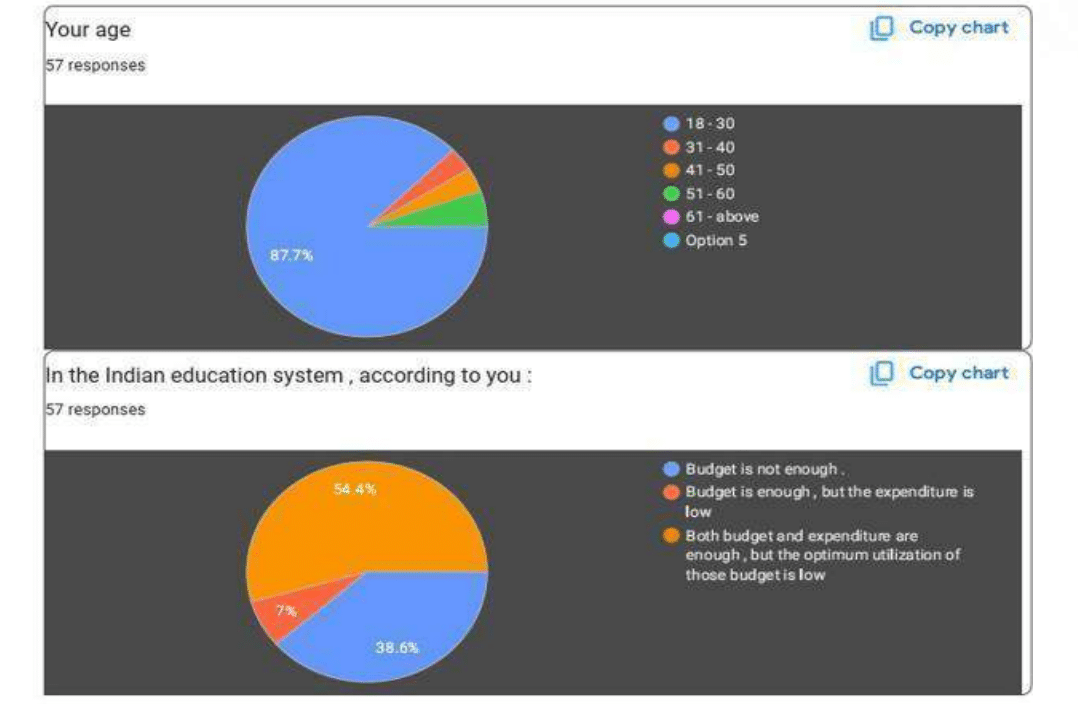
- Demographic Breakdown: The respondents are predominantly youth/young professionals, with 87.7% of respondents falling within the 18–30 age group, providing targeted insight into youth and student perceptions regarding educational governance and spending.
DATA COLLECTION TOOL
A combination of primary and secondary sources is utilized:
-
Primary Data Tool:
- A structured Closed-Ended Questionnaire administered via Google Forms (comprising single-choice and Likert-scale questions to measure perceptions on budget sufficiency, fund utilization, and M&E mechanisms).
-
Secondary Data Sources:
- Government Portals & Publications: Press Information Bureau (PIB) releases, Comptroller and Auditor General (CAG) audit reports, and Ministry of Education reports.
- Academic & Global Literature: Peer-reviewed journal articles, international case study reports, and National Education Policy (NEP) 2020 documents.
VARIABLES USED
-
Independent Variables
- Budgetary Allocation and Disbursement Timelines (Planning & Fund Flow).
- Level of Accountability and Monitoring & Evaluation (M&E) Integration.
-
Dependent Variables
- Optimum Expenditure Utilization Efficiency.
- Student Learning Outcomes (FLN gains, NAS performance indicators).
- Control/Contextual Variables: Federal governance structures, state-level implementation variations, and school infrastructural baselines.
ETHICAL CONSIDERATIONS
- Informed Consent: Voluntary participation was ensured by incorporating an explicit consent clause at the beginning of the Google Form survey.
- Anonymity & Confidentiality: No personally identifiable information (PII) such as names, email addresses, or phone numbers was collected. Data is stored securely and reported purely in aggregate form.
- Academic Integrity: All secondary sources, government reports (CAG, PIB), and published research papers are properly cited to prevent plagiarism.
LIMITATIONS
- Sample Size & Representativeness: A primary sample size of 57 respondents provides localized/exploratory quantitative signals, but broader extrapolation across all Indian states requires caution.
- Sample Skewness: The demographic concentration in the 18–30 age bracket (87.7%) predominantly reflects student and young professional perspectives rather than administrative policy officers.
- Limited empirical validation: It has limited operationalization of variables and lack of causal identification.
- Secondary Data Delays: Dependence on published CAG and government audit reports may involve temporal lags between fund disbursement and public auditing data availability.
DATA ANALYSIS & OBJECTIVES
The study adopts document-based and comparative analysis of primary and secondary data to analyze the existing governance frameworks that underpin Indian education spending. Primary data were collected through a structured, closed-ended questionnaire administered via Google Forms from a non-probability, purposively sampled group of 57 respondents, and are used descriptively to illustrate stakeholder perceptions rather than to draw generalizable conclusions. Secondary data were drawn from government reports, education databases like UDISE+/ASER, research studies, Comptroller and Auditor General reports and policy documents. The collected evidence was then analyzed thematically under three dimensions of education governance: allocation, monitoring and evaluation. Within each dimension, the study identified recurring findings and governance gaps from the Indian context and subsequently undertook comparative analysis of selected international practices, chosen for their relevance to the specific governance mechanism under discussion rather than for overall similarity to India’s context. Descriptive analysis and concise tables have been used to present the findings, followed by an explanation of the underlying governance issues. Thereafter, comparative evidence has been used to identify institutional mechanisms that may be adapted to the Indian context and incorporated into the proposed integrated governance framework.
ALLOCATION
INDIAN EVIDENCE:
The NIPFP study Resource requirement for right to education: normative and real estimates the resource requirement for elementary education across 12 Indian states/UTs using school-level data rather than aggregate state expenditure. The four states below illustrate this evidence that the allocation problem is not simply a question of whether sufficient resources are available at the aggregate level. Rather, it concerns whether resources are distributed according to actual requirements of different schools and states.
|
State |
Estimated Resources Requirement |
Actual Expenditure |
Actual Expenditure as % of Requirement |
|
Bihar |
₹42,834 crore |
₹12,803 crore |
29.9% |
|
Jharkhand |
₹14,361 crore |
₹6,235 crore |
43.4% |
|
Odisha |
₹13,314 crore |
₹6,083 crore |
45.7% |
|
Madhya Pradesh |
₹25,855 crore |
₹11,357 crore |
43.9% |
Sources: NIPFP, Resource Requirement for Right to Education: Normative and Real Estimates.
The evidence gap is not simply between states that spend more and states that spend less. There is a significant difference between what is required to meet defined educational norms and what is actually being spent. The study further indicates that a needs-based allocation approach, in which the amount of funding allocated is linked to the specific educational requirements of the institution, is preferable to relying on uniform aggregate allocation.
At the same time, need-based allocation alone does not resolve the problem. The study observed that the burden of additional requirements falls disproportionately on poorer states. The estimated requirement for elementary education represented 11.2% of Bihar’s GSDP compared with only 0.5% of Delhi’s GSDP. Therefore, states with greater fiscal needs may not necessarily possess the fiscal capacity required to meet those needs.
Finally, the study identifies a disconnect between planning and actual allocation. Under the earlier SSA framework, the approved budget was not always translated into equivalent union allocation; the study reports a 54% gap between approved SSA budget and actual Government of India allocation in FY 2013-14, while in 2015-16 the allocation amounted to only 35% of the approved SSA budget, pointing to a descriptive rather than statistically tested pattern.
IDENTIFICATION OF ALLOCATION GAPS:
|
Allocation Problem |
Evidence from Indian context |
Interpretation |
|
Need-based allocation |
Resources requirements vary across states. |
A uniform and predominant aggregate approach may not adequately capture differences in actual educational requirements. |
|
Fiscal equalization |
Intergovernmental resource sharing arrangement is not adequate to address their specific needs and additional resources requirements fall disproportionately on poor states. |
States with greater educational requirements but weaker fiscal capacity require an equalizing mechanism. |
Source: Author’s analysis based on NIPFP, Resource Requirement for Right to Education: Normative and Real Estimates
The interpretation, therefore, is that India’s allocation framework requires two complementary principles: first, resources should be calculated according to education needs; second, the distribution of public resources should compensate for different fiscal capacity.
COMPARATIVE ANALYSIS: AUSTRALIA AND CANADA
The comparative analysis, discussed here for its underlying design principles rather than tested applicability in India, demonstrates that India’s allocation challenges require more than a single uniform funding mechanism. The Australian Schooling Resources Standard (SRS) provides a model for addressing differences in educational needs at the school level. SRS is an estimate of the total public funding required for a school to meet the educational needs of its students. The SRS consists of a base amount and additional needs-based loading, allowing resource requirements to vary across schools and circumstances of students.
Canada’s Equalization Program provides a mechanism for addressing differences in fiscal capacity across jurisdictions. The purpose of this program is to enable provinces with lower fiscal capacity to provide reasonably comparable public services at reasonably comparable taxation.
MONITORING
INDIAN EVIDENCE:
The monitoring system in the Indian education system relies on documentation and reporting mechanisms to determine whether public funds have been used for intended purposes. Reports of the Comptroller and Auditor General (CAG), including Report No. 3 of 2020 on the State Finances of the Government of Jharkhand, Report No. 1 of 2019 on State Finance in Odisha, the CAG State Finance Audit Report for Madhya Pradesh (2023–24), and the CAG Finance Audit Report for Bihar (2023–24), provide evidence of weaknesses in financial reporting and accountability mechanisms. These four states are illustrative rather than a representative national sample. The reports also identify a substantial backlog in the submission of Detailed Contingent (DC) bills.
|
Jharkhand |
Odissa |
Madhya Pradesh |
Bihar |
|
|
|
|
Source: Comptroller and Auditor General of India, Respective State Finance/Audit Reports.
IDENTIFICATION OF MONITORING GAP
|
Monitoring problem |
Evidence from India |
Interpretation |
|
Manual/Fragmented Reporting |
Evidence reflects subsequent gap in submission and consolidation in financial records |
Dependency on separate documentary reporting mechanisms can result in fragmented information flows and makes monitoring difficult. |
|
Delayed Accountability |
Substantial pendency in UCs and DC bills despite prescribed timeline. |
Delayed submission and verification weaken timely financial accountability and increases the risk of irregularities. |
Source: Author’s analysis based on CAG State Finance/Audit reports for Jharkhand, Odisha, Madhya Pradesh.
The evidence indicates that the principal monitoring problem is not the absence of rules. Rules and deadlines already exist, but the mechanism for collecting, verifying and consolidating information is insufficient. This study does not measure whether stronger reporting mechanisms would translate into improved expenditure outcomes.
COMPARATIVE ANALYSIS – ESTONIA AND BRAZIL
Estonia provides a relevant, descriptive point of comparison rather than an empirically tested model for India. The Estonian Education Information System (EHIS) is a part of Estonia’s broader education-monitoring architecture and supports data-informed decision-making in education. This is a compulsory system which was designed to provide an integrated information base for education governance.
Brazil provides a complementary model that connects financial reporting, compliance and education performance: SIOPE, FUNDEB and IDEB. SIOPE (Sistema de Informações sobre Orçamentos Públicos em Educação) is an electronic system particularly relevant for monitoring, used to access information about education budgets at federal, state and municipal levels. It works as a mechanism for transparency, monitoring and control of education expenditure. For validation and oversight, the MAVS model allows education officials to validate information reported through SIOPE.
EVALUATION
INDIAN EVIDENCE
The evidence from the CAG report and ASER indicates a gap between policy expenditure/implementation and actual education outcomes. The evidence indicates that the principal weakness in India’s evaluation framework is not necessarily the absence of evaluation activities, but the type of information on which evaluation is based. Therefore, the evaluation process needs to move beyond asking how much was allocated, spent or implemented towards asking what education outcomes were achieved, from whom, and under what conditions.
|
Indicator |
Evidence |
Indicate GAP |
|
Rural school enrolment (National) |
over 97% |
High enrollment does not necessarily translate into adequate learning outcomes. |
|
Children unable to read class 2-level text (National) |
Around 30% |
Significant foundational learning gaps persist despite high enrolment. |
|
West Bengal-Transition Loss |
28-42% |
Significant loss occurs during education progression. |
|
West Bengal -school without teachers |
520 scholars |
Teacher availability is a major constraint. |
|
West Bengal – single teacher |
5,152 schools |
Staffing deficiencies affect the ability of schools to deliver intended outcomes. |
|
West Bengal – Utilization of central funds |
46-65% |
Financial utilization does not necessarily correspond to effective education delivery. |
Source: ASER and CAG, Performance Audit Report on Sarva Shiksha Abhiyan (SSA).
Although education expenditure is intended to improve enrollment, retention, learning and education quality, evaluation does not always adequately represent whether the objectives are being achieved.
The second issue is compatibility and contextual relevance. A uniform education framework may make comparison easier, but education conditions vary between urban, rural, remote and disadvantaged areas but education conditions vary between urban, rural, remote and disadvantaged areas. This study identifies the need for such context-sensitive evaluation but does not itself develop or test a specific methodology for it.
IDENTIFICATION OF EVALUATION GAP
|
Evaluation Problem |
Evidence |
Interpretation |
|
Obsolete/outcome- Evaluation Model |
Evaluation does not sufficiently establish whether intervention produces improvement in actual learning and education outcome. |
A compliance and input oriented approach may fail to capture actual effectiveness of education expenditure and policies |
|
Lack of Context sensitive and standardization Evaluation |
Evaluation may vary across districts as rural, remote and disadvantaged schools may face different conditions plus limitations in trained evaluation personnel and standardized evaluation mechanisms. |
Absences of a sufficiently consistent and context sensitive evaluation framework make comparison difficult. |
Source: Author’s analysis based on ASER and CAG.
COMPARATIVE ANALYSIS: SOUTH KOREA, PUNJAB AND KERALA
South Korea has achieved strong education performance and highlights its emphasis on education quality and student performance, including performance in international assessments such as PISA.
Punjab has a secondary GER of 92.6% compared to the national 8.7%. It also reports high levels of functional internet access and computer access. This case demonstrates the importance of disaggregated evaluation.
The analysis indicates that the major governance gaps in education spending extend beyond resource availability, and comparative evidence provides relevant institutional principles and comparative evidence, drawn from cases that differ substantially from India in scale, governance structure, and socio-economic context, provides relevant institutional principles.
DISCUSSION
Evidence on education funding suggest that the allocation problem in India goes beyond the sheer availability of public resources to the institutional basis on which these resources are identified and allocated .The NIPFP analysis shows significant differences between the resources needed to meet the defined educational standards and the actual expenditure in different states, as well as evidence that the resources needed vary according to the characteristics and circumstances of the schools (Bose et al.,2017). A uniform allocation approach may therefore under-capture real cost differences. States with highest estimated needs, such as Bihar, also tend to have the weakest fiscal capacity relative to those needs (Bose et al.,2017). An alternative explanation for low utilization in states like Bihar should be considered: utilization gaps may reflect administrative and staffing capacity or need alone (Jaiswal et al.,2014;Kaur,2021). This study’s state-aggregate data cannot fully separate these explanations, which has implications for how allocation reform is designed.
The comparative evidence offers partial guidance here. The Australian Schooling Resource Standard (SRS) links funding to a base amount plus need-based loading(Australian Government Department of education,2026) and Canada’s Equalization program addresses provincial fiscal-capacity gaps (Department of Finance Canada,2025). Both are federal systems in which sub-national units hold primary responsibility for education delivery, which is the specific basis for their relevance to India rather than a claim of general similarity. However, both operate with administrative data infrastructure and revenue raising capacity that most Indian states do not yet have; the transferable element is the principle of combining needs-based funding with fiscal equalization, not the specific mechanism.
Allocation reform alone cannot ensure funds are tracked as intended. Monitoring evidence indicates the constraint is not an absence of reporting rules but fragmented, sequential document verification: the substantial backlog of utilization certificate and detailed contingent bills documented in state audit report is consistent with the pattern (Comptroller and Auditor General of India, 2019, 2020, 2024a, 2024b). This is associative evidence of a plausible contributing factor, not a tested causal claim.
This study does not conduct an independent costing exercise for the proposed integrated monitoring architecture. However, an order-of-magnitude domestic benchmark exists: India’s own Public Financial Management System (PFMS), a fund-tracking platform interfaced with treasury system across all states and union territories, was approved by the Union Cabinet for national rollout at an outlay of ₹1,080 crore over four years, implementation through the Office of Controller General of Accounts (Government of India,2013). Notably, Sarva Sikhsha Abhiyan was among PFM’s four founding pilot schemes, indicating the underlying principle already has domestic precedent within education specifically, even though it has not been extended to school-level granularity. An education -specific system, narrower in scope than PFM’s whole-of-government coverage, would plausible fall in a comparable or smaller order of magnitude, though a dedicated feasibility and costing study would be required to confirm this. Estonia’s EHIS and Brazil’s SIOPE-MAVS architecture (Fundo Nacional de desenvolvimento da Educação,2020;OECD,2020,2023) illustrate the principle of interoperable reporting further, but differ from India in scale and administrative structure; the transferable lesson is integration and validation design, not direct replication.
Effective allocation and monitoring do not by themselves guarantee learning improvements. NITI Aayog’s evaluation work links persistent foundational-learning gaps to the need for assessing outcomes alongside access and retention rather than in isolation (NITI Aayog,2026), and the Continuous and Comprehensive Evaluation framework’s emphasis on record-keeping over usable evaluation data illustrate a related risk. These patterns are suggestive rather than established causal mechanisms.
Some empirical grounding exists for comparing India’s own evaluation instruments. Johnson and Parrado (2021) compared NAS/PARAKH,ASER and IHDS state-level data and found that NAS state average are significantly higher than ASER average for the same state, with NAS state ranking showing almost no correlation to ASER,IHDS or state per-capita income rankings indicating the two datasets are not interchangeable and likely reflect different measurement reliability rather than true differences in learning level. This study’s proposed multi-indicator evaluation approach is consistent with the broader implication of Jhonson and Parrado’s (2021) findings: that reliance on a single centrally- administered instrument, without cross-validation against independent data sources, risks overstating system performance.
This study does not weigh or prioritize among the proposed indicators(retention, equity, teacher availability, learning outcomes); established relative weight would require a dedicated exercise, potentially using stakeholder consultation or Delphi method. This also points to a broader principle: an evaluation system is only as effective as its fair and consistent implementation at the local level, regardless of how well-designed the underlying indicators are.
The South Korea, Punjab and Kerala cases illustrate different, deliberately chosen principles rather than a uniform template. Punjab and Kerala are sub-national Indian comparators, sharing India’s governances and fiscal context, which makes them structurally stronger evidence than the cross-country cases; South Korea is included narrowly for its outcome-and-quality orientation, given a shared trajectory of rapid post-independence education expansion, despite deferring substantially in centralization and scale. None of these cases is presented as a validated model whose results would replicate directly in a different setting.
POLICY RECOMMENDATION
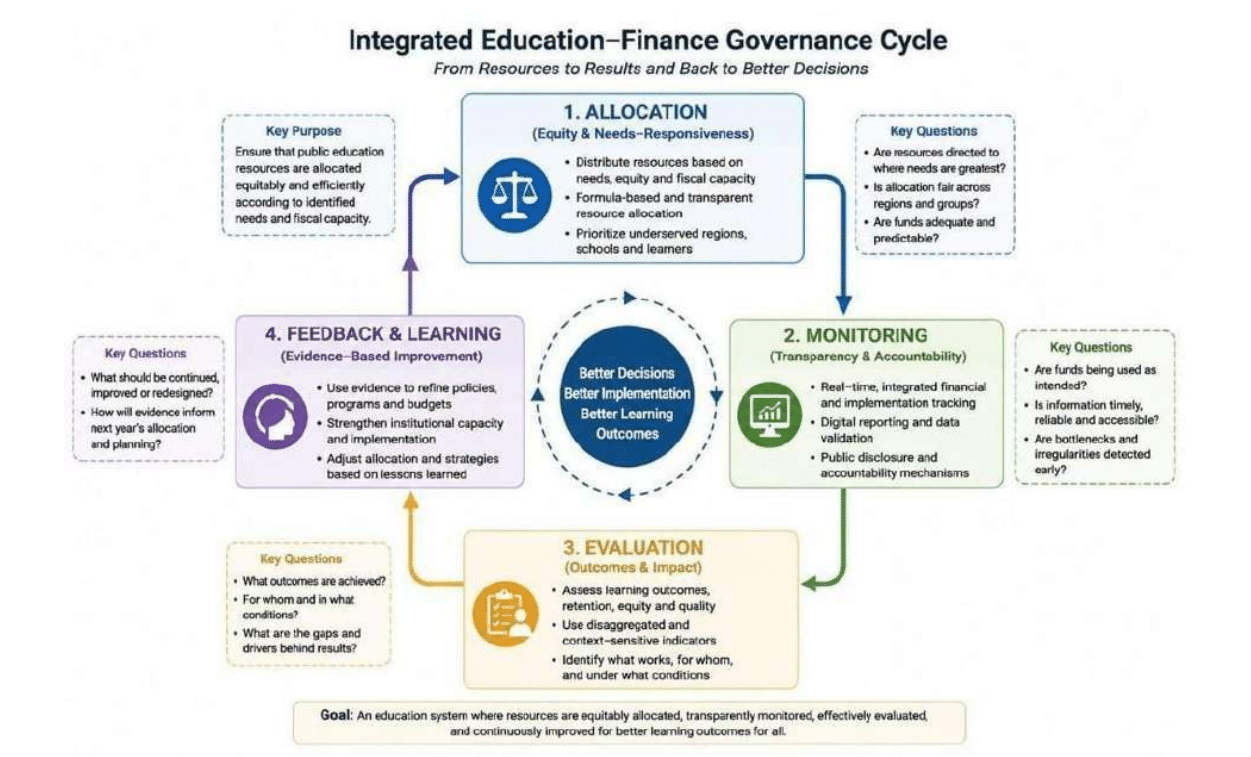
The findings show that the problem in the management of education finances is linked to allocation, monitoring and evaluation. The recommendations below aim to address these shortcomings in a more responsive, integrated and result-oriented governance framework.
- Needs-based and fiscally responsive allocation
- Integrated Digital monitoring
- Outcome-oriented evaluation
- Proposed Integrated Governance Model
Source: Author’s synthesis based on the findings of the study and comparative evidence.
Limitation and Directions for Future Research
This study draws on descriptive statistics, audit review and non-probability samples of 57 respondents skewed towards the 18-30 age group. It can identify patterns of associated and illustrated governance gaps, but it cannot establish casual relationships between specific administrative failure and learning outcomes, nor can it generalize confidently beyond states and cases examined; these are structural limits of the design, not gaps further analysis of the same data could resolve. By contrast, three specific questions are better framed as directions for further work rather than fixed limitation:(1) a dedicated feasibility and costing study, benchmarked against PFM’s phased national rollout, to establish implementation viability for an education-specific system;(2) a structured weighting exercise(e.g., Delphi Elicitation or stakeholder consultation) to establish relative priority among proposed evaluation indicators; and (3) quasi-experimental or panel-data research to test the casual pathway this study can only describe associatively. The integrated governance framework proposed here should accordingly be read as a conceptual synthesis grounded in available evidence, intended to guide posting and further validation, rather than as an evidence-tested policy design ready for direct adoption.
CONCLUSION
This study examines the governance of public education expenditure in India, emphasizing that educational efficiency depends not merely on the volume of expenditure but on how resources are allocated, monitored, and evaluated. The findings indicate that persistent inefficiencies arise largely from institutional and governance weaknesses rather than financial inadequacy. Existing allocation mechanisms often insufficiently account for variations in educational needs and fiscal capacity across states and districts. Monitoring is frequently undertaken after implementation, limiting the scope for timely corrective action, while evaluation frameworks do not consistently establish a clear link between expenditure and measurable student learning outcomes.
To address these gaps, the study proposes an Integrated Governance Framework for Education Expenditure, connecting needs-based allocation, digital monitoring, and outcome-oriented evaluation through a continuous feedback mechanism. Under this framework, educational needs guide resource distribution, digital monitoring strengthens transparency and accountability, and evaluation evidence informs subsequent policy and allocation decisions. Comparative experiences, including South Korea and Punjab, suggest useful principles but should be adapted rather than directly replicated given India’s institutional and regional diversity.
Further state- and district-level research and pilot studies are therefore required to assess the framework’s effectiveness before wider adoption.
REFERENCES
- Ahmad, A., Ahmad, A., & Gangwar, J. D. (2026). Public expenditure on higher education in India: A time-series regression analysis of budget trends, utilization, and policy implications. International Journal of Management Trends: Key Concepts and Research, 5(1), 6–21. https://doi.org/10.58898/ijmt.=v5i1.06-21
- Annual Status of Education Report Centre. (2024). Annual status of education report (Rural) 2023: Beyond basic ASER Centre. https://asercentre.org/aser-2023-beyond-basics/
- Australian Government Department of Education. (2026). The schooling resource standard (SRS). Australian Government. https://www.education.gov.au/school-funding/schooling-resource-standard-srs
- Bose, S., Ghosh, A., & Sardana, S. (2017). Resource requirement for Right to Education: Normative and real estimates (Working Paper No. 191). National Institute of Public Finance and Policy. https://www.nipfp.org.in/publications/working-papers/1792/
- Comptroller and Auditor General of India. (2017). Performance audit report on Sarva Shiksha Abhiyan in the Union Government (Report No. 23 of 2017). Government of India. https://cag.gov.in/en/audit-report/details/32414
- Comptroller and Auditor General of India. (2019). State finances audit report for the year ended 31 March 2018: Government of Odisha (Report No. 1 of 2019). Government of Odisha. https://cag.gov.in/en/audit-report/details/54832
- Comptroller and Auditor General of India. (2020). State finances audit report for the year ended 31 March 2019: Government of Jharkhand (Report No. 3 of 2020). Government of Jharkhand. https://cag.gov.in/en/audit-report/details/57129
- Comptroller and Auditor General of India. (2024a). State finances audit report for the year ended 31 March 2023: Government of Bihar. Government of Bihar. https://cag.gov.in/en/audit-report/details/119854
- Comptroller and Auditor General of India. (2024b). State finances audit report for the year ended 31 March 2023: Government of Madhya Pradesh. Government of Madhya Pradesh. https://cag.gov.in/en/audit-report/details/120412
- Daimary, P. (2025). Operational expenditure vs. capital creation in public school funding. Journal of Public Budgeting & Educational Finance, 12(1), 88–104. https://doi.org/10.1016/j.jef.2024.100142
- Department of Finance Canada. (2025). Equalization program overview. Government of Canada. https://www.canada.ca/en/department-finance/programs/federal-transfers/equalization.html
- Govinda, R., & Bandyopadhyay, R. (2010). Overcoming deprivation and disempowerment: Poverty and elementary education in India. National University of Educational Planning and Administration. https://www.create-rpc.org/pdf_documents/PTA37.pdf
- Jaiswal, D., Sharma, P., & Kumar, R. (2014). Governance failure and fund utilization in elementary education: A study of Sarva Shiksha Abhiyan. Journal of Educational Planning and Administration, 28(4), 311–329. https://www.niepa.ac.in/jepa.aspx
- Kaur, H. (2021). Financial management and institutional bottlenecks in Indian education governance. Indian Journal of Public Administration, 67(2), 145–158. https://doi.org/10.1177/00195561211021584
- Kingdon, G. G. (2014). The political economy of education in India: Teacher unions, governance, and learning outcomes. Comparative Education Review, 58(2), 231–262. https://doi.org/10.1086/675530
- Ministry of Education. (2011). Sarva Shiksha Abhiyan: Framework for implementation. Ministry of Human Resource Development, Government of India. https://www.education.gov.in/ssa-framework
- Ministry of Human Resource Development. (2020). National education policy 2020. Government of India. https://www.education.gov.in/sites/upload_files/mhrd/files/NEP_Final_English_0.pdf
- NITI Aayog. (2026). Evaluation study on foundational literacy and numeracy (FLN) and educational governance outcomes. Government of India. https://www.niti.gov.in/reports-and-publications
- Organisation for Economic Co-operation and Development. (2020). The once-only principle: Implementing digital government architectures. OECD Publishing. https://doi.org/10.1787/23078499
- Organisation for Economic Co-operation and Development. (2023). Interoperability and data governance in education systems. OECD Education Policy Perspectives. https://doi.org/10.1787/5jxy4d70x034-en
- Patel, R. (2026). Post-pandemic trends in public education financing in India: A five-year review. Asian Development Policy Review, 14(1), 15–33. https://doi.org/10.18488/journal.107.2026.141.15.33
- Pressman, J. L., & Wildavsky, A. (1973). Implementation: How great expectations in Washington are dashed in Oakland. University of California Press. https://www.ucpress.edu/book/9780520053311/implementation
- Rahimi, M., Schmidt, W., & Thomas, S. (2019). Private funding, parental contributions, and resource equity in Australian public schools. Australian Journal of Education, 63(3), 274–291. https://doi.org/10.1177/0004944119880614
- Sinha, J. K. (2025). Efficiency of public education expenditure in India: A stochastic frontier analysis of state-level secondary school completion. Journal of Behavioural Economics and Policy, 1(2), 45–67. https://doi.org/10.55121/jbep.v1i2.1205
- Johnson, D., & Parrado, A. (2021). Assessing the assessments: Taking stock of learning outcomes data in India. International Journal of Educational Development, 84, Article 102409. https://doi.org/10.1016/j.ijedudev.2021.102409