AUTHORS:
AADYA SINGH, AARNA FAUZDAR, BHAVIKA JAIN, KANISHKA, KHUSHAL GOEL, MAXIMILIEN DESQUIENS MEKHLOUFI, NISHA CHAUDHARY, NIVEDITA JAIN, RITIKA NAIR, SIMRAN MAVI
ABSTRACT
This study examines the potential of United Nations General Assembly (UNGA) voting patterns to identify emerging geopolitical alignments and communities in contemporary international relations. Using roll-call voting data, the research treats voting similarity as an indicator of states’ revealed foreign policy preferences and explores how these patterns have evolved beyond traditional Cold War alliance structures. Particular attention is given to the emergence of informal coalitions, BRICS expansion, strategic hedging, and shifting alignments among major and regional powers. The study proposes network analysis as a framework for identifying clusters and emerging geopolitical communities based on dyadic voting similarities. Bangladesh is considered an illustrative case to examine changing patterns of proximity with India, China, Russia, and the United States. However, the research also distinguishes between voting similarity, political alignment, and formal geopolitical alliances. External pressure, foreign aid, diplomatic relations, strategic abstention, and absence from votes may influence UNGA behaviour, limiting its ability to capture underlying preferences. Thus, UNGA voting data are best understood as a valuable empirical indicator of political proximity rather than definitive evidence of geopolitical alliances.
1. INTRODUCTION
The structure of international relations and geopolitics has traditionally been understood through diplomacy, treaties, defence pacts, and declared foreign or security doctrines. Yet the nature of international relations is so dynamic and ever-changing that the contemporary geopolitical landscape is increasingly based on issue-based coalitions and alliances that are fluid and often form, realign, or disintegrate in response to specific crises, economic interests, ideological currents, or the realpolitik considerations of war, survival, and self-help (Steinert& Weyrauch, 2024). There has been a growing informality and backdoor diplomacy in interstate cooperation, posing challenges for scholars and policymakers in identifying how these emerging alliances might manifest as geopolitical blocs in the global order. The United Nations General Assembly (UNGA) offers a valuable resource in this matter.
The UNGA has recorded roll-call votes since 1946, producing one of the longest and most continuous data sets on state-level foreign policy behaviour, which aids in identifying emerging geopolitical alliances. Therefore, this paper employs a systematic, conceptual qualitative study of UNGA voting patterns using network analysis (in which states are represented as nodes and voting similarity as edges). Using this data as a proxy for underlying global dynamics and diplomatic engagement, we can highlight the political proximity and policy inclinations of states through their strategic voting on various resolutions like disarmament, human rights, trade, etc. (Khan, 2020).
Our primary goal in this research paper is to understand how the composition and structure of geopolitics have been altered by alliance communities-based UNGA voting, as well as, since the end of the Cold War how the geopolitical communities have emerged, endured and realigned (Pauls & Cranmer, 2017). It further aims to study the impact of states on voting patterns to discover the power imbalance between the great powers and the developing nations in international relations.
However, one must be aware that the voting patterns have often been studied in isolation, but they should rather be understood through a multilayer network pattern, keeping in context the contemporary geopolitical realities. The evolution and reorientation of states on specific agendas/ sessions over time should be accounted for. There has been ample analysis on how the voting pattern reflects the policy preferences of the major powers, but there has been limited study of the foreign policies of the developing nations and their exercise of power through voting.
The findings aim to demonstrate the usefulness of analysing the voting communities in the UNGA voting network and estimating their relative influence in geopolitics, which would help in identifying the degree of centrality, closeness or voting similarity while comparing it with the existing theories on alliance formation and international relations theories. Understanding these emerging alliances is critical not only for academic inquiry but also for policymakers to anticipate the shifts in global governance dynamics.
2. LITERATURE REVIEW
A. UNGA Voting, a representation of political alignment and alliances?
The United Nations General Assembly (UNGA) serves as one of the most significant multilateral forums for expressing states’ foreign policy positions and affiliations. Each country represents one vote, and resolutions are usually adopted by a simple majority, or in certain cases, by a ⅔ majority. UNGA votes are roll calls, meaning each representative votes with “yes,” “no,” or “abstain”. The detailed votes of every resolution, from 1946 to 2025, are compiled within the UN digital library.
Even if the resolutions taken under the UNGA are non-binding, contrary to the Security Council, the states’ votes remain a precious dataset, often closely linked to national foreign policies (Bailey et al, 2017). UNGA voting records constitute one of the most reliable sources of empirical evidence for analysing foreign policy preferences, because they capture governments’ revealed positions on a broad range of international issues. Changes in voting behaviour are therefore interpreted as reflecting broader transformations in states’ diplomatic orientations. Moreover, the non-binding nature of UNGA votes makes strategic voting less prevalent, highlighting their reliability (Bailey et al, 2017).
These data have been used by international relations scholars to determine interstate alignments, relying on a wide range of different methods, since the 1950s (Ball (1951); Lijphart (1963); Moon (1985); Vengroff (1976); Russett (1966)…). Nevertheless, recent literature tends to privilege a bidimensional, or a multidimensional, spatial distance model where each State has a conceptualised ideal point. The latter is the specific coordinate position that represents an actor’s (such as a country) most preferred policy or ideological outcome in a defined space. For example, Binder and Payton (2022) used this model, exploiting 500 votes at the UNGA between 2002 and 2011 to calculate the alignment between 3 groups of countries: G7, the BRICS, and the IBSA (India, Brazil, and South Africa). UNGA voting patterns appear critical to assess dyadic similarities between two actors, while looking at their votes on different matters (Adarkwah et al, 2026).
In short, the more two countries tend to vote in unison on shared issues, the more correlated their ideal points are, and the more politically aligned they appear to be on the subject.
However, one key insight remains: the fine distinction between a political alignment and an alliance. The UNGA votes allow us to analyze States behavior from a broader perspective (G7, BRICS and their global ideal points) or a specific issue perspective (colonialism, the Middle East, economic development, nuclear issues and disarmament, and human rights). UNGA voting patterns remain mainly indicators of inter-state political proximity; therefore, such proximity should not automatically be equated with formal alliance ties.
B. Contemporary geopolitical alignment within the UNGA
Geopolitical alignment within the UNGA has been developing hand in hand with changes in the international system, from relatively fixed bipolar alignments during the Cold War era, to a more fluid and overlapping model of cooperation. Whereas Cold War voting has been predominantly influenced by the rivalry between the USA and the USSR, post-Cold War voting has seen a rise in development, sovereignty, human rights and North-South divides. Current research increasingly connects these changes to the transformation of the international system from being bipolar to multipolar, mainly due to the rising power of China and Russia and other emerging powers.
Such shifts become evident from the increasing importance of informal and emergent groups. According to Nurullayev & Papa (2023), members of G77, BRICS, and SCO increasingly tended to vote in favour of the stances shared by China-Russia, whereas NATO members mostly voted along the lines of the US stances. Such a tendency reflects the creation of new voting groups as opposed to fixed geopolitical blocs.
However, current alignments do not need to be based on any economic or institutional relations between countries. According to Steinert & Weyrauch (2024), while studying China’s Belt and Road Initiative (BRI), the authors did not find any significant increase in voting similarity between China and the majority of BRI states, at least in the short term. It shows that states can cooperate economically but have different political positions at the UNGA.
Such a multiplicity becomes especially evident when considering the situation with the Global South. While Draguljić & Anspach (2025) reveal significant voting cohesion of G77 members, they point out substantial differences in the positions of some members of the group. In such a way, modern UNGA alignment becomes increasingly multipolar, flexible, and issue-specific; states form overlapping groups in accordance with their geopolitical and strategic interests.
C. Network analysis and the detection of emerging geopolitical communities
The methodology employed in this study is network analysis, chosen for its enabling capacity to allow systematic investigation at multiple levels of analysis, including nodes, edges, and groups of units of any size. IR scholarship uses this in response to the growing complexity of international systems, allowing it to move beyond the limited traditional dyadic or state-centric methods. This enables tracking and analysing these complexities with ease. Thus, qualitative study is interpretive, where questions arising from analyses like who clusters with whom and voting agreements are treated as evidence of emerging alliances rather than data to be scored.
Existing computational studies of UNGA voting (Macon et al, 2012) are useful as findings that can be qualitatively interpreted to assist in this study. For e.g. the 75th UNGA session (2020-21) grouped states on a spectrum of their “Western Affinity”, suggesting the European states were clustered tightly around Western alignments while countries like Russia or China showed weaker affinity with the non-Western ends. This is the kind of study that employs methods that do not need to run underlying statistics similar to what is being employed in this study. There have been other international organisations where a similar framework has been applied: scholars analysing the overlap between trade partnerships and voting alignment suggesting that economic dependence and diplomacy reinforce each other. There have been qualitative interpretations of arms cooperation partnerships suggesting that ideological and institutional affinity explains which states get drawn into a state’s core versus its periphery.
D. The limits of UNGA voting patterns as a measure of geopolitical alignment
It is critical to assess and nuance the exact accuracy of UNGA voting patterns as a measure of geopolitical alignment. The vote of a country for a UN resolution is admittedly non-binding; however, other factors than political preferences must not be underestimated in the decision-making of a State while voting. Some scholars (Carter & Stone, 2015; Lektzian & Biglaiser, 2023) demonstrate the importance of US foreign aid in the countries’ choice of political alignment with the US on certain resolutions, especially for democracies: “we claim that the pattern arises because democracies are more likely to be punished or rewarded for their votes” (Carter & Stone, 2015). UNGA resolutions carry strong symbolic significance and can be the subject of external pressure, public opinion, or the existence of strong diplomatic ties with certain actors, and might not always represent the State’s real preferred choice for an issue.
Roll call votes are characterised by their simplicity (YES, NO, ABSTAIN), closely looked to assess a State’s preference. Nevertheless, it does not take into account the absence of countries for the vote, which can have a true political meaning (Morse & Coggins, 2024). Between October 2022 and February 2023, the UN voted on two similar resolutions on the Russian-Ukrainian conflict, which registered the almost exact same number of absences (45 in 2022 and 44 in 2023) with countries like Afghanistan, Morocco, or Jordan. Absence appears as a strategic tool for weaker States to counteract geopolitical pressure derived from the control exerted by powerful countries on international institutions. By not being present during the vote, the country might choose not to highlight its preference and to avoid indirect pressure such as the withdrawal of foreign aid or support.
Finally, we have to take a look back to distinct three notions: voting similarity, political alignment, and effective geopolitical alliance. Erik Voeten wrote: “states do not vote on how much they like each other but whether they agree with specific proposals.” (Voeten, 2024). Recent literature tends to highlight the possible bias of some voting similarities that can be overestimated by existing indices (such as the S index), especially when bodies of voting support an issue with large majorities (Benati & Capurri, 2026). The introduction of new measures, similar to the A index, shows that clusters do not revolve around large voting similarities and have to be nuanced. The BRICS, for example, appear to vote similarly on certain issues such as Human Rights, but do not seem to vote conjointly in a general way like a geopolitical alliance or block.
3. RESEARCH GAPS
In the UN voting patterns, abstentions and absences are calculated as general missing; however, the authors themselves flag more nuanced models for the same. This model often works by looking at a single dimension, often always ignoring other factors like border conflict or regional issues. Earlier findings on such cases by Oneal and Russett (1999) and Gartzke (2000) remain irrelevant, as they are no longer considered once temporal dependence is controlled. Research thus relied heavily on agenda -independent preference measures.
The UNGA voting is thoroughly examined through two-mode block modelling as compared to the one-mode approaches; however, solution procedures are distinctively limited to networks of 25×25, thus preventing their application to large-scale data. The proposed VNS heuristic automatically outperforms the existing methods, but it has its own limitations.
Looking at studies highlighting UNGA voting from 1946 to 2025, yet it fails to establish causal bonds between geopolitical factors and voting behaviour. Most of the prior literature focuses on bilateral ties rather than collective non-Western states’ behaviour patterns. The need of the hour is a network analysis with a combination of trade, investment and aid data.
Global Diplomacy Net is one of the world’s first global corpus; it doesn’t cover 40 UN member states. The analysis covers data only up to 2024; it misses longitudinal trends and cross-cultural patterns in diplomatic communication. Combining the corpus with vision models and social media is the need of the hour.
The Crisis Adjusted Divergence Index doesn’t measure the direction of threats; thus, it fails to differentiate between rivalry-driven divergences from structural divergence. From 2015 to 2024, it covered only 3 BRICS member states, and it has not been tested in high commitment settings like NATO or the EU.
The biggest problem while highlighting research gaps is that most studies have analysed UN voting patterns in isolation. The need of the hour is to couple these UN voting patterns along with hard IR politics like defence or bilateral trade, thus converting it into a multilayer network pattern.
4. RESEARCH QUESTIONS AND OBJECTIVES
-
Research Questions-
- How have voting-based clusters (alliances, communities) among UN member states changed in terms of composition and structure from UNGA sessions since the end of the Cold War to date?
- How do geopolitical voting communities emerge, persist and reconfigure when the pattern of UN General Assembly voting is studied session by session rather than statically?
- To what extent does the measure of centrality and influence of states in the network analysis of UNGA voting patterns reveal the asymmetry of power between major and developing countries in the voting pattern?
-
General objective-
Conceptual study on how the network analysis of the UN General Assembly voting pattern may be employed to identify, trace, and understand the emergence and evolution of geopolitical alliances among member states.
-
Specific Objectives
- To construct the structure of the UNGA voting network using nodes (states) and edges (voting similarities) and identify some of the network measures such as degree, centrality, betweenness, and closeness.
- To detect voting communities in the UNGA voting network and to trace the way they emerge, persist or reconfigure from one UNGA session to another.
- To estimate the relative influence of major and developing countries in the voting network and to compare it with the existing theories on alliance formation.
4. CONCEPTUALIZING NETWORK ANALYSIS IN GEOPOLITICAL RESEARCH (RESEARCH METHODOLOGY)
Research Design
The present study adopts a conceptual qualitative research design to examine the application of Network Analysis (NA) in understanding relationships among countries in international relations. It is an exploratory and descriptive study that examines patterns of interaction, cooperation, and geopolitical relationships using existing literature and secondary sources. Network analysis is a methodological approach that examines relationships among interconnected actors within a system. In this framework, actors are represented as nodes, while their relationships are represented as edges or links.
Nature of Research
The nature of this research is qualitative and conceptual. Rather than testing hypotheses through experiments or surveys, the study focuses on understanding patterns of interaction and cooperation in global politics. It explores how network analysis can be applied to study diplomatic behaviour, geopolitical alliances, and evolving international relationships. International relations are increasingly interconnected through diplomacy, trade, security cooperation, and multilateral institutions, making network analysis a useful framework for understanding these connections.
Sample & its Technique
The study does not involve primary sampling or selection of human participants. The unit of analysis consists of countries and their interactions within international networks. The study focuses on countries represented in the United Nations General Assembly (UNGA), which consists of 193 Member States. Secondary datasets, particularly UNGA voting records, are used to analyse similarities in voting behaviour and diplomatic preferences among countries.
Data Collection Tool
The study relies entirely on secondary data collected from scholarly books, peer-reviewed journal articles, reports published by international organisations, and official online sources. A major source of data is the United Nations General Assembly voting records, particularly the Voeten UN General Assembly Voting Dataset, which covers voting records from 1946 onwards. These records provide valuable information for examining similarities and differences in countries’ voting behaviour.
Variables Used
The study does not involve traditional independent, dependent, or control variables as it is conceptual in nature. However, in the network analysis framework, countries are represented as nodes, while similarities in voting behaviour represent connections or edges. Key network concepts such as degree, centrality, betweenness, closeness, and community detection are used to understand the position and relationships of countries within the network.
Ethical Considerations
Since the research is based on secondary data and publicly available sources, it does not involve direct interaction with human participants. The study follows ethical research practices by using credible academic sources, properly acknowledging existing literature, and maintaining accuracy in interpretation of available data.
Limitations
The study is conceptual in nature and does not involve primary data collection or statistical testing. It depends on existing academic literature and official documents to explain the relevance of network analysis in international relations. Although it does not develop or test a new network model, it provides a structured understanding of how network analysis can be applied to examine evolving geopolitical relationships through UNGA voting patterns and offers a foundation for future empirical research.
6. DATA SOURCES AND PROCESSING
Data Source
This study relies on United Nations General Assembly (UNGA) voting records as the primary source of empirical data for identifying emerging geopolitical alliances. The UNGA represents the most inclusive multilateral decision-making body in international politics, with every member state formally expressing its position on resolutions concerning international peace and security, human rights, development, international law, and numerous other global issues. Since these votes constitute official statements of state preferences, they provide a consistent and observable measure of diplomatic behaviour and foreign policy orientation of states.
The dataset used in this research covers the period from 1946 to 2025, encompassing the first seventy sessions of the United Nations General Assembly. It contains 738,764 individual country votes cast on 5,270 resolutions, involving 200 countries and territories. For each voting record, the dataset includes the Assembly Session, Resolution Identification Number, State Code, State Name, and the recorded vote, which is classified as Yes, No, or Abstain. This extensive temporal and geographical coverage enables the study to examine both long-term continuity and short-term changes in diplomatic alignments across different historical periods.
Dataset Description
The dataset is organised as a structured relational database in which each row represents one country’s vote on a single General Assembly resolution. The principal variables include the Assembly Session, Vote Identification Number, Resolution, State Code, State Name, Membership Status, and Vote Outcome. Voting outcomes are encoded into three mutually exclusive categories: Yes, Abstain, and No.
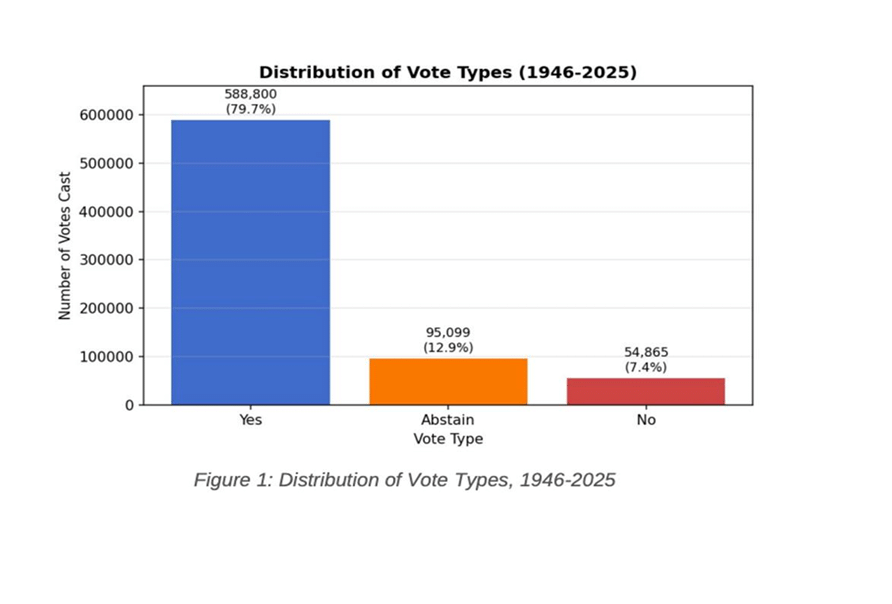
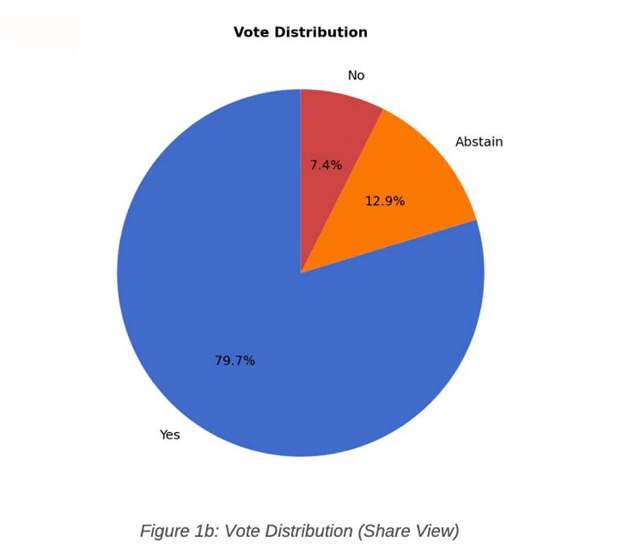
An analysis of the voting data indicates that ‘Yes’ votes account for the vast majority of decisions in the United Nations General Assembly, comprising 79.7% of all recorded votes. In comparison, ‘Abstain’ votes represent 12.9%, while ‘No’ votes make up only 7.4%. This distribution reflects the Assembly’s consensus-oriented decision-making process, where resolutions typically undergo extensive negotiations before being brought to a formal vote. As a result, most proposals receive broad support, and direct opposition remains relatively limited. Nevertheless, the predominance of affirmative votes should not be interpreted as evidence of complete international consensus. Rather, it also illustrates the influence of pre-vote consultations, diplomatic bargaining, and amendments that shape resolutions before they are formally considered by member states.
Since every member state participates within the same institutional setting, the dataset provides a standardised basis for comparing foreign policy preferences across countries and across time. This data makes it possible to investigate the emergence, persistence, and transformation of geopolitical alignments.
Data Cleaning
Before analysis, the dataset underwent a systematic validation process to ensure its accuracy, consistency, and suitability for network modelling. An independent verification was conducted to confirm the integrity of the data before any analytical procedures were undertaken.
The validation process confirmed that the dataset contained 738,764 observations distributed across seven variables, with no missing values identified in any column. Duplicate records were also absent, ensuring that each observation represented a unique country-resolution combination. To maintain consistency in country identification, state codes were cross-checked against state names, confirming a one-to-one correspondence and eliminating the possibility of duplicate country identities arising from alternative spellings or naming conventions.
Assembly session numbers were verified to range continuously from Session 1 to Session 70 without interruption, while voting outcomes were confirmed to contain only the three valid response categories representing Yes, Abstain, and No. Furthermore, the variable labelled member was found to contain a constant value across all observations, indicating that it contributed no analytical information.
Data transformation for Network Analysis
Following data validation, the cleaned voting records were transformed into a format suitable for network analysis. While the original dataset records individual voting decisions, network analysis requires the representation of relationships between states. Consequently, the primary objective of data processing was to convert individual voting behaviour into measurable patterns of interstate similarity.
The first stage involved grouping all votes cast by each country during a particular Assembly session. Each country’s voting profile was therefore represented as a sequence of voting decisions across all resolutions considered during that session. Countries were then compared pairwise to determine the degree of similarity in their voting behaviour. Similarity was assessed by comparing how frequently two countries cast identical votes on the same resolutions. States that consistently voted alike were interpreted as exhibiting stronger diplomatic alignment, whereas frequent disagreement indicated weaker alignment.
These pairwise similarity values were subsequently organised into an adjacency matrix, in which both the rows and columns represent member states. Each cell within the matrix records the strength of voting similarity between a pair of countries. This matrix serves as the mathematical foundation for network construction.
Using the adjacency matrix, a weighted network was generated in which each country is represented as a node, and the connections between countries are represented as edges. The weight assigned to each edge reflects the degree of similarity between the voting behaviour of the connected states. Stronger edge weights indicate higher levels of diplomatic agreement, while weaker weights represent more divergent voting patterns.
|
Countries |
USA |
GBR |
FRA |
RUS |
CHN |
IND |
PAK |
ISR |
BRA |
ZAF |
|
USA |
1.0 |
0.53 |
0.48 |
0.19 |
0.12 |
0.17 |
0.16 |
0.86 |
0.2 |
0.16 |
|
GBR |
0.53 |
1.0 |
0.92 |
0.5 |
0.45 |
0.47 |
0.46 |
0.53 |
0.51 |
0.51 |
|
FRA |
0.48 |
0.92 |
1.0 |
0.51 |
0.46 |
0.48 |
0.47 |
0.48 |
0.53 |
0.52 |
|
RUS |
0.19 |
0.5 |
0.51 |
1.0 |
0.75 |
0.65 |
0.67 |
0.22 |
0.59 |
0.65 |
|
CHN |
0.12 |
0.45 |
0.46 |
0.75 |
1.0 |
0.77 |
0.85 |
0.17 |
0.72 |
0.79 |
|
IND |
0.17 |
0.47 |
0.48 |
0.65 |
0.77 |
1.0 |
0.84 |
0.21 |
0.75 |
0.8 |
|
PAK |
0.16 |
0.46 |
0.47 |
0.67 |
0.85 |
0.84 |
1.0 |
0.21 |
0.76 |
0.83 |
|
ISR |
0.86 |
0.53 |
0.48 |
0.22 |
0.17 |
0.21 |
0.21 |
1.0 |
0.25 |
0.19 |
|
BRA |
0.2 |
0.51 |
0.53 |
0.59 |
0.72 |
0.75 |
0.76 |
0.25 |
1.0 |
0.84 |
|
ZAF |
0.16 |
0.51 |
0.52 |
0.65 |
0.79 |
0.8 |
0.83 |
0.19 |
0.84 |
1.0 |
Table 4.1: The table above shows the UNGA voting-similarity adjacency matrix for ten representative member states (2016–2025). Each cell gives the share of resolutions where the row and column countries cast identical votes, ranging from 0 (complete divergence) to 1 (identical behaviour); diagonal values equal 1 by definition, since every country agrees perfectly with itself.
On this 10-country slice, it would recover three clusters cleanly: (USA, ISR), (GBR, FRA), and (RUS, CHN, IND, PAK, BRA, ZAF) as one loosely-connected Global South mass, with China–Pakistan (0.85) and Brazil–South Africa (0.84) as the tightest sub-pairs inside it.
Temporal Network Construction
Since the principal objective of this research is to identify emerging geopolitical alliances, the analysis adopts a temporal rather than a static perspective. Instead of constructing a single network encompassing the entire 1946–2025 period, separate networks are generated for individual General Assembly sessions. This approach allows changes in diplomatic relationships to be observed across time rather than assuming that alliance structures remain constant.
Summary
The UNGA voting dataset provides a comprehensive and reliable empirical foundation for analysing geopolitical alignments over nearly eight decades. Following systematic validation and data cleaning, individual voting records are transformed into weighted interstate networks that capture patterns of diplomatic similarity. By constructing separate networks for successive Assembly sessions, this study is able to examine the emergence, continuity, and transformation of geopolitical alliances over time. This processing framework establishes the methodological foundation for the subsequent application of network analysis and community detection techniques to identify evolving patterns of international cooperation and alignment.
7. DATA ANALYSIS AND IDENTIFYING EMERGING ALLIAINCES
Background
Studying the interactions of member states across periods and different issues helps reveal the changes in behaviour that may not be identifiable by observing individual processes and resolutions of the UNGA, which is otherwise seen as a passive arena for political interactions between sovereign states. In the earliest years of UN, the term “automatic majority” was coined, referring to the majority votes mobilised by the US-aligned bloc in the General Assembly. Heavily outnumbered, the USSR relied on the Security Council veto to check Western Initiatives. (Ball, 1951). This strife continued until 1955, when a package deal admitted 16 new member states, which led to the dilution of bloc politics, which collapsed further across the 1960s as decolonisation shaped the assembly’s future. The landmark resolution 1514 (1960) sponsored by a coalition of forty-three Afro-Asian states and the 1961 Belgrade Summit, laying the foundation for the Non Aligned Movement, signalled the emergence of a new bloc centred on non-alignment and anti-colonialism rather than siding with either side in the Cold War, thus outnumbering the Western blocs. This is visible quantitatively when the agreement rates among Western states fell to roughly ten points across the 1970s from 85% under Kennedy and Johnson and further by twenty points in the 1990s, indicating the weakening of the Western alliances. The 1991-2000 period, with the dissolution of the USSR, saw the emergence of the North-South developmental cleavage as a new structure of the Assembly.
Identified Alliances
Analysing the similarity matrix (2016-2025) against history helps understand the alliances that have persisted and those which are giving way to something new. The GBR-FRA pairing (0.92) is the strongest surviving dyad of the Cold War era. This entails a bloc that has changed little in its ways but experiences gradual decline in its position of influence within the UNGA. The RUS-CHN-IND PAK-BRA-ZAF is another strong network identified with CHN-PAK (0.85) and BRA-ZAF (0.84) as the strongest links. This network is understood as a descendant of the NAM/Afro-Asian bloc now organised around the North-South developmental axis. A unique observation derived from the matrix is the USA-ISR dyad standing at 0.86. This showcases a link that is neither a descendant of Cold War politics nor part of the Global South bloc.
The origins of this link can be dated back to the 1970s resolution “Zionism is a form of Racialism”, where both the USA and ISR first voted as an isolated pair. Arising as an aftermath of the 1967 Six Day War Israeli victory. This led the Arab Nations to use their oil and political leverage over the Western nations. They fused with the Afro-Asian bloc and the Soviet Union, which saw this as an opportunity to project the West as defenders of imperialism and racism. Voeten’s dimensional analysis of Assembly voting corroborates this study that on the dominant East-West axis, the UK, France, the US and Israel occupy the four most extreme Western positions, and that the US has drifted away from the Western nations since the Cold War era (Voeten, 2000). The USA-ISR dyad is thus simply not a pro-Western bloc but one that has increasingly diverged from the West it was part of.
Why the USA-ISR Alliance Emerged and Persists
Four explanations have recurred in the literature. The most familiar argument for this “special relationship” attributes it to *regular lobbying* by AIPAC, the Conference of Presidents, etc., which function less as persuaders of the executive but more as rewarders and punishers in line with policy discourse. (Mearsheimer & Walt). A second is associated with the much-debated reason put forth by Slater, locating the tie in religious and cultural affinity: Christian Zionism, Holocaust and a shared settler- colonial self-perception that transformed the Jewish race from outsiders to insiders in American politics. Third, America treats Israel as a strategic asset, especially after the 1967 victory over the Arab states, thus identifying it as a pillar of Middle East strategy reinforced by convergent ideas on counterterrorism against Hamas and allied actors. Lastly, identifying the gap between elite and public preference: survey data showing three-quarters of Americans do not favour either side in the conflict Mearsheimer, J. J., & Walt, S. M, 2009). Suggesting that it is sustained by organised interests of Congress and less by mass sentiments.
8. DISCUSSION
GEOPOLITICAL INTERPRETATION AND SPECIFIC ISSUE NUANCE
Since the UN’s founding in 1945, General Assembly voting records have tracked shifts in international politics. Beyond state preferences, these patterns reveal geopolitical alignments, ideological divisions, regional cooperation, and changes in global power balances. Spanning resolutions from 1946 through 2025, the dataset enables analysis of almost eight decades of alignment, with interpretation extending into 2026’s geopolitical landscape.
1. The Cold War Era (1946–1991)
UN voting during this period was bipolar, splitting between the US-led Western bloc and the Soviet-led Eastern bloc, reflecting ideological competition between capitalism and communism more than issue-specific cooperation. NATO members voted closely with the United States, while Warsaw Pact states aligned with the Soviet Union. The emergence of the Non-Aligned Movement created a third grouping of states that pursued strategic independence, voting according to anti-colonial, developmental, and sovereignty-related concerns rather than bloc allegiance.
2. Post-Cold War Transition (1991–2000)
The Soviet collapse weakened the East-West divide. New voting communities formed around democratisation, humanitarian intervention, economic globalisation, peacekeeping, and human rights. Eastern European states shifted toward Western alignment as they pursued NATO and EU integration, while developing nations continued cooperating on trade and sovereignty issues, producing more complex and less rigidly ideological voting networks.
3. Multipolarity and Emerging Powers (2000–2015)
The international system moved gradually from unipolarity toward multipolarity. China, India, Brazil, South Africa, and Russia coordinated positions on economic governance, climate negotiations, development financing, and sovereignty. The formation of BRICS strengthened alternative diplomatic coalitions visible in voting data, with network analysis revealing denser developing-country communities and growing divergence from Western democracies on several issues.
4. Contemporary Geopolitics (2016–2026)
This decade has grown increasingly fragmented amid strategic competition among the US, China, and Russia. Major events COVID-19, intensifying US-China rivalry, the Russia-Ukraine conflict, energy security concerns, technological competition, and AI governance debates- have shaped voting behaviour. Rather than fixed blocs, contemporary networks reveal issue-specific coalitions: states may cooperate on climate while disagreeing on security or align economically while diverging on human rights. Middle powers such as India, Türkiye, Indonesia, Brazil, Saudi Arabia, and South Africa demonstrate strategic autonomy, acting as bridging nodes connecting otherwise distinct geopolitical communities depending on national interest.
5. Issue-Specific Voting Patterns
- Peace and Security: Reflects military alliances and regional strategic interests.
- Human Rights: Divisions emerge between liberal democracies and states emphasising sovereignty and non-interference.
- Climate and Sustainable Development: Developing countries and Small Island Developing States often form cooperative clusters.
- Economic Development and Trade: Reveals North-South divisions, with G77 and BRICS supporting reform of global economic governance.
- Decolonisation: African, Asian, and Latin American states have historically shown high voting cohesion on anti-colonial resolutions.
6. Role of Regional Organisation
The EU demonstrates high voting cohesion through coordinated foreign policy. The African Union often votes collectively on development and decolonisation issues, while ASEAN, the GCC, and CELAC show varying coordination depending on the issue, as internal political and economic differences limit complete unity.
7. Interpreting Network Communities
High voting similarity shouldn’t be automatically read as formal alliance—it may reflect shared preferences on specific issues rather than enduring partnerships. States can vote differently at the UN while maintaining strong bilateral trade or defence ties. Voting networks are best interpreted alongside trade flows, military agreements, regional memberships, aid relationships, and diplomatic engagement. Temporal analysis distinguishes stable, persistent alliances from short-term coalitions responding to specific crises. Overall, UN voting from 1946–2026 traces the transformation from Cold War bipolarity through post-Cold War internationalism toward an increasingly multipolar, issue-based global order.
9. COMPARATIVE ANALYSIS
The existing research points to a broad conclusion: UN General Assembly (UNGA) voting is useful for studying patterns of international political alignment, but voting similarity alone does not provide a complete picture of geopolitical alliances. What differs across the approaches is the level at which alignment is understood. Some studies focus on changes in individual state preferences, while others examine recurring relationships among groups of states. Network-based approaches extend this further by treating states as part of a wider structure rather than as isolated actors.
One important distinction is between preference and alignment. Similar voting behaviour can indicate that two states hold comparable positions on particular issues, but this does not necessarily mean that they share a broader strategic relationship. States may vote together because of regional interests, economic considerations or a specific international crisis, while maintaining different positions on other questions. This limitation becomes more visible when voting is examined over longer periods, since relationships that appear stable in aggregate may change substantially across issues and time. The literature therefore supports the use of UNGA voting as an indicator of proximity, but also suggests caution in treating that proximity as evidence of an alliance.
A second difference concerns the unit of analysis. Bilateral approaches are useful for identifying strong relationships between particular countries, but they can miss broader patterns that become visible only when several states are analysed together. Network analysis addresses this limitation by identifying clusters or communities formed through repeated similarities in voting behaviour. The work on affinity communities and two-mode blockmodeling demonstrates how such methods can reveal structures that are difficult to detect through country-pair comparisons alone. At the same time, some network techniques involve methodological and computational constraints when applied to larger datasets, which limits their practical use for analysing the full UNGA membership over extended periods.
The treatment of abstentions and absences presents another point of difference. Conventional voting measures often treat non-participation as missing information, whereas the literature increasingly recognises that abstention and absence may carry different political meanings. An abstention can communicate disagreement without an explicit opposing vote, while an absence may sometimes reflect strategic avoidance of a position. Ignoring these distinctions can therefore affect the structure of the resulting network and, in turn, the interpretation of political alignment. This is particularly important for studies attempting to identify emerging rather than already established geopolitical communities.
Taken together, these differences reveal an important limitation in the existing approaches. UNGA voting can show which states tend to move together, and network analysis can show how those relationships are organised, but neither necessarily establishes why those relationships emerge or whether they are durable. The research gap identified by the present study follows directly from this limitation. Geopolitical alignment is shaped not only by diplomatic voting but also by trade, investment, aid, defence cooperation and regional security concerns. These relationships can reinforce voting convergence, weaken it, or produce different patterns across issues.
The present study therefore builds on the strengths of earlier approaches while addressing their separation. It treats UNGA voting as one layer of a broader geopolitical relationship and focuses on how networks change over time. This makes it possible to distinguish temporary issue-based convergence from more sustained patterns of alignment and, ultimately, to identify whether emerging voting communities reflect wider shifts in the structure of international relations.
10. POLICY IMPLICATIONS AND GLOBAL ORDER OUTLOOK
Our mapping of voting data points to a stark reality that traditional multilateralism prefers to ignore: the current framework for global technology governance is fundamentally broken. For decades, international relations relied heavily on sweeping consensus within the United Nations General Assembly. Today, however, that machine moves far too slowly. Political polarisation, bureaucratic friction, and the relentless pace of software innovation have paralysed decision-making. As Voeten et al. demonstrated through quantitative voting alignment metrics, static political blocs no longer explain how nation-states navigate digital policy. Countries frequently cross traditional geopolitical lines depending on the specific technology or trade issue under debate. The old consensus model is therefore increasingly ineffective. Global leaders should abandon the unrealistic goal of a single top-down international technology agreement and instead pursue modular, issue-specific regulatory frameworks that allow nations to protect their digital interests while maintaining broad global cooperation across diverse jurisdictions. This shift would better reflect the fluid coalitions already visible in digital trade and standards negotiations.
The immediate operational challenge is resolving what Gertz and Maas term the AI governance regime complex. International relations are currently crowded with overlapping non-binding guidelines, regional laws, and competing policy initiatives from the UN, ITU, OECD, and G7. This fragmented regulatory patchwork creates significant loopholes across borders and actively encourages major technology corporations to engage in strategic regulatory arbitrage by operating where rules are weakest and enforcement is limited. Addressing this through a single comprehensive global AI treaty is unlikely to succeed because national disagreements would create perpetual diplomatic gridlock. A more practical approach involves developing robust cross-institutional interoperability protocols. Policymakers should focus on functional alignment around specific high-risk areas such as algorithmic auditing standards, cross-border data transfer protocols, and dual-use hardware export controls. Combining operational standards with diplomatic oversight offers a much stronger pathway toward rules that function effectively in real-world practice. Without such targeted coordination, the existing regime complex will continue to generate both under- and over-regulation, leaving critical risks unaddressed while stifling beneficial innovation.
More broadly, global power dynamics are undergoing a fundamental structural transformation. Tech politics is no longer simply a binary contest between Washington and Beijing. Power is increasingly decentralising across dynamic regional hubs, driven by the strategic agency of middle powers, directly reflecting the analytical frameworks of Ikenberry and Lim. States such as India, Brazil, the UAE, and Singapore increasingly resist binary, all-or-nothing technological alliances. Instead, they pursue highly calculated strategies of strategic hedging. By leveraging large consumer markets, regulatory independence, and diplomatic flexibility, these states maintain active connections with competing power centres simultaneously. This strategic autonomy enables them to preserve vital trade, capital, and access to critical technologies while protecting their national digital sovereignty and economic resilience. Recognising this behaviour as a durable feature of the system, rather than a temporary anomaly, is essential for any realistic governance design.
Ultimately, effective global technology governance will not emerge from forcing every region into strict ideological alignment. It will depend on establishing a functional, dynamic equilibrium among competing regional power centres. International diplomacy must therefore adapt to this polycentric reality rather than resist it. Policy frameworks that treat middle-power strategic hedging as a stabilising balance-seeking mechanism, rather than an unwanted disruption, will be far better positioned to develop realistic, durable, and sustainable international norms for artificial intelligence across the global system.
11. CONCLUSION
Changing voting Patterns in the United Nations General Assembly (UNGA) suggest wider changes in the international system, moving away from the rigid bipolar structure of the Cold War toward the more flexible and complex structure of the international system today. The presence of changing clusters, cross-regional alliances and bridging states means that today’s geopolitics cannot be explained by fixed alliance structures alone. States are becoming more flexible in their alliances today, aligning with different partners depending on the issue and the geopolitical context.
However, while UNGA voting patterns give insight into international relations, they represent but one aspect of them. Economic interdependence, military collaboration, foreign direct investment and strategic alliances play an equally important role in determining state behaviour without being reflected in voting patterns. In fact, such voting patterns can only be considered evidence for political alignment, not alliances. Future research should address this problem through multilayer network analysis taking into account both political and economic ties and using dynamic and issue-oriented approaches. These research approaches would give a more accurate description of emerging geopolitical structures. Modern international relations are characterised by the emergence of flexible, overlapping and issue-oriented coalitions rather than fixed geopolitical blocks. UNGA network analysis thus offers a valuable means of identifying these evolving patterns and understanding the changing architecture of global power.
REFERENCES
- Mosler, M., & Potrafke, N. (2020). International political alignment during the Trump presidency: voting at the UN General Assembly. International Interactions, 46(3), 481–497. https://doi.org/10.1080/03050629.2020.1719405
- Khan, M. Z. I. (2020). Is Voting Patterns at the United Nations General Assembly a Useful Way to Understand a Country’s Policy Inclinations: Bangladesh’s Voting Records at the United Nations General Assembly. Sage Open, 10(4).https://doi.org/10.1177/2158244020961117
- Steinert, C. V., & Weyrauch, D. (2024). Belt and Road Initiative membership and voting patterns in the United Nations General Assembly. Research & Politics, 11(1).https://doi.org/10.1177/20531680241233784
- Pauls, S. D., & Cranmer, S. J. (2017). Affinity Communities in United Nations voting: Implications for democracy, cooperation, and conflict. Physica A: Statistical Mechanics and Its Applications, 484, 428–439. https://doi.org/10.1016/j.physa.2017.04.177
- Bailey, Strezhnev and Voeten (2017), Estimating dynamic State preferences from United Nations voting data, https://journals.sagepub.com/doi/10.1177/0022002715595700
- Gilbert Kofi Adarkwah, Christopher Albert Sabel & Flladina Zilja (2026), Measuring geopolitics: the promise and limits of UNGA voting data for IB research, https://link.springer.com/article/10.1057/s42214-025-00237-3
- Stefano Benati & Agnese Capurri (2026), The alignment index and its applications to voting at the United Nations General Assembly, https://link.springer.com/article/10.1007/s11135-026-02814-x
- Binder & Payton (2022), With “frenemies” like these: rising power voting behavior in the UN General Assembly, https://centaur.reading.ac.uk/93690/3/02Nov2020frenemies_acceptedsubmission.pdf
- Nurullayev, D., & Papa, M. (2023). Bloc politics at the UN: How other states behave when the United States and China-Russia disagree. Global Studies Quarterly, 3(3), ksad034. https://doi.org/10.1093/isagsq/ksad034
- Draguljić, G., & Anspach, N. M. (2025). Southern solidarity? A mixed-methods analysis of the G77 in the United Nations General Assembly. https://doi.org/10.1093/isagsq/ksaf027
- Macon, K. T., Mucha, P. J., & Porter, M. A. (2012). Community structure in the United Nations General Assembly. Physica A: Statistical Mechanics and its Applications, 391(1), 343–361. https://doi.org/10.1016/j.physa.2011.06.015
- Morse, J. C., & Coggins, B. (2024). Your silence speaks volumes: Weak states and strategic absence in the UN General Assembly. The Review of International Organizations, 19(3), 515–544. https://doi.org/10.1007/s11558-024-09538-3
- Carter, D. B., & Stone, R. W. (2015). Democracy and multilateralism: The case of vote buying in the UN General Assembly. International Organization, 69(1), 1–33. https://doi.org/10.1017/S0020818314000186
- Lektzian, D., & Biglaiser, G. (2023). Sanctions, aid, and voting patterns in the United Nations General Assembly. International Interactions, 49(1), 59–85. https://doi.org/10.1080/03050629.2023.2155151
- Voeten, E., Strezhnev, A., & Bailey, M. (2009). United Nations General Assembly Voting Data. Harvard Dataverse. (Alternatively: Bailey, M. A., Strezhnev, A., & Voeten, E. (2017). Estimating dynamic state preferences from United Nations General Assembly votes. Journal of Conflict Resolution, 61(2), 430-456.)
- Gertz, G., & Maas, M. M. (2020). Managing the AI governance regime complex: Institutional fragmentation and diplomatic avenues. Global Policy / Centre for the Study of Existential Risk.
- Ikenberry, G. J., & Lim, D. J. (2017). China’s emerging institutional statecraft: The Asian Infrastructure Investment Bank and the prospects for international order. Brookings Institution Project on International Order and Strategy.
- Voeten, E. (2024). United Nations General Assembly voting data and analyses. In B. Reinalda & M. Louis (Eds.), Routledge handbook of international organization (2nd ed., pp. 71–82).
- Brusco, M. J., Doreian, P., Lloyd, P., & Steinley, D. (2013). A variable neighborhood search method for a two-mode blockmodeling problem in social network analysis. Network Science, 1(2), 192-210. https:/doi.org/10.1017/nws.2013.5%5d(https:/doi.org/10.1017/nws.2013.5)
- Muğurtay, N., Şirin, K. G., Najafabad, M. H., Kahya, A. T., Yılmaz, F. G., Zouzou, Y., Bahçeci, B., Demir, A., Tosun, D., Müftüler-Baç, M., & Varol, O. (2025). Quantifying global foreign affairs with a multimodal dataset of diplomatic websites. Scientific Data, 12. [https://doi.org/10.1038/s41597-025-06334-5](https://doi.org/10.1038/s41597-025-06334-5)
- Sena, A. B. (2026). BRICS under stress: A crisis-adjusted divergence index for measuring coalition alignment under systemic pressure. Research Square preprint. [https://doi.org/10.21203/rs.3.rs-10480130/v1](https://doi.org/10.21203/rs.3.rs-10480130/v1)
- Gallop, M., & Minhas, S. (2021). A network approach to measuring state preferences. Network Science, 9(2), 135–152. https://doi.org/10.1017/nws.2020.44
- Office of the United Nations High Commissioner for Human Rights. (1960). Declaration on the Granting of Independence to Colonial Countries and Peoples (UNGA Resolution 1514 (XV)). https://www.ohchr.org/en/instruments-mechanisms/instruments/declaration-granting-independence-colonial-countries-and-peoples
- Hammad, F. (2023, November 29). A brief history of the US-Israel “special relationship” shows how connections have shifted since long before the 1948 founding of the Jewish state. USC Dornsife News.https://dornsife.usc.edu/news/stories/brief-history-of-us-isreal-relations/
- Ball, M. M. (1951). Bloc Voting in the General Assembly. International Organization, 5(1), 3–31. doi:10.1017/S0020818300029805
- Mearsheimer, J. J., & Walt, S. M. (2009). Is It Love or The Lobby? Explaining America’s Special Relationship with Israel. Security Studies, 18(1), 58–78. https://doi.org/10.1080/09636410802678031
- Newman, M. E. J. (2010). Networks: An introduction. Oxford University Press.
- United Nations Dag Hammarskjöld Library. (2025). United Nations General Assembly voting data: Resolutions 1 (11 December 1946) to 79/328 (5 September 2025) [Data set]. United Nations. https://digitallibrary.un.org/record/4060887
- Voeten, E. (2013). Data and analyses of voting in the UN General Assembly. In B. Reinalda (Ed.), Routledge handbook of international organization. Routledge.
- Voeten, E., Strezhnev, A., & Bailey, M. (2009). United Nations General Assembly voting data [Data set]. Harvard Dataverse. https://doi.org/10.7910/DVN/LEJUQZ
- United Nations Adjacency Matrix. (2025, December 5). United Nations General Assembly voting data. United Nations Digital Library. Retrieved August 5, 2026, from https://digitallibrary.un.org/record/4060887/files/2025_9_19_ga_voting.csv/