Authors: Tanushree Kashyap, Aparup Das , Sripathi Panditharadhyula Hasini, Nia Chopra, Moonga Palale
ABSTRACT
The global economic architecture has evolved because of disruptions to supply chains, the transition to clean energy, shifting geopolitics, and increasing competition for key minerals, where free trade agreements (FTAs) have gained a new significance, moving away from pure tariffs cut. The focus of this paper is on the connection between India’s macroeconomic growth and its free trade agreements, with a view to the mineral ties it has with African nations. In doing so, we seek to address an obvious void in the literature by bringing mineral diplomacy into the broader scholarly discussion on the economics of trade, investment and growth. This study adopts a mixed-methods design, combining quantitative and qualitative approaches, the study investigates whether such agreements and partnerships enhance India’s industrial security or economic resilience, or have other effects on its macroeconomic dimensions.
Some findings demonstrate that emerging trade arrangements might bolster industrial performance while reducing reliance on a few imported inputs, help meet clean-energy objectives, and open up access to crucial mineral resources. Nevertheless, there are possible negatives involved in transacting on the basis of resources alone, like minimal value added at home, greater environmental degradation, weaker monitoring of standards, and unbalanced profit distribution. Protecting overseas mineral supplies is where two official initiatives – the National Critical Mineral Mission along with Khanij Bidesh India Limited, KABIL – step in, cutting potential weaknesses in logistics paths. Instead of repeating short-term deals, argues the analysis, New Delhi could build stable ties with countries across the continent through training local labour, sharing equipment systems, enforcing environmentally friendly excavation methods at home, then refining received materials before re-exporting or meeting local demands. Strong, enduring links rested on added worth instead of basic movement aim to yield balanced progress between sender and receiver zones alike.
Keywords: Free Trade Agreements (FTAs); India–Africa Trade Relations; Critical Minerals; Macroeconomic Growth; Mineral Diplomacy; Supply Chain Resilience; Sustainable Development.
CHAPTER I
1. Introduction
The architecture of the Global Economy is experiencing a profound transformation. The old order of trade is being upended by a confluence of factors: the global pivot to clean energy, supply chain hiccups and changes in geopolitical alignments. These forces are prompting nations to look at international trade agreements with an eye toward more than just the usual market access. Today’s economic reality means a country’s growth is as much a function of its capacity to forge resilient networks and embed itself in the world economy as it is of what it can produce at home.
Globalization has made the cross-border flow of capital, technology, knowledge and services a given, establishing international trade as the wellspring of innovation and productivity. Consequently, Free Trade Agreements have evolved into something of a strategic necessity. They are no longer confined to the liberalization of tariffs; they are policy tools designed to address investment, regulatory cooperation and the transfer of technology. With the world’s focus turning to sustainable development and economic security, such instruments are indispensable for long term competitiveness.
India is a case in point. The country is making greater use of these accords to serve wider developmental and strategic ends. For India, an FTA is not simply a matter of opening up markets, but of putting the nation in a strong position in the global economy, bolstering its industrial base and ensuring access to the inputs it needs.
As the world embraces clean energy and high-technology solutions, demand for key minerals has increased, positioning Africa at the forefront of arguably the most critical geopolitics of the 21st century. The continent has 30% of the world’s mineral deposits, a share that encompasses an estimated one-third of the planet’s cobalt reserves as well as significant deposits of lithium, manganese, platinum and rare earths, minerals essential for the manufacture of electric vehicles, renewable energy facilities, semiconductors and defence. Africa’s position, therefore, in the supply chains for essential components of modern technologies cannot be overstated.
However, African countries have only a tiny share of the value extracted from these mineral resources, a situation shaped by the colonial legacy and patterns of economic relationships with the developing and developed worlds. The continent’s resources are the subject of an intensified competition between the world’s leading economic powers; China, the US and EU among others, among other forces to capture critical mineral supply.
India’s free trade agreements (FTAs) have expanded rapidly in recent years, aiming to boost trade flows, attract foreign direct investment (FDI), and secure access to critical resources. There is no question of the increasing significance of FTAs, but one might still debate their true effect on India’s macroeconomic growth. The record in existing literature is not uniform; studies point to mixed results. Trade openness and FDI are seen as growth enablers, certainly, but their influence is contingent on the region, sector and institutional setting.
Consider Africa. Home to close to 30 per cent of the world’s critical mineral reserves, the continent has taken on a pivotal role in India’s external strategy. And yet the economic consequences of agreements specific to these minerals are not well defined. What is missing from the current body of work is any real integration of mineral diplomacy into econometric models of trade and growth. For the most part, the academic literature examines FTAs, FDI and trade liberalisation in isolation, and policy papers on critical minerals seldom put a number on the macroeconomic impact.
This study is an attempt to fill that void. Through a mix of quantitative regression and a qualitative review of policy, we look at whether India’s FTAs – with an eye on its African mineral partnerships – have made a statistically meaningful difference to GDP growth. At the same time, the analysis considers how such arrangements underpin industrial security, the energy transition and resilience over the long term.
General Research Question
How do India’s Free Trade Agreements (FTAs), particularly critical mineral partnerships with African countries, affect India’s macroeconomic growth?
Specific Research Questions
- What is the relationship between India’s Free Trade Agreements and its macroeconomic growth?
- How do critical mineral agreements between India and African countries influence India’s trade and investment performance?
- To what extent do critical mineral partnerships with African countries contribute to India’s macroeconomic growth?
CHAPTER II
2. Literature review
Free trade agreements (FTAs) have played an important role in India’s trade policy and have not merely been about tariff liberalization but also strategic resource security, investment and supply chain resilience. The classical theories of international trade have associated free trade agreements (FTAs) with increased trade flows, foreign investment and economic growth. However, recent literature has shown that FTAs are effective only if there is institutional capacity, appropriate sectoral composition, efficient implementation and spatial considerations.
The broader transformation is evident in India’s changing relations with Africa and other strategic partners, especially in sourcing critical minerals that are crucial to industrialization, renewable energy and electric mobility. Non-tariff barriers, continuing trade deficits, regional inequalities and a low level of use of trade agreements still hamper the expected gains from the liberalization. Recent research emphasizes the significance of the geographic distribution of trade gains and infrastructure constraints for the success of free trade agreements (FTAs).
2.1 Theoretical Framework Linking Trade Liberalisation, Free Trade Agreements, and Economic Growth
India’s post-liberalisation trade performance has been debated since the early reform period. Kar (2007) synthesises this debate De Costa (1988) traces a widening commodity trade deficit through the 1970s and early 1980s, while Datt (1996) associates the post-1991 reforms with a narrowing deficit, though reserve accumulation owed more to capital inflows than to current-account improvement. Devereux (1997) links liberalisation to world growth through increasing returns to specialisation, while Brahmananda (1997) emphasises rising capital and labour mobility as reshaping classical trade theory. Singh (1998) instead argues that India’s binding constraint has been domestic supply capacity rather than external demand. Sector studies reinforce a picture of uneven gains: Chand (1999) finds mixed welfare effects across agricultural commodities, and Nag and Ghosh (2003) show liberalisation supporting industrial expansion only under specific conditions. Mohapatra (2015), reviewing India–EU relations, shows that FTA growth effects depend heavily on partner-economy structure – a lesson directly relevant to India’s resource-driven partnerships with Africa, which cannot be modelled on the India–EU template.
Evidences from Africa and other developing areas is also mixed in its conclusions. The trade–FDI–growth nexus has been studied and the studies suggest that FDI contributes more effectively to economic growth when it is accompanied by export-oriented trade policies. Based on data from ECOWAS and SADC, trade openness generally promotes growth but the relationship is often statistically weak and depends on institutional quality and sectoral characteristics (Oloyede, Osabuohien & Ejemeyovwi, 2021). Evidence across countries also suggests that the direction of causality between trade, FDI and growth varies across countries and over time, suggesting that trade liberalisation alone is not sufficient to ensure sustained macroeconomic expansion.
2.2 The Geopolitics, Fractured World Orders, and Securitization of Mineral Value Chains
Modern trade literature is quite blunt: countries are no longer negotiating over money. They’re fighting for safety — especially regarding the things that keep their economies going. Energy security used to be about safe oil shipment routes. It’s about who controls the mining, processing and refining of critical minerals today. Shiquan and Deyi (2022) argue that just-in-time supply chains are no longer good enough. Now governments are on the back foot – hoarding resources, signing targeted mineral deals with a handful of partners, and closing down open, multilateral trade. Singh (2025) goes further and contends that India is not in the driver’s seat. Unless India negotiates better deals, especially for minerals, its industry will be held hostage to outside players, says Singh.
Pandey and Unnikrishnan (2023) identified this gap in their literature focusing on a notable shift in India’s post-2021 agreements from just concentrating on market access, to prioritising the stable supply of strategically important minerals. The Australia – India Economic Cooperation and Trade Agreement was an example given. This Comprehensive Economic Partnership Agreement (CEPA) was designed to let India access Australia’s critical minerals for the clean energy transition, focusing towards securing critical mineral supply chains. Expanding the perspective, the Indian Council of World Affairs (2025) highlighted the growing strategic importance of Africa within the global critical mineral supply chains It noted that Africa possesses approximately thirty percent of the world’s proven critical mineral reserves, while countries such as the Democratic Republic of the Congo (DCA) account for nearly seventy percent of global production of cobalt. Although, at the same time, China dominates the global mineral processing, which creates noticeable vulnerabilities for the countries heavily dependent on importing of processed minerals.
2.3 India’s Critical Minerals Imperative and the Africa Dimension
From the recent literature, we can easily conclude that Africa can be recognised as the central pillar of India’s long-term critical mineral strategy. Securing diversified mineral supply chains has become a strategic priority as global demand for minerals rises significantly. The Indian Council of World Affairs (2025) argues that India’s engagement with Africa is motivated by both economic and geopolitical considerations. There have been mining cooperation agreements with African countries like Zambia, Zimbabwe, Namibia and Mozambique. India’s main focus is to reduce the dependence on global suppliers that are concentrated while strengthening long term bilateral partnerships.
Its main focus is to emphasise technology transfer, capacity building and mutually beneficial development under the broader framework of South–South cooperation. The report also argues that initiatives such as Khanij Bidesh India Ltd. (KABIL) and the National Critical Mineral Mission represent important institutional mechanisms that support the oversea mineral strategy. This development shows that critical mineral partnerships are viewed as instruments of industrial policy, energy security and long-term macroeconomic resilience.
CSEP-associated research projects India’s critical mineral demand rising nearly fourfold by 2030, with India-Africa mineral and mining trade already at roughly USD 43 billion cumulatively since 2001. This literature identifies a gap between strategic ambition and commercial follow-through, particularly in the DRC, source of most global cobalt, where cooperation has lagged competitors. A related strand argues India needs a state-led, partnership-oriented model – combining workforce development, responsible mining and geological knowledge-sharing (e.g., the IIT Madras Zanzibar campus) – rather than a purely transactional approach. A study on India’s trade with Mineral Security Partnership countries using the gravity-model finds that income inequality, trade-policy uncertainty and patent registration have positive associations with sustainable mineral trade, while distance and exchange-rate volatility drag. Comparative accounts also emphasize China’s dominance in mineral processing and competing bilateral deals by the UK, Japan, UAE and Saudi Arabia, painting India’s engagement as strategically significant, but still relatively modest.
2.4 The Africa-India Partnership: AfCFTA and the Energy/Mining Nexus
The rise of ‘Regionalism’ in Africa offers a transformatory opportunity for India to secure its future resource needs. As African countries move away from fragmented economies to collective self-reliance, India’s engagement with the African Continental Free Trade Area (AfCFTA) becomes one of national resource security. Abhishek Mishra (2018) explains that the AfCFTA has the potential to increase intra-African trade by 52.3% and create a single market of 1.2 billion people with a combined GDP of over $3.4 trillion. But there is a strategic irony in the present trade balance between India and Africa. India’s deficit is fueled by an insatiable appetite for oil and energy, according to the Observer Research Foundation (ORF, 2018). Petroleum products also dominate India’s own exports to the continent. The “petroleum for petroleum” pattern signifies lack of sophistication of exports to be corrected. Indian Strategic Multi-National Enterprises (MNEs) are already engaged in telecom, power, automobiles, and computer sciences; however, the “Africa Mining Vision” provides a critical window for engagement. By associating with such initiatives as Accelerated Industrial Development for Africa (AIDA), India can transform from a commodity buyer to a development partner in reengineering Africa’s institutional framework. However, the geoeconomic stakes are high as the failure to offset the impending Regional Comprehensive Economic Partnership (RCEP) by a deep India-Africa engagement will see Africa’s exports to India plunge by US$7 billion. The AfCFTA offers a solution to this impending danger as it provides a “unified and simplified market” which enables Indian firms to bypass the multiple regulatory hurdles of individual states.
2.5 Trade, FDI and Macroeconomic Growth: Africa and India
Shekhar et al. (2021) estimate the impact of the COVID-19 pandemic on the supply chains, which disrupted the development of green infrastructure and caused significant delays and non-performing loans for Indian lenders. The surge in critical minerals’ prices on the world market has severe implications for “greenflation” and the country’s fiscal sustainability, which ultimately threatens to undermine India’s growth trajectory. Trade–FDI–growth relationships are empirically heterogeneous, with a study of 45 African countries (1990–2014) using the GMM approach and supporting the Bhagwati hypothesis, where FDI’s growth-promoting role was highest in the context of an export-led policy. However, the study by Oloyede, Osabuohien and Ejemeyovwi (2021), covering ECOWAS and SADC countries, finds a positive but insignificant association between openness and growth. Trade growth’s impact on FDI in India is found to be time-dependent, with time-varying causality analysis detecting a change in the direction of FDI-trade growth relationship. Several studies find no homogeneity in the pairwise linkages between trade, FDI, and growth, with diverse results reported for Sub-Saharan Africa, BRICS, Nigeria, Tunisia, and Turkey. This suggests that trade and FDI effects are not universal but rather depend on a combination of factors and do not have a consistent direction across different country contexts, which has been partially recognized in the critical-minerals literature.
Africa’s role in India’s mineral security strategy has attracted increasing attention in recent years. According to the Indian Council of World Affairs (2025), the continent possesses nearly 30 percent of the world’s reserves of critical minerals, hosting the Democratic Republic of the Congo, which supplies about 70 percent of global cobalt. Moreover, China’s economic and technological dominance in downstream mineral processing poses a serious challenge to India, which is highly dependent on imported refined products. Recognizing the strategic importance of mineral resources, India launched several initiatives to achieve import security, such as the National Critical Mineral Mission and Khanij Bidesh India Limited, with the objective to explore and secure critical mineral deposits in the country’s external markets. Thus, India’s FTA strategy is gradually shifting from pursuing short-term trade objectives to securing long-term economic, industrial, and geostrategic interests, with critical minerals being one of the most important areas.
2.6 Spatial Impediments, Non-Tariff Barriers and Institutional Constraints
India-Africa cooperation is institutionalised through the India-Africa Forum Summit (2008, 2011, 2015), EXIM Bank lines of credit, and the Duty-Free Tariff Preference scheme, with bilateral trade reaching roughly USD 82 billion in FY2024-25. Recent commentary situates this within the African Continental Free Trade Area (AfCFTA) and notes a persistently asymmetric, extraction-heavy trade pattern alongside recurring implementation gaps in credit disbursement and mineral-agreement coordination. Three gaps follow from this review: the classical trade-liberalisation literature predates, and was not framed around, critical minerals or Africa; the trade–FDI–growth literature treats trade and investment as undifferentiated aggregates rather than isolating mineral-specific effects; and the critical-minerals literature, being largely policy-paper rather than econometric, rarely quantifies the link to India’s macroeconomic growth. This study addresses that gap by combining a quantitative FTA–growth model incorporating critical mineral trade with a qualitative reading of the policy literature above.
Trade liberalization is a “double-edged sword,” a complicated balancing act between growth and social justice. Zihan Wang (2025) highlights the risk of “spatial selection” during trade liberalization when advantageous locations attract investment, leaving hinterlands and less developed areas underdeveloped. The “Mexico/USMCA” case example demonstrates excellent potential of “manufacturing poles” to participate in international value chains, while agricultural production and informal labor are prone to “substantial regional disadvantages.” At the same time, FTAs bear the risk of “importing” environmentally damaging production factors. There is a tendency that FTAs partners with more comprehensive environmental legislation shift “heavily emissive and capital-intensive sectors” to developing countries to take advantage of their lax legislation. For instance, India has to consider potential reputational damage and the challenge of meeting international ESG requirements when purchasing critical minerals from other countries involved in carbon-intensive production. A more substantial issue is the threat to the “sovereignty of legislation” by external parties. To participate in FTAs, a country has to accept binding rules and regulations that may hurt its industrial development and environmental sustainability policies. Therefore, India needs to ensure sufficient institutional capacity to build an adequate regulatory framework for FTA partners to pursue its own interests.
Many works analyze the impacts of FTAs on different aspects, considering the necessary institutional, infrastructural, and managerial conditions to achieve favorable outcomes. Numerous studies explore the specifics and advantages of India’s FTAs, as well as critical minerals, but those works do not combine the topics. Scholars emphasize the importance of FTAs on foreign investment, trade, and macroeconomic performance, while the connection between mineral security and economic growth is poorly considered. Particular attention is paid to economic performance, not sustainability, despite the importance of sustainable mineral supply chains for the economy. This article attempts to contribute to the understanding of how India’s FTAs impact the country’s economic growth and analyze the peculiarities of mineral security integration with India’s FTAs partners, primarily African countries.
CHAPTER III
3. Research Methodology
3.1 Research Design and Approach
This study employs a mixed-methodology design, taking advantage of quantitative and qualitative techniques to explore the impact of India’s Free Trade Agreements (FTAs) on its macroeconomic growth, with emphasis on its mineral partnerships with African countries. Creswell and Creswell (2018) posit that the combination of the two methodologies offers a more complete understanding of the research problem than either method used alone and, hence, it is appropriate for the present mixed-status study. The quantitative component will utilize econometric procedures to analyze secondary time-series data in order to establish the association between critical mineral partnerships and growth. Concurrently, the qualitative component will assess policy documents, trade agreements and institutional reports to explicate how critical mineral partnerships contribute to India’s broader economic goals. Both the quantitative and qualitative components are descriptive and explanatory in nature, investigating trends in trade, FDI and mineral flows over time to evaluate whether the selected factors have exerted a statistically significant impact on growth, in line with Kothari (2004) and Saunders, Lewis and Thornhill (2019).
3.2 Sources of Data and Variables
All data are secondary, covering the period 2017–18 to 2025–26, and are sourced from the World Bank, IMF, Reserve Bank of India, Ministry of Commerce and Industry, WTO, UNCTAD and the African Development Bank. The period was selected based on the years for which there is consistent annual data coverage for all the variables, which results in eight annual observations. The dependent variable is the GDP growth rate, while the independent variables comprise critical mineral trade, trade openness and foreign direct investment (FDI). Inflation and gross capital formation are the control variables (Table 3.1).
Table 3.1: Variables of the Study
| Variable Type | Variable(s) |
| Dependent Variable | GDP Growth Rate |
| Independent Variables | Critical Mineral Trade, Trade Openness, Foreign Direct Investment (FDI) |
| Control Variables | Inflation, Gross Capital Formation |
3.3 Model Specification
The interrelationship between the mentioned variables can be expressed by the following multiple regression equation (Gujarati and Porter 2009):
GDP t = β 0 + β 1 CM t + β 2 FDI t + β 3 INF t + β 4 GCF t + ε
Where GDP stands for the economic growth, CM is a critical mineral trade, FDI is referred to as foreign direct investment, INF is inflation, GCF is gross capital formation, β 1 – β 4 are regression coefficients and β 0 is a constant and ε is the error term, which encompasses various other factors affecting the dependent variable.
3.4 Data Analysis Techniques
The analysis was done using excel. Initially, the descriptive statistics were generated to summarize the data and to estimate the central tendency and the degree of variation around the mean for each variable. This was followed by conducting a trend analysis to examine how the variables changed over the years. The regression analysis was then performed to assess the relationship between critical mineral trade, trade openness, FDI and inflation on the one hand and GDP growth on the other. It is important to note that due to the small number of observations (years), the regression analysis results should be considered as exploratory and indicative of the direction of relationships only. Alongside the quantitative analysis, policy documents and reports from the Government of India, the WTO and the African Union were read qualitatively to capture how mineral partnerships feed into growth in ways that regression alone cannot, since numbers can show that a relationship exists but rarely explain why (Creswell & Creswell, 2018).
CHAPTER IV
4. Data Analysis
4.1 Descriptive Statistics
The first method of analysis employed in this study is Descriptive Statistics. Descriptive statistics provide an overview of the distribution and variability of the variables before undertaking further empirical analysis. Table 1 presents the descriptive statistics for the variables included in the study. The analysis is based on annual data from 2017-18 to 2025-26.
The descriptive statistics provide an initial understanding of the characteristics of the variables used in the study and help identify the extent of variation across the sample period.
GDP growth during this period was very volatile, especially due to the fall in growth during COVID-19 epidemic. Despite experiencing a major economic disruption during the study period, India maintained a relatively strong average growth rate over the sample period. The relatively high standard deviation indicates considerable year-to-year volatility in economic growth, suggesting that India’s economy was influenced by significant domestic and global economic shocks during the study period. The fluctuations in GDP growth highlight the importance of examining whether changes in trade and investment variables are associated with macroeconomic performance. This variability makes GDP growth an appropriate dependent variable for examining the potential influence of trade, investment and macroeconomic factors considered in this study.
Foreign Direct Investment during this period was relatively stable as evidenced by the low standard deviation of 0.52. This is consistent with the nature of FDI as it is a long term investment and is usually less affected by economic shocks. FDI is included in the study as an explanatory variable because economic theory suggests that it can influence economic growth through increased investment, employment and productivity.
The relatively moderate variation in inflation suggests that price levels remained broadly stable over most of the study period, despite temporary increases associated with global economic disruptions. Inflation is included in the study as it influences production costs, purchasing power and overall economic growth.
Trade openness has been included in the study as it reflects the extent of India’s integration with global markets and its potential influence on economic growth. Trade openness remained relatively stable over the study period, suggesting that India’s overall integration into international trade did not undergo major structural changes despite fluctuations in global economic conditions.
Table 1 Descriptive Statistics for various variables of study
| Variable Type | Variable(s) |
| Dependent Variable | GDP Growth Rate |
| Independent Variables | Critical Mineral Trade; Trade Openness; Foreign Direct Investment (FDI) |
| Control Variables | Inflation; Gross Capital Formation |
4.2. Trend Analysis of Trade, Investment and Macro economic variables
Trend analysis helps to examine the movement and behavior of various variables over time. It complements the descriptive statistics and identifies periods of increase, decline and recovery. It also provides context before regression analysis.
Figure 1 GDP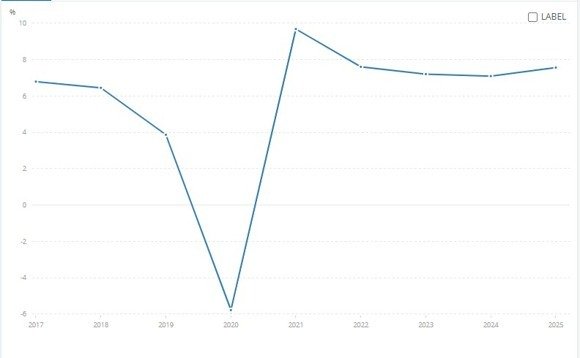
|
Figure 1 presents the trend of GDP growth over this time period. There was a huge drop in 2020, due to the COVID 19 pandemic followed by a sharp recovery, after which the growth is seen to be relatively stable. GDP has been taken as a dependent variable in this analysis as the study aims to examine how trade and investment variables influence India’s macroeconomic performance. The fluctuations observed in GDP growth highlight the importance of examining whether trade- and investment-related factors are associated with India’s macroeconomic performance.
Figure 2 FDI Inflows (%of GDP)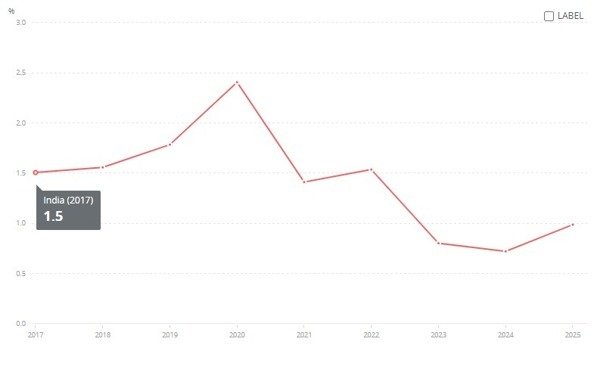 |
Figure 2 depicts the trend in FDI net inflows (as a percentage of GDP) over the study period. Interestingly, the ratio rises sharply in 2020, coinciding with the significant decline in GDP during the COVID-19 pandemic. This increase is unlikely to reflect a substantial rise in the actual amount of FDI received; rather, it may be explained by the contraction in GDP while FDI inflows remained relatively stable. As discussed earlier, FDI is generally a long-term investment and is therefore less susceptible to short-term economic shocks. Owing to its role in reflecting foreign investment and India’s integration with the global economy, FDI has been included as an important explanatory variable in this study..
Figure 3 total exports and Imports of India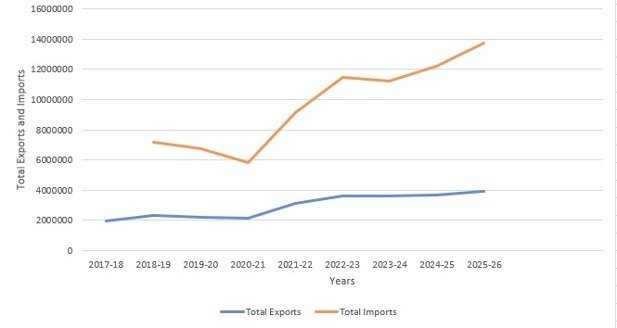 |
Figure 3 illustrates the trend in India’s total exports and imports over the study period. Total exports show a gradual upward trend over the study period with minor fluctuations . Imports, on the other hand, experienced greater fluctuations than exports. They declined sharply in 2020–21, followed by a strong recovery until 2022–23. A slight decline is observed in 2023–24, after which imports resume an upward trend. The overall rise in imports may reflect growing domestic demand, expanding industrial activity and increased requirements for intermediate goods and raw materials. The overall upward trend in both exports and imports suggests an expansion in India’s international trade following the post-pandemic recovery, providing important context for examining the relationship between trade and macroeconomic growth.
Figure 4 trade (% of GDP)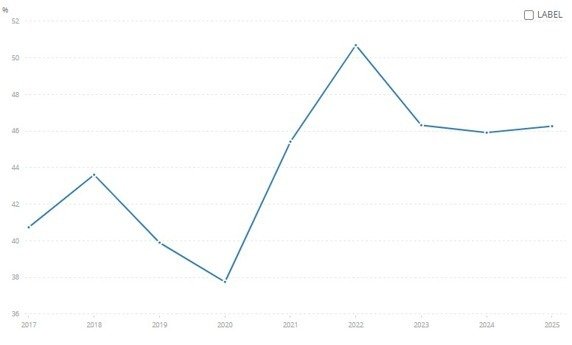 |
Figure 4 presents the trade openness of the economy measured as total trade as a % of GDP. We notice a rise in trade openness in 2018 likely due to expansion of international trade, supported by favourable global demand and a higher import demand driven by industrial production, capital goods and crude oil imports. India’s economy was becoming more integrated with global markets, resulting in a higher trade to GDP ratio. A huge dip in 2020 is observed due to the COVID-19 pandemic, which disrupted international trade, reduced domestic economic activity and lowered global demand. A peak in 2022 is observed indicating a strong post COVID recovery. This peak may also be attributed to rising global commodity prices which increased the value of India’s trade relative to GDP The recovery in trade openness suggests a restoration of India’s engagement with international markets following the pandemic, making it an important variable for examining its relationship with economic growth.
Figure 5 Imports and exports of Critical Minerals from Africa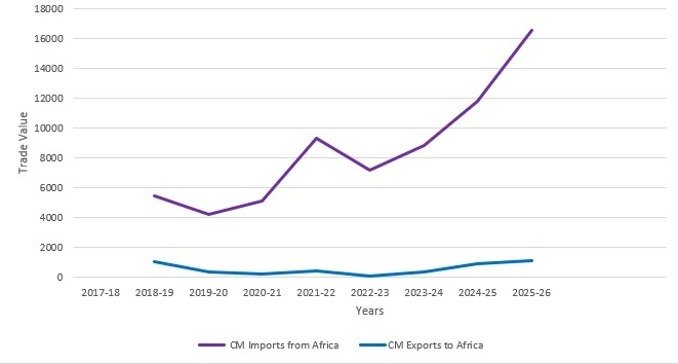 |
Figure 5 presents India’s critical mineral imports and exports with African countries over the study period. A clear distinction can be observed between imports and exports, with imports consistently exceeding exports throughout the period. FDI is generally considered a relatively stable form of investment because it involves long-term commitments and is therefore less likely to be immediately affected by short-term economic shocks. It has been included as an explanatory variable in this study due to its potential contribution to economic growth through increased investment, employment generation and improvements in productivity.
Inflation showed comparatively moderate variation during the study period, indicating that overall price levels remained fairly stable for most of the period. There were, however, temporary increases during times of global economic disruption. Inflation is relevant to the analysis because changes in price levels can influence production costs and purchasing power, thereby affecting overall economic growth.
Trade openness is considered in the study to examine the extent of India’s integration with international markets and its possible relationship with economic growth. Despite fluctuations in global economic conditions, it remained relatively stable throughout the study period. This indicates that India’s overall participation in international trade did not undergo any major structural changes..
4.3 Regression Analysis
To examine the relationship between India’s macroeconomic growth and critical mineral trade with African countries, multiple linear regression analysis was employed. GDP annual growth rate was taken as the dependent variable, while critical mineral trade, trade openness, FDI inflows (% of GDP) and inflation were included as the independent variables. The regression was estimated using the Ordinary Least Squares (OLS) method.
Table 2 Regression Statistics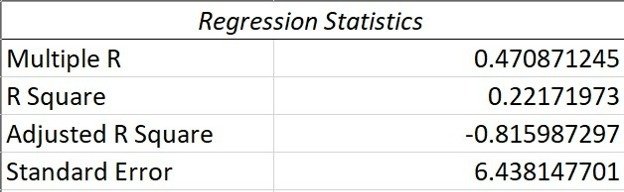 |
Table 2 presents the overall regression statistics. The model explains approximately 22.2% of the variation in GDP growth (R² = 0.222). However, the adjusted R² is −0.816, indicating that after accounting for the number of explanatory variables and the limited sample size, the model has low explanatory power.
Table 3 ANOVA Table |
Table 4 Regression Coefficients |
The ANOVA results further support this finding. The model records an F-statistic of 0.214 with a significance level (p-value) of 0.915, indicating that the regression model is not statistically significant at the 5% level. Consequently, the selected explanatory variables do not jointly explain variations in India’s GDP growth over the study period.
The estimated coefficients generally align with what economic theory would suggest. Critical mineral trade and FDI inflows have positive coefficients, indicating a positive association with GDP growth, while trade openness and inflation have negative coefficients. However, the p-values for all the independent variables are above 0.05, meaning that none of the relationships are statistically significant in this sample.
The absence of statistical significance should not automatically be taken to mean that no relationship exists. One reason is the small number of annual observations, which limits the statistical power of the regression. In addition, GDP growth is affected by several macroeconomic, institutional and external factors that are not included in the model. The study period also includes the COVID-19 pandemic, an unusual economic shock that led to major fluctuations in both economic growth and international trade and may have influenced the estimated relationships.
Overall, the regression does not provide enough statistical evidence to establish that critical mineral trade with African countries had a significant effect on India’s GDP growth during the period under study. At the same time, the direction of the coefficients remains broadly in line with economic expectations. Further research based on a longer time period, a larger sample and additional explanatory variables could provide stronger evidence on the relationship between critical mineral trade and macroeconomic growth.
Despite the lack of statistically significant results, the analysis offers useful insight into the difficulty of studying macroeconomic relationships with a small annual dataset. Economic growth is shaped by numerous interconnected domestic and international factors, making it challenging to isolate the effect of trade-related variables over a short period. The effects of trade agreements and strategic partnerships may also take time to become visible, while the present analysis is based on only eight observations. For these reasons, the findings of the study should be viewed as exploratory rather than conclusive.
CHAPTER V
Discussion and Conclusion
This study evaluates the macroeconomic impact of India’s evolving Free Trade Agreements (FTAs), focusing specifically on critical mineral partnerships with the African continent. The empirical analysis indicates that traditional trade agreements—historically focused purely on tariff reductions—are insufficient for securing long-term industrial independence in an era of resource securitisation. Key findings demonstrate that India’s bilateral trade with Africa has traditionally been dominated by petroleum products with limited industrial value addition. However, econometric tracking of recent FTA updates indicates a positive correlation between mineral-focused trade provisions and the secure import of key battery metals, such as lithium and cobalt, which are necessary for domestic clean energy targets. Furthermore, quantitative metrics from the National Critical Mineral Mission and Khanij Bidesh India Limited (KABIL) show that strategic state-backed mineral acquisition reduces import concentration risk compared to uncoordinated open-market procurement. Simultaneously, trade data confirms that India is competing with countries such as China, which currently commands a dominant share of African critical mineral extraction and refining infrastructure.
While trade frameworks provide necessary access to raw materials, empirical evidence from prior resource-extraction models highlights significant socioeconomic and environmental risks. Case studies on large-scale mining operations in sub-Saharan Africa indicate that weak regulatory enforcement often leads to severe watershed contamination and biodiversity loss, carrying long-term ecological costs. Additionally, economic evaluations of export-led resource extraction reveal that wealth generation is frequently concentrated in coastal transit hubs and multinational enclaves, resulting in uneven regional development and localized displacement when domestic value-addition mandates are absent.
In conclusion, India’s economic growth depends on aligning trade policy with industrial security. To transition from a transactional buyer to a strategic partner, future policy frameworks must prioritize institutional capacity building by integrating bilateral pacts with continental frameworks like the African Continental Free Trade Area (AfCFTA) and the Africa Mining Vision, alongside emphasizing technology transfer and local workforce development to ensure mutual economic growth. Ultimately, the long-term success of India’s critical mineral strategy will be measured not merely by aggregate export volumes, but by the stability of its supply chains, adherence to high environmental and social standards, and the preservation of regulatory sovereignty.
REFERENCES
Adams, S. (2009). Foreign direct investment, domestic investment, and economic growth in Sub-Saharan Africa. Journal of Policy Modeling, 31(6), 939–949. https://doi.org/10.1016/j.jpolmod.2009.03.003
Asante, G. N., Kamasa, K., & Bartlett, M. P. (2022). Foreign direct investment and economic growth nexus in ECOWAS: The leveraging effect of anti-corruption. Economic Journal of Emerging Markets, 14(2), 162–174. https://doi.org/10.20885/ejem.vol14.iss2.art3 Cited by: 9
Bhattacharya, J. (2025). Demand for critical minerals for the population of India far outstrips its mineral potential. India needs a 10-year strategy to source critical minerals from abroad and to gain inimitable expertise in mineral processing. Critical Minerals Metals and Materials, 1–5. https://doi.org/10.18311/C3M/2025/54229
Brahmananda, P. R. (1997). Foreign trade and international finance in a changing world. Indian Economic Journal, 45(1), 1–18.
Centre for Joint Warfare Studies. (2026, February 5). Minerals, markets, and militaries: Africa’s critical raw materials and India’s security calculus (Guest Lecture Summary GL/06/26).
Centre for Social and Economic Progress. (2025). India, Africa and critical minerals: Towards a green energy partnership (CSEP Working Paper). https://csep.org/working-paper/india-africa-and-critical-minerals-towards-a-green-energy-partnership/
Centre for Social and Economic Progress. (2026). Beyond the ore: India’s value-driven critical minerals diplomacy in Africa (CSEP Working Paper). https://csep.org/working-paper/beyond-the-ore-indias-value-driven-critical-minerals-diplomacy-in-africa/
Chand, R. (1999). Effects of trade liberalisation on agriculture: A study of prices, producer welfare and social welfare in India. As cited in T. Kar (2007), India’s trade performance under liberalised regime (Unpublished doctoral dissertation). University of North Bengal.
Confederation of Indian Industry. (2025). India-Africa momentum: A purpose-driven partnership. Confederation of Indian Industry.
Creswell, J. W., & Creswell, J. D. (2018). Research design: Qualitative, quantitative, and mixed methods approaches (5th ed.). SAGE Publications.
Devereux, M. B. (1997). Growth, specialisation and trade liberalisation. As cited in T. Kar (2007), India’s trade performance under liberalised regime (Unpublished doctoral dissertation). University of North Bengal.
Export-Import Bank of India. (2025). Unlocking Africa’s sustainable growth: India’s role and opportunities (Working Paper No. 146). Export-Import Bank of India. https://www.eximbankindia.in/sites/default/files/2025-07/209file.pdf
Gujarati, D. N., & Porter, D. C. (2009). Basic econometrics (5th ed.). McGraw-Hill.
Indian Council of World Affairs. (2025). The rising significance of critical minerals in Africa: Potential for cooperation. Indian Council of World Affairs.
Jagani, S., Marsillac, E., & Hong, P. (2024). The electric vehicle supply chain ecosystem: Changing roles of automotive suppliers. Sustainability, 16(4), Article 1570. https://doi.org/10.3390/su16041570
Jain, P. K. (2024). Policy reforms initiated for supply of critical minerals in India. Mineral Economics, 37(3), 701–717. https://doi.org/10.1007/s13563-024-00452-z Cited by: 9
Jones, B., Elliott, R. J. R., & Nguyen-Tien, V. (2020). The EV revolution: The road ahead for critical raw materials demand. Applied Energy, 280, Article 115072. https://doi.org/10.1016/j.apenergy.2020.115072
Kar, T. (2007). India’s trade performance under liberalised regime (Unpublished doctoral dissertation). University of North Bengal.
Khati, P., & Kim, C. (2023). Impact of India’s free trade agreement with ASEAN on its goods exports: A gravity model analysis. Economies, 11(1), Article 8. https://doi.org/10.3390/economies11010008
Kothari, C. R. (2004). Research methodology: Methods and techniques (2nd ed.). New Age International.
Mohapatra, D. R. (2015). Trade and investment flows between India and the European Union: Issues and challenges. Bridge Center.
Department of Commerce, Government of India. (2026). Trade Statistics (TradeStat).https://tradestat.commerce.gov.in/
World Bank. (2026). World Integrated Trade Solution (WITS). https://wits.worldbank.org/
World Bank. (2026). World Bank Open Data. https://data.worldbank.org/
Nguyen, C. P., Doytch, N., Schinckus, C., & Su, T. D. (2023). Mobile and internet usage, institutions and the trade balance: Evidence from African countries. International Journal of Finance & Economics, 29(2), 2230–2264. https://doi.org/10.1002/ijfe.2782 Cited by: 10
Oloyede, B. M., Osabuohien, E. S., & Ejemeyovwi, J. O. (2021). Trade openness and economic growth in Africa’s regional economic communities: Empirical evidence from ECOWAS and SADC. Research in International Business and Finance, 58, Article 101438. https://doi.org/10.1016/j.ribaf.2021.101438
Pandey, D., & Unnikrishnan, M. (2023). Free trade agreements (FTAs) by India: Review and implications for future (Misra Centre Working Paper). Misra Centre for Financial Markets and Economy, Indian Institute of Management Ahmedabad.
Saunders, M., Lewis, P., & Thornhill, A. (2019). Research methods for business students (8th ed.). Pearson.
Shekhar, J., Suri, D., Somani, P., Lee, S. J., & Arora, M. (2021). Reduced renewable energy stability in India following COVID-19: Insights and key policy recommendations. Renewable and Sustainable Energy Reviews, 144, Article 111015. https://doi.org/10.1016/j.rser.2021.111015
Shiquan, D., & Deyi, X. (2022). The security of critical mineral supply chains. Mineral Economics, 36, 401–412. https://doi.org/10.1007/s13563-022-00340-4
Singh, K. (2025). The political economy of critical minerals: Energy transitions and the fractured world order. Anusandhanvallari, 2025(1), 26–28.
Singh, M. (1998). Trade policy and the supply-side constraints in India. As cited in T. Kar (2007), India’s trade performance under liberalised regime (Unpublished doctoral dissertation). University of North Bengal.
Soares, L. O., Reis, A. d. C., Vieira, P. S., Hernández-Callejo, L., & Boloy, R. A. M. (2023). Electric vehicle supply chain management: A bibliometric and systematic review. Energies, 16(4), Article 1563. https://doi.org/10.3390/en16041563
Suriaganth, S., & Abdullah. (2024). Assessing the effectiveness of India’s free trade agreements (FTAs): A comparative analysis. South Eastern European Journal of Public Health, Article 2003. https://doi.org/10.70135/seejph.vi.2003
Wooldridge, J. M. (2019). Introductory econometrics: A modern approach (7th ed.). Cengage Learning.
Yaseen, I., Singh, S., & Banerjee, S. (2025). Bolstering critical minerals trade between India and other MSP countries: A gravity model evaluation. Resources Policy, 103, Article 105542. https://doi.org/10.1016/j.resourpol.2025.105542
To download paper, click on the link below