Authors: Femi Mariya Johncy, Meenakshi N A, Veena Kumari, Aastha Bharal, Alwia Noorien, Vihaan Gupta, Shreya Bachwan, Harsh Dixit, Stuti Paul, Atharv Nagare
Abstract
Education is a fundamental driver of human capital development, social equity, and sustainable economic growth. Despite increasing public investment in school education, gaps between budget allocation and actual expenditure continue to affect the effective implementation of educational programmes in India.
Purpose – This study examines the gap between budget allocation and actual expenditure in the Indian school education system and evaluates public fund utilization across states and regions.
Methodology/Design – The study adopts a descriptive and analytical research design using secondary data from Ministry of Education Annual Reports, Union Budget documents, Economic Surveys, and other official reports for 2018-19 to 2023-24. Trend, gap, comparative, descriptive, percentage, ranking, and graphical analyses were employed.
Findings – The analysis shows that although budget allocation for school education increased significantly, a persistent gap remained between allocated and utilized funds. The COVID-19 period recorded the highest expenditure gap, with notable regional disparities in fund utilization, highlighting the need for more efficient financial management in school education.
Originality/Value – The study highlights the importance of strengthening financial governance, improving fund utilization mechanisms, and addressing administrative inefficiencies to support evidence-based policymaking. The findings contribute to the existing literature on educational financing and offer practical policy recommendations for achieving SDG 4 (Quality Education) and advancing the vision of Viksit Bharat 2047.
Keywords: Budget Allocation, Educational Expenditure, Fund Utilization, Public Finance, School Education, SDG 4.
Acknowledgements
The authors would like to acknowledge the contribution of Ms. Nidhi Trivedi and Mr. Ashwin Vats in the research and writing of this paper. The authors also thank the International Institute of SDGs and Public Policy for their support and guidance throughout this study.
Introduction
The present time is marked by increasing modernization, technological development, digital transformation, and the emergence of knowledge economies in globalization, thus making education a crucial factor in sustainable development of countries. In today’s competitive environment, the improvement of human capital is a determining factor of economic growth, social progress, and national competitiveness. Education goes beyond basic literacy as it fights poverty, economic inequality, unleashes human capability, stimulates innovation, and improves quality of life. Consequently, countries all over the world regard education as a public good which should be funded for proper implementation. Public financing is an important part of education sector development as it helps to create a network of schools, employ and train teachers, and reform education content and methods. In India, government funding is especially important as a significant part of education is carried out in public educational institutions. The promulgation of the Right of Children to Free and Compulsory Education Act, 2009 and the National Education Policy (NEP) 2020 proves that government is committed to ensuring equal access and quality education. In particular, the Government of India has implemented the following flagship programs – Samagra Shiksha, PM POSHAN, PM SHRI Schools, NIPUN Bharat Mission, DIKSHA Digital Platform, and National Means-cum-Merit Scholarship Scheme in order to achieve this goal.
Although, budgetary allocations are on the rise, achieving good outcomes in terms of education relies heavily on spending performance of these funds effectively. A major problem in the management of public finances in India is the inconsistency between fund allocations and actual utilization of these funds. Delays in the release of funds due to administrative delays, poor capacity to implement and lack of monitoring of the expenditures lead to under utilisation of funds. These holdups also develop regional differences in the education sphere.
Given these circumstances, the present study investigates the gap between budget allocation and actual expenditure in Indian school education. Although, the existing evidences discuss financing in education, expenditure patterns and regional differences, only limited studies have given attention to consistent state-wise comparison of allocated funds, actual expenditure and spending efficiency over a common period. Therefore, the study analyses trends from 2018–19 to 2023–24, measures the gap between budget and expenditure, compares level of fund utilisation over states and regions, and assesses efficiency of spending to provide insights and evidences for improving financial management in schools and implementation of new policies in school education sector. In this regard, the study seeks to answer the following research question:
RQ: What is the gap between budget allocation and actual expenditure in the Indian school education system, and how efficiently are the allocated funds utilised ?
Literature Review
1. Public Financing of school education system in India
Public funding in the school education sector in India has seen a significant growth over the past few years, being the central institution for the source of funding. However, even though public expenditure in the school education system has increased, it has remained inadequate. The imbalanced spending and regional disparities have raised concerns regarding the quality of the school education system in India (Tilak, 2003)1. There exists state wise imbalance in funding in the school education system, while comparing and analysing the public spending in Bihar and Kerala on education we can understand the signifying gap in budget and utilisation in different states in India (Bose & Sharma, 2023)2. Even though the spending in school education in India is around the benchmark range set by UNESCO, it still falls short against the ambitious 6% GDP target cited in the Indian policies (Samanta & Samanta, 2026)3. Since education is considered as one of the most valuable human resources for an individual, public expenditure on schools has been crucial to ensure quality education provided to students and accessible to all. The CBGA-CRY fact sheet (2016)4 also stresses upon the fact that funding for school education in India continues to face such adequacy and regional imbalances across all the states.
Educational expenditure in India has changed over time with differences in funding patterns, budget priorities, and resource allocation across school education. If we look at the educational financing which is shared between central and state governments, the states continue to carry a larger responsibility in educational expenditure and school development (Behera & Khatei, 2018)5. The expenditure on education increased over the years, but spending remained lower than the expected level in relation to GDP (Ansari & Khan, 2018)6. In addition, the interstate analysis (2021)7 highlighted variation in educational expenditure among Indian states, leading to differences in educational opportunities and development. The budget trends from 2020 to 2025 illustrates greater attention towards school education, digital learning, teacher development, and educational schemes (Patel, 2026)8. The above studies consistently highlight the relevance of budget allocation in improving school education through better educational access, infrastructure, and teacher development. However, only limited researches have specifically explored the gap between budget allocation and actual expenditure and its influence on the effective utilisation of school education funds over Indian states. Therefore, the present research is necessary to address these identified gaps.
Taken together, the literature shows that higher public financing is necessary but not the only way to ensure effective policy implementation. The comparison across the studies shows the importance of utilisation capacity and interstate differences, supporting the need to examine the gap in budget expenditure.
2. School Budget Allocation: Trends in expenditure and fund utilization patterns
Financing in the educational sector specifically in school education plays an important role in improving access, quality and equity. In India the government allocates various financing strategies through different educational schemes for undertaking the development initiatives. However, the gap between budget allocation & expenditure brings more concerns regarding fund utilization and spending. The rate of public expenditure remained at lower levels representing around 4% of GDP from the targeted rate as per the study of 2023 which resulted in underutilization of allocated funds and over burden among states (Motkuri & Revathi, 20239; Tilak & JBG, 2018)10. However, budget allocation and public expenditure will not increase the efficiency of attaining educational outcomes unless it is equally distributed & utilized (Rani, 200411; Singh & Shastri, 2020)12.
Recent studies has further analysed the relation between educational allocations and their utilization at school level. Bordoloi, M et.al., (2020)13 reported that even though school education expenditure increased among states between 2014-2015 and 2019-2020, substantial differences existed in pattern of spending and per student expenditure, which highlights the uneven distribution of resources. It was observed that many states continued to spend below desirable levels relative to their GSDP, limiting the effectiveness of school development initiatives (Singh, 2019)14. On the other hand, there exist interstate disparity in educational expenditure and the variations in fiscal capacity along with administrative inefficiency have affected the utilization of funds (Mehta et al., 2025)15. The elementary education received the largest share of educational spending, reflecting a policy focus on foundational schooling (Guleria et al., 2025)16. However, the overall spending remained below the recommended benchmark. Thus, the reviewed evidences states that effective utilization and adequate allocation of funds through the budget is essential for improving school education outcomes and the under exploration of inefficiency in utilization still stands as a gap to be addressed.
Overall, the literature indicates that increased allocation cannot be treated as direct source to measure the effectiveness of policy. Efficient conversion of allocation into actual expenditure is equally important.
3. Factor affecting or determinants of gaps in budget expenditure
From several years almost 7.7 % of the total budget allocated to the Indian school education system remains unused. The existence gap between allocated budget and actual budget utilized is largely due to weakness in educational planning, resources allocation and implementation rather than shortage of funds (Tilak & J.B.G, 2003)17. Since the educational financing in India involves multilayered financing system which delays the release and utilization of funds, leading to budget and infrastructural gap in elementary education, so increasing the budget alone won’t solve the problem unless it is properly managed and timely allotted (De & Endow, 200818; M & Pahwa, 2020)19.
The multidimensional disparities like in school enrolment, dropout rates, and teacher training varies across the States this reveal that disparities are linked to unequal public expenditure and uneven distribution of resources (Sahoo & Behera, 2019)20. The financial and governance-related challenges associated with achieving SDG 4, suggests that inadequate financial resources, constrained budgets, poor infrastructure, insufficient teacher recruitment, and gender disparities continue to undermine education ( Drabo, 2020)21 When the state government which is primarily responsible for school financing, prioritize elementary level students while secondary and higher level students receive low attention which results in uneven allocations of funds across the sectors (Ansari & Khan, 2018)22.
Although public expenditure on education in India has increased, it remains unevenly distributed across states due to various administrative and non-administrative factors which can correlate with corruption (Chaitali Ravde, 2026)23. These regional disparities in funding, poor planning and underutilisation of funds affect the equitable distribution of educational resources. At the same time a chronic disconnect is present between budget allocations and actual district-level educational deprivation, because budgets are rarely aligned with on-the-ground needs, local administrators struggle to implement projects effectively, ultimately resulting in low actual expenditure against allocated funds (Jhingran & Sankar, 2009)24.
Thus, the literature links the gap to both administrative and financial constraints. Factors like sound planning, timely release and sufficient institutional capacity alongwith the adequate funds required for the efficient policy implementation.
4. Financial performance of educational schemes.
The government of India have brought various schemes and programes to develop the educational quality and standard. Several researches using the secondary data from government official reports and policy reviews have explored the financial performances of various schemes on education, in accordance to that Global Hunger Index Report, the rank of India out of 117 is 102, by MidDay Meal the government is working on nutritional component and also help in higher attendance of students and lower drop-outs in schools (Paltasingh & Bhue, 2022)25. As per the policy and official documentation analysis PM SHRI is a network of modern schools, these are established according to the NEP 2020 which focuses on Experiential Learning (Sahu et.al, 2026)26. The SSA scheme brought by the government integrates three preceding initiatives: Sarva Shiksha Abhiyan (SSA), the RMSA interventions and the Teacher Education (TE) programme, these initiatives altogether aim to enhance school infrastructure, improving teacher proficiency, access to digital education etc (Kadve and Kumar, 2023)27. According to Centre of Civil Society (2009)28 NMMSS Scheme works to reduce drop outs at secondary level by providing financial help for meritorious students from weaker sections. But, the pass percentage is very less.
Recent literature highlights the distorted financial performance of these educational schemes. In the case of SMSA programme even though fund allocation improved in 2019-20, it faced inconsistency within its components across states and failed to achieve its dual target of resource utilisation and equitable distribution (Khanna, 2021)29. A research on implementation of Samagra Shiksha scheme analysed that although budget allocations for the scheme increased, variations in fund releases and expenditure across states affected implementation efficiency Avani Kapur et.al (2022)30. The findings in recent evidences reveal that even though budget allocation improved stably across SMSA, POSHAN, PMSHRI but failed to achieve targeted benchmarks (Guleria and RK, 2026)31. Despite the fact that the budget increased in the year 2020-25, the major educational interventions were at loss to standardise quality education (Patel, 2026)32. Collectively, the explored studies indicates that policies on government school education have substantially promoted access to education, nutrition, infrastructure, skill development of teachers, and digital learning environment. However, their impact is largely depended on timely fund allocation, equality in distribution, and optimum utilisation of financial resources. Other than these positive contributions, how the influence gap between budget allocation and actual expenditure on financial performance of these schemes across Indian states is still under explored. Therefore, the present study is relevant to fill these gaps.
Overall, the studies suggest that the effectiveness of educational schemes depends on how consistently financial resources are translated into implementation. The objectives of positive programmes are also need to be assessed.
5. Impact of Underutilization of Funds
An important challenge in India’s public education sector is the gap between actual fund release and real-time expenditures. Using the details using secondary data collected from government budget documents, national education finance reports, and policy documents, it is identified that although the Sarva Shiksha Abhiyan (SSA) improved enrolment and school infrastructure, shortcomings in execution and expenditure performance limited the scheme’s overall effectiveness, Radhika and Revathy (2020)33. Similarly, the Ministry of Education (2024)34, based on an analysis of official budget allocation, fund release, and expenditure records, reported that central fund releases for major school education schemes such as Samagra Shiksha are often lower than the initial allocations. Moreover, Bose et.al, (2022)35 analysed state-level education expenditure during 2005–2020 and found significant interstate disparities, noting that despite higher tax devolution under the 14th Finance Commission, school education expenditure did not increase proportionately across states, thus indicating persistent inefficiencies in use of allocated funds. Furthermore, India’s public expenditure on education has consistently remained below the 6% of GDP recommended by the Kothari Commission, consequently constraining infrastructure development, teacher availability, and learning outcomes reported by Mehta (2020)36.
According to PRS Research (2021-22)37, the National Education Mission has been alloted Rs 31,300 crore which highlights the 2% annual decrease in apportionment as compared to 2019-20. Additionally, The Standing Committee on Human Resource Development (2020)38 noted that the Department of School Education and Literacy had been allocated 28% less than what the Ministry had proposed in 2020-21 (allocated Rs 59,845 crore against the proposed amount of Rs 82,570 crore). A study by Dr. Indra M and Nikita Pahwa (2020)39 also demonstrate that the issues of unspent allocation of existing funds persist. Findings by Sukanya Bose and Harshita Sharma (2023)40 suggests that there is an underutilisation of funds particularly in the secondary education budget of SMSA which effect the overall quality of education sector in India. The existing research recommends that inefficient utilisation of allocated funds unfavourably affects learning resources, infrastructure, and the quality of school education. However, only few studies have detailly investigated the degree of budget expenditure gap and its consequences for fund utilisation all over the states of India which recommends the necessity of detailed investigation.
Taken together, these findings shows that both inadequate allocation and underutilization can weaken policy effectiveness. The literature therefore supports examining actual expenditure alongside allocation to understand whether financial commitments are being translated into educational interventions.
6. Budget Expenditure During the COVID-19 Period
The COVID-19 pandemic exposed major challenges in the expenditure and utilization of public funds within the Indian school education system. Although the Government of India introduced measures to sustain learning, expenditure on digital infrastructure, scholarships, and educational support remained inadequate to meet the increased needs of disadvantaged learners (Kundu & Sonawane, 2020)41. The IRDSE Policy Brief (2020)42 highlighted that disruptions in educational expenditure and unequal access to digital resources widened learning inequalities among economically weaker students. The insufficient investment in digital infrastructure and remedial support contributed to learning losses, particularly in rural areas (Singh, 2022)43. The ineffective utilization of financial resources, poor technological infrastructure, and accessibility constraints have also limited the effectiveness of online education (Choudhury, 2022)44. Thus, the efficient education spending and effective utilization of public funds are essential for promoting education system resilience, equity, and uninterrupted learning during future public health crises.
Due to the COVID-19 pandemic, the need for financial planning and evenly distributing learning resources has become clearer. Many schools have reported being unable to keep their teaching and learning going due to not having enough money for digital devices, internet access, or training for teachers (UNICEF 2021)45. According to World Bank (2021)46 those countries that had invested heavily in education technology and assisted in providing emergency learning programs have been much more successful in reducing the disruptions of learning. The students living in low-income households are severely impacted due to a lack of access to smartphones, computers, or a reliable internet connection, regardless of all the government initiatives that were made available to them ASER (2021)47. Thus, the effective usage of education budgets must include not only building infrastructure but support digital equity, building teacher capacity, and supporting at-risk students (UNESCO, 2021)48. The existing literatures emphasized only on the financial barriers faced by the school education sector during the period of COVID-19 pandemic.
Overall, the COVID-19 evidence reinforces the importance of timely and targeted expenditure, particularly for disadvantaged learners. It also reflected the financial and utilisation challenges during the pandemic, which needs to be considered during post pandemic spending efficiency.
Research Gap
The existing literature extensively examined public financing and expenditure in school education, and documents the gap between the allocated and utilized budget in Indian school education system. The study shows that expenditure remains below desirable levels and that regional disparities and imbalance persist even though India has seen an increase in budget allocation in school education. However, most studies rely on broad and descriptive comparison of overall allocation and spending pattern, which makes it difficult to identify the clear reason for gap between budget and expenditure in Indian school education system.
Therefore, a clear research gap lies in limited analysis of budget utilization in school education. The existing literature provides limited empirical evidence as to why some states perform better than others. This study addresses that gap by conducting a comprehensive state wise analysis of budget allocation, actual expenditure and efficiently utilized funds in Indian school education system from year 2018-19 to 2023-24.
Research Methodology
This study uses a descriptive and analytical research design to analyse the gap between budget allocation and funds utilisation. Secondary data for the period 2018-19 to 2023-24 was collected from Ministry of Education Annual Reports, Union budget documents and other official government reports and economic surveys. To accurately measure financial efficiency, four main variables were tracked down: Total Budget Allocated for Education, Actual Expenditure on Education, Unspent Amount and Spending Rate.
For the analysis of data trend analysis is applied to examine differences in budget and expenditure over time, gap analysis to identify unspent funds, and regional and comparative analysis to analyse imbalances in utilisation and to compare the state performances in fund utilization and interpret its findings clearly Percentage, ranking and graphical analysis was used. Overall, these methods align directly to the objectives of the study and enable consistent comparison of fund utilisation across the study period.
Data Analysis & Interpretation
1. Trend in Budget Allocation and Expenditure
Table. No: 1
Year-wise representation of Budget Allocation, Actual Expenditure, Unspent Amount, & Spending Rate for School Education in India from 2018 -19 to 2023-24
| Year | Allocated (₹ Cr) | Spent (₹ Cr) | Unspent (₹ Cr) | Spending rate |
| 2018-19 | 68,881.12 | 63,528.79 | 5,352.33 | 92.23% |
| 2019-20 | 74,679.94 | 69,123.34 | 5,556.60 | 92.56% |
| 2020-21 | 68,772.37 | ……61,268.79 | 7,503.58 | 89.09% |
| 2021-22 | 81,482.23 | 75,662.63 | 5,819.60 | 92.86% |
| 2022-23 | 96,956.44 | 89,872.36 | 7,084.08 | 92.69% |
| 2023-24 | 1,07,822.36 | 1,00,549.43 | 7,272.93 | 93.25% |
Source: Secondary source (Compiled by the researcher from Ministry of Education, Government of India; Union Budget Document)
Figure. No: 1
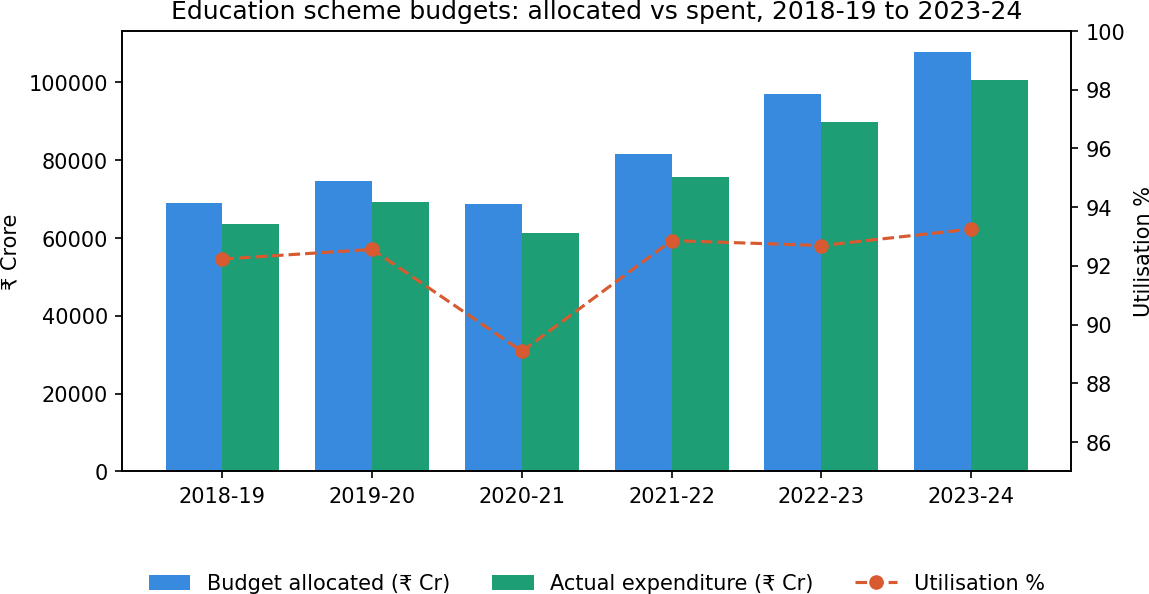
Graphical representation of Budget Allocation & Actual Expenditure for School Education in India from 2018-19 to 2023-24
Source: Secondary source (Prepared by the researcher based on data compiled from the Ministry of Education, Government of India, Union Budget Documents)
Table 1 and Figure 1 presents the trends in budget allocation, actual expenditure, unspent amount, and spending rate for school education in India from 2018–19 to 2023–24. The results indicates a constant increase in budget allocation from ₹68,881.12 crore in 2018–19 to ₹1,07,822.36 crore in 2023–24, showing an increment of 56%. Likewise, actual expenditure rised from ₹63,528.79 crore to ₹1,00,549.43 crore, representing nearly 58% of growth during the period.
Regardless of the increase in both allocation and expenditure, every year actual spending stood below the allocated budget, indicating chronic underutilisation of funds. The least spending rate (89.09%) occurred in 2020–21, keeping ₹7,503.58 crore unspent, resulted from disruptions caused by the COVID-19 pandemic. Even though, utilisation improved in the following years and reached 93.25% in 2023–24, ₹7,272.93 crore still underutilization exists.
Overall, the results indicate that while government investment in school education has significant increase, efficient utilisation of allocated funds continues to remain a policy concern.
2. Assessment of gap between Budget and Expenditure on School Education system India as per the data from the period 2018-19 to 2023-24 given in Table 1.
During the period 2018-19 to 2023-24, the Government of India invested approximately ₹4,98,594 crores for school education and actual expenditure showed as ₹4,60,005 crore. Therefore, around ₹38,589 crore stayed underutilised, approximately 7.7% of the total allocation. On the other hand, 2020–21 shows the largest expenditure gap, when more than ₹7,500 crore remained unutilised. Although, utilisation improved after the pandemic, over ₹7,200 crore still remains as unspent in 2023–24, indicating that the problem extends beyond pandemic-related disruptions.
Since, educational budgets are aimed to strengthen teacher quality, infrastructure, digital learning outcomes, student welfare, the ongoing existence of unspent funds highlights fragility in financial management and implementation other than insufficient budgetary commitments. According to (PRS Legislative Research 2026), delays in fund release and concentration of expenditure in the financial year reduce efficiency of spending. Therefore, timely fund release, improving financial planning, better monitoring, and institutional accountability is important to reduce the gap between allocation and expenditure and boost the effectiveness of public investment in education.
3. Differences in Budget Utilization across different States and Regions of India
Table. No: 2
State wise Budget utilization for School Education in India (2018-19 to 2023-24)
| State | Allocated (₹ Cr) | Spent (₹ Cr) | Unspent (₹ Cr) | Spending rate |
| Uttar Pradesh | 78,315.43 | 70,519.42 | 7,796.01 | 90.05% |
| Bihar | 41,995.10 | 37,881.10 | 4,114.00 | 90.20% |
| Maharashtra | 40,943.99 | 38,927.45 | 2,016.54 | 95.07% |
| West Bengal | 34,006.77 | 31,180.55 | 2,826.22 | 91.69% |
| Madhya Pradesh | 31,081.78 | 28,521.07 | 2,560.71 | 91.76% |
| Rajasthan | 30,900.09 | 28,216.18 | 2,683.91 | 91.31% |
| Karnataka | 25,826.47 | 24,405.03 | 1,421.44 | 94.50% |
| Tamil Nadu | 23,592.23 | 22,744.32 | 847.91 | 96.41% |
| Andhra Pradesh | 22,726.43 | 21,259.33 | 1,467.10 | 93.54% |
| Gujarat | 20,309.34 | 19,097.79 | 1,211.55 | 94.03% |
Source: Secondary source (Compiled by the researcher from Ministry of Education, Government of India; Union Budget Document)
Table 2 compares budget utilisation between the ten states receiving the highest budget for school education. From the results Uttar Pradesh received the highest allocation (₹78,315.43 crore), followed by Bihar (₹41,995.10 crore) and Maharashtra (₹40,943.99 crore). These states also recorded the highest levels of expenditure due to their larger school and student populations.
However, utilisation efficiency differed considerably across states. Uttar Pradesh shows the highest unspent amount (₹7,796.01 crore), followed by Bihar (₹4,114.00 crore). Whereas, Tamil Nadu gained the highest spending rate (96.41%), followed by Maharashtra (95.07%). These findings implies that higher budget allocation alone does not result in better utilisation efficiency.
Table. No: 3
Regional wise Budget utilization for School Education System in India
| Region | Allocated (₹ Cr) | Spent (₹ Cr) | Unspent (₹ Cr) | Spending rate |
| West | 62,417.23 | 59,117.69 | 3,299.54 | 94.71% |
| South | 1,01,987.79 | 96,588.93 | 5,398.86 | 94.71% |
| Islands | 647.21 | 603.45 | 43.76 | 93.24% |
| Central | 43,013.68 | 39,427.84 | 3,585.84 | 91.66% |
| North | 1,54,241.76 | 1,40,657.86 | 13,583.90 | 91.19% |
| East | 1,06,776.75 | 97,079.53 | 9,697.22 | 90.92% |
| North-East | 29,510.04 | 26,530.04 | 2,980.00 | 89.90% |
Source: Secondary source (Compiled by the researcher from Ministry of Education, Government of India; Union Budget Document)
Figure. No: 2
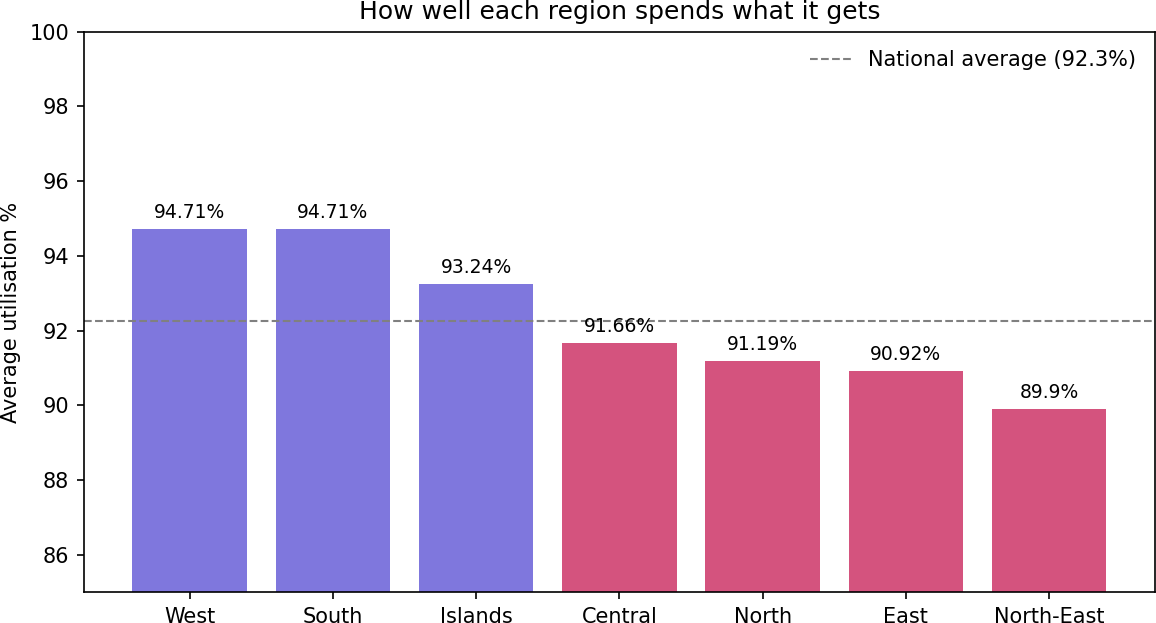
Graph representing regional wise differences in Budget Utilization
Average spending rate by region, compared against the national average of about 92.3%
Source: Secondary source (Prepared by the researcher based on data compiled from the Ministry of Education, Government of India, Union Budget Documents)
Regional analysis shown in Table 3 and Figure 2 reveals notable disparities. The Southern and Western regions has the highest spending rate (94.71%), followed by the Islands (93.24%), where all are performing above the national average of approximately 92.3%. In contrast, the North-Eastern region reported the least utilisation (89.90%), followed by the Eastern (90.92%), Northern (91.19%), and Central (91.66%) regions.
Although, the Northern region received the highest allocation (₹1,54,241.76 crore), it also documented the highest unspent amount (₹13,583.90 crore), followed by the Eastern region (₹9,697.22 crore). These identified disparities show that allocating large amount of funds alone does not promote efficient utilisation. Variations in institutional capacity, distribution of funds, monitoring and its implementation may influence the conversion of allocated funds into actual expenditure.
4. Comparison of state efficiencies with other States & Union Territories
Figure. No: 3
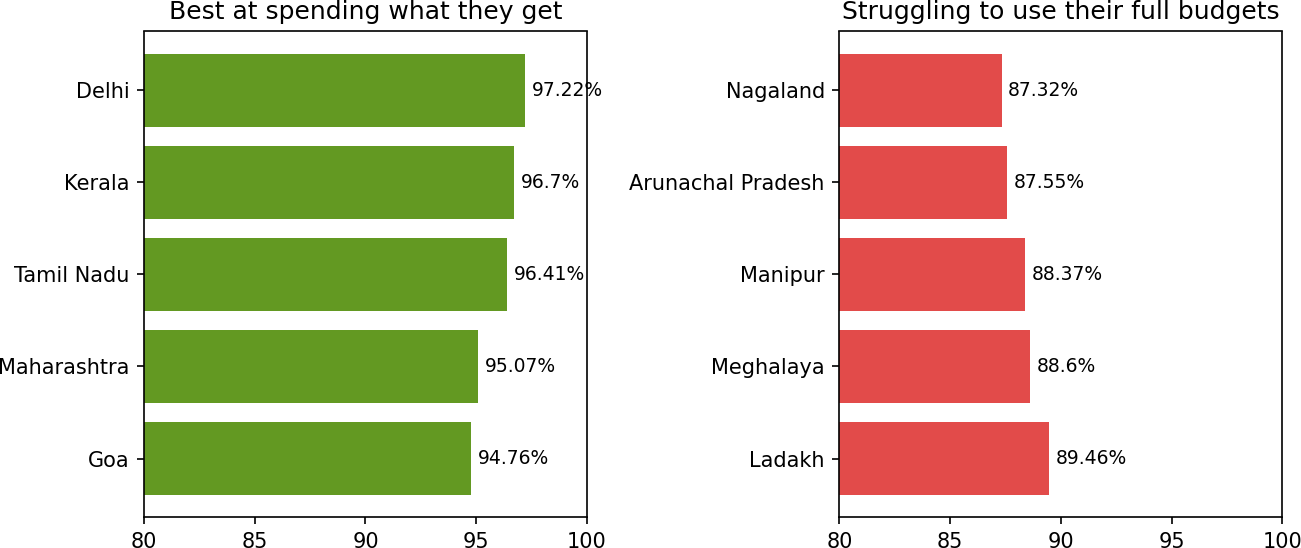
Graphical representation of leading and lagging states in Budget Utilization Efficiency
Source: Secondary Source (Prepared by the researcher based on data compiled from the Ministry of Education, Government of India, Union Budget Documents)
Figure 3 ranks states according to their budget utilisation efficiency. Delhi emerged as the best-performing state with a spending efficiency of 97.2%, followed by Kerala (96.7%) and Tamil Nadu (96.4%). These states demonstrate effective financial planning, fund management, and implementation practices.
In contrast, Nagaland (87.3%), Arunachal Pradesh (87.6%), Manipur (88.37%), Meghalaya (88.6%), and Ladakh (89.46%) recorded the lowest spending efficiencies. Several lower-performing states are located in the North-Eastern region, suggesting that geographical and administrative constraints may influence utilisation. The nearly 10 percentage-point difference between the highest and lowest performers highlights substantial variation in financial management efficiency across states.
Table. No: 4
States V/S Union Territories
| Category | Allocated (₹ Cr) | Spent (₹ Cr) | Unspent (₹ Cr) | Spending rate |
| States | 4,83,693.83 | 4,46,087.08 | 37,606.75 | 92.23% |
| Union territories | 14,900.63 | 13,918.26 | 982.37 | 93.41% |
Source: Secondary Source (Compiled by the researcher from Ministry of Education, Government of India; Union Budget Document)
Table 4 compares budget utilisation between States and Union Territories. States received ₹4,83,693.83 crore and spent ₹4,46,087.08 crore, leaving ₹37,606.75 crore unspent with a spending rate of 92.23%. When comparing both, Union Territories utilised 93.41% of their allocated budget, keeping only ₹982.37 crore unspent.
The higher utilisation rate of Union Territories reveal that smaller administrative structures may have advantages in financial planning, coordination, implementation and monitoring. Therefore, improved institutional potential and governance plays an important role in ensuring that educational budgets are converted into significant educational outcomes.
Findings And Discussions
From the period of 2018–2019 to 2023–2024, the budget allocation for school education has steadily increased from ₹68,881.12 crore to ₹1,07,822.36 crore, which indicates greater emphasis by the government on school education. Expenditure has also increased, but it remained below the alloted budget, with approximately ₹38,589 crore (7.7%) remained unspent, with an average utilization rate of 92.3%. The largest gap between allocation and expenditure occurred in 2020–2021 due to the COVID-19 pandemic. The National Education Policy (2020) also recommended combined public expenditure by both the Centre and the states on education at 6% of GDP; it was only 4.1% in 2022–2023. This indicates that the gap between budget and expenditure is associated with both the public expenditure level and the underutilization of alloted funds.
States like Uttar Pradesh and Bihar had higher budget allocations but also showed bigger gaps in spending performance. In contrast, Tamil Nadu, Maharashtra, Delhi, and Kerala recorded larger budget spending than Uttar Pradesh and Bihar, and regional disparities were also evident, with southern and western regions holding greater utilisation rate of funds than northern and northeastern regions. These differences indicate that higher fund allocation alone does not guarantee efficient utilisation and may reflect changes in implementation and administrative capacity. On the other hand, Union Territories recorded higher utilisation when compared with states, suggesting that inequalities in administrative structure and financial management may affect expenditure efficiency.
The data from the Department of School Education and Literacy shows similar trends. The budget allocated in 2018-19 was Rs 50,000 crore, 2023-24 Rs 68,804 crore, and Rs 83,562crore in 2026-27 which is approximately 60% of the Ministry of Education’s total budget (Details acquired from DFG Analysis on Education 2026-27 of PRS Legislative Research). This clearly indicates an increase in budget allocation over the years. But the expenditure remained below the allocated budget, indicating continuous underutilization of funds. Although the budget allocation by government has increased every year in the education sector, the continued gap between allocation and its expenditure recommends the necessity of effective implementation, infrastructural development, capacity building, and strong governance for better utilization and educational outcomes.
Conclusion
The study concludes that the continuous underutilization of education funds critically compromises the implementation of education policies. The study highlights a persistent gap between allocated funds and actual expenditure. While financial allocation is an important part of policy planning the failure of deploying these resources acts as a major issue in providing quality education. At its core with underutilization of the educational budget there are severe challenges in infrastructure quality, timely teacher recruitment and inclusion of practical curriculum. Strengthening these areas is important for the better educational outcomes.
For the attainment of the SDG Goal 4-Quality Education and the goal of VIKSHIT BHARAT 2047 immediate policy and administrative interventions are required. This study contributes to the existing literature by identifying the gap in budget allocation and expenditure in school education and providing suggestions that may guide to policymakers and support future research on educational financing and governance in India.
Suggestions
To bridge the gap between allocated budget and unspent expenditure, the Ministry of Education must create a fiscal schedule and track spending of funds on monthly basis through digital portals to avoid delay in fund spending during final months of the financial year. To tackle the inter-state inconsistency in fund utilisation, MoE must inspect administrative bottlenecks hampering fund utilisation in states and position efficient personnel to upgrade the enacted education schemes and eliminate the frictions at sub- district level. Supervising states with large administrative procedures can accelerate the fund utilisation. A consolidated departmental workflow enhances educational outcomes.
Furthermore, establish a non-lapsable education fund to carry forward unspent allocations, preventing fund lapses. Additionally, introduce milestone-based fund releases to ensure timely financing, reducing project delays and improving fund utilisation.
References
- Ansari, T. H., & Khan, M. A. (2018). An analysis of public expenditure on education in India. World Wide Journal of Multidisciplinary Research and Development, 4(4), 89–92.
- ASER Centre. (2021). Annual status of education report (Rural) 2021.
- Behera, P. K., & Khatei, R. (2018). An analysis of public finance on education sector in India. VISION: Journal of Indian Taxation.
- Behera, P. K., & Sahoo, J. R. (2019). Multidimensional disparity in elementary education: A study of East and South Indian states. Indian Journal of Economics and Development.
- Bordoloi, M., Pandey, S., Irava, V., & Junnarkar, R. (2020). State education finances: A deep-dive into school education finances in eight states. Accountability Initiative, Centre for Policy Research.
- Bose, S., & Sharma, H. (2023). Public spending on school education in Bihar: The gaps that COVID-19 highlights. National Coalition for Education.
- Bose, S., Noopur, & Nayudu, A. S. H. (2022). Intergovernmental fiscal transfers and expenditure on education in India: State level analysis, 2005–2020. National Institute of Public Finance and Policy.
- Choudhury, S. (2022). A review of COVID-19 impact on school education in India. International Journal of Food and Nutritional Sciences, 11(Special Issue 1).
- De, A., & Endow, T. (2008). Public expenditure on education in India: Recent trends and outcomes (RECOUP Working Paper No. 18).
- Draboo, S. (2020). Achieving quality in education under SDG 4: Financial challenges and gaps from an Indian perspective. In The Asian Conference on Education & International Development 2020 Official Conference Proceedings.
- Gadbade, G. B., & Kokate, C. N. (2021). Public expenditure on education: An interstate analysis of India. PalArch’s Journal of Archaeology of Egypt/Egyptology.
- Govinda, R. (2019). Financing school education in India: Trends, issues and challenges. In India Infrastructure Report 2019.
- Geetha Rani. (2004). Financing higher education in India: Equity and access. Economic and Political Weekly.
- Guleria, N., Mittal, R. K., Isha, T., & Goutam, S. (2025). Public expenditure on education in India: Trends and implications. International Journal of Engineering Technologies and Management Research, 12(6), 32–50.
- Hussain, T. H., & Khan, M. A. (2018). An analysis of public expenditure on education in India. World Wide Journal of Multidisciplinary Research and Development, 4(4), 89–92.
- Institute for Research and Development in School Education. (2020). Policy brief: Impact of COVID-19 on school education in India.
- Jain, M. (2009). National Means cum Merit Scholarship Scheme: A review. Summer Research Internship.
- Jhingran, D., & Sankar, D. (2009). Addressing educational disparity: Using district-level education. World Bank Policy Research Working Paper No. 4955.
- Kadve, D., & Kumar, B. (2023). Samagra Shiksha Abhiyan: A review of access, equity, ICT integration, and implementation challenges in school education. International Journal of Creative Research Thoughts.
- Khanna, P. (2021). Financing education under Samagra Shiksha Abhiyan: An initial analysis in selected states of India. Journal of Business Thought, 12.
- Kundu, P., & Sonawane, S. (2020). Impact of COVID-19 on school education in India: What are the budgetary implications? Centre for Budget and Governance Accountability & Child Rights and You.
- Kundu, P., Rout, S., Singh, G., & Rehman, K. M. U. (2016). Public financing of school education in India: A fact sheet.
- Mehta, A., Narang, D., Gupta, S., Sethi, B., & Kaushal, V. (2025). Trends in public expenditure on education in India: An inter-state analysis. International Journal of Arts & Education Research, 14(4).
- Mehta, A. C. (2020). Public expenditure on education in India: A review. National Institute of Educational Planning and Administration.
- Motkuri, V., & Revathi, E. (2023). Public expenditure on education in India: Centre–state allocations. Journal of Development Policy and Practice, 8(2), 194–208.
- Paltasingh, T., & Bhue, P. (2022). Efficacy of Mid-Day Meal Scheme in India: Challenges and policy concerns. Indian Journal of Public Administration.
- Patel, H. (2026). A five-year budget trend analysis and evaluation of important priority areas for education financing in India. International Journal of Multidisciplinary Research and Growth Evaluation, 7.
- PRS Legislative Research. (2026). Demand for Grants 2026–27: Education. Author.
- Radhika, M., & Revathy, V. (2020). An assessment of India’s path toward achieving Sarva Shiksha Abhiyan (SSA). International Journal of Management.
- Ravde, C. H. (2026). Public expenditure on education in India: A systematic review of trends, patterns, and impacts. International Journal for Multidisciplinary Research.
- Samanta, S., & Samanta, T. (2026). Public financing of school education in South Asia: A longitudinal comparative study of expenditure priorities and their implications for India. International Journal of Education and Technology.
- Sahu, T. K., Sharma, M. M., & Longowal, A. K. (2025). PM SHRI: A catalyst for educational transformation in India. Journal of Education & Psychology, 15(2).
- Singh, C. B. P. (2022). School closures: Facing challenges of learning loss in India. Issues and Ideas in Education, 10(1).
- Singh, D., & Shastri, S. (2020). Public expenditure on education, educational attainment and unemployment nexus in India. International Journal of Social Economics, 47(5), 663–674.
- Singh, U. (2019). A comparative study of the trends of public expenditure on education in India with special reference to school education. Journal of Economic & Social Development, 15(1).
- Tilak, J. B. G. (2003). Public expenditure on education in India: A review of trends and emerging issues. Ravi Books/National Institute of Educational Planning and Administration.
- Tilak, J. B. G. (2018). Public financing of education in India: Trends and issues. In Education and Development in India: Critical Issues in Public Policy and Development. Palgrave Macmillan.
- (2021). Education: From disruption to recovery.
- (2021). COVID-19 and education reports.
- World Bank. (2021). The state of the global education crisis: A path to recovery