
Author: Suvangi Banerjee
Abstract
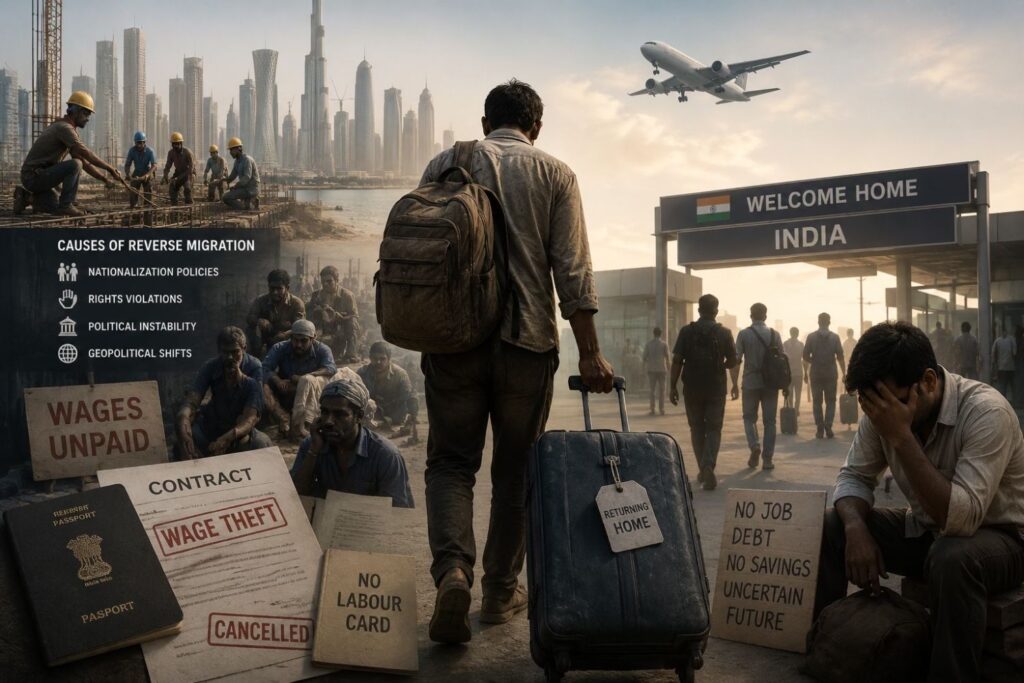
India has the largest Diaspora in the world and most of it resides in the Gulf countries. Many of these workers are blue collar workers – in semi-skilled and unskilled areas. Owing to the recent wave of nationalization, systematic violation of their rights, political upheavals and geopolitical shifts, there has been an increase in reverse migration from the gulf countries. The unskilled migrants face many hardships during and after the process. This paper aims to give an overview of their plight. The causes of reverse migration are inextricably linked with process. We first analyze the reasons they return to India. Then, the problems faced by them during the process of migration, such as wage theft, lack of resources and documentation are discussed. The difficulties after the migration process are numerous as well, encompassing financial strain, social alienation and limited income opportunities. We aim to bring attention to their difficulties so that the existing Indian framework for migrants can be improved by the government. This paper suggests more cooperation with the GCC and the development of policy frameworks to address the problems migrants face.
Keywords: Indian workers, reverse migration, GCC countries, human right
Introduction
The Gulf Cooperation Council states are among the biggest employers of migrant workers, who make up for almost a third of the total GCC population (Bel-Air, 2022). Reverse Migration from the Gulf Countries to India is a cyclic phenomenon due to economic shocks, policy changes and temporary laws for migrant laborers. The recent wave of nationalization and labour policy changes in the Gulf Cooperation Council, combined with the pre-existing human rights violations and exploitation, has increased the reverse migration from these countries, namely, Qatar, Saudi Arabia, United Arab Emirates, Bahrain, Oman, and Kuwait (Seethi, 2022). Many of these workers fall into the blue-collar category, i.e., semi-skilled and unskilled workers. They are fundamental to the GCC’s large infrastructure projects and their outwardly obscure contributions to construction, manufacturing, logistics, and healthcare are crucial to keep the country functioning efficiently. Yet, they have been toiling in uncertainty and mistreatment. Grappling with multiple predicaments abroad, many resolve to return home, but they face numerous problems. Even though they give huge contributions to the economy, making India the world’s largest recipient of remittances, the existing Indian framework for migrants is inept at rectifying their problems (Ansari & Rahman, 2021; World Bank, 2025). Hence, this study examines India’s capacity to support crisis-driven reverse migration of blue-collar workers returning from GCC countries and identifies policy gaps hindering their safe, dignified, and economically secure reintegration.
Despite recent labour laws reform in several GCC countries, such as the dismantling of the Kafala sponsorship system and other legislative changes that aim to grant migrant workers greater job mobility and rights. Indian blue-collar migrants continue to face persistent discrimination, exploitation, wage theft, passport confiscation, poor working and living conditions and restricted labor mobility due to weak enforcement of protection and structural power imbalances in host countries. Hence, our research focus will be on, how equipped is India to support crisis-driven reverse migration of blue-collar workers returning from GCC Countries and what policy gaps exist in ensuring their safe, dignified and economically secure reintegration?
Our study examines these objectives
- analyze the extent of labour exploitation (e.g., wage theft, passport confiscation, and unsafe conditions) as a primary driver of crisis-driven reverse migration among Indian blue-collar workers in GCC countries.
- To conduct a policy evaluation of the efficacy and implementation gaps of recent GCC labour reforms in protecting Indian blue-collar workers and mitigating human rights risks.
- To assess the socioeconomic and psychological reintegration challenges (e.g., unemployment, skill mismatch, and social stigma) faced by returning migrants in India.
- To identify and evaluate post-returning policy gaps in India’s framework for migrant welfare and protection to ensure safe and economically secure reintegration.
Literature Review
An ample of research highlighting the conditions of Indian migrants in Gulf countries is present, especially after the pandemic. A broad overview of all circumstances and policies related to Indian migration to GCC, and insights into how the migrant structure has evolved over time has been given by Seethi (2022). This paper was crucial in providing knowledge upon the history of exploitation that is persistent in Gulf countries. Ansari & Rahman (2021) evaluated the implications of Covid-19 upon Gulf migrants from Kerala. It focuses on the Socio-Economic Life-Social networks of the migrants. This paper discussed through data the problems faced by migrants and how the State addressed them, giving a clear idea of the direction of further reforms.
Gulf Labour Migrants and Migration have a plethora of useful factsheets, analysis, and books to understand the management of labour migration in countries of the Gulf Cooperation Council. Shah (2017) has elucidated the nature of irregular migration in the Gulf. The process through which laborers fall into traps of irregular cycles has been discussed. There is a homogeneity among Seethi, Ansari and Shah in agreeing with the lack of a proper policy framework for the migrants, both, in the host and source countries. It has thus become the focus of this research paper.
Existing scholarship on Indian blue-collar migration to GCC countries reveals persistent human rights vulnerabilities driving reverse migration, despite policy reforms. Dhankhar elucidates how the Kafala system—characterized by passport confiscation, contract substitution, and employer-controlled mobility—traps workers in bonded labor cycles, restricting job changes or exits even amid abuse, with weak enforcement perpetuating racial discrimination and unsafe conditions. Complementing this, Rajan and Balan (2023) provide Gulf-specific data on Indians as the dominant migrant group, documenting widespread wage theft, long hours, and social exclusion that undermine remittances’ economic narrative, while highlighting ECR-category workers’ heightened precarity due to low skills and debt burdens.
Recent analyses highlight a critical tension between legislative evolution and practical implementation in GCC labour sectors. While Tabassum (2026) documents “progressive shifts”—including Saudi Arabia’s 2025 Kafala abolition and the UAE’s 2024 mandates for written terms—these legal advancements are fundamentally challenged by Dhankhar’s critique of “reforms on paper.” The structural power imbalances inherent in nationalization policies, such as Saudization and Emiratization, often prioritize citizen employment quotas over migrant protections, effectively sidelining blue-collar Indian workers. This suggests that without addressing the underlying power dynamics and the absence of robust bilateral enforcement, legal reforms may fail to mitigate the systemic exploitation fueling undocumented returns.Broader welfare critiques expose India’s complementary shortcomings. Sarma (2021) illustrates domestic policy execution flaws through uneven Janani Shishu Suraksha Karyakram rollout, paralleling migrant schemes like SWADES’ failures in job matching for returnees, as noted by Rajan and Balan (2023). Collectively, the literature identifies exploitation mechanisms, reform inadequacies, and reintegration voids—but lacks post-2025 empirical synthesis on crisis-driven reverse migration, a gap this study addresses through mixed-methods analysis of blue-collar trajectories.
This study employs a mixed-methods approach, integrating qualitative and quantitative techniques to comprehensively examine reverse migration patterns and human rights risks among Indian blue-collar workers from GCC countries. Data collection involves semi-structured key informant interviews, utilizing purposive sampling to select diplomats, government ministers, and civil society actors to capture nuanced policy perspectives and lived experiences. This is supplemented by secondary quantitative data sourced from official organizations like the International Labour Organization (ILO) and United Nations agencies. Detail on the analytical procedures follows: qualitative data will undergo multi-stage thematic analysis to identify recurring patterns in exploitation and reintegration challenges, while quantitative data will be analyzed using statistical correlation techniques to establish relationships between variables, such as correlating wage theft incidence with return migration rates.
Historical Background of Indian Migration
Opportunities for the labor force to the Gulf opened up in the 1970s. Even before that, in the 19th century Indian merchants and sailors crossed the Arabian Sea for employment. However, due to the oil boom, cheap labor was in high demand and South Asia came at the forefront of supplying it. Workers travelled in high quantities from Kerala, Tamil Nadu and Uttar Pradesh. They became the backbone of the economy through remittances and were crucial in raising the socio-economic standard of these states. Due to the large number of temporary workers, settlement and citizenship was restricted for them unlike migration to developed western countries. This temporary nature was backed by both Gulf immigration laws, which explicitly restricted settlement and India’s emigration regime, which looked at overseas employment primarily as a form of economic relief. With recruitment agencies and middlemen extracting hefty fees and Gulf employers having total authority over employment and residency, Indian workers became subject to double vulnerabilities which were at home and abroad (Dhankhar, 2025).
Even though workers have struggled throughout decades, the Covid-19 pandemic extraordinarily highlighted the structural vulnerabilities faced by migrant workers and the importance of stronger policy interventions. The sudden upsurge in reverse migration was a bane for the migrants and the source countries. Indian blue-collar migrant workers are primarily employed in sectors such as construction, domestic work, transportation, and other service-related industries. For many individuals from economically disadvantaged regions of India, migration to the Gulf has long been an important strategy for improving household income and living standards. Higher wages and employment opportunities in GCC countries encourage workers to migrate and remit remittances to their families. These remittances play a crucial role in supporting household consumption, education, healthcare, and local economic development in many parts of India (World Bank, 2022).
Besides employment challenges, the pandemic also exposed the difficult living and working conditions faced by many migrant workers. Overcrowded labour accommodations, restricted mobility during lockdowns, and limited access to healthcare increased the vulnerability of migrant workers during the crisis (ILO, 2021).
Determinants of Crisis-Driven Return
Harsh working conditions
The Kafala system mandates that a person or institution that is not his sponsor or Kafeel employs a migrant worker. According to it, every non-citizen must have a sponsor to reside legally in a Gulf country. Once a person is hired on a valid work permit, issued by the concerned government authorities, he/she is issued a residency permit, usually for the period of the contract. Failure to issue or renew a work permit or residency permit can cause the worker’s illegal (Shah, 2017). This means Kafala gives employers almost complete control over workers and leaves them with few protections. To make matters worse, workers are not covered by these countries’ labor protections.
The scale of these human rights risks is reflected in the 48,095 labour complaints received by Indian embassies in the six GCC countries between 2019 and June 2023. The dire psychological toll of these conditions is further evidenced by rising suicide rates among Indian emigrant workers, which rose from 303 in 2016 to 322 in 2017 across UAE, Oman, Saudi Arabia, and Kuwait, with Indians consistently topping expat lists.
Across the countries where kafala is in place, domestic workers frequently report instances of employers withholding pay, failing to provide proper living conditions, forcing them to work extremely long hours without breaks, and verbally, physically, and sexually assaulting them (Human Trafficking Search, 2022). Migrant construction workers face wage theft, are forced to work backbreaking 12-hour days for months and even years on end without a single break day. Workers often run away from their employers to escape the abuse, but they become “irregular” since they are unlikely to have any documents, such as passports, since those documents are usually taken and kept by the kafeel (Shah, 2017).
Political Changes
Historically, Indian migrants have been navigating through the Gulf War (1990), the economic crisis (2008), the Arab Spring (2011) and the most intensive of them all – the Covid-19 pandemic (2020). Popular discontent with the internal politics and deteriorating economic conditions has often fueled the anti-immigrant outlook in these countries. In Oman, overseas migrants were blamed by protestors, who charged them with supporting corrupt local administration and commercial elites to manipulate the wage structure (Seethi, 2022).
Geopolitical instability has impacted the security of life and led migrant workers to seek ways back home. The recent escalation of tensions between the U.S.A. and Iran has precipitated the conflict to the Gulf. With multiple strikes in the area, it is a life threat to live there. Rescue is easier for the high skilled/white-collar workers but the blue-collared workers get the short end of the stick. They struggle with paying the high costs of the flights and some, after stumbling into the “irregular” status, don’t have any documents left to prove that they are Indian citizens.
Nationalization
Popular voices of discontent in the countries prompted the Gulf regimes to resuscitate the erstwhile policies of labour nationalisation (often referred to as Saudization, Qatarization, Omanization, Kuwaitization, Bahrainization, Emiratiszation etc.) and put in place measures to boost nationals’ employment. The GCC countries also applied pressures on commercial establishments (largely in the private sector) to regulate their overseas expatriate workforce. Saudi Arabia, for example, initiated a policy regime called Nitaqat (ranges) in September 2011. Saudi Arabia’s Vision-2030 agenda also caused alarm among the repatriates.
Qatar started austerity measures and called for public-funded companies to downsize their programmes, which had its natural impact increasingly felt among the expatriates in the country. Qatar Petroleum (QP), for example, laid off thousands of expatriate employees. Similarly, Oman introduced various policy measures aimed at substituting overseas workers with the country’s nationals. In Kuwait, the government-initiated Kuwaitization drive was part of the push to recruit more of its nationals. In Bahrain also, there was pressure on the government to slash the number of migrants. The law stipulated that in every firm a Bahraini should be employed for every four overseas workers (Seethi, 2022).
Issues Arising in the Return Phase
Migrant workers faced multiple systemic and personal hurdles during repatriation, particularly during crises like the COVID-19 pandemic, political unrest and conflicts, etc. These barriers are often compounded, turning a basic right to return home into a protracted struggle involving financial, logistical, and administrative obstacles.
Lack of Resources and Documentation
Perhaps the issue at the forefront is that blue-collar workers often don’t have the necessary finances to return during adversity. A study done by Rajan, I.S., & Arokkiaraj, H., (2021) highlights the insufficient measures by the Indian embassy during the pandemic in being able to repatriate migrants. Many were unable to pay the high prices of airfare. For example, the special flight from Kuwait to Chennai costs 78 Kuwaiti dinars (approximately Rs 19,100, or USD 263). If they were unable to pay the cost, no assistance was provided by the Indian embassy. Through the case of one, they tell the plight of many migrants wanting to return from the countries.
Due to harsh treatment by the employer, workers may run away from them, stranding them from their sole legal identity in the host country. Since, their documents proving them as Indians reside with their employer under the Kafala system; during their return many are unable to prove their nationality. This leaves them further stranded in a foreign land.
Wage Theft
Prominently seen during the Covid-19 pandemic but it has always been eminent. During 2020-21, thousands of migrant workers from South and Southeast Asia were denied wages amounting to $25.5 million and countries such as India, Bangladesh, Nepal (South Asia), Indonesia, and the Philippines (Southeast Asia) were the worst affected in terms of pay and benefit- related violations committed by employers and agencies in host countries (Seethi, 2022). Migrant rights promulgate strict protection of workers against wage theft but when the existing system permits it, no heed is paid to the moral rules. The ambiguous nature of employment is such that accountability can be easily avoided due to lack of proper documentation. The host countries ignore such vulnerabilities and violation continues despite ‘reforms’ on paper.
Post-Return Challenges faced by Gulf Migrants-The economic, psychological, and social problems that the Indian migrant labourers returning to the GCC countries have led to a convergence that has rendered reintegration among the seasons of the migration process to be one of the hardest. The data, and especially that of Kerala, where migrant returns are the most concentrated in India, is much flatteringly indicative of an inverse economic mobility trend and an institutional vacuum
Economic Poverty and Joblessness
The first challenge is unemployment. In an influential study of the Kerala rich, Kerala returnees were found to leave home to find themselves unemployed by a half, with the remaining half retiring or engaging in self-employment and wage labour. In a survey of 300 Kozhikode returnees of the Nitaqat-era, significant income and savings declines were observed . After returning, fewer offered programmes of state reintegration existed and a fundamental incompatibility between migrant profiles and policy support.
It is an important dimension that is underestimated. Based on the data of the Kerala Migration Survey 2018, 1 study concluded that 45.52 percent of Keralite emigrants had taken out loans to finance the move, which obliged them to have no source of income to repay their debts. The research arrived at a conclusion that funding migration through debts might not be a lucrative and sustainable venture (Sudha P., 2023). The Kerala emigrants in the Gulf, during COVID 19, lost up to half a million of their jobs. The state experienced an estimated loss of 13,000 crore of annual remittances (Paul & Mandal, 16).
Mismatch in Skills and Labor Market Barrier
The job crisis is caused by a structural issue that has no framework of mutual recognition of educational and vocational qualifications between India and GCC states. The employees who had years of construction, hospitality, or technical training in the Gulf do not feel the competencies are appreciated in their home countries. The expatriated workers of the COVID time are stereotypically categorized as of middle years, low education level, skills, and experience the type that the domestic labour market did not know how to utilize.
Mental Health and Psychological Misery
A survey of 330 return migrants in the Gulf discovered that the predictors of psychological well-being in return migrants were the quality of life, status in the occupation and stress. The reports on migrant workers in the GCC showed that those who came back as a failure, feeling worthless on their re-entry, and lacked access to the right type of jobs at home were in acute distress.
One study on psychosocial workplace conditions among 410 Indian migrants (low and semi-skilled workers in the Warangal district) in the GCC countries found that there were high work-related psychosocial health issues that the migrants bring to their countries.
Social Stigmatization and Family Destabilization
Return migrants are treated with a social reception that is impolite at best. An examination of Goan returnees established that they faced treatment as an unwanted guest in their family, society and state despite their decades of remittances made (Amballoor R., 2014).
The loss of the Gulf migrant identity, which is an important social prestige in sending communities, is a painful creation of status reversal. Once the main breadwinners, migrants are forced to rely on family networks, which puts immense pressure on the workers to navigate its way out amid the unwanted treatment faced by them.
Gaps within the existing system
Current frameworks for migrant repatriation reveal critical deficiencies, including inadequate coordination between central authorities and state governments, limited embassy support in host countries, and insufficient welfare mechanisms for low-income workers. These gaps exacerbate vulnerabilities, leaving returnees without timely financial aid, legal guidance, or reintegration support during crises in the migrant country or home country.
Responses by Policymakers
India’s response to return migration demonstrates significant institutional reach, most notably through the Vande Bharat Mission, which successfully repatriated over 926,000 workers from GCC countries during the pandemic. The government provides a multi-channel grievance system including MADAD and eMigrate, alongside specialized welfare wings in missions abroad. Kerala has further led the way with NORKA, an ambitious department designed to address returnee welfare. However, these mechanisms remain fragmented. For example, while the Skilled Workers Arrival Database for Employment Support (SWADES) creates a valuable inventory of skill sets, it has often failed to translate into sustainable domestic jobs, highlighting a persistent gap between repatriation logistics and long-term economic reintegration.
The Migration Research Series published by the IOM has recommended reintegration measures that transcend the economic aspect of the issue, incorporating a social and psychological aspect as well – a recommendation that has not been much put into practice. The structural issue lies in its centre, the GCC migration system constructed on the Kafala framework views labour as a disposable resource. During boom, the workers are imported and during bust, they are exported and there is no responsibility by both the sending and the receiving countries to deal with the aftermath of sending workers back home. Until India can generate some systematic and portable form of social protection of its migrant workers and some reliable methods of reintegration back home every economic shock in the Gulf is going to repeat the same episode of suffering.
The Gulf region has been a prominent destination for Indian migrants seeking employment opportunities and higher wages. 2019 till June 30, 2023, the Indian embassies in Bahrain, Oman, Kuwait, United Arab Emirates, Qatar and Saudi Arabia, together received 48,095 labour complaints from Indian migrant workers. However, this migration corridor involves complexities and hardships, which can have significant implications for the migrant workers, their families, and the sending and receiving countries (IndiaSpend, 2023).
“Despite the positive experiences of migrant workers, a significant number face undue hardships and abuse in the form of low wages, poor working conditions, virtual absence of social protection, denial of freedom of association and workers’ rights, discrimination and xenophobia as well as social exclusion” (ILO, 2004). Unskilled, semi-skilled and low skilled workers, many of whom fall under the ECR category in India are more likely to get trapped in very precarious situations in India and abroad due to their inherent problems. “Temporary workers and migrant domestic workers often have limited legal rights, may be excluded from social security benefits and may face multiple disadvantages (ILO, 2004)”.
Humanitarian agencies like Human Rights Watch (HRW), Gulf Centre for Human Rights (GCHR), Emirates Association for Human Rights (EHRA) and Amnesty International are actively engaged in the Gulf region and regularly document these violations. Sadly, none of the Gulf countries that hire workers, or India, has approved the UN’s International Convention on the Protection of the Rights of All Migrant Workers and Their Families (ICPRAMWTF). So, these Gulf countries have no international duty to protect their migrant workers.
The Gulf labour market is characterised by rigidity, imperfections and absence of labour rights. In spite of that wages for lower rungs of jobs in the Gulf countries are still quite higher in comparison with the wages in labour exporting countries. This is because demand for labour for manual and menial jobs in India, the Philippines, Pakistan, Nepal, Bangladesh, Sri Lanka and Indonesia (Fargues, P. & Nasra M. Shah, 2012) is very high. The labour force entering the Gulf for these jobs from other countries get absorbed in blue collar jobs which are characterized by delayed payment, long working hours and poor working conditions.
Contract Substitution and Passport Confiscation
Passport confiscation enables one of the worst exploitations: bonded labour. Employers often re-skill and re-medical them to justify lower wages, force daily overtime without fair pay, and subject them to indecent working conditions. Workers endure inhuman, pathetic accommodation, shackled employment with no job security, and zero tenure protections. Without unionisation or bargaining power, they remain powerless.
Compounding this vulnerability, GCC regulators and governments struggle to effectively monitor compliance. Despite legal bans on passport retention (such as Oman’s 2023 decree), weak enforcement enables employers to avoid accountability. At the same time, India’s Protector General of Emigrants (PGoE) and overseas missions lack real-time oversight of recruitment chains, leaving blue-collar workers exposed and without proactive protection.
Rising Suicide Rate among Indian Emigrant Workers in Gulf
Between 2019 and June 2023, 48,095 complaints of abuse were filed by Indian workers in the six Gulf countries, with the highest number coming from Kuwait. The miseries of the Indian emigrant workers in the Gulf are evident from an alarmingly rising suicide rate among them. For instance, suicides rose from 303 in 2016 to 322 in 2017 across UAE, Oman, Saudi Arabia, and Kuwait, with Indians topping expat lists—over 40% in Saudi alone and trends persisting into recent years. A 2026 review confirms Indians as the majority of cases, mostly young males using hanging or jumping amid exploitation.
The MEA placed all blame on fake recruitment agencies in response to a parliamentary question over the emigrants’ miseries, despite over 29,000 total deaths in the last four years. Without labor mobility partnership agreements (LMPAs) with Gulf countries, Indian missions remain powerless. The Indian and state governments’ apathy worsens this helplessness. Surprisingly, neither knows how many emigrants live or work there, let alone their whereabouts.
Limited Adoption and Ineffective Implementation of Labour Laws
The UAE’s Federal Decree Law No. 33 (2021) and No. 9 (2024) mandated written contracts, abolished unlimited terms, introduced flexible work categories, extended maternity leave, and required labour cards with rapid onboarding. However, Emiratization quotas (e.g., two Emiratis for firms over 50 workers) prioritize nationals, sidelining migrants amid uneven enforcement and persistent wage disputes.
Saudi Arabia’s 2025 Kafala abolition via the Labour Reform Initiative (2021) allowed job changes without sponsor consent, exit without permission, fixed-term contracts (one-year default), and unified written forms. Yet, unreleased implementing regulations, Saudization penalties (e.g., non-renewal of permits), and training quotas for nationals create implementation gaps, leaving blue-collar workers exposed to non-compliance by employers.
Kuwait’s Resolution No. 15 (2025) demands electronic tracking of hours and rest via PAM, while exit permits remain employer-controlled. Kuwaitization penalties tighten restrictions, contradicting flexibility elsewhere. Weak oversight sustains passport confiscation and forced labour cycles despite documentation mandates.
Qatar’s Law No. 19 (2020) eliminated NOC and exit permits, introduced a QAR 1,000 minimum wage (2021), and added support centres with new courts. Implementation falters through inconsistent enforcement, especially for domestics, and structural biases favouring nationals over low-skilled migrants.
Bahrain’s Law No. 14 (2024) limits Labour Fund aid to 100% Bahraini-owned firms, bans visit-to-work visa conversions, caps foreign hires, and boosts Bahrainization. These restrictive shifts, unlike relaxations elsewhere, drive reverse migration without compensatory protections, highlighting policy reversals over reform.
Oman’s Royal Decree 53/2023 banned passport withholding, required written five-year contracts, granted 30-day leave, and set dispute mechanisms, while banning expat visas for 200 professions. Omanization focus undermines adoption, as employers evade rules, prolonging poor conditions for unskilled Indians.
Across GCC states, reforms exist on paper but falter due to an institutional failure where deep-seated structural power imbalances and nationalization quotas institutionally override formal legal changes and worker rights. The prioritization of citizens via Saudization or Emiratization effectively sidelines blue-collar Indians, fueling undocumented returns without reintegration support. True change demands rigorous audits, cross-border agreements, and penalties for violations to address the underlying power dynamics that override legislative evolution.
While the Government of India has schemes that support these blue-collar migrant workers fleeing Gulf hardships like the Kafala system and passport confiscation remains fragmented and inadequate.
According to the MEA, under the Vande Bharat Mission, beginning May 7, 2020, India has brought back 926,852 workers from the GCC countries until September 15. This is almost two-thirds of the total Indians repatriated under the mission from all over the world and one tenth of the total Indian expatriates in the GCC. Post-2025 trends show rising returns without reintegration support. Given the economic challenges and labour reforms in the Gulf, the return migration trend is unlikely to witness a serious reversal soon.
Yet to support this return migration, initiative has been made through Skilled Workers Arrival Database for Employment Support (SWADES) that aims to create a database of qualified citizens based on their skill sets and experience to empower them with relevant employment opportunities. However, it failed to deliver sustainable jobs, with returnees facing unemployment, low wages and skill match amid post-Covid economic losses. (IDSA, 2020)Chain of Unregulated IntermediariesA primary loophole lies in the multi-layered chain of intermediaries between authorised recruiting agents and prospective migrants. This opaque network inflates migrants’ costs often exceeding official fees by 5-10 times,
pushing workers into debt bondage and preys on low-skilled, uninformed individuals. India must enforce strict licenses, digital tracking of agent chains and caps on fees to dismantle this exploitative structure.
Absence of Labor Mobility Agreement and Data Deficiencies
With our bilateral labor mobility partnerships with Gulf states like Saudi Arabia or UAE, Indian missions abroad operate as passive observers, reliant on host governments’ whims. Compounding this, bureaucratic apathy from central and state governments leave mission powerless. Surprisingly, neither the Protector General of Emigrants (PGoE) nor missions track migrant numbers accurately, estimates 8-10 million Indian blue – collar workers in the Gulf, but official e-migrate portal data covers under 20%.
Reforms should prioritize LMPs for reciprocal protections, mandatory migrant registration via a centralized database, and empowered missions with proactive monitoring.
These gaps only fuel human rights risks such as wage theft and force repatriation but also erode India’s
diplomatic leverage. Addressing them through legislative updates and tech integration could safeguard millions.
Conclusion
The Indian government maintains a robust framework for safeguarding blue-collar migrant workers, prioritizing emigrant welfare through dedicated mission labor wings and Labor and Manpower Cooperation MOUs with all GCC states. Multi-channel grievance systems such as MADAD, CPGRAMS, and the 24×7 helplines in Dubai and Riyadh provide essential lifelines for workers facing abuse. These mechanisms offer active mediation and consular support that provide a vital foundation for migrant protection. Despite the value of these current systems, significant implementation gaps persist—unregulated recruitment chains, persistent passport confiscation, and fragmented reintegration support—which exacerbate human rights risks and drive reverse migration. True reform requires evolving these existing mechanisms into comprehensive bilateral enforcement frameworks to ensure that formal protections translate into safe and dignified returns.
Missions actively mediate with employers and local authorities while organizing consular camps for direct worker feedback. However, this study reveals that formal mechanisms fail to address implementation shortfalls—unregulated recruitment chains, persistent passport confiscation, and fragmented reintegration support—leaving millions vulnerable despite official frameworks, underscoring the urgent need for bilateral enforcement and policy reform to ensure safe, dignified returns.
Yet challenges persist as many returnees face difficulties finding suitable employment because of limited job opportunities in the domestic labour market and a mismatch between their overseas work experience and available local employment. The loss of remittance income also places financial pressure on migrant households and communities that depend on overseas earnings (IOM, 2021).Improving bilateral labour agreements between India and GCC countries can help ensure better protection of migrant workers’ rights, fair wages, and safer working conditions, while drawing on successful international models such as EU‑style voluntary‑return and reintegration programmes, Canada’s and Australia’s development‑oriented labour‑mobility frameworks, and Scandinavian active‑labour‑market approaches that explicitly link returnee support with employment guarantees and skill‑upgradation. The Indian government should therefore strengthen national‑level mechanisms such as a dedicated National Return and Reintegration Programme, expand bilateral readmission and reintegration agreements, pre‑departure counselling, and in‑country job‑match platforms, and align reintegration programmes, skill‑development initiatives, and employment opportunities for returning migrants with sector‑specific demand. Such policy measures are essential for reducing the economic and social challenges associated with reverse migration, preventing abrupt policy‑induced returns, and promoting more secure, dignified, and sustainable migration systems in the future.
References
Amballoor R., G. (2014). Socio – Economic Concerns of Return Emigrants: A Case Study on Goa. Asian Review of Social Sciences , 3 (2), 30-33.
Bel-Air, F. D. (2022, October ). Explaining the “Demographic Imbalance” in the Gulf States. Retrieved March 2026, from Gulf Labour Markets, Migration and Population: https://gulfmigration.grc.net/explaining-the-demographic-imbalance-in-the-gulf-states/
Dhankhar, A. S. (2025). Challenges Faced By Indian Migrant Workers In Gulf Countries: The Kafala System, Bonded Labor, And The Need For Legal Reform. Indian Journal of Law and Legal Research , 7 (4).
Human Trafficking Search. (2022, August 19). The Kafala System: An Issue of Modern Slavery. Retrieved from Human Trafficking Search: https://humantraffickingsearch.org/the-kafala-system-an-issue-of-modern-slavery/
International Organization of Migration. (2024). World Migration Report 2024. Retrieved March 2026, from World Migration Report: https://worldmigrationreport.iom.int/msite/wmr-2024-interactive/
Ministry of External Affairs. (2025, March). Population of Overseas Indians. Retrieved March 2026, from Ministry of External Affairs, Government of India: https://www.mea.gov.in/population-of-overseas-indians.htm
Parambengal, A., & Kalam, S. P. (2023). An institutional framework for the socio-economic reintegration of return migrants: A Kerala experience. Journal of Public Affairs , 23 (3), e2855.
Paul, M., & Mandal, S. (16). Debt-financed emigration, migration experience, and household economy: insight from Kerala, India. South Asian Diaspora , 125 – 143.
Rajan, S. I. (2023). Return Migration Governance in India during COVID-19. Geneva: International Organization for Migration.
Rajan, S. I., & Arokkiaraj, H. (2021). Amnesty and undocumented Indian workers in Kuwait during COVID-19. Retrieved March 2026, from Max Planck Institute for Social Anthropology: https://www.eth.mpg.de/5818096/amnesty_and_undocumented_indian_workers
Rajan, S. I., & Balan, J. R. (2023). Indians in the Gulf [Policy brief]. Gulf Labour Markets, Migration and Population Programme.
Rajan, S. I., Pattath, B., & Tohidimehr, H. (2023). The last straw? Experiences and future plans of returned migrants in the India-GCC corridor. Journal of Ethnic and Migration Studies , 49 (20), 5169–5189.
Sarma, B. B. (2021). Assessment of the performance of Janani Shishu Suraksha Karyakram (JSSK) in Kamrup district of Assam. International Journal of Research in Academic World , 2 (7).
Seethi, K. M. (2022). Human Mobility and Reverse Migration in Asia: Triggers and Travails. Journal of Polity & Society , 21-41.
Shah, N. M. (2017). Introduction: Skilful Survivals – Irregular Migration to the Gulf. In P. Fargues, & N. M. Shah, Skilful Survival: Irregular Migration to the Gulf(Edited Volume) (pp. 1-11). Gulf Labour Markets and Migration.
Sudha P., M. (2023). Return Migration in the Era of Global Uncertainty: Revisiting Kerala’s Nitaqat Repatriation as a Policy Framework for Emerging Repatriation Threats. Educational Administration: Theory and Practice , 29 (4), 5696–5700.
Tabassum, M. (2026, February 5). Indian expatriates and labour reforms in GCC countries (Issue Brief). Retrieved from Manohar Parrikar Institute for Defence Studies and Analyses: https://idsa.in/wp-content/uploads/2026/02/Issue-Brief-Ms-Tabassum-05-February-2026.pdf