Authors: Vidhi , Ronak Reddy , Prerna Parashar
Abstract
Plastic pollution has become one of the most pervasive environmental challenges of the twenty-first century, with microplastics (<5 mm) and macroplastics (>5 mm) now documented across rivers, lakes, estuaries, and oceans, with more limited but growing evidence in groundwater systems. To keep the analysis tractable, this review concentrates on riverine and marine contamination as primary sources and transport pathways, drawing on groundwater and drinking-water literature only where it directly informs the detection methodologies discussed. It adopts a dataset-driven, integrative synthesis approach, combining five secondary sources — a Lagrangian ocean particle-tracking model (Chassignet et al., 2021), a systematic review of microplastics in drinking water (Danopoulos et al., 2020), a river sediment field survey (Tibbetts et al., 2018), the Atlas of Ocean Microplastics (AOMI, 2024), and the OECD Global Plastics Outlook (1990–2060) — with peer-reviewed literature on ecological impacts, microbial colonization, and detection methodology. These five sources were selected for complementary rather than overlapping coverage: each contributes a distinct combination of geographic scope, temporal depth, or analytical resolution that the others do not, as detailed in the Literature Review.
Findings indicate that global plastic leakage into the environment, estimated at around 22 million tonnes per year as of 2019, is projected under current policy settings to roughly double by 2060, with transport pathways carrying debris across ocean basins into persistent accumulation zones such as the major oceanic gyres. Beyond physical harm through ingestion and entanglement, plastic surfaces host distinct microbial communities — the “plastisphere” — that may, under certain conditions, act as vectors for opportunistic or pathogenic organisms, while leached additives such as phthalates and BPA raise health concerns that remain under active investigation rather than settled. Because analytical techniques (FTIR, Raman spectroscopy, SEM-EDS, and PyGC/MS) differ substantially in sensitivity, cost, and destructiveness, cross-study comparability remains limited; this review therefore adopts a narrative rather than statistical synthesis, and presents a systematic, criterion-based comparison of the four detection techniques rather than treating them as interchangeable. The study concludes that plastic contamination in aquatic systems is a compounding, multi-pathway problem that requires standardized detection protocols and stronger policy intervention to curb future leakage.
Keywords
Microplastics; Macroplastics; Water pollution; Plastisphere; Marine debris; FTIR; Detection and quantification; Environmental leakage
Introduction
Plastic is one of the most widely used materials in modern life, valued across packaging, construction, textiles, and consumer goods for its versatility, durability, and low cost. The same durability that makes plastic useful is also the source of a growing environmental problem: plastic degrades extremely slowly under natural environmental conditions, with large items persisting for decades to centuries before fragmenting into microplastic particles. These particles enter rivers, lakes, estuaries, and oceans, where they come into contact with aquatic life and sediments, and — via drinking water and the food chain — with human populations. Evidence of microplastic presence in groundwater is more limited but is an area of active and growing research.
Global plastic waste generation has risen sharply since 1990, and despite improvements in recycling and waste-management infrastructure in some regions, a substantial share of this waste is not captured by any organized collection system and instead becomes environmental leakage. This leakage is not confined to its point of origin: ocean circulation can carry plastic debris thousands of kilometres from its source, while inland pathways move it from soil to rivers and, to a lesser and less well-characterized extent, through aquifers toward treatment infrastructure.
Plastic debris also carries ecological dimensions that are only beginning to be understood. Microplastics enter aquatic food webs at low trophic levels, and macroplastics cause entanglement and ingestion-related blockage in larger organisms; evidence for biomagnification through higher trophic levels, however, remains mixed across the literature rather than uniformly established, as discussed in the Literature Review. Plastic surfaces also host distinct microbial communities — the plastisphere — that differ compositionally from the surrounding water and, in some documented cases, include potentially pathogenic taxa. Meanwhile, the identification and quantification of plastic particles remains methodologically difficult because of the diversity of particle size, shape, and polymer type, and because of the differing sensitivity and destructiveness of available analytical methods.
Given this breadth, this review deliberately narrows its scope to microplastic and macroplastic contamination in freshwater and marine systems, with particular emphasis on riverine and coastal environments as primary sources and transport pathways. Groundwater and drinkingwater contamination are referenced only where they intersect with the detection methodologies under discussion, rather than treated as a fully separate thematic pillar; a comprehensive treatment of every water-body type was judged to be beyond the scope of a single review, and this narrower focus allows deeper engagement with the analytical and ecological literature rather than a survey-level treatment of the entire hydrosphere.
Within this narrowed scope, the purpose of this study is to synthesize existing knowledge and quantitative data on micro- and macroplastic pollution in water bodies across four thematic areas: (1) sources and global distribution of plastic pollution, (2) ecological impact and transport pathways, (3) microbial colonization of plastic debris, and (4) detection and quantification methodology. The aim is to characterize the direction, relative magnitude, and trend of plastic contamination in aquatic systems, and to make explicit the methodological constraints — differing units, sampling depths, and detection thresholds — that limit direct comparison across the underlying data sources.
Literature Review
Plastic’s affordability, light weight, durability, and versatility have driven its widespread global consumption and production. Because plastic degrades only very slowly under natural environmental conditions, it accumulates rather than dissipates, producing the widespread pollution now documented across rivers, lakes, estuaries, oceans, and — to a lesser extent — groundwater systems. This accumulation affects water quality, aquatic life, and, increasingly, human health. Microplastics (particles <5 mm) and macroplastics (particles >5 mm) are the principal size classes driving this contamination.
The five datasets underpinning this review were selected for the distinct, non-overlapping evidence each contributes, rather than for simple availability. The Chassignet et al. (2021) Lagrangian ocean model simulates a decade (2010–2019) of mismanaged plastic waste transport across more than 190 countries, making it the principal source for origin-todestination transport pathways rather than concentration measurement. The NOAA NCEI Marine Microplastics database complements this by providing long-run (1972–present) empirical measurements across four environmental compartments — ocean water, sediments, beaches, and nurdle surveys — offering the temporal depth that a decade-scale model cannot. The Atlas of Ocean Microplastics (AOMI, 2024) contributes fine-grained spatial resolution on present-day hotspot distribution, though its coverage has been operational only since 2024 and is still developing global reach. The Tibbetts et al. (2018) river sediment survey extends the analysis inland, addressing a freshwater and benthic compartment that the primarily marine datasets do not cover. Finally, the OECD Global Plastics Outlook (1990–2060) supplies the macro-level productionand-leakage trajectory — historical and projected — against which the other, more spatially or temporally bounded datasets can be interpreted. Because these datasets differ in geographic coverage, time window, and reporting unit (tonnes/year, particles/L, particles/kg sediment, particles/m³), they are not statistically pooled; their value lies in the complementary angles they provide on a single underlying phenomenon, as elaborated in the Research Methodology section.
Read together, these sources indicate that microplastic concentration varies considerably with oceanographic conditions, geographic location, and proximity to pollution sources, rather than following a uniform global distribution. OECD data show that global plastic waste generation rose substantially between 1990 and 2019; despite improved recycling and waste-management systems in some regions, a large share of plastic waste continues to be landfilled, incinerated, or released into the environment. When plastic waste escapes formal waste-management systems and enters natural ecosystems, this is termed environmental leakage.
Once in aquatic systems, microplastics are consumed by plankton, small fish, and shellfish, entering the food web at its lowest trophic levels. Laboratory exposure studies report that microplastics can cause oxidative stress, cellular damage, inflammation, reproductive impairment, and behavioural changes in aquatic organisms, though these effects are typically observed at exposure concentrations that exceed those measured in the field, which limits direct extrapolation to wild populations. Evidence for biomagnification — the accumulation of plastic particles in progressively larger organisms up the food chain — is similarly not uniform: some studies report measurable accumulation in higher-trophic-level organisms, while others find no significant trophic transfer, so this remains an area of active investigation rather than an established pattern. Taken together, the literature demonstrates a consistent association between rising plastic production, waste generation, environmental leakage, and the accumulation of plastic in aquatic ecosystems, even where the downstream biological consequences of that accumulation are still being characterized.
Ecological Impacts and Environmental Distribution of Micro- and Macroplastic Pollution
Beyond microplastic ingestion at the cellular level, macroplastics inflict direct physical harm on aquatic organisms through entanglement and blockage. Marine mammals, turtles, seabirds, and fish frequently become trapped in discarded fishing gear, packaging, and other floating debris, resulting in restricted movement, injury, and in some cases death. Ingested macroplastic fragments can obstruct digestive tracts, contributing to false satiation, reduced feeding efficiency, and malnutrition. The Chassignet et al. (2021) ocean model demonstrates that this harm is not confined to the point of origin: plastic released from one country’s coastline can travel thousands of kilometres via ocean currents before settling in convergence zones such as the North Pacific, South Pacific, North Atlantic, South Atlantic, and Indian Ocean gyres. These gyres function as longterm accumulation sites, concentrating both micro- and macroplastic debris into dense garbage patches over extended timescales; the model estimates the Great Pacific Garbage Patch alone holds several hundred thousand tonnes of mismanaged plastic waste accumulated over a decade, though this figure reflects model assumptions about decay and transport rather than a direct field census.
The AOMI dataset indicates that microplastic concentration is not uniform but clusters in specific hotspots — the North Pacific, North Atlantic, Mediterranean Sea, Arabian Sea, and Bay of Bengal — typically corresponding to coastal zones near dense urban populations, shipping lanes, and fishing grounds. This spatial clustering suggests ecological effects are disproportionately concentrated in these regions, where sustained exposure compounds biological stress on local marine life. The NOAA NCEI Marine Microplastics database extends this picture beyond the
Water column, documenting microplastic burdens in sediments, beaches, and nurdle deposits, which indicates that plastic contamination also accumulates in the benthic environment, where bottom-dwelling and filter-feeding organisms face prolonged exposure.
The OECD Global Plastics Outlook adds a structural dimension: environmental leakage, estimated at roughly 22 million tonnes in 2019, is projected to approximately double to around 44 million tonnes per year by 2060 under existing policy settings, meaning the scale of the physical and ecological harm described above is expected to intensify rather than plateau under a businessas-usual trajectory. Plastic particles — both micro and macro — can also act as vectors for secondary contamination, adsorbing heavy metals, pesticides, and persistent organic pollutants from the surrounding water; whether and to what extent these adsorbed contaminants transfer into organism tissue upon ingestion, and how this compounds toxicological effects relative to the plastic particle alone, remains an active area of research rather than a fully resolved mechanism.
Microplastic pollution is not confined to marine settings: rivers, lakes, and — to a more limited and less consistently documented extent — groundwater and treatment plants also contribute to inland dispersal of these particles. Reported levels differ considerably by region and by testing method, and while wastewater treatment plants remove a large proportion of influent microplastics, the sheer volume of water processed means that even a small residual leakage fraction can be significant in aggregate. Groundwater contamination, where documented, is generally attributed to particle seepage through soil or exchange between rivers and aquifers; because this remains a comparatively understudied pathway relative to surface-water contamination, this review treats groundwater findings as indicative rather than comprehensive.
Microbial Colonization: The “Plastisphere” Effect
An emerging dimension of plastic pollution research concerns the microbial communities that colonize plastic debris surfaces, termed the “plastisphere” by Zettler et al. (2013). Their study of plastic marine debris collected from the North Atlantic used scanning electron microscopy and gene sequencing to identify a diverse microbial community of heterotrophs, autotrophs, predators, and symbionts, compositionally distinct from that found in the surrounding seawater. Surface pitting observed on plastic fragments matched bacterial morphology, suggesting active microbial hydrolysis of the polymer, and the sequencing work identified several hydrocarbondegrading bacteria, raising the possibility that microbes contribute to plastic degradation in the marine environment.
This colonization is not incidental: plastic’s longer persistence relative to natural floating substrates, combined with its hydrophobic surface, appears to promote microbial colonization and biofilm formation in a manner distinct from naturally occurring materials in the upper ocean layers. Subsequent taxonomic work has found that Proteobacteria — including the
Classes Alphaproteobacteria, Gammaproteobacteria, Betaproteobacteria, and Deltaproteobacteria — are Consistently enriched on plastic surfaces relative to surrounding seawater, alongside diatoms and cyanobacteria that often dominate as early colonizers of particular relevance to ecological and public-health risk, plastisphere communities have in some field studies been found to include members of the Vibrio genus — a bacterial group encompassing several human and marine-organism pathogens — dominating specific plastic samples under specific conditions; this finding should be read as evidence that plastic debris can host pathogenic taxa under favourable conditions, not as a general claim that plastisphere colonization routinely produces pathogen transport. This observation has nonetheless prompted research examining whether plastic debris functions as a vector transporting pathogenic or opportunistic microorganisms across long distances via the same ocean currents mapped by the Chassignet et al. model — a linkage that couples physical transport pathways with biological risk in a way the OECD, NOAA NCEI, and AOMI datasets do not individually capture.
Human exposure to microplastics occurs primarily through ingestion, inhalation, and dermal contact, and microplastic particles have been detected in blood, placental tissue, lung tissue, and, in preliminary studies, brain tissue. Research increasingly points to potential reproductive, digestive, respiratory, and cardiovascular effects; however, the current evidence base establishes association and biological plausibility rather than confirmed causation in humans, and no regulatory exposure limits currently exist.
Beyond surface-hosted microorganisms, plastics themselves contain chemical additives such as plasticizers and flame retardants that can leach out over time, particularly under sun exposure. Compounds such as phthalates and BPA are associated with hormonal disruption in laboratory and epidemiological studies, and remain largely unregulated in this context, though the strength of evidence varies by compound and exposure route.
Inconsistent testing standards across studies make direct comparison difficult, and international negotiations toward a binding plastics treaty remain ongoing without full resolution, leaving freshwater-specific risks comparatively less addressed than marine risks in current policy frameworks.
Detection and Quantification of Microplastics in Water Bodies
Accurate detection and quantification of microplastics is fundamental to assessing the extent of plastic pollution in aquatic ecosystems. Because microplastics vary widely in size, shape, colour, and polymer composition, no single analytical technique can identify every particle, and researchers typically combine sampling, separation, identification, and characterization methods.
Water samples are commonly collected using grab sampling, manta trawl nets, neuston nets, or pump filtration systems, depending on the water body. Rivers and lakes generally use grab or pump sampling, whereas marine studies frequently employ manta trawls with mesh sizes ranging from 300–500 µm. After collection, samples are filtered through glass-fibre or membrane filters to concentrate plastic particles.
Organic matter in the samples is typically removed through chemical digestion using hydrogen peroxide (H₂O₂), Fenton’s reagent, potassium hydroxide (KOH), or enzymatic digestion. Density separation is then performed using saturated sodium chloride (NaCl), zinc chloride (ZnCl₂), or sodium iodide (NaI) solutions, since most plastics have lower densities than mineral particles; this allows plastic particles to float while heavier sediments settle.
Initial identification is usually carried out by stereomicroscopy, classifying particles by colour, shape (fibres, fragments, films, foams, or pellets), and size. Visual inspection alone, however, cannot reliably distinguish plastics from natural materials and frequently results in misidentification, which is why confirmatory spectroscopic or chemical methods are generally required.
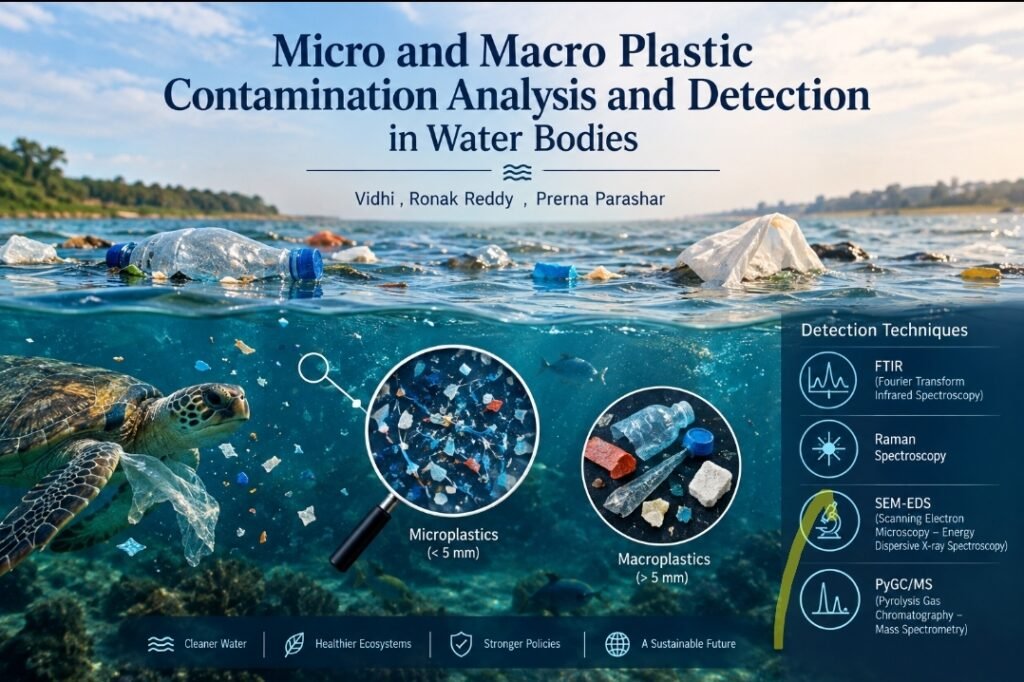
The four principal confirmatory techniques — FTIR, Raman spectroscopy, SEM-EDS, and PyGC/MS — differ substantially in sensitivity, cost, destructiveness, and the particle-size range each can reliably detect. Rather than being interchangeable, each is suited to a different stage or purpose within a detection workflow.
Fourier Transform Infrared Spectroscopy (FTIR) is the most widely adopted technique for polymer identification, measuring the infrared absorption spectrum of particles and comparing it against reference polymer libraries to identify materials such as polyethylene (PE), polypropylene (PP), polyethylene terephthalate (PET), polystyrene (PS), and polyvinyl chloride (PVC). Micro-FTIR can detect particles as small as approximately 20 µm with high accuracy, but cannot reliably resolve particles below that threshold.
Raman spectroscopy offers higher spatial resolution, capable of identifying particles smaller than 1 µm, and is less affected by water content than FTIR, making it particularly useful for coloured or weathered plastics. Fluorescence interference and higher instrument cost, however, remain significant practical limitations.
Scanning Electron Microscopy (SEM), often coupled with Energy Dispersive X-ray Spectroscopy (EDS), is used to examine surface morphology, weathering patterns, and elemental composition. SEM imaging reveals cracks, pits, and biofilm formation associated with environmental degradation, but on its own confirms Morphology and elemental signature rather than definitive polymer identity.
Pyrolysis Gas Chromatography Mass Spectrometry (Py-GC/MS) is among the most precise techniques for quantitative polymer analysis: particles are thermally decomposed into characteristic compounds, enabling accurate identification and mass quantification of different polymers. This precision comes at the cost of being fully destructive — the analyzed particle is consumed — and the technique requires sophisticated laboratory equipment.
Because no single method satisfies all four criteria (sensitivity, cost, non-destructiveness, and particle-size range) simultaneously, studies increasingly pair a non-destructive screening method — FTIR or Raman — with a destructive confirmatory method such as Py-GC/MS for chemical validation. Recent advances, including hyperspectral imaging, automated FTIR mapping, fluorescence staining using Nile Red dye, and artificial-intelligence-based image analysis, aim to reduce analysis time while improving detection accuracy, though their adoption across the datasets reviewed here remains uneven.
Research Methodology
This study adopts a dataset-driven, integrative synthesis design, combining peer-reviewed literature with five secondary datasets to examine plastic contamination across sources, transport pathways, concentrations, and future projections. Five sources were analyzed: a Lagrangian ocean particle-tracking model (Chassignet et al., 2021; also released as UNEP data), a systematic review of microplastics in drinking water (Danopoulos et al., 2020), a river sediment field survey (Tibbetts et al., 2018), the Atlas of Ocean Microplastics (AOMI, Japan MOE, 2024), and OECD Global Plastics Outlook data (1990–2060), cross-referenced with NOAA NCEI’s Marine Microplastics database (1972–present).
Data were extracted and compared across four dimensions: geographic/temporal coverage, data granularity, measurement units, and policy relevance, following a capability-comparison framework used to benchmark the datasets against one another. Because units differ substantially (tonnes/year, particles/L, particles/kg sediment, particles/m³), findings were synthesized narratively rather than statistically pooled, consistent with the heterogeneity-driven approach adopted in the Danopoulos et al. (2020) systematic review.
Modeled outputs (Chassignet et al., 2021; OECD projections) were treated as scenariodependent estimates rather than direct measurements, given their documented sensitivity to assumptions such as decay timescale and business-as-usual policy conditions. Empirical datasets (NOAA NCEI, AOMI) were used to contextualize and, where possible, cross-check modeled predictions, while acknowledging their own limitations — namely, non-standardized historical sampling protocols and AOMI’s still-developing global coverage since its 2024 launch. Sourceattribution data (OECD) and transport-pathway data (the Chassignet et al. model) were combined to construct an originto-destination pollution chain, while explicitly noting that OECD figures likely underestimate leakage relative to more recent land-to-sea transport estimates.
Literature Search, Selection Criteria, and Qualitative Synthesis
Beyond the five quantitative datasets described above, the review incorporated a targeted body of peer-reviewed literature to address dimensions the datasets alone cannot capture — ecological mechanisms, microbial colonization, and analytical detection methodology. Sources were identified through keyword searches (e.g., “microplastic,” “macroplastic,” “plastisphere,” “ocean gyres,” “polymer detection”) and prioritized where they corresponded directly to entities represented in the quantitative datasets, so that the narrative synthesis could interpret dataset findings rather than stand apart from them.
The ecological-impact literature (entanglement, ingestion, biomagnification) was synthesized to contextualize the physical-harm pathways underlying the AOMI hotspot distributions and the OECD leakage projections — that is, dataset-reported concentrations were paired with mechanism-level literature explaining how elevated concentration relates to organismal harm, rather than treating concentration as an end point in itself.
Zettler et al. (2013) was treated as the anchor source for the microbial colonization (“plastisphere”) dimension, since none of the five quantitative datasets captures biological colonization directly. This source was used to extend the transiport-pathway analysis established through the Chassignet et al. model: because plastisphere communities (including Vibrio spp.) have been documented on debris tracked by the ocean-particle model, the two sources were combined to frame long-distance microbial transport as a secondary, biologically mediated pathway layered on top of the model’s physical transport estimates — a linkage not present in either source individually.
The detection-methodology literature (FTIR, Raman spectroscopy, SEM-EDS, Py-GC/MS, and emerging AI-assisted approaches) was synthesized separately as a methods-comparison layer, evaluated against three criteria: minimum detectable particle size, destructive versus nondestructive analysis, and throughput/cost. This layer serves a distinct methodological function relative to the five datasets — rather than contributing pollution estimates, it establishes the measurement basis by which any dataset’s underlying particle counts were originally generated, which is directly relevant to interpreting cross-dataset comparability.
Cross-Source Reliability and Comparability Assessment
Because the datasets and literature sources draw on different detection techniques, sampling depths, and mesh/pore-size thresholds, an explicit reliability check was applied before drawing any comparative claims. Datasets and literature relying on coarser separation methods (e.g., manta-trawl surveys underlying parts of the NOAA NCEI historical record) were flagged as likely undercounting sub-300 µm particles relative to sources using finer filtration or spectroscopic confirmation (e.g., more recent AOMI-linked field studies). This asymmetry was treated as a source of systematic — rather than random — bias, meaning discrepancies between datasets are interpreted here as partly methodological artifacts rather than purely reflecting real-world variation in contamination.
Limitations of the Methodological Approach
Non-comparability of units precluded meta-analysis. The narrative rather than statistical synthesis approach means this review cannot report a single pooled contamination estimate; it can only characterize direction, relative magnitude, and trend across sources.
Temporal misalignment across sources. The datasets span markedly different time windows — NOAA NCEI (1972–present), OECD (1990–2060, partly projected), AOMI (operational only since 2024) — so any cross-source comparison implicitly assumes a degree of temporal stationarity in contamination processes that the literature (e.g., OECD’s own leakage-growth projections) suggests may not hold. reliance on model-derived and secondary data. Because two of the five sources
(Chassignet et al., OECD) are simulation outputs rather than direct measurements, and this review does not generate primary field or laboratory data, all synthesized conclusions remain bounded by the assumptions and validation limits of the original source studies rather than independently verified here.
Data Analysis and Synthesis
Information from the selected literature was analyzed using a qualitative approach. Each source was examined to identify its objectives, study area, methodology, major findings, and conclusions relevant to micro- and macroplastic contamination in water bodies. Relevant information was extracted and organized into thematic areas, including sources of plastic pollution, classification of plastics, occurrence and distribution in aquatic ecosystems, environmental and human-health impacts, plastisphere formation, and detection and characterization methodology.
Findings reported by different authors were compared to identify common trends, similarities, and variations in the occurrence and behaviour of plastic pollutants across aquatic environments. Particular attention was given to the analytical techniques used for detection and identification of microplastics — visual microscopy, FTIR, Raman spectroscopy, SEM-EDS, and Py-GC/MS — and their respective advantages, limitations, and applications were compared systematically
The synthesized information was organized to provide a coherent account of the current state of plastic contamination in water bodies, with particular attention to the research gaps, methodological challenges, and emerging trends identified across the reviewed literature.
Conclusion
This review indicates that micro- and macroplastic contamination is not confined to a single marine problem but constitutes a growing, multi-pathway environmental issue. Evidence from global particle-tracking models, drinking-water systematic reviews, river sediment surveys, and long-term monitoring data consistently points to the same broad trend: plastic waste generation and environmental leakage have increased significantly since 1990 and are projected to continue rising, with leakage likely to approximately double by 2060 under current policy conditions. This debris is transported by ocean currents to distant accumulation zones such as the oceanic gyres and coastal hotspots, and, to a lesser and less well-quantified extent, by inland pathways into rivers, sediments, and groundwater — contaminating areas far removed from the original source.
This contamination carries a range of ecological consequences, including entanglement and ingestion-related harm, cellular-level oxidative stress and reproductive impairment in laboratory studies, and — in some but not all studies — biomagnification through aquatic food chains. The discovery of the plastisphere adds a biologically mediated dimension to this picture, raising the question of whether plastic debris also functions as a vector for pathogenic microorganisms over long distances, in addition to its role as a physical pollutant, though this vector role has been documented under specific conditions rather than established as a general phenomenon. Regulatory exposure limits for humans are not yet established, and exposure pathways — inhalation, ingestion, and leached chemical additives such as phthalates and BPA — remain incompletely understood.
A consistent methodological finding of this synthesis is the lack of standardization in detection techniques and sampling protocols across the literature. Reported concentrations are subject to systematic bias arising partly from differences in digestion procedure and partly from differences in analytical resolution (visual microscopy versus FTIR, Raman spectroscopy, SEMEDS, or PyGC/MS, as compared in Table 1). These limitations, combined with the noncomparability of reporting units (tonnes/year, particles/L, particles/kg, particles/m³) and the temporal misalignment between historical, current, and projected contamination data, preclude a single pooled contamination estimate and support only a narrative, trend-level synthesis.
Moving forward, plastic contamination in aquatic ecosystems will need to be detected and reported using harmonized protocols to enable meaningful comparison across studies, expanded monitoring of understudied compartments such as groundwater and sediments, and continued research into the plastisphere as a potential vector for biological risk. Stronger policy action at the source — reducing plastic production, improving waste infrastructure, and coordinating international treaty efforts — remains essential to pre-empt the further spread of ecological and public-health impacts from a leakage trajectory currently projected to double by 2060.
References
Chassignet, E. P., Xu, X., & Zavala-Romero, O. (2021). Tracking marine litter with a global ocean model: Where does it go? Where does it come from? Frontiers in Marine Science, 8, Article 667591.
Danopoulos, E., Twiddy, M., & Rotchell, J. M. (2020). Microplastic contamination of drinking water: A systematic review. PLOS ONE, 15(7)
Japan Ministry of the Environment. (2024). Atlas of Ocean Microplastics (AOMI) [Data set].
http://Japan Ministry of the Environment. (2024). Atlas of Ocean Microplastics (AOMI) [Data set].
National Centers for Environmental Information. (n.d.). NOAA Marine Microplastics database.
http://National Centers for Environmental Information. (n.d.). NOAA Marine Microplastics database.
National Oceanic and Atmospheric Administration. https://www.ncei.noaa.gov/products/microplastics
Organisation for Economic Co-operation and Development. (2022). Global plastics outlook: Policy scenarios to 2060. OECD Publishing.
Tibbetts, J., Krause, S., Lynch, I., & Sambrook Smith, G. H. (2018). Abundance, distribution, and drivers of microplastic contamination in urban river environments. Water, 10(11), Article 1597. http://Tibbetts, J., Krause, S., Lynch, I., & Sambrook Smith, G. H. (2018). Abundance, distribution, and drivers of microplastic contamination in urban river environments. Water, 10(11), Article 1597.
Zettler, E. R., Mincer, T. J., & Amaral-Zettler, L. A. (2013). Life in the “plastisphere”: Microbial communities on plastic marine debris. Environmental Science & Technology, 47(13), 7137–7146.