Authors:
Isha Singh, Harsh Sharma, Sameer Kumawat, Hitika Aggarwal, Kiran Hegde, Khatira Ahmadi, Levi Soro, Manishankar Mishra, and Sharandeep Kaur
ABSTRACT
The changing structure of the international system has increased the need to identify emerging geopolitical alignments before they become formalised through institutional memberships or strategic partnerships. This study examines whether United Nations General Assembly (UNGA) voting patterns can serve as an indicator of emerging geopolitical realignment and whether voting communities can be distinguished from temporary or issue-specific convergence. Using official UNGA roll-call data from 1946-2025, the study constructs voting-similarity networks across selected resolutions concerning major geopolitical issues, including Ukraine and Crimea, Gaza/Palestine, sanctions, sovereignty, and global governance reform. States are treated as nodes, while similarities in voting behaviour are analysed using network analysis and Louvain community detection, with modularity used to assess the degree of community structure. The findings reveal substantial issue-specific variation. Ukraine-related resolutions produced a distinct two-community structure, while Gaza/Palestine resolutions exhibited near-consensus and little evidence of bloc formation. The core pro-Russia voting community in Ukraine-related resolutions contracted from 20 states to 11 after 2024, suggesting an alignment in flux, whereas approximately 95% persistence on the democratic and equitable international order resolution indicates a more entrenched pattern. Comparison of BRICS expansion with political shifts in Mali, Burkina Faso, and Niger further suggests that formal institutional membership does not necessarily generate distinctive voting convergence, while informal political and security realignments may be more visible in voting behaviour. The study concludes that UNGA voting similarity alone cannot establish formal alliances; however, persistent changes in voting communities may provide useful early indicators of broader geopolitical realignment.
Keywords: UN General Assembly; voting patterns; network analysis; geopolitical alignment; community detection; voting blocs; geopolitical realignment
1. INTRODUCTION
For nearly eighty years, the United Nations General Assembly (UNGA) has served as a unique global forum where roll-call voting records provide a comparable record of state preferences in international politics. The post-war period (1946) marked a turning point towards the development of analytical frameworks for identifying common state interests through voting behaviour. UNGA voting can produce different patterns across issues: some resolutions may generate clear community divisions, while others may produce broad convergence. This variation raises the central question of whether repeated voting relationships signal durable geopolitical realignment or instead reflect circumstantial agreement linked to a particular issue, crisis, or diplomatic context. The stakes are strategic. Whether governments seek to build coalitions, anticipate the impact of sanctions, or understand the choices of non-aligned states, they need to distinguish durable geopolitical alignment from fleeting, issue-specific agreement. Detailed empirical results are presented in the Data Analysis section.
This study addresses three key questions. First, it assesses the ability of UN voting patterns to identify emerging geopolitical realignments. Second, it examines how durable alignment can be distinguished from short-lived, issue-specific agreement. Third, it examines how voting communities evolve in relation to economic, diplomatic, and strategic contexts.
The literature can be organised around three connected debates: whether voting similarity captures meaningful political affinity; whether apparent convergence can instead be explained by economic, domestic, or issue-specific constraints; and whether voting communities remain stable as state preferences and international conditions change. Voeten (2013) cautions that apparent shifts in alignment may result from changes in the content of resolutions rather than genuine shifts in foreign-policy preferences. Building on this concern, Pauls & Cranmer (2017) use network analysis to identify ‘communities of affinity’ that go beyond simple bilateral comparisons of votes. Their approach treats states as interconnected actors whose repeated similarities in voting behaviour may reveal broader patterns of political affinity. Together, these studies suggest that network structure can add information beyond single-issue or pairwise comparisons, while leaving open the question of what detected communities actually represent.
A second strand of the literature provides competing explanations for voting convergence. Brazys & Panke (2017) show that poorer and aid-recipient states are more prone to repeated or ‘serial’ shifts in voting positions, indicating that domestic capacity and external dependence can affect voting behaviour. Steinert & Weyrauch (2024), however, show that participation in the Belt and Road Initiative does not necessarily translate into consistent political alignment with China in the UNGA. Khan (2020) similarly finds that apparent alignment may reflect the type and content of resolutions rather than a fundamental foreign-policy shift. These studies therefore caution against treating voting similarity as direct evidence of geopolitical alignment. Institutional groupings such as BRICS, the Shanghai Cooperation Organisation, and the G77 may influence voting, but their members can retain distinct interests and preferences (Nurullayev & Papa, 2023). Roll-call voting also captures only part of UN diplomacy because negotiation, sponsorship, and consensus-building occur before the recorded vote (Seabra & Mesquita, 2022).
The present study therefore treats voting similarity as observable evidence of convergence rather than proof of a formal political or security alliance. It draws on a historical database covering 1946 to 2025, comprising 5,694 resolutions, 947,434 individual country votes, and 202 states. The analysis focuses on the crisis in Crimea and the war in Ukraine, the conflict in Gaza, sanctions, resolutions relating to sovereignty and mercenaries, and the reform of global governance. Each state forms a node in the network, linked to others by voting agreement. Voting communities are compared across issues and time periods to assess whether relationships persist, weaken, reorganise, or remain confined to particular issues. Economic constraints, strategic interests, diplomatic pressures, and regional groupings are treated as contextual interpretative tools rather than fixed causal variables (Brazys & Panke, 2017; Khan, 2020; Nurullayev & Papa, 2023).
Our empirical approach is based on a mixed-methods methodology that is both comparative and documentary, combining quantitative network analysis of roll-call voting data with qualitative interpretation of resolutions and the relevant academic literature; the full analytical protocol, including the treatment of states as network nodes, community detection, and the thematic and temporal basis for comparison, is set out in the Methodology section.
The study also compares formal institutional changes with less formal developments driven by security considerations, notably BRICS expansion and the evolution of relations between several Sahelian states and Russia. This comparison allows the research to examine whether formal membership and informal political change are reflected differently in voting behaviour. Official membership does not necessarily imply a homogeneous voting bloc, while informal realignment may become visible in voting before it is formally recognised. The central puzzle is therefore not whether states sometimes vote together, but whether repeated convergence persists sufficiently across time and issues to provide stronger evidence of durable alignment. In a multipolar order, states may not choose one permanent side; they may choose different partners for different issues.
2. LITERATURE REVIEW
The literature on UNGA voting can be grouped around a central tension: voting networks can reveal meaningful political affinity, but the same patterns may also arise from issue-specific or context-dependent factors. Voeten (2013) shows why changes in voting behaviour must be interpreted carefully because shifts may reflect changes in resolution content rather than underlying foreign-policy preferences. This establishes the first side of the debate: UN voting can provide evidence of state preferences, but the meaning of convergence cannot be assumed from a single vote or simple pairwise similarity.
Pauls & Cranmer (2017) advance this debate by conceptualising states as interconnected actors and identifying ‘affinity communities’ through network analysis. Their approach moves beyond bilateral comparisons and shows how repeated voting similarities can form broader communities. Their findings associate these communities with wider patterns of cooperation and international relations, supporting the use of network analysis as a tool for identifying political affinity. However, the existence of a network community does not by itself establish a formal alliance.
The network perspective is therefore useful because it identifies repeated connections, larger communities, and states that may bridge otherwise distinct groups. Its analytical value lies in detecting structure across many relationships rather than interpreting an isolated vote. The unresolved issue is how to distinguish a persistent geopolitical alignment from a community produced by a limited set of issues or circumstances.
The second debate concerns why states change their voting positions. Brazys & Panke (2017) emphasise domestic and international constraints, particularly financial capacity and the ability of governments to maintain independent positions. Their findings suggest that economic dependence and domestic constraints can influence voting behaviour. This provides an alternative explanation to the interpretation that every shift represents a change in geopolitical orientation.
Steinert & Weyrauch (2024) further complicate the relationship between economic cooperation and political alignment. Their study of Belt and Road Initiative member countries finds that economic cooperation with China does not necessarily produce consistent UNGA alignment with China. States can therefore maintain economic relations with one country while pursuing different strategic, political, or normative positions on particular issues. This challenges a simple material-dependence explanation for voting convergence.
Khan (2020), through a longitudinal analysis of Bangladesh’s voting coincidence with China, India, Russia, and the United States, similarly argues that UNGA voting can reveal policy inclinations without necessarily indicating a fundamental foreign-policy shift. Bangladesh’s apparent movement towards India after 2013 was substantially related to changes in the types and content of resolutions, while its positions remained relatively consistent on issues such as disarmament and non-proliferation. The literature therefore points to several competing explanations for voting similarity, including principled preferences, strategic interests, regional pressures, security considerations, and issue characteristics.
These findings establish an important implication for the present study: voting relationships should be examined across different issues and periods. A country may vote with one group on one issue and adopt a different position on another. Consequently, an emerging voting relationship should not immediately be treated as an emerging geopolitical alliance.
A third debate concerns the flexibility of geopolitical alignment. Nurullayev & Papa (2023) show that states may respond differently when major powers disagree and may be influenced by institutional relationships, their own interests, and the issue under consideration. Rather than choosing one permanent side, states may adopt flexible positions. This supports an understanding of geopolitical alignment as potentially cross-cutting rather than organised into fixed blocs.
Bailey, Strezhnev, & Voeten (2017) reinforce this dynamic perspective through their ideal-point model, which allows estimated state preferences to change over time. Their findings demonstrate that state preferences are not fixed and that UN voting can help track changes in foreign-policy orientation. For the present study, this means that a community identified at one point in time should be treated as a snapshot whose persistence must be examined rather than assumed.
A further limitation concerns the diplomatic process itself. Seabra & Mesquita (2022) point out that focusing only on roll-call voting does not capture all aspects of UN diplomacy and use sponsorship behaviour to examine signals and pressures that can emerge before a recorded vote. Voting is therefore one observable component of diplomacy rather than a complete representation of it.
This limitation does not make voting data unusable. Roll-call records provide a clear and comparable record of positions taken by states, but they must be interpreted within their institutional and diplomatic context. The appropriate question is therefore not whether voting data perfectly represent geopolitics, but under what conditions their repeated patterns provide stronger evidence of alignment.
Kusari, Roy, & Sengupta (2026) provide a recent methodological development by combining voting data with GDP per capita and resolution topic. Their approach identifies BRICS- and SCO-like clusters before formal institutionalisation while also showing that voting alone can oversimplify alignment. This strengthens the case for combining network structure with contextual indicators, but it leaves open the central question of whether statistically identified clusters represent durable geopolitical alignments or similarities produced by voting and economic position.
Taken together, network analysis provides a way to move beyond individual votes and examine evolving bridges, clusters, and strategically positioned states. It can identify which countries are strongly connected, which connect different groups, and how these relationships change over time. The contribution of the present study is not simply to identify such communities, but to examine their persistence and issue breadth before interpreting them as evidence of durable alignment.
The same countries may be connected for different reasons at different times. A relationship may strengthen during one crisis and weaken when the issue changes; it may also be influenced by economic links, regional groupings, or relations with major powers. The relevant distinction is therefore between patterns that persist across time and, where possible, issues, and patterns that remain confined to a particular context. This provides the conceptual basis for assessing whether a network relationship represents durable alignment, a temporary coalition, or issue-specific convergence.
Recent scholarship also questions the extent to which UNGA voting can serve as a general proxy for geopolitics. Adarkwah, Sabel & Zilja (2026) compare UN voting with alternative indicators and highlight the limits of using voting alone to infer long-term, cross-country alignment. Topic-level divergence and the large number of decisions adopted without recorded votes can limit the predictive value of roll-call data (Adarkwah et al., 2026). This reinforces the need to interpret voting networks as one source of evidence rather than as a standalone measure of geopolitical alignment.
The literature therefore converges on two points while leaving a clear uncertainty. First, network analysis can identify meaningful structures in UN voting. Second, those structures can be shaped by issue content, domestic constraints, economic dependence, institutional relationships, and changing strategic preferences. What remains less clear is how to distinguish a community that reflects durable geopolitical alignment from one produced by temporary or issue-specific convergence.
Research on the UN Security Council and UNGA provides further evidence that voting patterns can be used to study geopolitical relationships, but there remains scope for systematically examining how such relationships are transformed, reconfigured, or fragmented, particularly among Global South states in an increasingly multipolar order. The Gaza conflict provides a further issue-specific setting in which voting configurations can be examined as a structural dataset. Van Steenberghe (2024) approaches the conflict primarily through international law, including jus ad bellum, jus in bello, and international justice.
Existing research has examined Gaza through international law, institutional authority, and the Israel-Palestine conflict. Comparatively less attention has been given to treating voting configurations related to the conflict as a network structure capable of revealing evolving communities. This creates an opportunity to move beyond static bloc classifications towards dynamic, issue-specific, and multi-dimensional analysis of geopolitical alignment (Van Steenberghe, 2024).
Taken together, these studies show that UNGA voting should neither be dismissed as merely symbolic nor treated as a straightforward measure of strategic alignment. Voting behaviour is produced through the interaction of underlying preferences, issue characteristics, institutional context, domestic constraints, material dependence, and external political pressure. A change in voting may indicate preference change, strategic adaptation, reputational calculation, or pressure from more powerful actors. The present study therefore treats persistence, cross-issue consistency, and community change as important evidence when interpreting voting networks.
2.1 Research Gap
The existing literature demonstrates that UN voting networks can identify communities and patterns of international political affinity. Pauls & Cranmer (2017) show that voting communities can represent meaningful political relationships, while Bailey et al. (2017) demonstrate that state preferences can change over time. Other studies show that economic dependence, domestic constraints, strategic interests and institutional relationships can influence voting behaviour.
The key gap is not simply the absence of network analysis. Network analysis has already been used to identify clusters and communities within UN voting data. The more important gap is the lack of clarity on what these clusters represent.
A statistical cluster may represent a genuine geopolitical alliance, but it may also represent temporary cooperation, issue-specific voting, economic dependence, strategic pressure, or similar positions on particular resolutions. To make this distinction operational, the study treats durable alignment as a voting relationship that persists across multiple time periods and, where the data permit, across more than one issue area. A temporary coalition is defined as convergence concentrated in a limited period or crisis that subsequently weakens, while issue-specific convergence refers to similarity confined primarily to one thematic area without comparable persistence across other issues. Because formal alliances involve political and security commitments beyond voting behaviour, UNGA data alone are treated as evidence of alignment rather than proof of a formal alliance. Kusari et al. (2026)show that combining voting data with economic characteristics can identify potential geopolitical blocs, but whether these clusters represent durable geopolitical alignments remains open.
This leads to three important questions:
- Can UN voting networks serve as an early-warning system for geopolitical realignment?
- Can we distinguish an emerging alliance from a merely statistical cluster?
- When does a UN voting community represent an emerging geopolitical alignment rather than temporary or issue-specific voting convergence?
The overarching research gap is therefore that contemporary geopolitical alignment may be issue-specific, fluid, and cross-cutting rather than organised into fixed blocs. The study seeks to examine whether changing patterns of UN voting reveal flexible geopolitical coalitions amid the rise of the Global South, BRICS expansion, and intensifying US-China rivalry, while applying persistence and cross-issue consistency as indicators for distinguishing durable patterns from temporary convergence.
The study will identify emerging patterns of geopolitical alignment through UN voting networks and assess whether these patterns represent durable alignment, temporary coalitions, or flexible, issue-specific cooperation. By connecting network structures with IR theories, the study moves beyond identifying voting similarity to examine the strategic, normative, and institutional contexts associated with emerging geopolitical alignments.
3. RESEARCH METHODOLOGY
3.1 Research Design
This study adopts a documentary and analytical research design with a comparative approach, examining whether patterns of voting similarity among UN member states indicate the emergence of contemporary geopolitical alliances. It draws on official UN voting records, UN resolutions, and published academic literature, and is informed by established approaches to studying UN voting behaviour, including statistical models, comparative voting affinity models, and network analysis frameworks.
3.2 Nature of Research
The present study adopts a mixed-methods approach with an empirical orientation. It integrates quantitative research of UNGA voting records with qualitative analysis of UN resolutions and existing academic literature on geopolitical alignment and voting behaviour.
3.3 Data Collection Tool
This study relies on secondary data from the UN Digital Library, including official UNGA resolutions and roll-call voting records. Peer-reviewed literature is used for contextual interpretation. Issue areas were selected on substantive, ex ante grounds: they represent major geopolitical developments and provide contrasting settings for examining alignment – the Crimea/Ukraine crisis and Gaza for conflict-related voting, sanctions and sovereignty/mercenary resolutions for coercion and state authority, and global-governance reform for long-run normative alignment. Selection was therefore based on geopolitical relevance and comparability across time, not on the community structures observed in the results. The possibility that alternative resolution sets could produce different patterns is treated as a selection-bias limitation.
3.4 Sample & Technique
The unit of analysis is the state. Each UN member state is represented as a node, and pairwise voting agreement is used to identify communities across the selected resolutions. The sample covers resolutions and roll-call records from the issue areas specified in Table 1. The selection permits comparison across major events, issue types, and time periods, while avoiding the assumption that one crisis or one vote represents a state’s general foreign policy. Because the sample is purposive, the findings are interpreted within the selected issue areas and are not presented as automatically generalisable to all UNGA voting.
3.5 Analytical Technique
Each state is a node and each pair of states is connected by a weighted voting-similarity edge. For states i and j, the agreement score is calculated as S_ij = A_ij / N_ij, where A_ij is the number of selected resolutions on which both states recorded the same substantive vote and N_ij is the number of resolutions on which both recorded a vote. Yes, No, and Abstain are treated as recorded vote categories; Absent is excluded from the denominator because it does not express a voting position. Community structure is identified using the Louvain community-detection method on the resulting weighted network. The method partitions states into groups with relatively stronger internal voting connections. Modularity is used as a descriptive measure of how clearly the network is partitioned; no formal null-model or permutation test is applied. The analysis uses the same network-construction rules across issue areas and periods. No alternative similarity measures, overlap thresholds, or Louvain resolution settings were tested. The exact software/package version and the minimum overlap threshold used in the original computational workflow were not retained in the final research record; this is therefore reported as a reproducibility limitation rather than inferred or retroactively supplied. Comparisons involving BRICS and Sahel cases are descriptive baselines, not statistically matched causal designs.
3.6 Variables Used
The analysis is guided by several analytical dimensions identified in the literature on UN voting behaviour, including economic dependence, external aid, diplomatic pressure, influence of major powers, regional groupings, strategic interests, domestic constraints such as financial and institutional capacity, and humanitarian and security considerations, with particular attention to groupings such as the G4 and the Coffee Club. These factors are treated as interpretive tools rather than independent statistical variables. They are used to contextualise why states may vote similarly or differently across issue areas; they are not presented as tested causal determinants. Detected communities are interpreted using the study’s operational distinctions between durable alignment, temporary coalition, and issue-specific convergence.
3.7 Ethical Considerations
This study relies exclusively on publicly available secondary sources, including UNGA Resolutions, Official UN voting records, and academic literature. The study uses only publicly available secondary data and therefore involves no human participants, confidential information, or procedures requiring informed consent. All sources and analytical decisions are reported transparently to support responsible use of publicly available data.
4. DATA ANALYSIS
4.1 Introduction and Approach
We used official UNGA roll-call data (1946-2025) from the UN Digital Library to identify voting-similarity networks. As stated in the methodology, we selected UN resolutions tied to major geopolitical events, plus a long-running resolution on global governance reform used for temporal comparison (Table 1). We applied the Louvain community detection method to identify voting communities and used modularity scores to assess how clearly each network was divided into groups. Community membership is treated as evidence of alignment – observable convergence in voting behaviour – rather than proof of a formal alliance, which implies a more durable political or security relationship. Four main findings emerged from the analysis.
4.2 Data Overview and Selection
The analysis is based on the official UNGA roll-call voting dataset covering 1946-2025, which records 947,434 individual country votes across 5,694 resolutions and 202 states, with each vote coded as Yes, No, Abstain, or Absent. We narrowed the dataset to resolutions tied to major geopolitical developments most relevant to identifying emerging alignment. Before analysis, the data were checked for missing values, duplicates, inconsistent country names, and invalid vote codes; none were found.
|
ISSUE AREA |
SELECTION BASIS |
ANALYTICAL PURPOSE |
|
|
|
|
|
|
|
|
|
|
|
|
|
|
|
Table 1: Data-selection Framework
Source: Author’s compilation based on selected UN General Assembly resolutions and roll-call voting data (1946–2025).
4.3 Voting Blocs Show Consistent Community Structure
Before interpreting any group of countries as an alliance, we assessed whether the voting network displayed a clear community structure. When the Louvain method was applied to the Ukraine, Sanctions, and Sovereignty/Mercenaries resolutions, the networks consistently produced a two-community partition, with modularity scores around 0.20-0.23. Because the analysis does not include a formal null-model or permutation test, these scores are treated as descriptive evidence of community structure rather than statistical proof of non-randomness. In the Ukraine case, the network split 176 states into two communities: a 78-member Western-Aligned Community and a 98-member community including Russia, China, and many Global South states. The 176-state network reflects the coverage/shared-vote criterion applied during network construction; states without sufficient overlapping roll-call observations were not included in this particular network. These divisions closely correspond to observable diplomatic alignments and provide a foundation for the subsequent analysis. The modularity comparison is shown in Figure 1.
Applying the Louvain method to Gaza/Palestine resolutions (October 2023-2025) produced modularity near zero, indicating no clear bloc division. Every resolution passed by a wide margin (opposition never exceeded 11% of votes cast), so UNGA voting was largely consensual and community detection provided limited interpretive value. We therefore examined the states that consistently opposed these resolutions descriptively rather than treating them as a formal community. Two broad descriptive patterns were visible: several Pacific Island states whose voting behaviour is consistent with the literature on aid dependence (Brazys & Panke, 2017), and Argentina and Hungary, whose voting positions may reflect political or strategic preferences. The voting data alone cannot establish the specific motivation of these states. This also reflects a known limitation: Seabra & Mesquita (2022) note that roll-call votes capture only part of the diplomatic picture, and near-unanimous outcomes can conceal meaningful minority behaviour.
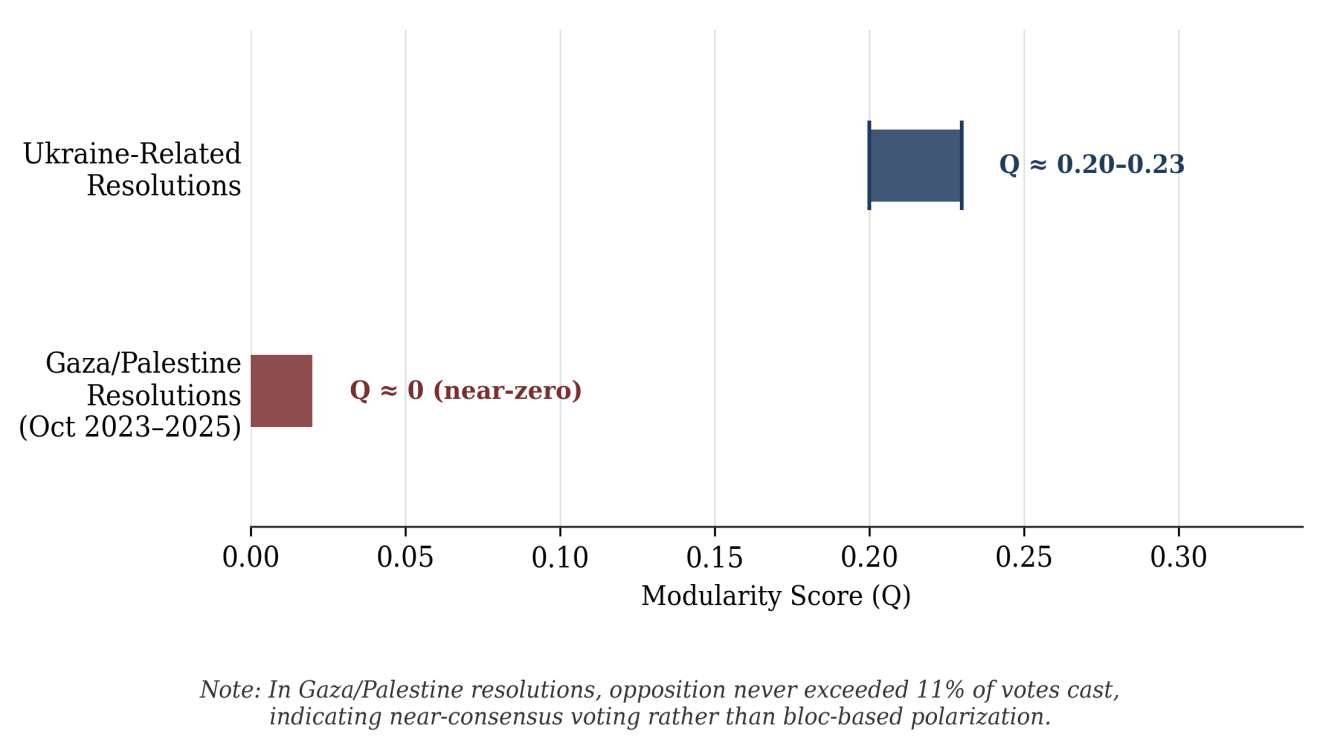
Figure 1: Modularity by Issue Area – Ukraine versus Gaza/Palestine Resolutions.
Source: Author’s analysis based on UN General Assembly roll-call voting data (1946–2025).
4.4 Not All Issues Produce Bloc Structure: The Gaza Exception
This minority displayed two broad descriptive patterns: several Pacific Island states (Micronesia, Palau, Nauru, Tonga, and Papua New Guinea), whose voting behaviour is consistent with literature on aid dependence (Brazys & Panke, 2017), and Argentina and Hungary, whose positions may reflect political or strategic preferences. These categories describe observed voting patterns and do not establish the underlying motivation of the states.
4.5 Alignment Is Not Static: Evidence of Emergence and Entrenchment
Since the study focuses on emerging alignments, we examined whether community structures change over time, extending Bailey, Strezhnev & Voeten’s (2017) argument that state preferences are dynamic. For Ukraine-related votes, the core pro-Russia group shrank from 20 states before 2024 to 11 after 2024. China was notable in this shift, moving away from the tighter pro-Russia grouping toward a looser developing-country community, consistent with China maintaining strategic autonomy. The voting data alone, however, cannot establish the diplomatic motivation for this movement. A different pattern emerged for the annual resolution on a democratic and equitable international order. The opposing Western-aligned bloc changed little, with approximately 95% of the same countries opposed in the early 2000s and in 2021–2025, with Argentina as the only clear newcomer. The contrast between the contraction of the pro-Russia community and the persistence of the democratic-order bloc indicates that alignment changes are not uniform: some voting communities are actively changing, while others remain highly stable over long periods. The temporal comparison is shown in Figure 2.
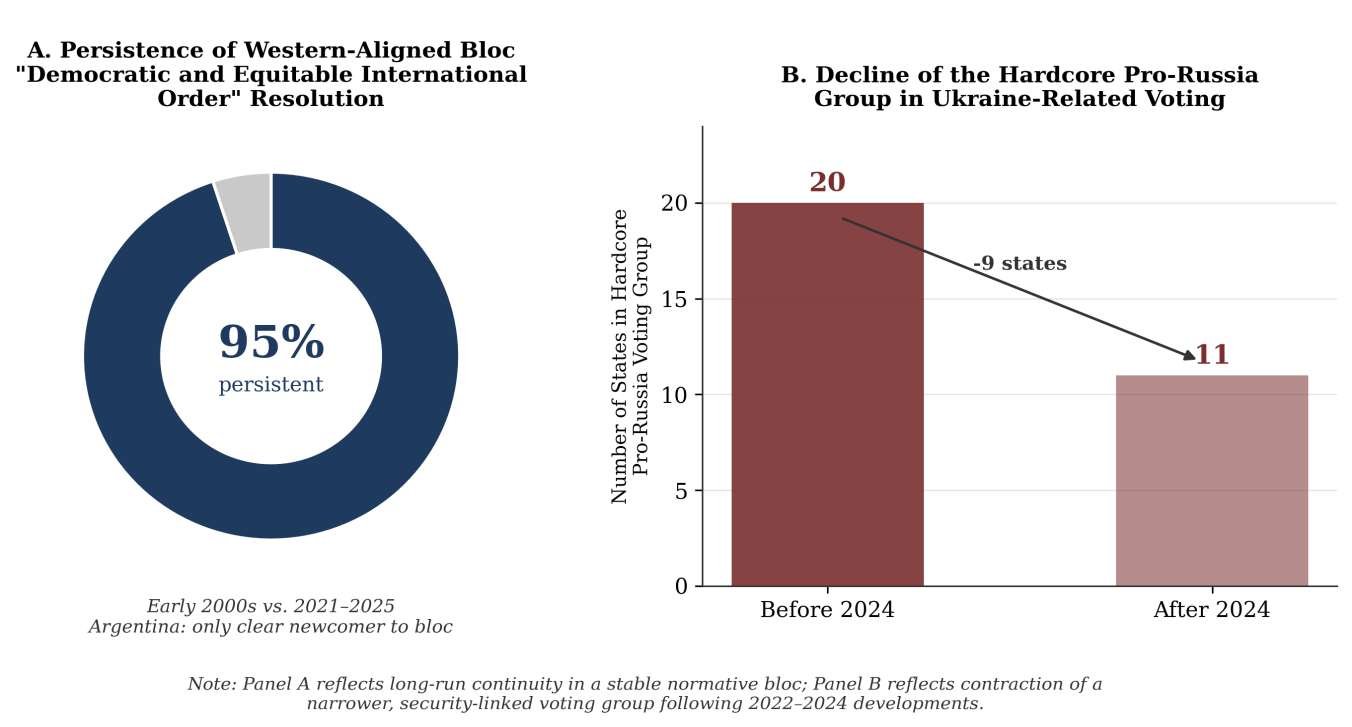
Figure 2: Temporal Stability and Change in UN Voting Blocs.
Source: Author’s analysis based on UN General Assembly roll-call voting data (1946–2025).
4.6 Distinguishing Realignment from Nominal Membership: Institutional vs. Ideological Realignment
This analysis addresses the central research gap: whether an identified voting cluster reflects durable alignment or merely statistical similarity. Kusari, Roy, & Sengupta (2026) leave this question open, while Steinert & Weyrauch (2024) show that institutional participation does not necessarily produce closer UNGA alignment. Two contrasting cases are examined: BRICS expansion and political realignment in the Sahel. Following the January 2024 BRICS expansion, Egypt, Ethiopia, Iran, and the UAE recorded increased voting agreement with the BRICS core of +0.09 to +0.11. A descriptive comparison group of non-BRICS states recorded a larger increase of +0.16 to +0.24 during the same period. This comparison is descriptive: it asks whether the increase among new BRICS members was distinctive relative to the comparison baseline. Because no formal matching algorithm or treatment effect is estimated, the comparison is not a causal comparison-group design. The overall Yes-vote share also increased from roughly 72% to 77%, further indicating a broader rise in consensus voting. The four original BRICS members – Brazil, India, China, and South Africa – displayed high pairwise voting agreement (0.73–0.85), while Russia showed lower agreement with most of them (0.58–0.64), except with China (0.73). This suggests that the BRICS label does not correspond to a completely unified voting bloc.
A different pattern emerged among Sahel states that experienced military coups and subsequently shifted towards Russia. Mali (2021), Burkina Faso (2022), and Niger (2023) increased their voting agreement with Russia by approximately +0.030, +0.011, and +0.165, respectively, while a descriptive baseline group of non-coup African states (Senegal, Ghana, Kenya, Tanzania, and Ivory Coast) showed declining agreement. Niger’s shift was particularly large, from 0.549 to 0.713. The contrast is instructive: formal BRICS expansion was not associated with a distinctive change in voting behaviour, whereas the selected informal security and political shifts in the Sahel coincided with clearer changes. These patterns are descriptive and do not establish that political upheaval caused the observed voting changes. They nevertheless indicate that UN voting networks may be useful for identifying possible political reorientation, particularly when changes persist over time and are considered alongside independent diplomatic, economic, and security evidence.
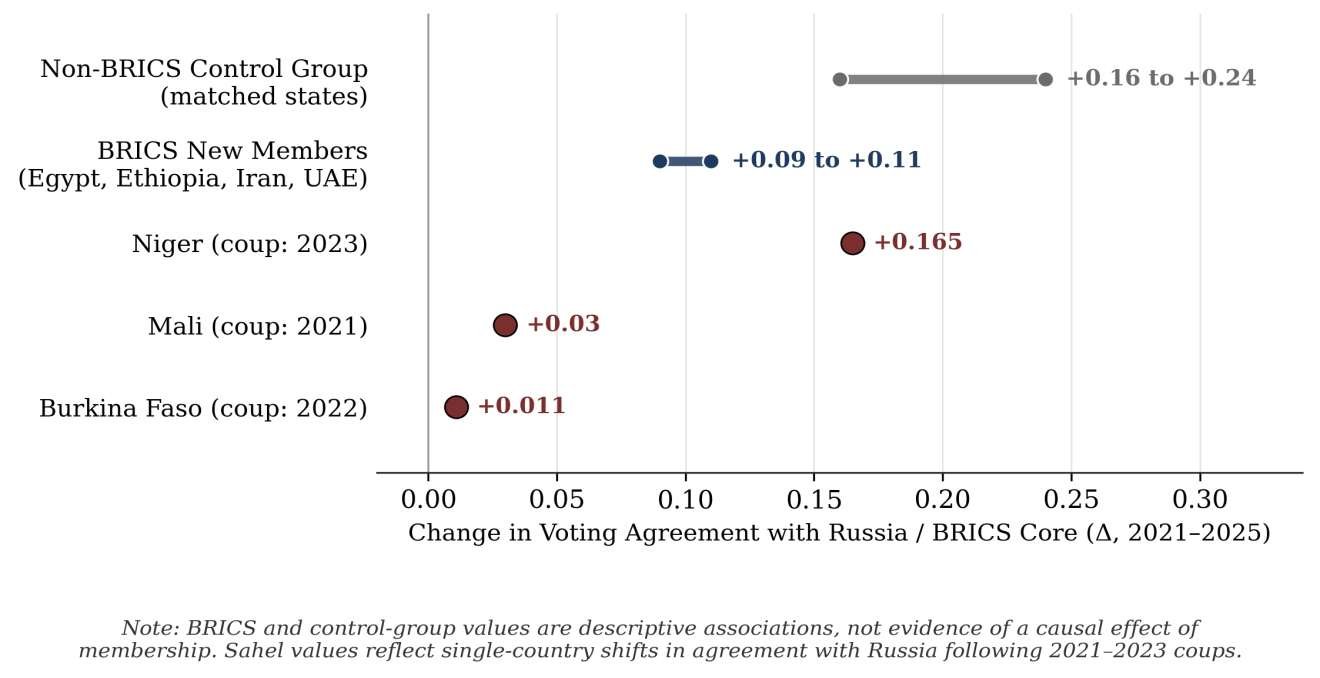
Figure 3: Magnitude of Change in Voting Agreement – BRICS Expansion versus Sahel Political Pivots.
Source: Author’s analysis based on UN General Assembly roll-call voting data (1946–2025).
4.7 Limitations
Several limitations should be noted. First, resolutions were selected purposively on substantive geopolitical grounds rather than randomly, so alternative resolution sets could produce different community structures and the findings cannot automatically be generalised to all UNGA voting. Second, roll-call votes capture only part of UN diplomacy; many resolutions are adopted without a recorded vote (Seabra & Mesquita, 2022). Third, the voting-similarity measure treats Yes, No, and Abstain as recorded positions and excludes Absent from the pairwise denominator; states with insufficient overlap were excluded from particular networks. The exact minimum-overlap threshold used in the original computational workflow was not retained, and no formal sensitivity analysis of alternative thresholds, edge specifications, or Louvain resolution settings was conducted. The software/package version was likewise not retained in the final research record. These limitations constrain exact replication and robustness assessment. Finally, explanations such as aid dependence, regime type, and historical foreign-policy traditions are drawn from the literature rather than tested through causal regression. The findings should therefore be understood as descriptive and interpretive rather than causal.
Overall, UNGA voting networks reveal both emerging realignment and entrenched preferences, but voting similarity alone does not establish a geopolitical alliance. The Ukraine case shows a changing community structure, while the Gaza case shows that near-consensus issues need not produce bloc divisions. The contrast between BRICS expansion and the Sahel pivots suggests that formal membership does not reliably generate distinctive voting change, while informal political and security realignment may be more visible in voting behaviour. Persistence over time provides stronger evidence of durable alignment than a single-period cluster. These findings suggest that UN voting networks have potential as early-warning indicators of geopolitical realignment, although this requires further testing alongside diplomatic, economic and security indicators.
5. DISCUSSION
The findings demonstrate that UNGA voting patterns provide a useful but conditional indicator of geopolitical alignment. Ukraine-related resolutions produced a distinct two-community structure, whereas Gaza/Palestine resolutions showed near-consensus and little evidence of comparable bloc formation. This issue-specific variation supports Pauls & Cranmer’s (2017) argument that network analysis can identify communities of affinity, while reinforcing Bailey, Strezhnev, & Voeten’s (2017) understanding of state preferences as dynamic. The contraction of the core pro-Russia voting group from 20 to 11 states after 2024 further suggests that geopolitical alignment can weaken or reorganise over time.
The comparison between BRICS expansion and the Sahel cases further qualifies the relationship between institutional membership and political alignment. The increase in voting agreement among new BRICS members was smaller than that observed in the descriptive comparison group, indicating that the change was not distinctive relative to comparable non-members. This is consistent with Steinert and Weyrauch’s (2024) finding that Belt and Road participation did not translate into closer UNGA alignment with China. In contrast, increased voting agreement with Russia among Mali, Burkina Faso, and Niger following political upheaval suggests that informal security and political realignments may be more visible in voting behaviour.
Overall, voting similarity alone does not establish a geopolitical alliance; persistence over time provides stronger evidence of durable alignment. The pro-Russia community’s contraction reflects an alignment still in flux, whereas approximately 95% persistence on the democratic and equitable international order resolution indicates a more entrenched pattern. These findings raise the question of whether voting networks can serve as early-warning indicators of geopolitical realignment. Establishing predictive value requires longitudinal testing; the present findings remain descriptive, not causal.
6. CONCLUSION
This study examined whether UN General Assembly voting patterns can help identify emerging geopolitical realignment and distinguish durable alignment from short-term or issue-specific convergence. The findings show that voting patterns alone cannot establish a formal or permanent alliance; rather, they provide evidence of observable alignment in foreign-policy preferences. The political significance of voting convergence depends on the issue, its persistence over time, and the broader geopolitical and strategic context.
The comparison of Gaza/Palestine and Ukraine illustrates this distinction. Gaza/Palestine resolutions produced near-consensus and little comparable bloc structure, whereas Ukraine-related resolutions produced a clear two-community structure. The core pro-Russia voting community decreased from 20 states to 11 after 2024, indicating an alignment that remains in flux. By contrast, approximately 95% of states maintained their existing positions on the resolution concerning a democratic and equitable international order, indicating a much more persistent pattern.
The comparison between BRICS expansion and the Sahel cases further shows that formal institutional membership does not necessarily produce distinctive voting convergence. The new BRICS members recorded increased agreement with the BRICS core, but the increase was smaller than that observed in the descriptive comparison group. In contrast, Mali, Burkina Faso and Niger showed increased voting agreement with Russia following political upheaval. These findings suggest that UN voting networks may be particularly useful for identifying informal political or security realignments rather than simply confirming formal institutional membership.
An important question arising from these findings is whether voting networks can serve as early-warning indicators of geopolitical change. The evidence suggests potential when voting shifts persist over time and coincide with independently documented diplomatic, economic, or security developments. However, predictive value cannot be established from the present descriptive analysis; it requires longitudinal testing against external indicators and alternative specifications.
REFERENCES
- Adarkwah, G. K., Sabel, C. A., & Zilja, F. (2026). Measuring geopolitics: The promise and limits of UNGA voting data for IB research. Journal of International Business Policy, 9(1), 102-123. https://doi.org/10.1057/s42214-025-00237-3
- Bailey, M. A., Strezhnev, A., & Voeten, E. (2017). Estimating dynamic state preferences from United Nations voting data. Journal of Conflict Resolution, 61(2), 430-456. https://doi.org/10.1177/0022002715595700
- Brazys, S., & Panke, D. (2017). Why do states change positions in the United Nations General Assembly? International Political Science Review, 38(1), 70-84. https://doi.org/10.1177/0192512115616540
- Hammarskjöld, D. (1954, May 13). Address by Secretary-General Dag Hammarskjöld at University of California Convocation, Berkeley, California (Press Release No. SG/382) [Press release]. United Nations Department of Public Information. https://digitallibrary.un.org/record/1291161
- Khan, M. Z. I. (2020). Is voting patterns at the United Nations General Assembly a useful way to understand a country’s policy inclinations: Bangladesh’s voting records at the United Nations General Assembly. SAGE Open, 10(4), 1-16. https://doi.org/10.1177/2158244020961117
- Kusari, C., Roy, S., & Sengupta, S. (2026). Understanding geopolitical alignments through covariate augmented spectral clustering of heterogeneous UNGA voting data [Preprint]. arXiv. https://doi.org/10.48550/arXiv.2606.25490
- Nurullayev, D., & Papa, M. (2023). Bloc politics at the UN: How other states behave when the United States and China–Russia disagree. Global Studies Quarterly, 3(3), ksad034. https://doi.org/10.1093/isagsq/ksad034
- Pauls, S. D., & Cranmer, S. J. (2017). Affinity communities in United Nations voting: Implications for democracy, cooperation, and conflict. Physica A: Statistical Mechanics and its Applications, 484, 428-439. https://doi.org/10.1016/j.physa.2017.04.177
- Seabra, P., & Mesquita, R. (2022). Beyond roll-call voting: Sponsorship dynamics at the UN General Assembly. International Studies Quarterly, 66(2), sqac008. https://doi.org/10.1093/isq/sqac008
- Steinert, C. V., & Weyrauch, D. (2024). Belt and road initiative membership and voting patterns in the United Nations General Assembly. Research & Politics, 11(1), 1-12. https://doi.org/10.1177/20531680241233784
- Van Steenberghe, R. (2024). The armed conflict in Gaza, and its complexity under international law: Jus ad bellum, jus in bello, and international justice. Leiden Journal of International Law, 37(4), 983-1017. https://doi.org/10.1017/S0922156524000220
- Voeten, E. (2013). Data and analyses of voting in the UN General Assembly. In B. Reinalda (Ed.), Routledge handbook of international organization (pp. 54-66). Routledge.