Authors: Vanshika Pandey; Lakshita Kapoor; Tejas Rao; Muskan Yadav; Mihika; Adeebah Asim; Naveen Sharma
Abstract
This paper attempts to determine whether voting patterns of the United Nations General Assembly can demonstrate a shift in international relations. The analysis uses the Voeten dataset for debates in the UNGA voting records from 2015 to 2025, split into three voting blocks: pre-pandemic, pandemic, and post-Russia-Ukraine war. Multiple networks were then created in NetworkX and Gephi, and Louvain’s community discovery was applied to identify similar voting countries. The study assumes that votes can indicate shifting alliances but does not necessarily prove them, as countries can vote similarly for different reasons.
The results demonstrate that while the UNGA voting blocs voted jointly to accept resolutions, their ability to maintain this cohesion declined throughout the observed decade. This shift became particularly apparent in 2025 as the United States started to vote for previously universally accepted resolutions, including those concerning the status of Palestine, separately. However, this approach does not appear to have isolated the U.S. as much as Israel, which was even more explicit in its position on the Russia-Ukraine war. In turn, Argentina’s voting bloc shifted significantly towards the U.S. and Israel, and not necessarily due to ideological proximity, as the country’s economy depends on the U.S. under the new Milei administration. This hypothesis has been supported by other considerations apart from the voting bloc data.
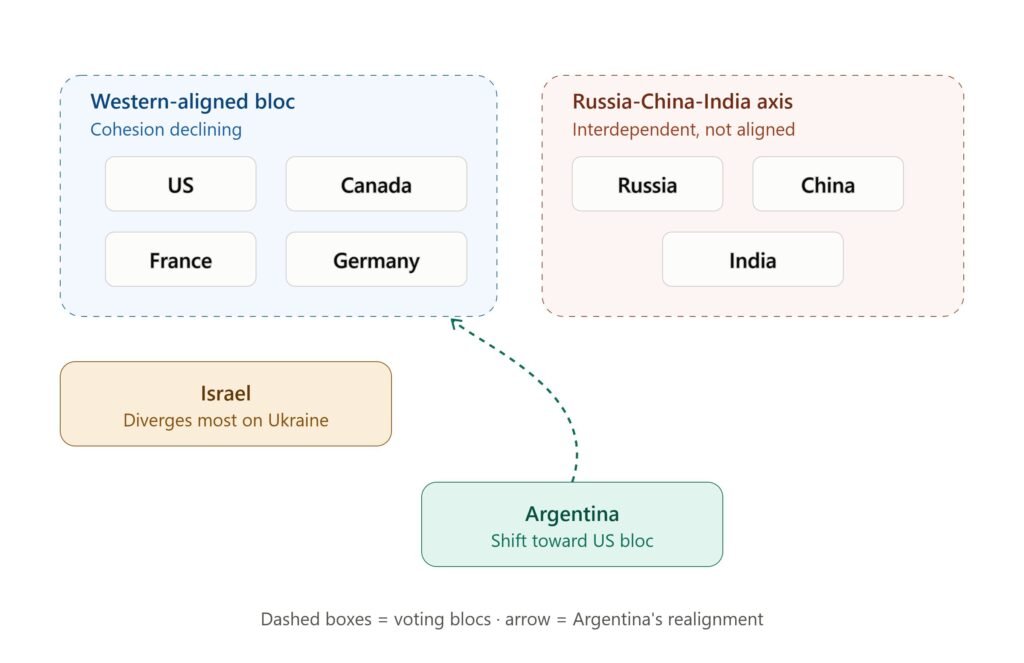
In particular, Russia, China, and India, which tend to vote similarly in the UNGA, are projected to be more dependent on each other economically, although not explicitly ideologically or strategically. This tendency was evident in the patterns of voting on Russia-Ukraine war-related issues, which dissolved this bloc, if only temporarily, voting differently on specific issues. Similar observations can be made on the U.S. coalition of countries, partners of the U.S., which failed to support the U.S. in Palestine and the Russia-Ukraine war resolutions. Overall, the paper identifies trends that cannot be explained by ideological similarities, which implies the emergence of a multipolar world order. While voting blocs of the UNGA can be used for such analysis, they rarely provide definitive evidence of alliances or their absence, as this research has demonstrated.
Keywords: UN General Assembly, network analysis, voting patterns, Russia-Ukraine War, geopolitical alliances, multipolarity, consensus degradation, community detection, foreign policy alignment.
Introduction
The UNGA, as one of the main constituent organs of the United Nations, is the “organ of legislation” and “deliberation” of the organization, which usually meets in September to December and occasionally throughout the year. The UNGA can be defined as a multilateral forum where the 193 countries discuss and adopt a number of resolutions on the agenda and sub-agenda items. Each of the UNGA members has one vote that could be casted “in favor”, “against”, or “abstention” with a simple or two-thirds majority vote depending on the resolution. It has become traditional for member states to express their will, position, and votes on many issues in the UNGA voting. Nevertheless, for some time, voting results were subject to in-depth analysis in order to highlight patterns of international politics. The UNGA research methodology includes similarity indices (Kirsamer & Riha, 2025), network analysis (Macon et al., 2012; Magu & Mateos, 2018), dynamic spatial modeling (Bailey et al., 2017), and community detection to identify patterns of voting. In other words, UNGA votes can be visualized as a network where states are nodes that are connected to similar voting items. Thus, international relations could be understood through the lens of community detection and voting networks as states’ actions are never taken in isolation but rather in interaction with other countries. However, it has to be stressed that voting similarity captures diplomatic agreement on the items voted in the UNGA and should not be confused with geopolitical alliances and should not be used as evidence of some deeper causal relations. Since 2020, the world has faced significant geopolitical events, namely, the COVID-19 pandemic, Russia-Ukraine war, and Israel-Palestine conflict, resulting in the adoption of many resolutions. Also, the world political system has entered a new phase of a more complicated multipolarity, affecting the traditional blocks of countries as well Nurullayev and Papa (2023). Therefore, the study of UNGA voting and diplomatic practices is of particular importance now as the international community is entering a new stage of diplomatic interactions with emerging new blocs of countries.
It has to be added that, despite the significant amount of research on UNGA voting practices, the existing literature has several limitations. First, the majority of the scholars studied voting practices before the COVID-19 pandemic, which makes it unclear how the new wave of international relations affects the patterns of UNGA voting. Second, the bulk of the literature is affected by the consensus problem, as voting practices in the UN reflect the significant heterogeneity of the member states’ geopolitical positions. Third, there is a lack of systematic analysis of multiple waves of voting since recent structural geopolitical shifts occurred. Therefore, the current study aims to fill this gap by analyzing voting patterns during three distinct periods, namely, before the COVID-19 pandemic (2015-2019), during the pandemic (2020-2021), and since 2022. The year 2022 was selected as the starting point of the third period due to the Russia-Ukraine war, which significantly impacted the international community by initiating sanctions waves and new geopolitical alignments among countries. The current research compares the diplomatic voting in UNGA for the three time intervals in order to detect the patterns of international relations in the aftermath of the pandemic and Russia-Ukraine war. In particular, this study will examine resolutions related to the Russia Ukraine conflict, Israel-Palestine conflict, Two-State resolution, aid and relief to Palestinian refugees via UNRWA, and many other items related to international security and peacekeeping. Moreover, the voting on human rights, gender, children, young people, WASH, prevention of torture, and tribal rights, the US embargo on Cuba, and other issues will be taken under consideration. The recent changes on both the diplomatic practices of statecraft and voting patterns in UNGA will be detected. In particular, this study will analyze the changes in Argentina’s voting patterns as its recent geopolitical position is close to the US and Israel. In this respect, the current study will explore shifts in the votes of agreement, as dramatic shifts like Argentina’s one usually indicate the interrelation between states’ economy and their diplomatic practices. Nevertheless, it is important to mention that the current research will not attempt to identify the casual forces that drive these patterns but focus on the voting alignment as such. At this point, it is crucial to mention that recent tendencies visualize a shift from recorded votes “for” to recorded votes “against” in GA, which has become a growing concern.
The research part of the project will be devoted to network analysis of the UNGA voting. In particular, the United Nations General Assembly Voting Files will be analyzed in order to identify a network of states’ voting similarity. This network’s structure will be detected based on the resolutions related to current geopolitical issues. This network will then be visualized with network community detection algorithms. Moreover, network analysis will include the calculation of network metrics like Degree, Betweenness, Closeness, and Eigenvector Centralities in order to identify the most influential members of the UNGA voting network. By combining the Network Science and International Relations perspectives, this project will offer novel insights into international relations as diplomatic voting blocs that emerge through the interactions of states in voting on international security items, with consideration of the limitations that voting data imposes on international relations analysis.
Literature Review
The United Nations General Assembly serves as an important platform where the member states vote on a wide range of international issues such as Climate change, nuclear weapons, human rights and security issues. Scholars study United Nation General Assembly voting because it is one of the only records where nearly every country in the world formally declares a position on the same set of issues, repeatedly, over more than seventy years. This makes UNGA voting data a rare lens into how geopolitical alignments form, shift and dissolve, offering insight into foreign policy preferences and the evolution of international alliances that few other data sources can match. By analysing these voting patterns, researchers can identify similarities and differences in how states vote and examine how geopolitical alliances take place.
Macon et al. (2012) examined whether network analysis can identify meaningful voting communities in the United Nations General Assembly (UNGA). The authors convert UNGA voting records into three different types of networks weighted, signed and bipartite and applied modularity based community detection techniques to identify groups of countries with similar voting behavior. Since modularity has a known resolution limit, the authors tested multiple resolution parameter instead of relying on a single modularity value, using Jaccard distance comparisons to confirm which detected communities are reliable. They then compared the results to three historical sessions spanning Early cold war through post-cold war era. The study finds that UNGA voting behavior shifted from an East-West split during the Cold War to a North-South split afterward, reflecting broader geopolitical development. This robust, multi-parameter approach set a high methodological standard for the field, offering strong evidence that network analysis can recover real historical alignments, though its reliance on three historical case studies rather than continuous coverage limits its ability to detect gradual, ongoing shifts.
Building on previous studies of UNGA voting behavior, Bailey et al. (2017) proposed a dynamic ordinal spatial model to provide a more reliable measure of foreign policy preferences. Unlike Macon et al. (2012), who focused on grouping countries into voting based communities using network analysis, Bailey et al. (2017) measured each country’s foreign policy position on a continuous ideal point scale. Their model adjusted for changes in the UN agenda over time, making it possible to compare countries’ foreign policy consistently over time. However, the study represents foreign policy preferences using only one dimension. Since geopolitical alignments are often more complex and may need multiple dimensions, a one-dimensional model may not fully capture it.
Magu & Mateos (2018) addressed the limitations of earlier approaches to measure the voting similarity in the United Nations General Assembly (UNGA) by considering both agreements and disagreements in voting behavior. Using the vote similarity methodology, the authors tried to improve the similarity measure and then build a voting network. Then they applied Louvain community detection algorithm to identify the voting blocs, resulting in the identification of two major voting communities. To validate their findings, they compared the voting communities with an independent bilateral trade network, finding a substantial overlap (Jaccard similarity up to 0.72), suggesting that countries with similar voting patterns also tend to maintain stronger economic relationships. However, the study relied only on 2014-15 voting data and treated all UNGA resolutions as equally significant. While Magu and Mateos validated their communities structurally by comparing them to trade networks, Pomeroy et al. (2018) took a different route entirely, questioning whether voting data alone was ever sufficient in the first place. They therefore combined voting data with UN General debate speeches within a multiplex network framework, using word embeddings and community detection across linked network layers. They discovered that combining votes and texts produces more accurate estimation of state preferences than voting data alone. Community detection techniques were then applied to identify preference affinity blocs. These were further validated by examining whether bloc membership could predict the onset of interstate conflict. This approach, while more robust approach, is also more data-intensive and constrained by limited, inconsistent speech-transcript availability.
Most recently, Steinert & Weyrauch (2024) examined whether membership in China’s Belt and Road Initiative (BRI) influences Countries’ voting behavior in UNGA. Unlike earlier studies that described voting communities, this study used community detection within a causal inference framework to estimate the effect of Belt and Road Initiative membership on voting alignment with China. This study first identified communities of countries with similar UNGA voting patterns and then employed Generalized Synthetic Control approach to compare BRI members with similar non-members. This helped them in analyzing what a country’s voting behavior would have been had if not joined the BRI. The findings indicate that BRI membership had little overall effect on voting alignment with China. However, the results differed across regions. This study focuses specifically on the BRI and China’s geopolitical influence; its findings can’t be applied to all types of geopolitical alliances. Moreover, Community Detection is used to study how the voting communities changed over time and to identify voting blocs not to study the voting network itself, a methodological role distinct from earlier papers in this review.
Across these studies, a consistent theme emerges that network-based analysis of UNGA voting data is an effective method for identifying geopolitical alliances between countries. The literature shows a clear methodology progression, starting with agreement based network analysis (Macon et al., 2012), advancing to bias-corrected similarity measures (Bailey et al.,2017; Magu & Mateos, 2018) to incorporating voting and speech data to improve the representation of foreign policy preferences (Pomeroy et al., 2018) and finally to combining community detection with a GSC model to examine the causal effect of BRI initiative membership on countries’ UNGA voting alignment (Steinert & Weyrauch, 2024).
For over seventy years the United Nations General Assembly has kept a record of how countries vote on important issues, and renewed geopolitical competition has brought fresh attention to this record.Studies have found that the old idea of a US led international system is not supported by the data. For a time, many scholars thought that the world was in a diffuse US led system. Nurullayev and Papa challenged this view by looking at three decades of UN General Assembly votes from 1991 to 2020. What they found was surprising: when the US disagreed with China and Russia most countries supported China and Russia. In fact, the US only got support from several countries in disputed cases.
This trend is not the same. Developing countries rarely support the US while countries in groups like BRICS and the Shanghai Cooperation Organization often vote with China and Russia. Countries in NATO usually support the US. Their level of support has not changed much over time. What is important here is the direction of the trend. Over thirty years support for China and Russia has grown among developing countries, BRICS and the Shanghai Cooperation Organization. This is not a leftover from the Cold War; it shows that modern geopolitical groups are forming. The more striking finding, though, is how these groups are actually organized. Nurullayev and Papa found that informal groups, like BRICS and the Shanghai Cooperation Organization are better at keeping their members in line than alliances like NATO. This challenges the idea that formal security pacts drive diplomatic coordination. Instead, looser aligned groups seem to be the real drivers of modern bloc politics. For network analysts this offers methodological insights: we cannot just rely on formal military alliances to understand how countries form groups.
While Nurullayev and Papa see UN General Assembly votes as a measure of global alignment, Adarkwah, Sabel and Zilja question this assumption. When they compared UN General Assembly agreement scores with metrics, they found that the numbers did not match. These tools capture aspects of state behaviors rather than measuring a single underlying reality.
Why is there a discrepancy? Adarkwah and others point to problems with the UN General Assembly data itself. Voting indexes are too slow to reflect geopolitical crises and impose an artificial symmetry on bilateral relations that are often skewed. Furthermore, UN General Assembly resolutions simplify diplomacy into a binary choice: for or against. This rigid structure creates problems when applying voting data to issues like foreign direct investment decisions or economic coercion. Furthermore, UN General Assembly resolutions simplify diplomacy into a binary choice: for or against. This rigid structure creates problems when applying voting data to issues like foreign direct investment ( FDI ) decisions or economic coercion, where countries rarely take such a clean stance.
This is arguably a gap the UN itself could help close. Voting records alone were never built to capture economic pressure or dependency, they only show a yes or no on a resolution. A more useful approach might be for the UN to track additional layers of behavior alongside plenary votes: things like abstention patterns, co-sponsorship of resolutions, or positions taken in bodies like UNCTAD that deal directly with trade and investment. Something closer to a weighted alignment score, rather than a strict for/against count, would probably reflect real world coercion and dependency far better. Until that kind of data exists, it’s fair to say the Voeten dataset works well for measuring diplomatic alignment, but not economic alignment, and should be paired with other sources when studying things like FDI.
Still Adarkwah and others do not suggest abandoning UN General Assembly data. Instead, they propose a framework grounded in theoretical fit, empirical validity and replicability. Their advice boils down to four rules: align your metric with your research question create a sample that matches the mechanism you are studying maintain transparency in coding and acknowledge the limitations of your data. For any network analysis using the Voeten dataset these guidelines are essential. A study of UN General Assembly voting should be understood for what it’s a map of expressed diplomatic alignment on multilateral resolutions. Not a universal measure of bilateral relations or perceived media risk.
A new wave of research is moving away from bilateral agreement scores and ideal-point scaling focusing instead on network graphs and cluster analysis. Kusari, Roy and Sengupta lead this shift by applying clustering to the bipartite country-resolution network. By incorporating variables like GDP per capita into their model, they uncover deeper structural patterns. When analyzing the transition period from 1990 to 2000 their algorithm successfully identified US and China backed clusters, as well as early formations of BRICS and the Shanghai Cooperation Organisation. Years before these organizations existed on paper. The conclusion is striking formal international organizations tend to formalize partnerships that are already emerging from voting behavior than establishing new alignments from scratch. Moreover, the stability of these core groups across robustness checks reassures us that the clusters reflect real diplomatic dynamics, not just random statistical noise.
Methodologically, Kusari, Roy and Sengupta demonstrate two points. First community detection algorithms excel with UN General Assembly data accurately recovering known factions as a built-in validity check. Second combining voting data with economic indicators provides a more nuanced understanding of why these clusters emerge. Their direct comparison with ideal-point scaling is especially useful here. While ideal-point models attempt to reduce every country to a left and right or liberal authoritarian scale network clustering asks a more practical question: which countries vote as a united group?
To understand why network clustering works well for international bodies it helps to look at a domestic analogy. In their study of the Italian Chamber of Deputies Dal Maso and others created a graph where individual legislators were nodes connected by edges representing how often they voted the same way. By applying community detection algorithms to the votes. Without including any information about party affiliations. They accurately reconstructed the governing and opposition coalitions. When they tracked the network month by month, they found that coalition loyalty, then specific policy issues drove nearly all voting behavior. Over time their analysis showed that polarization between government and opposition factions intensified.
The parallels with the UN General Assembly literature are clear. Just as Nurullayev and Papa revealed that informal groups mobilize blocs more effectively than treaty alliances, Dal Maso and others found that actual legislative voting often disregards official party lines. Both studies highlight the behavioral reality: whether examining individual politicians or sovereign states group allegiance often outweighs the importance of individual issues. This consistency across domains supports using coalition-detection algorithms on UN General Assembly records. However, it also reveals a limitation. A network graph can show you exactly who is voting together and how tightly bonded they are. It cannot explain why. Whether a state aligns with a cluster due to ideological agreement, party discipline or strategic decision-making is something the network structure alone cannot clarify
Together these four studies outline what network analysis of UN General Assembly voting can achieve and where its limits are. Nurullayev and Papa highlight the empirical challenge: a growing global shift from the US toward China and Russia largely driven by informal diplomatic networks. Kusari, Roy and Sengupta show that spectral clustering can extract these groupings from bipartite voting graphs. Better it can detect early alliances years before they officially emerge. An invaluable advantage when using tools like Gephi to identify new factions in the Voeten dataset. Finally, Dal Maso and others provide validation across contexts confirming that coalition loyalty, rather, than policy debate is the main factor guiding voting patterns. With this foundation future network research can track how today’s global voting blocs are evolving without losing sight of the inherent limits of the data.
Despite these methodological advances, the literature remains restricted by its reliance on historical voting and the assumption that all UNGA resolutions carry equal significance in the measurement of geopolitical alignment. Two gaps remain unaddressed. First, most foundational studies (Macon et al., 2012; Magu & Mateos, 2018) rely on data that predates major recent shifts in the international system. China’s rising assertiveness since the late 2010s, for instance, directly challenges the north-South framework Macon et al. (2012) identified in earlier decades— yet no study reviewed here tests whether that structure still holds under China’s expanded diplomatic reach. Similarly. The voting realignments plausibly triggered by the 2022 Russia-Ukraine War would test whether Magu and Mateos’s (2018) trade-voting overlap still holds when major economies face active sanctions rather than steady trade relationships. This leaves it unclear whether previously identified structure still hold. Second, nearly every method reviewed here treats all UNGA resolutions as equally important (Macon et al., 2012; Magu & Mateos, 2018). Routine resolutions do not reveal real political alignment, yet previous studies gave them equal importance, risking a dilution of genuine alliance signals.
Research Methodology
Research Design
This research paper was conducted using both quantitative and qualitative data. Network Analysis for geopolitical alliances was studied through UNGA voting patterns. Voting data was obtained from the UN Digital Library’s official datasets: the General Assembly Resolutions dataset and the General Assembly Voting Data dataset which were compiled and categorized into four categories – Yes (Y), No (N), Abstain (A), and Nonvoting (X). Voting period of 2015–2025 was taken for analysis which was further sub-divided into three periods: pre-pandemic (2015–2019), pandemic (2020–2021), and Russia–Ukraine war (2022–2025). These three sub-periods represent the significant global events which is one the reasons to choose this. Also studying the entire decade as a whole would be difficult, so dividing made it easier. Several tools were used to compile the data; Pandas, NumPy, Plotly express, Networkx etc. We will look at each of them in detail further.
Data Collection Method
Pandas was used for cleaning and structuring the raw CSV data. NumPy for numerical compilations. Since the original datasets contained missing values and inconsistent country names in some years, Pandas was also used to standardize country labels. The datasets were prepared so that voting records could be matched correctly across the entire 2015–2025 period. To address specific research questions regarding global crisis alignment, the overall 2015–2025 dataset was further filtered to extract resolutions specifically related to major global events using target keywords such as COVID-19, Ukraine, and Israel-Palestine.
Data Analysis Method
Then the voting data was converted to scores of 0 to 1, where higher score shows more close alliance. The value was derived using the equation, each pair of countries vote on resolutions relative to the mutual votes casted. Edge weights of countries were narrowed down using NetworkX. It classified the strong voting alliances from the low-weight edge. Countries with very low edge weight were treated as weakly connected or not connected at all, so that the final network only showed alliances that were actually meaningful. To measure network position and influence, NetworkX calculated key network metrics across each sub-period: Degree Centrality: Measured total direct voting alignments. Major powers (such as the US, EU block members, and China) maintained high degree centrality, reflecting consistent voting clusters. Betweenness Centrality: Identified key bridging nations across geopolitical blocs. Countries with high betweenness centrality functioned as crucial diplomatic bridges during voting shifts, particularly among non-aligned nations during the pandemic and Russia–Ukraine war periods. Closeness Centrality: Highlighted how rapidly a country aligned with the global majority on resolutions. Eigenvector Centrality: Revealed countries connected to other highly influential, well-connected voting nodes, illustrating core-periphery alliance dynamics. Plotly Express was used for making visual representations through graphs for voting patterns across some recent events for a specific time period. These mutual voting were then further studied across the three sub-periods to see who was closer, who drifted and who formed the new alliances. This also helped in identifying countries that were closely aligned in one period but slowly moved apart in another, especially around the pandemic and the Russia–Ukraine war period. This helped in better grasping of geopolitical relationships. As the paper focuses on recent worldwide events, resolutions were extracted using keywords such as COVID-19, Ukraine, Israel-Palestine. These keywords were selected because they represent major international events that give significant discussion on voting activity in the UN General Assembly during the study period. While the underlying data pipeline processed all recorded votes from 2015–2025 for baseline cleaning, the focused network analysis presented here is derived specifically from these key event-driven resolutions to highlight alliance shifting under crisis conditions.
Ethical Consideration
The data was obtained from the UN Digital Library , which was then studied and analyzed for research purposes. No personal and confidential information was collected.
Limitations
This study is limited to UN General Assembly voting data from 2015–2025 and focuses on selected global events. UN voting patterns may not provide informal diplomatic relations or other cooperation. So, rather than complete measures of geopolitical alliances, this shows a pattern of voting alignment.
Data Analysis of United Nations General Assembly Dynamics
In times immemorial, the United Nations Assembly has opted for a strong institutional preference for consensus, cohorting to a vast majority of its resolutions without a formal recorded vote. Ever since the 1950s followed particularly by 1975, in order to protect the collective moral and political weight of its decisions, the institution moved away from majoritarian vote. In the recent years preceding 2025, approximately 72% of the UNGA resolutions were opted without a formal vote, signifying a highly institutionalised cooperative norm.
The ever-withholding operational paradigm faced an immense structural inversion during the 80th session of the General Assembly in 2025. This session marked an intentional move for the policy of strategic disengagement and subversion pursued by the United States. This lead to the consensus building process to collapse across multiple committees.Instead of allowing resolutions to pass through the usual consensus process, the United States increasingly called for formal recorded votes on draft resolutions that had long been accepted without opposition. This gradually altered the General Assembly’s established way of making decisions. As a result, the Assembly witnessed a historic change: for the first time in its modern history, more resolutions were adopted through recorded votes than by consensus..
The Third Committee, which deals with social, humanitarian and cultural aspects of human rights, was hit hardest by this collapse. In the 2024 session, the third committee adopted 34 resolutions by consensus. And in 2025, the number was down to just 15 resolutions. The United States alone called for votes on dozens of these texts and voted against 38 resolutions in the human rights committee alone.
Quantitative Metrics of Consensus Degradation
To model this transition mathematically, the Consensus Ratio ($text{CR}$) for a given legislative session can be expressed as:
CR=C/(C+V)
Where C is the number of resolutions adopted by consensus (without a vote) and V is the number of resolutions adopted by a recorded vote. Consequently, the Consensus Degradation Index (CDI) is defined as:
CDI = 1 – CR = V/(C + V)
In 2025, the CDI reached record highs, on the back of a calculated move to push rifts on traditional mandate renewals. The disruption was motivated by a strong rejection of what the United States described as “performative UN politicking” and a “globalist wish list of divisive cultural causes,” and instead chose to take on established language on gender identity, climate change, diversity, equity and inclusion (DEI), and sexual and reproductive health.
However, this strategy of forcing divisions failed to alter the normative trajectory of the General Assembly. Instead of fragmenting the assembly or building a counter-coalition, the forced votes revealed a deep global consensus, resulting in unusually high “Yes” voting tallies. The vast majority of the 193 member states consistently voted in favor of the original draft language, effectively translating previous consensus into formal, heavily lopsided majorities.
This pattern of isolation extended to subsidiary bodies. During its seventieth session in early 2026, the United States proposed eight amendments to the traditionally consensus-adopted “Agreed Conclusions” in the Commission on the Status of Women (CSW). The amendments sought to restrict the definition of “gender” to biological sex only, and to remove references to reproductive rights and regulation of artificial intelligence. The amendments were rejected by the commission in a single block vote of 1-26 with 14 abstentions.
Argentina Realigns Strategically, Becomes Transactionally Dependent
If mere voting similarity cannot establish why Argentina changed its position, the reason why it did so was not economic imperialism but ideological conviction, is undermined by the very fact that a $20 billion currency swap agreement was made conditional upon Milei winning the election, which is discussed below. A notable pattern can be observed In Argentina’s voting records when 2015-2019 and 2022-2025 periods are compared. Agreement with the United States rose by 32.5 percentage points which is the largest increase among all states examined. Similarly, Agreement with Israel rose by 28.4 points which happens to be the third largest. Together the figure below suggests that Argentina’s position within the UN General Assembly has moved considerably compared to the past.
Argentina has taken a radical turn in foreign policy under president Javier Milei, methodically abandoning its historical regional alliances and middle-power multilateralism in favor of the United States and Israel. Milei’s government categorically rejected the “Third-Worldist” and Peronist historical foreign policy, and decided to join what it calls the “free world”.
This alignment is defined by a “carrots and vulnerability” dynamic. The Milei government remains financially dependent on the United States to handle its chronic economic crisis, high inflation and complex capital controls. US President Donald Trump conditioned a vital US$20 billion currency swap on the electoral success of Milei’s party, La Libertad Avanza (LLA), in the October 2025 legislative elections, explicitly stating that a loss would end Washington’s financial generosity in a bilateral meeting in October 2025.
To obtain that assistance, the U.S. Treasury intervened in the currency market by buying pesos to stabilize Argentina’s exchange rate, causing the Milei administration to vote with Washington on 82 percent of UNGA resolutions. This reliance on transactional exchanges coincided with several major policy shifts, which, along with the currency-swap conditionality, help explain why Argentina’s UNGA turnaround should be viewed as economically rather than ideologically motivated:
- Rejection of BRICS: One of the first acts of Milei’s administration was to announce that Argentina would not join the BRICS bloc of emerging economies.
- CELAC-China De-alignment: At the CELAC-China Summit in Beijing in May 2025, Argentina sent a low-level representative and was the only country to not sign the final joint declaration.
- The Cuba Embargo Divergence: Argentina’s Foreign Minister Gerardo Werthein diverged from the regional consensus held for decades calling for the end of the US embargo against Cuba. He voted with the United States, Israel, Ukraine, Hungary, Paraguay and North Macedonia in opposition of the resolution.
- Opposition to Indigenous Rights: On November 11, 2024, Argentina was the only country out of 169 at the UNGA to vote against a draft resolution on the rights of indigenous peoples, putting foreign
Patagonia mining investments under the Large Investment Incentive Regime (RIGI).
Eurasian Faultlines: Russia and its Isolation in Ukraine
Using network analysis, It can be examined whether broad geopolitical alignment translated into support for Russia during the Ukraine conflict. The same was done by comparing all UN General Assembly resolutions from 2022-2025, and only resolutions concerning the Russia Ukraine War. The comparison clearly revealed that while Russia China and India appear broadly connected in overall voting behaviour, the alignment weakens considerably when we restrict our attention to Ukraine related resolutions.
In the broader voting network, Russia, China, and India occupy relatively proximate positions within the larger Eurasian voting bloc. Although China, India and Russia Seems to be broadly aligned in forums such as the BRICS or the Shanghai Corporation Organisation (SCO), voting patterns on Ukraine related resolutions show clear important differences. The analysis depicts that China and India do not consistently align with Russia on resolutions concerning the invasion. Despite furnishing Russia vital economic support by procuring its discounted hydrocarbons, both China and India maintain a diplomatic distance from Russia at UNGA. While providing no political shield to Moscow via co-votes against resolutions denouncing its use of force, Beijing and New Delhi habitually cast abstention votes instead.
- Feb 24, 2025 Resolution ES-11/7: 93 countries voted yes. Just 18 said no – Russia among them, also Belarus, Mali, and Nicaragua. 65 stayed quiet – nations like China, India, Brazil, and Iran stepped aside.
- Feb 24, 2025 Resolution ES-11/8: Ninety-Three countries agreed. Only eight opposed. Seventy-Three stayed absent.
- Feb 24, 2026 Resolution ES-11/10: One-Oh-Seven voted yes. Twelve said no. Fifty-One sat out.
Voting similarity can tell us that China and India are both non-interventionist when it comes to decisions on Russia’s territorial integrity breaches, but it cannot tell us why. It can be because these countries do not want to intervene in the conflict due to similar concerns about territorial integrity breaches in their regions or because they want to retain their trading opportunities with the West. It could also be a combination of reasons, but there is not enough data to confirm this. The information provided in the voting data can be interpreted in multiple ways, and only additional data concerning trade relations or diplomatic positions can clarify the reasons for voting.
The Diplomatic Encirclement of the US-Israel Axis on Palestine
Between 2022 and 2025, the analysis of voting behavior on Palestine related resolutions clearly show that the United States and Israel occupy a completely distinct position from almost every other major country.
The figure illustrates that both countries consistently had the highest proportion of “No” votes and lowest proportion of “Yes” votes. At the same time, other countries, even traditional US allies, voted overwhelmingly in favor of Palestine related resolutions.
The clearest manifestation of this divide came in July 2025 when the High-Level International Conference in favor of a two states solutions produced an initiative called the “New York Declaration” which was a 15 month phased process resulting in total disarmament of Hamas and international peace forces deployed on ground. Eventually governing power transferred to the Palestinian Authority in an international monitored transfer process. Although both measures have repeatedly failed to take place, the political weight they casted on both Washington and Tel-Aviv in the subsequent years is difficult to overestimate.
On September 12, 2025, the General Assembly passed resolution A/DEC/80/506, formally endorsing the New York Declaration.
- In Favor: 142 (including traditional US allies like the UK, Canada, France, and India)
- Against: 10 (US, Israel, Argentina, Hungary, Paraguay, and Pacific microstates like Nauru, Palau, Micronesia, Tonga, and Papua New Guinea)
- Abstentions: 12 (including Australia, Czechia, Guatemala)
This overwhelming vote demonstrated that traditional Western allies decoupled entirely from Washington’s position, signalling a transition toward parallel, extra-hegemonic frameworks that deliberately bypass US resistance to preserve international law and a two-state settlement.
Discussion
The UNGA voting patterns have become significant in analysing international alliances and relations. The data analysis showed that, in today’s world, they are effective in showcasing changing loyalties, emerging alliances, and geopolitical pressure groups. Through our analysis, we concluded that instead of fixed geopolitical blocs, the current alignments in world politics remain conditional and interest driven. This marks a departure from the bloc based diplomacy of the Cold War era, signalling a rising multipolar world order in which the strategic autonomy of nations remains central to voting behaviour in the UNGA. One of the core findings of the research was the increasingly disintegrating power of the hegemon as the voting went from a consensus-based style of voting to one that has become more fractionalized and broken. Theories of hegemonic stability asserted that power would be exerted from a single country that would ensure world order throughout the globe- by providing stability, leadership and by seeking conformity through the maintenance of international regimes. In recent times however it has been observed that the United States has not been successful in wielding its military and economic power to translate into votes at the UNGA. For instance the Israeli Palestine crisis has seen countries that were the long-term partners of the USA (e.g. Canada, France, Germany) champion the “Two State Solution.” While our study found that Argentina showed support for the United States due to its economic dependency on the same under the regime of Javier Mile. However, its voting policy seemed to be influenced by its economic dependency, instead of long term geopolitical alignment. The voting patterns have also stirred Argentina away from its traditional regional partnerships, showing the flaws of prioritising short term gains over long term partnerships that are fostered by shared values. China, and India also showed growing independence from the established orders; India, having been engaged in a long-term association with Russia, tried to remain neutral during the Ukraine War. It succeeded in maintaining a balanced alliance of its strategic partnership with Russia while growing relations with the west. China too succeeded in maintaining its strategic autonomy while engaging with Russia financially and diplomatically, without supporting the same for the Ukraine issue. As with Argentina, this reading of China and India’s motives is an inference from voting behaviour rather than a conclusion the voting data can establish on its own. Such developments have thus shown how the geostrategic alliances of the current day have led to issue based support instead of the traditional bloc structures formed on ideological solidarity.
Conclusion
This study pointed out that the international arena is stirring away from the rigid bloc based diplomacy to a multipolar order under which states can choose to be guided by their personal interests, preserve their sovereignty, and offer issue-based support to the powerful nations instead of unconditional loyalty. It also showed how UNGA voting patterns remain an integral empirical tool to understand the geopolitical alignments and the changing world order. While this study provided a data-driven framework for identifying emerging geopolitical alliances through the analysis of United Nations General Assembly (UNGA) voting patterns, certain limitations must also be acknowledged. This study primarily used the data of UNGA, which does not inherently reflect international realities, as countries might vote similarly due to strategic interests or regional issues. Additionally, the analysis was limited to a few contemporary major events, such as the Israel–Palestine war and the Russia–Ukraine crisis. The study was also limited to analysing voting behaviour within the UN General Assembly. International relationships are influenced by many other factors, including military alliances, bilateral agreements, trade partnerships, economic cooperation, diplomatic visits, and regional organisations. Since these dimensions have not been included in the analysis, the findings should be understood as reflecting diplomatic behaviour within the UN rather than the entirety of a country’s foreign relations. Another important limitation related to the time period covered by the study. The research compares voting patterns across the pre-pandemic, pandemic, and post-2022 periods to understand recent geopolitical shifts. However, in a rapidly changing global world, this analysis remains time-bound and constrained. Despite these limitations, the study provides a systematic and evidence-based approach to understand contemporary geopolitical alignments. By combining UN voting data with network analysis, it offers meaningful insights into emerging patterns of international cooperation while also laying the groundwork for future research in related domains.
References
Adarkwah, G. K., Sabel, C. A., & Zilja, F. (2026). Measuring geopolitics: The promise and limits of UNGA voting data for IB research. Journal of International Business Policy
https://doi.org/10.1057/s42214-025-00237-3
Dal Maso, C., Pompa, G., Puliga, M., Riotta, G., & Chessa, A. (2014). Voting behavior, coalitions and government strength through a complex network analysis. PLOS ONE, 9(12), e116046
.https://doi.org/10.1371/journal.pone.0116046
Kusari, C., Roy, S., & Sengupta, S. (2026). Understanding geopolitical alignments through covariate augmented spectral clustering of heterogeneous UNGA voting data (arXiv:2606.25490) [Preprint]. arXiv.
https://arxiv.org/abs/2606.25490
Nurullayev, D., & Papa, M. (2023). Bloc politics at the UN: How other states behave when the United States and China–Russia disagree. Global Studies Quarterly, 3(3), Article ksad034.
https://doi.org/10.1093/isagsq/ksad034
Bailey, M. A., Strezhnev, A., & Voeten, E. (2017). Estimating dynamic state preferences from United Nations voting data. Journal of Conflict Resolution, 61(2), 430–456.
https://doi.org/10.1177/0022002715595700
Macon, K. T., Mucha, P. J., & Porter, M. A. (2010). Community structure in the United Nations General Assembly (arXiv:1010.3757). arXiv.
https://arxiv.org/abs/1010.3757
Magu, R., & Mateos, G. (2018). United Nations General Assembly vote similarity networks. In C. Cherifi et al. (Eds.), Complex Networks & Their Applications VI (Studies in Computational Intelligence, Vol. 689, pp. 1174–1183). Springer.
https://doi.org/10.1007/978-3-319-72150-7_95
Steinert, C. V., & Weyrauch, D. (2024). Belt and Road Initiative membership and voting patterns in the United Nations General Assembly. Research & Politics, 11(1).
https://doi.org/10.1177/20531680241233784
United Nations Dag Hammarskjöld Library. (2025). United Nations General Assembly resolutions: Resolutions 1 (11 December 1946) to 79/277 (25 March 2025) [Dataset]. United Nations.
https://digitallibrary.un.org/record/4060945
Affinity communities in United Nations voting: Implications for democracy, cooperation, and conflict – ScienceDirect