Authors:
Aditya Dharmawat, Adwait S Deep, Aryaman Srivastava, Biswarupa Mishra, Nishat Ahmed, Saumya Parashar
ABSTRACT
India’s judicial system continues to face the persistent challenge of case pendency, raising concerns about the timely access to justice and the effective realisation of the constitutional right to speedy trial. Fast track courts (FTCs) and Fast Track Special Courts (FTSCs) were introduced to accelerate case disposal, particularly in serious offences and crimes against women and children. This study evaluates their effectiveness in reducing pendency and examines whether faster disposal contributes to substantive justice. Using a quantitative secondary data approach, the study draws upon data from the Department of Justice, NCRB, NJDG, NALSA and other institutional sources. It compares court functionality, pendency, disposal rates, trial duration, judicial vacancies and conviction rates across states. The findings show that FTCs and FTSCs dispose of cases faster than regular courts; however, institutional weaknesses still constrain their effectiveness. The study also finds that institutional capacity, rather than the number of courts alone, significantly shapes performance. It concludes that fast-track mechanisms have produced measurable but uneven gains, and that sustainable improvement requires stable funding, dedicated judges and staff, adequate infrastructure, effective case management, enforcement timelines, and evaluation based on fairness and substantive justice alongside disposal speed.
Keywords:
Judicial pendency | speedy justice | case disposal | judicial vacancy | POCSO
INTRODUCTION
The Indian judicial system is one of the world’s largest constitutional democracies, yet it faces a chronic and escalating institutional crisis: judicial backlog and case pendency. As of 2026, case pendency across Indian courts has surpassed 55 million cases, with over 85 per cent concentrated in district and subordinate courts. This structural bottleneck severely hinders access to justice, undermines procedural fairness, and delays judicial relief, ultimately eroding citizens’ confidence in the legal system. The scale of the problem is not merely administrative; it reflects deeper systemic constraints in judicial infrastructure, human resources, and procedural design that have accumulated over decades of institutional neglect.
To address these delays, the Government of India, upon the recommendations of the 11th Finance Commission in 2000, introduced Fast-Track Courts (FTCs) as an ad hoc adjudicatory mechanism designed to expedite trials and reduce case accumulation. FTCs were initially conceived as a temporary, centrally sponsored scheme to clear long-pending sessions and other cases within a defined time frame, using additional judicial officers appointed on an ad hoc basis. The evolution of these specialized forums led to the establishment of Fast-Track Special Courts (FTSCs) under the 2019 Scheme, specifically concentrating on sexual offences under the Indian Penal Code (IPC) and the Protection of Children from Sexual Offences (POCSO) Act, 2012. This shift from a general case-clearance mechanism to a victim-centric, offence-specific model marks an important evolution in how the state has attempted to reconcile speed of disposal with the substantive rights of vulnerable litigants.
The right to a speedy trial is a crucial element of the right to life and personal liberty guaranteed under Article 21 of the Constitution of India, as affirmed in landmark judicial pronouncements such as Hussainara Khatoon v. Home Secretary, State of Bihar and Sheela Barse v. Union of India. These judgments established that undue delay in the adjudication of criminal proceedings amounts to a violation of fundamental rights, not merely a procedural inconvenience. Prolonged trial delays result in extensive pre-trial detention for undertrial prisoners, cause severe psychological trauma to victims of violent crimes, and weaken public faith in the rule of law. For survivors of sexual violence in particular, repeated adjournments and prolonged proceedings can compound trauma and discourage reporting, undermining the very protective intent of the legislation.
Moreover, legislative enactments like the Criminal Law (Amendment) Act, 2018, and the newly implemented Bharatiya Nagarik Suraksha Sanhita (BNSS), 2023, have mandated strict statutory timelines for criminal investigations and trials, reflecting a legislative recognition that speed of disposal is central to justice delivery. Evaluating the operational effectiveness of court systems and fast-track mechanisms is therefore essential to ensure that statutory rights are translated into reality, rather than remaining aspirational commitments on paper. Understanding whether these timelines are actually met, and under what conditions, is central to assessing whether India’s judicial reforms are achieving their intended outcomes.
Despite repeated legislative interventions, policy updates, and financial allocations under schemes like the Nirbhaya Fund, the operational performance of specialized fast-track courts remains inconsistent across states. While FTCs were designed to streamline procedures and reduce overall pendency, empirical data indicates that pendency rates in sexual offence cases continue to rise — increasing from 281,049 in 2020 to over 417,673 by late 2022. This upward trend, occurring even as dedicated courts were being established, suggests that the mere creation of specialized forums is insufficient without corresponding investment in enabling infrastructure and personnel.
Systemic bottlenecks, including massive judicial vacancies, the assignment of judges on an ‘additional charge’ basis, low conviction rates, inadequate forensic support, and deficient courtroom infrastructure, continue to hinder expeditious trial delivery. The practice of assigning FTSC judges additional charge over regular courts dilutes the very purpose of establishing dedicated forums, since such judges must divide their attention and time between fast-track and ordinary dockets. Similarly, delays in forensic reporting and inadequate victim and witness protection mechanisms often stall trials at critical evidentiary stages, regardless of how efficiently the court itself is administered.
Existing scholarly literature primarily focuses on either the normative constitutional framework governing the right to a speedy trial or basic macro-level statistical summaries of case disposal rates across state jurisdictions. However, a critical synthesis of current studies highlights several fundamental unaddressed gaps within the literature. First, while modern judicial reforms emphasize digital transformation, existing research lacks an evaluation of how technology integration and digital infrastructure affect the long-term operational sustainability of Fast-Track Courts. Second, the literature lacks empirical research directly linking Fast-Track Courts’ institutional weaknesses—such as judge shortages, ad hoc staffing, and heavy additional dockets—to actual outcomes in trial fairness and the substantive quality of justice, rather than focusing on disposal speed alone. Third, while FTSCs operate under central guidelines, significant procedural gaps and state-level performance disparities remain under-examined, particularly regarding how local administrative practices, forensic delays, and judicial assignment norms directly impact victim protection and evidentiary standards. Finally, there is a distinct shortage of comparative socio-legal analysis examining regional patterns across diverse geographic landscapes, assessing how these specialized courts serve marginalized communities, and situating the Indian fast-track experience within broader global legal perspectives.
PURPOSE OF STUDY
The purpose of this study is to critically evaluate the operational effectiveness of Fast-Track Courts and Fast-Track Special Courts in mitigating case pendency in India. By analyzing statutory frameworks, operational capacity, judicial precedents, and institutional challenges, this paper seeks to provide policy recommendations for strengthening special court infrastructure, enforcing binding disposal timelines, and harmonizing procedures under the BNSS, 2023. In doing so, the study aims to contribute both to the academic literature on judicial reform and to practical, implementable recommendations for policymakers seeking to close the gap between legislative intent and on-the-ground judicial capacity.
LITERATURE REVIEW
Our literature review examines the effectiveness of Fast-Track Courts (FTCs) and Fast-Track Special Courts (FTSCs) in reducing case pendency and delivering substantive justice in India. We’ve found that the literature broadly points to four interconnected concerns: weak institutional foundations, as FTCs emerged reactively through measures such as the 11th Finance Commission, the Nirbhaya case and Verma Committee recommendations, without a dedicated statute or stable funding framework; persistent implementation gaps, including shortages of functional courts, judicial vacancies and infrastructure, resulting in disposal rates below targets; significant differences in performance across states and countries, suggesting that specialised courts, adequate staffing and infrastructure matter more than simply increasing the number of courts; and the fact that a higher number of courts does not necessarily translate into lower pendency or higher conviction rates. Overall, we’ve concluded that FTCs have produced measurable but uneven gains, but existing research remains largely descriptive and doctrinal, focusing on institutional data and disposal rates rather than trial quality, victim and litigant experiences, or the reasons behind state-level differences.
Theme 1 – Institutional Accountability and Consistency in Delivering Substantive Justice
What emerges most strikingly from the literature on Fast Track Courts (FTCs) is not merely that they were created reactively, but that this reactiveness seems to have been normalised as an acceptable mode of institution-building. FTCs were born from crisis response, the 11th Finance Commission’s backlog anxieties, then the 2012 Nirbhaya case and Verma Committee recommendations (Singh, 2021), rather than from any considered institutional design. It is telling, and arguably damning, that FTCs still operate without a dedicated statute, resting instead on what Singh & Jha (2024) rightly call a “tangled set of statutory provisions”, with core questions of mandate and procedure left to ad hoc judicial and state interpretation.
The Supreme Court’s decision in Brij Mohan Lal v. Union of India*deserves particular scrutiny here: by permitting the Centre to walk away from funding obligations and pushing continuation onto individual states, the Court arguably institutionalised precarity rather than resolving it. The result, “inconsistent implementation,” in the literature’s own terms feels less like an unintended side effect and more like the predictable consequence of a federal design that never seriously grappled with sustainability [1]
More troubling still is the quality question. It is one thing for FTCs to be slow or patchy; it is another for them to actively reproduce injustice through outdated practices like the two-finger test, or through under-trained judges handling deeply sensitive cases with no specialised preparation ( [2]; [1]). This suggests the “fast track” label may be doing more rhetorical than substantive work.
Perhaps the sharpest indictment in the literature is how narrowly accountability itself is defined. Reducing FTC “success” to disposal-rate statistics [1]conveniently sidesteps harder, less measurable questions about fairness and witness protection (Gulzar & Majid, 2015). Repeated calls for independent audits and standardised guidelines [3] read, at this point, less like fresh recommendations and more like an unresolved refrain.
Despite this substantial body of critique, the existing literature remains predominantly descriptive and doctrinal, cataloguing FTCs’ shortcomings without empirically testing why accountability mechanisms fail to translate into practice. Notably absent is comparative, state-level data linking specific funding models or judicial deputation practices to measurable variation in trial quality, not just disposal speed. Nor has the literature adequately examined litigants’ or witnesses’ lived experiences within FTCs, relying instead on institutional and judicial sources. Future research would benefit from mixed-methods studies pairing quantitative case-outcome data with qualitative accounts from prosecutors, defence counsel, and victims, testing whether proposed reforms like independent audits would actually shift outcomes, or merely add another layer of unenforced recommendation.
Theme 2 – Speedy Justice on Paper, delayed justice in practice
The idea behind Fast-Track Courts (FTCs) is simple: justice should not have to wait endlessly in a queue. As the familiar saying goes, “justice delayed is justice denied,” given that when people wait years for a verdict, justice loses much of its meaning. Introduced in 2000 following the recommendations of the 11th Finance Commission, FTCs were envisioned as a way to reduce the mounting burden of pending cases and ensure quicker disposal, particularly in matters involving women, children, and undertrial prisoners. The literature presents this as an important shift towards making the justice system more responsive and accessible [1]
Yet, reality appears more complicated than the policy promise. While studies acknowledge that FTCs have helped in reducing pendency and, in some instances, have delivered decisions faster than regular courts, their performance remains uneven across states( The RG Kar case (2024) highlighted West Bengal’s failure to operationalise 123 sanctioned FTSCs, despite high pendency. Similar gaps exist in several other states) [4]
The literature also reveals that the policy promise of speed often clashes with institutional reality. As of 31 January 2023, more than 2.43 lakh POCSO cases remained pending before FTSCs. The India Child Protection Fund found that FTSCs were disposing of only around 28 cases per court annually, far below the intended target of approximately 165 cases a year. Delhi’s FTSCs reportedly disposed of only 1,049 of 4,369 pending cases by May 2023, reflecting a disposal rate of about 19 %. These figures show that merely calling a court “fast-track” does not automatically make justice faster. [1]
The gap is largely explained by structural constraints: judicial vacancies, non-exclusive judges and staff ( Judicial officers are often given FTSCs as “additional charge” instead of being posted full-time, reducing specialisation and efficiency), inadequate infrastructure(Only 59% of court complexes have first-aid kits, 60% lack functional toilets, and just 27% are wheelchair-accessible, weakening victim-centric justice), limited technology, frequent adjournments, and heavy daily cause lists. The literature therefore concludes that FTCs remain a valuable policy tool, but their effectiveness depends on implementation. Without adequate personnel, resources, and case-management support, the promise of speedy justice may remain, unfortunately, more of a policy slogan than a practical reality. [4]
Theme 3 – Fast‑Track Special Courts and the Paradox of Speedy Justice in Crimes Against Women and Children: Efficiency, Pendency, and Substantive Outcomes
Till 2011, there was no specific focus on women and children, but after the 2012 Nirbhaya gang rape case, the Justice J.S. Verma Committee report recommended the Fast Track Special Court, which would specifically focus on gender-based violence and violence against children under POCSO. In 2019, the central government approved the proposal to set up 1023 FTSCs, including 389 courts exclusively for POCSO.
Data from the Department of Justice indicates that out of 1,023 sanctioned Fast Track Special Courts (FTSCs), only 760 were operational as of March 2024, tasked with clearing a backlog of 166,882 rape and POCSO cases. Despite a mandate for time-bound trials, their efficacy is severely constrained by operational bottlenecks. According to the India Justice Report, approximately 30% of judicial positions in these courts remain vacant nationwide. This acute understaffing, combined with rural infrastructural deficits, inconsistent data reporting, delayed investigations, and sluggish forensic turnarounds, impedes timely adjudication and exposes a critical gap between policy design and judicial execution.
Since the Central government left FTC and FTSC funding and continuation to the states, sharp disparities have emerged in disposing of rape and POCSO cases. States like Maharashtra, Kerala, and Delhi show relatively higher disposal rates, while Uttar Pradesh, despite recording the highest number of crimes against women, has over 1.1 lakh pending POCSO and rape cases with only 186 functional FTSCs against a required 218. Bihar, Odisha, and Jharkhand lack the basic infrastructure needed for efficiency. Globally, similar initiatives exist, Ghana trains jurists and staff dedicated specifically to its gender-violence courts; Spain’s gender-violence courts achieved a 77% disposal rate as of August 2021, Kenya established “Court E” for crimes against women.
Neither paper explains why some states outperform others, nor examines whether speed itself compromises conviction quality or victim outcomes, leaving the speed-versus-substantive-justice trade-off empirically untested.
Theme 4 – Evaluating the Effectiveness of Fast‑Track Courts in India in Reducing Judicial Pendency and Enhancing Justice Delivery.
In recent years, India’s Fast‑Track Courts (FTCs) have become central to discussions on judicial efficiency and access to justice. They were introduced to deal with the growing backlog of cases and to make justice delivery faster, especially in sensitive matters like sexual offences and crimes against children.
Aditi and Devanshi Singh’s paper, The Efficacy of Fast‑Track Courts in India, points out that FTCs have indeed helped reduce pendency. Cases that earlier took four to five years now often conclude within 14-18 months. Conviction rates in these courts are slightly higher than in regular courts, showing that speed has not necessarily diluted fairness. Victims and families also feel less burdened by prolonged trials. Yet, the study reminds us that “justice hurried is justice buried,” as infrastructure gaps, uneven distribution of courts, and shortage of judges continue to slow down the system in many states.
Bandana Singh and Dr. Rajesh Kumar Verma’s research on POCSO Justice and Fast‑Track Courts in India adds a data‑based view. Their state‑wise analysis shows that having more courts doesn’t automatically mean faster justice. Uttar Pradesh, for instance, has the highest number of FTCs but also the largest pendency, while smaller states like Mizoram and Nagaland record higher conviction rates despite fewer courts. Trial durations vary widely- from 180 days in Puducherry to over 1,600 days in Delhi – showing that administrative efficiency and case management matter as much as court numbers.
Fast‑Track Courts have shown what can happen when justice moves faster, but they also remind us that lasting change needs deeper structural commitment. The literature reviewed under this theme shows that while progress has happened, challenges remain in making these courts uniformly effective across the country.
LITERATURE SYNTHESIS
Our review of the literature on Fast-Track Courts (FTCs/FTSCs) in India leads us to a central paradox: institutions created to deliver faster justice are themselves slowed by weaknesses in the system supporting them. We think this problem begins with their institutional design, as FTCs emerged largely as reactive measures to address case backlogs, particularly after the Nirbhaya case, without a dedicated statutory framework or stable funding, while Brij Mohan Lal v. Union of India placed greater financial responsibility on individual states. We’ve found that this design problem is reflected in implementation gaps – only 760 of 1,023 FTSCs were operational, judicial vacancies remain around 30%, and actual disposal is far below the intended target. Our comparative review also suggests that states with better staffing and infrastructure, such as Maharashtra and Kerala, perform better, while Spain’s experience shows that specialisation and dedicated resources matter more than simply creating “fast-track” courts. We’ve also concluded that the number of courts alone does not determine outcomes: Uttar Pradesh has many FTCs but very high pendency, while smaller states such as Mizoram and Nagaland record better conviction rates. Overall, we believe FTCs have delivered some gains in speed and convictions, but these remain uneven and fragile, largely because success is measured through disposal rates rather than fairness, trial quality and substantive justice.
RESEARCH GAP
1.Sustainability and Technology Integration in Fast‑Track Courts
2.The literature lacks empirical research linking Fast Track Courts’ institutional weaknesses to actual outcomes in trial fairness, rather than disposal speed alone.
3.Gaps in FTSC Procedures Affecting State-Level Performance and Quality of Justice
4.A Comparative Analysis of Fast-Track Courts: Regional Patterns, Marginalised Communities, and Global Perspectives.
Fast-Track Courts in India embody both promise and paradox: while they have reduced pendency and offered quicker disposal in sensitive cases, their effectiveness remains uneven due to structural bottlenecks, inconsistent accountability, and inadequate infrastructure. The literature highlights gaps in empirical testing of accountability mechanisms, unexplored state-level variations, and limited attention to victim and litigant experiences. By situating your study within these themes-linking institutional design, implementation challenges, and the speed-versus-substantive-justice trade-off-you address the critical research gap of whether “fast-track” justice translates into fair and sustainable justice delivery. This positions your work as a necessary step toward evaluating not just how fast justice happens, but how meaningfully it serves those who seek it.
METHODOLOGY
This study adopts a quantitative secondary-data approach to examine Fast-Track Courts (FTCs) in India through four interlinked themes:
1.The gap between the policy objective of speedy justice and delays in practice,
2.The effectiveness of FTCs in reducing judicial pendency and improving justice delivery,
3.Institutional capacity, accountability, and consistency in the delivery of justice, and
4.The tension between speed and substantive outcomes in Fast-Track Special Courts (FTSCs) dealing with crimes against women and children.
Rather than relying on primary data collection through surveys, interviews, or courtroom observation, the study draws upon existing government and institutional datasets to undertake a comparative, indicator-based assessment of FTC/FTSC performance across states and Union Territories. This approach situates the present study alongside similar evaluative work undertaken by bodies such as the Vidhi Centre for Legal Policy, the Centre for Social Justice, and periodic reviews by the Department of Justice and the e-Committee of the Supreme Court, which have likewise relied on official pendency and disposal statistics to assess court performance rather than field-based data collection.
Data Sources
The principal data sources include the Department of Justice FTSC/e-POCSO Dashboard, which provides state-wise, near real-time figures on the number of sanctioned and functional Fast-Track Special Courts, cases instituted, and cases disposed; the National Crime Records Bureau (NCRB) statistics, particularly the annual “Crime in India” reports, which offer disaggregated data on case registration, pendency, and conviction rates under the Indian Penal Code and special legislation such as the POCSO Act; and relevant secondary evaluation reports, including studies by the India Child Protection Fund (ICPF) on POCSO disposal and conviction rates, which supplement official statistics with independent analysis of trial outcomes. Together, these sources allow the study to triangulate government-reported figures against independent assessments, thereby strengthening the reliability of the indicators used.
From these sources, state-wise indicators are compiled, including the number of sanctioned and functional courts, case pendency, disposal rates, conviction rates, average trial duration, and case-institution-to-disposal ratios. These indicators are mapped onto the four thematic areas outlined above: pendency, disposal, and trial-duration data address the first two themes by capturing the extent to which FTCs have reduced the backlog of cases relative to the policy objective of speedy trials; court functionality, staffing, funding continuity, and institutional capacity address the third theme by indicating whether courts are adequately resourced to sustain their intended pace of disposal; and conviction rates together with trialduration indicators relating to POCSO and sexual-offence cases inform the fourth theme by allowing an assessment of whether faster disposal has come at the cost of case quality or fairness.
Analytical Tools and Approach
The study employs descriptive and comparative statistical techniques rather than inferential modelling, given the constraints of the available secondary data. State-wise indicators are tabulated and compared using simple measures such as percentage disposal rates, pendency ratios, and average trial duration, allowing patterns to be identified across states without requiring primary statistical testing. Where appropriate, indicators are grouped and cross-tabulated, for instance, comparing states with a higher number of functional FTSCs against their corresponding conviction and disposal rates to examine whether institutional capacity correlates with outcomes. This indicator-based, comparative method follows the approach used in earlier government and civil-society evaluations of the fast-track court scheme, allowing the present study’s findings to be read alongside, and where relevant contrasted with, that existing body of work.
Where indicators are reported for different reference periods, for instance, court-functionality data from one period and conviction or trial-duration data from another, the temporal variation is explicitly acknowledged rather than treating all indicators as observations from a single common time point. The study therefore uses these datasets to identify broader patterns and associations, that is, recurring relationships across states, such as a tendency for higher court functionality to coincide with higher disposal rates rather than statistically validated causal links, while recognising the limitations created by differences in reporting periods and data availability.
The compiled indicators are analysed comparatively across states to examine whether differences in institutional capacity and functioning are associated with variations in disposal efficiency and case outcomes. Particular attention is given to the extent to which an emphasis on speedy disposal corresponds with substantive outcome indicators in FTSCs dealing with crimes against women and children. This enables the study to examine the policy versus practice gap, the divergence between the stated objective of speedy, quality justice and the on-the-ground reality reflected in the data and the potential tension between procedural speed and substantive justice outcomes.
By relying on publicly available quantitative data collected and published by government and institutional bodies, the methodology provides a replicable and resource-efficient framework for assessing FTC performance across the four thematic areas: replicable in that any researcher can access the same public datasets and reconstruct the analysis, and resource-efficient in that it avoids the cost and time associated with primary fieldwork such as surveys or courtroom observation. It addresses the identified research gap by moving beyond an assessment based solely on the speed of disposal and examining how institutional differences may be associated with measurable variations in the functioning and outcomes of FTCs.
Limitations
A key limitation of the study is its dependence on the accuracy, consistency, availability, and timeliness of secondary data. Accuracy is a concern insofar as the study cannot independently verify the figures reported by government dashboards and cannot rule out reporting or entry errors at the source. Consistency is affected by differences in how states and agencies define and record indicators such as “pendency” or “disposal,” which may not be strictly comparable across jurisdictions. Availability is limited where certain states or time periods have incomplete or missing data on the Department of Justice dashboard or in NCRB publications, constraining the scope of comparison. Timeliness is a further concern because government datasets are often published with a lag, meaning the most recent figures used in the study may not reflect the current functioning of FTCs at the time of writing. These four dimensions, together with the differences in reporting standards and reference periods noted earlier, may constrain direct comparison across states. Moreover, quantitative indicators such as conviction rates and disposal rates cannot independently capture the complete quality or fairness of judicial decision-making. The findings are therefore interpreted as evidence of institutional performance, efficiency, and measurable justice outcomes, rather than as a comprehensive measure of substantive justice.
Keywords
Fast-Track Courts; Fast-Track Special Courts; Judicial Pendency; POCSO; National Crime Records Bureau (NCRB); Institutional Capacity; Disposal Rate; Conviction Rate; Policy– Practice Gap; Secondary Data Analysis.
DATA ANALYSIS
Introduction
This section analyses the data reported across the law-journal articles consulted for this study: Singh, Role of Fast-Track Courts in Addressing Crimes Against Women in India An Assessment; and Aditi & Singh, The Efficacy of Fast Track Courts in India (Journal of the Oriental Institute, Vol. 73, Jan-Mar 2024). All the papers rely on doctrinal, secondary data drawn from the National Crime Records Bureau (NCRB), the Department of Justice (DoJ), NALSA, the India Justice Report, the National Judicial Data Grid (NJDG) and the DAKSH research initiative; none conducts primary fieldwork or formal statistical modelling. The purpose here is to consolidate the disposal, pendency, vacancy and conviction figures reported by the sources, reconcile overlapping or conflicting data points, and identify which figures are most current and most directly relevant to assessing whether Fast-Track Courts (FTCs) and Fast Track Special Courts (FTSCs) have reduced case pendency in India.
Data Overview / Sample Profile
None of the papers surveys a primary sample of respondents; each compile administrative and judicial statistics published by government and research bodies. The reporting periods differ meaningfully: Chadah & Kaushal draw mainly on 2021-22 data (NCRB 2021, a DAKSH study, and news reporting); Aditi & R. Singh draw on a longer 2010-2023 window using NJDG and DoJ figures; R. Singh (2025) is the most current, citing the DoJ’s March 2024 Progress Report, the NALSA 2022 survey, the India Justice Report 2022, NCRB 2022 data, and a January 2025 Ministry of Law and Justice update. The unit of analysis across all is the national FTC/FTSC network, with particular focus on cases under Section 376 IPC (rape) and the POCSO Act, 2012. Given the differing ages, Singh (2025) is treated as the most reliable baseline for current figures, while the other papers are used to validate trends and show change over time.
Descriptive Statistics
Table 1: core descriptive figures reported across the source
|
Indicator |
Value |
|
FTCs sanctioned(original scheme) |
1734 |
|
Central grant for original FTC scheme |
Rs. 502.90 crore |
|
FTSCs sanctioned (Nirbhaya Fund) |
1,023(incl. 389 POCSO-only) |
|
FTSCs operational |
760 / 1,023 (74%) |
|
Judge-post vacancy, FTCs/FTSCs |
~30% |
|
FTSCs with full-time judicial officer |
38% |
|
Target pending rape/POCSO caseload |
1,66,882 cases |
|
Share of target caseload disposed |
38% |
|
FTSC pendency (earlier snapshot) |
~1,93,000 cases |
|
Cumulative cases disposed, all FTCs |
1.8 million (2010 – 2020) |
The FTC/FTSC network shrank from 1,734 courts sanctioned in 2000 (Rs. 502.90 crore, 11th Finance Commission) to 1,023 FTSCs sanctioned in 2019 under the Nirbhaya Fund, of which only 760 (74%) were operational as of March 2024. Roughly 30% of judge posts in FTCs/FTSCs remained vacant nationally in 2022, and only 38% of FTSCs had a full-time judicial officer – both figures consistent with Chadah & Kaushal’s qualitative account of ad hoc, under-staffed courts. Against a target caseload of 1,66,882 pending rape/POCSO cases, only 38% had been disposed of by January 2025, a modest advance on the roughly 1,93,000 cases pending in FTSCs as of October 2022 reported by Chadah & Kaushal.
Distribution / Group Comparisons
Chart 1: Average case disposal time, FTC vs regular courts.
(Source: Aditi & Singh, 2024)
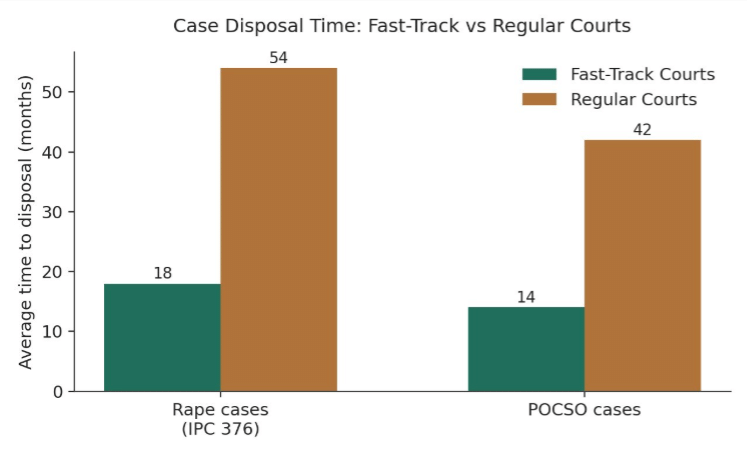
Chart 1 reproduces Aditi & Singh’s comparative disposal-time data – the clearest evidence of FTC efficiency gains relative to regular courts. Rape cases average 18 months in FTCs against 4-5 years (taken as 54 months) in regular courts, while POCSO cases average 14 months against 3-4 years (42 months). This is the single most policy-relevant comparison across the sources, since it directly measures the efficiency differential this paper investigates.
State-wise, Singh (2025) reports stark regional disparities: Maharashtra, Delhi and Kerala show comparatively high disposal rates, while Uttar Pradesh – despite recording the highest number of crimes against women nationally – had 1.1 lakh pending POCSO/rape cases and only 186 of a required 218 FTSCs functional (85%). Bihar, Jharkhand and Odisha lag further, attributed to judicial vacancies and weak infrastructure. Chadah & Kaushal’s 2022 account of Uttar Pradesh topping national pendency charts, followed by Maharashtra, corroborates this pattern; Singh’s 2024-25 dataset is more granular and recent and should be preferred wherever the two diverge on state-level numbers.
Variable-wise Analysis
The variables recur across all the papers as explanatory factors behind uneven pendency reduction.
Funding continuity: the 2011 withdrawal of central funding, noted identically in all the papers, created a governance vacuum only partially addressed by the 2019 Nirbhaya Fund scheme, leaving FTC survival dependent on state-level political will.
Human-infrastructure adequacy: judge vacancy (~30%), the low share of FTSCs with full-time judicial officers (38%), and Chadah & Kaushal’s finding that Fast-Track Courts frequently share buildings, stenographers and prosecutorial staff with regular courts together constrain throughput regardless of formal caseload targets.
Statutory timeline compliance: Section 309 CrPC prescribes disposal of rape trials within 60 days of the charge sheet, yet Singh (2025) records an average FTSC disposal time of 246 days – roughly four times the statutory benchmark – while Chadah & Kaushal’s DAKSH-sourced figure of 122 days, though closer to target, still exceeds it substantially. Both figures suggest the statutory timeline functions as an aspirational benchmark rather than a binding constraint in practice.
Econometric / Statistical Results
None of the sources reports regression, correlation or logit/probit estimates; all present descriptive and comparative statistics rather than inferential models – a limitation Aditi & Singh explicitly flag as a research gap. The closest approximations to effect-size estimates are Aditi & Singh’s claim that FTCs dispose of cases 40-60% faster than regular courts (NJDG-sourced), and their benefit-cost estimate that every Rs. 1 invested in FTCs yields approximately Rs. 2.5 in social and economic benefit – both stated without disclosed methodology, sample or confidence intervals, and so should be read as indicative rather than statistically validated claims.
Chart 2: Conviction-rate estimates reported across the sources, plus an international benchmark
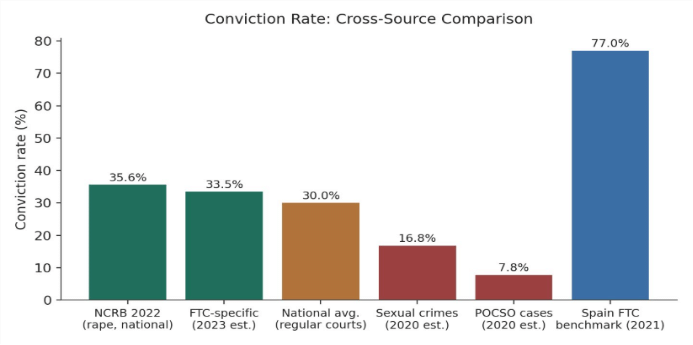
Conviction-rate data (Chart 2) illustrates the same descriptive-only character of the evidence base while also revealing wide variance: Singh (2025) reports 35.6% for rape cases (NCRB 2022); Aditi & Singh report 32-35% for FTCs against a 30% national average; Chadah & Kaushal report markedly lower figures of 16.8% (sexual crimes) and 7.8% (POCSO), drawn from 2020-vintage secondary reporting. Spain’s comparable gender-violence courts, cited by Chadah & Kaushal as an international benchmark, report a 77% conviction rate.
Diagnostic / Robustness Checks
The comparison of the sources exposes inconsistencies that affect confidence in the underlying figures.
Average disposal time ranges from 122 days (DAKSH, methodology undisclosed) to 246 days (DoJ, 2024) to roughly 540 days for rape cases (Aditi & Singh’s 18-month figure) – a more than four-fold spread reflecting differences in case-type scope, measurement period and possibly the sample of courts covered, rather than a genuine swing in performance. Conviction-rate estimates show comparable spread (7.8% to 35.6%), largely because Chadah & Kaushal’s figures derive from an older (2020) media-sourced estimate rather than a primary NCRB release. Where sources conflict, the more recent, dashboard-sourced figures in Singh (2025) – drawing directly on DoJ and NCRB 2022-24 data – are treated as the more reliable baseline, with the other two papers used to corroborate direction and trend rather than exact magnitude. Notably, all the papers converge without contradiction on the qualitative diagnosis that judicial vacancies, infrastructure deficits and the absence of dedicated enabling legislation for FTSCs are the primary bottlenecks – which strengthens confidence in that particular finding despite the numeric discrepancies elsewhere.
Key Findings
FTCs/FTSCs measurably outperform regular courts on disposal speed (40-60% faster; 18 vs 54 months for rape cases; 14 vs 42 months for POCSO cases), confirming a genuine efficiency gain though absolute performance still falls well short of the 60-day statutory target under Section 309 CrPC.
- Operational capacity lags sanctioned capacity: only 74% of sanctioned FTSCs were functional as of March 2024, and roughly 30% of judge posts nationally remain vacant.
- The case backlog remains large and is shrinking only slowly: from ~1.93 lakh cases pending in FTSCs in 2022 to 62% of a 1.67 lakh target caseload still undisposed as of January 2025.
- Regional disparity is severe and persistent across the 2022-2024 period: Maharashtra, Delhi and Kerala perform comparatively well, while Uttar Pradesh, Bihar, Jharkhand and Odisha consistently lag in both papers that measure state-wise performance.
- Conviction-rate data is the least reliable metric across sources (ranging 7.8%-35.6%) and should be cited cautiously in the main paper, preferring the most recent NCRB-sourced figures (Singh, 2025).
- None of the sources uses inferential statistics; all findings are descriptive/comparative in nature, a limitation the group paper should note explicitly when drawing causal conclusions.
FINDINGS
Major findings
- FTCs dispose of cases faster than regular courts: rape cases take about 18 months against 54, and POCSO cases about 14 against 42 (roughly 40-60% faster).
- Performance still misses the law: average FTSC disposal is about 246 days against the 60-day Section 309 CrPC benchmark.
- Only 760 of 1,023 FTSCs (74%) are operational, about 30% of judge posts are vacant, and just 38% have a full-time judicial officer.
- Only 38% of the 1,66,882-case target caseload was disposed of by January 2025.
- Court numbers do not decide outcomes: Uttar Pradesh has the most FTCs and over 1.1 lakh pending cases, while Mizoram and Nagaland convict more despite fewer courts.
- Conviction rates range from 7.8% to 35.6% across sources, making them the least reliable indicator.
Objectives and hypotheses addressed
- To examine the gap between the policy goal of speedy justice and delays in practice: FTCs are faster than regular courts, yet far from statutory timelines and targets (28 cases per court a year against an intended 165).
- To assess the effectiveness of FTCs in reducing pendency and improving justice delivery: gains are real but uneven, and the backlog is shrinking slowly (about 1.93 lakh pending in 2022).
- To evaluate institutional capacity, accountability and consistency in FTC/FTSC functioning: vacancies, no dedicated statute and unstable funding explain the state-level disparities.
- To analyse the tension between speed and substantive outcomes in FTSCs handling crimes against women and children: no clear sign that speed lowered convictions, but fairness remains unmeasured.
Most important insights
- Capacity, not court count, drives performance.
- Sources agree on the causes (vacancies, infrastructure, no statute) even where their numbers differ.
- All evidence is descriptive, so findings show association, not causation.
CONCLUSION
Overall conclusion: Fast-Track Courts have delivered measurable but uneven and fragile gains in reducing pendency. Institutions built to speed up justice are themselves slowed by reactive design, no dedicated statute, unstable funding and thin staffing.
How the research answers the questions: It confirms an efficiency advantage over regular courts, but the promise of speed is only partly met in practice. It links institutional capacity (staffing, funding continuity, infrastructure) to state-level variation. It also shows that disposal and conviction data alone cannot settle whether fast justice is fair justice.
Main contribution: The study moves the assessment of FTCs beyond disposal speed. It reconciles scattered figures into one comparative framework across the four objectives and flags which indicators are reliable. Its limits are its reliance on secondary data with differing reference periods, and the fact that quantitative indicators cannot capture the fairness of judicial decisions.
Policy Recommendations
Actions that should be taken
- Enact a dedicated statutory framework with stable, multi-year funding for FTCs/FTSCs.
- Operationalise all sanctioned FTSCs, fill vacancies, and replace “additional charge” with exclusive full-time judges and staff.
- Prioritise resources for lagging states (Uttar Pradesh, Bihar, Jharkhand, Odisha) and adopt practices from Maharashtra, Kerala and Delhi.
- Improve infrastructure, victim-friendly facilities and case-management technology.
- Enforce timelines and limit adjournments.
- Train judges and prosecutors in gender- and child-sensitive handling.
- Standardise data reporting and add independent audits covering fairness, not just disposal.
- Fund mixed-methods research on trial quality and victim experience.
Who should implement them
- Union Ministry of Law and Justice, Department of Justice and Parliament (legislation, funding).
- High Courts and state governments (staffing, infrastructure, case management).
- Judicial academies (training).
- NCRB, NJDG managers and research bodies (data, audits, research).
How they address the research problem
These steps fix the structural causes of delay (funding, vacancies, uneven state capacity) and change how success is measured, from disposal speed alone to fairness and substantive outcomes.
References
[1] P. Jaiswal, “Fast-Track Courts in India: Assessing Efficacy and Proposing Solutions for Case Backlog,” International Journal of Legal Science and Innovation, vol. 6, no. 3, pp. 1482-1496, 2024. https://ijlsi.com/article/view/fast-track-courts-in-india-assessing-efficacy-and-proposing-solutions-for-case-backlog
[2] A. Singh, “ Fast Track Courts in India: Past, Present and Future,” International Journal of Law Management and Humanities, vol. 4, no. 4, pp. 696-703, 2021https://ijlmh.com/paper/fast-track-courts-in-india-past-present-and-future/
[3] S. Singh and R. Jha, “Legal framework vs. practical realities: The effectiveness of fast track courts in achieving speedy justice,” International Journal of Law Managment and Humanities, vol. 7, no. 3, p. 2117, 2024. https://ijlmh.com/paper/legal-framework-vs-practical-realities-the-effectiveness-of-fast-track-courts-in-achieving-speedy-justice/
[4] R. Singh and Priyanka, “Fast-Track Courts in India: Legislative Intent Vs. Ground Reality,” Iconic Research And Engineering Journals, vol. 9, no. 12, 2026. https://www.irejournals.com/formatedpaper/1719143.pdf
[5] A. Mishra, “Analyzing the Efficacy of Fast Track Courts in India,” White Black Legal-International Journal, vol. 2, no. 16, p. 19,2024.https://www.whiteblacklegal.co.in/public/uploads/issues/1618375273.pdf
[6] B. Singh and R. Verma, “POCSO justice and fast-track courts in India: A state-wise empirical analysis of court capacity, trial duration, conviction and judicial pendency,” International Journal for Legal Research and Analysis, vol. 3, no. 5, pp. 887-898, 2026https://www.ijlra.com/uploads/940979189.pdf
[7] A. and D. Singh, The efficacy of fast track courts in India: An analysis of efficiency and justice delivery,” Journal of the Oriental Institute, vol. 73, no. 1, 2024. https://journaloi.com/index.php/JOI/article/download/919/165/501
[8] S. Chadah and Isha Kaushal, “Role of Fast Track Special Courts in Curbing Crimes against Women: An Assessment,” Indian Institute of Public Administration, pp. 111-124, 2025. https://journaloi.com/index.php/JOI/article/download/919/165/501
[9] R. Singh, “ROLE OF FAST-TRACK COURTS IN ADDRESSING CRIMES AGAINST WOMEN IN INDIA,” Supremo Amicus, vol. 39, 2025. https://supremoamicus.org/wp-content/uploads/2025/10/Radhika-Singh-Assistant-Professor-at-Bundelkhand-College-Jhansi.-.pdf
[10] A. Singh, “Judicial Reforms and Pendency of Cases,” International Journal of Research and Analytical Reviews (IJRAR), vol. 12, no. 2, pp. 574-578, 2025. https://www.ijrar.org/papers/IJRAR25B1468.pdf