
Yash Saxena

IIT (ISM) Dhanbad
B-tech | 2024-2028 | Environmental Engineering
Research Intern — Environmental Domain
International Institute of SDGs and Public Policy Research
Abstract
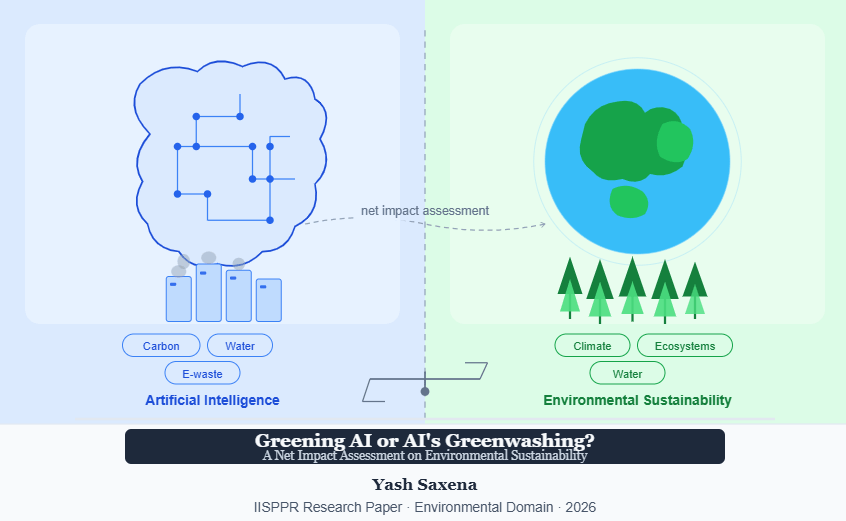
Artificial intelligence (AI) has emerged as both a powerful tool and a significant environmental stressor. Proponents claim AI will accelerate climate action through energy optimisation, precision agriculture, and climate modelling. Critics, backed by a growing body of empirical evidence, point to substantial and rapidly growing ecological costs: carbon emissions from training and inference, water consumption at data centres, and e-waste from accelerated hardware cycles. This paper presents a Net Impact Assessment (NIA) of AI on environmental sustainability, explicitly defined as a multi-criteria comparative evaluation of AI’s quantifiable ecological costs against its attributable environmental benefits, with corrections for rebound effects and additionality. It further analyses structural greenwashing patterns in the technology sector, where corporate net-zero pledges are systematically undermined by AI-driven emission growth. Drawing on peer-reviewed literature and corporate sustainability disclosures, this paper concludes that AI’s net environmental impact is application-specific and currently skewed negative at the infrastructure level, and proposes targeted policy interventions to reorient AI deployment toward substantive rather than performative sustainability.
Keywords: Artificial Intelligence, Environmental Sustainability, Carbon Footprint, Greenwashing, Net-Zero, Climate Change, Energy Consumption, Net Impact Assessment
1. Introduction
The intersection of artificial intelligence and environmental sustainability is one of the most contested arenas in contemporary environmental discourse. On one side stands an optimistic narrative, championed largely by Big Tech: AI as a planetary solution capable of modelling climate systems with unprecedented accuracy, orchestrating smart energy grids, and identifying efficiencies invisible to human analysts. On the other stands a growing body of critical scholarship questioning whether AI is, in practice, a net environmental liability dressed in the language of green innovation.
The urgency of this question cannot be overstated. Global AI investment exceeded $500 billion in 2024 (International Energy Agency, 2024), and the infrastructure supporting it: data centres, training clusters, and semiconductor fabrication facilities is expanding at an exponential rate. The IEA has projected that data centre electricity demand could double by 2026, with AI workloads constituting a substantial and growing share (IEA, 2024). Meanwhile, major technology corporations including Google, Microsoft, and Amazon have each made high-profile net-zero commitments that are, in several cases, being quietly revised in the face of rising operational emissions driven by AI scale-up.
This paper employs a Net Impact Assessment (NIA) framework defined here as a structured, multi-criteria evaluation that compares the quantifiable ecological costs of AI systems (energy consumption, water use, hardware lifecycle emissions) against their attributable environmental benefits (emissions avoided, resources conserved), corrected for rebound effects and additionality. This framework is introduced explicitly at the outset because it shapes the analytical logic of every subsequent section. Unlike conventional lifecycle analysis, NIA incorporates counterfactual reasoning: benefits are only credited where AI intervention demonstrably produced outcomes that would not have occurred otherwise.
This paper does not adopt a technophobic position. AI offers tools with genuine and measurable environmental utility. The argument is that the current discourse suffers from a structural imbalance: benefits are amplified and costs obscured, partly through honest enthusiasm and partly through deliberate corporate narrative management. The paper proceeds as follows. Section 2 quantifies AI’s direct environmental costs. Section 3 examines credible environmental benefits with critical scrutiny. Section 4 analyses greenwashing patterns and their structural drivers. Section 5 applies the NIA framework. Section 6 offers findings-linked policy recommendations, and Section 7 concludes.
2. The Environmental Costs of AI
2.1 Energy Consumption and Carbon Emissions
Training large-scale AI models represents a significant and growing source of greenhouse gas emissions. Strubell et al. (2019) estimated that training a single large transformer model produced approximately 284 tonnes of CO2 equivalent roughly five times the lifetime emissions of an average American car. Training GPT-3, with 175 billion parameters, has been estimated at approximately 552 tonnes of CO2e (Patterson et al., 2021). Frontier models released since 2022 are estimated to require an order of magnitude more computation, with training runs exceeding tens of thousands of GPU-hours at energy-intensive facilities.
A critical but underappreciated distinction is between training and inference costs. While model training is a one-time event, inference the process of generating outputs for users occurs billions of times daily. Patterson et al. (2021) estimate that inference may account for 80–90% of a deployed model’s total energy footprint over its operational lifetime. As AI is integrated into search, productivity tools, and enterprise software at scale, inference-related emissions represent the dominant and fastest-growing component of AI’s carbon budget.
The carbon intensity of this energy depends on the grid mix powering data centres. Lannelongue et al. (2021) demonstrated that the same computation can produce up to 500 times more CO2 depending on geographic location. Many data centres remain in regions with coal-heavy grids, and renewable energy procurement, while growing, does not eliminate marginal fossil fuel draws during demand peaks. These structural dependencies mean that AI’s carbon emissions cannot be addressed through procurement alone; absolute reductions in compute intensity are required.
2.2 Water Consumption
Data centres require substantial water for cooling. Li et al. (2023) estimated that GPT-3 consumed approximately 700,000 litres of freshwater during training in Microsoft’s Iowa data centres. Microsoft reported a 34% increase in global water consumption between 2021 and 2022 (Microsoft Sustainability Report, 2022), a period coinciding with its AI infrastructure scale-up; Google reported a 20% increase over the same period (Google Environmental Report, 2022). The implications are geographically concentrated: many data centres are deliberately sited in lower-cost, lower-regulation regions that are simultaneously water-stressed, creating direct competition between AI infrastructure and agricultural and municipal water needs.
2.3 Electronic Waste
AI’s demand for specialised high-performance hardware: GPUs, TPUs, and custom silicon accelerates hardware refresh cycles in data centres, with chips often retired within three to five years due to rapid architectural improvements. The environmental costs are twofold: the carbon and water intensity of semiconductor manufacturing (Pirson and Bol, 2021), and the e-waste generated at end-of-life. Forti et al. (2020) projected global e-waste at 74 million metric tonnes annually by 2030, with AI hardware constituting a growing and poorly tracked share. Unlike carbon emissions, e-waste is largely invisible in corporate sustainability reporting, representing a significant gap in current accounting frameworks.
These three cost categories: carbon, water, and e-waste are not independent. They share a common structural root: the business model of AI at scale. Larger models, more frequent model releases, and broader deployment all simultaneously increase energy demand, water withdrawal, and hardware turnover. The environmental costs of AI are not incidental externalities but structural outputs of how AI products are designed and monetised.
3. AI’s Genuine Environmental Benefits
3.1 Energy Grid Optimisation
The most substantiated environmental application of AI is in energy system optimisation. DeepMind’s deployment of reinforcement learning to manage cooling in Google’s data centres achieved approximately 40% reductions in cooling energy (DeepMind, 2016). In power grid management, AI-driven demand forecasting and load balancing have demonstrated reductions in renewable energy curtailment and improvements in grid stability. IRENA (2023) estimated that AI-assisted grid optimisation could reduce global power sector emissions by up to 1.5–2 gigatonnes of CO2 per year by 2030.
Critical qualification is warranted, however. IRENA’s estimates are based on modelled scenarios with optimistic adoption rates. The additionality question is significant: much grid optimisation can be achieved through conventional software and statistical methods; the marginal contribution of AI specifically is rarely isolated. Rebound effects also apply: efficiency improvements in energy systems may stimulate demand increases that partially offset the gains (Jevons, 1865; Greening et al., 2000).
3.2 Climate Modelling and Scientific Research
AI has demonstrably accelerated climate science. Lam et al. (2023) showed that Google DeepMind’s GraphCast model achieved medium-range weather forecast accuracy comparable to the European Centre for Medium-Range Weather Forecasts (ECMWF) operational model at a fraction of the computational cost. NVIDIA’s FourCastNet achieved similar results. In greenhouse gas monitoring, AI analysis of satellite data has improved methane emission detection and attribution with direct implications for regulatory enforcement and voluntary abatement (Lauvaux et al., 2022)
The limitation here is scope: AI accelerates existing climate science but does not substitute for the policy action required to act on that science. Improved forecasting does not reduce emissions; it only improves the information environment in which policy decisions are made.
3.3 Precision Agriculture and Ecosystem Monitoring
AI-powered precision agriculture systems, combining satellite imagery, IoT sensors, and machine learning, have demonstrated water use reductions of 20–50% in controlled trials (FAO, 2022). Given that agriculture accounts for approximately 70% of global freshwater withdrawals (UNESCO WWAP, 2019), these efficiency gains represent a meaningful opportunity. Similarly, optimised fertiliser application reduces nitrous oxide emissions from agricultural soils, a potent greenhouse gas with a global warming potential approximately 265 times that of CO2 over a century.
However, precision agriculture technology remains concentrated in high-income countries with existing digital infrastructure. The regions most vulnerable to climate-related agricultural disruption: sub-Saharan Africa, South Asia, are least likely to access these tools without targeted technology transfer and public investment (Campanhola and Pandey, 2019). Benefit estimates that do not account for adoption distribution overstate AI’s realistic contribution.
3.4 Industrial and Buildings Efficiency
AI-driven building management systems, smart thermostats, and industrial process optimisation have collectively achieved energy savings of 10–30% in commercial and industrial settings. When deployed at scale, these incremental efficiencies aggregate into significant emissions reductions. The Ellen MacArthur Foundation has estimated that AI-enabled efficiency improvements across industrial sectors could contribute to reducing annual greenhouse gas emissions by 2.6–5.3 gigatonnes of CO2e by 2030.
4. Corporate Greenwashing in the AI Sector
4.1 The Pledge-Performance Gap
The most prominent manifestation of AI greenwashing is the widening gap between stated climate commitments and actual performance among major technology firms. Microsoft, which pledged in 2020 to become carbon negative by 2030, reported in its 2024 sustainability report that its emissions had increased by 29% since the pledge was made, driven primarily by the energy demands of its AI infrastructure expansion, including the scale-up of Azure AI services and its partnership with OpenAI. Google similarly reported a 48% increase in emissions between 2019 and 2023, acknowledging that ‘the path to net zero is complicated by AI’.
These disclosures to the companies’ credit, made publicly reveal the structural tension at the heart of AI sustainability claims: the same corporations investing most aggressively in AI are also the ones whose emissions are growing fastest. The net-zero pledges, announced with considerable fanfare, now function in some cases as forward-dated licenses for present-day emission growth.
4.2 Structural Incentives for Greenwashing
The pledge-performance gap is not primarily a product of bad faith. It reflects a structural conflict embedded in the AI business model: the same investments that drive revenue growth (larger models, broader deployment, more frequent product cycles) simultaneously drive emission growth. Net-zero pledges are announced by sustainability teams; AI scale-up decisions are made by product and infrastructure teams with different incentive structures and reporting lines. This organisational disconnect means that greenwashing in the AI sector is, in significant part, a coordination failure rather than deliberate deception though the effect on atmospheric CO2 is identical.
A secondary structural driver is competitive pressure. In a market where AI capabilities are a primary competitive differentiator, the costs of restraining compute scale are borne immediately and competitively, while the environmental costs are diffuse, delayed, and socialised. Without external regulatory constraints, the rational corporate actor will continue scaling compute while managing reputational risk through sustainability communications (Tilmes, 2022)
4.3 The Carbon Offset Mechanism
Much of the claimed progress toward net-zero in the AI sector relies on carbon offset purchases. West et al. (2023), in a systematic analysis of credits certified by Verra, the world’s largest voluntary carbon market certifier found that over 90% of rainforest offset credits did not represent genuine emissions reductions. For AI companies relying on such offsets to substantiate net-zero claims, this represents a material integrity gap.
Corporate AI sustainability reporting also systematically omits Scope 3 emissions, which include supply chain emissions from semiconductor manufacturing, hardware lifecycle emissions, and downstream emissions from enterprise customers’ AI deployments (Ligozat et al., 2022). A full Scope 1, 2, and 3 accounting would substantially alter the sustainability profiles of the sector’s leading firms.
4.4 Selective Disclosure and Scope 3 Omissions
Corporate AI sustainability reporting frequently employs selective disclosure, highlighting renewable energy procurement and operational efficiency gains while omitting or minimising Scope 3 emissions, which include supply chain emissions (notably semiconductor manufacturing), hardware lifecycle emissions, and the emissions of downstream AI deployments by enterprise customers. A comprehensive accounting framework, one that applies consistent lifecycle assessment methodology across Scope 1, 2, and 3 would substantially alter the sustainability profiles of the AI sector’s leading firms.
5. A Net Impact Assessment Framework for AI
As defined in Section 1, the Net Impact Assessment (NIA) framework is a multi-criteria comparative evaluation of AI’s quantifiable ecological costs against its attributable environmental benefits, corrected for rebound effects and additionality. Its application requires five analytical components, each directly addressing a limitation identified in previous sections:
- Lifecycle Carbon Accounting: Training emissions + annualised inference emissions over deployment lifetime + hardware manufacturing and disposal emissions, minus attributable avoided emissions from AI applications. This addresses the selective disclosure problem identified in Section 4.3.
- Water Stress-Adjusted Impact: Data centre water consumption weighted by the water stress index of the host region, compared against water savings from AI-enabled agricultural and industrial applications. This captures the geographic inequity identified in Section 2.2.
- Rebound Effect Correction: Efficiency gains enabled by AI are subject to Jevons-type rebound effects, wherein cost reductions stimulate demand increases. Net impact assessments must incorporate rebound effect estimates drawn from comparable efficiency interventions (Greening et al., 2000).
- Additionality Assessment: Environmental benefits attributed to AI must pass an additionality test: would the outcome have occurred absent the AI application? As noted in Section 3.1, many AI environmental claims fail this test when conventional software alternatives are considered.
- Temporal Discounting: Near-term emission costs must be evaluated against the timeframes over which AI environmental benefits materialise, with appropriate treatment of carbon budget constraints in the 2030 and 2050 climate policy horizons (IPCC, 2022).
Applying this framework to the current landscape produces a differentiated picture. AI deployed for foundational model training at scale, with no direct environmental application, is a net negative by virtually all metrics. AI deployed in targeted energy optimisation contexts, where additionality can be demonstrated and rebound effects are bounded, can achieve genuine net positive outcomes. The framework’s principal value is in forcing this distinction currently obscured by aggregate industry-level claims into the evaluation of individual AI deployments.
6. Policy Recommendations
The following recommendations are derived directly from the analytical findings of this paper. Each addresses a specific failure mode identified in preceding sections.
- Mandatory Lifecycle Emission Disclosure: As established in Section 4.3, selective Scope 3 omission enables greenwashing. Regulatory bodies should require AI companies to disclose training, inference, and hardware lifecycle emissions under a standardised reporting framework analogous to the Task Force on Climate-related Financial Disclosures (TCFD), extended to cover AI-specific emission categories.
- AI Compute Carbon Price: As identified in Section 4.2, the absence of a price on AI-related emissions removes the financial incentive to constrain compute scale. A carbon price applied to data centre electricity consumption would internalise the environmental costs established in Section 2 and incentivise investment in compute-efficient model architectures.
- Additionality-Based Green AI Certification: Given the additionality problem identified in Section 3.1, a credible green AI certification scheme must require demonstration that claimed benefits are attributable to AI specifically, not to concurrent efficiency programmes or general technology improvements. Independent audit is essential.
- Voluntary Carbon Market Reform: As established by West et al. (2023), the offset market integrity problem identified in Section 4.3 cannot be resolved without regulatory oversight. Restrictions on the use of low-integrity offsets to substantiate net-zero claims are a necessary condition for credible AI sustainability commitments.
- Public Investment in Efficient AI Architectures: The structural incentive analysis in Section 4.2 suggests that individual firms will under-invest in compute efficiency research relative to the social optimum. Significant public investment in sparse models, neuromorphic computing, and hardware-software co-design could reduce the energy intensity of frontier AI systems without compromising capability.
7. Conclusion
The question posed by this paper is AI greening our future or greenwashing it? does not admit of a simple answer. AI is neither an unambiguous environmental saviour nor a straightforwardly harmful technology. It is a powerful and rapidly scaling general-purpose tool whose environmental impact is determined by how, where, and for what purpose it is deployed, and how rigorously those impacts are measured and reported.
What the evidence does establish is that the current discourse is structurally distorted. The environmental costs of AI infrastructure are substantial, growing, and as Ligozat et al. (2022) and Patterson et al. (2021) document systematically underreported. The environmental benefits of AI are real in targeted domains but are claimed with insufficient rigour and often without credible additionality. Corporate net-zero pledges, in several documented cases, are being undermined by the very AI investments they nominally accompany.
The Net Impact Assessment framework proposed in this paper offers a methodological basis for moving from aggregate, often misleading, industry-level claims toward application-specific accountability. Its five components lifecycle carbon accounting, water stress adjustment, rebound correction, additionality assessment, and temporal discounting collectively address the principal gaps in current AI environmental evaluation.
AI can be a meaningful contributor to a sustainable global economy. But only if the standards applied to its environmental claims are as rigorous as the technology itself.
References
Campanhola, C., & Pandey, S. (Eds.). (2019). Sustainable Food and Agriculture: An Integrated Approach. FAO and Academic Press.
DeepMind. (2016). DeepMind AI reduces Google data centre cooling bill by 40%. DeepMindBlog.
Forti, V., Baldé, C. P., Kuehr, R., & Bel, G. (2020). The Global E-waste Monitor 2020: Quantities, flows and the circular economy potential. UNU/UNITAR.
Google LLC. (2022, 2024). Google Environmental Report. Mountain View, CA: Google.
Greening, L. A., Greene, D. L., & Difiglio, C. (2000). Energy efficiency and consumption — the rebound effect — a survey. Energy Policy, 28(6–7), 389–401.
International Energy Agency. (2024). Electricity 2024: Analysis and forecast to 2026. IEA.
IPCC. (2022). Climate Change 2022: Mitigation of Climate Change. Contribution of Working Group III to the Sixth Assessment Report. Cambridge University Press.
IRENA. (2023). Renewable Power Generation Costs in 2022. International Renewable Energy Agency.
Jevons, W. S. (1865). The Coal Question: An Inquiry Concerning the Progress of the Nation, and the Probable Exhaustion of Our Coal-Mines. Macmillan.
Lam, R., et al. (2023). Learning skillful medium-range global weather forecasting. Science, 382(6677), 1416–1421.
Lannelongue, L., Grealey, J., & Inouye, M. (2021). Green algorithms: Quantifying the carbon footprint of computation. Advanced Science, 8(12), 2100707.
Lauvaux, T., et al. (2022). Global assessment of oil and gas methane ultra-emitters. Science, 375(6580), 557–561.
Li, P., Yang, J., Islam, M. A., & Ren, S. (2023). Making AI less thirsty: Uncovering and addressing the secret water footprint of AI models. arXiv preprint arXiv:2304.03271.
Ligozat, A. L., Lefèvre, J., Bugeau, A., & Combaz, J. (2022). Unraveling the hidden environmental impacts of AI solutions for environment. Patterns, 3(6), 100488.
Microsoft Corporation. (2022, 2024). Environmental Sustainability Report. Redmond, WA:Microsoft.
Patterson, D., Gonzalez, J., Le, Q., Liang, C., Munguia, L., Rothchild, D., So, D., Texier, M., & Dean, J. (2021). Carbon emissions and large neural network training. arXiv preprint arXiv:2104.10350.
Pirson, T., & Bol, D. (2021). Assessing the embodied carbon footprint of IoT edge devices with a bottom-up life-cycle approach. Journal of Cleaner Production, 322, 128966.
Strubell, E., Ganesh, A., & McCallum, A. (2019). Energy and policy considerations for deep learning in NLP. Proceedings of the 57th Annual Meeting of the Association for Computational Linguistics. ACL.
Tilmes, C. (2022). Whither climate finance? One Earth, 5(6), 575–578.
UNESCO WWAP. (2019). The United Nations World Water Development Report 2019: Leaving No One Behind. UNESCO.
West, T. A. P., et al. (2023). Overstated carbon emission reductions from voluntary REDD+ projects in the Brazilian Amazon. Science, 380(6646), 1u20139.