Authors:
Kirtiben Pingle, Smriti Rai, Anjani Sharma, Vasudha Shriya, Chitra Dev, Sneha Some, Dibakar Jyoti Bora
Introduction:
The United Nations General Assembly (UNGA) which was established as the primary gathering for discussing international matters following the World War II. The UNGA, consisting of 193 sovereign member states, regularly votes on a variety of resolutions, creating a decades-long data list of states stances. In the past, rigid, binary geopolitical structures—most notably the East-West ideological polarisation of the Cold War era—were used by international relations researchers to analyse these voting alliances. However, due to decolonisation and the rise of the Global South, the post-cold-war environment has changed the fundamental balance of power at the international level. State-to-state relations in contemporary times are no longer limited to long-term, monolithic blocs; instead, countries increasingly participate in flexible, fluid, and issue-specific forms of cooperation. As a result, examining UNGA voting patterns offers an essential perspective on how diplomatic, economic, and strategic realignments appear on the international stage.
Voting records from the UNGA provide a valuable insight into the political inclinations, diplomatic positions, and preferred policies of sovereign states. Member nations have the diplomatic right to cast express votes, which can be classified as affirmative, negative, abstentions, or absences, but UNGA decisions are primarily non-binding. When examined thoroughly, these recorded decisions reveal underlying patterns of agreement and disagreement across a variety of global issues, from trade and economic development to international security and human rights. Yet it takes some good amount of effort to interpret these patterns. Consistent voting closeness does not always indicate a formal, long-lasting geopolitical alliance, even though it frequently indicates shared strategic or economic goals. Due to shared views on sovereignty, regional solidarity, transient economic interests, or reliance on foreign help, states often vote together. As a result, examining vote patterns must go beyond basic agreement counts to consider the larger political, economic, and strategic elements that influence foreign policy choices.
Therefore, it is crucial to examine voting alignment in order to spot trends of new and changing geopolitical alignment in a multipolar world. The complex nature of contemporary international relations can be oversimplified by traditional methods that classify nations only according to their formal treaty membership or geographic location. Instead of assuming permanent geopolitical blocs, network analysis can help map these links by treating states as nodes and similarities in their voting behaviour as connections. This allows academics to look at patterns of interdependence. Such a technique can be used to determine how informal and issue-specific alignments evolve over time and how modern coalitions—such as the G77 and BRICS—relate to more significant shifts in the international system. In the end, knowing how and why states align in the UNGA can give important insight into how geopolitical cooperation and alignment are evolving.
Even though UNGA voting patterns are helpful in comprehending international political conduct, it is still challenging to determine a geopolitical alliance based alone on voting similarities. Without necessarily having long-term political cooperation, nations may vote similarly due to mutual economic interests, regional priorities, diplomatic concerns, or agreement on a specific topic. Thus, comparable voting patterns must be analysed in light of the broader political and economic environment in which states make their choices. This is especially important when researching regional and developing-nation groups, where collaboration may be robust on certain subjects but inconsistent on others.
Existing studies have looked at how political alignment, economic interests, regional groupings, foreign aid, and shifting geopolitical conditions affect UN voting behaviour. But there is still scope to analyse these variables collectively and determine whether voting similarities are primarily related to specific concerns or reflect larger geopolitical linkages. In this way, the contribution of emerging and Global South governments is particularly crucial because their voting patterns may indicate types of collaboration that do not always fit into established geopolitical blocs. Finding recurrent patterns between states and determining whether these similarities constitute larger clusters or are restricted to specific problems can be further aided by a network-based approach.
Considering this, the current study investigates UNGA voting patterns from three interrelated perspectives: the correlation between trade and economic interests and voting behaviour among ASEAN nations, issue-based voting on security and terrorism among G77 nations and voting similarity and clustering patterns among states. The study looks at convergence, divergence, and relationships between states using network-based analysis and descriptive comparison. The goal is to investigate if recurrent voting patterns can offer proof of new, evolving, or issue-specific forms of geopolitical alignment rather than assuming that comparable voting always signifies a formal geopolitical alliance. This method is especially helpful to understand how governments can maintain differences on other international issues while cooperating around common goals.
Literature Review Overview:
Voting patterns at the United Nations offer a valuable means of understanding the political ties and shifting alignments between states. Member states’ voting patterns, especially in the UN General Assembly, can highlight parallels and discrepancies in their diplomatic stances, political inclinations, and reactions to significant global concerns. Research already conducted indicates that these trends have evolved in parallel with significant shifts in global politics, such as the Cold War, decolonisation, the rise of the Global South, and the formation of more recent geopolitical coalitions.
Since nations that consistently demonstrate similar voting patterns may have broader political, strategic, or economic objectives, the study of UN voting is therefore essential to establishing new geopolitical alliances. However, as trade interests, foreign aid, economic ties, and shifting geopolitical conditions can also affect state action, vote alignment cannot necessarily be interpreted as proof of a lasting partnership.
This literature review examines existing research on UN voting patterns and their relationship with geopolitical alignment. It is organized around four themes: UN Voting Patterns as Indicators of Political Alignment and Alliance Formation; Changing Geopolitical Blocs: From Cold War Emerging Coalitions; Economic Interests, Foreign Aid and Geopolitical Influence on Voting Alignment; Network Analysis and the Identification of Emerging and Shifting Alliances. When taken as a whole, these themes offer a foundation for comprehending how shifting patterns of international political alignment can be examined using UN voting data.
THEME 1: UN Voting Patterns as Indicators of Political Alignment and Alliance Formation
Experts are increasingly using UN vote trends as a measure of governments’ political stance. In order to comprehend the political ties that exist between nations, academics look at similarities and differences in voting behaviour rather than seeing votes in the UN General Assembly as separate choices. The vast amount of UN voting data provides proof of states’ preferences and enables scholars to identify groups of nations that exhibit comparable behavioural tendencies. Because of this, UN voting is especially helpful in determining if political alignments are associated with more general geopolitical connections.
In order to find commonalities between states and the strength of voting blocs, early methods to the study of UN voting mostly focused on agreement and cohesion measures. Nevertheless, these methods’ capacity to capture nuances in state preferences and complex political relationships was constrained. As more sophisticated quantitative methods emerged, researchers started examining shifts in nations’ voting positions over time using geographical models and other approaches. Thus, the literature demonstrates a shift from merely assessing voting agreement to discovering more profound patterns of political alignment.
Le et al. (2013) highlight the importance of computational analysis by analysing UN vote data using diffusion geometry and thematic clustering. According to their research, voting patterns can provide insight into more general geopolitical trends and shifts in global politics. Voting conduct may represent significant changes in the international system, according to their analysis, which highlights times of polarisation and shifts in state views.
Lee and Stek (2016) expand on this strategy by examining shifting communities within the UN General Assembly thru network analysis of co-sponsorship and voting relationships. Their results show that states can be members of institutional communities with comparatively cohesive voting patterns while simultaneously shifting their relationships over time, challenging the notion that alliances are necessarily stable. They also argue that the complexity of international political interactions might be oversimplified by analysing governments just through ideological or regional divisions.
In the same way, more recent research by Benati and Capurri (2026) illustrates how UNGA voting data can reveal political commonalities and differentiate between governments that are aligned and those that are not. They show how quantitative metrics can be used to identify groups of nations that have similar voting positions by using an Alignment Index and clustering algorithms. This implies that compared to direct comparisons of individual votes, systematic examination of voting behaviour can offer a more accurate picture of political blocs.
In general, research shows that voting trends at the UN can be a good predictor of shifting alliance structures and political stance. The findings do, however, also show that voting associations are not static but rather dynamic. This offers a crucial basis for evaluating new geopolitical alliances using network analysis, which allows interactions between states to be examined as shifting patterns of connectivity rather than as permanent blocs.
THEME 2: Changing Geopolitical Blocs: From Cold War Divisions to Emerging Coalitions
After proving that political alignment can be determined by UN voting patterns, the next question is how these patterns have evolved in parallel with the evolution of the international system. According to the literature, voting alignments in the UN have changed over time. Rather, they have represented significant changes in world politics, shifting from the stark ideological differences of the Cold War to new kinds of alignment based on economic interests, development, sovereignty, and the formation of more recent geopolitical coalitions.
The ideological rivalry between the US and the USSR had a significant impact on UN voting throughout the Cold War. On significant topics, especially those relevant to international governance, security, and disarmament, formal allies often showed a high degree of voting cohesiveness. However, neither powerhouse was always regularly followed by neutral or developing nations. Their voting patterns could be exploited to advance development aid, security concerns, and diplomatic recognition. This suggests that UN voting represented more complex relationships than a straightforward split between two opposed blocs, even during a time when East-West rivalry predominated.
After that, decolonisation brought a significant new aspect to UN politics. Alongside the earlier East-West division, a North-South divide emerged as more and more newly independent developing nations joined the organization. The establishment of the Group of 77 (G-77) and the Non-Aligned Movement (NAM) gave developing nations a venue to voice concerns about economic development, economic justice, national sovereignty, and resistance to foreign involvement. According to the research, developing nations showed strong vote solidarity on issues pertaining to non-intervention and global economic change, resulting in a political division that could not be fully explained by Cold War ideology.
It appears from more recent research that such distinctions have grown more complex. While shifting geopolitical conditions can change state-to-state ties, current UN voting patterns can reflect the growing significance of the Global South and more recent alliances like BRICS. According to the literature, nations may work together on certain issues without being a part of a long-term political bloc. This is in line with the results presented in Theme 1, where network-based research demonstrates that voting communities are dynamic rather than static.
The literature shows that more diverse and adaptive forms of geopolitical collaboration are replacing primarily ideological Cold War alliances. Therefore, UN voting offers a way to track the creation and evolution of new political coalitions as well as old blocs, offering a crucial foundation for investigating the strategic and economic elements that might affect these alignments.
THEME 3: Economic Interests, Foreign Aid, and Geopolitical Influence on Voting Alignment
The changing geopolitical blocs covered in Theme 2 show that governments don’t always vote in harmony due to enduring military or ideological ties. This raises the question, “What explains voting alignment when states with different political positions cooperate on specific UN issues?” According to the literature, trade, financial dependency, foreign aid, and economic ties are significant determinants of diplomatic behaviour. Voting similarity may be a sign of a growing geopolitical relationship, but it may also be the product of strategic economic goals rather than a long-term alliance, therefore examining these effects is crucial for this research.
The relationship between economic power and voting behaviour is especially highlighted in the study concerning the North-South divide. As a reflection of their common developmental goals, developing nations have frequently shown collective stances on matters like trade, economic self-determination, and international economic reform. Incentives for specific voting decisions may also be created by economic ties with more powerful states. Loans, economic access, and foreign aid are listed as potential ways that donor nations can affect recipient states’ foreign policy decisions. Therefore, it is challenging to take every instance of vote similarity as proof of a geopolitical alliance because voting alignment may represent both shared political preferences and material objectives.
The findings on financial institutions and geopolitical relationships complement this more comprehensive view of economic influence. For instance, Obydenkova et al. (2020) concentrate on the connection between voting alignment with the United States in the UN General Assembly and regional development banks. Their study examines the potential impact of regional development banks and collective financial statecraft on borrowing members’ geopolitical compliance. This study focuses on financial institutions and their possible influence on international political behaviour, whereas the North-South literature highlights the wider consequences of aid, trade, and economic dependency. When taken as a whole, these viewpoints imply that economic influence functions both at the institutional level through financial institutions and at the bilateral level through relationships like trade and aid.
Economic theories, however, shouldn’t be regarded as a comprehensive account of UN voting behaviour. Economic ties interact with political preferences, regional interests, and shifting geopolitical conditions, according to the literature itself. This is especially crucial as nations may agree on strategic or economic matters without creating a long-term geopolitical bloc. Therefore, rather than if every voting connection reflects the same kind of political relationship, finding a pattern of comparable votes demands attention to the broader environment in which that alignment happens.
Taken together, the studies reviewed in this theme suggest that geopolitical influence and economic interests can greatly impact UN vote alignment, but they also make it more difficult to identify true emerging coalitions. This serves as a crucial foundation for Theme 4, where network and computational techniques can be used to investigate whether recurring voting links indicate transitory and issue-specific relationships or form persistent clusters.
THEME 4: Network Analysis and the Identification of Emerging and Shifting Alliances
The discussion of economic interests in Theme 3 demonstrates how various types of political, strategic, or economic ties may result in comparable UN voting behaviour. As a result, determining an alliance cannot be based just on whether two nations cast identical ballots. Network and computational methods, which enable links between states to be analysed as patterns of connections and clusters, are increasingly being used in the literature to address this issue. This is especially crucial for the current study since the goal is to find new geopolitical alliances using the connections shown by UN voting patterns rather than just measuring vote similarities.
When considered collectively, the studies reviewed in this subject show that, as opposed to defining alliances as fixed categories, network and computational methods offer a firmer foundation for finding geopolitical alliances since they can reveal clusters, links, and changes in relationships. As a result, they offer the methodological framework for analysing whether current UN voting trends indicate stable geopolitical coalitions, evolving alliances, or new issue-based alliances.
Literature Summary
As considered collectively, the literature shows that voting patterns at the UN offer a valuable foundation for understanding political alignment and shifting geopolitical ties. Researchers generally acknowledge that voting behaviour can reflect broader international divisions and transformations, ranging from the North-South divide and Cold War polarisation to more recent and adaptable forms of collaboration. However, research suggests that vote similarity does not always signal a long-term geopolitical alliance because state action can also be influenced by economic interests, foreign aid, regional interests, and shifting political conditions. Therefore, the literature stresses the importance of analysing links across time, topics, and groups of states and portrays geopolitical alignment as dynamic rather than fixed. By enabling the identification of patterns of connections, clusters, and alignment shifts rather than presuming that states belong to permanent blocs, network and computational approaches further reinforce this perspective.
Research gap
There continue to be several gaps in the literature, even though current research shows that UN voting patterns can disclose political alignment and shifting geopolitical connections. First, the influence of developing and Global South nations on the formation of new voting coalitions has received very less attention. Economic interests, trade, foreign aid, and financial ties have all been found to have an impact on voting behaviour in previous studies, but more research is needed to determine how these factors relate to the development of new geopolitical alliances.
Second, there is room to explore whether newer, issue-based coalitions are forming beyond conventional East-West and North-South divisions because a large portion of the work now in publication focuses on established ideological, regional, or institutional groupings.
Third, there is still a need to systematically apply network and computational approaches to current UN voting relationships, even though these approaches have proven effective in detecting groupings and shifting patterns of alignment.
In order to fill these gaps, the current study uses network analysis of UN voting patterns to find new geopolitical alliances, analyse shifting state-to-state connections, and ascertain if current voting clusters represent stable alignments or developing forms of cooperation. This helps explain how the modern international system is changing geopolitical alliances.
Research Questions:
- In what ways do ASEAN and G77 member states demonstrate voting convergence on selected trade-related and issue-specific UNGA resolutions?
- What new and changing geopolitical alignments among states are revealed by UNGA voting patterns?
- What kinds of stable, changing, or issue-based types of geopolitical alignment are suggested by the patterns or clusters of states that can be found through commonalities in UNGA voting?
- To what extent do G77 member states converge on the selected terrorism-related UNGA resolution?
The research questions are closely tied to the analysis. The ASEAN section looks at voting similarities on trade-related resolutions. The G77 section looks at convergence on the selected terrorism-related resolution. The network analysis looks at relationships and communities formed through similarities, in UNGA voting.
METHODOLOGY
Research Design:
The study uses a network-analysis research design to look at voting trends in the United Nations General Assembly (UNGA) and identify new geopolitical coalitions. Voting similarities between states create edges, while sovereign states are regarded as nodes. This architecture makes it possible to trace relationships, clusters, and shifts in state alignment across time in a methodical manner, which makes it appropriate for determining if recurrent voting patterns signify stable, evolving, or issue-based geopolitical cooperation.
Nature of Research:
The research uses quantitative network analysis, complemented by descriptive and historical contextual analysis. The quantitative part of the study analyses similarities of UNGA voting network links and community structures. The descriptive and historical discussion provides an understanding of the cases of ASEAN and G77. The contextual analysis is used to provide explanations for possible political, economic, regional and issue-based correlations of observed voting behaviour, rather than to establish causal relationships. The study does not statistically measure bilateral trade or economic dependence. Instead, voting patterns are interpreted with contextual variables such as trade and economic factors. The quantitative analysis mainly deals with the similarity of voting behaviour at the UNGA.
Sample and its technique:
Sovereign states participating in the UNGA and their documented votes on particular resolutions serve as the unit of study. A minimum of one vote observation for each of the selected resolutions will be included. The ASEAN case uses targeted selection of trade-related resolutions because the study specifically looks at the connection between trade and UNGA voting. The resolutions that were picked were chosen because they are directly connected to trade negotiations. The larger network analysis uses UNGA voting data from 2016, to 2025.
Selection of resolutions was based on clear criteria to minimise selection bias. To analyse ASEAN, the resolutions chosen had to be directly related to international trade or multilateral trade negotiations and have a recorded vote available. Instead of selecting individual countries based on their voting behaviour, the study used the existing UNGA voting records for the period 2016-2025 for the purpose of the wider network analysis.
Data collection tools:
The study is based on documentary analysis and secondary data. The United Nations Digital Library and General Assembly voting records, among other official UN databases and papers, will provide UNGA vote records and data. Once they meet the study’s selection criteria, existing datasets utilised for network analysis and UN voting will also be taken into consideration. Voting results such as “yes,” “no,” “abstention,” and “non-vote” will be included in the data.
Variables used:
Countries will be represented as nodes, and the formation and strength of links between them will be determined by voting similarities. For each pair of countries voting similarity is measured by looking at how many resolutions both countries voted the way on. Votes of Yes, No or Abstention count as votes. If a country does not vote or is absent that resolution is not counted. When voting similarity reaches seventy percent or more, we draw a line or edge, between those two countries. To carry out the network analysis each country’s recorded UNGA vote was written as Yes, No, Abstention or Non-voting. Yes No and Abstention were counted as voting choices. Non-voting or absence was treated as separate and was not counted as agreement. For every pair of countries voting similarity was measured for the resolutions on which both countries cast a real vote. The voting similarity score was found by dividing the number of resolutions on which the two countries chose the vote by the total number of resolutions on which both countries voted. The resulting value was shown as a percentage: Voting Similarity (%) = (Number of matching votes / Number of resolutions on which both countries voted) × 100
A link (edge) was created between two countries whenever their voting similarity reached seventy percent or more. Thus, each country acts as a node, in the network and each edge shows that two countries share a level of voting similarity. Any non‑voting or missing vote was left out of the calculation of being counted as a shared voting choice.
Ethical considerations:
The current research will utilise freely available official data from the United Nations. However, the voting outcomes will be reported, with the results presented without any personal or sensitive information. In addition, the analysis will not use selective reporting or interpretation of results to support the desired outcome.
Limitations:
Countries may vote similarly for many political, strategic, or economic reasons, hence voting similarity does not always indicate a geopolitical union. Additionally, states may differ on some resolutions while agreeing on others. Furthermore, the research ignores other diplomatic exchanges such as negotiations, declarations, and informal ties in favour of only concentrating on documented UNGA votes. Therefore, the resulting network represents patterns of voting similarity rather than definitive geopolitical alliances.
Data analysis:
This part looks at how countries vote in the United Nations General Assembly and how their votes line up. It does this from three angles: how ASEAN countries and others vote on trade issues how the G77 group votes on security and terrorism and how all the countries in the UN vote in relation to each other. The study uses comparisons and network analysis to see where countries agree, where they disagree and where they group together. The findings help to understand if the way countries vote is mostly about issues or if it shows bigger and repeated patterns of political alignment. Voting similarity is treated as evidence of alignment in voting behaviour rather than as proof of a formal geopolitical alliance.
Data Overview and Sample Profile:
Association of Southeast Asian Nations (ASEAN): Trade-Related UNGA Voting Data
The first part of the analysis focuses on ASEAN and looks at how voting behaviour in the UNGA is related to regional economic interests. UNGA voting records related to international trade discussions are used in the research, with special focus on the voting patterns of the five founding members of ASEAN. UNGA resolutions from 1972 and 1979 are among the chosen cases, which enable the study to assess whether the founding ASEAN members showed convergence in their stances on trade-related issues. The nations are used as the analytical units, and the recorded votes serve as the foundation for determining how similar their stances are. This element is a historical example of how multilateral voting behaviour may reflect regional economic concerns.
| Country Stance | No. of Countries |
| YES | 99 |
| NO | 20 |
| Abstentions | 7 |
| Non- Voting | 6 |
| ASEAN Countries with YES | 5 |
Table1: UN voting pattern in January 1972
| Country Stance | No. of Countries |
| YES | 111 |
| NO | 1 |
| Abstentions | 22 |
| Non- Voting | 17 |
| ASEAN COUNTRIES with YES | 5 |
Table 2: UN voting pattern in December 1979
The extent to which the chosen ASEAN members agreed on the identified trade-related issues is demonstrated by the vote record above. The empirical foundation for investigating whether regional economic interests were accompanied by shared UNGA positions is provided by the observed voting pattern.
G77 and the Issue of Terrorism: Analysis of Member-State Stances
The Group of 77 (G77) is examined here as a collective group of developing countries in relation to the issue of terrorism and counter-terrorism cooperation. The purpose of the analysis is to identify the extent to which G77 members converge in their recorded position on a terrorism-related UN General Assembly resolution.
Research question: To what extent do G77 countries converge in their stance on an international counter-terrorism measure, and what does the pattern suggest about collective positioning within the UN system?
The unit of analysis is the country. The dataset is based on the UN Digital Library’s recorded vote for A/RES/79/55. The coding is: Yes = Support; Abstention = Neutral; No = Oppose; Non-voting = Non-voting. Non-voting is kept separate because an absence from the roll-call is not substantively equivalent to opposition or neutrality.
The analytical sequence follows the guide used in the original document: Pattern → Comparison → Magnitude → Interpretation → Research Link. The analysis therefore reports the distribution, compares broad regions, measures the size of differences and then connects the finding to the research question.
| Vote status | G77 UN member states | Percentage |
| Support (Yes) | 126 | 94.7% |
| Neutral (Abstention) | 1 | 0.8% |
| Oppose (No) | 0 | 0.0% |
| Non-voting | 6 | 4.5% |
| Total | 133 | 100.0% |
Table 3: Verified distribution of G77 UN member-state vote statuses on A/RES/79/55.
Source: Author’s calculation from the United Nations General Assembly recorded vote; G77 membership from the official G77 member list.
The main pattern is very strong convergence. Of the 133 G77 members that are UN Member States, 126 (94.7%) voted in favour. Only one G77 member, Iran, abstained, while none voted against. Six G77 members did not cast a vote in the recorded roll-call. Thus, opposition is completely absent in this case, while support is overwhelmingly dominant.
The magnitude is especially clear when only participating G77 members are considered: 126 of the 127 G77 members that cast either a yes or abstention vote supported the resolution, equivalent to 99.2%. This indicates near-unanimous support among G77 members that participated in the vote.
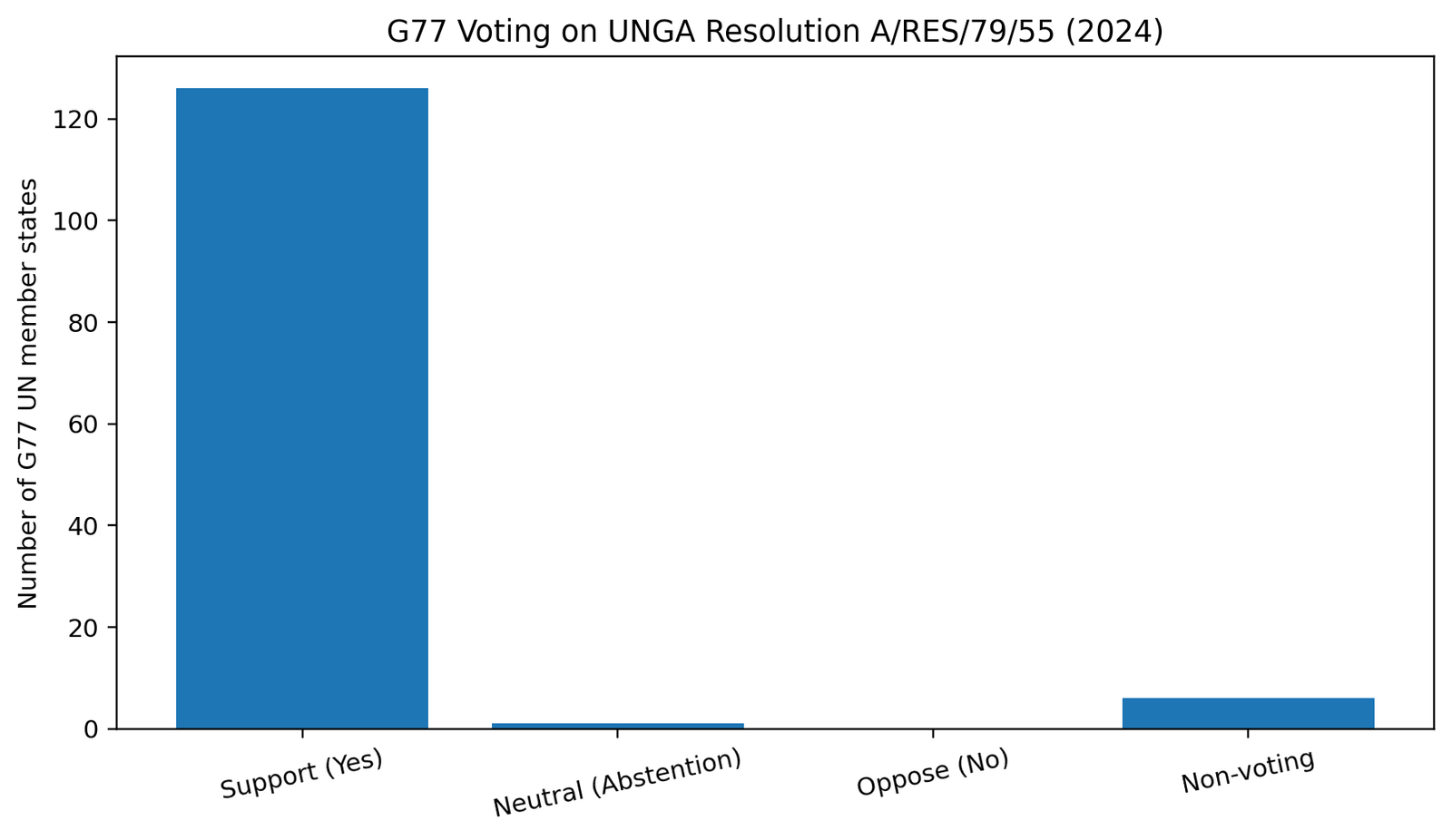
Figure 1: G77 vote status on A/RES/79/55.
Source: Author’s calculation from the verified UN recorded vote.
ASEAN Membership/Trade Relations and Similarity in UNGA Voting
This section examines comparable UNGA voting trends among ASEAN member states, with trade and economic relations used as contextual factors. To determine whether nations with stronger regional or economic ties also exhibit more comparable voting patterns, it combines data on ASEAN membership, trade and economic ties, and UNGA voting records. UNGA voting similarity serves as the foundation for determining relationships between countries, which are handled as analytical units. To ascertain whether patterns of regional economic integration correlate with voting in the UNGA, the economic and voting factors might be contrasted.
| Sovereign
Node |
Core Centrality Profile | Total ‘Yes’
Votes |
Total ‘No’
Votes |
Abstentions | Absences /
Logs |
| Thailand | High-Activity Consensus Anchor | 789 | 12 | 44 | 9 |
| Malaysia | Central Non-Aligned Balancer | 780 | 15 | 52 | 7 |
| Singapore | Institutionalised Global Hub | 778 | 8 | 60 | 8 |
| Indonesia | Autonomy-Maximising Node | 754 | 19 | 71 | 10 |
| Cambodia | Peripheral Eastern-Aligned
Node |
712 | 28 | 31 | 39 |
| Laos | Peripheral Eastern-Aligned
Node |
705 | 32 | 26 | 23 |
| Myanmar | Isolated Network Outlier | 654 | 36 | 54 | 110 |
Table 4
Source: Authors’ compilation based on UNGA voting records and contextual information on ASEAN regional and economic relations.
In order to determine whether ASEAN members are in closely related positions within the voting network, the network representation serves as a foundation for cluster identification. To determine whether the two types of connectivity overlap, the economic dimension can then be compared with these voting linkages.
Descriptive Statistics: An initial summary of voting convergence and divergence within the study’s instances can be found through the descriptive analysis. While available, the distribution of affirmative, negative, abstention, absence, and non-voting stances is considered while analysing the UN General Assembly vote statistics. Before delving more into the ASEAN and G77 examples, the goal at this point is to determine the general direction of voting behaviour.
The five founding members of ASEAN exhibit a clear pattern of convergence in the votes related to trade. All five of the founding members supported the resolution on global trade discussions in December 1972. All five of them voted in favour in January 1979 and December 1979, following the same pattern. International support for these resolutions was also demonstrated by the broader UNGA results: 99 countries voted favourably in 1972, 110 in January 1979, and 111 in December 1979. Because the G77 analysis’s issue-specific voting patterns necessitate reviewing verifiable UNGA voting records prior to making empirical findings, it is given separately.
Thus, the verifiable data that is currently available shows that voting convergence can be particularly evident on certain topic areas; the specific ASEAN and G77 sections look at the scope and significance of this convergence.
ASEAN: Trade/Economic Relations & UNGA Voting
When it comes to UNGA resolutions concerning multilateral trade discussions, the five founding states of ASEAN—Indonesia, Malaysia, the Philippines, Singapore, and Thailand—consistently vote in unity. The three votes that were looked at, from 1972 and 1979, show that there was agreement on a matter that was directly related to developing nations’ economic interests.
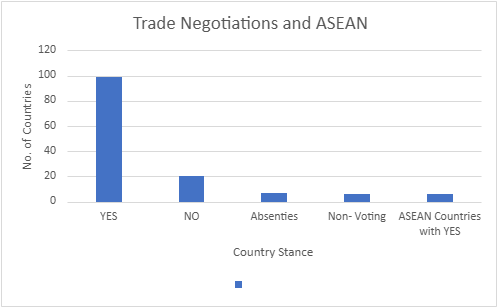
Chart1
Multilateral trade negotiations: resolution / adopted by the General Assembly 1972-12-19
In the 19 December 1972 vote, all five founding ASEAN members voted in favour of the resolution. The overall UNGA vote also showed majority support, with 99 countries voting in favour, 20 against, 7 abstaining and 6 not voting.
Given that ASEAN was founded just a few years prior, in 1967, the five founding members’ homogeneity is significant. Thus, their shared stance on global trade talks is an early illustration of voting convergence on a matter of economic concern. Despite not being a member of ASEAN at the time, Laos also cast a vote in favour.
January 1979: Continued Convergence
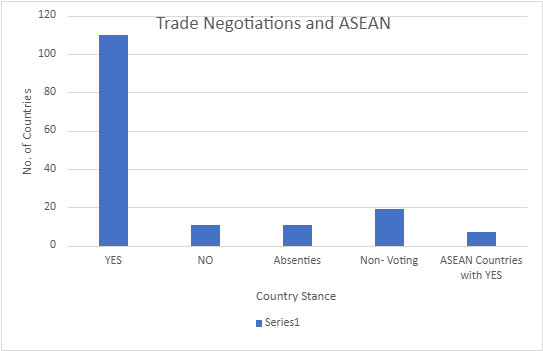
Chart2
Multilateral Trade negotiations: resolutions/ adopted by the General Assembly 1979-01-29. Data Source: UN Digital Library
The pattern persisted over time, as evidenced by the vote in January 1979. As before, Indonesia, Malaysia, the Philippines, Singapore, and Thailand presented their votes in favour. In the UNGA, there were 110 votes in favour of the resolution, 11 against it, 11 abstentions, and 19 non-voting positions.
The five founding members voted the exact same way on all three of the selected occasions, which suggests consistency in the limited set of resolutions examined. However, the small number of observations does not allow us to generalise this pattern to the voting behaviour of ASEAN. Vietnam and Laos also voted in favour, demonstrating that the convergence was not confined to the five founding members.
December 1979: Stable Voting Pattern
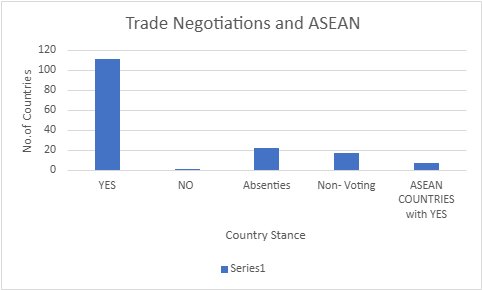
Chart 3
Multilateral trade negotiations: resolution / adopted by the General Assembly, 1979
Data Source: UN Digital Library
The trend is further supported by the vote in December 1979. Once more, all five of the original ASEAN members voted in favour. With 111 votes in favour, just one against, 22 abstentions, and 17 non-voting seats, the resolution was overwhelmingly supported in the General Assembly.
The overall ASEAN Trend:
The three resolutions chosen to show that the five founding members of ASEAN have a high degree of convergence in their descriptions of trade-related issues. However, as the analysis relies on only three historical resolutions from 1972 and 1979, it is insufficient to establish a broader or causal relationship between ASEAN economic integration and UNGA voting behaviour. The findings therefore suggest voting convergence on the selected trade-related issues, but not that this convergence was driven by ASEAN economic integration. The ASEAN case demonstrates that UNGA voting can be used as evidence of issue-specific regional alignment, but more general conclusions would require a larger number of resolutions over a longer period of time.
Therefore, the ASEAN case shows that voting in the UNGA can disclose types of issue-based alignment that go beyond official political or military alliances.
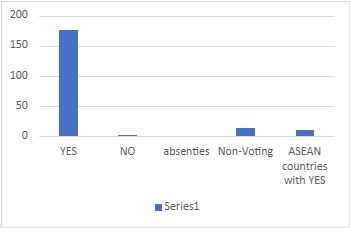
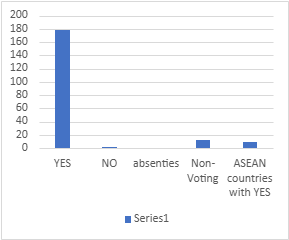
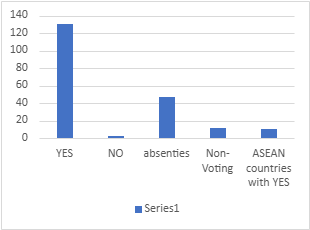
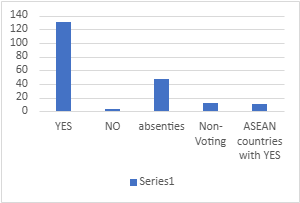
Recent ASEAN Voting Patterns: A descriptive observation of ASEAN voting patterns from 2017 to 2025 reveals a continued support for selected international trade and development-related resolutions. This recent pattern further adds to the understanding of regional voting behaviour. But it does not constitute a statistical test of the relationship between ASEAN economic integration and UNGA voting. The historical ASEAN analysis above is based on three selected resolutions from 1972 and 1979, and the latter 2017–2025 observations are applied to provide supplementary descriptive evidence.
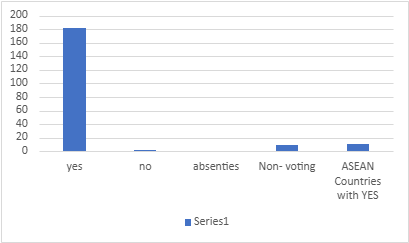
2017
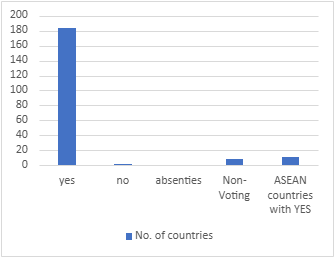
2018
2019
2021
2024
2025
International trade and development: resolution / adopted by the General Assembly.
The analysis covers voting records from 2017 to 2025, revealing significant regional foreign policy convergence. Southeast Asia shows higher integration in voting cohesion compared to others, reflecting regional dynamics.
G77: Terrorism & Issue-Based Voting
Share of Each Vote Status
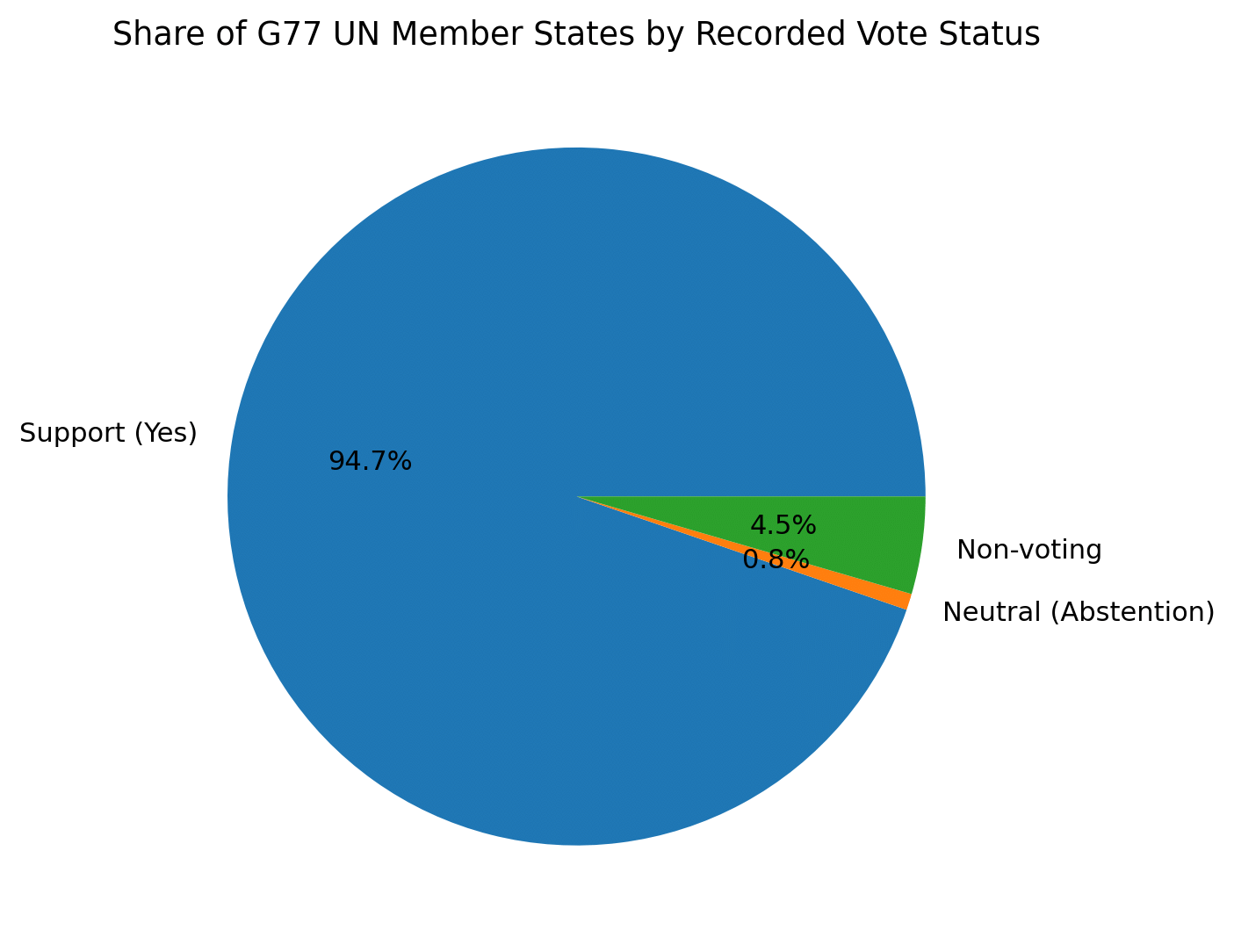
Figure 2: Share of G77 UN member states by recorded vote status.
Source: Author’s calculation from the verified UN recorded vote.
The pie chart reinforces the same finding: almost the entire G77 voting sample falls within the support category. The 4.5% non-voting share should not be interpreted as disagreement. It only indicates that those states were not recorded as voting on the resolution. The single abstention is small in comparison with the overall supportive pattern.
Regional Comparison
| Region | Support | Abstention | Oppose | Non-voting | Total |
| Africa | 52 | 0 | 0 | 1 | 53 |
| Asia-Pacific | 44 | 1 | 0 | 3 | 48 |
| Latin America & Caribbean | 30 | 0 | 0 | 2 | 32 |
| Total | 126 | 1 | 0 | 6 | 133 |
Table 5: Regional distribution of verified G77 vote statuses.
Source: Author’s calculation using the official G77 member list and UN recorded vote.
Support is the dominant position in all three broad regions. Africa records 52 supportive votes out of 53 G77 UN member states, while Asia-Pacific records 44 supportive votes out of 48 and Latin America and the Caribbean records 30 out of 32. The only abstention is in Asia-Pacific (Iran). Non-voting is also most visible in Asia-Pacific because three members—Democratic People’s Republic of Korea, Nauru and Tonga—did not vote; Africa has one non-voting member (South Sudan), and Latin America and the Caribbean has two (Dominica and Venezuela).
The regional differences are therefore differences in the small minority of non-voting or abstaining cases rather than differences in the direction of the substantive vote. No region contains a G77 opposing vote.
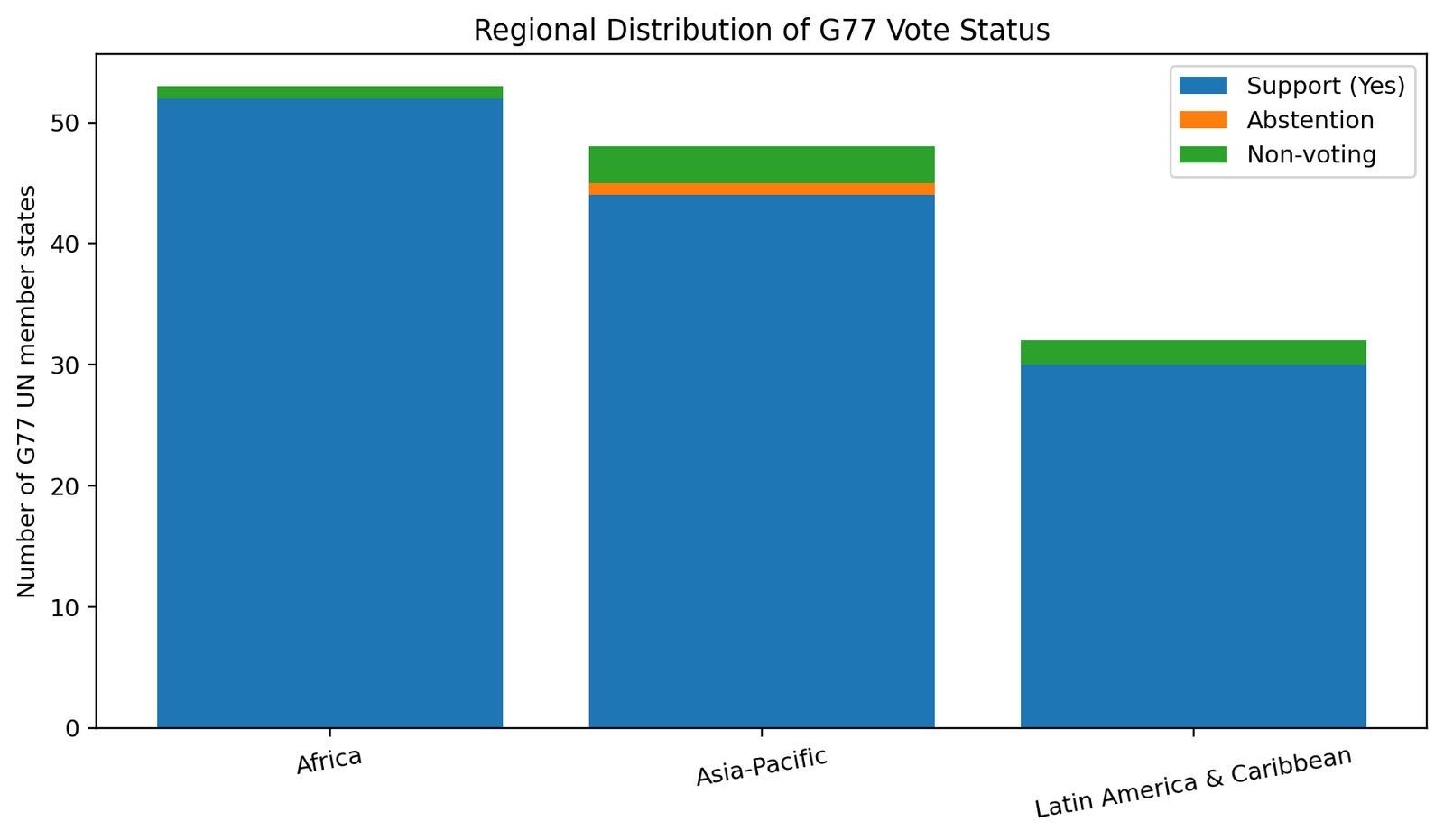
Figure 3: Regional distribution of G77 vote statuses.
Source: Author’s calculation from verified UN voting data and G77 membership.
Interpretation: What Does the Pattern Mean?
The central descriptive finding is strong convergence around the selected counter-terrorism measure. A 94.7% support rate across G77 UN member states suggests that preventing terrorist acquisition of radioactive sources provided substantial common ground across a diverse coalition.
At the same time, the finding should not be treated as proof that the G77 has one identical position on terrorism as a whole. The resolution addresses a relatively specific security issue—radioactive sources and terrorism. Countries can converge on this narrow measure while disagreeing on other counter-terrorism questions, including definitions of terrorism, sovereignty, sanctions, external intervention, human rights safeguards or the scope of counter-terrorism operations.
The six non-voting cases also require caution. A non-vote does not reveal the reason for non-participation and cannot be coded as opposition. Therefore, the evidence supports a claim of recorded voting convergence, not a claim that every G77 government actively endorsed every dimension of counter-terrorism policy.
Link to G77 and Collective Positioning:
The result is relevant to the wider question of whether a large developing-country coalition can translate shared interests into a coherent multilateral position. In this particular recorded vote, the answer is strongly positive: 126 of 127 participating G77 UN member states supported the resolution. However, the vote alone cannot establish that G77 membership caused countries to vote together. Shared regional security interests, national policies, international legal commitments, the technical nature of the resolution and broader diplomatic considerations may also explain the convergence. The evidence should therefore be interpreted as descriptive evidence of alignment rather than proof of causation.
Network Analysis of UNGA Voting Patterns:
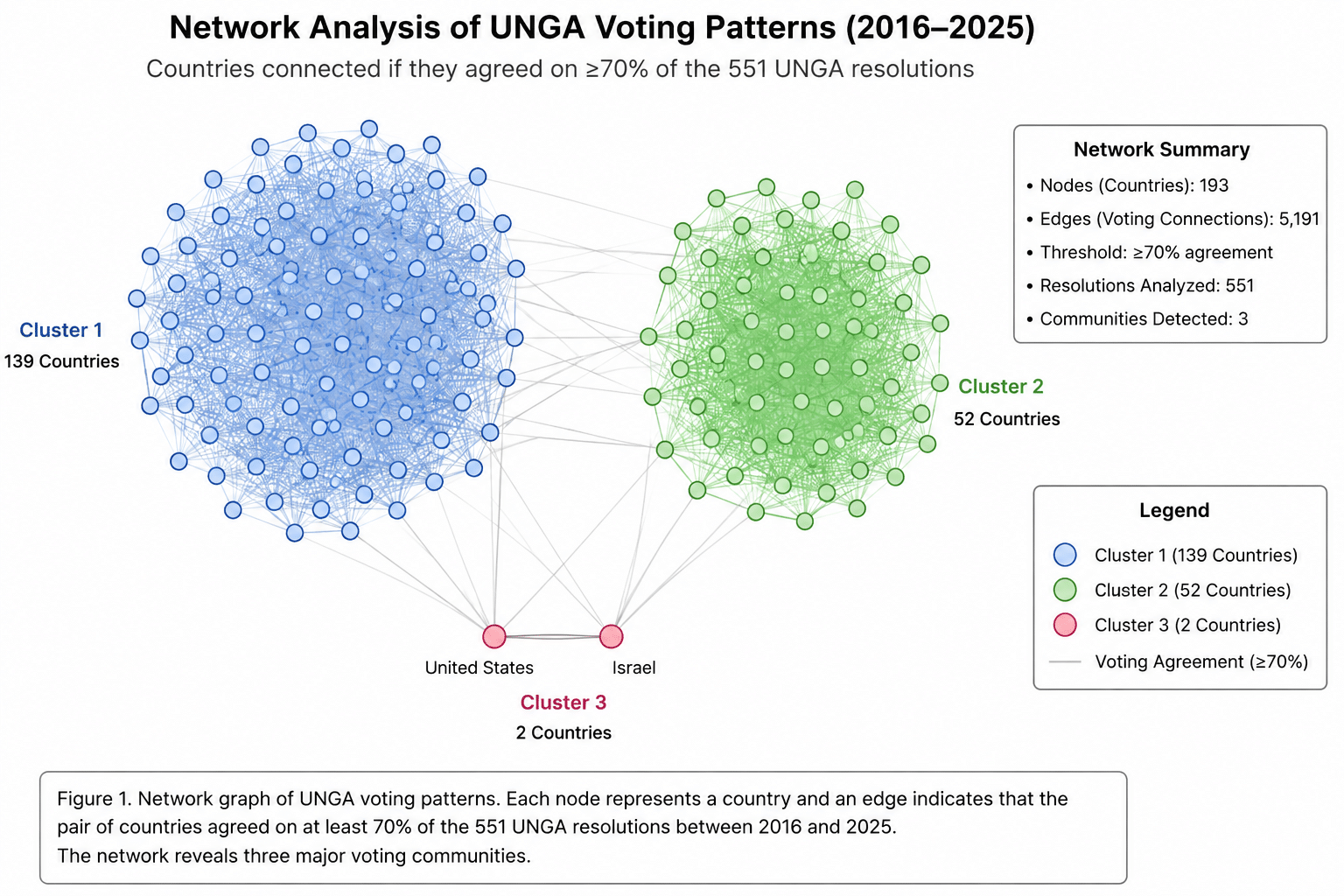
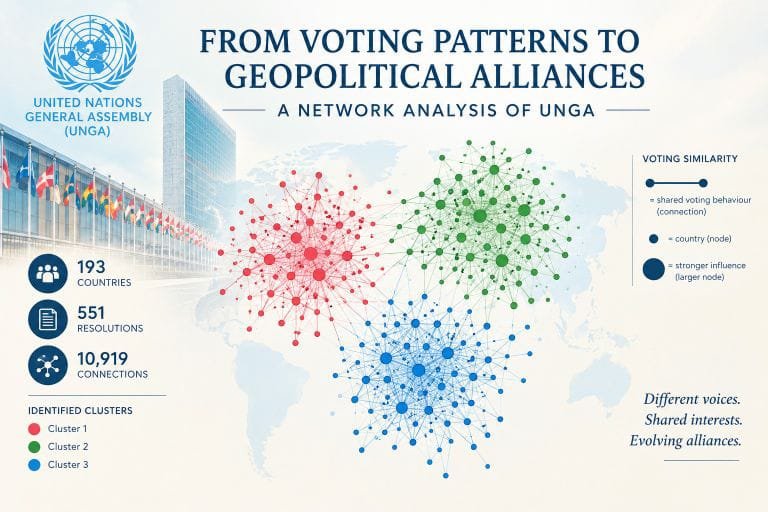
We wanted to look at patterns of voting alignment, so the study looked at United Nations General Assembly roll‑call voting data from 2016 to 2025. The study used data from 193 countries and 551 resolutions. In the network each country was a node and a link between two countries showed how similar their voting behaviour was. Two countries were linked when they agreed on 70 % or more of the resolutions on which both countries cast a vote. A vote of “no vote” or an absence did not count as an agreement.
The network had 10,919 voting connections. Revealed three broad clusters of countries that voted in similar ways. The biggest cluster had 139 countries a second cluster had 52 countries, and a small cluster had two countries: the United States and Israel. These findings show that UNGA voting is not fully uniform and that countries often form groups when their voting patterns keep matching. ASEAN and developing countries were in the large cluster showing that regional ties and specific issues can overlap in UNGA voting.
The network analysis gives evidence that voting alignment goes beyond single resolutions. Still the clusters should not be taken as geopolitical alliances right away. Similar voting behaviour can also come from economic interests, regional positions, diplomatic priorities or agreement on international issues. Thus, the network is helpful for spotting patterns of geopolitical and issue‑based alignment, but it cannot, on its own prove that a formal alliance exists.
Key Findings:
Several significant trends in UNGA voting behaviour are revealed by the investigation. First, all five of the founding members of ASEAN voted in favour of the three resolutions under consideration, demonstrating a strong and consistent convergence on trade-related concerns. This indicates consistent voting convergence among the founding ASEAN members on the selected trade-related resolutions.
Second, 126 of 133 G77 UN member states (94.7%) voted in favour of A/RES/79/55. Only one G77 UN member state abstained, while none voted against the resolution. Among G77 members that cast a substantive yes/abstention vote, 99.2% supported the resolution. Support was the dominant position in Africa, Asia-Pacific and Latin America & the Caribbean. The six non-voting G77 members should not be interpreted as opponents because non-voting does not reveal a substantive position. The finding demonstrates strong convergence on this specific terrorism-related measure, but one resolution cannot establish sustained G77 alignment across all terrorism issues.
Third, the similarity bolsters the more general claim that formal alliances are not the only way that geopolitical alignment can arise around issues. Stronger linkages between states can be shown by recurring vote similarities, which can also be used to spot possible UN system clusters. Overall, the results indicate that while vote convergence by itself cannot prove causation or a long-term alliance, UNGA voting patterns might offer helpful evidence for spotting new trends of geopolitical and issue-based alignment.
Limitations: The analysis is limited in several ways. First, a formal geopolitical alliance is not always indicated by UNGA voting uniformity. Due to common economic interests, regional agendas, diplomatic concerns, or the phrasing of a specific resolution, nations may vote in similar ways. Second the analysis uses one recorded vote. A single resolution cannot establish whether G77 convergence is persistent over time. And A/RES/79/55 concerns a specific aspect of terrorism prevention—radioactive sources—so it’s voting pattern may not represent broader counter-terrorism positions. Also, non-voting states cannot be assigned a substantive stance without additional evidence. On the other hand, the analysis is descriptive and does not establish causal relationships.
For a stronger final research project, the dataset should be expanded to multiple terrorism-related UN General Assembly resolutions across several years. Repeated votes could then be compared to determine whether convergence is temporary or sustained and whether issue areas generate greater disagreement.
Third, rather than looking at every country’s voting conduct during the whole UNGA timeframe, the study looks at a few issues and resolutions. As a result, the conclusions cannot be applied to all foreign policy concerns or international alignment.
Lastly, voting statistics reveal which nations decided to cast votes, but they don’t always indicate why. Therefore, further data would be needed to determine the reasons underlying observed patterns, including diplomatic, economic, and regional context.
Discussion :
The findings suggest that geopolitical alignment in the UN General Assembly is better understood as issue-based and flexible rather than as a fixed division between formal alliances. The ASEAN case suggests that diplomatic convergence could be associated with shared regional and economic interests. The consistent voting of the five founding members on trade-related resolutions suggests that regional economic integration can translate into a degree of common positioning in multilateral institutions.
However, this does not necessarily mean that ASEAN membership itself causes voting similarity. Rather, shared economic priorities and regional interests appear to provide common ground for coordination. This supports the broader argument that economic interdependence can shape diplomatic behaviour beyond formal political or military alliances. The G77 findings point towards a somewhat different form of alignment. The concentration of supportive positions on counterterrorism suggests that developing countries can converge when they perceive a common international concern, even when their wider regional interests differ. At the same time, the presence of neutral and opposing positions demonstrates that the G77 cannot be treated as a completely unified geopolitical bloc. Thus, alignment within large coalitions may emerge selectively around particular issues rather than across foreign policy. Importantly, this finding is based on one particular UNGA resolution on terrorism and should be read as evidence of issue-specific convergence, not conclusive evidence of sustained G77 alignment on all terrorism-related issues. The network and cluster perspective reinforces this interpretation. Countries with recurring voting similarities can be understood as forming stronger connections, while differences produce weaker links. This makes it possible to identify issue-specific clusters that may not correspond to formal alliance structures. The network therefore captures the possibility of states occupying different positions depending on the issue, rather than belonging permanently to a single geopolitical camp. These findings broadly align with the literature reviewed in the study, particularly the argument that economic and political relationships can influence UN voting behaviour. The ASEAN results support the idea that countries with shared economic interests may display greater voting convergence, while the G77 findings extend this logic by showing how common security concerns can generate temporary issue-based alignment. At the same time, the findings reinforce the literature’s caution that voting similarity alone cannot establish causation or prove the existence of an alliance. Overall, the study implies that contemporary geopolitical alignment is increasingly multidimensional and issue-specific. States may cooperate with different partners on trade, security, development, or other questions rather than consistently aligning with one geopolitical bloc. UNGA voting can therefore serve as an early indicator of emerging diplomatic networks and shifting patterns of cooperation, although these patterns must be interpreted alongside economic, regional, and diplomatic context.
Conclusion:
This study examined UNGA voting patterns to understand how states come together on different international matter and what these patterns can tell us about changing geopolitical alignments. The findings suggest that developing and Global South states continue to shape voting coalitions, but they do not necessarily act as one unified bloc. Instead, cooperation appears to depend on the issue being considered and can change when the interests or concerns surrounding that issue change. This supports the view that contemporary geopolitical alignment is becoming more flexible rather than being based only on traditional East-West or North-South divisions.
The ASEAN and G77 cases show two different ways in which voting consistency can emerge. In the ASEAN case, the five founding members showed consistent voting convergence on the selected economic and trade-related resolutions. In the G77 case, common concerns relating to terrorism and security provided a basis for convergence, although the presence of neutral and opposing positions shows that the group cannot be treated as a completely unified bloc. The G77 analysis is rooted in a single UNGA resolution on terrorism, and as such, these findings should be viewed as an indication of strong issue-specific convergence, rather than definitive evidence of broader or sustained G77 alignment.
The network analysis also helps us see which countries tend to vote similarly and which relationships are weaker or more temporary. This helps distinguish between more consistent patterns of alignment and short-term cooperation. Overall, the study suggests that similar UNGA voting can provide useful evidence of emerging and shifting geopolitical alignment, but it cannot by itself prove the existence of a formal or lasting alliance. Future research could strengthen this analysis by using a longer timeframe and incorporating other factors such as trade and aid relationships.
References:
https://ieeexplore.ieee.org/document/6753881
UN Bodies > General Assembly > General Assembly Plenary Resource Type > Voting Data
About ASEAN – ASEAN Main Portal
https://unctad.org/news/countries-trade-together-vote-together