
Authors:
Parth Patel, Amit Adhikari, Rudell Williams, Rohita Katyayini
1. Abstract
Physical early-warning infrastructure — satellite thermal monitoring, regional heatwave-alert systems, forecasting models with demonstrated lead-time skill — already proves that early warning of marine climate stress is possible. The open question is whether biological signals, particularly marine microbial community change, add predictive value beyond these physical systems, and whether such signals could inform fisheries management, community adaptation, and policy. This interdisciplinary narrative review traces an evidentiary chain from environmental stress through microbial response, ecosystem change, and fisheries effects to community, economic, and policy outcomes, applying process tracing within two contrasting cases — the Great Barrier Reef/Ningaloo (Australia) and small-scale fisheries in Maharashtra, Kerala, and the Sundarbans (India) — chosen for differing monitoring and institutional capacity. Marine microbial sensitivity to thermal stress, acidification, nutrient enrichment, and hypoxia is well supported across systems, but responses are taxon-dependent and standardization across systems remains limited. Evidence for genuine temporal precedence — a dated microbial signal preceding, rather than merely accompanying, downstream stress — is partially supported at best: most studies document concurrent or retrospective change, and one meta-analysis found no significant difference in community instability between opposing stressors, complicating assumptions several sources treat as settled. Fisheries and community linkages are correspondingly limited, since ecosystem change propagates unevenly by species and location. No policy response identified is currently triggered by a validated biological signal rather than physical forecasts or fixed regulatory calendars. The review concludes that microbial early warning is proposed, not established: closing the gap requires coordinated, prospective monitoring explicitly testing temporal precedence and predictive value across the full chain, rather than continued domain-isolated research.
Keywords:
Marine Microbial Communities, Climate Change, Early-Warning Indicators, Fisheries Management, Coastal Livelihoods, Socioeconomic Impacts, Adaptive Policy.
2. Introduction
Climate change is reshaping marine systems through a cascade of effects that can begin with environmental stressors and ultimately reach human systems: warming, deoxygenation, acidification, and altered nutrient and circulation regimes can modify microbial and lower-trophic communities, with consequences that propagate through organisms, ecosystems, fisheries, and the communities that depend on them. Many of these links have been documented extensively, but often in isolation within individual disciplines. What remains unclear is whether this cascade can function as an early-warning system—whether change at an earlier biological layer occurs reliably and sufficiently in advance to anticipate downstream ecological or fisheries disruption.
This paper asks whether early biological responses, particularly changes in marine microbial communities, can provide a reliable temporal lead over downstream ecosystem and fisheries impacts, and whether validated signals could be translated into actionable indicators for fisheries management, community adaptation, and policy. Answering this requires a precise definition of “early warning,” since the term is often used loosely in the literature. Here, early warning means a measurable and reproducible temporal lead in which biological change reliably precedes and provides predictive information about subsequent ecosystem or fisheries disruption—not simply concurrent sensitivity to a shared climate stressor. Importantly, biological responses must also be distinguished from seasonal variability and other environmental or anthropogenic stressors before they can be considered reliable warning signals. That distinction, between sensitivity and precedence, runs through every section of this paper, because a preceding review of the literature found that the two are frequently conflated, with sensitivity treated as though it already demonstrated precedence.
That review left three specific questions unresolved, and this paper is structured around answering them rather than restating them as a generic gap. First, does microbial change consistently precede organism, community, or ecosystem-level stress, or does it merely accompany a shared response to environmental change? Second, given that ecosystem change reaches fisheries indirectly and unevenly, affecting different species and locations differently even under the same climate event, can early-warning indicators be meaningfully linked to fisheries outcomes? Third, could a biological or microbial stress signal trigger economic or policy action before the effects are visible in catch numbers or income statistics, closing the gap between when the ocean first shows stress and when the people who depend on it are able to respond?
A further consideration sharpens all three questions. Physical early-warning infrastructure for marine climate stress already exists and, in some settings, already informs management. Global seasonal forecasts now provide up to a year’s advance notice of marine heatwaves, with demonstrated skill explicitly framed around applications including sustainable fisheries management (Jacox et al., 2022). At a finer scale, satellite-based thermal stress monitoring — such as NOAA Coral Reef Watch’s heat-stress forecasts, which anticipated the Great Barrier Reef’s 2021–2022 bleaching event weeks ahead of peak thermal stress (Spady et al., 2022) — underpins standing coral bleaching response protocols in Australia, and comparable heatwave-alert systems operate across the Indian Ocean. This means the central question this paper investigates is not whether early warning is possible in principle — it demonstrably is, using physical indicators — but whether a biological signal adds meaningful predictive value or lead time beyond what existing physical forecasting already provides. This reframes the paper’s contribution: rather than asking simply whether biology can provide warning, it asks what additional predictive value biological signals must demonstrate to complement existing physical systems. This paper’s approach follows directly from that reframing. Rather than treating documented sensitivity as sufficient evidence, the analysis classifies findings as established, emerging, or proposed so that conclusions never rest on more certainty than the underlying studies support. That classification is then tested, not merely asserted, using process tracing within two contrasting regional cases: the Great Barrier Reef and Ningaloo/Nyinggulu Reef in Australia, following the 2024–2025 mass bleaching event, and small-scale fisheries across Maharashtra, Kerala, and the Sundarbans in India. These cases were selected for contrasting institutional capacity and monitoring infrastructure, allowing the paper to test whether any observed pattern holds generally or depends on the resources available to detect and respond to it. Where neither the literature nor the case evidence can resolve a question, the paper specifies, rather than simply calls for, the direct test a future study would need to run — including a comparison against the physical forecasting systems already in place.
The paper therefore neither assumes that biological early warning is established nor dismisses it as unsupported. It is a paper that narrows, specifically and evidentially, what would need to be true — and what would need to be tested, in what order, and against what existing baseline — for microbial and biological signals to earn a place in fisheries management and coastal climate policy. By evaluating the pathway as a connected system rather than assessing each link in isolation, the paper addresses a gap in a literature that has largely examined these relationships separately.
3. Literature review
Climate change spreads through systems as a connected chain: environmental stress causes changes in microbial and lower-trophic communities and these changes can move through ecosystems to fisheries and the human systems that depend on them (Larkin et al., 2025; Zhang et al., 2024). Each part— sensitivity to stress, ecosystem changes and the economic effects of fisheries decline—has been studied in its own area. What is still not clear is whether the first part, the microbial change happens consistently and early enough to act as a real early-warning system instead of just happening at the same time as other changes. This review asks whether the sensitivity of microbes to climate stress can lead to a time that predicts impacts.
“Early warning” means a repeatable biological or microbial response that happens before and gives information about, a later ecological, fisheries or economic impact—not simply a response that changes at the same time as the impact because both are caused by the same thing. This difference between sensitivity (a reaction to stress) and precedence (a reaction that predicts a separate impact) is central to the review.
The review follows one path of evidence: environmental stress leads to biological response, which leads to ecosystem change, which leads to fisheries effects, which leads to community and economic impacts, which leads to policy action (Sumaila et al. 2011; Holsman et al. 2020). At each step it asks whether the evidence shows an order or just a reaction using recent (2020–2026) evidence when possible and older studies when needed.
3.1 Microbiology and Environmental Factors
Marine microbial sensitivity to climate stress is the supported part of this chain. In time series, global metagenomic surveys and controlled experiments microbial communities react to warming, acidification,
nutrient enrichment and low oxygen levels. An 11-year study in Southern California found that microbial types and functions followed seasonal and El Niño cycles with warming lowering the ability to break down carbon (Larkin et al. 2025); a global model of 953 ocean-surface metagenomes projected microbial changes under high-emissions scenarios (Zhang et al., 2024); and reef seawater microbiomes were more responsive to the environment than those attached to hosts (Glasl et al., 2019). Controlled experiments across multiple stressors reinforce this pattern with causally manipulated evidence, examined in detail in the Results section below.
Sensitivity is not the same as early warning. Most studies show changes that happen at the time as or after stress not testing whether the microbial change comes first and predicts a later separate impact (Barreto et al., 2021; Currie et al., 2017; Figuerola et al. 2025; Stenger et al. 2024). The timing is not clear: a 2025 study on algal blooms found bacterial changes before the bloom started by 24–48 hours but global models suggest that sudden plankton changes are often not reliably preceded even by physical signs (Cael et al. 2021). The direction of change also differs by type of organism and system (Sehnal et al., 2021; Vila Duplá, 2025) while Li et al. (2023) Looking at 1,377 samples found no difference in community stability between warming and cooling. So the big question remains whether microbial changes reliably happen before of just following changes further down the chain (Terzin et al., 2024).
3.2 Fisheries and Marine Ecosystem Impacts
Climate-driven changes in ecosystems affect fisheries but not equally. A model of a reef food web under bleaching, low oxygen and acidification predicted drops in biomass especially where climate pressure and overfishing added up (Arias-González et al. 2017). After the 2016 Great Barrier Reef bleaching 186 sites showed changes in coral, fish and invertebrate communities although the effects were not only from coral loss and sometimes came directly from temperature (Stuart-Smith et al. 2018). Coral trout responses to the heatwave also varied by place going down in some areas and staying the same or increasing in others (Brown et al. 2020). The loss of mangroves and seagrass leads to in the decline of the nursery and shelter functions that fisheries depend on.
Direct mechanistic links from microbial-level change to a population-relevant ecological outcome remain rare in this literature (Nelson et al., 2020) and are discussed further in Results. Most fisheries studies look back at changes after a disturbance of testing whether an early biological signal could predict it. So early-warning signals for fisheries—biological or any other—remain mostly untested for reliability, clarity and use in management.
3.3 Policy and Economics
Changes in fish productivity and where fish live because of climate create uneven economic costs. Sumaila et al. (2011) showed that as fish move fishing costs go up and some places suffer damage. Raubenheimer and Phiri (2023) found that South Africa’s fisheries adapted in some areas as warming limited catches. Holsman et al. (2020) study interpreted that instead of managing one species at a time, managing fisheries based on the ecosystem could be a wiser decision for recovery after a collapse – But the condition given, only if temperatures doesn’t rise above a certain level, beyond which fish biomass and catches drop no matter what. At the community level Abu Samah et al. (2021) found that how well a community adapts depends a lot on funding and rules. Together these studies show that climate impacts are not the same how well a community adapts depends on money and rules and policy needs to be more active.
None of these studies directly test if a biological or microbial sign could lead to economic or policy actions before changes appear in catch or income data. The big gap is not just that economic signs come after changes but that no system clearly shows how the timing and reliability of a possible early warning signal should be tested. Such a signal must be proven, using data with dates to come before a fisheries or economic outcome and its lead time must be compared to existing physical signs like sea-surface temperature and chlorophyll. Without this comparison a biological sign cannot be shown to add any value beyond what’s already known.
3.4 Conclusion
Across microbiology, ecosystems, fisheries and policy one pattern is clear: each part is sensitive to climate stress. The links between them—especially whether a change comes first or just follows the next change—remain mostly untested. Microbial communities react quickly to warming and acidification; fish and invertebrate communities change unevenly after heatwaves and bleaching; and economic and community effects depend on how strong the local rules are as well as how much they are exposed. Most of the evidence is still looking back at what happened.
4. Methodology
4.1 Research Design
This study uses an interdisciplinary, policy-oriented qualitative research design based on structured narrative synthesis of secondary evidence. It examines whether marine microbial and other biological responses can serve as potential early-warning indicators of climate-related change in marine ecosystems and fisheries. An early-warning indicator is defined here as a measurable biological or microbial response that occurs before a downstream ecological or fisheries impact and may therefore provide useful lead time for management. A response occurring at the same time as an impact is treated as co-occurring evidence rather than evidence of early warning.
The fundamental question is not about the reactions of marine species to climate change – which has been extensively demonstrated – but whether these reactions occur consistently enough before other consequences of climate change to be used as early warnings.
Searches were run independently in Scopus, Web of Science, and Google Scholar using Boolean combinations of climate-stressor terms, biological-response terms, and outcome terms specific to each analytical area. For the microbiology and environmental-change area, the core string was: (“marine microbi*” OR “microbial communit*”) AND (“climate change” OR “ocean warming” OR “marine heatwave*” OR “ocean acidification” OR hypoxia OR eutrophication) AND (“early warning” OR “temporal precedence” OR “lead time” OR indicator). Comparable strings were constructed for the ecosystem/fisheries, socioeconomic, and policy areas by substituting the corresponding outcome terms (e.g., “fisheries productivity,” “catch decline,” “coastal livelihood,” “adaptive policy,” “ecosystem-based management”) for the biological-response and outcome components, while retaining the same climate-stressor terms.
Screening proceeded in two stages. First, titles and abstracts were screened by the reviewer responsible for the relevant analytical area against the eligibility criteria below; records with insufficient information to judge eligibility were advanced to the next stage rather than excluded outright. Second, full texts of all advancing records were read in full and assessed against the same criteria, with the relevance categorization (High / Moderate / Not Relevant) applied at this stage.
Evidence from marine microbiology, environmental science, ecology, fisheries science, climate science, economics, and governance were organized using the pathway.
The search returned 40 records across the three databases after removing duplicates. Titles and abstracts were screened against the eligibility criteria described below, yielding 40 records for full-text assessment. Of these, 40 met the full inclusion criteria and were retained for analysis, distributed across the four analytical areas as follows: marine microbiology and environmental change (12 sources), marine ecosystems and fisheries (10 sources), socioeconomic and community impacts (9 sources), and policy and adaptation (9 sources).
It comprises six stages, analysed in sequence throughout this review:
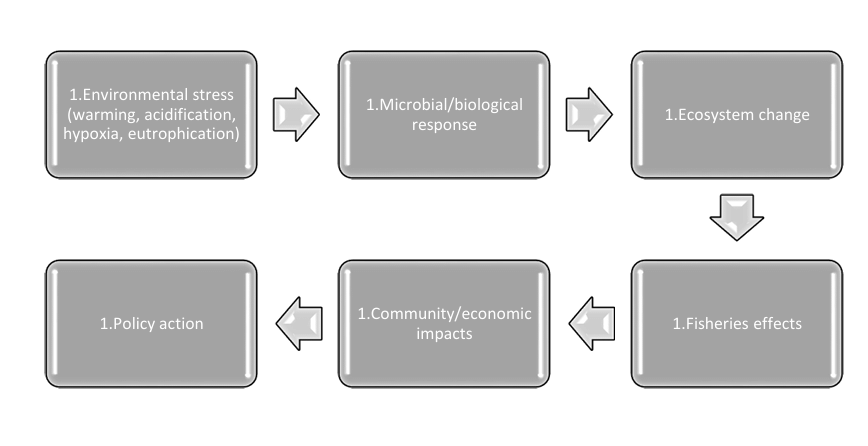
Figure 1. Six-stage analytical pathway linking climate-related environmental stressors to microbial and biological responses, ecosystem change, fisheries impacts, community and economic consequences, and policy action.
This pathway was used as an organizing framework for comparison, while recognizing that the links are not necessarily linear, universal, or causally demonstrated in every study.
4.2 Nature of the Research
The study follows a qualitative narrative synthesis approach rather than a systematic review with meta-analysis. Statistical pooling was not considered appropriate because the included studies differ substantially in design, organism, geographic setting, stressor exposure, biological measurements, outcome variables, and reporting methods.
The retained literature was organized according to the six-stage analytical pathway and grouped by the principal theme addressed, such as microbial diversity, microbial functional change, habitat degradation, fisheries productivity, economic loss, community vulnerability, or policy response. Sources addressing more than one stage were cross-referenced across the relevant sections.
Where studies reported conflicting findings, the findings were retained and presented together. Conflicting evidence was not resolved through selective emphasis. Instead, the relevant pathway link was classified as partially supported when the evidence was inconsistent, context-dependent, or insufficiently replicated.
4.3 Literature and Case Selection
The unit of analysis was the published study, organized into four analytical areas: (i) marine microbiology and environmental change; (ii) marine ecosystems and fisheries; (iii) socioeconomic and community impacts; and (iv) policy and adaptation. Studies spanning more than one area were cross-referenced where appropriate. Retained sources were drawn predominantly from established, high-impact peer-reviewed venues, supplemented by relevant government and institutional reports (e.g., ICAR-CMFRI, INCOIS, DCCEEW) where a documented policy or monitoring arrangement required it.
Sources were considered eligible when they addressed one or more climate-related marine pressures— described above, were peer-reviewed (or a necessary institutional source), fell within the most recent ten years (older foundational studies retained where necessary), and were relevant to the pathway.
The relevance was categorized as High Relevance (a study that establishes direct relationship between a biological process and an outcome), Moderate Relevance (evidence for one part of a pathway or necessary contextual information), or Not Relevant (not used in the analysis).Retained studies were also screened for methodological transparency, including clearly reported data sources, study dates, methods, sampling context, and outcome measures. This screening reduced reliance on findings that could not be independently traced.
4.3.1 Case Selection
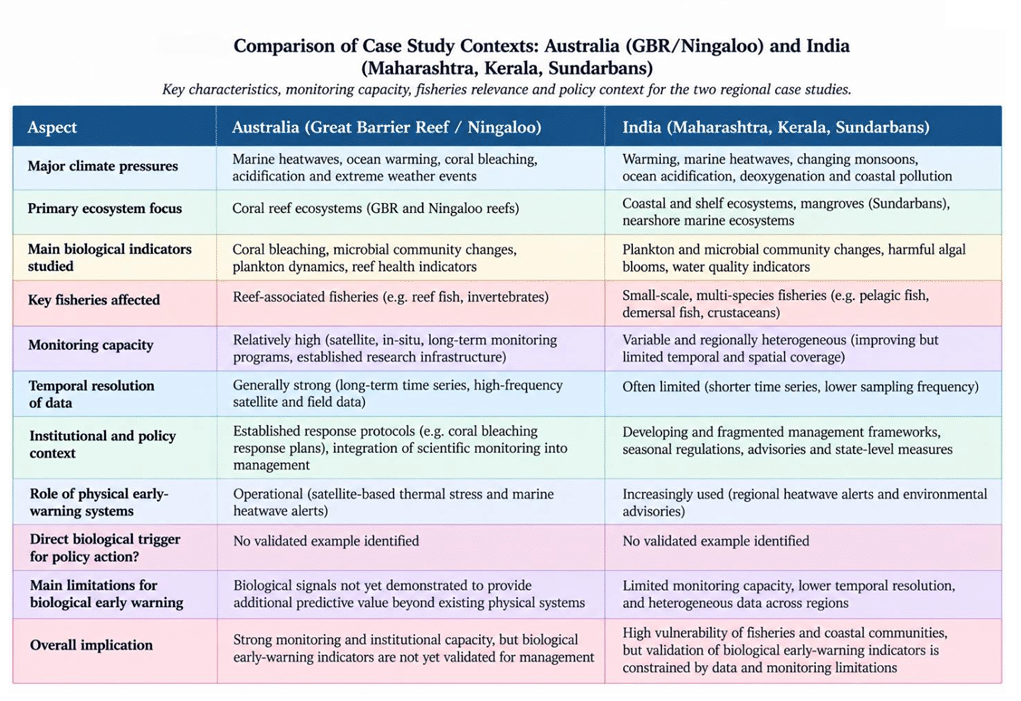
Australia—the Great Barrier Reef and Ningaloo/Nyinggulu Reef—and India—small-scale fisheries in Maharashtra, Kerala, and the Sundarbans—were purposively selected as contrasting policy and monitoring contexts rather than as statistically representative samples of marine systems.
The Australian examples provide detailed, long-term reef monitoring, biological observation, and institutional structure, which is formal, and in some instances, jointly managed by Indigenous peoples. The Indian examples involve small-scale fisheries, where monitoring and institutional arrangement are heterogeneous, thereby making community- and state-level information all the more relevant for the comparison to determine if there is any dependence of biological signal-policy linkages on monitoring and institutional structures.
The 2024–2025 mass coral bleaching event was used as the principal anchoring event for the Australian case material, while the Indian case material was examined in relation to sustained warming and repeated marine heatwave exposure reported for the Arabian Sea and Bay of Bengal. The cases were compared using four common criteria: (i) the type and timing of the earliest reported biological or microbial signal; (ii) the documented sequence from signal to ecosystem, fisheries, economic, and policy outcomes; (iii) the monitoring and governance capacity available to detect and respond to the signal – including the duration of long-term ecological monitoring, the existence of formal early-warning protocols, the extent of community or co-management participation, and documented use of biological indicators in policy; and (iv) the strength and limitations of the evidence supporting each pathway link.
4.4 Analytical Approach to the Research Gaps
Each case was examined using process tracing to reconstruct the sequence and timing of reported events—from a biological or microbial response through ecosystem change and, where evidence existed, to fisheries, socioeconomic, and policy outcomes. Only dates and findings explicitly reported in the published record were used. Publication dates were not treated as event dates.
A finding was classified as temporally preceding only when the evidence reported a date, time period, or defined sequence of events whereby the stage occurred prior to another stage; where evidence showed only a co-occurrence of a response and its impacts during the same climatic event, it was considered evidence of a co-occurrence and not early warning evidence. Temporal precedence is viewed in this context as being necessary but not sufficient for predictive validity.
Cross-case comparison was conducted by examining the classification of each pathway link—well supported, partially supported, or limited—and the direction of evidence in each case. A pattern was treated as cross-case only when the same pathway link showed a comparable direction and classification in both cases. The case analysis was used to identify repeated patterns, contextual differences, and evidence gaps; it was not used to claim universal generalizability.
The study also specifies a validation protocol for future primary research but does not apply that protocol within the present synthesis. The proposed protocol would require direct, co-located, same-time-frame monitoring of biological, environmental, ecosystem, and fisheries variables; analysis of time lags; and comparison with existing physical or thermal forecasting systems.
4.5 Evidence Sources and Extraction
All evidence was secondary and collected through long-term monitoring studies, experiments conducted in laboratories and fields, modelling, meta-analysis, and government or institutional documents. Information collected from these sources included – climate stressor, location, study design, biological response, temporal information, downstream effect, and relevance of the pathway.
The microbial studies were analysed for any shifts in the community structure and function, the ecosystem and fisheries studies for impact on habitats, biomass, and catch dynamics, and socioeconomic/policy studies for economic impacts and adaptive strategies as well as biological indicators use for decision-making.
Findings were evaluated qualitatively based on their direction, timing, consistency, and strength, and percentage changes + effect sizes retained alongside qualitative interpretation. The reliability of the findings was determined qualitatively based on methodology and the date of its execution.
Table 1. Evidence extraction and classification of studies included in the review.
|
Study |
Location |
Stressor |
Design and timing |
Biological signal |
Downstream outcome |
Evidence type |
|
Kearns et al. (2016) |
Plum Island Ecosystems LTER, New England |
Nitrogen (nitrate) enrichment |
Long-term in situ nutrient enrichment of salt marsh creeks; 16S rRNA (active) and 16S rRNA gene (total) sequencing; enriched since 2004, sampled 2005–2014 |
Decreased diversity and shifted structure of active bacteria; dormant taxa doubled (45% to 90%); total community unchanged |
Total diversity maintained (resilience via dormancy reservoir); hypothesized increased respiration leading to marsh edge collapse |
Long-term in situ field experiment |
|
Rodríguez et al. (2018) |
Northern coastal Baltic Sea (Umeå Marine Sciences Center, Sweden) |
Increased terrestrial dissolved organic matter (tDOM) and organic pollutant mixture |
6-week, 2 × 2 factorial mesocosm (Control, +tDOM, +Pollutants, +both) in 946 L tanks; sampled weekly |
Significant shifts in pelagic bacterial composition (33 key taxa); tDOM increased activity and diversity, pollutants reduced them |
Possible disruption of basal food web efficiency (shift toward net heterotrophy); altered pollutant entry and bioaccumulation |
Experimental mesocosm |
|
Glasl et al. (2019) |
Great Barrier Reef, Australia (Magnetic and Orpheus Islands) |
Temperature anomalies and eutrophication (chlorophyll, turbidity) |
16-month longitudinal monitoring; 16S rRNA sequencing of seawater, sediment, corals, sponges, macroalgae |
Compositional variation and temporal succession in the free-living seawater microbiome |
Accurate prediction of ambient environmental parameters; early indicator of reef stress |
Observational field study with predictive machine learning |
|
Nelson et al. (2020) |
Otago Harbour, New Zealand |
Ocean acidification (pH 7.8 and 7.4) |
Flow-through aquaria for biofilm development (up to 69 days; assayed at 23 and 60 days), then larval settlement assays (24 and 48 h) |
Reduced biofilm biomass and pigments (chlorophyll-a, carotenoids); shift from autotrophic to heterotrophic communities |
Altered larval settlement success of the tubeworm Galeolaria hystrix |
Experimental |
|
Cael et al. (2021) |
Global ocean (equatorward of 65°N; Atlantic and Pacific subtropics) |
Climate change under high-emission scenario (warming, stratification, altered nutrient supply) |
Complex virtual marine microbial ecosystem simulation; events across the 21st century |
Abrupt shifts in biomass (diatoms, dinoflagellates, diazotrophs, coccolithophores), primary production, Shannon diversity, size distributions |
Wholesale shifts to alternative ecosystem states affecting food webs, elemental cycling, fisheries |
Predictive ecosystem modeling / simulation |
|
Santoro et al. (2021) |
Mesocosm (controlled environment) |
Heat stress (30°C) |
75-day mesocosm; Mussismilia hispida fragments given a Beneficial Microorganisms for Corals (BMC) consortium vs. saline placebo; sampled at T0, T1 (peak temperature), T2 (end of 10-day peak heat), T3 (after 15-day recovery at 26°C) |
Microbiome restructuring (e.g., Ruegeria enrichment), DMSP degradation, lipid maintenance, transcriptional reprogramming of repair, stress-protection and immune genes |
Mitigated bleaching; stable Fv/Fm; survival 100% vs. 60% in placebo (40% increase) |
Experimental in vivo mesocosm trial (16S rRNA, RNA-seq, NMR) |
|
Sehnal et al. (2021) |
Global (aquatic ecosystems) |
Anthropogenic and natural change (climate change, pollution, toxic cyanobacteria, microplastics) |
Critical review |
Microbiome composition and function (free-living and host-associated: gills, skin, gut) |
Effects on aquatic animal health; potential microbiome indicators of ecosystem health |
Review |
|
Su et al. (2021) |
Estuarine surface sediments, Jimei District, Xiamen, China |
Ocean acidification (pH 5.0, 5.8, 6.8, 7.5) |
50-day anoxic microcosm incubation |
Altered bacterial communities; reduced nutrient-cycling functional genes; increased animal fungal pathogens |
Inhibited extracellular enzyme activities (P, C, N transformation); lower basal respiration; disrupted nutrient cycling |
Experimental microcosm (in vitro) |
|
Li et al. (2022) |
Terrestrial and aquatic (especially marine) habitats |
Experimental warming and cooling |
Meta-analysis of controlled lab experiments (1,377 microbiomes, 43 species) |
Decreased ASV-level phylogenetic diversity and altered composition (no effect on beta dispersion) |
Diversity depletion, especially in aquatic/marine hosts under cold; sudden, long, static shifts cause loss, attenuated by acclimation or ramped warming |
Meta-analysis |
|
Terzin et al. (2024) |
Coral reefs (global context) |
Elevated temperature, nutrient loads (eutrophication), increased macroalgae cover |
Review and conceptual framework |
Proliferation of copiotrophic and pathogenic microbes (e.g., Flavobacteriaceae, Vibrio); increased heterotrophic activity (microbialisation) |
Harmful algal blooms, hypoxia, coral disease, tissue necrosis, colony mortality, algal dominance; microbial shifts precede visible bleaching |
Literature synthesis / proposed framework |
|
Zhang et al. (2024) |
Global surface ocean (26 Longhurst Provinces) |
Anthropogenic climate change (temperature, pCO₂, salinity, dissolved oxygen, nutrients) |
Machine learning on global metagenomic surveys (Bio-GO-SHIP, n = 953); present (2023) to end of 21st century |
Shifts in diversity, taxonomic structure (e.g., Bacteroidetes) and functional traits (photosystems I and II, Calvin cycle, sulfur oxidation) |
Reorganization of ~32.44% of surface ocean; poleward taxa shifts, increased photosynthetic carbon fixation, decreased nutrient metabolism |
Predictive modeling / observational synthesis |
|
Figuerola et al. (2025) |
Pota del Llop, Medes Islands Marine Reserve (NW Mediterranean) |
Extreme marine heatwave |
Field study at two depths (13 m vs. 17 m); September 2022, after the summer heatwave |
Altered microbiome composition (higher alpha diversity, fewer key functional genera) |
Sublethal alterations and early dysbiosis without visible host necrosis |
In situ field observation |
|
Larkin et al. (2025) |
Southern California Bight, California Current |
Ocean warming and changing nutrient inputs (seasonal and ENSO cycles) |
11-year time series (2011–2021); environmental data plus 267 metagenomes |
Shift from large-genome to small-genome lineages (e.g., Prochlorococcus, Pelagibacter) in warm, nutrient-deplete conditions |
Reduced organic carbon degradation potential and biomass; elevated carbon-to-nutrient ratios; more macronutrient stress genes |
Longitudinal field study |
|
Stenger et al. (2025) |
Hermitage fringing reef, La Réunion (Western Indian Ocean) |
Anthropogenic eutrophication, nitrate discharge, freshwater runoff, land use change |
In situ sampling at 3 contrasting sites; 16S, 18S, ITS and tufA sequencing of seawater, sediment, coral rubble; July 2021 and January 2022 |
Taxonomic bioindicators: Firmicutes:Bacteroidota and Ascomycota:Basidiomycota ratios; Vibrio, Photobacterium, Aspergillus, Cladosporium, Ostreobium, Symbiodinium, Pelagodinium |
Multimarker baseline for early detection of reef decline to support conservation and management |
Observational field study / in situ profiling |
|
Vila Duplá (2025) |
Global (marine ecosystems) |
Climate change and invasive species |
Systematic literature review; search conducted 22 February 2025 |
Microbiome community structure and functional composition |
Host health, adaptation, climate resilience, invasion success |
Systematic review |
|
Sathishkumar et al. (2026) |
Gulf of Mannar and Southeastern Arabian Sea, India |
Noctiluca scintillans bloom and decay phases |
Field observation across Active Bloom, Bloom Decay and Non-Bloom zones; November 2022 (>45 days after bloom formation) |
Elevated ammonium, DOC and chlorophyll-a; proliferation of pathogenic bacteria (e.g., Vibrio cholerae) |
Zooplankton shifts: calanoid copepods declined in decay, replaced by cladocerans, appendicularians, hydrozoans |
Observational / correlational field study |
4.6 Analytical Dimensions
The review uses analytical dimensions rather than statistical variables. Candidate biological and microbial indicators were assessed using four criteria:
- Sensitivity: whether the biological response changed measurably under the relevant climate stressor.
- Specificity: whether the response could reasonably be distinguished from other stressors, such as seasonality, salinity, nutrients, pollution, or habitat differences.
- Temporal precedence: whether the response was reported, with an identifiable date or sequence, before a downstream ecological or fisheries impact.
- Practical value: whether the response could feasibly be measured, repeated, and integrated into existing or near-term monitoring systems.
Each pathway link (defined further) was classified as well supported, partially supported, or limited, based on the temporal clarity, volume, consistency, and methodological transparency of the evidence.
These four criteria were applied using the following decision rule. A pathway link was classified as well supported when at least two independent studies, using different methods or settings, reported findings in the same direction with an explicitly reported temporal sequence or a clearly reasoned mechanism. A link was classified as partially supported when the direction of evidence was consistent across studies but temporal sequence was not reported, reporting was inconsistent across contexts, or supporting evidence came from a single study. A link was classified as limited when evidence was absent, directly conflicting without a plausible contextual explanation, or based solely on a conceptual or validated proposal rather than empirical data. This rule was applied uniformly across all four analytical areas and both regional cases.
4.7 Ethical Considerations
As the study relies entirely on secondary reports and publicly available literature, it does not involve any primary data collection, human participants, or confidential information. Ethical responsibility instead focused on accurate, non-selective representation of published findings — retaining conflicting evidence rather than excluding it — specifically for studies concerning small-scale fisheries, coastal communities or Indigenous governance. References to Indigenous co-management in Australia draw only on secondary academic and government sources; the study makes no claim to represent Indigenous knowledge directly.
4.8 Limitations
The purposive selection of literature and dependence on published evidence mean that relevant studies may have been missed and that the conclusions are bounded by the available evidence. The search was structured but was not conducted as a fully registered systematic review, and no formal risk-of-bias or meta-analytic procedure was applied.
Most studies included were retrospective, designed to measure responses to a disturbance rather than to test early-warning performance prospectively – so the synthesis can’t always discern a genuine advance signal from mere co-occurrence with ecological change. Process tracing could establish temporal precedence, but only where the published record gave clearer dates or sequences. Data availability also differed between the cases as – Australian monitoring programs provided continuous, standardized observations generally, while several Indian sources reported impacts with no precise timing needed to establish precedence, leaving some Indian evidence classified as co-occurring or temporally indeterminate.
The cross-domain synthesis is interpretive because the review team is not independently cross-trained across every discipline represented in the study. The analysis therefore integrates findings reported by domain specialists rather than independently revalidating every disciplinary claim.
The evidence supports the conclusion that microbial and biological indicators can show measurable sensitivity to climate stressors and may precede downstream impacts in a subset of well-dated cases. However, their predictive reliability, specificity, transferability, and usefulness for fisheries management, community adaptation, and climate policy remain to be tested through coordinated, prospective monitoring.
5. Results / Data Analysis:
Results have been classified according to pathways –
environmental stress → microbial/biological response → ecosystem changes →
effects on fisheries → impact on communities/ economies → policy responses
→ case comparison
and analysis in light of the four criteria of analysis (sensitivity, specificity, temporal precedence, and practicality)
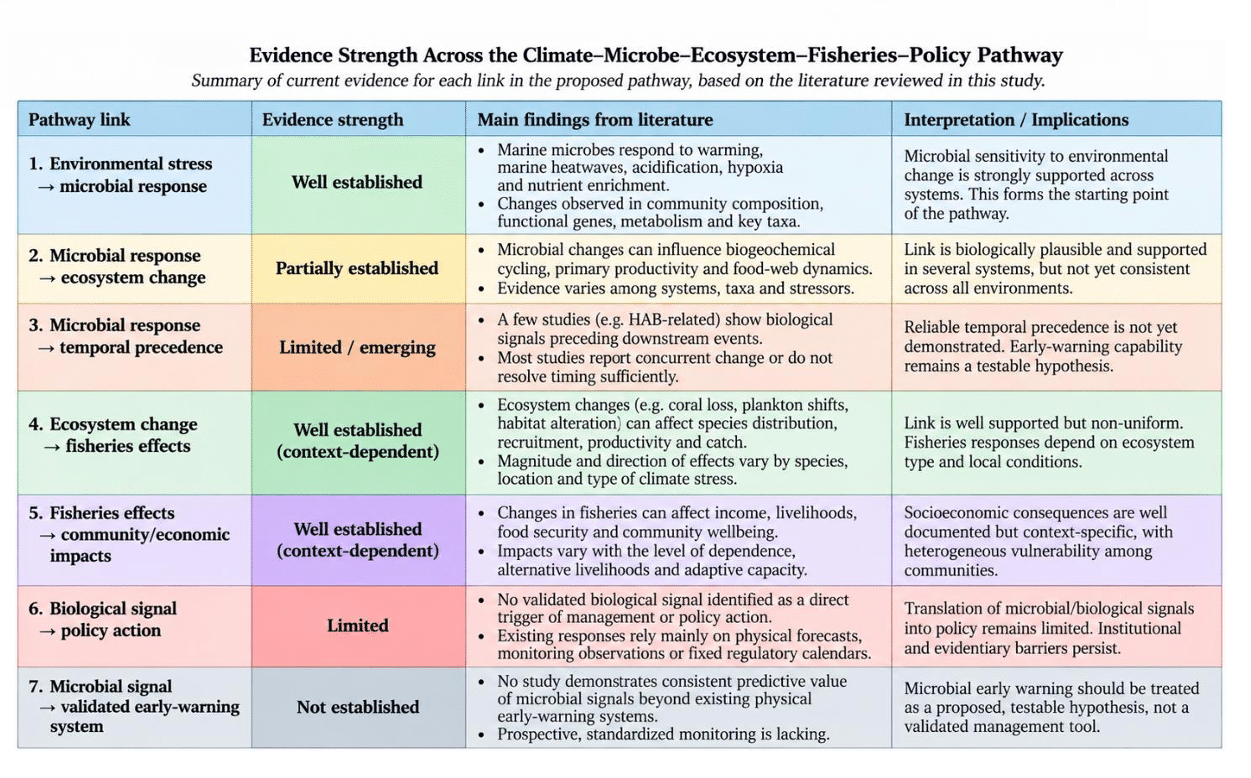
Environmental Stress → Microbial/Biological Response
(Strongly Supported)
The most well-supported connection in the data set is that of sensitivity of microorganisms to environmental stress induced by climate factors, supported by observational and manipulative studies.
Larkin et al. in his paper (2025) substantiated covariation between microbial taxonomy and function with seasonal and El Niño cycles over an 11-year time series in Southern California. Zhang et al. in 2024 explained that present-day environment-microbiome coupling across 953 metagenomes globally – and Glasl et al. (2019) demonstrated that free-living Great Barrier Reef seawater microbiomes are roughly five times more environmentally responsive than host-associated microbiomes.
Five experimental studies reinforce this with causally manipulated evidence across four distinct stressors. Kearns et al. (2016), using a decade-long nitrogen-enrichment experiment at the Plum Island LTER site, found the potentially active sediment bacterial community shifted significantly under enrichment (PERMANOVA F = 7.75, p < 0.01) while the total community showed no response at all — dormant taxa rose from ~45% to ~90% of the community Su et al. (2021) found that bacterial communities in estuarine sediments were strongly segregated by ph (PERMANOVA R2 = 0.737), while fungal communities were not; both basal respiration and a multifunctionality index decreased monotonically with decreasing pH.
Biofilm biomass, chlorophyll-a, and bacterial community composition were significantly altered under acidification (Nelson et al. 2020) and the coral-associated microbiome, metabolome, and transcriptome, all were restructured under heat stress (Santoro et al. 2021). Rodríguez et al. (2018) found terrestrial organic-matter loading dominated bacterial production and diversity in Baltic mesocosms, though a specific pollutant-responsive OTU (Methylophilus) was detectable only at fine taxonomic resolution against that dominant signal. Across these five, a consistent methodological finding emerges: the most sensitive signals are not whole-community metrics but finer-scale ones — active/dormant fractions, individual stressor-responsive OTUs, or functional-gene abundance — a direct design implication for any future monitoring protocol. Coral-associated microbiome studies more broadly show measurable shifts under thermal stress (bacterial abundance, diversity, dominant taxa), sometimes preceding visible tissue necrosis.
Microbial/Biological Response → Temporal Precedence (Partially Supported — the Central Unresolved Link)
This link is the paper’s core open question, and the combined evidence shows it is genuinely mixed rather than simply underdeveloped.
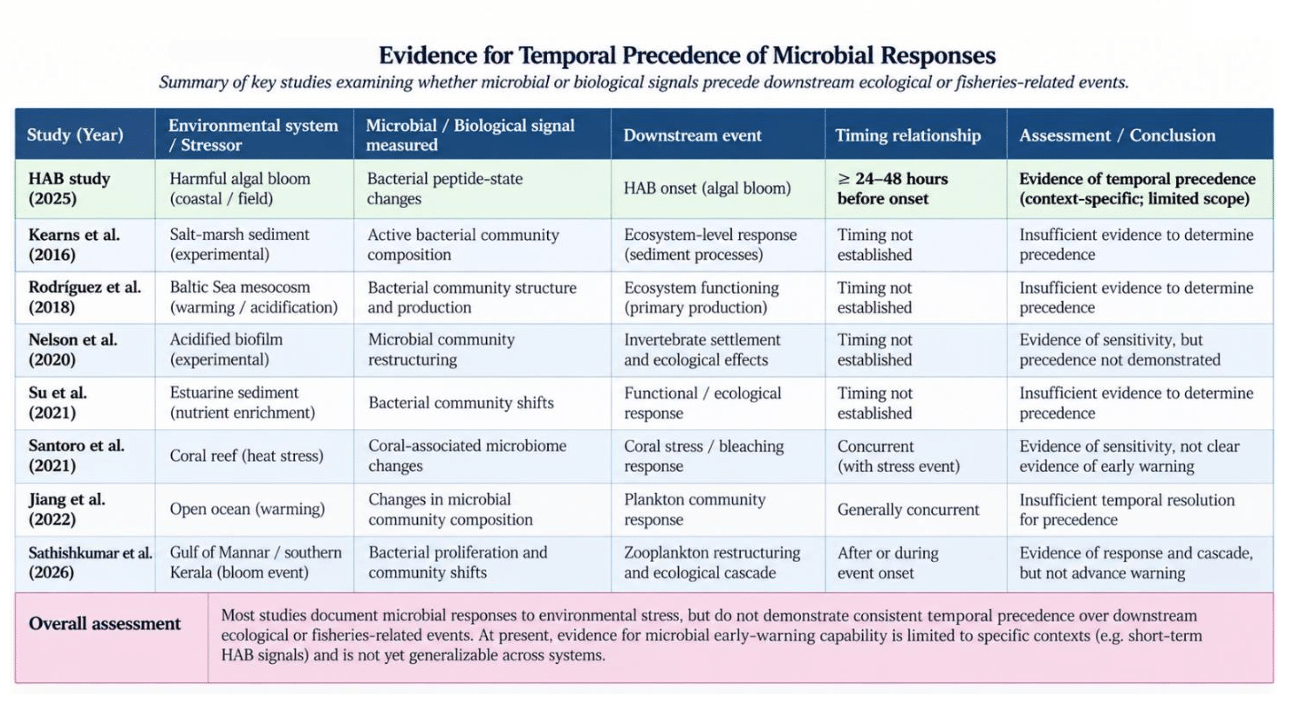
Positive evidence is narrow but real. The strongest result identified is a 2025 harmful-algal-bloom precedence study, which found bacterial peptide state shifts occurring ≥24 hours before bloom onset, cross-validated across two chemically divergent systems — but bounded to a 24–48-hour window, orders of magnitude shorter than the weeks-to-months lead time fisheries management would need. Sathishkumar et al. (2026) documented a dated November 2022 Noctiluca scintillans bloom in the Gulf of Mannar/southern Kerala coast with a genuine, ordered cascade (nutrient release → bacterial proliferation → zooplankton restructuring, with copepods replaced by cladocerans and appendicularians during decay) — but this captures the bloom-to-decay cascade only, not a pre-bloom signal, and cannot be read as precedence evidence for the primary research question.
Negative and complicating evidence is substantial. Cael, Dutkiewicz and Henson (2021) modelled plankton communities through 2100 and found abrupt shifts are not reliably preceded by conventional statistical early-warning signals even in physical variables — a direct caution against assuming biological signals will perform better. Two decades of correlational data have not yet yielded validated, real-time indicators, and the mechanistic pathway from microbial change to reef-scale resilience remains “hypothesised,” and not proven with lag-tested data, explicitly setting the field’s bottleneck (Terzin et al., 2024). Li et al. (2023) did not find significant increase in community instability with either warming or cooling, challenging the Anna Karenina Principle considered settled by several sources, while Sehnal et al. (2021) and Vila Duplá (2025) show response direction and magnitude depending on the taxonomic affiliation- and system-dependent in opposite directions — fish gut microbiomes respond weakly where mammalian ones show dysbiosis, while algal microbiome diversity increases with stress where host-associated microbiomes tend to decline.
The five papers – Kearns et al. (2016), Rodríguez et al. (2018), Nelson et al. (2020), Su et al. (2021), and Santoro et al. (2021) — are the complete set of retained sources with a controlled experimental design and a clear pre-treatment baseline. No other source met both criteria, so the convergence reported below is the full eligible set, not a selection from it. Critically, these independent experimental studies converge on the same temporal verdict. Kearns et al. (2016), Rodríguez et al. (2018), Nelson et al. (2020), and Su et al. (2021) are each classified timing undetermined, and Santoro et al. (2021) as a concurrent indicator only — meaning that even in tightly controlled, causally manipulated experiments with clear pre-treatment baselines, none demonstrated that a microbial change preceded and predicted an independently measured downstream ecological consequence. The probiotic-manipulation coral study by Santoro et al. (2021) is the most closely resembling a causal mechanism (100% survival in microbiome treated corals vs. 60% in placebo), but the microbial restructuring was measured during the stress event, not beforehand. This five-for-five convergence across an independent experimental literature set substantially strengthens the claim that precedence is proposed, not established.
Ecosystem Change → Fisheries Effects (Well Supported, Non-Uniform)
Climate-driven ecosystem restructuring reaching fisheries is well evidenced but non-uniform in magnitude and direction. Stuart-Smith et al. (2018) surveyed a total of 186 sites of the Great Barrier Reef after the bleaching event in 2016, resulting in notable shifts in coral, fish, and invertebrate communities. Not all the changes were directly related to coral loss – but also due to increased temperature. Coral trout responses to the same heatwave also differed by site (Brown et al., 2021), declining in some locations but stable or increased in others. Modelling of Caribbean reefs predicted declines in biomass under compounding bleaching, deoxygenation, acidification, and fishing pressure, but did not predict a uniform decline pattern (Arias-Gonzalez et al., 2017). Nelson et al.’s (2020) finding that acidified biofilms alter polychaete larval settlement provides one of the clearest mechanistic, if narrow, bridges from microbial-level change to a population-relevant ecological consequence identified anywhere in the dataset. Acidification-driven pathogen enrichment could be a threat to aquaculture and fisheries species, but this was an inference rather than a direct finding in the study by Su et al. (2021).
Fisheries Change → Impacts on Community/Economy (Strongly Supported, Contextualised)
According to Sumaila et al., 2011, there is an economic-damage pathway foundation where climate changes resulting in the productivity and distribution of fish cause unequal economic damage due to increased cost of fishing along with stock movement. Raubenheimer & Phiri, 2023, showed adaptation in the sector in South Africa during 1960 to 2021 but where increasing warming is increasingly inhibiting catches. Abu Samah et al. (2021) categorized community-level adaptation into five types as – financial, governmental, community, technological and temperature-related, finding institutional and funding access and not exposure alone — determines adaptive capacity. Von Schuckmann et al. proposed recently, in 2026 to convert biophysical ocean data into policymaker-usable indicators, mentioning such indicators remain far less developed than land-based equivalents.
Declines in fisheries have impacts on communities through several different channels: loss of livelihood, which extends beyond fishers to include those involved in processing, transport and marketing; food and nutritional insecurity of fish-dependent diets; migration and displacement; loss of community and occupational identity associated with generational fishing knowledge; and unevenly distributed vulnerability, with those most affected being small-scale fishers who lack diversification options.
Figures from the Central Marine Fisheries Research Institute (ICAR-CMFRI, 2026) states – 35.7 lakh tonnes of marine fish production, $69,254 crore landing-centre value, 297,702 crore retail value and 248,585 crore Gross Value Added (GVA). It confirms the sector’s substantial economic scale in India, though these figures don’t demonstrate value of any early-warning system specifically, but the sectoral importance.
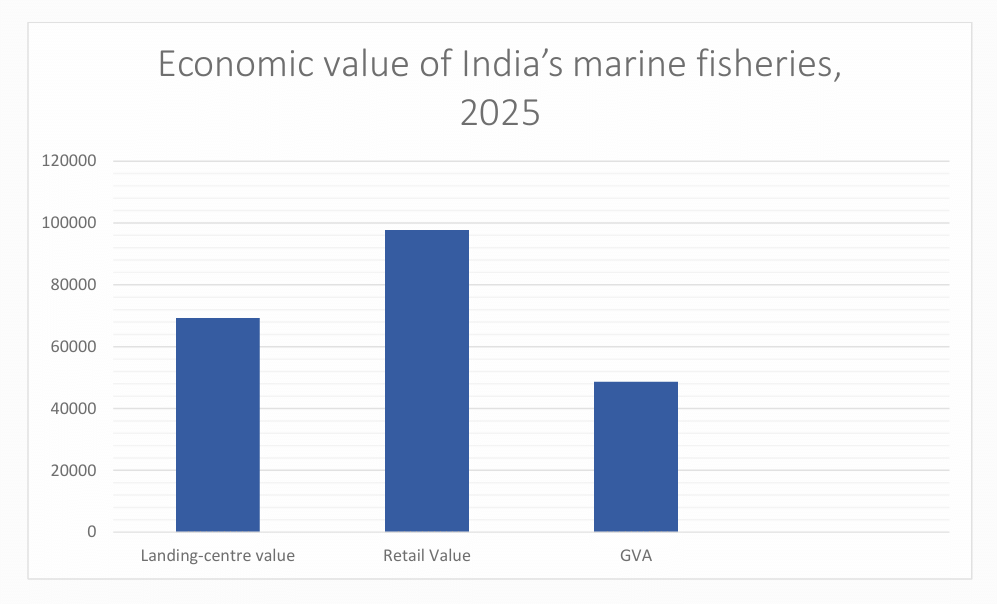
Figure 2. Economic value of India’s marine fisheries in 2025, showing landing-centre value, retail value, and gross value added (GVA).
Source: CMFRI (2025).
The visible gap between landing-centre and retail value, together with a Gross Value Added of 248,585 crores shows that sector’s economic significance extends well beyond primary catch, encompassing processing, distribution, and market activity – and none of which is currently informed by any biologically-triggered signal.
Biological Signal → Policy Action (Limited)
This link is the weakest in the pathway. In the Australian case, the Great Barrier Reef’s 2024–25 bleaching response followed the chain temperature/thermal forecast → monitoring → observed bleaching → management action (COTS control, zoning compliance, surveys) — a physically triggered response, not a biologically triggered one. The associated gillnet phase-out cannot be attributed to the bleaching event: it was committed as part of broader fisheries reforms before the 2024–25 bleaching occurred. In the Indian case, Kerala’s 52-day mechanised trawling ban (June 10–July 31, 2024) follows a fixed annual calendar tied to the breeding season — a pre-set regulatory rule, not a threshold crossed by a biological indicator — and existing operational advisories in Indian waters already rely on physical indicators (SST, chlorophyll) rather than biological ones.
Consistent with this, the literature supports a general science-to-management pathway, but evidence for the specific pathway biological signal → early economic warning → policy trigger remains limited. A tiered biological early-warning framework can be proposed for future validation — Level 1 (anomaly detected, monitoring increased), Level 2 (biological signal plus physical stress, stock surveys intensified), Level 3 (confirmed risk, catch limits adjusted) — This tiered framework is a proposed research direction only and has not been validated against real-world data. Therefore, it should not be read as a ready-to-implement policy tool. Applying it with no prior validation of the underlying biological signal risks triggering management action on an untested basis.
5.1 Case Comparison
Comparing Australia (GBR/Ningaloo) and India (Maharashtra, Kerala, Sundarbans) across the four Methodology criteria, the clearest difference is monitoring and governance capacity rather than the underlying biological phenomenon. Glasl et al. (2019), Stuart-Smith et al. (2018) and Terzin et al. (2024) show that there is precisely dated Australian which is- part of formal management. Sathishkumar et al.’s (2026) Noctiluca study, the strongest Indian case candidate, documents a genuine dated sequence but only from bloom onset forward, leaving the pre-signal stage temporally indeterminate. No single pathway link met the cross-case threshold (comparable direction and classification) in both regions simultaneously.
Synthesis Against the Four Analytical Dimensions
Sensitivity is established, corroborated by twelve microbiology sources and five independent experimental manipulations. Specificity is partially supported: Sehnal et al. (2021) , Vila Dupla (2025) , Zhang et al. (2024), and Rodriguez et al. (2018) each show taxon- system or driver-dependence that complicates generalization. Temporal precedence is partially supported at best — achievable only in narrowly scoped, high-frequency sampling designs, explicitly contradicted at the environmental-driver level by Cael et al. (2021), and unanimously absent across five independently reviewed experimental studies. Practical/policy value remains unproven: no fisheries policy identified in either case is currently triggered by a validated biological signal, and any proposed policy-trigger framework remains explicitly contingent on validation this review does not itself perform.
5.2 Interpretation
Taken together, the results point to one consistent conclusion: marine microbial and biological communities are sensitive indicators of climate stress but not yet validated early-warning signals. Sensitivity is the strongest and most convergent finding across every source type — observational time series, global metagenomic surveys, and five independent manipulative experiments all agree that microbial communities respond rapidly and measurably to warming, acidification, and nutrient stress.
Temporal precedence is where the evidence breaks down. Positive precedence exists only in narrow, high-frequency-sampled cases (the 24–48-hour harmful-algal-bloom signal), while a validated ecosystem model shows even physical variables often fail to precede abrupt ecological shifts. Most tellingly, five independently reviewed experimental studies — despite clean baselines and controlled manipulation — unanimously failed to demonstrate that microbial change preceded a later, independently measured ecological outcome. This convergence across methodologically diverse, independently selected studies is strong evidence that the gap is real, not a sampling artifact of any one literature set.
The chain also weakens as it extends outward: ecosystem-to-fisheries linkage is real but uneven by species and location, and the biological-signal-to-policy link is absent in both the cases (GBR gillnet phase-out and Kerala’s trawling ban) examined here – they are not driven by a biological threshold, but by fixed calendars or physical forecasts. Whether this pattern holds more generally is a question this two-case comparison cannot resolve. This review attributes the missing biological-policy link to insufficient evidence, not unwillingness to act. Regulatory inertia remains an unaddressed alternative explanation. Communities appear only as policy recipients here, not as signal sources. Fisher observation of biological anomalies is a candidate early-warning input this review does not examine.
6. Conclusion
This review set out to test whether marine microbial and other early biological responses can provide a reliable temporal lead over downstream ecosystem and fisheries impacts of climate change, and whether such signals could inform actionable policy. Drawing on twelve microbiology sources, five independent manipulative experiments, and case evidence from Australia and India, the answer is clear and consistent: sensitivity is established; precedence is not.
Marine microbial communities respond rapidly and measurably to warming, acidification, nutrient enrichment, and hypoxia — this holds across observational time series, global metagenomic surveys, and controlled experiments alike. But whether this response reliably precedes rather than merely accompanies downstream stress remains genuinely unresolved. The one strong positive result — a 24–48-hour lead time before harmful algal bloom onset — is real but far too short for fisheries-relevant timescales. Set against this, a validated ecosystem model shows even physical environmental signals often fail to precede abrupt ecological shifts, and five independently selected experimental studies unanimously failed to demonstrate precedence despite clean, causally manipulated designs. This convergence across methodologically diverse sources is the review’s strongest finding: the evidentiary gap is real, not an artifact of any single literature set.
The chain weakens further outward. Ecosystem change reaches fisheries unevenly, shaped by species, location, and interacting pressures. And no policy response identified in either case study — the Great Barrier Reef gillnet phase-out or Kerala’s mechanised trawling ban — is triggered by a biological signal; both rest on fixed calendars or physical forecasts. The gap between domains, not within any one of them, is where this project’s contribution lies: isolated disciplinary research cannot resolve a question that is fundamentally about connection across links.
Accordingly, this review concludes that microbial early warning should be treated as a proposed, testable hypothesis, not an established management tool. Realizing its potential requires coordinated, prospective, co-located monitoring that pairs high-resolution biological sampling with independently measured ecosystem, fisheries, and economic outcomes — explicitly benchmarked against the lead time physical forecasting already provides. Only this kind of validation, rather than continued single-domain research, can determine whether biological signals add genuine predictive value to fisheries management, community adaptation, and climate policy.
7. References
- Abu Samah, A. A. et al. (2021). A systematic review on adaptation practices in aquaculture towards climate change impacts. Sustainability, 13(20), 11410. https://doi.org/10.3390/su132011410
- Arias-González, J. E., Fung, T., Seymour, R. M., Garza-Pérez, J. R., Acosta-González, G., Bozec, Y.-M., & Briceño, F. (2017). A trophic model of a Caribbean coral reef ecosystem: Effects of climate change and fishing. Ecological Modelling, 352, 92–102. https://doi.org/10.1016/j.ecolmodel.2017.02.019
- Brown, C. J. et al. (2020). Impacts of the 2016 marine heatwave on coral trout and the Great Barrier Reef coral trout fishery. Global Change Biology. https://doi.org/10.1111/gcb.15472
- Brown, C. J., Mellin, C., Edgar, G. J., Campbell, M. D., & Stuart-Smith, R. D. (2021). Direct and indirect effects of heatwaves on a coral reef fishery. Global Change Biology, 27(6), 1214–1225. https://doi.org/10.1111/gcb.15472
- Cael, B. B., Dutkiewicz, S., & Henson, S. (2021). Abrupt shifts in 21st-century plankton communities. Science Advances, 7, eabf8593. https://doi.org/10.1126/sciadv.abf8593
- Jacox, M. G., Alexander, M. A., Amaya, D., Becker, E., Bograd, S. J., Brodie, S., Hazen, E. L., Pozo Buil, M., & Tommasi, D. (2022). Global seasonal forecasts of marine heatwaves. Nature, 604, 486–490. https://doi.org/10.1038/s41586-022-04573-9
- Spady, B. L., Skirving, W. J., Liu, G., De La Cour, J. L., McDonald, C. J., & Manzello, D. P. (2022). Unprecedented early-summer heat stress and forecast of coral bleaching on the Great Barrier Reef, 2021–2022. F1000Research, 11, 127. https://doi.org/10.12688/f1000research.108724.4
- Di Pane, J., Bourdaud, P., Horn, S., Duarte Moreno, H., & Meunier, C. L. (2024). Global change alters coastal plankton food webs by promoting the microbial loop: An inverse modelling and network analysis approach on a mesocosm experiment. Science of the Total Environment, 921, 171272. https://doi.org/10.1016/j.scitotenv.2024.171272
- Glasl, B., Bourne, D. G., Frade, P. R., Thomas, T., Schaffelke, B., & Webster, N. S. (2019). Microbial indicators of environmental perturbations in coral reef ecosystems. Microbiome, 7, 94. https://doi.org/10.1186/s40168-019-0705-7
- Holsman, K. K. et al. (2020). Ecosystem-based fisheries management forestalls climate-driven collapse. Nature Communications, 11, 4579. https://doi.org/10.1038/s41467-020-18300-3
- Larkin, A. A., Brock, M. L., Fagan, A. J., Moreno, A. R., Gerace, S. D., Lees, L. E., Suarez, S. A., Eloe-Fadrosh, E. A., & Martiny, A. C. (2025). Climate-driven succession in marine microbiome biodiversity and biogeochemical function. Nature Communications, 16, 3926. https://doi.org/10.1038/s41467-025-59382-1
- Li, J., Bates, K. A., Hoang, K. L., Hector, T. E., Knowles, S. C. L., & King, K. C. (2023). Experimental temperatures shape host microbiome diversity and composition. Global Change Biology, 29, 41–56. https://doi.org/10.1111/gcb.16429
- Australia clause — NOAA Coral Reef Watch’s satellite heat-stress products are the actual basis for GBR bleaching response protocols. Real citation: Spady, B. L., Skirving, W. J., Liu, G., et al. (2022). Unprecedented early-summer heat stress and forecast of coral bleaching on the Great Barrier Reef, 2021–2022. F1000Research, 11, 127. https://doi.org/10.12688/f1000research.108724.4
- Indian Ocean / fishery clause — Koul, V., Brune, S., Akimova, A., et al. (2023). Seasonal prediction of Arabian Sea marine heatwaves. Geophysical Research Letters, 50(18), e2023GL103975. https://doi.org/10.1029/2023GL103975
- Pinhassi, J., Farnelid, H., Martínez García, S., Teira, E., Galand, P. E., Obernosterer, I., Quince, C., Vila-Costa, M., Gasol, J. M., Lundin, D., Andersson, A. F., Labrenz, M., & Riemann, L. (2022). Functional responses of key marine bacteria to environmental change – toward genetic counselling for coastal waters. Frontiers in Microbiology, 13, 869093. https://doi.org/10.3389/fmicb.2022.869093
- Raubenheimer, C., & Phiri, A. (2023). The impact of climate change and economic development on fisheries in South Africa: A wavelet-based spectral analysis. Humanities and Social Sciences Communications, 10, 881. https://doi.org/10.1057/s41599-023-02408-0
- Sathishkumar, R. S., Arayillath, A., Ramakrishnan, S. G., Chandrasekaran, M., Shah, C., Natarajan, L., Sivadas, S. K., & Ramu, K. (2026). Impact of Noctiluca scintillans bloom and decay phases on coastal water quality and zooplankton dynamics in Indian coastal waters. Frontiers in Marine Science, 13, 1706039. https://doi.org/10.3389/fmars.2026.1706039
- Sehnal, L., Brammer-Robbins, E., Wormington, A. M., Blaha, L., Bisesi, J., Larkin, I., Martyniuk, C. J., Simonin, M., & Adamovsky, O. (2021). Microbiome composition and function in aquatic vertebrates: Small organisms making big impacts on aquatic animal health. Frontiers in Microbiology, 12, 567408. https://doi.org/10.3389/fmicb.2021.567408
- Stuart-Smith, R. D., Brown, C. J., Ceccarelli, D. M., & Edgar, G. J. (2018). Ecosystem restructuring along the Great Barrier Reef following mass coral bleaching. Nature, 560, 92–97. https://org/10.1038/s41586-018-0359-9
- Sumaila, U. R., Cheung, W. W. L., Lam, V. W. Y., Pauly, D., & Herrick, S. (2011). Climate change impacts on the biophysics and economics of world fisheries. Nature Climate Change, 1, 449–456. https://doi.org/10.1038/nclimate1301
- Terzin, M., Laffy, P. W., Robbins, S., Yeoh, Y. K., Frade, P. R., Glasl, B., Webster, N. S., & Bourne, D. G. (2024). The road forward to incorporate seawater microbes in predictive reef monitoring. Environmental Microbiome, 19, 5. https://doi.org/10.1186/s40793-023-00543-4
- Vila Duplá, M. (2025). Advancements in algal microbiome research: A game-changer for climate resilience and invasion success? Microbial Ecology, 88, 63. https://doi.org/10.1007/s00248-025-02563-8
- von Schuckmann, K. et al. (2026). Global ocean indicators: Marking pathways at the science-policy nexus. Marine Policy, 184, 106922. https://doi.org/10.1016/j.marpol.2025.106922
- Zhang, Z., Zhang, Q., Chen, B., Yu, Y., Wang, T., Xu, N., Fan, X., Peñuelas, J., Fu, Z., Deng, Y., Zhu, Y.-G., & Qian, H. (2024). Global biogeography of microbes driving ocean ecological status under climate change. Nature Communications, 15, 4657. https://doi.org/10.1038/s41467-024-49124-0
- ICAR-CMFRI. (2026). CMFRI Annual Report 2025; India’s Marine Fish Landing Data 2025. Kochi: ICAR-CMFRI. http://eprints.cmfri.org.in/id/eprint/19885
- (2026). Marine Fishery Advisories, Potential Fishing Zone Advisories and Marine Heat Wave Advisory Bulletin. Ministry of Earth Sciences, Government of India. https://incois.gov.in/MarineFisheries/MarineFisheryAdvisory
- Government of Kerala, Fisheries and Ports Department. (2024). G.O.(P) No. 2/2024/F&PD: Trawl Ban 2024; G.O.(Rt) No. 265/2024/F&P: Free ration during trawl-ban period. https://fisheries.kerala.gov.in/government-orders
- Australian Government, DCCEEW. (2025). Great Barrier Reef Progress Report 2025. https://www.dcceew.gov.au/parks-heritage/great-barrier-reef/publications/great-barrier-reef-progress-report-2025
- Great Barrier Reef Marine Park Authority. (2025). Commercial fishing and zoning. https://www.gbrmpa.gov.au/access/zoning/commercial-fishing-and-zoning
- Australian Institute of Marine Science. (2025). Great Barrier Reef Condition Summary 2024–25. https://www.aims.gov.au/monitoring-great-barrier-reef/gbr-condition-summary-2024-25
- Copernicus Climate Change Service. (2026). Europe’s early and intense heatwave in May 2026. https://climate.copernicus.eu/what-do-we-know-about-europes-early-and-intense-heatwave-may-2026
- European Commission. (2026). Seafloor marine heatwaves are becoming more frequent but are rarely captured by current models. https://environment.ec.europa.eu/news/seafloor-marine-heatwaves-are-becoming-more-frequent-are-rarely-captured-current-models-2026-06-08_en
- Plymouth Marine Laboratory. (2026). New report forecasts major impacts on the marine food web as sea temperatures rise and plankton shift. https://pml.ac.uk/news/new-report-forecasts-major-impacts-on-the-marine-food-web-as-sea-temperatures-rise-and-plankton-shift/
- Kearns, P. J., Angell, J. H., Howard, E. M., Deegan, L. A., Stanley, R. H. R., & Bowen, J. L. (2016). Nutrient enrichment induces dormancy and decreases diversity of active bacteria in salt marsh sediments. Nature Communications, 7, Article 12881. https://doi.org/10.1038/ncomms12881
- Rodríguez, J., Gallampois, C. M. J., Timonen, S., Andersson, A., Sinkko, H., Haglund, P., Berglund, Å. M. M., Ripszam, M., Figueroa, D., Tysklind, M., et al. (2018). Effects of organic pollutants on bacterial communities under future climate change scenarios. Frontiers in Microbiology, 9, Article 2926. https://doi.org/10.3389/fmicb.2018.02926
- Nelson, K. S., Baltar, F., Lamare, M. D., & Morales, S. E. (2020). Ocean acidification affects microbial community and invertebrate settlement on biofilms. Scientific Reports, 10, Article 3274. https://doi.org/10.1038/s41598-020-60023-4
- Su, X., Yang, X., Li, H., Wang, H., Wang, Y., Xu, J., Ding, K., & Zhu, Y.-G. (2021). Bacterial communities are more sensitive to ocean acidification than fungal communities in estuarine sediments. FEMS Microbiology Ecology, 97(5), fiab058. https://doi.org/10.1093/femsec/fiab058.
- Santoro, E. P., Borges, R. M., Espinoza, J. L., Freire, M., & Peixoto, R. S. (2021). Coral microbiome manipulation elicits metabolic and genetic restructuring to mitigate heat stress and evade mortality. Science Advances, 7(33). https://doi.org/10.1126/sciadv.abg3088
- Figuerola, B., Linares, C., Aparicio-Estalella, C., López-Sendino, P., Garrabou, J., & del Campo, J. (2025). Microbiome composition in a common Mediterranean bryozoan following an unprecedented marine heatwave. Environmental Microbiology Reports, 17(5), Article e70185. https://doi.org/10.1111/1758-2229.70185
- Stenger, P.-L., Tribollet, A., Guilhaumon, F., Cuet, P., Pennober, G., & Jourand, P. (2024). A multimarker approach to identify microbial bioindicators for coral reef health monitoring—Case study in La Réunion Island. Microbial Ecology, 87, Article 179. https://doi.org/10.1007/s00248-025-02495-3