Authors: Shivani Khanna, Dakshika Sejwal, Adwaith Krishnan A.S.
ABSTRACT
India’s public expenditure on education remains below the 6% of GDP benchmark recommended by the Kothari Commission and reiterated in the National Education Policy (NEP) 2020. However, the adequacy of allocations alone does not determine the effectiveness of public education spending. The extent to which approved budgets are released, utilised, and converted into educational outcomes is equally important.
Against this background, this study examines budgetary allocations, expenditure patterns, and implementation outcomes across major school education schemes and institutions in India. The study has three objectives: first, to examine the extent of budget–expenditure gaps across selected school education programmes; second, to identify the administrative and institutional factors associated with underutilisation and downward budget revisions; and third, to assess whether financial execution is reflected in educational outcomes. The study adopts a qualitative, descriptive, and comparative methodology based on secondary data from Union Budget documents, Demand for Grants, Ministry of Education reports, UDISE+ data, parliamentary analysis, and other official and institutional sources.
The analysis is informed by Public Expenditure Theory and Governance Theory. It finds that budgetary challenges in school education are not adequately explained by the level of allocation alone. Differences in expenditure execution across schemes suggest that implementation capacity, fund-release mechanisms, administrative coordination, and monitoring systems significantly influence the conversion of budgetary commitments into actual spending. The study also finds that improvements in financial utilisation do not automatically guarantee improvements in learning, infrastructure, nutrition, or digital access. The findings therefore support a shift from allocation-centred budgeting towards outcome-oriented and governance-sensitive public expenditure management.
Keywords: school education, public expenditure, budget utilisation, budget–expenditure gap, education finance, governance, India
1. INTRODUCTION
India’s school education system serves approximately 14.7 lakh schools and nearly 24.7 crore students, making public expenditure management in education central to the country’s social and economic development. Education is also a shared responsibility under the Concurrent List of the Constitution, requiring coordination between the Union and state governments. The scale and institutional complexity of the sector therefore make the relationship between budgetary allocation, actual expenditure, and educational outcomes particularly important (PRS Legislative Research, 2026).
The question is not simply whether the government allocates funds to education, but whether these funds are released and spent effectively. Public spending on education in India remains below the 6% of GDP target recommended by the Kothari Commission and reaffirmed by NEP 2020. PRS Legislative Research (2026) estimates combined Centre and state expenditure on education at approximately 4.1% of GDP, while central government education expenditure has remained around 2.4%–2.6% of the total Union Budget in recent years. This indicates a continuing resource constraint, but the size of allocations alone cannot explain the performance of the education system.
Major programmes such as Samagra Shiksha, PM POSHAN, and PM SHRI have been designed to address different dimensions of school education, including access, infrastructure, nutrition, inclusion, teacher development, and school improvement. At the same time, institutions such as Kendriya Vidyalaya Sangathan (KVS), Navodaya Vidyalaya Samiti (NVS), the National Council of Educational Research and Training (NCERT), and the Atal Tinkering Labs (ATL) initiative contribute to the wider school education ecosystem.
The existence of these programmes, however, does not guarantee effective service delivery. Budget estimates may be revised during the financial year, expenditure may remain below authorised allocations, and improvements in spending may not be reflected proportionately in learning or infrastructure outcomes. Recent budget analysis shows that in 2025–26, several major school education programmes had revised estimates below their original budget estimates, while the 2026–27 Budget proposed increased allocations for several schemes. Such changes need to be interpreted carefully: a downward revision may reflect underutilisation, changes in implementation requirements, delayed execution, or altered spending priorities, rather than automatically proving administrative failure (Ministry of Finance, 2026; PRS Legislative Research, 2026)
This study therefore examines the relationship between budgetary allocation, expenditure execution, and educational outcomes in India’s school education sector.
1.1 Research Problem
Existing discussions on education finance frequently focus on whether government spending is adequate. However, the relationship between approved allocations and actual expenditure receives comparatively less systematic attention. A large allocation does not necessarily produce effective outcomes if funds are delayed, underutilised, poorly targeted, or not accompanied by sufficient administrative capacity.
The central research problem addressed in this study is therefore:
To what extent do budgetary allocations for major school education schemes translate into actual expenditure and improved educational outcomes, and what institutional and governance factors influence this process?
1.2 Research Objectives
Examine budgetary allocations, revised estimates, and expenditure patterns across selected school education schemes and institutions.
Identify the administrative, institutional, and governance-related factors associated with budget–expenditure gaps and underutilisation.
Compare expenditure execution across major school education programmes to assess differences in financial efficiency.
Examine whether financial execution is reflected in educational outcomes relating to learning, infrastructure, nutrition, and digital access.
Suggest policy measures for strengthening outcome-oriented and accountable education expenditure.
2. LITERATURE REVIEW
2.1 Public investment and educational outcomes
The literature on education finance begins with the recognition that public expenditure is essential for expanding access and reducing inequalities. Education is associated not only with individual welfare but also with the development of human capital and long-term economic productivity. Hanushek and Woessmann (2015), however, distinguish between the quantity of resources invested in education and the quality of learning produced by those resources. Their analysis suggests that expenditure increases alone do not consistently generate better outcomes; the effectiveness of spending and the quality of institutions also matter.
This argument is particularly relevant to India. While the underfunding perspective emphasises that India’s public education expenditure remains below the 6% benchmark, the efficiency perspective argues that additional expenditure must be accompanied by better planning, implementation, and accountability. These two perspectives are not necessarily contradictory.
The central issue is that inadequate funding and inefficient expenditure can coexist.
2.2 Allocation adequacy versus expenditure efficiency
The literature on Indian education finance identifies persistent gaps in resource availability, infrastructure, teacher provision, and interstate spending capacity. CBGA’s analysis of school education budgets across six states found that although financial provisioning improved during the Fourteenth Finance Commission period, significant gaps remained, particularly in teacher availability and infrastructure. The study also emphasised the importance of moving towards outcome-oriented budgeting rather than assessing budgets solely by the amount allocated (Centre for Budget and Governance Accountability [CBGA], 2018).
This perspective differs from a purely allocation-based approach. An allocation-centred analysis asks whether sufficient resources have been budgeted. An expenditure-efficiency approach asks whether those resources have been converted into services and outcomes. The former highlights fiscal adequacy; the latter highlights implementation capacity.
The distinction is important because a budget can be inadequate and underutilised simultaneously. Similarly, an increase in expenditure does not necessarily mean that the system has become more efficient. Consequently, this study treats budgetary adequacy and expenditure efficiency as related but distinct dimensions of education finance.
2.3 Governance and the causes of expenditure gaps
Governance provides a second important explanation for differences between allocations and outcomes. Public expenditure is implemented through multiple levels of government and administrative institutions. In centrally sponsored schemes, the Union government, state governments, implementing agencies, districts, and schools may all play different roles. From a governance perspective, the effectiveness of public expenditure depends on coordination, administrative capacity, monitoring, accountability, and the timely flow of information and funds. The World Bank (1992) conceptualises governance in terms of the institutional processes through which public authority is exercised and resources are managed. Applied to education, this suggests that expenditure outcomes are influenced not only by the amount of money available but also by the quality of institutional arrangements through which that money is administered.
The existing literature therefore identifies several possible causes of expenditure gaps, including delayed releases, administrative bottlenecks, weak planning, procurement constraints, and inadequate monitoring. However, the evidence also suggests that these factors should not be assumed solely from the existence of a BE–RE gap. A downward revision is an indicator requiring interpretation, not conclusive proof of a specific cause.
2.4 From expenditure to outcomes
A further limitation in existing research is the separation between financial and educational analysis. Budget studies often examine allocations and spending, while education studies focus on learning outcomes, infrastructure, or nutrition. These areas are closely connected but are not always examined together.
Recent evidence demonstrates that financial execution and educational outcomes do not necessarily move together. PRS Legislative Research (2026) reports that utilisation of several major school education schemes has improved, but significant challenges remain in areas such as digital infrastructure and student well-being. NITI Aayog (2026) similarly identifies continuing gaps in student health, nutrition, and holistic development despite the expansion of education-related programmes. This creates the central research gap addressed by the present study. Existing literature has extensively discussed the adequacy of public expenditure, fiscal inequalities, and educational outcomes. However, fewer studies systematically connect three stages of public expenditure: allocation → expenditure execution → educational outcomes. This study attempts to address this gap by combining budgetary analysis with a comparative examination of expenditure efficiency and outcome indicators.
3. THEORETICAL FRAMEWORK
3.1 Public Expenditure Theory
Public Expenditure Theory provides the first analytical foundation for this study. The theory examines why governments spend public resources and how such spending contributes to social welfare and economic development. In the education sector, public expenditure is justified by the positive externalities associated with education, including improved productivity, social mobility, health, and civic participation.
However, the theory also raises questions concerning the efficiency and effectiveness of expenditure. Public expenditure cannot be evaluated solely by the amount allocated. The quality of spending, its distribution, and the outcomes generated are equally important.
This study therefore conceptualises education expenditure through three stages: Budget allocation → Expenditure utilisation → Educational outcomes. A gap at any stage can weaken the effectiveness of public spending. For example, an allocation may be reduced before implementation, funds may remain unspent, or expenditure may occur without producing significant improvements in learning or infrastructure.
3.2 Governance Theory
Governance Theory complements Public Expenditure Theory by explaining why financial resources may not translate into effective service delivery. Governance includes institutional coordination, accountability, transparency, administrative capacity, monitoring, and the distribution of responsibilities across levels of government.
This framework is particularly relevant to India’s centrally sponsored education schemes. Since implementation often involves both Union and state governments, the final outcome depends on coordination across multiple institutions. Consequently, the study interprets expenditure gaps not simply as financial problems but as possible indicators of institutional and administrative constraints.
Together, the two theories provide the analytical framework for this study: Public Expenditure Theory explains the importance of adequate, efficient, and outcome-oriented spending, while Governance Theory explains how institutional capacity and administrative processes influence the conversion of budgets into expenditure and outcomes.
4. METHODOLOGY
This study adopts a qualitative, descriptive, and comparative research design based on secondary data.
The analysis uses Union Budget documents, Expenditure Budgets, Demand for Grants, Ministry of Education reports, UDISE+ data, parliamentary analysis, scheme-related documents, and selected institutional reports. The primary focus is on major school education programmes including Samagra Shiksha, PM POSHAN, PM SHRI, STARS, and DHRUV . Selected institutions and initiatives, including KVS, NVS, ATL, and NCERT, are also examined.
The study uses four analytical indicators:
Budgetary allocation: Budget Estimates (BE) and Revised Estimates (RE).
Expenditure utilisation: Actual expenditure relative to authorised or budgeted allocations.
Financial efficiency: Comparative analysis of expenditure execution across schemes.
Outcome performance: Indicators relating to learning, infrastructure, nutrition, teacher availability, and digital access.
The study does not attempt to establish a causal relationship between expenditure and educational outcomes. Instead, it examines patterns and associations between financial execution and educational performance. This limitation is important because educational outcomes are influenced by multiple factors, including socioeconomic conditions, teacher quality, school management, household characteristics, and regional inequalities.
5. BUDGET ANALYSIS
5.1 Samagra Shiksha
Samagra Shiksha is an integrated school education scheme covering education from the pre-school stage to senior secondary education. It aims to support access, equity, inclusion, teacher development, infrastructure, and learning outcomes.
According to budget analysis, the scheme received a Budget Estimate of ₹41,250 crore in 2025–26, while the Revised Estimate was ₹38,000 crore. The 2026–27 Budget Estimate increased to ₹42,100 crore. The reduction between the 2025–26 BE and RE represents a 7.9% downward revision, while the 2026–27 allocation is approximately 10.8% higher than the revised estimate of the previous year (Ministry of Finance, 2026; PRS Legislative Research, 2026). However, the 2026–27 increase should not be interpreted automatically as a major expansion in real terms. A substantial part of the increase restores funding following the downward revision in 2025–26. This illustrates why comparisons between BE and RE are important for understanding the trajectory of public spending.
5.2 PM SHRI
PM SHRI seeks to upgrade approximately 14,500 government schools into model institutions aligned with NEP 2020. The scheme is implemented through a centrally supported funding structure and requires cooperation between the Centre and states.
The scheme’s Budget Estimate increased from ₹4,000 crore in 2023–24 to ₹6,050 crore in 2024–25 and ₹7,500 crore in 2025–26. However, its Revised Estimates were lower in each of these years: ₹2,800 crore, ₹4,500 crore, and ₹4,500 crore respectively.
The recurring difference between BE and RE suggests that the scheme’s implementation trajectory has not matched the level of planned expenditure. However, the data alone cannot establish whether the cause was administrative delay, slower project implementation, revised requirements, or other factors. The more defensible conclusion is that the scheme experienced persistent downward revisions and therefore warrants closer examination of its implementation and fund-utilisation mechanisms.
5.3 PM POSHAN
PM POSHAN provides cooked meals to children in government and government-aided schools and aims to address nutrition, school participation, and educational inclusion. The allocation increased from ₹10,600 crore in the 2025–26 Revised Estimate to ₹12,750 crore in the 2026–27 Budget Estimate, representing a 20% increase (PRS Legislative Research, 2026).
However, financial allocation does not fully capture the quality of service delivery. Parliamentary analysis identifies continuing concerns relating to malnutrition and meal quality, including the need for stronger monitoring and quality audits. NITI Aayog (2026) similarly identifies continuing gaps in student health and nutrition.
The implication is that increased funding must be assessed alongside the quality, coverage, and nutritional adequacy of actual delivery.
5.4 KVS, NVS, ATL, and NCERT
The school education system also includes institutions and initiatives with distinct administrative structures and expenditure patterns.
KVS and NVS operate as major networks of centrally administered schools. Their expenditure patterns are therefore not directly comparable with centrally sponsored schemes such as Samagra Shiksha or PM SHRI. Similarly, ATL and NCERT have different institutional mandates and cannot be evaluated solely through the same BE- RE framework.
This institutional diversity is important. A scheme that provides grants to states faces different implementation challenges from an autonomous institution that directly manages its own administrative expenditure. Consequently, comparisons must be made cautiously.
The available evidence nevertheless suggests that expenditure transparency is uneven across institutions. While budgetary allocations may be available, comparable scheme-level expenditure and outcome data are not always easily accessible. This limits the ability to assess efficiency consistently across all components of the school education system.
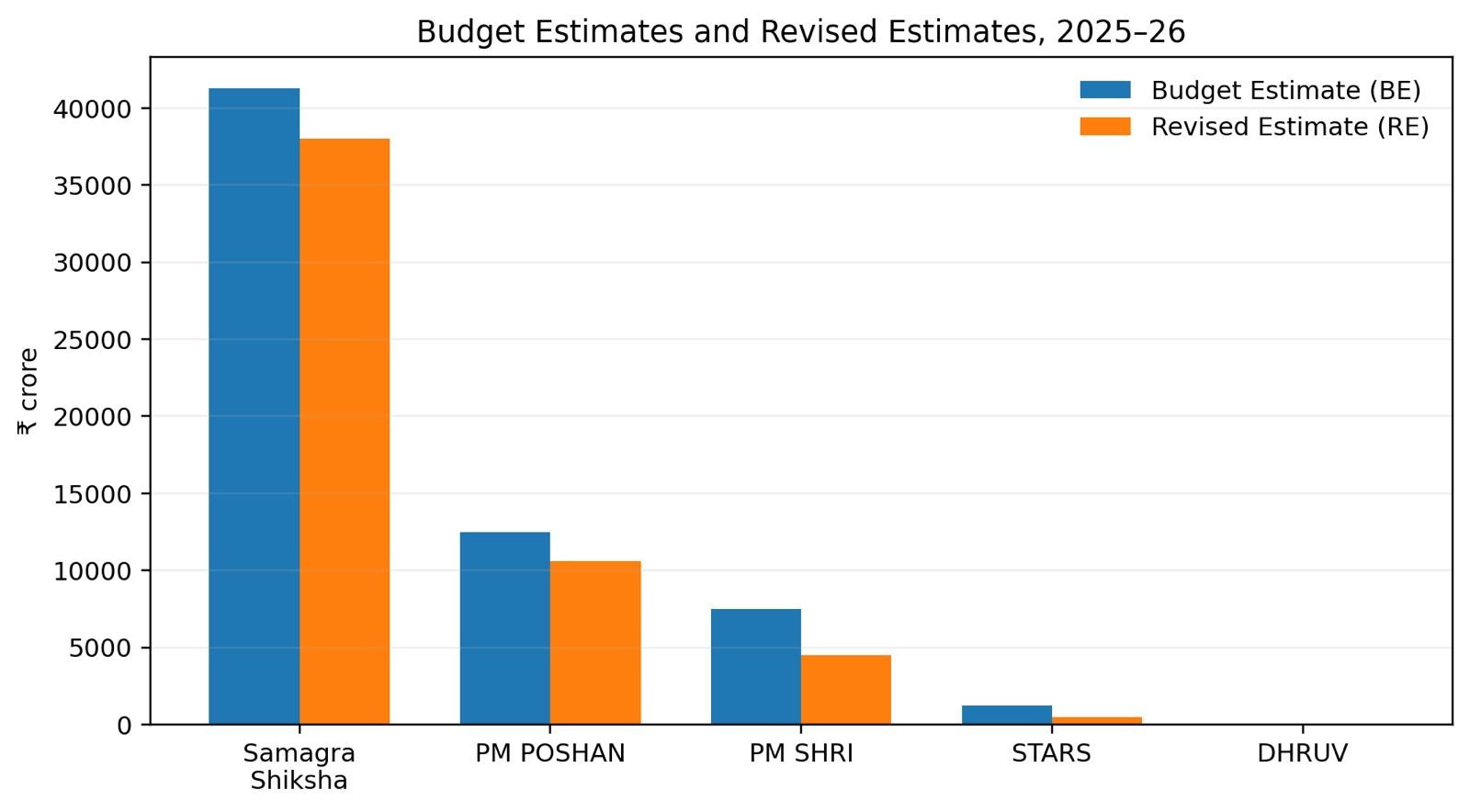
Figure 1. Budget Estimates and Revised Estimates for Major School Education Schemes, 2025–26
Source: Ministry of Finance (2026); figures compiled from the study.
6. GAP ANALYSIS
6.1 Financial Gaps
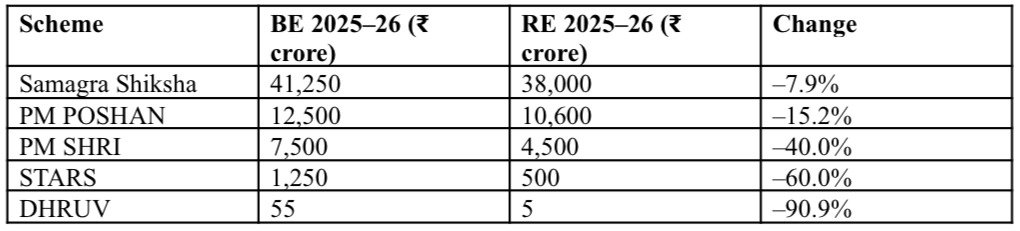
The largest downward revisions occurred in DHRUV and STARS, while PM SHRI experienced a substantial 40% reduction. Samagra Shiksha, although the largest programme in absolute terms, experienced a smaller proportional reduction.
These figures demonstrate that the magnitude of a budget revision cannot be interpreted independently of the size and design of the scheme. A 90.9% reduction in a small programme and a 40% reduction in a large programme represent different financial situations. The analysis therefore considers both absolute and proportional changes. The BE–RE gaps suggest that planned expenditure was not fully maintained during implementation. However, they should be treated as signals of possible implementation or utilisation challenges rather than definitive evidence of administrative failure. The available data establish the existence of financial gaps, while the specific causes require additional administrative and implementation evidence.
6.2 Utilisation Gaps
The relationship between budget estimates and actual expenditure provides a stronger indicator of expenditure execution. Across selected major centrally supported school education programmes, utilisation improved from approximately 80.2% in 2023–24 to 88.2% in 2024–25 according to the study’s compiled data. This suggests an improvement in financial execution. However, expenditure remained below the level of planned allocations.
The broader budget evidence also demonstrates that utilisation varies across schemes. PRS Legislative Research (2026) reports that Samagra Shiksha has historically utilised approximately 86% of its allocations on average, while utilisation patterns for PM POSHAN and PM SHRI have varied over time.
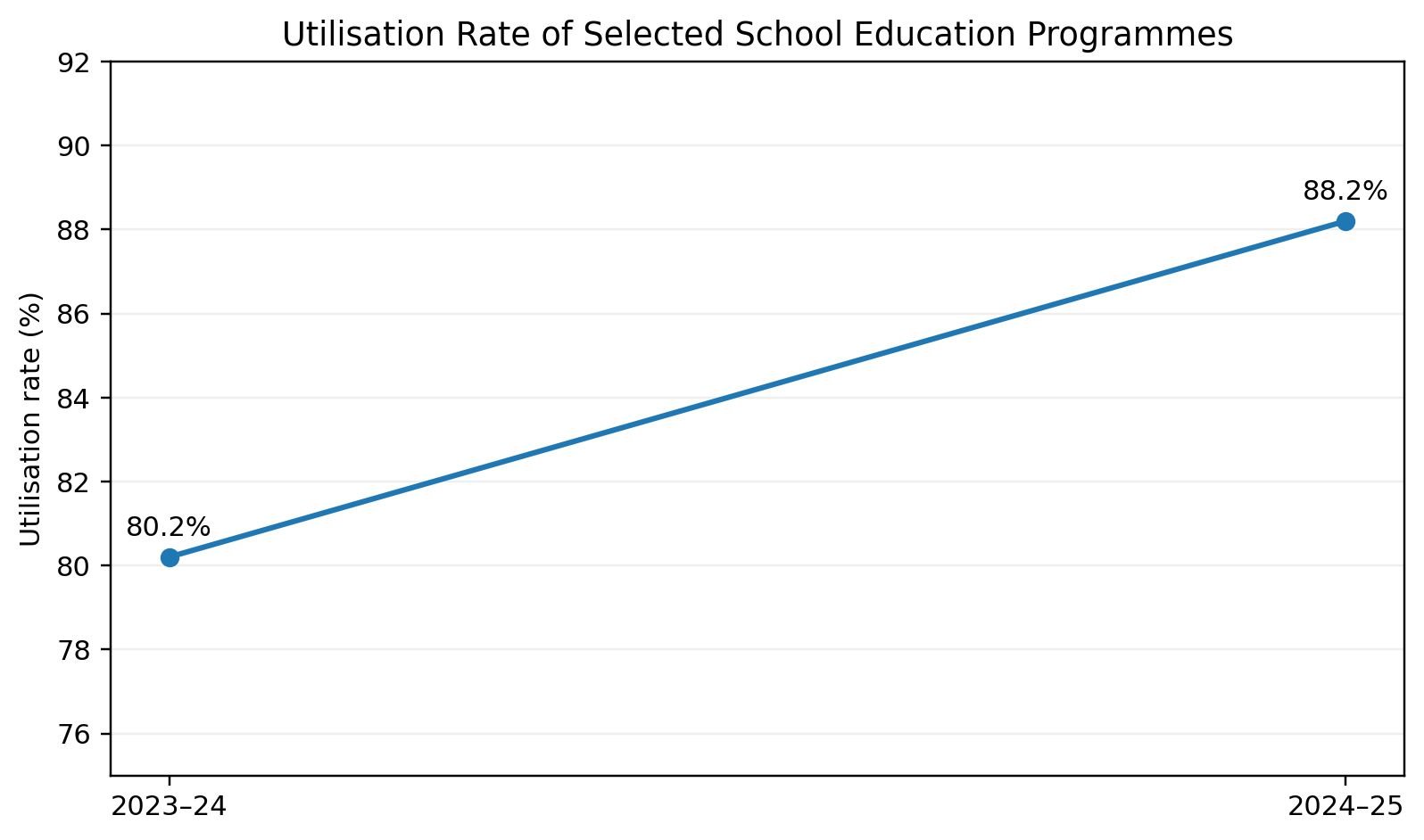
Figure 2. Utilisation Rate of Selected Centrally Supported School Education Programmes
Source: Ministry of Education (2025); figures compiled from the study.
This comparison is significant. It suggests that expenditure efficiency is not uniform across the education sector. Differences may arise from scheme design, the number of implementing agencies, Centre–State funding arrangements, administrative capacity, and the nature of expenditure involved.
6.3 Comparative Expenditure Efficiency
A comparison of selected schemes produces three broad categories:
Higher and relatively stable execution
Large, established schemes such as Samagra Shiksha have relatively predictable expenditure structures and established administrative systems. Their utilisation rates, although not perfect, have generally remained substantial. Improving but variable execution PM POSHAN and PM SHRI demonstrate more variable expenditure patterns. PM POSHAN is affected by recurring delivery and monitoring requirements, while PM SHRI requires infrastructure upgrading and coordination with states and schools
High volatility
Smaller or more specialised programmes may experience larger proportional changes because their implementation depends on specific projects or administrative milestones. The large BE–RE changes associated with STARS and DHRUV therefore indicate greater volatility in planned expenditure.
The comparative analysis shows that the size of a scheme does not automatically determine its efficiency. Instead, the institutional architecture and implementation requirements of each scheme influence financial execution.
6.4 Outcome Gaps
Financial execution does not automatically produce educational improvement. ASER 2024 reported continuing learning challenges in rural India, including significant difficulty among Grade 5 children in reading Grade 2-level text. Official UDISE+ data also identify continuing gaps in infrastructure and digital facilities across schools. NITI Aayog (2026) identifies persistent gaps in student well-being, health, nutrition, and holistic development.
The implication is that budgetary efficiency should not be measured only by the percentage of funds spent. A programme can achieve high financial utilisation while producing limited outcomes if expenditure is poorly targeted or if institutional and service-delivery constraints remain unresolved.
Therefore, the education sector requires a broader definition of expenditure efficiency: Efficient expenditure = financial utilisation + timely implementation + equitable service delivery + measurable outcomes.
7. FINDINGS AND DISCUSSION
The findings provide five major conclusions.
First, budgetary allocations remain important but are insufficient as a measure of policy commitment. India’s education expenditure remains below the 6% of GDP policy benchmark, indicating continuing resource constraints. However, the analysis demonstrates that allocation levels alone cannot explain differences in programme performance.
Second, budget–expenditure gaps are widespread but vary considerably across schemes. PM SHRI, STARS, and DHRUV experienced larger proportional downward revisions than Samagra Shiksha. This suggests that the implementation environment differs significantly across programmes.
Third, financial execution has improved in some areas but remains uneven. The available data indicate that utilisation rates have increased across several major schemes, but planned allocations are still not always converted into actual expenditure.
Fourth, financial efficiency and educational outcomes are not identical. Persistent gaps in learning, nutrition, infrastructure, and digital access demonstrate that increased expenditure must be accompanied by effective implementation and outcome monitoring.
Fifth, governance is a central connecting factor. Centrally sponsored schemes require coordination between multiple levels of government. Delays or weaknesses at any stage can affect the final expenditure outcome. This supports the argument that budget–expenditure gaps should be analysed through both a public finance and governance lens.
The findings therefore support a more nuanced interpretation of India’s school education financing problem. The sector faces both an adequacy problem and an implementation problem. Increasing allocations remains necessary, particularly given the scale of infrastructure, teacher, and learning challenges. However, increasing budgets without strengthening administrative capacity and monitoring systems may not produce proportionate improvements.
8. POLICY RECOMMENDATIONS
1. Move towards outcome-oriented budgeting
Education budgets should increasingly connect expenditure with measurable indicators such as learning outcomes, teacher vacancies, infrastructure availability, digital access, and nutritional quality.
2. Strengthen fund-flow monitoring
Digital fund-tracking systems should be used to monitor the movement of funds from the Union government to states and implementing agencies. This can improve transparency and identify delays.
3. Improve state-level planning capacity
Since education is a shared responsibility, states require stronger planning and financial-management capacity. Timely submission of utilisation certificates and improved expenditure forecasting can reduce avoidable revisions.
4. Publish comparable expenditure data
Institutions such as ATL and NCERT should provide accessible scheme-wise expenditure and outcome information. Greater transparency would enable stronger assessment of value for money.
5. Link expenditure to outcomes
The government should move beyond measuring whether funds have been spent. Financial reporting should be linked to the services delivered and outcomes achieved.
6. Strengthen independent monitoring
Independent financial and social audits can improve accountability, particularly in programmes involving multiple implementing agencies and decentralised delivery.
9. CONCLUSION
This study examined the relationship between budgetary allocations, expenditure execution, and educational outcomes in India’s school education sector.
The first objective was to examine budget–expenditure patterns across major schemes. The analysis found significant differences between Budget Estimates and Revised Estimates, particularly in PM SHRI, STARS, and DHRUV . The second objective was to identify the factors associated with expenditure gaps. The evidence suggests that financial execution is influenced by administrative capacity, coordination requirements, fund-flow systems, implementation structures, and monitoring mechanisms. However, the study also emphasises that a BE–RE reduction alone cannot conclusively establish the specific cause of an expenditure gap.
The third objective was to compare expenditure efficiency across schemes. The findings indicate that utilisation is uneven and that scheme design and institutional structure influence financial execution. Large and established programmes such as Samagra Shiksha demonstrate different expenditure patterns from infrastructure-oriented or specialised initiatives.
Finally, the study examined whether financial execution translated into educational outcomes. The evidence indicates that improved utilisation does not automatically eliminate learning, infrastructure, nutrition, and digital-access gaps. This demonstrates the importance of evaluating education expenditure not merely by how much money is allocated or spent, but by what public spending achieves.
The principal contribution of this study is therefore its integrated approach to education finance. It connects three dimensions that are often examined separately: budget allocation, expenditure execution, and educational outcomes. The findings suggest that India’s school education sector requires both greater public investment and stronger expenditure governance. Future research can build on this study through state-level comparisons, scheme-specific causal analysis, and longitudinal research linking expenditure patterns with measurable learning and infrastructure outcomes. Such research would strengthen the evidence base for designing education budgets that are not only larger, but also more efficiently implemented and more closely connected to educational improvement.
REFERENCES
Atal Innovation Mission. (2025). Annual report 2024–25. NITI Aayog. Centre for Budget and Governance Accountability.(2018).
Budgeting for school education: What has changed and what has not? Analysis of six states in the 14th Finance Commission recommendation period.
https://www.cbgaindia.org/study-report/budgeting-school-education-changed-not/
Hanushek, E. A., & Woessmann, L. (2015). The knowledge capital of nations: Education and the economics of growth. MIT Press.
Ministry of Education. (2020). National Education Policy 2020. Government of India. Ministry of Education. (2024). Samagra Shiksha: An integrated scheme for school education.
Government of India.https://www.education.gov.in/en/samagra-shiksha
Ministry of Education. (2025). Annual report 2024–25. Government of India.
Ministry of Finance. (2026). Expenditure budget 2026–27. Government of India.
https://www.indiabudget.gov.in/
National Council of Educational Research and Training. (2022). National achievement survey 2021. Government of India.
National Council of Educational Research and Training. (2023). National curriculum framework for school education 2023. Government of India.
NITI Aayog. (2026). School education system in India: Challenges and bottlenecks—Gaps in student well-being and holistic development. Government of India.
Pratham Education Foundation. (2025). Annual status of education report (rural) 2024. Pratham.
PRS Legislative Research. (2026). Demand for grants 2026–27 analysis: Education.
https://prsindia.org/budgets/parliament/demand-for-grants-2026-27-analysis-educationThe World Bank. (1992). Governance and development. The World Bank.