
Author: Spandana S Arakere
ABSTRACT
Education is not only an expenditure in Indian middle-class households, but also a long-term investment that guarantees a pay-off in a stable future. Nevertheless, constant increment in tuition fee in schools, colleges and universities has threatened the sustainability in the long run. This paper looks at the impacts of such increments on affordability, budgeting and access to quality education, whilst keeping in view the increasingly growing gap between education inflation and income growth.
It addresses the key questions related to the long-term compounding fee increases and the responses of the middle-class households to the same. Referring to the mixed-method approach based on secondary data, existing literature and trend analysis, the research indicates cost escalation over a period of 10-15 years in relation to income patterns.
The paper also puts into the limelight the multidimensional financial burden on middle-income households, including such key terms as disproportionate assignment of income and augmented reliance on debts or high-interest education loans and the increasing influence of shadow education costs like private coaching. The weak fee regulation, the prevalence of the private sector and the stickiness of enrolment are other factors that add to this load. In general, the research indicates that the annual fee increases in the long term make education less affordable, which explains the importance of effective policy measures.
Keywords: education inflation, middle-class households, financial burden, income-expenditure gap, household budgeting, debt dependency, shadow education, quality education[1]
INTRODUCTION
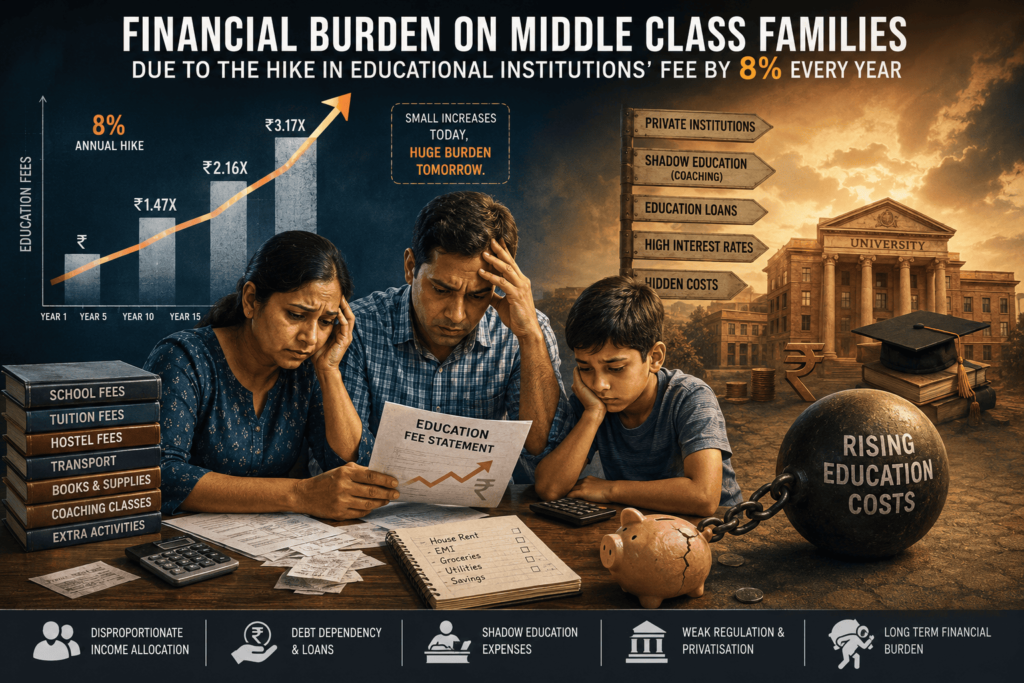
Education can be regarded as one of the aspects of being socio-economically empowered, particularly for middle-class families. It is concerned with the holistic development of an individual through personal development, enhancement of quality of life, promoting independence and building confidence. This renders education a necessity for every household. However, escalating school educational expenses, universities, and other institutions have economically and emotionally strained middle-class households. An increase of 8% in education fees may not seem too daunting, but when it is applied over a decade, it can increase educational spending by two times or even more. To middle-class families, this spiral makes education a long-term financial burden, rather than a budgeted expense. It changes the priorities of households, leads to financial losses, and threatens the stability in the future. High-quality education thus gets more expensive. Conversely, other financial obligations like loans, savings and housing costs, that are supposed to be managed at the same time, also burden middle-class households.
Rising education prices, particularly higher education, put financial and emotional pressure on families. Budgetary restrictions force many families to reduce necessary spending in order to pay for growing school expenses. Numerous structural variables, including infrastructure investments, rising faculty salaries and staff expenses, technological integrations, and regulatory compliance requirements, have all led to an increase in educational costs. Furthermore, state-level disparities and varying levels of development influence the rise in education costs. Moreover, the Indian education market is considered an under-regulated market, led by private organisations that have a profit motive, while government-funded institutions are sidelined due to low public funding.
This research calculates the effect on middle-class households due to the rising education costs. It evaluates the repercussions of an 8% annual increase in education fees on equitable access to quality education. It is the expression of the correlation between inflation and the non-rising income. Moreover, the paper discusses the challenges of middle-income families, who are not entitled to receive any financial assistance and are not financially stable, which exposes them to an increase in education costs. The study investigates how it affects their spending, financial behaviour and overall economic situations. It also analyses the financial burden qualitatively and analytically, from credible secondary data such as academic papers, publications, and websites.
The increase in the expense of schooling has been caused by several factors. Income stagnation, the growing expense of more privatised educational institutions, and restricted access to government subsidies have made middle-class families more vulnerable. The persistent and largely under-recognised nature of this cost escalation is significant: education prices rise by 8-10% each year, while general inflation and salary growth rise by only 5-6%. Even small annual variations over time can add up to a significant long-term financial burden for middle-class households since education prices often rise more quickly than overall consumer inflation. Furthermore, these families are neither poor enough to qualify for state-subsidized schooling or RTE regulations, nor rich enough to afford these exorbitant fees without compromising daily costs.
Moreover, factors such as the explosive growth of parallel coaching industries, hidden costs and “mandatory” add-ons, extensive privatisation of educational institutions, the education loan trap, and high interest rates have transformed education into a required financial burden, forcing families to liquidate savings or reduce essential daily expenditures. These factors have not only imposed a strain on middle-class families, but they have also drained their savings, increased inequality, and caused enormous social and emotional stress, drawing them into a self-reinforcing cycle in which rising fees deplete savings, depleted savings increase reliance on debt, and debt repayment further restricts the capacity to absorb the next fee increase — a dynamic this paper refers to descriptively as the education-cost reinforcement cycle, an author-developed term rather than an established theoretical construct.
The existing research has only examined the causes that lead to an increase in the cost of schooling. However, a more thorough examination of the impacts of regular price increases on middle-class financial security is still needed, despite the increasingly popular awareness. To reform fee-structure regulations, avoid education inflation from surpassing income growth, and prevent education from becoming a luxury product, this tension must be addressed. These processes should be studied to create well-informed policy responses and establish fair access to high-quality education.
Taken together, these dynamics indicate that the central and most measurable driver of long-term financial strain on middle-class households is not any single cost category but the compounding effect of a recurring annual fee increase. This study is therefore designed to examine, specifically, how an annual education fee increase of approximately 8% – the rate most consistently reported across Indian private schooling and higher-education institutions in the secondary data reviewed here – compounds over a 10–15-year schooling and higher-education cycle, and how middle-class households respond to this compounding cost through changes in savings, debt, and expenditure behaviour. The 8% figure is selected as the central variable because it represents the modal and most frequently cited annual fee-hike rate across the secondary sources reviewed, and because, unlike single-year cost figures, an 8% compounding rate captures the cumulative, structural nature of the burden that this paper argues has been under-examined in existing research. The objective of the study is therefore twofold: first, to quantify the long-term financial trajectory implied by an 8% compounding fee increase relative to typical middle-class income growth; and second, to assess the resulting behavioural and welfare consequences for households, so as to inform policy responses to education-fee regulation.
LITERATURE REVIEW
The increasing expense of education in India has emerged as a major issue, especially for middle-class families that rely largely on the commercialisation of educational schools. Current research indicates that the growing communication, along with inflationary forces, has led to a consistent increase in institutional fees over the years. Jandhyala B.G. Tilak (1994) offers a fundamental insight into educational expenses by analysing the framework of education funding in India. Tilak differentiates between direct expenses like tuition fees and indirect expenses such as transportation, study supplies, and living costs. His research highlights that families shoulder a significant portion of educational costs, making affordability a key issue, particularly for those in middle-income brackets.
Recent research has connected the increase in tuition costs to wider macroeconomic influences. Saroj Jha et al. (2025) examine how inflation affects operational expenses in educational organisations. Their research shows that increasing spending on salaries, infrastructure, and digital resources has raised institutional expenses, which are then passed on to families through regular fee increases. This offers a structural rationale for frequent rises, like yearly increases of approximately 8%, which are typically defended as essential for upholding quality.
The financial effects of these increases are especially significant for middle-class families. Nitisha Srivastava (2024) notes that increasing living expenses have changed spending habits, leading to a larger portion of income being directed toward vital services such as education. The research highlights a decrease in household savings and a growing dependence on credit, indicating that educational costs are adding to financial strain.
In support of this, Saini, Goyel, and Malik (2025), through a primary survey of middle-class families, identify that inflation has greatly raised household spending while diminishing the ability to save. Families employ strategies like reducing expenses and taking loans, showing that ongoing financial strains like increasing tuition costs have a combined effect on economic stability.
These four strands of literature, however, diverge in both focus and method. Tilak (1994) and Jha et al. (2025) approach the issue primarily from the supply side, treating fee increases largely as a cost-driven response to rising institutional expenditure; in this framing, the annual hike is an outcome of structural cost pressures rather than a variable to be interrogated in its own right. Srivastava (2024) and Saini, Goyel, and Malik (2025), by contrast, approach the same phenomenon from the household side, using expenditure and survey data to show how families absorb cost increases through reduced savings and greater borrowing. The two strands agree that fee increases are steadily eroding household financial buffers, but they differ in analytical emphasis — institutional cost structure versus household financial behaviour — and neither treats the annual percentage increase itself, as opposed to the absolute cost level, as the central unit of analysis. None of the four studies models the multi-year compounding effect of a recurring annual rate; this is the specific point of divergence that motivates the present study’s focus on the 8% annual rate as a compounding variable rather than a static cost figure.
Aside from direct financial pressure, the literature also places education within a wider socio-economic context. Research on education and economic growth — most notably Psacharopoulos and Patrinos’s (2004) update of Human Capital Theory — frames education expenditure as an investment expected to generate future returns through higher earnings, positioning it as a fundamental force in promoting social mobility and income equality. Nonetheless, rising expenses threaten to restrict access to quality education, thus exacerbating inequality and diminishing chances for upward mobility. Framed through this lens, a recurring 8% annual fee increase can be understood as a rising entry cost to a human-capital investment whose expected return, in the form of future income, is not growing at a comparable rate — which is precisely the structural mismatch this study investigates.
In spite of these contributions, the current research primarily emphasises either cost structures or overall inflationary patterns. There is still minimal examination of the long-term compounding impact of regular yearly fee increases, like an 8% rise, throughout the entire period of schooling and higher education. Moreover, there is an absence of research focused on policy that explores how these increases can be managed without undermining institutional quality. This unresolved gap — the absence of a compounding-rate analysis that connects supply-side cost drivers, household-level financial behaviour, and human-capital investment logic within a single framework — is the specific space this research aims to fill, by examining the financial strain and its wider effects on middle-class families through the lens of the 8% annual rate as a compounding structural variable rather than an isolated cost figure.
RESEARCH METHODOLOGY
Why do recurring fee increases in educational institutions create a disproportionate financial burden on middle-class families? How does an annual increase of approximately 8% translate into long-term financial stress?
This study adopts a mixed-method approach, combining secondary data analysis with insights from existing empirical studies to provide a comprehensive understanding of the issue. The two methodological strands used are: (i) a quantitative trend-and-compounding analysis applied to secondary macroeconomic and institutional cost data, and (ii) a qualitative synthesis of findings from existing empirical and survey-based literature — in particular Saini, Goyel and Malik (2025) — used to interpret the household-level meaning of the quantitative trends. The design is therefore integrative rather than based on new primary data collection: the quantitative trend data establishes the scale of the compounding fee increase, while the qualitative literature synthesis is used to interpret its behavioural and welfare implications for households.
The secondary data component forms the primary basis of this research. Sources were selected according to three criteria: (a) recency, with priority given to data published or updated within the last five years; (b) institutional credibility, restricting sources to government bodies (such as the RBI, NSSO, and Ministry of Education), peer-reviewed journals, and recognised research organisations; and (c) direct relevance to at least one of the three analytical variables used in this study — fee/cost growth rate, household income growth rate, or household expenditure and savings behaviour. It draws upon:
Studies on education cost structures (Tilak, 1994)
Research on inflation and institutional expenditure (Jha et al., 2025)
Household consumption and savings trends from reports by the Reserve Bank of India and National Sample Survey data
Recent macroeconomic data show that household financial savings in India have dropped notably from approximately 22–23% of GDP in 2020 to about 18% in recent years, suggesting rising financial strain on families. An increasing share of income is being allocated to necessary expenses like education, healthcare, and housing. This trend offers a wider economic framework in which increasing educational expenses need to be examined.
To grasp the impact of fee increases, the research utilises a trend and compounding analysis methodology. Educational costs are expected to rise by 8% each year, in line with typical institutional trends. Throughout a span of 10–15 years (encompassing both schooling and higher education), this leads to a significant rise in overall spending as a result of compounding effects. The research contrasts this increase with average income growth rates (usually 4–6%), emphasising the expanding disparity between earnings and costs. The compounding calculation applies the standard compound-growth relationship — future cost equals present cost multiplied by (1 + r) raised to the number of years — to a baseline current fee figure, holding the annual rate r constant at 8% across the projection period. This constant-rate assumption is a simplifying device, since in practice fee increases vary from year to year and across institutions; the resulting projections should therefore be read as an illustrative trajectory of compounding rather than a precise forecast for any individual institution.
Moreover, the approach integrates results from current primary research. For example, Saini et al. (2025) carried out a survey-based study of middle-class families, looking into alterations in spending habits, saving practices, and adaptation methods during inflationary challenges. These results are utilised to enhance secondary data and offer an understanding of household-level financial reactions.
The analytical structure emphasises three primary aspects:
Cost increase: Rise in tuition expenses over time
Income analysis: Link between fee increase and income increase
Effects on households: Variations in savings, spending, and lending behaviours.
By integrating macroeconomic trends with household-level data, the approach seeks to encompass both the structural and experiential dimensions of the financial burden. The methodological limitations that arise from this reliance on secondary data and on the constant-rate assumption described above are discussed in Section 10 (Limitations and Scope for Future Research).
CASE STUDY FRAMEWORK – THE INSTITUTIONAL AND ECONOMIC GAP
The conceptual framework applied in this section is developed by the author(s) specifically for this study; it is not drawn from an established named model in the literature, but it is informed by, and situated within, the broader logic of Household Consumption Theory and the Permanent Income Hypothesis, both of which model household spending as an attempt to smooth consumption relative to expected long-term income rather than to short-term fluctuations. Applied here, the framework below traces what happens when a recurring, income-outpacing cost — the 8% annual fee increase — disrupts that consumption-smoothing behaviour.
In the case study framework, a Multidimensional Vulnerability Lens is used to analyse the impact of regular annual fee increments, in particular, the 8% “Every Year” (E.Y.) increase, on the fiscal stability of middle-income Indian households. This framework advances the simple financial audit to explore the “Information Asymmetry” between educational institutions and parents. Since there are symbolic barriers to the participation of citizens in the system of urban governance, the process of fee fixation in private institutions is often protected from the scrutiny of parents. The study uses the concept of “Stickiness of Enrolment”, suggesting that education is an inelastic service and parents are unlikely to change schools due to the high social and psychological costs to the child. This allows institutions to have the market power to impose consistent hikes without fear of significant attrition.
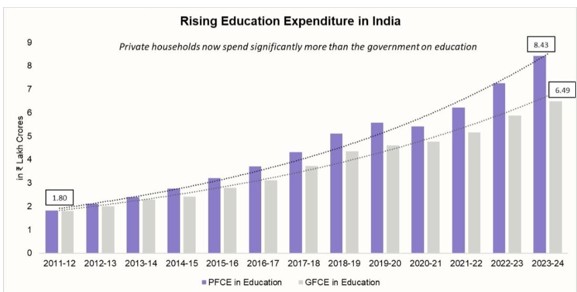
Source : MoSPI, 1 Finance Research
( Note: PFCE = Household spending on education (fees, books, coaching, etc.)
GFCE = Government spending on public education (schools, teachers, infrastructure)).
To operationalise the impact of these hikes, the framework categorises households into a Three-Tier Vulnerability Model:
Sustainable Engagement: Households in this tier absorb the 8% increase by utilising existing monthly surpluses. These families continue to enrol, but often experience a “lifestyle stagnation” where they cut discretionary spending on personal growth, travel or nutrition to pay for the higher tuition.
Consumption Displacement: At this level, the 8% increase causes a fundamental reallocation of the household budget. Families are forced to reallocate funds meant for critical long-term safety nets such as retirement corpus (EPF/PPF), life insurance premiums or emergency healthcare funds to meet immediate educational fees.
Distress Financing: This is the worst effect, where families move from savings-based financing to credit-based survival. Households in this tier rely on high-interest personal loans, credit card debt or the liquidation of long-term assets like gold or ancestral property to keep their children from dropping out or downshifting to lower-quality institutions.
The case study uses this tiered model to investigate the effect of 8 per cent annual growth rates, which double the cost of education every nine years, as a regressive economic force that compounds over a 12-year schooling cycle.
KEY FINDINGS
Applying the trend-and-compounding methodology described in Section 4, together with the vulnerability framework in Section 5, to the secondary data set yields five key findings regarding the financial burden experienced by middle-class families. The financial burden on middle-class families, driven by regular educational fee increments, has crossed a tipping point. The actual ‘Education Inflation’ in India, according to market research by Deb (2026), is closer to 10–12% annually, roughly twice the rate of general CPI inflation.
The ‘Education Inflation’ Gap
Outpacing Income: While average salary increments in India stand at 8% to 9%, education costs rise at 10-12%. This creates a ‘funding gap’ in which the cost of schooling and higher education takes up an increasingly larger portion of the household budget.
Compound Effect: At an 8-12% annual hike, the cost of education doubles every 6 to 7 years. The cost of a professional course, which is ₹10 lakh now, is likely to be close to ₹40–50 lakh by the time a child in primary school goes to college. (Motkuri & Revathi, 2024)
Disproportionate Household Expenditure
Budget Share: Many urban middle-class families now allocate 40 to 80 per cent of their annual income on the education of just one child.
Lifestyle Sacrifices: While families are increasingly cutting back on discretionary spending (vacations, dining, luxury goods), more importantly, families are diverting funds initially intended for retirement savings and health care to meet immediate school fee payments. (Motkuri & Revathi, 2024)
Increased Debt Dependency
Loans as Primary Funding: Education loans are no longer supplementary safety nets but can be considered primary funding mechanisms for higher education. Household Debt Explosion: Rising in fees has contributed to the ‘explosion’ in household debts as families take on personal loans or gold loans to cover the non-tuition fees costs like coaching, laptops, and transportation, which also experience annual inflation. (Tilak, 2020)
Psychological and Social Impact
Parental Stress – Studies show that constant fee increments (even at 8%) cause great psychological pressure and stress on parents, who are compelled to make a choice between ‘quality’ schooling for their child and the financial sanity of the family. ‘Informal’ Cost of Education: Apart from institutional charges, the middle class is also burdened by the ‘Shadow Education’ market (coaching and private tuitions), which has become a non-negotiable expense in the case of competitive exams, adding more layers to the financial burden. (Maity, 2025)
Shift to ‘Affordable’ Alternatives
Private to Public Migration: Parents are increasingly rushing to withdraw their children from high-end private schools and enrolling them in mid-tier or ‘budget’ private schools to cope with the more than 8% annual increments.
Delayed milestones: Young professionals are forced to delay certain vital milestones in life, such as purchasing a home or raising a family, due to the burden of repaying educational debts. (Lhungdim & Hangsing, 2021)
Read together, these five findings show that the burden documented above is not a collection of separate pressures but a single compounding mechanism: each additional year of fee inflation simultaneously widens the income-cost gap (Finding 1), raises the required budget share (Finding 2), deepens debt reliance (Finding 3), and intensifies the psychological and lifestyle adjustments (Findings 4-5).
DATA OVERVIEW – THE STATISTICAL REALITY OF EDUCATION INFLATION
Building on the qualitative findings above, this section quantifies the scale of the education-cost burden using national and sectoral data. For middle-income Indian families, the financial reality is a stark contrast between broad-based economic growth and the rising cost of specialised education. The national Consumer Price Index (CPI) in India is showing about 5% inflation overall, but education inflation has settled at 10%-12% in metros and Tier-2 cities. This results in a systematic “wage-price gap” where the 8% annual increase in institutional fees far exceeds the average increase in middle-class wages, which is 5-7% today. Indeed, the country’s household spending on education has jumped from ₹1.8 lakh crore in FY12 to an estimated ₹8.43 lakh crore in 2024 – a 4.6x jump, according to data from current fiscal reports (Ministry of Statistics and Programme Implementation, 2025). This trajectory shows that education is taking an increasing share of the disposable income of families, and this, in turn, reduces the overall financial resilience of households.
The burden of these increases falls mainly on the private unaided sector. Here, spending is nearly nine times higher than in government institutions. According to the Comprehensive Modular Survey on Education (2025), the average yearly cost for a student in a private institution is about ₹25,002, while it’s only ₹2,863 in government schools. For urban middle-income families, the basic cost is even greater. Average course fees are around ₹15,143, compared to ₹3,979 in rural areas. When an 8% E.Y. increase is added to these higher urban figures, the actual amount of the increase becomes a significant monthly expense. This pressure is further aggravated by “Shadow Education” or private coaching, which adds an average annual burden of ₹10,000 per student, making the advertised fee hike merely one component of a much larger out-of-pocket expenditure (OOPE).
The ongoing annual fee increases stem from major gaps in regulation and a lack of funding for public infrastructure. The National Education Policy (NEP) 2020 suggested raising public spending on education to 6% of GDP. However, current data from the 2026 PRS Legislative Research analysis shows that spending has hardly changed, remaining around 4.1%. This gap in funding pushes private institutions to depend heavily on student fees for their capital and operating costs. Some states have tried to introduce regulations, like the Delhi School Education (Transparency in Fixation and Regulation of Fees) Act, 2025, but there have been significant delays and legal issues in implementing these measures. This lack of action leaves middle-income families without a standard way to address complaints, forcing them to accept the 8% “Every Year” hike as an unavoidable part of achieving social mobility. (Choudhary et al., 2026)
DISCUSSION
Read alongside the quantitative picture established in the Data Overview above, the consistent 8 per cent rise in school tuition is creating a structural squeeze on middle-class families, and the architecture of family finances is changing. This issue transcends inflationary concerns, representing instead a systemic threat to the future prosperity and social mobility of the very class perceived as the driver of the economy. (Choudhury et al., 2023)
The Income and Aspiration Divide
At the core of this argument is the disparity between the sluggish real growth of salaries and the compounded increase in education expenses. An 8% hike may seem negligible in isolation, but over a student’s 15-year schooling career, its effect becomes astronomical. Middle-class incomes, which often merely keep pace with the Consumer Price Index, are dwarfed by the targeted rise in education expenses. This leads to an ‘aspiration tax,’ where families must shoulder increasingly greater burdens to attain the same standard of education as they had years prior. This pattern is consistent with the logic of the Permanent Income Hypothesis, which holds that households aim to smooth consumption according to expected long-run income rather than short-term earnings: because education costs are rising faster than the income households can reasonably expect over the long run, families increasingly borrow against future income to sustain present educational consumption, rather than consumption-smoothing working in their favour. (Tilak, 2018)
The Loss of Retirement and Resilience
Perhaps the most detrimental aspect is the reallocation of funds from long-term wealth accumulation toward immediate education spending. Middle-class families are forced to deplete their retirement accounts, borrow against their properties or discontinue pension contributions simply to meet tuition payments. This shifts the burden from the current generation to the next: parents enter their retirement years without an adequate financial cushion, while their children begin their careers indebted from the cost of their education. This is a direct illustration of Household Consumption Theory’s prediction that, when a rising and near-mandatory expenditure category crowds out a household budget, the reallocation falls first on the most deferrable categories of spending — in this case, long-term savings and insurance — rather than on the immediate expenditure itself. The contemporary ‘Siddharth-type’ middle-class family is characterised by asset ownership, particularly homes, but poor cash flow, and is highly susceptible to any adverse economic change. (Sarkar, 2017)
The Explosion of the ‘Shadow Education’ Economy
The 8% institutional cost hike does not paint the full picture. To compete in a saturated job market, middle-class families must invest in private tuition and specialised training as part of the ‘shadow education’ system. The overall expense for developing human capital becomes exorbitant when institutional hikes are factored in with the rising costs of these services. This in turn bifurcates the middle class: the affluent can afford a premium education, while the rest are relegated to less prestigious public schools with possibly lower quality of teaching. (McVey, 2012)
The Social and Demographic Transition
Lastly, these financial constraints are also a significant catalyst for social and demographic change. Higher education expenses contribute to the falling fertility rates among urban middle-class families, leading to a shift toward having only one child. Graduates are pushed toward ‘secure’ corporate jobs to pay off their loans, sacrificing the risk-taking and entrepreneurship that characterise a dynamic economy. Ultimately, the 8% annual education fee hike will foster a ‘hollowed-out’ middle class. Without regulations that cap tuition hikes or substantial investment in affordable, quality public education, the middle class may face a future of debt, diminishing savings, and undue reliance on a system that is currently draining their resources. (Nambissan, 2010)
Read alongside the conceptual framework in Section 5 and the theoretical grounding in Section 3, these four dimensions indicate that the 8% annual fee increase functions less as an isolated price signal and more as a structural variable that reshapes household investment and consumption decisions across the life-cycle.
Policy Implications
Based on the findings above, three evidence-based policy directions emerge. First, fee-regulation mechanisms such as the Delhi School Education (Transparency in Fixation and Regulation of Fees) Act, 2025, need faster and more consistent implementation across states, since the Data Overview above shows that regulatory delay is a key reason the 8% annual increase continues largely unchecked. Second, raising public expenditure on education toward the NEP 2020 target of 6% of GDP — rather than remaining near the 4.1% reported in the 2026 PRS Legislative Research analysis — would reduce private institutions’ dependence on fee revenue as their primary funding source. Third, targeted income-linked fee-support instruments, such as tiered fee caps or education-cost-indexed savings schemes, could directly address the income-cost gap identified in Finding 1, without requiring wholesale restructuring of the private education sector. The limitations of the present analysis, which qualify how far these recommendations can be generalised, are set out in Section 10.
CONCLUSION
The “accelerating 8% year-on-year jump” has ceased to be an inflationary issue and has become a “structural constraint to the middle-class standard of living”. According to the findings, education has become the latest engine of wealth destruction rather than wealth creation.
Currently, the middle-class is being “squeezed” with children, working adults sacrificing pension/old age security and paying off high-interest debt, with children having fewer options. The middle class is forced to use the following approach:
Generation A (parents) run down all their savings to pay for education.
Generation B (students) work with debts or no family “security” net.
The economy declines because entrepreneurship and discretionary spending fall as too many households are spending too much on debt servicing.
Finally, it would seem that this 8% hike is just “an inflexion point”. If there is no public policy intervention, such as controlling education prices or reinventing a strong quality public education system, then the middle-class will increasingly be an “asset-rich but cash-poor” group unable to benefit from their present wealth, just because it has to be used to purchase their future. The demographic dividend has more to do with the “affordability” of education.
LIMITATIONS AND SCOPE FOR FUTURE RESEARCH
This research has some specific limitations. Initially, it depends mainly on secondary data and previous research, which might not completely reflect the variety of experiences among various regions and socio-economic categories. Although national data offers a general perspective, discrepancies in fee structures between institutions and states may not be completely captured.
Secondly, the analysis presumes a consistent annual fee increase of 8%, while in practice, fee increases can differ greatly among institutions and educational levels. Furthermore, the research fails to fully consider indirect or concealed expenses like private tutoring, online learning resources, and extracurricular programs, all of which add to the total financial strain.
A further limitation is the dependence on combined household data, which might not accurately capture individual financial behaviours or decision-making processes. The lack of extensive primary data related to educational spending limits the thoroughness of the analysis.
Subsequent studies can tackle these constraints by performing extensive primary surveys that concentrate on educational costs among various income brackets. Longitudinal research following households over time would offer a greater understanding of the cumulative effects of increased fees. Additional studies may also analyse state-level regulations related to fee hikes to evaluate their efficacy.
Moreover, comparative analyses of public and private education systems can reveal structural disparities in cost and access. Investigating different models like digital learning and public-private partnerships could provide policy options to lessen the financial strain on middle-class households.
In general, broadening the empirical foundation and including policy assessment will be crucial for creating more efficient and fair methods of addressing increasing educational expenses.
REFERENCES
Tilak, J. B. G. (1994). Analysis of Costs of Education in India. Occasional Paper No. 10. National Institute of Educational Planning and Administration (NIEPA).NUEPA Occasional Paper No-10-Analysis of Costs of Education in India_RS_No Acc.pdf
Jha, S., et al. (2025). Impact of Inflation on Government and Private Schools and College Operational Costs.DOC-20251216-WA0004_TKeZIXf.pdf
Srivastava, N. (2024). The Effect of Rising Cost of Living on the Expenditure Behaviour of Middle-Income Families.55480.pdf
Saini, A., Goyel, S., & Malik, P. (2025). Rising Inflation and its Impact on Cost of Living among Middle-Class Families in India. International Journal of Innovative Research in Technology (IJIRT).IJIRT186178_PAPER.pdf
Psacharopoulos, G., & Patrinos *, H. A. (2004). Returns to investment in education: a further update. Education Economics, 12(2), 111–134. https://doi.org/10.1080/0964529042000239140
Reserve Bank of India (RBI). (2023). Handbook of Statistics on Indian Economy. Handbook of Statistics on Indian Economy – Reserve Bank of India
National Sample Survey Office (NSSO). (2018). Household Social Consumption on Education in India. Ministry of Statistics and Programme Implementation, Government of India. Key Indicators of Household Social Consumption on Education In India NSS 75TH Round (JULY 2017- JUNE 2018)
Government of India. (2020). National Education Policy (NEP) 2020. Ministry of Education.NEP_2020.pdf
Kotak Mutual Fund. (2026). Education inflation in India: Why costs rise faster than income. Education Inflation in India: Why Costs Rise Faster Than Income
Ministry of Statistics and Programme Implementation. (2025). publications_reports1757588642898_9ba30fe0-3677-478c-8d53-9a0d2ba107f0_CMS_E_2025L.pdf
PRS Legislative Research. (2026). Demand for grants analysis 2026-27:Demand for Grants 2026-27 Analysis – Education
School Serv. (2026). Analysis of Delhi fee regulation act.bill03.pdf
Frontiers in Public Health. (2026). Socioeconomic impact of out-of-pocket expenditure on education. https://www.frontiersin.org/journals/public-health/articles/10.3389/fpubh.2026.1762886/full
Choudhury, P. K., Joshi, R., & Kumar, A. (2023). Regional and socioeconomic inequalities in access to pre-primary education in India: evidence from a recent household survey. International Journal of Child Care and Education Policy/International Journal of Child Care and Education, 17(1), 13. https://doi.org/10.1186/s40723-023-00117-4
Deb, S. (2026). Impact of inflation on the Middle-Class Families. SSRN Electronic Journal. https://doi.org/10.2139/ssrn.6149055
Lhungdim, M. L., & Hangsing, E. (2021). Privatization of school Education: Problems and Prospects. Shanlax International Journal of Education, 9(3), 261–267. https://doi.org/10.34293/education.v9i3.3897
Maity, A. (2025). Effect of parental pressure on academic stress mediated by test anxiety of college students. The International Journal of Indian Psychology. https://doi.org/10.25215/1302.225
McVey, M. (2012). Shadow education: Private supplementary tutoring and its implications for policy makers in Asia. International Review of Education, 58(6), 809–811. https://doi.org/10.1007/s11159-012-9324-2
Motkuri, V., & Revathi, E. (2024). Private and public expenditure on education in India. Indian Public Policy Review, 5(1 (Jan-Feb)), 90–112. https://doi.org/10.55763/ippr.2024.05.01.002
Nambissan, G. B. (2010). The global economic crisis, poverty and education: a perspective from India. Journal of Education Policy, 25(6), 729–737. https://doi.org/10.1080/02680939.2010.508180
Sarkar, N. (2017). DETERMINANTS OF HOUSEHOLD EXPENDITURE ON HIGHER EDUCATION IN INDIA. International Education and Research Journal, 3(6). http://ierj.in/journal/index.php/ierj/article/view/1120
Tilak, J. B. G. (2018). Private Higher Education in India. In Private Higher Education in India (pp. 535–551). https://doi.org/10.1007/978-981-13-0250-3_18
Tilak, J. B. G. (2020). How Do Students Fund their Higher Education in India? A Study of Loan Financing in Engineering Education. Journal of Higher Education Policy and Leadership Studies, 1(1), 4–24. https://doi.org/10.29252/johepal.1.1.4
[1]Acknowledgement: The author(s) gratefully acknowledge Debarpita Das, Krishma and Isha Roy for their valuable contributions and assistance in the writing of this research paper.