Authors: Anshika Tiwari, Akanksha Raj, Tejas Navale, Ayushi
Abstract
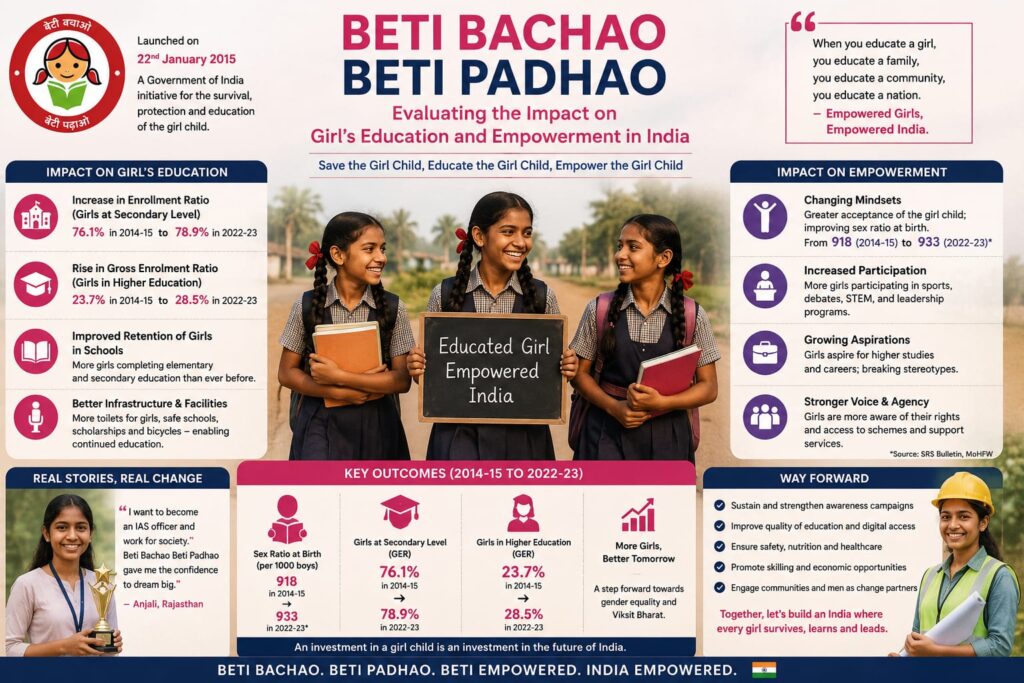
This research investigates the effects of the Beti Bachao Beti Padhao program on crucial measures of gender parity within India, specifically focusing on the child sex ratio at birth, female education levels, female literacy rates, and women’s participation in the workforce.
Initiated in 2015, the program’s primary objective is to combat gender-based discrimination and foster the empowerment of girls.
Introduction
“No country can ever truly flourish if it stifles the potential of its women and deprives itself of the contributions of half its citizens.”
Michelle Obama
India is a country full of contradictions. A country where males enjoy full freedom and opportunities to leverage their skills and talents; females, on the other hand, are still struggling to meet the basic amenities of life—an equal opportunity to education and employment. India has long placed girls at a severe disadvantage through rigorous social norms, and after centuries of all these discriminations, it is obvious that India presents a grim picture when it comes to gender equality.
It was against this backdrop that the Government of India launched the Beti Bachao, Beti Padhao (BBBP) scheme in January 2015, targeting districts with the lowest child sex ratio (CSR). However, almost a decade after successfully running one of India’s most crucial gender intervention schemes, the critical question remains: has the scheme been successfully able to meet its ambitious objectives and measurable goals in girls’ education and empowerment across India?
The recent studies and research papers on gender welfare programs often indicate a mixed bag of success and failure. On the one hand, the government bases its success on metrics such as the increased national sex ratio at birth and the rise of the Gross Enrolment Ratio (GER) for girls in secondary education; reality shows otherwise. In rural areas, the policy still faces numerous problems, often due to the gap between the policy intent and ground-level impact, such as inadequate implementation, lack of community engagement, and insufficient resources allocated for education and welfare programs.
Our research paper seeks to evaluate the impact of the Beti Bachao, Beti Padhao scheme on girls’ education and empowerment in India. Based on government reports, district-level data, academic literature, and field studies, the paper examines whether BBBP has been able to create structural and behavioural change in its population or if it just remained a mere campaign of visibility without specific outcomes.
Research Objectives
1.To analyse the impact of the Beti Bachao Beti Padhao (BBBP) scheme on the improvement of the Child Sex Ratio at Birth in India.
2.To evaluate the changes in girls’ enrolment and access to education following the implementation of the BBBP scheme.
3.To investigate female labour force participation as an indicator of women’s economic empowerment.
4.To examine regional disparities in the implementation and outcomes of the BBBP scheme across different states and Union Territories.
5.To critically assess whether the BBBP scheme has led to structural transformation in gender equality or primarily remained a symbolic policy intervention.
Literature Review
Historical Context: Gender Discrimination and the Girl Child in India
WOMEN ARE NOT BORN, THEY ARE MADE: SIMON DE BEAUVOIR.
Amartya Sen’s concept of “missing women” highlights structural gender inequality in areas such as education, economy, and political participation.
Historical trends highlights a decline in women’s status due to patriarchal structures and exclusion from economic and social rights.
Some scholars argue that social institutions, including religion, reinforce gender hierarchies.
The Son Meta Preference
Son preference reflects deeply rooted gender discrimination and socio-cultural norms in India. This is driven by socio-economic and cultural expectations associated with male children. This contributes to an imbalanced sex ratio in India.
Girls continue to face barriers such as poverty, socio-cultural norms, and safety concerns.
Policy Framework, Design, and Implementation of BBBP
Initially, the BBBP scheme targeted districts with low child sex ratio and later expanded nationwide. Studies suggest that the scheme adopted a data-driven approach targeting gender-backward regions.
However, the scheme has faced challenges in its implementation. Reports indicate that a large share of funds was spent on media campaigns rather than direct intervention.
Fund utilisation remained low in several states, indicating implementation gaps. Audit reports highlight issues such as weak monitoring, poor coordination, and inadequate documentation.
Studies suggest that BBBP outcomes depend significantly on administrative capacity at the district level. States with stronger infrastructure show better outcomes compared to weaker regions. The literature highlights strong policy design but weak implementation.
States with better performance tend to have stronger institutional frameworks and higher awareness levels, whereas weaker-performing states continue to face challenges due to socio-economic conditions and entrenched gender norms.
This suggests that policy interventions alone are insufficient without addressing deeper social and economic barriers.
Impact on Girls’ Education and Empowerment
Despite progress in development, gender disparities in education and opportunities persist in India. Girls continue to face barriers such as socio-cultural norms, inadequate infrastructure, and safety concerns. The Beti Bachao Beti Padhao scheme was introduced to promote girls’ education and empowerment.
Studies suggest that awareness initiatives have contributed to improving attitudes towards girls’ education. Enrolment rates have increased to around 77–78%, dropout rates have declined, and school infrastructure has improved, reflecting progress in girls’ education. Now women make up 54.2% of teachers. Overall, literacy levels among women have improved, indicating positive trends in education.
State-Wise Comparative Analysis of BBBP Outcomes
States such as Haryana and Uttar Pradesh show improvement in sex ratio trends over time. However, fund utilisation remained low in some states. This indicates inefficiencies in fund utilisation, which may limit the overall effectiveness of the scheme despite the availability of financial resources.
States such as Bihar and Karnataka show weaker performance in sex ratio trends. At the national level, improvements in sex ratio, education, and institutional deliveries indicate progress, although disparities remain. Awareness campaigns have contributed to changing social attitudes towards girls. These initiatives have supported greater participation of women in society.
This reflects that the BBBP scheme has had a positive yet limited impact, with outcomes varying significantly across regions.
Research Gaps
Analysis of the scheme at the national level.
Financial utilization and budget efficiency on creating the real time impact- digital and media influence gap.
Checking and knowing the grassroot reality rather than just relying on the data part?
Why are few states outperforming other underperforming states? BBBP and honour killing after educating them for having their own Voice- Haryana father killing daughter for being the breadwinner and independent in 2025.
Can we still call it a national success, are we able to change the son meta preference mindset completely in 11 years?
Intersectionality gap (caste, class, religion, persons with disabilities) infrastructure and school environment studies.
Has it helped women and girl children to attain financial stability and have decision making power in family and society?
Methodology
In our research paper, we primarily relied on a descriptive and evaluative research method to understand the impact of the Beti Bachao, Beti Padhao (BBBP) scheme on girls’ education and empowerment in India.
Nature of the Study
The study primarily relies on secondary data, mainly from government reports rather than exclusive fieldwork and surveys. This approach is justified on the grounds that:
BBBP, a national-level scheme, necessitates macro-level data that primary research cannot accurately collect. Existing government data is sufficient enough to understand.
This method allowed us to compare the implementation of the scheme at the state level and to find out its success parameters.
Sources of Data Government Sources
Ministry of Women and Child Development Annual Reports
Census of India
National Family Health Survey (NFHS)
Parliamentary Committee Reports
Press Information Bureau (PIB)
Academic Sources
Peer-reviewed journal articles
Research papers from think tanks such as Observer Research Foundation and International Center for Research on Women
News reports and articles
Variables and Indicators
To evaluate BBBP’s impact comprehensively, the study examines the following key variables:
Child Sex Ratio (CSR) at birth
Girls’ Enrolment in Education
Female Workforce Participation
Female literacy rates
Justification of the Study
Given the complex and multidimensional nature of the topic, we preferred a mixed-method research approach, with both quantitative secondary data and qualitative analysis such as government reports, peer-reviewed articles, and academic literature ensures validity and reliability of data.
This method is most appropriate, as it allows for both measurement of outcomes and critical interpretation of processes and contexts.
It also reduces the risk of bias, reporting errors, or data manipulation, which may affect the findings of the study.
Limitations of the Study
The primary constraint in our research is the difficulty in differentiating between BBBP’s impact on girls’ education and empowerment in a country from other successful schemes such as Sarva Shiksha Abhiyan, the Midday Meal Scheme, and state-level gender initiatives.
As we relied on government reports for data accuracy, our research paper may be subjected to reporting bias and may not accurately reflect current ground realities.
As we mainly focused our research on state and national levels, our research may lack the depth and understanding of problems in remote areas of the country.
Further, it also measures success from the scheme’s implementation point of view and may not include the contribution of other state actors such as strong community support, the help of NGOs, the level of awareness among the community, etc.
As the national-level data are too big to analyze within the given time frame, our research can also miss some other successful case studies.
Theory Integration
The findings of the Beti Bachao Beti Padhao (BBBP) scheme can be interpreted through established gender and development theories. Simone de Beauvoir highlights that gender roles are socially constructed, which explains the persistence of son preference despite policy interventions. This is reflected in the inconsistent improvements in gender-related indicators across states.
Similarly, Amartya Sen concept of “missing women” explains structural gender inequalities that result in skewed sex ratios and unequal access to opportunities. This is evident in the regional disparities observed in BBBP outcomes.
Overall, these theories suggest that while BBBP has improved awareness and produced incremental progress, deep-rooted socio-cultural and structural barriers continue to limit its transformative impact.
Results/Findings
This section highlights the key findings based on the collected data related to indicators such as Child sex ratio, girls’ education, literacy and female workforce Participation.
Sex Ratio at Birth Table 1
State-wise Child Sex Ratio at Birth Before and After the Launch of Beti Bachao Beti Padhao (2015)
State / Union Territory
2014–15
2023–24
A & N Islands
967
874
Andhra Pradesh
921
930
Arunachal Pradesh
916
939
Assam
920
894
Bihar
936
901
Chandigarh
—
832
Chhattisgarh
962
944
Dadra & Nagar Haveli
929
971
Daman & Diu
915
951
Delhi
924
882
Goa
939
916
Gujarat
901
965
Haryana
876
918
Himachal Pradesh
897
977
Jammu & Kashmir
936
925
Jharkhand
920
917
Karnataka
945
930
Kerala
959
955
Lakshadweep
1000
931
Ladakh
—
945
Madhya Pradesh
926
962
Maharashtra
920
831
Manipur
933
929
Meghalaya
938
946
Mizoram
971
964
Nagaland
948
919
Odisha
948
926
Puducherry
916
960
Punjab
892
924
Rajasthan
929
941
Sikkim
957
949
Tamil Nadu
917
939
Telangana
925
917
Tripura
958
973
Uttar Pradesh
885
936
Key Findings
National Average- Sex ratio at birth increased from 918 in 2014-2015 to around 930 in 2023-2024.
State Performance- The best three performing states in SRB by the implementation of BBBP are Arunachal Pradesh (1,085), Nagaland (1,007), and Mizoram (971), while the three worst performing states are Jharkhand (899), Bihar (900), and Haryana (910).
This suggests that while there has been a gradual improvement in the child sex ratio at birth, the progress remains inconsistent across states, indicating differences in implementation and persistent socio-cultural biases.
Girls’ Enrolment in Education Table 2
State-wise Girls’ Enrolment in Education Before and After the Launch of Beti Bachao Beti Padhao (2015)
State / Union Territory
2014–15
2023–24
A & N Islands
89.68
96.3
Andhra Pradesh
71.63
94.8
Arunachal Pradesh
73.93
70.5
Assam
74.95
85.5
Bihar
61.47
48.3
Chandigarh
92.64
118.3
Chhattisgarh
92.4
79.7
Dadra and Nagar Haveli
84.22
114.1
Daman and Diu
92.58
114.1
Delhi
99.13
105.4
Goa
103.42
110.8
Gujarat
64.33
72.5
Haryana
79.86
89
Himachal Pradesh
104.61
102.1
Jammu and Kashmir
62.03
66.3
Jharkhand
67.36
64.7
Karnataka
78.19
101.7
Kerala
102.67
99.1
Ladakh
NA
96.9
Lakshadweep
125.74
74.4
Madhya Pradesh
76.92
66.4
Maharashtra
84.73
92.1
Manipur
69.25
77.6
Meghalaya
76.1
96.7
Mizoram
92.9
103.7
Nagaland
57.59
65.2
Odisha
75.03
82.6
Puducherry
102.97
102.5
Punjab
83.21
94.2
Rajasthan
65.35
79
Sikkim
102.19
75.9
Tamil Nadu
93.82
98.1
Telangana
78.58
98.7
Tripura
107.11
82.6
Uttar Pradesh
69
62.4
Uttarakhand
91.56
95.6
West Bengal
82.95
104.2
Key Findings
National Average – Girls’ enrolment in secondary education increased from 75.5% in 2014–15 to around 77–78% in 2023-24.
State Performance- The best three performing states in GER by the implementation of BBBP are Kerala (91.7%), Chhattisgarh (90.1%), and Himachal Pradesh (84.7%), while the three worst performing states are Rajasthan (72.1%), Gujarat (73.4%), and Jharkhand (75%).
The variation in performance across states can be attributed to differences in governance quality, literacy levels, public awareness, and socio-economic conditions.
Female Workforce Participation Table 3
State-wise Female Workforce Participation Before and After the launch of Beti Bachao Beti Padhao (2015)
State / Union Territory
Female LFPR% 2017–18
2023–24
A & N Islands
20.4
33.2
Andhra Pradesh
42
50.2
Arunachal Pradesh
35.8
49.9
Assam
12
36.8
Bihar
4.4
20.3
Chandigarh
21
28.5
Chhattisgarh
42.1
63.8
Dadra & Nagar Haveli
18.2
29.4
Daman & Diu
18.2
29.4
Delhi
15
25.1
Goa
24.3
43.4
Gujarat
18
39.4
Haryana
13.9
28.7
Himachal Pradesh
47.4
67.6
Jammu & Kashmir
26.3
49.3
Jharkhand
15.1
43.1
Karnataka
23.3
41.7
Kerala
24.3
43.4
Ladakh
42.5
58.6
Lakshadweep
17.5
24.2
Madhya Pradesh
21
44.5
Maharashtra
25.5
44.8
Manipur
29.5
42.3
Meghalaya
41.8
71.8
Mizoram
39.2
55.4
Nagaland
30.2
48.6
Odisha
22.8
51.5
Puducherry
18.2
26.4
Punjab
17.5
30.6
Rajasthan
22.8
50.1
Sikkim
39.5
68.2
Tamil Nadu
33.4
48.9
Telangana
32.2
47.8
Tripura
18.2
34.1
Uttar Pradesh
14.1
34
Uttarakhand
23.5
39.4
West Bengal
19.8
32
Key Findings
National Average – Female Workforce Participation increased from 25.8% in 2014-15 to 41.7% in 2023-24.
State Performance- The best three performing states in LFPR by the implementation of BBBP are Meghalaya (71.8%), Sikkim (68.2%), and Himachal Pradesh (67.6%), while the three worst are Bihar (13%), Delhi (18.5%), and Haryana (24.2%).
This reflects that educational advancements do not always translate into economic empowerment, indicating a gap between access to education and actual employment opportunities for women.
Female Literacy Rate Table 4
State-wise Female Literacy Rate Before and After the Launch of Beti Bachao Beti Padhao (2015)
State / Union Territory
2011 Census
2023–24
A & N Islands
82.4
88.5
Andhra Pradesh
59.1
68.6
Arunachal Pradesh
57.7
71.2
Assam
66.3
78.4
Bihar
51.5
66.8
Chandigarh
81.2
87.4
Chhattisgarh
60.2
72.4
Dadra & Nagar Haveli
64.3
76.8
Daman & Diu
64.3
76.8
Delhi
80.8
87.3
Goa
84.7
91.2
Gujarat
69.7
78.5
Haryana
65.9
77.2
Himachal Pradesh
75.9
84.5
Jammu & Kashmir
56.4
69.1
Jharkhand
55.4
70.3
Karnataka
68.1
78.2
Kerala
92.1
97.5
Ladakh
50.6
73.4
Lakshadweep
87.9
93.4
Madhya Pradesh
59.2
71.5
Maharashtra
75.9
84.8
Manipur
70.3
79.8
Meghalaya
72.9
81.4
Mizoram
89.3
94.6
Nagaland
76.1
83.5
Odisha
64.0
76.5
Puducherry
80.7
87.5
Punjab
70.7
81.3
Rajasthan
52.1
68.4
Sikkim
75.6
84.2
Tamil Nadu
73.4
82.5
Telangana
57.9
69.8
Tripura
82.7
89.4
Uttar Pradesh
57.2
70.1
Uttarakhand
70.0
81.4
West Bengal
70.5
80.2
Key Findings
National Average – Female Literacy Rate increased from 65.46% in 2011 Census to 74.6% in 2023-24.
State Performance – The best three performing states in FLR by the implementation of BBBP are Mizoram (97%), Kerala (94%), and Lakshadweep (93.8%), while the three worst are Rajasthan (65.8%), Bihar (66.1%), and Madhya Pradesh (67%).
This highlights that although girls’ participation in education has increased, the rate of improvement is moderate, suggesting that structural barriers such as poverty, early marriage, and gender norms continue to affect outcomes.
Table 1:-The scheme is high on coherence with other schemes such as
Sector
Partner scheme
Convergence point
Stakeholder Impact
Education
Samagra Shiksha Abhiyan
Focusing on “Beti Padhao” by improving secondary school enrolment and providing good infrastructure.
Reduces dropout rates among girls.
Health
National Health Mission
Monitoring Sex Ratio at Birth and promoting institutional deliveries to ensure survival.
Ensures safer childbirth
Nutrition
Pradhan Mantri Matru Vandana Yojna
Providing cash
incentives for
pregnant and lactating mothers for the first living child.
Ensures better health and nutrition during pregnancy.
Financial security
Sukanya Samridhhi Yojna
Encouraging parents to open dedicated savings accounts for the girl child’s future
Encourages long term financial planning for daughters.
education and marriage.
Safety and support
One Stop Center
Providing integrated support for women and girls affected by violence.
Strengthens the environment for females
Best performance states
Graph 1: The improvement in Haryana state after Beti Bachao Beti Padhao
According to the graph Haryana’s annual sex ratio at birth and the number of girls born per 1,000 boys, rose to 923 in 2025. The improvement comes after the ratio fell to 910 last year, its lowest since 2014
Graph 2:- It shows comparison between best performance state in BBBP programme
According to this graph UP first fell from 940 in 2020-21 to 939 in 2021-22 but then improved to 944 in 2022-23. In Assam, it rose from 942 in 2020-21 to 944 in 2021-22, and then further rose to 951 in 2022-23.
In Rajasthan, the sex ratio (946) remained the same in all three years.
In India, the Beti Bachao, Beti Padhao (BBBP) program seeks to address gender-based issues, specifically the falling child sex ratio and encouraging girls’ education. Effective BBBP implementation presents difficulties in a number of regions. Sociocultural norms that prioritize male children are common in rural areas, which can result in discriminatory practices like female feticide and disregard for the education of girls. Historically, deeply ingrained patriarchal attitudes have caused states like Rajasthan and Haryana to struggle. Furthermore, it is difficult to give girls in economically disadvantaged areas equal opportunities. The persistence of gender disparities is attributed to a number of factors, including inadequate infrastructure, inadequate educational resources, and low awareness.
Funds Allocation in different state
Graph 3:- shows the funds allocation and utilization in different state
For instance, in 2020–21, Haryana utilised only Rs 142.26 lakh of the Rs 249.83 lakh, and in 2021–22, it used only Rs 27.09 lakh of the Rs 162.8 lakh it received.
On the other hand, Uttar Pradesh utilised Rs 742.60 lakh in 2020–21 even when Rs 577.95 lakh was released under the scheme, but in 2021–22, it used only Rs 162.89 lakh of the Rs 1,499.45 lakh that was allocated.
Graph 4:- shows the worst performing state in sex ratio trends
According to the graph:
Bihar saw a decline from 917 in 2020–21 to 915 in 2021–22, and then fell to 895 in 2022–23. Chandigarh, too, registered a steep fall. It first rose from 935 in 2020–21 to 941 in 2021–22, and then down to 902 in 2022–23.
In Karnataka, the sex ratio fell from 949 in 2020–21 to 940 in 2021–22, but there was a slight recovery in 2022–23 when it marginally rose to 945.
The sex ratio in West Bengal fell from 949 in 2020–21 to 943 in 2021–22 and then to 932 in 2022–23, said the government data.
State/UT
2020-21
2021-22
2022-23
Net Change
Bihar
917
915
895
-22
Chandigarh
935
941
902
-33
West Bengal
949
943
932
-17
Karnataka
949
940
945
-4
Nationwide outcomes
Graph 5:- Indicate improvement in girls scenario after BBBP programme
Graph 6:- Indicate the improvement in national progress indicators under Beti Bachao Beti Padhao:-
Graph 5 and graph 6 shows national progress indicators
Improvement in Sex Ratio at Birth.
Increase in Girl’s Enrolment in Secondary Education.
Increased Institutional Deliveries.
Impact Analysis of Beti Bachao Beti Padhao (BBBP) in India
We are looking at how the BBBP scheme is working in India. The scheme aims to improve the following:
Sex Ratio at Birth (SRB)
Girls’ Enrolment in Education
Female Workforce Participation
Female Literacy and Social Empowerment
We compare data from states and over time to see where things are getting better staying the same or getting worse.
Sex Ratio at Birth Trends
The Sex Ratio at Birth (SRB) is an indicator of the schemes success. The national average SRB improved from 918 in 2014-15 to 930 in 2023-24.
Some states have done well. For instance:
Arunachal Pradesh
Assam
Haryana
Uttar Pradesh
However, some states are still struggling:
Bihar
Nagaland
Odisha
Maharashtra
Girls’ Enrolment in Education
The data shows that girls’ enrollment in education increased from 75.5% in 2014-15 to 77-78% in 2023-24.
Some states have made the progress: Karnataka
Telangana
Delhi
Meghalaya
However. some states are still facing challenges:
Bihar
Madhya Pradesh
Jharkhand
In these regions, economic challenges, early marriage, and limited educational resources continue to affect girls’ schooling.
Female Workforce Participation
The Female Labour Force Participation Rate increased from 25.8% to 41.7% between 2017-18 and 2023-24.
Meghalaya
Sikkim
Himachal Pradesh
Chhattisgarh
However, some states still show relatively low participation levels: Bihar
Delhi
Haryana
These patterns reflect issues such as limited job opportunities, safety concerns, and social restrictions on women’s employment.
Women’s Empowerment and Social Impact
Increased Awareness: Public campaigns under BBBP have helped promote the importance of educating girls and protecting their rights.
Institutional Support: The programme works with schemes such as Samagra Shiksha Abhiyan, National Health Mission and Sukanya Samriddhi Yojana to improve girls’ health, education and financial security.
Changing Social Attitudes: In states that historically showed gender bias, the gradual improvement in SRB suggests slow but visible changes in community perceptions regarding the value of daughters.
This suggests that the scheme has been relatively more effective in raising awareness and influencing attitudes, rather than achieving deep structural changes in gender equality.
Non-Performing States
Despite overall progress, certain states continue to face challenges. States showing weaker performance include:
Bihar
Odisha
Nagaland
Maharashtra
These regions display declining or stagnant trends in some indicators, highlighting the need for:
stronger awareness campaigns improved education infrastructure
better monitoring of scheme implementation
targeted policy interventions
Table 2
Year-wise comparison of worst performing states in sex ratio
State / UT
2020–21
2021–22
2022–23
Net Change
Bihar
917
915
895
-22
Chandigarh
935
941
902
-33
West Bengal
949
943
932
-17
Karnataka
949
940
945
-4
Way Forward
The focus must shift from awareness campaigns to long-term behavioural change for the BBBP scheme to achieve greater impact.
Strengthening implementation is essential to ensure that the BBBP scheme achieves its intended impact. This requires better coordination, improved monitoring, and accountability in execution.
In addition, addressing socio-cultural barriers such as patriarchal norms, early marriage, and gender discrimination is crucial for long-term impact. Awareness efforts must be supported by structural improvements in education and employment.
Conclusion
The Beti Bachao Beti Padhao (BBBP) scheme has demonstrated measurable improvements in key indicators such as the Child Sex Ratio at Birth, girls’ education, and female workforce participation. These changes indicate that the scheme has played a positive role in generating awareness and improving gender related outcomes.
However, the impact of the scheme remains uneven across different states, reflecting variations in implementation efficiency, socio-economic conditions, and existing gender norms. In several regions, deep-rooted structural barriers such as patriarchal attitudes and institutional limitations continue to restrict long-term progress.
The findings of this study suggest that while BBBP has been effective in improving awareness and producing incremental changes, it has not yet achieved comprehensive structural transformation in gender equality. Therefore, sustained policy focus, stronger implementation mechanisms, and broader socio-cultural change are necessary for achieving long-term and inclusive gender empowerment in India.
References / Bibliography
Beauvoir, S. de. (1949). The second sex. Vintage Books. https://newuniversityinexileconsortium.org/wpcontent/uploads/2021/07/Simone-de-Beauvoir-The-Second-Sex-Jonathan-Cape-1956.pdf
Comptroller and Auditor General of India. (2018). Performance audit report on Beti Bachao Beti Padhao. https://cag.gov.in/uploads/performance_activity_report/PerformanceActivityReport-05de8a51fafd2d4-68138515.pdf
Health Policy and Planning. (2021). Impact of Beti Bachao Beti Padhao on gender outcomes. https://academic.oup.com/heapol/article/36/10/1499/6368532
Holm, J. (1994). Women in religion. Continuum. https://www.perlego.com/book/394185/women-in-religion-pdf
Kaur, R. (2017). Sex ratio at birth: The role of gender, class and education. United Nations Population Fund. https://www.researchgate.net/publication/353220556
Mathur, K. (2019). Women’s empowerment through state benevolence. Economic and Political Weekly.
Ministry of Education, Government of India. (n.d.). Unified District Information System for Education Plus (UDISE+). https://udiseplus.gov.in
Ministry of Health and Family Welfare, Government of India. (n.d.). Health Management Information System (HMIS) portal. https://www.hmis.moh.in
Ministry of Statistics and Programme Implementation (MoSPI), Government of India. (n.d.).
Periodic Labour Force Survey (PLFS) annual reports. https://mospi.gov.in
Ministry of Women and Child Development, Government of India. (2020). Annual report 2019–20.
Parliamentary Standing Committee. (n.d.). Empowerment of women through education with special reference to Beti Bachao Beti Padhao scheme. https://eparlib.sansad.in/bitstream/123456789/931997/1/17_Empowerment_of_Women_6.pdf
Press Information Bureau, Government of India. (2021). Beti Bachao Beti Padhao: Progress report. https://www.pib.gov.in/PressReleasePage.aspx?PRID=2222995
Press Information Bureau, Government of India. (2021). Government initiatives for girl child welfare. https://www.pib.gov.in/PressReleaseIframePage.aspx?PRID=1695199
PubMed. (2021). Study on Beti Bachao Beti Padhao and gender outcomes. https://pubmed.ncbi.nlm.nih.gov/34508362/
Sen, A. (1990). More than 100 million women are missing. The New York Review of Books,37(20), 61–66. https://www.researchgate.net/publication/24085657
Times of India. (2017). Beti Bachao Beti Padhao leads to improvement in sex ratio at birth. https://timesofindia.indiatimes.com/centre/beti-bachao-beti-padhao-leads-to-improvement-in-sex-ratio-at-birth/articleshow/60999081.cms
World Bank. (n.d.). Girls’ education: Global data and statistics. https://www.worldbank.org/en/topic/girlseducation
Women and Child Development Department, Haryana. (n.d.). Beti Bachao Beti Padhao scheme details. https://wcdhry.gov.in/schemes-for-women/beti-bachao-beti-padhao
Government of India. (n.d.). Beti Bachao Beti Padhao – PM India portal. https://www.pmindia.gov.in/en/government_tr_rec/beti-bachao-beti-padhao-caring-for-the-girl-child/
McGraw Hill Education. (n.d.). Courseware on Indian history. https://edge.mheducation.co.in/course/Indian-History-UPSC-118