
Authors: Tavraiz Sheikh, Arushi Pathania, Tanishka Israni, Ajah Precious Ezinne, Panishthi Mishra, Prishita Majumder, Mongal Dep Dey, Aarav Sachdeva
Abstract
This study examines whether voting alignment in the United Nations General Assembly reflects fixed geopolitical alliances or issue-specific coalitions that shift depending on the resolution at hand. Using roll-call voting records from Sessions 71 to 79 (2016-2025), the analysis applies social network analysis and the Louvain community detection algorithm to four voting networks: an aggregate network covering all resolutions, and three issue-specific networks addressing Russia-Ukraine, Gaza and Palestine, and Climate and Development resolutions. Pairwise voting agreement scores were calculated for every pair of states, and links below a 0.70 threshold were removed before community detection was applied. The Aggregate network produced a recognizable but weakly separated division, below the 0.3 reference threshold. Ukraine produced by far the strongest community structure, well above threshold, while Gaza showed broad consensus and weak bloc formation, with Climate and Development falling between the two. Among the G4, Germany and Japan clustered together throughout, while India and Brazil converged on Aggregate and Climate votes but split on Ukraine and Gaza. Shared institutional goals do not translate into stable voting cohesion; UNGA politics are better described through issue-specific coalitions than fixed geopolitical alliances.
Keywords: – United Nations General Assembly voting; alliances versus coalitions; multilateral diplomacy; social network analysis; Louvain community detection; issue-specific coalitions; coalition formation; G4 countries
1. Introduction
Every year the United Nations General Assembly records how nearly two hundred states position themselves on resolutions covering armed conflict, climate finance, and human rights Because these votes are public and comparable over time, they provide a valuable window into multilateral state behaviour. Voting records have become a standard data source in International Relations research, used to test whether declared partnerships hold up once states are actually asked to vote.
The connection between voting behaviour in multilateral institutions and formal security cooperation has received sustained attention in IR scholarship. However, these concepts are often treated as interchangeable despite representing distinct forms of interstate cooperation. Alliances involve long term institutionalised security commitments, whereas coalitions are generally temporary issue specific partnerships that do not impose binding obligations. Recognizing this distinction is important when assessing whether groups such as BRICS, the G4, or the Global South function as coherent geopolitical blocs or simply display occasional convergence on particular UNGA resolutions.
This study examines the G4: India, Brazil, Germany and Japan, as an illustrative case. Although the four countries jointly advocate permanent membership of the UNSC, their wider foreign policy strategies differ significantly. Germany remains embedded within NATO, Japan maintains a close partnership with the US, India emphasizes strategic autonomy, and Brazil’s external orientation has varied across successive governments. Consequently, it is unclear whether their common institutional objective translates into consistent voting alignment.
Most existing scholarship on UNGA voting relies on aggregate affinity scores or ideal-point estimates, or examines a single episode, such as the Cold War divide, on its own. Few studies place several issue areas side by side within the same time frame, and fewer still pair quantitative community detection with a qualitative reading of what the resulting clusters mean. This leaves open a basic question: when reform-minded states like the G4 share a common institutional goal, does that produce a shared voting position, or does it dissolve once the issue changes?
The Russian invasion of Ukraine and the subsequent Gaza ceasefire votes produced two of the most closely watched UNGA sessions in recent memory, both often read as tests of where the Global South stands. Whether these episodes reveal a durable realignment or a temporary, issue-bound convergence remains open.
To investigate this, the study analyzes UNGA voting records from Sessions 71 to 79 (2016-2025) using social network analysis and the Louvain community detection algorithm across four agreement networks: an overall voting network and three issue-based networks focusing on Russia-Ukraine, Gaza-Palestine, and Climate and Development resolutions. Three research questions guide the analysis: what community structures emerge in aggregate voting, how these structures differ across the three issue-specific networks, and what these differences reveal about coalition formation and the G4 in particular. Four hypotheses follow, proposing that aggregate voting shows identifiable but variable structure, that Ukraine-related voting is more sharply polarized than the other networks, that community structures differ meaningfully by issue, and that the G4 does not function as a single unified bloc.
2. Conceptual Framework
2.1 Coalitions versus Alliances
An alliance is defined as an agreement between two or more countries (formal or informal) with the objective of harmonizing their security policies toward one another (Walt, 1987). In contrast, a coalition involves no formal agreement or enforcement mechanism. Realism therefore treats only alliances as binding commitments (Walt, 1987), whereas alignment-based accounts argue that repeated coordination within institutions generates shared expectations without formal obligation (Wilkins, 2012); this study follows the latter.
The fact that countries vote together in UNGA does not make them allies, since UNGA voting patterns are not regulated by treaties or formal structures that ensure aligned security choices. Based on these assumptions we draw a contrast between a committed geopolitical bloc, and a specific-targeted coalition. This difference is crucial in understanding if the Global South constitutes an alliance partner, a committed geopolitical bloc or a sequence of issues-convenient coalitions
2.2 Network Analysis as a Tool
In network analysis, every UN member state becomes a node. The tie between any two states reflects how often they vote alike across resolutions, producing a pairwise agreement score. States that vote together frequently form tight links; those that rarely agree stay loosely connected or unconnected altogether. The Louvain algorithm then detects clusters within this network, groups of states bound more closely to one another than to the wider body (Maoz, 2010). Network analysis suits this question because alignment is treated as relational rather than as an attribute of single states, and because the method assumes nothing about BRICS or the Global South forming a coherent bloc beforehand. Clusters emerge purely from the voting data itself, and only afterward are they checked against the political groupings we might expect.
2.3 Issue-Contingency and the G4 Case
Issue-contingency theory holds that states align their foreign policy positions issue by issue rather than showing uniform alignment across all domains. Voting patterns on one UNGA issue rarely predict alignment on another. This paper tests that claim through the G4 countries: Germany, Japan, India and Brazil. All four want permanent UNSC seats, yet their geopolitical positions pull in different directions. Using network analysis alongside comparative methods, this study asks whether shared UNSC ambitions produce real voting alignment, or whether separate national interests still decide how coalitions form.
3 Literature Review
3.1 UNGA Voting and the West-Rest Cleavage
Building on these concepts, existing research on voting behaviour in the United Nations General Assembly (UNGA) consistently converges on a persistent division: despite expectations that the post-cold war era would produce alignments based on North-South disparities, civilisational identities or issue-specific coalitions, empirical evidence continues to indicate that the most enduring fault line separates Western and Non-Western states. An analysis of roll call votes between 1946 to 1996 demonstrated the presence of a counter-hegemonic bloc that frequently adopted positions which were at odds with those of the US (Voeten, 2000). More recent evidence reinforces this interpretation: Steinert and Weyrauch (2024) find that Belt and Road membership predicts convergence toward China’s UNGA positions, indicating that alignment increasingly follows economic ties. However, a careful analysis of this counter-hegemonic grouping’s internal dynamics has suggested that it should not be understood as a uniform political bloc. Instead, emerging powers displayed distinct strategic preferences neither fully integrating into the liberal international order nor acting as fragmented rivals pursuing entirely separate agendas (Bailey, Strezhnev & Voeten 2017). Taken together, these findings suggest that although a broad western/non-western divide remains evident, the composition and boundaries of the respective groupings are fluid rather than static.
3.2 BRICS, Rising Powers, and Global South Cohesion
Early cohesion building in BRICS was built over counter-terrorism, UNSC reform, and non-interference. BRICS, within a longer timeframe (1974-2011), underwent a gradual increase in voting cohesion, although it diverged on issues like human rights and nuclear disarmament. Holistically, it points to a strengthening pattern of alignment (Ferdinand, 2014). Within a shorter time frame (2006-2014), BRICS has acted as an issue-specific alignment, thus disguising the idea of bloc unity. Despite deeper diplomatic coordination since BRICS’ inception (2006), it has shown no real voting cohesion. Inclinations have been issue-based (56-63%); weakest in security/disarmament, moderate in social/humanitarian affairs, and strongest in decolonization/Israel-Palestine (Hooijmaaijers & Keukeleire, 2016).
Therefore, formal coordination didn’t always mean voting alignment as individual BRICS members had already developed diverging bilateral relationships with Western powers, reflecting a broader pattern of selective multilateralism among rising powers (Efstathopoulos, 2021).
BRICS voting behaviour has also shown significant convergence (2002-2011) coinciding with deeper institutional coordination against Western positions, sourced from their collective disgruntledness against the West. BRICS dispersion contracted by 49-77%, especially on matters like jointly voting against the G7 (Binder & Lockwood Payton, 2022). BRICS’ anti-West voting has thus become an issue-selective convergence which underwent a major shift post-2017. Among 47 issues, US-BRICS policy positions have converged in 8, like, regulating cross-border financial transactions, de-dollarization (Papa, Han & O’Donnell, 2023).
These findings reflect that BRICS cohesion is neither uniform nor entirely absent. It is evolving, issue-driven, and progressively shifting from broad ideological alignment towards targeted, strategic convergence, on issues that directly challenge Western dominance
3.3 Determinants of UNGA Voting Behaviour
Understanding of the literature elucidates that political alignment, ideology and economic factors form these patterns. Countries align on the basis of ideologies and economic sanctions play an important role in shifting alliances (Bailey et al., 2017; Voeten, 2000).
Ideological orientations affect foreign policies reflected in voting behaviour. Populist countries show voting behaviour against the Liberal International Order. Populist governments oppose liberal values such as human rights and liberal democracy, anticipating intervention by elite nations. This is often assumed to mean opposition to multilateralism, yet recent work shows that populist leaders support regional multilateralism to counter Western elite centrism. They differ in small sub groups attached to thick ideologies, left populist non-democratic nations are more likely to strongly oppose Liberal Order than right populist (Destradi & Vüllers, 2025; Verbeek & Zaslove, 2017).
Security Alliances like the Warsaw pact and NATO show greater cohesion in the international arena because this affects their domestic as well as international interest. The cohesion formation is guided by foreign policy alignment and incidences of external threat. Analysis shows highest cohesion in times of security threats. Dominant alliance members occasionally deviate from their collective position to promote their sovereignty and global interest. Recent analysis shows that non-member states also align in UNGA voting to strengthen strategic partnership, secure defence cooperation or improve their international standing (Walt, 1987; Maoz, 2010).
Foreign aid, trade relationships and economic sanctions shape the alignment of countries on International Issues. A study denotes that U.S. economic sanctions drive a targeted nation away from U.S. foreign policy goals. In the absence of foreign aid leverage, sanctioned nations typically vote against the U.S. in the UN General Assembly. However, when these countries heavily rely on U.S. aid, they are more inclined to align their UNGA votes (Dreher et al., 2008; Kuziemko & Werker, 2006).
3.4 Post-2022 Fragmentation and Issue-Contingent Alignments
The voting pattern in the UNGA resolution on Ukraine hinted at a group-behaviour of Global South that was not intentionally strategised. However, the literature observed that such a voting pattern was the result of bilateral relations and strategic collaborations with Russia and China (Amighini & García-Herrero, 2023). Studies have confirmed that the voting behaviour of the Global South is not the indication of their ideological inclination towards Russia (Tawat, 2025). However, the UNGA resolution seeking a ceasefire in Gaza demonstrated a different voting pattern (Mitra, 2025). European states deviated from their usual voting tendency in alignment with the USA and voted in favour of Gaza. The Global South voted in favour of Gaza which projected their collective stance for the humanitarian crisis.
Fragmentations have been identified in the case of European states more than the Global South in both the cases. Studies have identified the differences in approaches of Western and Central and East European states concerning Ukraine (Nielsen, 2026). Similarly, in the case of Gaza, the European states demonstrated a distinct cohesive stance by not voting in alignment with the USA.
In a situation where stable blocs demonstrate deviations and voting alignments are witnessed in Global South, the existing literature does not address whether it is a group behaviour or driven by individual national-interest. Recent network research supports this approach: Benati and Capurri (2026) show that voting-similarity measures are sensitive to resolution composition and recover blocs more reliably through clique partitioning. This study therefore treats each state as a node and applies the Louvain algorithm to identify clusters, testing whether alignments are issue-specific.
3.5 Synthesis
Collectively, the literature suggests that UNGA voting behaviour is shaped by a combination of geopolitical alignments, institutional interests, ideology, and national priorities. While broad patterns such as the West–Non-West divide remain evident, recent studies demonstrate that voting coalitions are increasingly fluid and contingent upon the issue under consideration. Consequently, understanding contemporary UNGA politics requires moving beyond aggregate measures to examine how community structures vary across different issue domains (Voeten, 2000; Bailey et al., 2017).
4. Research Gap, Research Questions, and Hypotheses
4.1 Research Gap
Existing scholarship on United Nations General Assembly voting has predominantly relied on aggregate affinity measures, ideal-point estimation, or case studies of single geopolitical episodes such as the Cold War divide or individual conflicts (Bailey et al., 2017; Voeten, 2000; Amighini & García-Herrero, 2023; Tawat, 2025). These approaches offer valuable insight into overall alignment patterns and temporal shifts in voting behavior, but are less suited to examining whether coalition structures remain stable or reconfigure across distinct issue domains within the same period (Bailey et al., 2017; Binder & Lockwood Payton, 2022). Comparatively few studies apply a common analytical framework to compare community structures across multiple issue areas simultaneously, and fewer still integrate quantitative community detection with qualitative geopolitical interpretation within a single study (Maoz, 2010; Bailey et al., 2017). This gap is particularly relevant given ongoing debate over whether reform-oriented states such as the G4 behave as consistent voting blocs or align differently depending on the issue at hand (Ferdinand, 2014; Hooijmaaijers & Keukeleire, 2016; Binder & Lockwood Payton, 2022). This study addresses this gap by applying social network analysis across four issue-specific voting networks within a unified period, combining quantitative community detection with qualitative interpretation.
4.2 Research Questions
- RQ1: What community structures emerge in aggregate UNGA voting during Sessions 71 to 79?
- RQ2: How do community structures differ across Ukraine, Gaza/Palestine, and Climate and Development voting networks?
- RQ3: What do these differences reveal about issue-dependent coalition formation, and how are these broader patterns reflected in the voting behaviour of the G4 countries?
4.3 Hypotheses
- H1: Aggregate UNGA voting exhibits identifiable community structures reflecting broad geopolitical alignments, though the strength of this separation may vary.
- H2: Ukraine-related voting demonstrates stronger polarization and higher community separation than the Aggregate, Gaza, and Climate and Development networks.
- H3: Community structures differ significantly across issue domains, indicating that coalition formation is issue-dependent rather than fixed.
- H4: G4 countries do not function as a unified voting bloc but exhibit issue-dependent community alignment across the four networks examined.
These hypotheses are examined using the mixed-method approach outlined in Chapter 5, combining network construction, Louvain community detection, and cross-network comparison.
5. Research Methodology
5.1 Research Design
This study adopts a quantitative network analysis approach applied comparatively across four voting networks, complemented by a qualitative case layer examining the G4 countries, together constituting a mixed-method research design.
5.2 Pairwise Voting Agreement Score
The analysis begins by calculating a pairwise voting agreement score for every pair of states, following the approach developed for United Nations voting data (Bailey, Strezhnev, & Voeten, 2017). It is the share of resolutions, among those on which both states voted, where they cast the same vote.Agreement values range from 0, indicating no voting similarity, to 1, indicating complete agreement. Abstentions are treated as a separate voting category rather than being excluded from the analysis, consistent with established practice in this literature.
5.3 Network Construction and Louvain Community Detection
These agreement scores are used to construct weighted networks in which countries serve as nodes and voting similarity determines the strength of the connections between them, an approach consistent with the network framework developed for the study of international relations (Maoz, 2010). To minimize the influence of weak voting similarity while preserving meaningful coalition structures, links with pairwise agreement scores below 0.70 were omitted. Community detection is then carried out using the Louvain algorithm (Blondel, Guillaume, Lambiotte, & Lefebvre, 2008), which identifies clusters by maximizing network modularity without requiring the number of communities to be specified in advance. Modularity measures how cleanly a network divides, from near zero for a body voting largely as one to higher values for separate blocs, and gives a single statistic that is comparable across issue subsets; a value above 0.3 is treated as evidence of meaningful clustering. To ensure reproducibility, a fixed random seed (random_state=42) was used across all analysis.
5.4 Issue Subset Construction
The same analytical procedure is applied to four networks: one covering all resolutions and three issue-specific networks focused on Ukraine, Gaza, and Climate and Development. The Ukraine subset includes all Emergency Special Session 11 resolutions, ES-11/1 through ES-11/7, alongside regular session resolutions explicitly addressing the Russia-Ukraine conflict between 2022 and 2025. The Gaza subset includes Emergency Special Session 10 resolutions and regular session resolutions concerning the humanitarian situation in Gaza from 2023 to 2025. The Climate and Development subset consists of Second Committee resolutions, identifiable by the A/C.2 prefix, spanning the full 2016-2025 period.
5.5 Qualitative Case: The G4 Countries
Following the construction of all four networks, the cluster positions of Germany, Japan, India, and Brazil are examined individually across each network. Each state’s network position is interpreted against its documented foreign policy orientation, allowing the analysis to determine whether shared institutional aspirations produce consistent clustering or whether distinct geopolitical interests continue to dictate coalition membership across issue domains.
6. Research and Data Analysis
6.1 Primary Dataset
This study draws on official UNGA roll-call voting records (Bailey, Strezhnev, & Voeten, 2017), filtered to Sessions 71–79 (2016–2025), as summarized in Table 6.1.
|
Dataset Stage |
Sessions |
Years Covered |
Vote Records |
% of Raw Data |
|
Raw dataset |
All available |
1947-2025 |
947,434 |
100% |
|
Filtered dataset |
71–79 |
2016–2025 |
164,629 |
17.38% |
Table 6.1. UNGA voting dataset
|
Network |
Countries |
Basis for Inclusion |
|
Aggregate |
199 |
All resolutions, Sessions 71-79 |
|
Ukraine |
199 |
Emergency Special Session 11 and related resolutions, 2022-2025 |
|
Gaza & Palestine |
199 |
Emergency Special Session 10 and related resolutions, 2023-2025 |
|
Climate & Development |
199 |
Second Committee (A/C.2) resolutions, 2016-2025 |
Table 6.2. Summary of the four analytical datasets.
6.2 Data Preprocessing and a Methodological Correction
Country names were standardized to resolve inconsistent labeling across sessions. During initial network construction, an error was identified in which edges were added to each graph without first registering the complete set of 199 member states as nodes, causing several countries, including the Russian Federation, Turkiye, and Brunei Darussalam, to be dropped from earlier versions of the network. This was corrected by explicitly initializing each graph with the full country list prior to adding weighted edges, after which all four networks retained the complete set of 199 states.
6.3 Threshold Selection
Because the pairwise agreement score produces a densely connected network at low thresholds, an edge-weight threshold was applied to retain only sufficiently strong voting relationships. Table 6.3 reports sensitivity testing conducted on the Aggregate network across six threshold values.
|
Threshold |
Edges |
Communities |
Modularity |
|
0.50 |
17,636 |
2 |
0.0865 |
|
0.60 |
13,297 |
2 |
0.1730 |
|
0.70 |
10,617 |
2 dominant + small satellites |
0.2175-0.2188 |
|
0.75 |
9,817 |
3 |
0.2156 |
|
0.80 |
8,785 |
5 |
0.2188 |
|
0.85 |
6,979 |
11 |
0.2185 |
Table 6.3. Threshold sensitivity analysis on the Aggregate network.
A threshold of 0.70 was selected as the primary analytical threshold, balancing excessive density at lower thresholds against progressive fragmentation at higher thresholds. This threshold was applied uniformly across all four networks.
6.4 Community Detection and Run-to-Run Stability
Community detection was performed using the Louvain algorithm (Blondel, Guillaume, Lambiotte, & Lefebvre, 2008), implemented via the python-louvain package. Across repeated runs at the 0.70 threshold, modularity values for a given network varied within a narrow range rather than remaining perfectly fixed, a known property of the Louvain algorithm’s greedy optimization process. The qualitative pattern proved stable across runs: the Aggregate, Gaza, and Climate and Development networks consistently produced two large dominant communities accompanied by several smaller satellite groupings of one to seven states, while the Ukraine network consistently produced substantially higher modularity than the other three. The statistics reported in Chapter 7 reflect a fully verified run in which community assignments were cross-checked at the country level.
Following dataset construction, threshold selection, and stability checks, the study proceeds to empirical analysis. Chapter 7 presents the resulting community structures, examines the G4 countries across the four networks, and evaluates the study’s hypotheses.
7. Results
Community detection was applied to four networks at the 0.70 agreement threshold. Table 7.1 reports the resulting network statistics.
|
Network |
Countries |
Edges |
Communities (Dominant + Satellite) |
Modularity |
|
Aggregate |
199 |
10,617 |
2 dominant (139, 56) + 3 satellite (2, 1, 1) |
0.2188 |
|
Gaza & Palestine |
199 |
13,827 |
2 dominant (104, 60) + 5 satellite (26, 6, 1, 1, 1) |
0.1922 |
|
Ukraine |
199 |
5,541 |
2 dominant (85, 70) + 6 satellite (21, 19, 1, 1, 1, 1) |
0.5110 |
|
Climate & Development |
199 |
11,229 |
2 dominant (102, 51) + 3 satellite (38, 7, 1) |
0.2908 |
Table 7.1. Network statistics across the four analytical datasets, verified at country level.
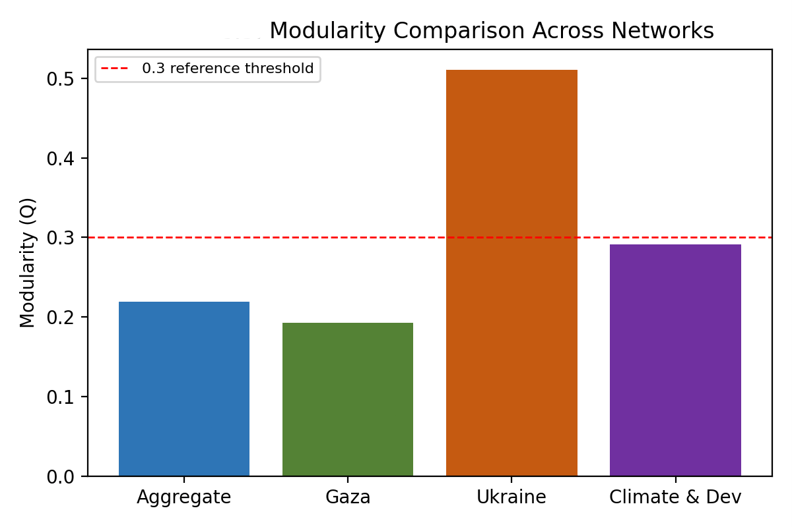
Figure 7.1. Modularity comparison across the four networks, relative to the 0.3 reference threshold.
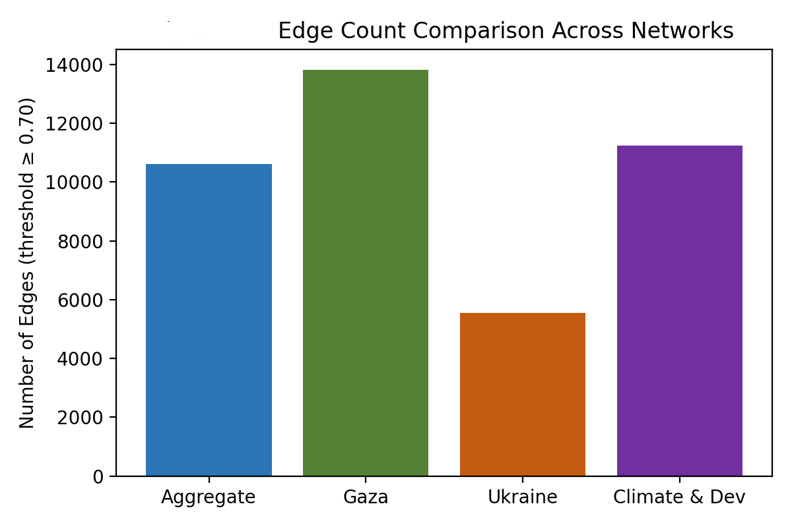
Figure 7.2. Edge count comparison across the four networks at the 0.70 threshold.
7.1 Aggregate Network
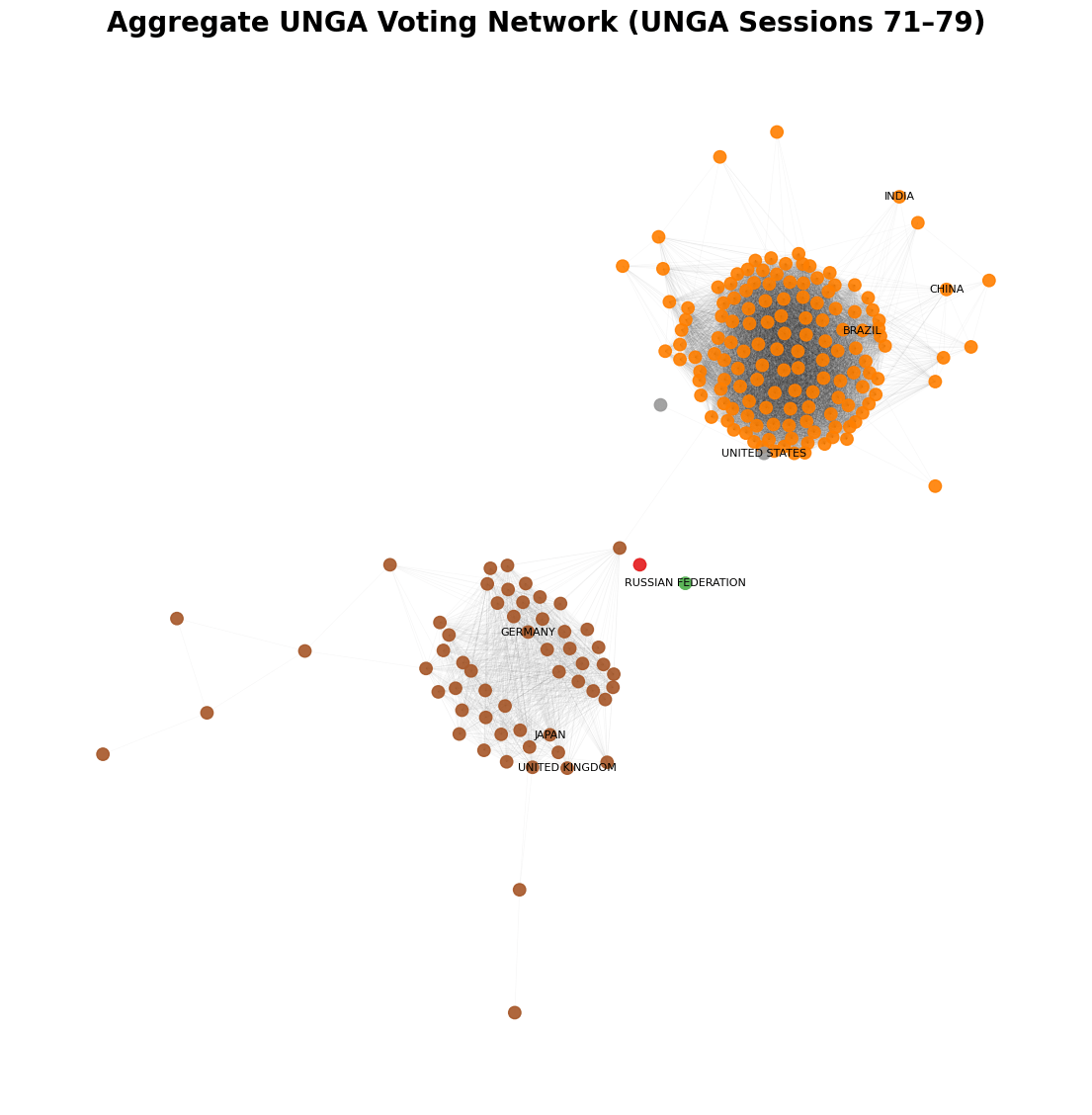
The Aggregate network produced two dominant communities of 139 and 56 states, together with three small satellite groupings. The larger community’s confirmed membership includes China, India, Brazil, Pakistan, South Africa, Indonesia, Saudi Arabia, Egypt, Nigeria, Mexico, and Argentina, broadly consistent with a Global South and non-Western aligned grouping. The smaller dominant community’s confirmed membership includes the United Kingdom, France, Germany, Japan, Canada, Australia, Italy, the Republic of Korea, Turkiye, and Ukraine, broadly consistent with a Western-aligned grouping. Notably, the United States and Israel formed their own small two-member community distinct from the broader Western grouping, while the Russian Federation was isolated in a singleton community. Modularity of 0.2188 falls below the 0.3 reference threshold, indicating that while a broad two-way division is present, it is not sharply bounded, and several states occupy structurally distinct positions outside the two dominant blocs. This bears on RQ1: aggregate voting reveals a recognizable but imperfectly separated division, with the United States, Israel, and Russia each standing apart from their expected respective groupings.
7.2 Ukraine Network
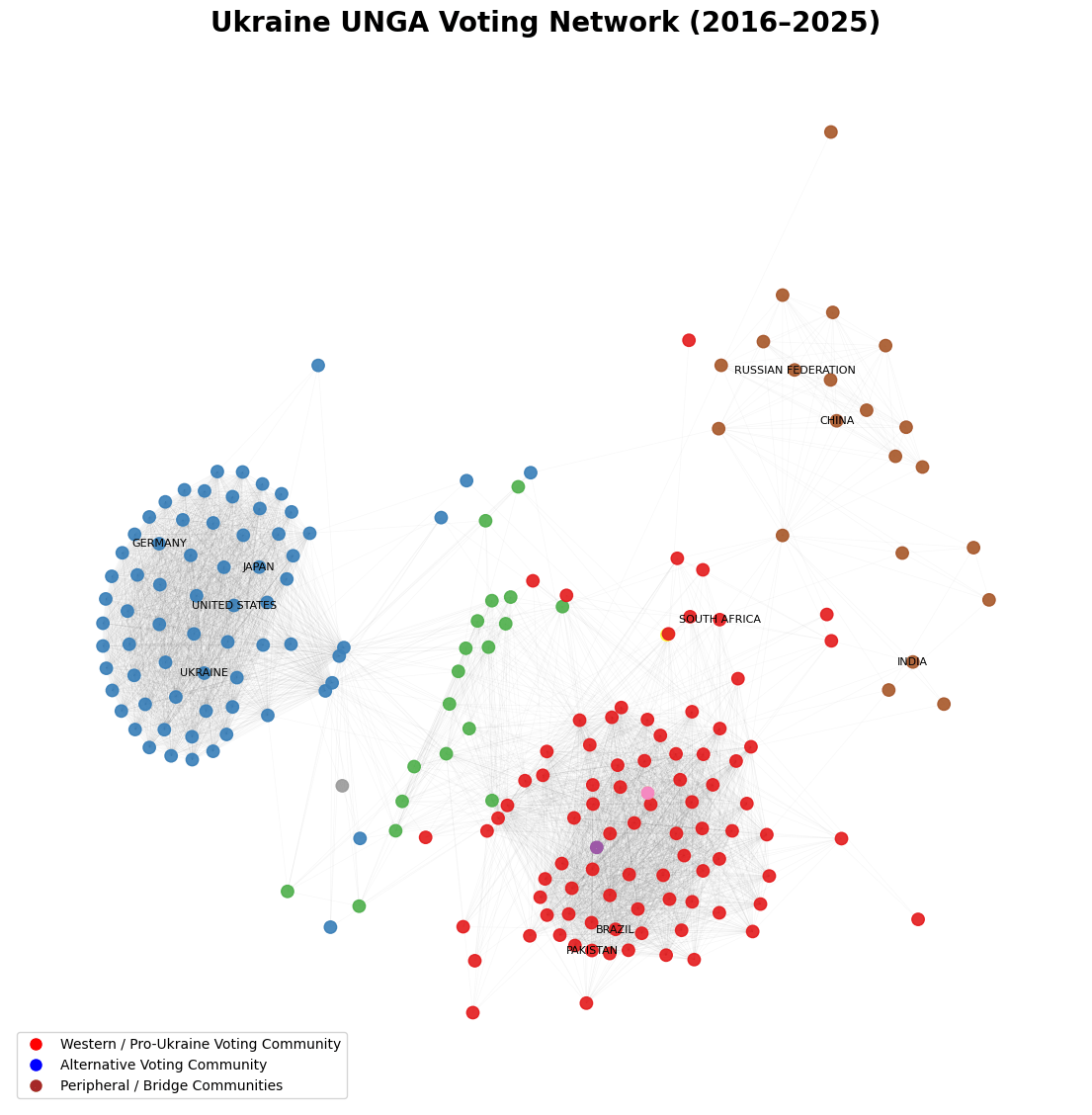
The Ukraine network produced the strongest community structure of the four networks, with modularity of 0.5110, well above the 0.3 reference threshold. Two dominant communities emerged, of 85 and 70 states. The larger community’s confirmed membership includes Brazil, Pakistan, South Africa, Indonesia, Saudi Arabia, Egypt, Nigeria, and Mexico. The second community’s confirmed membership includes the United States, United Kingdom, France, Germany, Japan, Canada, Australia, Italy, Turkiye, Ukraine, and Israel, consistent with a NATO-aligned and allied grouping. A separate, smaller community of 21 states contained China, the Russian Federation, India, and Iran together, a distinct grouping separate from both dominant communities. This speaks directly to RQ2: Ukraine-related voting divides the Assembly far more sharply than the Aggregate, Gaza, or Climate networks, and produces a distinct China-Russia-India-Iran grouping not observed as a unit in any other network examined.
7.3 Gaza and Palestine Network
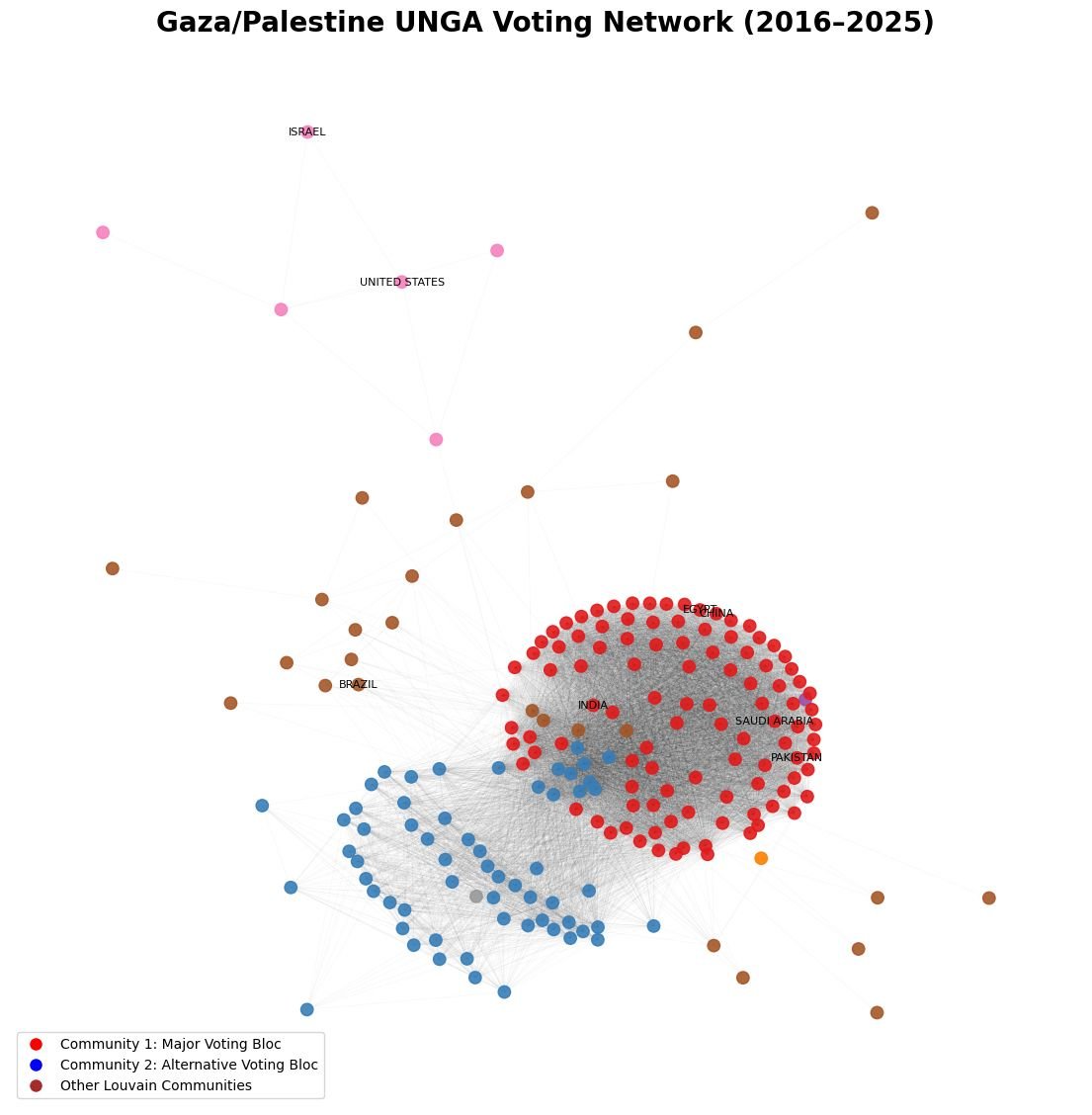
The Gaza network produced two dominant communities of 104 and 60 states, with modularity of 0.1922. The larger community’s confirmed membership includes China, India, Pakistan, South Africa, Indonesia, Saudi Arabia, Egypt, and Argentina, broadly consistent with a Global South coalition. The second community’s confirmed membership includes the Russian Federation, United Kingdom, France, Germany, Japan, Italy, Mexico, and Turkiye, a grouping whose composition does not correspond directly to a simple Western bloc given Russia’s inclusion. A separate community of 26 states included Brazil, and a small six-member community contained the United States, Canada, and Israel together, distinct from the broader European grouping. This bears on RQ2 and RQ3: Gaza-related voting does not reproduce the Western and non-Western division observed in the Aggregate network, instead separating a small United States-Canada-Israel cluster from a larger and more heterogeneous European and Russian grouping.
7.4 Climate and Development Network
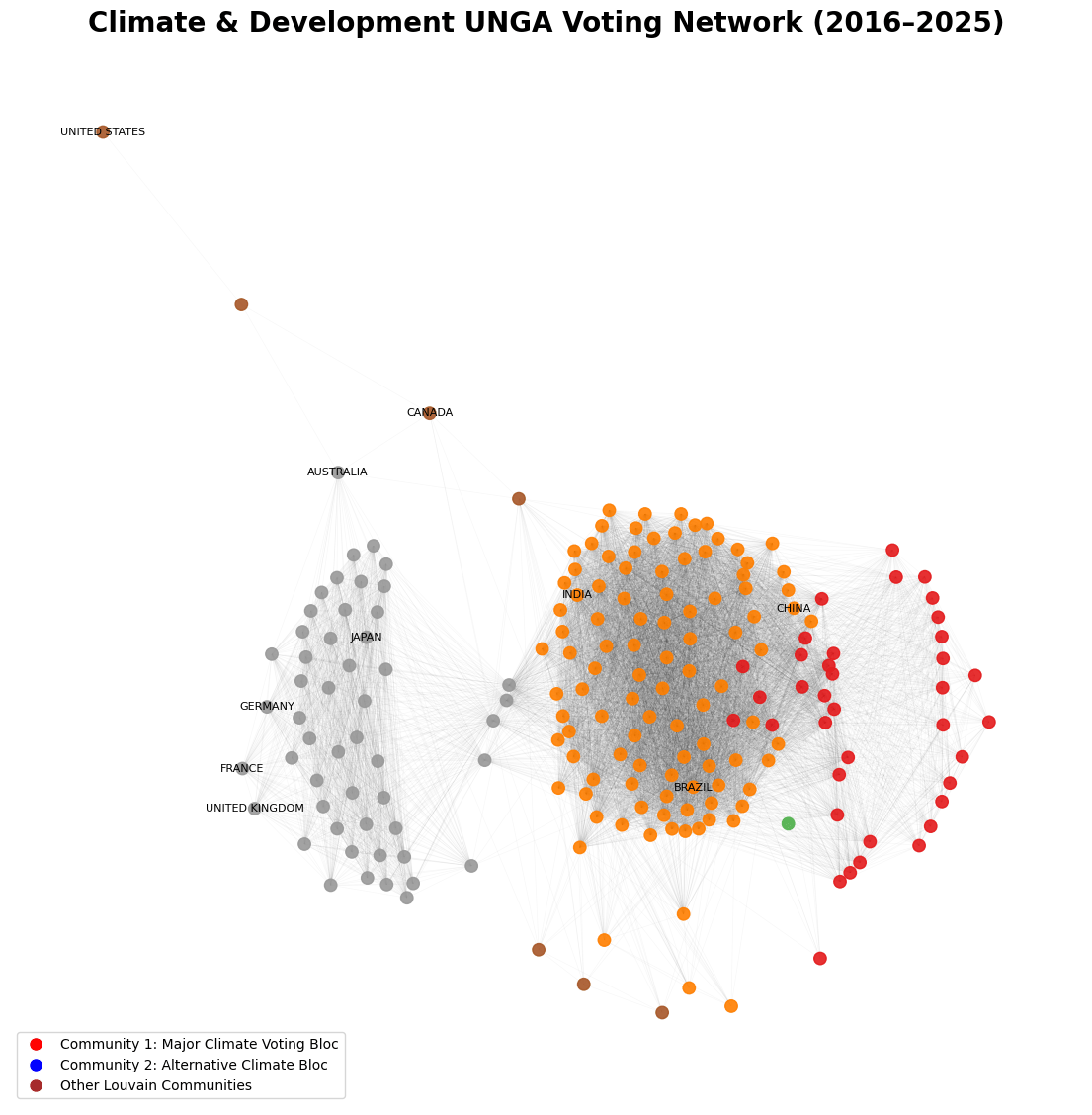
The Climate and Development network produced two dominant communities of 102 and 51 states, with modularity of 0.2908, the second highest of the four networks. The larger community’s confirmed membership includes China, the Russian Federation, India, Brazil, Nigeria, Mexico, and Argentina. The second community’s confirmed membership includes the United Kingdom, France, Germany, Japan, Australia, Italy, the Republic of Korea, and Ukraine. A separate community of 38 states included Pakistan, South Africa, Indonesia, Saudi Arabia, Egypt, and Turkiye, distinct from the larger developing-economy grouping. Notably, the United States, Canada, and Israel again formed a small separate community of seven states, mirroring the pattern observed in the Gaza network. This bears on RQ2: Climate and Development voting produces a structure closer to the Aggregate network’s broad divide, but with the United States again separating from the main Western grouping.
7.5 Representative Community Composition
|
Network |
Community |
Confirmed Members |
Characterization |
|
Aggregate |
Large (n=139) |
China, India, Brazil, Pakistan, South Africa, Indonesia, Saudi Arabia, Egypt, Nigeria, Mexico, Argentina |
Broadly Global South / non-Western |
|
Aggregate |
Large (n=56) |
UK, France, Germany, Japan, Canada, Australia, Italy, Rep. of Korea, Turkiye, Ukraine |
Broadly Western-aligned |
|
Aggregate |
Small (n=2) |
United States, Israel |
Distinct small pairing |
|
Ukraine |
Large (n=85) |
Brazil, Pakistan, South Africa, Indonesia, Saudi Arabia, Egypt, Nigeria, Mexico |
Broad non-aligned grouping |
|
Ukraine |
Large (n=70) |
US, UK, France, Germany, Japan, Canada, Australia, Italy, Turkiye, Ukraine, Israel |
NATO-aligned and allied states |
|
Ukraine |
Mid (n=21) |
China, Russian Federation, India, Iran |
Distinct grouping separate from both dominant blocs |
|
Gaza |
Large (n=104) |
China, India, Pakistan, South Africa, Indonesia, Saudi Arabia, Egypt, Argentina |
Broad Global South coalition |
|
Gaza |
Large (n=60) |
Russian Federation, UK, France, Germany, Japan, Italy, Mexico, Turkiye |
Heterogeneous European/Russian grouping |
|
Gaza |
Small (n=6) |
United States, Canada, Israel |
Small, cohesive distinct cluster |
|
Climate & Dev. |
Large (n=102) |
China, Russian Federation, India, Brazil, Nigeria, Mexico, Argentina |
Developing and emerging economies |
|
Climate & Dev. |
Large (n=51) |
UK, France, Germany, Japan, Australia, Italy, Rep. of Korea, Ukraine |
Industrialized Western economies |
|
Climate & Dev. |
Mid (n=38) |
Pakistan, South Africa, Indonesia, Saudi Arabia, Egypt, Turkiye |
Distinct developing-country grouping |
|
Climate & Dev. |
Small (n=7) |
United States, Canada, Israel |
Small, cohesive distinct cluster |
Table 7.2. Representative, verified community composition across networks. Characterizations describe the broad orientation of confirmed member states and are interpretive rather than definitive classifications.
7.6 G4 Countries Across Networks
|
Country |
Aggregate |
Gaza |
Ukraine |
Climate & Development |
|
Germany |
Community 3 |
Community 1 |
Community 1 |
Community 4 |
|
Japan |
Community 3 |
Community 1 |
Community 1 |
Community 4 |
|
India |
Community 2 |
Community 0 |
Community 5 |
Community 2 |
|
Brazil |
Community 2 |
Community 4 |
Community 0 |
Community 2 |
Table 7.3. G4 community membership across the four networks, verified at country level. Community numbering is specific to each network.
Germany and Japan occupied the same community in every network examined, the most stable pairing among the four G4 states. India and Brazil occupied the same community in the Aggregate and Climate and Development networks, but diverged into separate communities in both the Gaza and Ukraine networks. This indicates that G4 cohesion is not uniform: the Germany-Japan pairing held consistently across all four issue domains, while the India-Brazil pairing was contingent on the issue examined, converging on broad and climate-related votes but diverging on the Gaza and Ukraine votes. This bears directly on RQ3.
7.7 Hypothesis Evaluation
|
Hypothesis |
Status |
Empirical Justification |
|
H1: Aggregate UNGA voting exhibits identifiable community structures reflecting broad geopolitical alignments |
Partially supported |
Two dominant communities emerged with membership broadly consistent with a Global South / Western division, but modularity (0.2188) remained below the 0.3 reference threshold, and the United States, Israel, and Russia each occupied distinct positions outside the two dominant groupings. |
|
H2: Ukraine-related voting demonstrates stronger polarization and higher community separation than the Aggregate, Gaza, and Climate & Development networks |
Supported |
Ukraine recorded the highest modularity of all four networks (0.5110), exceeding the 0.3 threshold and substantially higher than Aggregate (0.2188), Gaza (0.1922), and Climate & Development (0.2908). |
|
H3: Community structures differ significantly across issue domains, indicating coalition formation is issue-dependent rather than fixed |
Supported |
Community composition varied meaningfully across networks; China, Russia, India, and Iran formed a distinct joint community only in the Ukraine network, and the United States/Canada/Israel cluster appeared separately from the main Western grouping in the Gaza and Climate networks but not in the Aggregate network. |
|
H4: G4 countries do not function as a unified voting bloc but exhibit issue-dependent community alignment |
Supported |
Germany and Japan clustered together across all four networks, while India and Brazil clustered together only in the Aggregate and Climate networks, diverging from one another in both the Gaza and Ukraine networks. |
Table 7.4. Summary evaluation of H1 through H4 against the verified empirical findings.
8. Discussion
The unevenness across the four networks does not appear if you look only at the Aggregate network, which suggests a fairly ordinary Western versus non-Western split, the kind of picture most of the literature already assumes. But modularity there is only 0.2188, below the 0.3 threshold, and three states, the United States, Israel, and Russia, do not sit inside either dominant bloc at all. The aggregate picture is real, but blurrier than a single number suggests.
Ukraine breaks from that pattern almost entirely. Modularity jumps to 0.5110, easily the highest of the four networks, and the resulting communities are the cleanest of the study: a Western-aligned bloc, a Global South-leaning bloc, and a smaller third grouping of China, Russia, India, and Iran that does not appear together as a unit anywhere else in the data. Gaza does the opposite. Modularity drops to 0.1922, the lowest figure recorded, and what emerges instead of sharp polarization is something closer to broad agreement, a large heterogeneous coalition set against a small United States-Canada-Israel cluster. Climate and Development lands in the middle, modularity of 0.2908, structurally closer to the Aggregate pattern but still peeling the United States away from the rest of the Western grouping.
Put the G4 into this picture and the same unevenness shows up again. Germany and Japan never separate, not once, across any of the four networks. India and Brazil tell a different story: together in Aggregate and Climate, but split the moment the issue turns to Ukraine or Gaza. A shared goal on Security Council reform has not been enough, by itself, to produce a shared voting position.
These findings should be interpreted cautiously. This study identifies patterns of voting alignment but cannot establish causation. Community membership reflects observed voting similarity rather than underlying diplomatic intent or strategic coordination. Alternative explanations also warrant weight: issue subsets differ in size and in how contested their texts were, so low modularity may reflect a consensual agenda rather than an absent coalition, while regional group practice and aid dependence can produce co-voting without shared positions (Dreher et al., 2008).
9. Conclusion
The four networks examined here show that a single, aggregate measure of UNGA voting hides more than it reveals. Once resolutions are separated by subject, community structures shift substantially, with modularity ranging from 0.1922 to 0.5110 across the four networks. This variation indicates that contemporary General Assembly politics remain far from settled, with states regrouping depending on what is actually being voted on rather than holding a fixed position across every issue.
The G4 case illustrates this well. Germany and Japan hold together across all four networks, but India and Brazil’s alignment depends on the issue at hand, converging on climate and broad votes while diverging sharply on Ukraine and Gaza. A shared institutional ambition, pursuit of permanent Security Council seats, has not produced a shared voting identity. These findings point toward a General Assembly better understood through issue-specific coalitions that form and dissolve around particular questions, rather than through fixed geopolitical alliances that hold steady across the board. For international relations theory, this favours issue-contingency and alignment-based accounts over alliance-centred realism, and implies that middle powers draw influence from mobility between coalitions rather than from membership in one. Future diplomatic research could extend this design across further sessions and issue domains.
References
Amighini, A., & García-Herrero, A. (2023). What really influences United Nations voting on Ukraine? Bruegel Analysis, 3. https://www.bruegel.org/analysis/what-really-influences-united-nations-voting-ukraine
Bailey, M. A., Strezhnev, A., & Voeten, E. (2017). Estimating dynamic state preferences from United Nations voting data. Journal of Conflict Resolution, 61(2), 430-456. https://doi.org/10.1177/0022002715595700
Benati, S., & Capurri, A. (2026). The Alignment index and its application to voting at the United Nations General Assembly. Quality & Quantity. https://doi.org/10.1007/s11135-026-02814-x
Binder, M., & Lockwood Payton, A. (2022). With “frenemies” like these: Rising power voting behavior in the UN General Assembly. British Journal of Political Science, 52(1), 381-398. https://www.cambridge.org/core/journals/british-journal-of-political-science/article/abs/with-frenemies-like-these-rising-power-voting-behavior-in-the-un-general-assembly/C9A6D7F908B47E50B8B4C444C1884BA1
Blondel, V. D., Guillaume, J.-L., Lambiotte, R., & Lefebvre, E. (2008). Fast unfolding of communities in large networks. Journal of Statistical Mechanics: Theory and Experiment, 2008(10), P10008. https://doi.org/10.1088/1742-5468/2008/10/P10008
Destradi, S., & Vüllers, J. (2025). Populism and the liberal international order: An analysis of UN voting patterns. The Review of International Organizations, 20(4), 1053-1080. https://doi.org/10.1007/s11558-024-09569-w
Dreher, A., Nunnenkamp, P., & Thiele, R. (2008). Does U.S. aid buy UN General Assembly votes? A disaggregated analysis. Public Choice, 136(1–2), 139–164. https://doi.org/10.1007/s11127-008-9286-x
Efstathopoulos, C. (2021). Southern middle powers and the liberal international order: The options for Brazil and South Africa. International Journal, 76(3). https://doi.org/10.1177/00207020211042915
Ferdinand, P. (2014). Rising powers at the UN: An analysis of the voting behaviour of BRICS in the General Assembly. Third World Quarterly, 35(3), 376-391. https://doi.org/10.1080/01436597.2014.893483
Hooijmaaijers, B., & Keukeleire, S. (2016). Voting cohesion of the BRICS countries in the UN General Assembly, 2006-2014: A BRICS too far? Global Governance, 22(3), 389-407. https://brill.com/view/journals/gg/22/3/article-p389_6.xml
Kuziemko, I., & Werker, E. (2006). How much is a seat on the Security Council worth? Foreign aid and bribery at the United Nations. Journal of Political Economy, 114(5), 905–930. https://doi.org/10.1086/507155
Maoz, Z. (2010). Networks of nations: The evolution, structure, and impact of international networks, 1816-2001. Cambridge University Press. https://www.cambridge.org/core/books/networks-of-nations/D648F66AF4B78F8E086C931618C2CC52
Mitra, D. (2025, June 13). As UNGA overwhelmingly backs Gaza ceasefire, India is an outlier. The Wire. https://thewire.in/diplomacy/india-abstains-unga-gaza-ceasefire-resolution-aid-access
Nielsen, K. L. (2026). Europe moving eastward? The changing dynamics in the EU and NATO following the war in Ukraine. East European Politics and Societies, 40(1), 65-90. https://doi.org/10.1177/08883254261420426
Papa, M., Han, Z., & O’Donnell, F. (2023). The dynamics of informal institutions and counter-hegemony: Introducing a BRICS Convergence Index. European Journal of International Relations, 29(4). https://doi.org/10.1177/13540661231183352
Steinert, C. V., & Weyrauch, D. (2024). Belt and road initiative membership and voting patterns in the United Nations General Assembly. Research & Politics, 11(1). https://doi.org/10.1177/20531680241233784
Tawat, M. (2025). The Russia-Ukraine war: Understanding the Global South’s vote at the UN and its implications for the current world order. Third World Quarterly, 46(16), 2019-2036. https://doi.org/10.1080/01436597.2025.2549357
Verbeek, B., & Zaslove, A. (2017). Populism and foreign policy. In C. Rovira Kaltwasser, P. Taggart, P. Ochoa Espejo, & P. Ostiguy (Eds.), The Oxford handbook of populism (pp. 384–405). Oxford University Press. https://academic.oup.com/edited-volume/27977/chapter/211653173
Voeten, E. (2000). Clashes in the Assembly. International Organization, 54(2), 185-215. https://www.cambridge.org/core/journals/international-organization/article/abs/clashes-in-the-assembly/4F638AC73870394253E43626CC4A359C
Walt, S. M. (1987). The origins of alliances. Cornell University Press. https://www.cornellpress.cornell.edu/book/9780801420542/the-origins-of-alliances/
Wilkins, T. S. (2012). ‘Alignment’, not ‘alliance’: The shifting paradigm of international security cooperation. Review of International Studies, 38(1), 53-76. https://www.cambridge.org/core/journals/review-of-international-studies/article/abs/alignment-not-alliance-the-shifting-paradigm-of-international-security-cooperation-toward-a-conceptual-taxonomy-of-alignment/0C7B86297FC2A61539D1944DF60AC405



One Response
.