Authors: Sanchita Sinha, Richa Saxena, Padma Rigzin, Grace Hall and Tshering Dolkar Lachenpa
ABSTRACT
In an era defined by deepening economic interdependence and intensifying geopolitical competition, maritime chokepoints have emerged as critical arenas of economic statecraft. This paper examines the Strait of Hormuz, through which approximately 20 per cent of global petroleum consumption and the majority of Qatari LNG exports transit daily, as an instrument of economic coercion, with particular attention to its implications for European energy security. Drawing on theories of weaponised interdependence (Farrell & Newman, 2019) and asymmetric interdependence (Keohane & Nye, 2012), it argues that Iran’s positional control over the strait enables a middle power to exercise disproportionate geopolitical leverage at relatively modest cost to itself. The analysis proceeds across seven interconnected themes: economic coercion as a foreign policy instrument, the strategic geography and military significance of the Strait of Hormuz, Iran and the politics of Hormuz, Europe’s structural energy vulnerabilities, and the contested economic consequences of closure, situated within broader geopolitical implications for the European and international order, alongside European responses and resilience strategies. The paper draws on these themes to test weaponised interdependence against a geographic chokepoint and address the Hormuz literature from a wider global lens. The paper concludes that Europe’s energy diversification strategies have displaced rather than resolved its underlying dependencies and that durable strategic resilience will require both accelerated domestic energy transition and a more candid reckoning with the geographic vulnerabilities that chokepoint politics expose.
Keywords: Economic Coercion, Strait of Hormuz, Weaponised Interdependence, Energy Security, European Energy Vulnerability, Maritime Chokepoints, Geoeconomics
INTRODUCTION
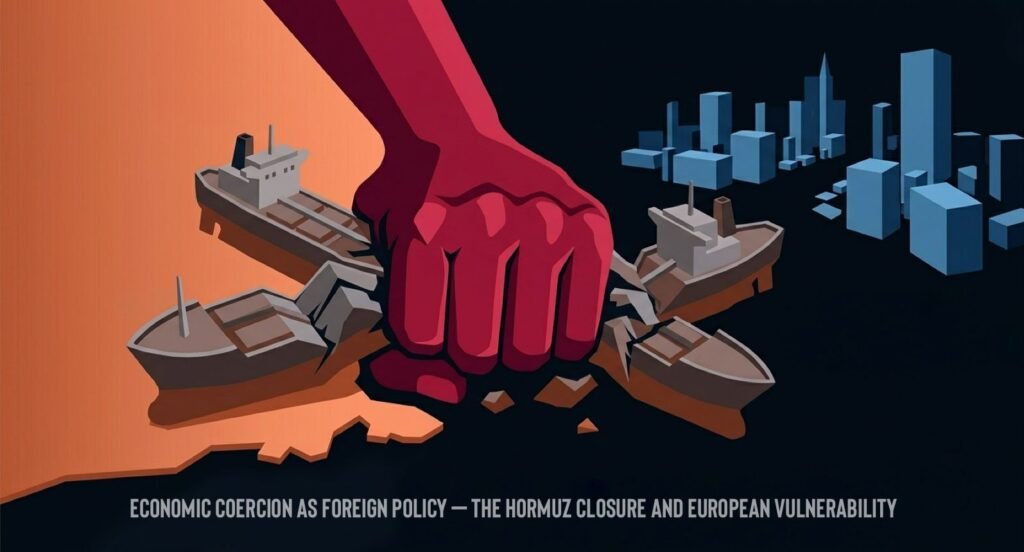
In the contemporary era, economic coercion has emerged as an important weapon of geopolitical competition. States no longer solely rely on military conflict but also use economic dependence as a pragmatic tool to exert pressure on rival states to achieve objectives (Cogan, 2024). In this instance, maritime chokepoints have emerged as a key geopolitical arena. The Strait of Hormuz, situated between Iran and Oman, is one of the world’s most strategically important energy transit routes (U.S. Energy Information Administration, 2023). During the 2024 Iran crisis, escalating tensions between Iran and Israel exposed Europe’s energy vulnerability of LNG dependency, particularly after reduced dependence on Russian gas post-Ukraine war (European Commission, 2024). Tehran’s threat to disrupt shipping activities through the Strait of Hormuz raised concerns over energy supply disruption affecting global energy markets (U.S. Energy Information Administration, 2023). This incident demonstrated the role of critical maritime chokepoints transiting from being a commercial trade route to an instrument of political and economic influence. This study examines the increasing strategic importance of the Strait of Hormuz and how it can be used as a tool of economic coercion, particularly in the context of Europe’s energy dependence and policy concessions.
This study is organised around that problem and pursues three specific objectives. First, it seeks to situate Iran’s use of the Strait within the existing theoretical literature on weaponised and asymmetric interdependence (Farrell & Newman, 2019; Keohane & Nye, 2012), assessing how well these frameworks explain a middle power’s ability to convert geographic position into political leverage. Second, it aims to assess the structural and immediate roots of European exposure to a Hormuz disruption, examining both the long-standing dependencies built up since the 1990s deregulation of European energy markets and the more recent dependencies created by the post-Ukraine pivot to LNG. Third, it evaluates the adequacy of Europe’s existing and proposed resilience strategies – including REPowerEU, joint gas procurement, and the EU’s anti-coercion instrument – against a coercive threat of this specific kind, namely one rooted in physical control of a transit corridor rather than in a supplier relationship that can be renegotiated or sanctioned.
The study addresses the problem through three main objectives. First, it examines Iran’s use of the Strait of Hormuz through existing theoretical literature on weaponised and asymmetric interdependence. Second, it assesses structural and immediate roots of Europe’s exposure and vulnerability to Hormuz disruption, examining both the long-standing dependencies built up since the 1990s deregulation of European energy markets and the more recent dependencies created by the post-Ukraine pivot to LNG. Third, it evaluates whether Europe’s existing and proposed resilience strategies, including REPowerEU, joint gas procurement, and the EU’s Anti-Coercion Instrument, are adequate to address a form of coercion based on physical control of a transit corridor rather than in a supplier relationship.
The significance of this study follows from its timing. Existing literature on Hormuz has largely examined disruption as a hypothetical possibility, often drawing on past episodes such as the 2011–2012 sanctions standoff or the Tanker War of the 1980s. The 2026 closure moves the issue beyond the theoretical scenario to a real-world case examining how the mechanisms of chokepoint coercion and the limits of diversification as a resilience strategy can be examined empirically. This makes the study particularly relevant for European policymakers, who are still navigating an incomplete energy transition, and for scholars seeking to refine theories of infrastructural coercion.
LITERATURE REVIEW
The study of economic coercion has evolved significantly from traditional analyses of sanctions and trade restrictions to broader examinations of economic statecraft and geoeconomic competition. Early scholarship viewed economic coercion primarily as the use of sanctions and embargoes to alter the behaviour of target states (Baldwin, 1985). However, debates emerged regarding its effectiveness, with some scholars arguing that economic pressure can influence policy decisions, while others contend that target states often adapt to coercive measures or develop alternative economic partnerships, limiting their impact (Pape, 1997). This debate highlighted the need to understand not only the economic costs imposed by coercion but also the conditions under which such measures translate into political influence.
Recent scholarship has shifted attention towards the concept of geoeconomics and the strategic use of economic networks. Farrell and Newman (2019) argue that globalization has created structures of “weaponized interdependence,” whereby states occupying central positions in global networks can exploit asymmetrical dependencies for political leverage. Building on this perspective, Drezner et al. (2021) emphasize that contemporary economic coercion increasingly operates through critical infrastructure, supply chains, financial systems, and strategic resources rather than through sanctions alone. This shift reflects a broader understanding of power in which influence derives not merely from economic strength but from control over key nodes within interconnected global systems
The Strait of Hormuz occupies a prominent place within the literature on energy security and maritime geopolitics. Existing studies identify the Strait as one of the world’s most significant energy chokepoints due to its role in facilitating global oil and liquefied natural gas exports (International Energy Agency [IEA], 2024). Most research, however, focuses on the military, strategic, and regional security implications of disruptions in the Strait, particularly in relation to tensions involving Iran and Gulf states. Comparatively less attention has been paid to the Strait’s potential role as an instrument of economic coercion within the broader framework of economic statecraft.
Similarly, contemporary studies on European energy security have expanded considerably following the Russia–Ukraine conflict. Scholars have highlighted Europe’s vulnerability to external energy shocks and the strategic risks associated with dependence on imported energy resources (European Commission, 2024). While this literature examines diversification strategies and energy resilience, limited research directly connects European vulnerability to the coercive potential of strategic maritime chokepoints such as the Strait of Hormuz.
This study seeks to bridge these strands of scholarship by examining the Strait of Hormuz not only as a geopolitical and energy-security concern but also as a potential instrument of economic coercion. By linking theories of economic statecraft and weaponized interdependence with the specific case of European energy vulnerability, the study contributes to a more comprehensive understanding of how strategic chokepoints can function as tools of foreign policy in an increasingly interconnected global economy
THEORETICAL FRAMEWORK
This study analyses the potential closure of the Strait of Hormuz through the concepts of economic coercion, strategic chokepoints, and asymmetric interdependence. Economic coercion refers to the use or threat of economic disruption to influence another state’s behaviour and has become a key component of economic statecraft in contemporary foreign policy (Baldwin, 1985; Blackwill & Harris, 2016). Recent scholarship argues that coercion extends beyond sanctions to include the manipulation of critical networks, infrastructure, and supply chains that underpin the global economy (Farrell & Newman, 2019; Drezner et al., 2021).
The Strait of Hormuz represents a strategic chokepoint through which a substantial share of global oil and liquefied natural gas exports transit. Due to its central role in global energy markets, disruptions in the Strait can generate economic uncertainty, increase energy prices, and affect states far beyond the Gulf region (International Energy Agency [IEA], 2024). Consequently, the threat of disruption itself can function as a form of economic leverage.
The concept of asymmetric interdependence further explains why certain actors are more vulnerable to such pressure. According to Keohane and Nye (2012), unequal patterns of dependence create opportunities for political influence. Europe’s dependence on imported energy and globally integrated energy markets makes it particularly susceptible to disruptions in critical transit routes. Therefore, the Strait of Hormuz can be understood as a potential instrument of economic coercion through which strategic vulnerabilities are transformed into foreign policy leverage.
RESEARCH GAP
Existing scholarship on the Strait of Hormuz has predominantly approached the chokepoint from military, strategic, and regional security perspectives, while comparatively limited attention has been given to its potential role as an instrument of economic coercion within broader frameworks of economic statecraft. Similarly, scholarship on European energy security has extensively examined diversification, resilience, and the restructuring of energy dependence following major geopolitical disruptions but has paid comparatively less attention to the coercive vulnerabilities created by dependence on critical maritime energy chokepoints. This gap is particularly significant in understanding how geographic control over critical energy flows can generate asymmetric vulnerabilities and translate into wider political and economic leverage.
RESEARCH METHODOLOGY
This study adopts a qualitative research approach grounded in an interpretivist framework to examine economic coercion as an instrument of foreign policy through the case of the Strait of Hormuz and its implications for European vulnerability. An interpretivist approach is appropriate because the study seeks to understand how strategic actors perceive, construct, and utilize economic leverage within the broader context of international relations and energy security rather than establish causal relationships through quantitative measurement (Creswell & Creswell, 2018).
The research employs a case study design, focusing on the Strait of Hormuz as a critical maritime chokepoint within the global energy system. According to Yin (2018), case studies are particularly useful for investigating contemporary phenomena within their real-world context, especially when the boundaries between the phenomenon and its environment are not clearly defined. The Strait of Hormuz provides a suitable case through which to analyze the relationship between economic coercion, strategic geography, and energy dependence.
The study relies exclusively on secondary data collected from academic journal articles, books, policy reports, government publications, and reports issued by international organizations, including the International Energy Agency (IEA), the European Commission, and relevant energy and security research institutes. Particular emphasis is placed on literature published between 2020 and 2025 in order to capture recent developments in geoeconomics, energy security, and European resilience following the Russia–Ukraine conflict.
Data are analyzed using qualitative thematic analysis. Following Braun and Clarke (2006), recurring themes related to economic coercion, strategic chokepoints, asymmetric interdependence, and European energy vulnerability are identified and examined. The analysis seeks to understand how disruptions or threats to energy transit routes can function as mechanisms of political leverage within the contemporary international system.
The study acknowledges certain limitations. As a qualitative analysis based on secondary sources, it does not seek to measure the precise economic impact of a potential Hormuz closure. Rather, its objective is to explore the strategic and political implications of such a scenario through the lens of economic coercion. Despite these limitations, the case study approach provides valuable insights into the role of critical energy infrastructure in contemporary foreign policy and international security.
ANALYSIS
1. Economic Coercion as a Tool of Foreign Policy
Economic coercion has become an increasingly prominent instrument of foreign policy amid deep economic interdependence and strategic competition. While military power remains central to statecraft, states increasingly use economic instruments to influence rivals, deter adversaries, and advance geopolitical objectives. Economic networks, supply chains, financial systems, and energy markets can therefore generate forms of leverage that may be less costly and politically risky than direct military confrontation (Blackwill & Harris, 2016).
The literature differs, however, in how it understands the mechanisms and effectiveness of economic coercion. Baldwin (1985) approaches coercion primarily through the use of economic instruments such as sanctions, trade restrictions, and economic isolation to impose costs and alter a target state’s cost-benefit calculations. Pape (1997), by contrast, questions whether imposing economic costs necessarily produces political compliance, particularly when target states can absorb costs, find alternative economic partners, or prioritize strategic objectives. The difference between the two approaches highlights a central problem in conventional economic coercion: economic pressure may impose costs without necessarily translating into political concessions.
Farrell and Newman (2019) extend this debate by shifting attention from the severity of economic punishment to the structure of global economic networks. Whereas Baldwin focuses on economic instruments that directly impose costs on a target, Farrell and Newman argue that coercive power can also derive from strategic positions within interconnected systems of trade, finance, technology, and resource flows. Their concept of “weaponised interdependence” therefore broadens the understanding of economic coercion from the deliberate imposition of costs to the exploitation of asymmetric vulnerabilities within networks. This distinction is particularly relevant to energy security, where control over resources and transit routes can generate geopolitical influence (Yergin, 2020).
As a major maritime chokepoint for globally traded oil and liquefied natural gas, its significance derives not only from the volume of energy passing through it but also from the limited availability of comparable alternative routes (International Energy Agency [IEA], 2024). Unlike conventional sanctions, which involve the direct application of economic restrictions, chokepoint coercion can operate through the threat of disruption. Even the possibility of interference with maritime traffic can generate market uncertainty, increase insurance and transportation costs, and produce energy-market volatility.
This distinction suggests that chokepoint-based coercion operates through systemic vulnerability rather than solely through direct economic punishment. Its objective need not be to damage a particular economy directly; rather, dependence on a critical transit route can create leverage through the possibility of disruption. The European Union illustrates this vulnerability. Despite efforts to diversify energy imports and accelerate renewable energy transitions, Europe remains integrated into global energy markets. A significant disruption in the Strait of Hormuz could, therefore, affect Europe not necessarily because it is the direct target of coercion but because its economic security remains connected to the uninterrupted functioning of global energy networks.
The progression from Baldwin’s emphasis on economic instruments, through Pape’s critique of their effectiveness, to Farrell and Newman’s focus on structural control demonstrates this broader understanding. In this context, the Strait of Hormuz provides a case through which the relationship between geographic control, economic dependence, and coercive leverage can be examined.
2. Strategic Importance of the Strait of Hormuz
The Strait of Hormuz is the world’s critical energy chokepoint connecting the Persian Gulf and the Arabian Sea. Its narrowest point spans 20 nautical miles and passes through Iranian territorial waters, meaning transit of any vessel in the strait is operated under Iran’s legal and military surveillance (EIA, 2024) – giving Iran strategic leverage over the global economy. Consequently, extending the Strait’s role from merely a transit corridor to a critical geopolitical asset has significant implications on the global supply chain.
In terms of volume, approximately 20.3 million barrels of petroleum and crude oil pass daily through the strait, accounting for over 25 per cent of the world’s maritime oil trade (Britannica, 2026). The strait alone represents one-fifth of petroleum liquid consumption in the world (EIA, 2024). Additionally, the strait is the world’s largest liquefied natural gas (LNG) exporter and serves as the primary route for Qatari LNG exports. Following Europe’s reduced dependence on Russian oil post-Ukraine War, the strategic relevance of Persian LNG exports through the strait has become increasingly pivotal. In 2023, Qatar supplied over 14 per cent of LNG shipments to the European Union. In conclusion, any disruption in the Strait of Hormuz can have serious implications on the global oil market and Europe’s energy supply network.
Over the years, Iran has historically demonstrated its heavy presence in the Strait of Hormuz, disrupting shipping activities. In 2026, Tehran severely disrupted the significant maritime trade route while retaliating against US and Israeli strikes. The Islamic Revolutionary Guard Corps (IRGC) attacked merchant ships and laid sea mines, threatening the international traffic that resulted in severe global energy shortages. Prior to this, during the Iran-Iraq “Tanker War” of the 1980s, both countries indulged in a long-standing fight, disrupting each other’s oil exports. Over 400 ships were attacked during this period, causing significant disruption in the Strait. In recent years, Tehran has heavily invested in anti-access/area-denial (A2/AD) technologies, coastal cruises, naval mines, and submarines specifically designed to operate effectively in confined waters (Krane, 2022; Cordesman, 2018).
Therefore, the significance of the Strait of Hormuz extends beyond a maritime trade route. It depends on the ability of a middle power state to have strategic leverage over the chokepoint regulating the world economy. Key scholars like Jason Bordoff and Meghan L. O’Sullivan note that such chokepoints function as the instrument of coercion by enabling weaker actors to exploit vulnerability caused by global energy dependence (Bordoff & O’Sullivan, 2022). In this context, Europe’s extended dependence on seaborne LNG has raised reliance on maritime sea routes – highlighting its energy vulnerability. Any disruption in the strait can create serious implications for energy supply shortages, potentially disrupting industrial production, electricity generation and broader economic stability.
In conclusion, the Strait of Hormuz’s geography plays a significant role in energy security and geopolitical power politics. Its strategic relevance is derived not merely from global energy supplies but also through pragmatic influence controlling the vital chokepoint. It perfectly acts as a strategic arena of economic coercion and strategic leverage.
3. Iran and the Politics of Hormuz
Iran’s relationship with the Strait of Hormuz forms an important component of its broader strategic posture. The Strait can be understood as a “chokepoint dividend” for the Islamic Republic—a geographical resource that provides leverage beyond what Iran’s conventional military capabilities might otherwise permit (Ostovar, 2016). Understanding this leverage requires examining also how interactions with the United States, European states, and other regional actors have shaped the credibility and limits of its coercive strategy.
The roots of Iran’s Hormuz strategy can be traced to the Iran-Iraq War (1980–1988), particularly the “Tanker War”, during which attacks on oil tankers demonstrated the vulnerability of commercial shipping in the Gulf (Ward, 2009). The experience established an important strategic logic for Iran: a militarily weaker state could threaten significant economic costs to stronger actors by targeting a critical maritime node. This logic was subsequently institutionalised through the Islamic Revolutionary Guard Corps Navy (IRGCN), whose asymmetric doctrine emphasised swarm tactics, fast attack craft, anti-ship missiles, and mine warfare to complicate access by conventionally superior naval forces (Cordesman, 2018). The significance of this development was therefore not simply the acquisition of particular capabilities but the creation of a relatively low-cost means of making disruption credible.
The interaction between Iranian coercion and external economic pressure further shaped this capability. During 2011–2012, US and EU sanctions targeted Iran’s oil exports, while Iranian officials responded with threats to block the Strait and the IRGCN conducted exercises involving mine-laying and anti-ship capabilities. Rather than producing an actual closure, the episode demonstrated how Iranian threats could interact with external sanctions to generate uncertainty in energy markets and prompt precautionary responses from Western governments. The coercive capability of Hormuz therefore rested not only on Iran’s ability to physically disrupt shipping but also on its ability to make the possibility of disruption economically consequential without assuming the costs of full implementation.
The post-2018 period further demonstrated this graduated character of Iranian coercion. Following the US withdrawal from the Joint Comprehensive Plan of Action (JCPOA) and the reimposition of sanctions, Iran engaged in actions including the seizure of foreign tankers, such as the *Stena Impero*, and other harassment operations (Tabatabai, 2020). These developments increased the operational credibility of Iranian threats by demonstrating that coercive signalling could be accompanied by limited action. At the same time, the responses of the United States, European states, and other actors constrained the extent to which Iran could escalate without generating greater military and economic costs.
Iran’s Hormuz strategy is therefore better understood as a continuous rather than binary form of coercion. Iranian policymakers have maintained a range of signalling, military posturing, and limited actions that create pressure without necessarily crossing into sustained closure (Chubin, 2006). This is particularly important because a complete closure would also impose substantial economic costs on Iran itself, given its dependence on the Strait for petroleum trade. The resulting asymmetry between the high potential cost of actual closure and the lower cost of maintaining a credible threat helps explain why ambiguity and controlled escalation can be strategically valuable.
The United States and its partners maintain a significant security presence in and around the Gulf, while Gulf states remain directly exposed to any disruption of maritime energy flows. European states, meanwhile, have an interest in the freedom and security of navigation because of their exposure to global energy markets. Iran’s coercive capability must therefore be understood as operating within a competitive environment in which other actors can respond through military presence, economic pressure, diplomatic measures, and efforts to reduce energy vulnerability. The Strait is consequently not an uncontested Iranian asset but a contested strategic space in which coercive leverage depends on the interaction between Iranian capabilities and the responses of other actors.
The importance of the Strait to international navigation means that any attempt to interfere with commercial shipping would have consequences beyond Iran’s bilateral relations with particular states. The legal and political expectations surrounding freedom of navigation therefore form part of the broader environment within which Iran’s threats are interpreted. This reinforces the importance of graduated coercion: maintaining the capacity to threaten disruption can generate leverage while avoiding the wider consequences associated with sustained interference with international maritime traffic.
The domestic dimension adds another layer to this strategy. Hormuz policy is not necessarily a unitary process but reflects institutional interests within Iran, particularly the IRGC’s interest in maintaining the strategic importance of the Strait alongside more pragmatic approaches within the broader government and foreign-policy establishment. The Supreme Leader’s office has played a role in managing this tension, allowing Iran to retain coercive options without entirely sacrificing diplomatic flexibility (Ostovar, 2016). Consequently, ambiguity itself becomes strategically useful. It preserves uncertainty for external actors while allowing Iran to calibrate the level of pressure according to changing circumstances.
Iran’s Hormuz strategy can therefore be understood as a form of asymmetric coercion in which historical experience, institutionalised military capabilities, external pressure, and the responses of other actors interact. The evolution from the Tanker War to later sanctions confrontations and maritime incidents did not simply demonstrate Iran’s willingness to threaten the Strait; it progressively established the credibility, signalling mechanisms, and operational options through which that threat could be exercised. At the same time, the presence of US and regional security actors, European interests, international legal constraints, and Iran’s own economic exposure limits the feasibility of sustained closure. Iran’s coercive advantage consequently lies less in an unrestricted ability to close the Strait than in its capacity to create uncertainty and economic pressure while retaining the option of calibrated escalation.
4. European Energy Dependence and Vulnerability
Europe’s energy security is now deeply linked with global geopolitics, leaving the continent open to major economic and strategic risks (Goldthau & Sitter, 2020). For decades, European nations chose to prioritise low costs and market efficiency over long-term security, relying heavily on foreign fossil fuels to drive their economic growth (European Commission, 2022). While this strategy offered stable energy supplies for a long time, it also built up dependencies that foreign actors could easily exploit. Recent disruptions, such as Russia cutting back its gas exports after invading Ukraine and the blockage of the Strait of Hormuz, clearly show how energy reliance can be turned into a tool for economic leverage (International Energy Agency [IEA], 2022). These crises prove that Europe’s weakness is not just about a few specific suppliers but is rooted in deeper structural issues within its entire energy framework.
Structural Roots of European Energy Dependence
The groundwork for Europe’s current energy vulnerabilities was laid in the 1990s during the deregulation of energy markets (Goldthau & Sitter, 2020). As governments stepped back from managing the energy sector, private corporations began prioritising cheap energy imports over diversifying their supply lines or safeguarding strategic security. As a result, Europe became deeply dependent on external countries for its natural gas, crude oil, and liquefied natural gas (LNG) (European Commission, 2022).
This dynamic creates an unequal power balance between exporters and importers. When specific nations hold central positions in global economic networks, they can weaponize this interdependence to gain political leverage (Farrell & Newman, 2019). In energy markets, this means supplier countries can pressure or influence buying nations simply by cutting off access to vital resources. Because of this, energy dependence is far more than an economic issue; it is a major geopolitical vulnerability.
The Russian Gas Crisis as a Case of Economic Coercion
The 2022 war between Russia and Ukraine offered a clear example of how energy can be weaponized for political gain. When Russian gas supplies to Europe dropped, energy prices skyrocketed across the continent, placing a heavy burden on households, businesses, and governments alike (IEA, 2022; European Council, 2023). The situation laid bare just how dependent European economic stability had become on foreign Russian fossil fuels.
In response, the European Union introduced the REPowerEU plan. This initiative aimed to cut ties with Russian energy by rapidly expanding renewable energy, boosting energy efficiency, and sourcing more LNG (European Commission, 2022). While these measures successfully lowered reliance on Russian gas and sped up the shift toward clean energy, they did not entirely fix Europe’s vulnerabilities. Instead, they shifted the continent’s dependence over to global LNG markets and alternative suppliers, bringing a new set of strategic hurdles (IEA, 2023). This shift demonstrates that relying solely on diversification might protect a nation from one source of pressure while simultaneously locking it into dependence on another.
The Strait of Hormuz Closure and Continuing Vulnerability
The shutdown of the Strait of Hormuz exposed the gaps in Europe’s post-2022 energy plans. As one of the planet’s most critical maritime chokepoints, this strait handles a significant portion of the world’s oil and LNG shipments (Strait of Hormuz; U.S. Energy Information Administration, 2024). Shipping disruptions there severely cut down the available energy supply and drove up global prices.
Europe took a heavy hit because LNG had become the backbone of its supply diversification strategy (IEA, 2023). The drop in exports from the Gulf sparked intense competition between European and Asian buyers, resulting in skyrocketing costs and widespread instability in energy markets. This event proved that Europe remains exposed not just to the whims of specific supplier nations, but also to physical breakdowns in global transit routes. Ultimately, the Hormuz crisis showed that energy security cannot be fixed just by swapping out suppliers; it also demands that Europe cut back its reliance on fragile international supply chains.
Towards Greater Strategic Resilience
Aware of the rising danger of economic coercion, the European Union has rolled out protective measures like the Anti-Coercion Instrument to safeguard its strategic independence (European Parliament, 2024). Yet, while these policies offer the tools needed to react to external pressure, they fail to fix the root causes of energy instability.
A much more durable fix involves speeding up the transition to homegrown renewable energy. By scaling up wind, solar, and other domestic green alternatives, Europe can reduce its need for foreign fossil fuels and prevent outside actors from leveraging energy markets against it (European Commission, 2023). Even so, reaching this goal will demand massive financial investments, major infrastructure upgrades, and tight political coordination among EU member states. Until these structural hurdles are solved, Europe will continue to be vulnerable to geopolitical shocks beyond its borders.
5. Economic Consequences of a Hormuz Closure
The Case for Structural Economic Shock
The shock thesis rests on a single mechanical assumption: that roughly 20 million barrels a day of supply cannot be meaningfully replaced or substituted for in the short run, so the entire adjustment burden falls on price. This is why the Dallas Fed’s numbers rise almost linearly with duration – $110 at one quarter, $132 at two, and $167 at three (Dallas Federal Reserve, 2026); the model is pricing in the exhaustion of buffers over time, not a one-off shock. That escalating structure is more informative than any single figure in it; it tells us the shock camp’s real claim is about the second and third quarters, not the first.
The World Bank’s March 2026 data lends some support to this claim; a 10.1 million barrel-per-day supply collapse and a 65 per cent Brent spike in a single month (World Bank, 2026) show the initial shock was at least as sharp as the model anticipated. But a sharp initial spike is consistent with either thesis: shock theorists read it as the front edge of a compounding crisis, resilience theorists read it as a shock that markets absorbed quickly.
Khezri’s “economic clock of war” framing (Khezri, 2026) reframes duration from a variable in a model to the actual object of analysis. If Khezri is right, then the Dallas Fed and Oxford Economics numbers aren’t really competing forecasts so much as different points sampled from the same underlying curve, and the disagreement in the literature is less about whether the economy will suffer and more about which week the curve bends from “absorbable” to “structural”. The Kiel Institute’s claim that developing-country income losses are irrecoverable (Hinz et al., 2026) is the sharpest version of this: it says the curve doesn’t bend back even after the strait reopens because the losses are distributional, not just aggregate. Poorer, food-import-dependent economies don’t get their lost income back the way oil-price relief flows back to consumers elsewhere. That is arguably the strongest claim because it survives even a relatively short closure.
The Case for Market Resilience
The resilience case is easy to overstate, because most of its evidence is time-conditioned in a way the literature doesn’t foreground. The IMF’s 3.1 per cent and the OECD’s 2.9 per cent growth forecasts (IMF, 2026; OECD, 2026) are frequently read as evidence that the global economy is absorbing the shock – but both figures are explicitly built on an assumption of mid-year resolutions. That is not independent evidence of resilience; it is closer to an assumption of resilience baked into the model’s premise. If the conflict does not resolve by mid-year, these forecasts don’t get revised downward at the margin, they lose their foundational assumption entirely. Citing them as proof of market resilience therefore risks circularity.
The stronger resilience evidence is mechanical rather than predictive: the IEA’s release of 400 million barrels from strategic reserves (IEA, 2026). This is where a genuine quantitative check is useful. Against the World Bank’s reported shortfall of roughly 10.1 million barrels per day, a 400-million-barrel release covers that gap for only around 40 days. That arithmetic suggests the reserve mechanism is better understood as a way of buying time for demand destruction and non-Gulf production to ramp up, not as a standalone solution. Brookings’ observation that prices stayed below 2022 highs (Brookings Institution, 2026) is consistent with this. The reserves are compressing the peak, but it doesn’t tell us what happens once the drawdown is exhausted, which is precisely the scenario the shock camp is modelling.
Goldman Sachs’ more modest scenario (Abecasis & Mericle, 2026) is useful for a different reason: it shows there is a real range of outcomes, from “manageable” to “25 per cent recession probability”. A one-in-four recession probability is not evidence of resilience so much as evidence that the resilience case is itself a bet, not a certainty.
Read this way, the two factors are not disputing the same fact from opposite conclusions but answering different questions with numbers that aren’t directly comparable. The shock estimates are conditional scenarios keyed to duration (what happens if the closure lasts one, two, or three quarters); the resilience estimates are largely full-year baseline forecasts that assume the closure does not last that long. The apparent debate is therefore less an empirical dispute and more a disagreement about the probability distribution of a single variable: how long the strait stays closed. On the arithmetic above, the reserve-and-substitution buffer that underwrites the resilience case looks reliable for roughly a month to six weeks; beyond that, the argument has to lean on demand destruction and non-Gulf supply response, both of which are slower-moving and less certain than a reserve release. That asymmetry, a fast, well-quantified buffer versus a slow, uncertain one, is arguably the paper’s real finding, and it’s one neither camp states directly.
6. Geopolitical Implications for Europe and the International System
Few waterways carry the geopolitical weight of the Strait of Hormuz – roughly 20–21% of the world’s traded oil and substantial volumes of liquefied natural gas transit it daily, making any serious disruption scenario far more than a regional problem (EIA, 2023). What makes the situation particularly urgent for Europe is the timing: since Russia’s 2022 invasion of Ukraine and the EU’s pivot away from Russian fossil fuels, European supply chains have grown considerably more tied to the Persian Gulf, with Qatar alone now accounting for over 15% of European LNG imports — all of which routes exclusively through Hormuz (European Commission, 2022; Goldthau & Westphal, 2022; IEA, 2023).
The use of economic pressure as a foreign policy tool is nothing new, but the strategic logic of chokepoints gives it a particular edge. Farrell and Newman’s concept of weaponised interdependence – that states embedded in global networks can exploit those very networks for coercive leverage – captures the dynamic well (Farrell & Newman, 2019; Drezner et al., 2021; Newman & Posner, 2023), and Hormuz is its clearest physical expression: one actor’s decision to close it imposes catastrophic costs on many others at modest cost to itself, which is precisely what makes closure a credible threat rather than a theoretical one (Mearsheimer, 2022; Mansfield & Pevehouse, 2023; Blackwill & Harris, 2023; Rodrigue, 2024).
Bruegel (2023) estimated that even a three-month closure could cut European gas availability by 10–15%, replicating the price shock of 2022 — with southern and central European states, lacking the regasification infrastructure of Rotterdam or Zeebrugge, bearing the heaviest burden (Zachmann et al., 2022; Prontera & Sartori, 2022; Cafiero, 2022). Beyond energy bills, downstream effects on petrochemicals, fertilisers, and energy-intensive manufacturing could generate inflationary pressures across the entire single market (Sgaravatti et al., 2023; Euractiv, 2023)
A Hormuz closure would expose something Europeans tend not to discuss openly: the EU’s military architecture is genuinely ill-suited to crises beyond its immediate neighbourhood. The United States has historically managed Gulf sea-lane security through its Fifth Fleet in Bahrain, but Washington’s strategic pivot toward the Indo-Pacific has introduced real ambiguity about its appetite for another Gulf commitment (Brands, 2023; U.S. Department of Defence, 2022; Betts, 2022). Europe’s own EMASoH mission, operational since 2020, remains constrained in both mandate and force composition, while internal EU divisions – France leaning toward autonomous military action and Germany toward diplomatic caution – mean the two rarely move in lockstep (Blockmans & Wessel, 2022; Fiott, 2022; Major & Mölling, 2023). NATO’s Article 5 simply does not extend to non-NATO waterways, leaving European states to improvise under pressure (Ringsmose & Rynning, 2023).
At the systemic level, the episode would be more than an energy crisis — it would constitute a direct challenge to the foundational norm of freedom of navigation enshrined in UNCLOS, and neither the ICJ nor ITLOS has the enforcement capacity to compel compliance from a state prepared to absorb sanctions, as Russia’s post-2022 conduct has already demonstrated (Churchill & Lowe, 2022; Rothwell & Stephens, 2023; Krisch, 2022).
China complicates matters further: as the Gulf’s largest oil importer, Beijing would absorb serious economic pain, yet its non-intervention doctrine and strategic rivalry with Washington could still preclude joining a US-led coalition, almost certainly deadlocking the UN Security Council and accelerating what Ikenberry (2023) calls the fragmentation of liberal order – more bilateralism, more energy nationalism, and a steady erosion of multilateral governance (Lain, 2023; Ye, 2023; Overland & Bazilian, 2023; Yergin, 2022).
What the scenario ultimately demands is not just better infrastructure or emergency reserves but a more unsentimental reckoning with the geography of European vulnerability and what it would genuinely cost to address it (Correlje & van der Linde, 2023; Goldthau et al., 2023).
7. European Responses and Resilience Strategies
Initial Shock Absorption: From Denial to Differentiated Action
When the energy crisis and the war in Ukraine first hit, Europe’s immediate response was less a coherent strategy and more a set of improvised national reflexes. Germany’s Zeitenwende and the rushed construction of LNG terminals contrasted sharply with France’s continued reliance on nuclear energy and Southern Europe’s push for a gas price cap. This divergence reveals a central feature of European resilience: it often emerges despite coordination, not because of it.
What observers tend to overstate is the role of the European Commission as a central planner. In reality, member states first fell back on pre-existing energy contracts, fiscal buffers, and infrastructure legacies. Resilience at the national level – e.g., Italy securing new gas deals in North Africa, or Poland expanding solid fuel subsidies – often preceded any common European framework.
The Turn to Strategic Autonomy
A Contested Narrative The concept of “open strategic autonomy” has become the flagship framing for Europe’s long-term resilience. However, its operational meaning remains fluid. In trade, it translates into anti-coercion instruments and carbon border adjustments. In energy, it means joint procurement and accelerated renewables. In semiconductors, the Chips Act.
Yet a closer look shows that resilience strategies are not yet truly autonomous. Europe remains dependent on Chinese rare earths for wind turbines and on US security guarantees for eastern flank stability. The rhetoric of “de-risking” without decoupling is a pragmatic admission of limits. This is not failure – it is realism. A master’s-level analysis should note that resilience is not the same as self-sufficiency; it is the capacity to absorb shocks while maintaining core functions.
Institutional Mechanisms That Actually Worked (and Those That Didn’t)
Europe’s crisis response produced a mixed institutional record. The table below demonstrates strategies that proved effective alongside those that fell short. Each is evaluated across two dimensions: success and limitations.
|
Strategy |
Success |
Limitations |
|
REPowerEU |
Set higher renewable targets and simplified permitting, bypassing some of the usual bureaucratic inertia; the speed was surprising by EU standards. |
Implementation still depends on member-state permitting capacity, which varies widely across the bloc. |
|
Joint gas purchasing (Aggregate EU) |
Broke a long-standing taboo on collective buying and weakened Russia’s ability to negotiate bilaterally with individual member states. |
Remains nascent; uptake and bargaining power are still limited relative to national procurement. |
|
Temporary Crisis Framework (state aid) |
Allowed Germany to protect its industrial base through the crisis. |
Created internal market distortions – a textbook case of resilience producing asymmetric recovery across member states. |
|
Common price cap on Russian gas |
——— |
Adopted after prolonged delay; the initial reluctance blunted its effectiveness when it was most needed. |
|
Demand reduction targets |
——— |
Rolled out slowly, weakening the EU’s ability to manage consumption ahead of peak winter demand. |
|
European energy solidarity mechanism |
——— |
Absent altogether before winter 2022, leaving member states to manage shortfalls largely on their own. |
Table 1: Effectiveness of EU Crisis response mechanism
Social and Political Limits of Resilience
No analysis is complete without acknowledging that European resilience strategies are increasingly tested by internal political fatigue. Farmers’ protests over green policies, populist gains in the 2024 European Parliament elections, and Eastern European resistance to migration solidarity mechanisms all show that resilience is not just technical – it is social. When governments prioritise industrial competitiveness over household energy bills, the social contract frays.
What is rarely discussed in official documents: resilience strategies often shift costs downstream. The poorest households paid proportionally more during the energy crisis, despite solidarity mechanisms like the Social Climate Fund. A truly resilient Europe would require not just diversified supply chains but also redistributive mechanisms that are politically saleable – a challenge no existing strategy has yet solved.
Forward-Looking but Not Optimistic
Looking ahead, Europe’s resilience will depend less on new plans and more on execution capacity. The real bottlenecks are not at the strategic level but in permitting, labour shortages, and judicial delays. The NextGenerationEU model – conditional funding for reforms – may be the most replicable instrument. But it requires trust in institutions, which is eroding.
In summary, European responses have been reactive, nationally varied, and institutionally messy – yet they have prevented economic collapse and maintained political unity under severe stress. That in itself is a form of resilience. The challenge now is to move from short-term crisis management to an embedded, socially inclusive model of strategic autonomy. Whether Europe succeeds depends less on technical roadmaps and more on whether citizens still believe in the project.
CONCLUSION
This study has demonstrated that economic coercion has evolved beyond traditional instruments such as sanctions, embargoes, and trade restrictions. In an increasingly interconnected global economy, states can derive influence not only from economic resources but also from their ability to exploit strategic vulnerabilities embedded within international networks. The Strait of Hormuz exemplifies this transformation, functioning not merely as a maritime passage but as a critical node in the global energy system whose disruption can generate consequences far beyond the Gulf region.
The analysis highlights that the coercive value of the Strait lies less in the feasibility of a prolonged closure and more in the leverage created by the threat of disruption. Even limited interference with energy flows can trigger market uncertainty, increase transportation and insurance costs, and generate volatility across global energy markets. In this sense, economic coercion operates through expectations and vulnerability rather than direct economic destruction. The case of Hormuz therefore illustrates how strategic geography can be converted into political influence within an era of geoeconomic competition.
The study further demonstrates that Europe remains particularly exposed to such pressures due to its continued dependence on imported energy and its integration into global energy markets. Although diversification efforts have strengthened resilience, external disruptions to critical transit routes continue to pose significant economic and strategic risks. Consequently, European vulnerability is not simply a question of energy supply but a reflection of broader patterns of asymmetric interdependence.
Ultimately, the Strait of Hormuz reveals a broader reality of contemporary international relations: power increasingly resides in the ability to control, influence, or threaten the networks upon which others depend. As economic interdependence deepens and geopolitical rivalries intensify, strategic chokepoints will remain important instruments of foreign policy, making resilience and diversification essential components of economic and national security.
REFERENCES
Baldwin, D. A. (1985). Economic statecraft. Princeton University Press. https://press.princeton.edu/books/paperback/9780691204420/economic-statecraft?srsltid
Betts, R. K. (2022). American strategic risk: Threat and response in an era of great power rivalry. Foreign Affairs, 101(5), 10–19. https://research.dial.uclouvain.be/bitstreams/72db7606-e37c-4c18-b880-0d6ab4f80abc/download
Blackwill, R. D., & Harris, J. M. (2016). War by other means: Geoeconomics and statecraft. Harvard University Press. https://www.jstor.org/stable/j.ctt1c84cr7
Blavatnik School of Government. (2026, April 8). Lessons from the Strait of Hormuz crisis. University of Oxford. https://www.bsg.ox.ac.uk/blog/lessons-strait-hormuz-crisis
Blockmans, S., & Wessel, R. A. (2022). EU security and defence cooperation in the Gulf. European Security, 31(4), 543–562. https://doi.org/10.1080/09662839.2022.2094221
Bordoff, J., & O’Sullivan, M. L. (2022). Green upheaval: The new geopolitics of energy. Foreign Affairs, 101(6), 102–117. https://www.foreignaffairs.com/articles/world/2021-11-30/geopolitics-energy-green-upheaval
Brands, H. (2023). The twilight struggle. Yale University Press. https://yalebooks.yale.edu/book/9780300268058/the-twilight-struggle/
Braun, V., & Clarke, V. (2006). Using thematic analysis in psychology. Qualitative Research in Psychology, 3(2), 77–101. https://doi.org/10.1191/1478088706qp063oa
Bruegel Institute. (2023). European gas supply security in the event of a Gulf disruption (Policy Contribution 2023/14). https://www.bruegel.org/policy-brief/european-union-gas-survival-plan-2023
Cafiero, G. (2022). Iran’s Hormuz strategy: Coercion, deterrence, and miscalculation. Middle East Policy, 29(2), 88–103. https://doi.org/10.1111/mepo.12617
Cordesman, A. H. (2007). Iran’s military forces and warfighting capabilities: The threat in the Northern Gulf. Center for Strategic and International Studies. https://www.csis.org/analysis/irans-military-forces-and-warfighting-capabilities
Creswell, J. W., & Creswell, J. D. (2018). Research design: Qualitative, quantitative, and mixed methods approaches (5th ed.). SAGE. https://www.ucg.ac.me/skladiste/blog_609332/objava_105202/fajlovi/Creswell.pdf
Dallas Federal Reserve. (2026). What the closure of the Strait of Hormuz means for the global economy (Working Paper No. 2609). https://www.dallasfed.org/research/economics/2026/0320
Drezner, D. W., Farrell, H., & Newman, A. L. (Eds.). (2021). The uses and abuses of weaponized interdependence. Brookings Institution Press. https://www.brookings.edu/books/the-uses-and-abuses-of-weaponized-interdependence/
Euractiv. (2023, October 19). EU LNG imports from Qatar surge after Russia pivot. https://www.euractiv.com/news/qatar-supplies-gas-to-europe-vying-with-us-to-replace-russia-supply/
European Commission. (2022). REPowerEU plan (COM/2022/230 final). https://commission.europa.eu/strategy-and-policy/priorities-2019-2024/european-green-deal/repowereu-affordable-secure-and-sustainable-energy-europe_en
European Commission. (2023). European Green Deal: Delivering on our targets. https://ec.europa.eu/commission/presscorner/detail/en/fs_21_3688
European Commission. (2024). European energy security and resilience: Annual report 2024. https://commission.europa.eu/document/download/867047dd-a69e-49ce-acda-f3903aa364c0_en?filename=ENER_AAR_2024_final.pdf
European Council. (2023). EU response to Russia’s war against Ukraine. https://www.consilium.europa.eu/en/policies/eu-response-russia-military-aggression-against-ukraine-archive/
Farrell, H., & Newman, A. L. (2019). Weaponized interdependence: How global economic networks shape state coercion. International Security, 44(1), 42–79. https://doi.org/10.1162/isec_a_00351
Goldthau, A., & Sitter, N. (2020). A liberal actor in a realist world: The European Union regulatory state and the global political economy of energy. Oxford University Press. https://doi.org/10.1093/acprof:oso/9780198719595.001.0001
Goldthau, A., & Westphal, K. (2022). Why the energy transition does not reduce geopolitical risks. Intereconomics, 57(3), 164–170. https://doi.org/10.1007/s10272-022-1047-5
Hinz, J., Mahlkow, H., & Sogalla, R. (2026). The cost of closing the Strait of Hormuz (Kiel Policy Brief No. 206). https://www.kielinstitut.de/fileadmin/Dateiverwaltung/IfW-Publications/fis-import/03f6ac6f-5c1e-4374-a169-9070d4732d8c-KPB_206.pdf
House of Commons Library. (2026). Israel/US–Iran conflict 2026: Reopening the Strait of Hormuz. UK Parliament. https://commonslibrary.parliament.uk/research-briefings/cbp-10636/
International Energy Agency. (2022). World energy outlook 2022. https://www.iea.org/reports/world-energy-outlook-2022
International Energy Agency. (2023a). Gas market report, Q3 2023. https://www.iea.org/reports/gas-market-report-q3-2024
International Energy Agency. (2022b). Gas market report, Q4 2022. https://www.iea.org/reports/gas-market-report-q4-2022
International Energy Agency. (2024a). Europe’s energy security and clean energy transition. https://www.iea.org/reports/clean-energy-transitions-programme-2024
International Energy Agency. (2024b). Oil market report december 2024. https://www.iea.org/reports/oil-market-report-december-2024
International Energy Agency. (2025). The Strait of Hormuz. https://www.iea.org/about/oil-security-and-emergency-response/strait-of-hormuz
International Monetary Fund. (2026). World economic outlook, April 2026. https://www.imf.org/en/publications/weo/issues/2026/04/14/world-economic-outlook-april-2026
Keohane, R. O., & Nye, J. S. (2012). Power and interdependence (4th ed.). Longman. https://is.cuni.cz/studium/predmety/index.php?do=download&did=231748&kod=JPM033
Khezri, M. (2026, March 12). Disruption in the Strait of Hormuz is a global inflation, shipping and growth story. LSE Business Review. https://blogs.lse.ac.uk/businessreview/2026/03/12/disruption-in-the-strait-of-hormuz-is-a-global-inflation-shipping-and-growth-story/
Mansfield, E. D., & Pevehouse, J. C. (2023). Trade policy and coercive diplomacy. Annual Review of Political Science, 26, 115–134. https://doi.org/10.1146/annurev-polisci-051921-102734
Mearsheimer, J. J. (2022). The tragedy of great power politics (Updated ed.). W. W. Norton. https://wwnorton.com/books/9780393349276
Newman, A. L., & Posner, E. (2023). Delegation by design. Journal of Common Market Studies, 61(2), 245–263. https://doi.org/10.1111/jcms.13370
Organisation for Economic Co-operation and Development. (2026). OECD economic outlook: Interim report. https://www.oecd.org/en/publications/oecd-economic-outlook-interim-report-march-2026_d4623013-en/full-report.html
Pape, R. A. (1997). Why economic sanctions do not work. International Security, 22(2), 90–136. https://doi.org/10.2307/2539368
Prontera, A., & Sartori, N. (2022). Italy and the EU energy crisis. Geopolitics, 27(5), 1549–1571. https://doi.org/10.1080/14650045.2022. 2071902
Rodrigue, J.-P. (2024). The geography of transport systems (6th ed.). Routledge. https://fondazionecerm.it/wp-content/uploads/2022/06/National-policies-to-shield-consumers-from-rising-energy-prices-_-Bruegel.pdf
Sgaravatti, G., Tagliapietra, S., & Zachmann, G. (2023). National policies to shield consumers from rising energy prices. Bruegel. https://fondazionecerm.it/wp-content/uploads/2022/06/National-policies-to-shield-consumers-from-rising-energy-prices-_-Bruegel.pdf
United Nations Conference on Trade and Development. (2026, April 1). Hormuz disruption deepens global economic strain across trade, prices and finance. https://unctad.org/news/hormuz-disruption-deepens-global-economic-strain-across-trade-prices-and-finance
U.S. Congressional Research Service. (2025, August 4). Iran conflict and the Strait of Hormuz: Oil and gas market impacts (Report No. R45281). Library of Congress. https://www.congress.gov/crs-product/R45281
U.S. Department of Defense. (2022). 2022 National defense strategy of the United States. https://media.defense.gov/2022/Oct/27/2003103845/-1/-1/1/2022-NATIONAL-DEFENSE-STRATEGY-NPR-MDR.PDF
U.S. Energy Information Administration. (2023, November 21). The Strait of Hormuz is the world’s most important oil transit chokepoint. https://www.eia.gov/todayinenergy/detail.php?id=61002
U.S. Energy Information Administration. (2024). World oil transit chokepoints. https://www.eia.gov/international/content/analysis/special_topics/World_Oil_Transit_Chokepoints/archive/pdf/WOTC_2024.pdf
World Bank. (2026). Strait of Hormuz disruption sends oil prices surging. https://blogs.worldbank.org/en/opendata/strait-of-hormuz-disruption-sends-oil-prices-surging
Yergin, D. (2026). The new map: Energy, climate, and the clash of nations (Updated ed.). Penguin Press. https://www.researchgate.net/publication/360875649_Daniel_Yergin_The_new_map_energy_climate_and_the_clash_of_nations_New_York_NY_Penguin_Press_2021
Yin, R. K. (2018). Case study research and applications: Design and methods (6th ed.). SAGE. https://www.sagepub.com/shop/buy-a-book/case-study-research-and-applications-6-250150
Zachmann, G., Fredriksson, G., & Claeys, G. (2018). The distributional effects of current EU energy policy. Bruegel Policy Brief. http://bruegel.org/blueprint/distributional-effects-climate-policies
2026 Iran war. (2026). Encyclopaedia Britannica. https://www.britannica.com/event/2026-Iran-war