Authors: Sharvari Rajesh Joshi & Gurkaran Gill
ABSTRACT:
The rapid expansion of digital technologies has fundamentally reshaped the manner in which individuals create, store and manage their personal identities and digital assets. Social media accounts, emails, photographs and other online data continue to exist even after a person’s death. These Digital Remains have assumed greater legal significance with the emergence of Artificial Intelligence, deepfake technology and digital resurrection, which allow the image, voice and identity of deceased persons to be recreated and used. While these technologies offer new opportunities, they also raise important legal, ethical concerns regarding privacy, dignity, consent and commercial exploitation.
Although the subject has attracted increasing scholarly attention, existing literature predominantly examines digital inheritance, succession of digital assets and the personality rights of celebrities. Comparatively, limited attention has been given to the protection of ordinary individuals, digital identities after death and the commercial use of their likeness through AI technologies. In India, the absence of a specific legal framework has created uncertainty regarding the ownership, control, and protection of digital legacy and postmortem privacy.
The primary objective of this research is to examine the legal issues relating to digital footprints, postmortem privacy, and the commercial exploitation of deceased persons. The study adopted a doctrinal research methodology based on books, journals, articles, statute, judicial decisions and other secondary sources. It also uses a comparative approach to analyse selected international legal frameworks and evaluate their relevance to the Indian legal system.
The study concludes that the present Indian legal framework does not address statutory provisions governing postmortem privacy, Digital Remains or AI-enabled commercial exploitation. In light of these deficiencies, it argues for a clear and comprehensive statutory framework capable of protecting the privacy, dignity and personal rights of deceased persons while ensuring the ethical and responsible use of Artificial Intelligence and other digital technologies.
Keywords: Digital Remains ; Postmortem Privacy; Artificial Intelligence; Commercial Exploitation; Digital Identity; Deepfake Technology; Personality Rights; Data Privacy.
INTRODUCTION:
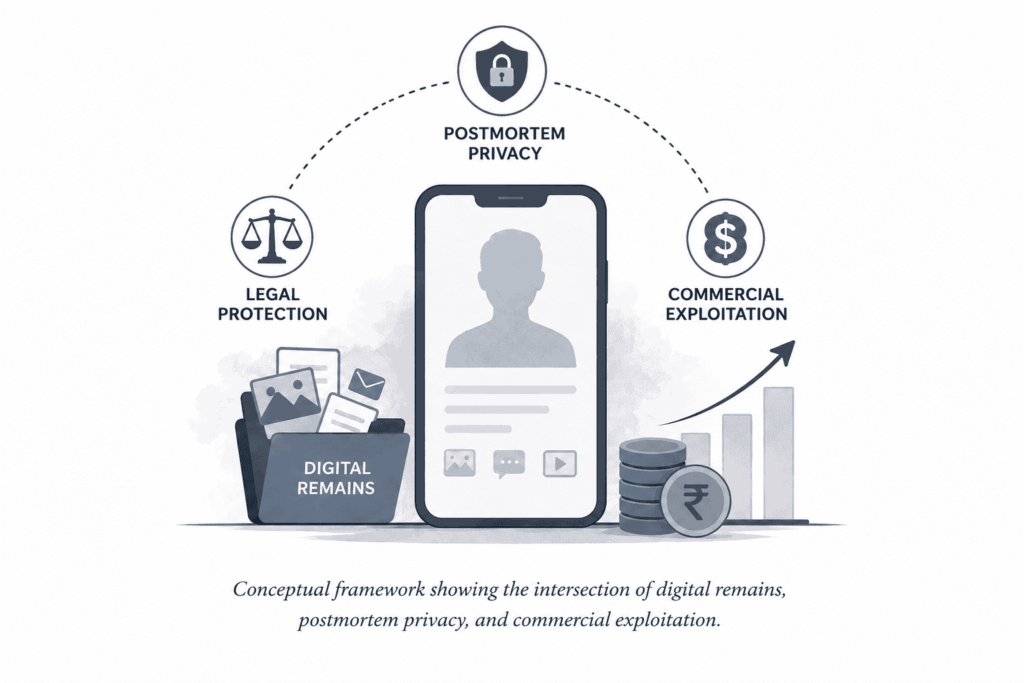
Digital technologies have become a part of everyday life. People routinely use social media, email, online banking, cloud storage, digital wallet, and many other online platforms to communicate, work and store personal information. Through these interactions, every individual creates an extensive digital footprint during their lifetime. Even after a person’s death, this digital information remains available online. These online accounts, personal data, photographs, videos, emails and other digital assets are commonly known as Digital Remains .
The legal significance of Digital Remains has grown considerably with recent advances in Artificial Intelligence, deepfake technology, virtual avatars and digital resurrection have made it possible to recreate the voice, image and personality of deceased persons. These technologies are increasingly being used in entertainment, advertising, business and social media. While they offer new opportunities, they also raise serious legal and ethical concerns. A deceased person’s Digital Identity can be used for commercial purposes without their consent or the permission of their family. Such use may affect the dignity, privacy and reputation of the deceased person.
These developments have brought the concept of Postmortem Privacy into sharper legal focus. Traditionally, privacy rights were considered to end after death. However, many legal scholars now argue that a person’s privacy, dignity, and Digital Identity should receive some level of protection even after the death, because digital information continues to exist and can easily be copied, shared or commercially exploited.
The position under Indian law remains uncertain. Although Indian courts have recognised personality rights during an individual’s lifetime, judicial decisions such as Krishna Kishore Singh v. Sarla A. Saraogi & Ors. (2023) SCC Online Del 3997, demonstrates that the law remains uncertain regarding the posthumous protection of such rights, particularly where commercial exploitation is involved.
Several jurisdictions, including the United States (right to publicity), France (personality and privacy protections), Germany(postmortem personality rights), etc are still developing laws to deal with these new challenges. Some jurisdictions recognise for smart and publicity rights or provide protection through data protection loss, while others have no clear legal framework. In India, the Supreme Court recognised privacy as a fundamental right under article 21 of the Indian Constitution in Justice K.S. Puttaswamy (Retd.) v. Union of India (2017) 10 SCC 1. However, Indian law does not specifically deal with digital footprints, postmortem, privacy, or commercial use of a deceased person’s Digital Identity through AI technologies.Most existing research focuses on digital inheritance, succession of digital assets and the personality rights of celebrities. Comparatively, very few studies examine the commercial exploitation of ordinary individuals’ digital identities after death.
This research aims to examine the legal issues relating to Digital Remains , Postmortem Privacy and commercial exploitation of a deceased person’s likeness in the digital age. It also analyses the existing legal framework in India, compares it with international approaches, identifies the gaps in the present legal system and suggests the need for a legal framework that protects privacy, dignity and Digital Identity of individuals after death while ensuring the responsible use of emerging technologies.
OBJECTIVES:
This research aims to examine the legal challenges arising from Digital Remains , Postmortem Privacy and the commercial exploitation of deceased persons’ likeness in the age of Artificial Intelligence. The study further identifies the adequacy of the existing legal framework in India through a comparative study of selected foreign jurisdictions and proposes reforms for protecting Digital Identity after death. Finally, the research also proposes recommendations for developing an effective legal framework that balances individual dignity, family interests, freedom of expression, and legitimate commercial interest in the digital era.
RESEARCH QUESTIONS:
The present study seeks to address the following research questions:
- Does the existing legal framework in India adequately protect Digital Remains and Postmortem Privacy in the age of Artificial Intelligence?
- To what extent can the commercial exploitation of a deceased person’s likeness through Artificial Intelligence, deepfake technology and digital resurrection be regulated under existing Indian laws?
- How have jurisdictions such as the United States, France and the United Kingdom addressed issues relating to Digital Remains , Postmortem Privacy and posthumous personality rights and what lessons can India draw from these approaches?
- What legislative and policy reforms are necessary to develop a comprehensive legal framework for protecting Digital Identity, Postmortem Privacy and personality rights while balancing technological innovation, commercial interest and freedom of expression?
REVIEW OF LITERATURE:
The legal disclosure surrounding Digital Remains and Postmortem Privacy has expanded alongside rapid development in digital technologies, Artificial Intelligence and data-driven platforms. Existing scholarship has examined issues such as the nature of digital assets, succession of online property and the privacy interest of deceased persons. However, the literature remains fragmented in its treatment of AI-enabled commercial exploitation, particularly where technologies such as deepfakes, digital resurrection and virtual avatar are used to recreate a deceased person’s identity. While scholars have made valuable contributions to understanding digital inheritance and posthumous privacy, comparatively little attention has been devoted to the legal implications of commercially exploiting the digital identities of ordinary individuals. This review therefore, examines the principal academic perspectives, relevant judicial developments and existing legal frameworks, while identifying the conceptual and regulatory gaps that necessitates for research in this area.
CONCEPT OF DIGITAL REMAINS :
Digital Remains refers to all the digital data traces, identities and assets linked to a person and any other information that exists or continues to exist even after the death of that individual. Scholars broadly agree that these include social media profiles, emails, cloud storage, photographs, videos, cryptocurrencies, digital wallets, online subscriptions and other virtual assets. However, there is considerable disagreement regarding their legal protection.
Carl Öhman conceptualises Digital Remains as the continuing digital traces that continue to exist after the death of the person and argues that these remains should be treated not merely as data but as a continuation of a person’s social and informational presence. (Öhman, 2024). This perspective places greater emphasis on dignity, identity and the continuing relationship between the deceased and their digital presence.
In contrast, Birnhack and Morse reject treating the Digital Remains as an inheritable property. They distinguished Digital Remains into four categories and argued that while certain remains may properly fall under succession law, personal data should primarily be protected through privacy principles rather than property law.
They further argued that users expect some degree of control over their individual Digital Remains after their death and favour mechanisms that balance family access with the deceased’s privacy expectations.(Birnhack & Morse, 2022)
Similarly, Öhman and Floridi argue that Digital Remains have become economically valuable assets within a growing “digital afterlife industry” raising concerns regarding ownership, dignity and commercial exploitation.(Öhman & Floridi, 2017)
Waagstein says that Digital Remains cannot be understood through a single legal framework, because they simultaneously possess personal, social, economic and technological dimensions.(Waagstein, 2023)
Another line of scholars primarily argue that Digital Remains can be examined through the legal framework of succession law. They contend that digital assets should be considered similar to conventional property, which enables heirs to inherit and manage the deceased person’s accounts. While this approach facilitates estate administration, critics argue that it inadequately protects the deceased person’s privacy of information, particularly where commercially valuable data are involved.
This discrepancy demonstrates that existing points of views of scholars lack consensus regarding whether the Digital Remains should constitute property, personality or a hybrid legal interest. Due to the absence of conceptual clarity it led to production of inconsistent legal protection across jurisdictions.
The literature demonstrates a continuing lack of consensus regarding the legal character of Digital Remains . While Öhman primarily conceptualises them as an extension of personal identity deserving dignity-based protection, Birnhack and Morse advocate a functional approach that distinguishes between different categories of digital assets according to their legal nature. Waagstein, meanwhile, argues that Digital Remains possess overlapping personal, technological and economic characteristics that cannot be accommodated within a single legal framework. Among these perspectives, the functional classification proposed by Birnhack and Morse appears more persuasive because it recognises the hybrid nature of Digital Remains while balancing privacy interest, succession principles and commercial realities. The absence of conceptual consensus however, continues to contribute to inconsistent legal protection across jurisdictions.
DIGITAL REMAINS AND POSTMORTEM PRIVACY:
A second stream of literature examines whether privacy survives death. The early conceptualisation of Harbinja’s Postmortem Privacy was the right of a person to preserve and control what becomes of his or her reputation, dignity, integrity, secrets or memory after death (Harbinja 2022). In her later work she posits that autonomy should transcend death, allowing individuals to control their privacy, identity and personal data postmortem. These arguments are grounded in philosophical and legal theoretical scholarship on autonomy, personhood and dignity (Harbinja 2017). She has also in her later work contended about an idea of one’s Digital Remains , postmortal self, existing in and through technology.
Scholars argue that although conventional privacy rights generally terminate upon death, modern digital technologies justify recognising limited posts,often privacy because personal information tends to circulate online. They further reinforce that unrestricted commercial use of digital identities may undermine both the dignity of the deceased person and the emotional interests of surviving family members.
Although scholars broadly agree that certain privacy interests deserve protection after death, they differ regarding the legal basis for such protection. Harbinja grounds Postmortem Privacy primarily in personal autonomy and human dignity, whereas others scholars emphasise the practical risk associated with the continued circulation and commercial use of digital information. These competing approaches demonstrate that Postmortem Privacy cannot simply be treated as an extension of conventional privacy rights but requires an independent legal framework capable of addressing the unique challenges created by digital technologies.
COMMERCIAL EXPLOITATION:
Recent studies have increasingly focused on the commercial exploitation of deceased person’s likeness through Artificial Intelligence, deepfake technology, holograms and digital resurrection. These technological developments have significantly expanded the commercial value of digital identities by enabling highly realistic reproduction of a person, image, voice, and personality for use in films, advertisements, entertainment, and other commercial activities. While such innovations create new economic opportunities, they also raise complex legal questions concerning consent, ownership, dignity and posthumous personality rights.
Bathla (2022), specifically examines AI–generated avatar of deceased persons and argues that existing legal frameworks remain adequate to regulate ownership, licensing and posthumous personality rights. He observed that technological capabilities have developed significantly faster than legislative responses, getting opportunities for unauthorised commercial exploitation.
Most existing studies primarily analyse celebrity image rights and entertainment law. Comparatively, very few scholars examine the commercial exploitation of ordinary individuals’ digital identities, despite the increasing accessibility of generative AI tools. Consequently, existing literature remains disproportionately focused on celebrities while overlooking broader societal implications.
Existing scholarship predominantly examines the commercial use of celebrity identities within the entertainment industry. Comparatively little research considers the unauthorised commercial exploitation of ordinary individuals through Artificial Intelligence after death. This imbalance reveals an important gap in existing legal scholarship and underscores. The need for a broader legal framework capable of protecting all individuals, irrespective of their public status.
JUDICIAL APPROACHES:
Judicial decisions recognise rights during an individual’s lifetime but fail to remain consistent during the posthumous protection.
In India, the landmark Supreme Court case Justice K.S. Puttaswamy (Retd.) v. Union of India (2017), unanimously declared that the Right to Privacy is a fundamental right under Article 21 of Indian Constitution. Although this judgment concerns the living person, several scholars argue that its emphasis on dignity provides a constitutional foundation for recognising limited postmortem privacy.
Similarity, Arun Jaitley v. Network Solutions Private Limited & Ors. (2011) is a landmark Delhi High Court judgement that strengthened the protection of personal names against cyber squatting in India. The court ruled that the law passing off applies to domain names, preventing unauthorised parties from monetising the names of prominent individuals. This case acknowledged the commercial value of personality rights but did not determine whether such rights survive death. The absence of definitive judicial guidance leaves major uncertainty regarding posthumous personality rights.
Correspondingly, in Titan Industries Ltd. v. Ramkumar Jewellers (2012), the Delhi High Court recognised that an individual’s identity possesses independent commercial value and restrain the unauthorised use of celebrity likeness in advertisements. Although the dispute concerned living personalities, the judgement reinforces the broad principle that personality rights deserve legal protection against commercial misuse.
The judicial decisions examined above demonstrates that courts have recognised privacy, dignity and personality rights during an individual’s lifetime but have provided limited guidance regarding their continuation after death. While foreign jurisdictions have developed varying degrees of statutory protection, Indian law continues to rely largely on constitutional principles and judicial interpretation. Consequently, uncertainty remains regarding the commercial exploitation of deceased persons’ digital identities, highlighting the need for comprehensive legislative intervention.
METHODOLOGY:
This research adopts a doctrinal legal research methodology complemented by a qualitative and comparative analytical approach to examine the legal issues surrounding Digital Remains , Postmortem Privacy and commercial exploitation of a deceased person’s likeness in the digital age. A doctrinal approach is appropriate as it enables a systematic examination, interpretation and critical evaluation of constitutional provisions, statutory framework, judicial precedents and scholarly writings to assess whether the existing legal framework adequately protects the digital identities and personality rights of deceased individuals.
The research is descriptive, analytical and comparative in nature. It first examines the foundations of Digital Remains , Postmortem Privacy and commercial value of existing legal frameworks governing these issues in light of emerging technologies such as artificial intelligence, deepfakes, digital resurrection, virtual avatars and generative media. Particular emphasis is placed on examining the legal and ethical challenges arising from the unauthorised commercial use of deceased persons, image, voice, likeness, and other digital assets through emerging AI technologies.
The study relies entirely on secondary sources of data. Primary legal materials include constitutional provisions, statutes , judicial decisions and relevant international instruments concerning privacy, personality rights, intellectual property, succession and data protection. Secondary materials comprise scholarly books, peer-reviewed articles, policy papers and reputable legal databases.These sources are analysed to trace the development of legal principles, compare competing scholarly viewpoints and identify gaps within the existing legal framework.
The comparative analysis between India, the United States, France and European Union forms an integral part of the research. The Indian legal framework is actively compared with specific jurisdictions, namely the United States, France and the European Union, both of which have developed individual approaches to personality rights, postmortem publicity rights, digital inheritance and data protection. The comparative study seeks to identify best practices, evaluate the effectiveness of legal frameworks and where the Indian legal framework needs more adaptation.
The scope of this research is confined to the legal dimensions of Digital Remains , Postmortem Privacy and posthumous personality rights, with particular emphasis on commercial exploitation through Artificial Intelligence and other digital technologies. As a doctrinal method, the research does not include any empirical methods such as surveys, interviews or questionnaires. Hence, the findings are derived from the critical analysis of legal sources and academic scholarships.
The jurisdictions selected for comparative analysis were chosen because they represent distinct legal approaches to regulating Digital Remains , post-mortem privacy and personality rights. The United States was selected due to its well-developed doctrine of the right of publicity and statutory recognition of posthumous publicity rights in several states. France was chosen because it has enacted specific legislation governing the management of digital data after death, making it one of the few jurisdictions to recognise postmortem Digital auto through statutory Majors. The United Kingdom represents a common law jurisdiction whose legal framework relies on privacy, succession and data protection principles rather than dedicated legislation. These jurisdictions provide diverse regulator models that facilitate a meaningful comparison with the Indian legal framework, which presently lacks comprehensive legislation on Digital Remains and postmortem privacy.
By adopting these methodological frameworks, the study evaluates the adequacy of the existing legal regime, identifies legislative and judicial gaps and proposes recommendations for developing a coherent legal framework that remains responsive to technological development while uploading constitutional values.
COMPARATIVE ANALYSIS:
A comparative analysis provides an effective framework for evaluating the adequacy of India’s existing legal position on Digital Remains and postmortem privacy. By examining the regulatory approaches adopted in the United States, France and the United Kingdom, the study identifies legislative best practices, highlights the strengths and limitations of different legal models and assesses their suitability for the Indian legal system. Such a comparison also demonstrates the extent to which Indian law lags behind evolving international approaches to the governance of Digital Identity after death.
1. United States-
The United States recognises the right to publicity, which protects an individual name, image, likeness, and other aspects of identity from unauthorised commercial use. The posthumous privacy, Digital Remains and the commercial exploitation of the deceased person’s likeness are primarily governed by a patchwork of state laws rather than a single federal statute. This fragmented framework intersects with digital privacy and intellectual property, the pending federal legislation aims to unify these rights. Unlike traditional privacy rights that generally end at death, a majority of states like California, New York, Indiana, Tennessee, etc., have enacted postmortem right of publicity laws that make this right an inheritable property asset. The length of protection varies significantly by state. For example, California provides protection for 70 years postmortem, while New York limits it to 40 years and Indiana extends it to 100 years. American courts have also considered disputes concerning posthumous publicity rights. In Shaw Family Archives Ltd. CMG Worldwide, Inc., litigation over the commercial use of Marilyn Monroe’s image demonstrated that posthumous publicity rights largely depend upon state legislation rather than a uniform Federal framework (California Civil Code § 3344.1; Shaw Family Archives Ltd. v. CMG Worldwide, Inc., 2007).
Judicial decisions such as Shaw Family Archives Ltd. v. CMG Worldwide, Inc further demonstrates that the protection of posthumous publicity rights depends largely upon state legislation rather than a uniform federal framework. This illustrates both the flexibility and the inconsistency of the American approach (Shaw Family Archives Ltd. v. CMG Worldwide, Inc., 2007).
2. France-
France is a pioneer in digital death. While the standard EU general data protection regulation applies only to living individuals, France uniquely protects the dignity, privacy and image rights of deceased individuals through a mix of civil and digital specific statutes. The primary legislation is the French digital Republic act (Loi pour une République numérique), which amended the French data protection act. Individuals can set binding “digital wills” during their lifetime to decide how online accounts, photos and personal data should be handled postmortem. If no directives are left, heirs can contact service providers to update or close user accounts or restrict the continued processing of the disease, person’s data, especially for settling states. Heirs are legally entitled to receive digital data or memories deemed “similar to family souvenirs”.
3. United Kingdom-
In the United Kingdom, the rights surrounding Digital Remains , posthumous privacy and commercial exploitation are highly fragmented. Unlike some international jurisdictions that recognise formal posthumous personality or data rights, English law relies on a complex overlap of data protection, succession, intellectual property and passing of laws. The UK GDPR and the data protection act 2018 explicitly apply only to the living individuals. There is no automatic legal right to data privacy or a right to be forgotten after a person passes away.
4. India-
In contrast to some of these jurisdictions, India has not yet enacted legislation specifically governing Digital Remains or postmortem privacy. Although the Supreme Court recognised privacy as a fundamental right under article 21 in Justice K.S. Puttaswamy (Retd.) v. Union of India (2017), the regiment does not clarify whether such protection extends beyond death. Existing laws relating to copyright, succession, personality rights, and data protection do not adequately regulate the commercial exploitation of deceased individuals through Artificial Intelligence or deepfake technology. Indian courts have recognised personality rights through judicial decisions such as ICC Development (International) Ltd. v. Arvee Enterprises, (2003) and Titan Industries Ltd. v. Ramkumar Jewellers, (2012). However, these decisions primarily protect living individuals and do not concisely determine whether search rights survive death, thereby creating uncertainty in cases involving AI-generated recreations of deceased persons.
The enactment of the Digital Personal Data Protection Act, 2023 represents an important milestone in India’s data protection framework. However, its protection is confined to the personal data of living individuals and does not extend to Digital Remains or AI-generated reproduction of deceased persons. Consequently, significant uncertainty continues to exist regarding ownership, consent, inheritance, and the commercial use of a deceased person’s digital identity (DPDP Act, 2023).
The legal uncertainty regarding ownership, consent, inheritance and enforcement of rights over a deceased person’s digital identity.
| Aspect | United States | France | United Kingdom | India |
| Postmortem Privacy | Limited | Moderate | Limited | Not recognised |
| Commercial Exploitation | Protected through right of publicity | Limited protection | no specific law | no specific law |
| AI/ Deepfake Regulation | partial | developing | developing | no dedicated regulation |
| Overall Protection | high | moderate | moderate | low |
CRITICAL EVALUATION OF COMPARATIVE LEGAL FRAMEWORKS:
The comparative analysis demonstrates that no jurisdiction has yet developed a complete legal framework capable of addressing every aspect of Digital Remains , Postmortem Privacy and AI-enabled commercial exploitation. The United States offers comparatively stronger protection through statutory recognition of posthumous publicity rights, although the absence of a uniform federal framework results in inconsistent protection across states. France adopts a dignity-oriented approach by recognising digital autonomy and permitting individuals to determine the management of their digital data after death, but its framework focuses primarily on data protection rather than AI-generated commercial exploitation. The United Kingdom relies on existing principles of privacy, succession and intellectual property law, providing flexibility but limited certainty in relation to posthumous personality rights.
India, by contrast, continues to depend largely on constitutional privacy jurisprudence and judicial recognition of personality rights without enacting dedicated legislation governing Digital Remains or postmortem privacy. Although Indian courts have acknowledged the commercial value of personality rights, they provide limited guidance on whether such rights survive death or apply to AI-generated reproductions. Rather than replicating any single foreign model, India should adopt a balanced statutory framework that integrates privacy, dignity, succession, and technological regulation while remaining consistent with constitutional principles and the realities of emerging digital technologies.
ANALYSIS:
Theoretical Perspectives on Digital Remains and Postmortem Privacy:
The legal regulation of Digital Remains and post-mortem privacy supported by several established jurisprudential theories. The personality rights theory recognises that an individual’s identity, name, image, voice, and likeness constitute integral aspects of personhood deserving legal protection against unauthorised commercial exploitation. Although these rights are traditionally recognised during a person‘s lifetime, emerging Digital tech technologies have challenged the assumption that such protection necessarily ends upon death.
Privacy theory, particularly as developed through informational privacy, jurisprudence, views personal information as an extension of individual autonomy and dignity. The constitutional recognition of privacy as a fundamental right in Justice Puttaswamy (Retd.) v. Union of India reinforces the principle that informational control is closely connected with human dignity (Justice K.S. Puttaswamy v. Union of India). While the judgement concerns living persons, its underlying constitutional values provide an important foundation for debates concerning postmortem privacy.
Developments in Artificial Intelligence have challenged traditional legal assumptions regarding identity, consent and ownership in the digital environment. Technologies such as deepfake, voice cloning and digital resurrection enable the realistic recreation of deceased individuals, exposing limitations within conventional legal doctrines. Collectively, personality rights theory, privacy theory and digital rights jurisprudence support the need for a balanced legal framework that safeguard dignity and autonomy while permitting responsible technological innovation.
1. Digital Remains and the Existing Legal Framework:
The concept of Digital Remains has emerged due to the increasing dependence on digital platforms. The COVID-19 pandemic caused an unprecedented surge in digital presence and mortality (World Health Organisation, 2023; Öhman, 2024). This forced a massive cultural and industrial shift, leading to rapid growth of the “digital afterlife” industry, there was normalisation of virtual everything and a new focus on posthumous privacy and digital estate planning (Öhman & Floridi, 2017; Öhman, 2024). Digital platforms are widely used by everyone for communication, financial transactions and social interactions. These Digital Remains include emails, social media accounts, photographs, cryptocurrencies and other digital assets that continue to exist even after the death of that individual. ¹While Carl thinks that Digital Remains are extensions of personal identity, Michael Birnhack and Tal Morse argue that Digital Remains carry both proprietary and privacy related characteristics, which requires different legal treatment depending on their nature. ²The latter approach appears more persuasive as it acknowledges the diverse nature of digital assets. For instance, cryptocurrencies may require treatment under succession law, whereas personal emails or photographs warrant stronger privacy protection. This demonstrates that a hybrid legal framework is more appropriate than relying exclusively on either property or privacy law.
India presently lacks a dedicated statutory framework governing Digital Remains . Existing protection is derived from succession law, privacy jurisprudence, intellectual property law, and contractual arrangements between users and digital platforms. As these legal regimes were not designed to address AI-enabled exploitation of digital identities after death, significant uncertainty remains regarding ownership, access, consent and commercial use. This demonstrates the need for legislation that recognises Digital Remains as a distinct legal interest deserving independent protection.
2. Postmortem Privacy and Personality Rights:
Privacy as a fundamental right was recognised by the Supreme Court in case of Justice K.S. Puttaswamy (Retd.) v. Union of India, provided an important constitutional foundation for protecting informational privacy. However, Indian law does not specify whether this protection extends after the death of an individual. Similarly, personality rights have been recognised in cases such as Arun Jaitley v. Network Solutions Pvt. Ltd. and Krishna Kishore Singh v. Sarla A. Saraogi, but again judicial opinions remain inconsistent regarding their posthumous application.
The judicial position also reflects the absence of a settled legal doctrine regarding posthumous personality rights. In Krishna Kishore Singh v. Sarla A. Saraogi, the Delhi High Court observed that personality and publicity rights are not automatically inheritable in the absence of statutory recognition. This decision demonstrates that, unlike privacy during a person’s lifetime, postmortem protection of identity remains uncertain under Indian law and requires legislative clarification, particularly where Artificial Intelligence enables the commercial recreation of deceased individuals (Krishna Kishore Singh v. Sarla A. Saraogi, 2023).
³Scholars such as Edina Harbinja and Lilian Edwards argue that digital technologies justify recognising limited Postmortem Privacy because personal data continue to exist and may be exploited commercially after death. Due to the absence of the statutory regime, uncertainty regarding the use of a deceased person’s image, voice or likeness, particularly in the age of Artificial Intelligence is created.
The decision in Titan industries confirms judicial recognition of commercial value of personality guides during an individual’s lifetime. However, neither Titan industries nor the other judicial authorities conclusively determine whether such rights continue after death. Consequently, courts continue to balance dignity, commercial interests, and freedom of expression without clear statutory guidance, leaving considerable legal uncertainty in cases involving AI-generated recreations of deceased persons.
3. Commercial Exploitation through Artificial Intelligence:
Artificial Intelligence has expanded the commercial value of digital identities by enabling deepfakes, voice cloning, digital resurrection and virtual avatars. These technologies are used to recreate the deceased individuals for films, advertisements and other commercial purposes without any prior consent. Existing Indian laws were enacted before these technologies were developed and therefore do not adequately regulate such practices (Information Technology Act, 2000; Digital Personal Data Protection Act, 2023).
Due to the lack of legal framework, it may create the possibility of misuse and unauthorised commercial exploitation. Although intellectual property law and contractual agreements provide limited protection, they fail to adequately safeguard dignity, privacy and posthumous personality rights. A specialised legal framework addressing AI-generated exploitation of deceased persons identities is therefore necessary.
The commercial recreation of deceased actors through AI-generated performances and voice cloning illustrate the inadequacy of existing legal framework. Although these technologies create new commercial opportunities, they also raise significant concerns regarding consent, dignity and posthumous personality rights, particularly with no prior authorisation being granted (Bathla, 2022; Öhman, 2024).
Existing statutory provisions provide only fragmented protection. The Information Technology Act, 2000 primarily addresses cyber offences, while the Digital Personal Data Protection Act, 2023 regulates the personal data of living individuals. Neither statute establishes a legal framework governing AI-generated reproductions of deceased persons or provides rules relating to concept, licensing or liability. Consequently, significant regulatory gaps continue to undermine effective protection against unauthorised commercial exploitation (IT Act, 2000 & DPDP Act, 202).
¹Carl Öhman, The Afterlife of Data: What Happens to Your Information When You Die and Why You Should Care (University of Chicago Press 2024).
²Michael Birnhack & Tal Morse, Digital Remains : Property or Privacy?, 30 Int’l J.L. & Info. Tech. 280 (2022).
³Edina Harbinja & Lilian Edwards, Protecting Post- Mortem Privacy: Reconsidering the Privacy Interests of the Deceased in a Digital World, 32 Cardozo Arts & Entertainment Law Journal 83 (2013).
4. Findings:
The foregoing analysis demonstrates that the existing Indian legal framework provides only fragmented protection for Digital Remains and postmortem privacy. Current legal principles are inadequate to regulate emerging technologies that enable the commercial exploitation of deceased persons’ identity. Comparative analysis further indicates that, although foreign jurisdictions offer useful regulatory models, none provides a complete solution. India should therefore adopt a hybrid statutory framework that integrates privacy, personality rights, succession and technological governance while balancing commercial interest, constitutional values and innovation.
RECOMMENDATIONS:
1. Enact a Comprehensive Legal Framework:
The existing legal framework does not provide statutory protection for Digital Remains , post-mortem privacy or the commercial use of a deceased person’s digital identity. Parliament should enact dedicated legislation or suitably amend existing laws to regulate these issues comprehensively. Such a framework should clearly define Digital Remains , establish rights and obligations relating to their management and provide effective remedies against unauthorised commercial exploitation.
2. Recognition of Postmortem Privacy Rights:
Although the right to privacy has been recognised as a fundamental right under article 21 of the Indian Constitution, Indian law does not expressly extend his protection beyond death. Legislation should recognise Limited post-mortem privacy and personality rights to safeguard a deceased person’s dignity, reputation, image, voice, and Digital Identity while balancing the interests of legal errors, freedom of expression and legitimate public interest.
3. Regulation of Artificial Intelligence and Deepfake Technology:
The increasing use of AI-generated avatars, synthetic voices and deepfake technology has made it possible to recreate deceased individuals for commercial purposes. To prevent misuse, the government should introduce clear regulations requiring informed consent from the individual during their lifetime or such consent is unavailable, authorisation from legally recognised representatives before any commercial use of the deceased person’s likeness. In addition, commercial generated AI content depicting deceased individuals should be combined by appropriate disclosure to promote transparency and minimise the risk of deception or misuse.
4. Recognition of Digital Estate Planning:
Individuals should be encouraged to make provisions regarding their digital assets through digital bills or digital estate planning mechanisms. The legal system should recognise instructions relating to social media accounts, cloud storage, digital wallets, emails, photographs, and other online assets. Such a mechanism would reduce disputes between family members and ensure that the deceased person’s wishes regarding their Digital Identity are respected.
5. Public Awareness and Ethical Governance:
Legal reform should be complemented by public awareness in initiatives, encouraging digital estate, planning and responsible management of digital assets. The government agencies, educational institutions and technology companies should collaborate to promote awareness regarding Digital Identity and postmortem privacy. At the same time, ethical standards for AI developers and digital content creators should be developed to ensure that technological innovation remains consistent with human dignity, informed consent and privacy.
CONCLUSION:
The rapid expansion of digital technologies has fundamentally transformed the manner in which individuals create, store and preserve their personal information. Social media accounts, emails, photographs, financial records and other digital assets continue to exist long after death, giving rise to what is now recognised as Digital Remains . At the same time, advances in Artificial Intelligence, deepfake technology, voice cloning and digital resurrection have significantly increased the commercial value of these digital identities while creating complex legal and ethical concerns relating to privacy, dignity, consent, and commercial exploitation.
This research examines the legal issues relating to Digital Remains , Postmortem Privacy and the commercial exploitation of a deceased person’s likeness. The study found that existing legal literature has mainly focused on digital inheritance, succession of digital assets and celebrity personality rights. Comparatively, the protection of ordinary individuals after death has received limited attention, particularly in relation to AI-generated recreations and commercial exploitation. This demonstrates an important research gap that is becoming more significant with the rapid growth of emerging technologies.
The comparative analysis further shows that countries such as the United States, France and the United Kingdom have adopted different legal approaches to regulate Digital Identity and posthumous rights. While these systems are not free from challenges, they provide useful guidance for protecting dignity, privacy and personality rights after death. In contrast, India still lacks a comprehensive legal framework, specifically dealing with Digital Remains , Postmortem Privacy and the commercial use of a deceased person’s likeness. Existing laws relating to privacy, succession, copyright, data protection and personality rights provide only partial protection and do not adequately address the challenges created by Artificial Intelligence and other digital technologies.
This research examined the legal issues surrounding Digital Remains , Postmortem Privacy and commercial exploitation of a deceased persons’ likeness through Artificial Intelligence. The comparative analysis demonstrates that all the jurisdictions such as the United States, France and the United Kingdom have adopted different regulatory approaches, none has developed a comprehensive framework capable of addressing every challenge posed by emerging technologies. In contrast, India’s legal framework remains fragmented, relying primarily on constitutional principles, judicial precedents and general statutory provisions that do not adequately regulate Digital Remains or AI-generated reproductions of deceased individuals.
Therefore, India should adopt a balanced and future oriented legal framework that recognises Digital Remains as a distinct legal interest, deserving protection. Such a framework should recognise limited Postmortem Privacy and posthumous personality rights, regulate the commercial use of AI-generated representation of deceased persons, establish clear rules regarding consent and digital estate planning and provide effective legal remedies against unauthorised exploitation. At the same time, the law should encourage technological innovation while ensuring that it remains consistent with constitutional values, human dignity, and ethical principles.
The study therefore concludes that legislative intervention has become imperative. Rather than adopting any single foreign model, India should develop a comprehensive statutory framework that recognises Digital Remains as a distinct legal interest, provides limited protection for Postmortem Privacy and personality rights, regulates the commercial use of AI-generated representation of deceased persons and establishes clear rules relating to consent, digital estate planning and legal remedies. Such legislation should balance technological innovation with constitutional values, including dignity, autonomy, freedom of expression and privacy.
As Artificial Intelligence continues to reshape the manner in which human identity and memory are preserved and reproduced, the protection of Digital Remains will become an increasingly significant legal concern. A coherent legal framework will not only safeguard the rights and dignity of deceased individuals and their families, but also promote responsible innovation by ensuring that technological progress is developed within clear, legal and ethical boundaries.
REFERENCES:
Bathla, N. (2022). Digital resurrection and posthumous personality rights: Ownership of AI-generated avatars of the deceased. Vintage Legal. https://www.vintagelegalvl.com/post/digital-resurrection-and-posthumous-personality-rights-ownership-of-ai-generated-avatars-of-decease
Birnhack, M. J., & Morse, T. (2022). Digital Remains : Property or Privacy? International Journal of Law and Information Technology, 30(3), 280-301. https://papers.ssrn.com/sol3/papers.cfm?abstract_id=4254683
Birnhack, M. J. (2017). Post-mortem privacy and informational self-determination. Ethics and Information Technology, 19(2), 129-142. https://www.researchgate.net/publication/315920837_Post-mortem_privacy_and_informational_self-determination
California Civil Code § 3344.1. https://codes.findlaw.com/ca/civil-code/civ-sect-3344-1/
Chaturvedi, S. (2026). The digital afterlife: Postmortem Privacy and Proprietary rights in the Information age. SCC Online. https://www.scconline.com/blog/post/2026/02/27/digital-afterlife-post-mortem-privacy-succession-india/
Constitution of India, 1950. https://share.google/sOguMeSWylpjg0dle
Digital Personal Data Protection Act, 2023 (India). https://share.google/e4bvsXzo3R02aFwiG
Digital Will. (2017). Digital estate planning: The smart way to prepare for your digital afterlife. https://www.digitalwill.com/post/digital-estate-planning-secure-your-digital-life-and-legacy
Erdos, D. (2021). Dead ringers? Legal persons and the deceased in European data protection law. Computer Law & Security Review, 40, 105528. https://papers.ssrn.com/sol3/papers.cfm?abstract_id=3599852
French Digital Republic Act, Law no. 2016- 1321 (France). https://www.wipo.int/wipolex/en/legislation/details/16380
General Data Protection Regulation, Regulation (EU) 2016/679.http://data.europa.eu/eli/reg/2016/679/oj
Harbinja, E. (2022). Posthumous privacy and the law. Edinburgh University Press.https://research.aston.ac.uk/en/publications/digital-death-digital-assets-and-post-mortem-privacy/
Harbinja, E., Edwards, L., & Morse, T. (2025). Digital Remains and Postmortem Privacy in the UK: What do users want? International Review of Law, Computers & Technology, 40(1), 5-28. https://papers.ssrn.com/sol3/papers.cfm?abstract_id=4813651
Information Technology Act, 2000 (India).https://share.google/xKQed0bU93RdnlAzS
Jus Corpus. (2026). The legal status of Digital Remains. https://www.juscorpus.com/the-legal-status-of-digital-remains
Morse, T., & Birnhack, M. J. (2022). The posthumous privacy paradox: Privacy preferences and behaviour regarding Digital Remains . New Media & Society, 24(6), 1410-1429. https://scispace.com/papers/the-posthumous-privacy-paradox-privacy-preferences-and-22dmgxpl8k
Öhman, C. (2024). The afterlife of data: What happens to your information when you die and why you should care. The University of Chicago Press. https://share.google/sIQem5j5zDJhhmP0P
Öhman, C, & Floridi, L. (2017). The political economy of death in the age of information: A critical approach to the digital afterlife industry. Minds and Machines, 27(4), 63-662. https://www.researchgate.net/publication/324499310_An_Ethical_Framework_for_The_Digital_Afterlife_Industry
Perera, A. (2025). Can I use the image of a dead celebrity in the US? Global Law Experts.https://globallawexperts.com/can-i-use-the-image-of-a-dead-celebrity-in-the-us/
Rai, U. (2026). The algorithmic ghost: A Jurisprudential inquiry into Digital Remains . Centre for Juridical and Legal Theory, National Law Institute University.https://cjlt.nliu.ac.in/
Waagstein, P. R. (2023). Digital Remains : A legal perspective. In B. Wagner, M. Kettemann, & K. Vieth (Eds.), Research handbook on law and ethics in the digital society. Edward Elgar Publishing. https://www.e-elgar.com/
World Health Organisation. (2023). WHO Coronavirus (COVID-19) Dashboard.https://data.who.int/dashboards/covid19/cases
Arun Jaitley v. Network Solutions Pvt. Ltd., 2011 SCC Online Del 2660 (India). https://indiankanoon.org/doc/754672/
ICC Development (International) Ltd. v. Arvee Enterprises, 2003 SCC Online Del 2 (India). https://indiankanoon.org/doc/358048/
Justice K. S. Puttaswamy (Retd.) v. Union of India, (2017) 10 SCC 1 (India). https://indiankanoon.org/doc/358048/
Krishna Kishore Singh v. Sarla A. Saraogi, 2023 SCC Online Del 3997 (India). https://indiankanoon.org/doc/71066966/
Shaw Family Archives Ltd. v. CMG Worldwide, Inc., 486 F. Supp. 2nd 309 (S.D.N.Y. 2007). https://www.quimbee.com/cases/shaw-family-archives-ltd-v-cmg-worldwide-inc
Titan Industries Ltd. v. Ramkumar Jewellers, 2012 SCC Online Del 2382, (2012) 50 PTC 486 (Del) (India). https://indiankanoon.org/doc/181125261/