

IISPPR

Category: Public Policies

Public Policies
Alok, Vaishnavi, Maitreyi, Sanskriti, Harshini, Yashwant

From Make in India to Atmanirbhar Bharat: An Empirical Analysis of Rising Import Tariffs and Domestic Manufacturing (2014–2025)

This study examines whether India’s shift toward higher tariffs under Make in India and Atmanirbhar Bharat strengthened domestic manufacturing between 2014 and 2025. Despite a marked rise in import duties, manufacturing’s share of national output remained broadly stagnant. Regression and structural-break analysis find that tariffs alone did not drive aggregate manufacturing growth, but their effects improved during the Atmanirbhar Bharat period when paired with Production-Linked Incentive schemes. Evidence from electronics, pharmaceuticals, and telecom suggests that performance-linked support can produce sector-specific gains, while raising concerns about input costs, global value-chain integration, and export competitiveness.

Read More »
Public Policies
Priyanshi Parmar

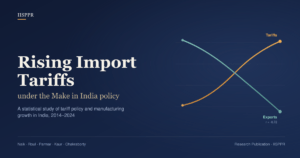
Rising Import Tariffs under Make in India Policy

This study examines India’s rising import tariffs under Make in India and their relationship with manufacturing performance during 2014–2024. Using correlation and regression analysis, it finds limited tariff impact, highlighting the importance of broader structural reforms.

Read More »
Public Policies
Shivani Khanna

From Budget Allocation to Educational Outcomes: Analysing Budget–Expenditure Gaps in India’s School Education Sector

This paper examines the gap between budget allocations and actual expenditure in India’s school education sector. It analyses major government schemes, including Samagra Shiksha, PM SHRI, PM POSHAN, STARS and DHRUV, along with institutions such as KVS, NVS, ATL and NCERT. Using secondary data from Union Budget documents, Ministry of Education reports, Demand for Grants and other official sources, the study looks at budget trends, expenditure patterns and implementation gaps. The findings suggest that budgetary allocations alone do not determine educational outcomes, as delays in fund utilisation, administrative challenges, implementation capacity and monitoring also influence how effectively resources reach schools and students. The paper concludes by suggesting measures to improve financial management, implementation, accountability and outcome-based planning in India’s school education system.

Read More »
Public Policies
Sikander Singh Bhangu

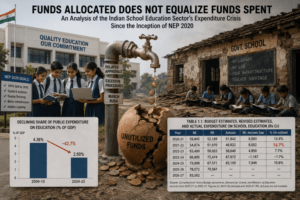
Funds Allocated Does Not Equalize Funds Spent An Analysis of the Indian School Education Sector’s Expenditure Crisis Since the Inception of NEP 2020

This study investigates the persistent gap between budget allocations and actual expenditure in India’s school education sector after NEP 2020. It identifies governance and implementation bottlenecks limiting effective fund utilization and argues that improving expenditure efficiency is essential to achieving equitable, high-quality education.

Read More »
Public Policies
Vihaan Gupta

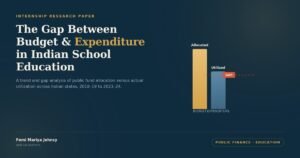
THE GAP BETWEEN BUDGET AND EXPENDITURE IN INDIAN SCHOOL EDUCATION SYSTEM

Excerpt This study examines the persistent gap between budget allocation and actual expenditure in the Indian school education system during 2018-19 to 2023-24. Using secondary data from official government sources, the study applies trend, comparative, descriptive, percentage, ranking, and graphical analyses to assess fund utilization. The findings reveal that despite a significant increase in budget allocations, a persistent expenditure gap remains, with the COVID-19 period recording the highest gap and notable regional disparities in fund utilization. The study emphasizes the need for improved financial governance, efficient fund utilization, and stronger administrative mechanisms to support quality education and evidence-based policymaking in alignment with SDG 4 and the vision of Viksit Bharat 2047.

Read More »
Public Policies
Krishnan Anicode

The Gap between Budget Allocation & Actual Expenditure in Indian Schooling System

**Excerpt:**
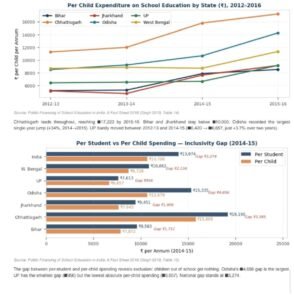
India’s education challenge is not merely about how much we spend, but how effectively and equitably we spend it. This study examines the gap between budget allocation and actual expenditure in education, highlighting chronic underinvestment, inter-state disparities and fund utilisation failures. Drawing on primary surveys and interviews alongside government reports and comparative data, the study finds that improving education outcomes requires more than higher allocations—it demands equitable resource distribution, effective utilisation, better infrastructure, skill-based learning and stronger governance.

Read More »
Public Policies
Subhash Gill

DIGITAL REMAINS, POST-MORTEM PRIVACY, AND THE COMMERCIAL EXPLOITATION OF A DECEASED PERSON’S LIKENESS.

Rapid advancements in generative AI enable the precise recreation of deceased individuals’ digital identities, exposing a critical regulatory void in Indian jurisprudence. Because traditional doctrines extinguish privacy rights upon death, domestic laws currently fail to address the commercial weaponization of digital remains. To resolve this, this study proposes the Unified Digital Afterlife Framework—a sui generis model that formally recognizes transmissible post-mortem personality rights and establishes a centralized licensing registry to preserve human dignity in a synthetic media landscape.

Read More »
Public Policies
Pranati Singh

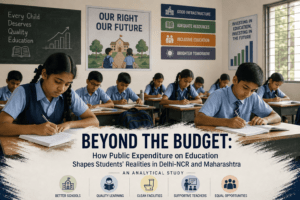
From Allocation to Impact: A Comparative Study of Public Educational Expenditure and Students Lived Experiences in Delhi and Maharashtra

Public expenditure has improved educational infrastructure and welfare provisions, but student experiences reveal gaps in maintenance, teacher engagement, welfare delivery, and digital access. The study finds that effective implementation, rather than investment alone, shapes meaningful educational outcomes.

Read More »
Public Policies
Saniya Mansoory

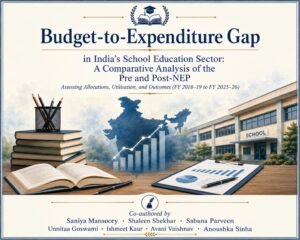
Budget-to-Expenditure Gap in India’s School Education Sector: A Comparative Analysis of the Pre and Post-NEP

Despite significant increases in education budget allocations following the introduction of the National Education Policy (NEP) 2020, India continues to face a persistent gap between allocated funds and actual expenditure. This paper examines the budget-to-expenditure gap in the education sector by comparing the pre-NEP (FY 2018–19 to FY 2019–20) and post-NEP (FY 2021–22 to FY 2025–26) periods. Drawing exclusively on official sources, including Union Budget documents, Parliamentary Standing Committee reports, CAG audits, and PRS Legislative Research, the study analyzes national spending trends and compares implementation outcomes in Kerala and Jharkhand. The findings show that although Ministry of Education allocations increased by 29.5%, public expenditure on education remains around 4.1% of GDP, well below the NEP target of 6%. Scheme-level analysis reveals an average utilization rate of 86% under Samagra Shiksha, but this masks substantial interstate disparities, delayed fund releases, and uneven implementation. The study identifies governance weaknesses, administrative delays, and inadequate monitoring as the primary drivers of the budget-to-expenditure gap. It concludes that higher budget allocations alone cannot improve educational outcomes unless accompanied by timely fund releases, efficient utilization, stronger accountability mechanisms, and outcome-oriented financial governance.

Read More »