Authors: Afasana Shaikh, Sri Anirudh Krishnamoorthy M, Anvitaa Singh, Asmi Thadeshwar
Abstract
This study explores the causes of placement disparities and their impact on engineering student’s employability. Utilizing (Periodic labor force survey) PLFS and National Statistical Office (NSO) and data from surveyed 5,767 Engineering individuals, reveals that, 20-25% of engineering graduates are employable. The key findings highlighted that, Employers recruits those candidates with industrial soft skills and having necessary professional portfolios developed through internships and training programs and engagement on professional platforms like LinkedIn, GitHub and haggle, furthermore, it also evaluates government initiatives through which students can developed as industrial ready for example, skill India, AICTE reforms and NEP 2020. These findings give comprehensive analysis of placement gap and suggested that, by aligning skill development with the policy frameworks, students can effectively bridge the employability gap.
Introduction
Despite the increasing number of engineering graduates in India, a gap remains between what students expect from jobs and their actual chances of being hired. Employability means that students and graduates can recognize, acquire, and improve the skills, knowledge, and personal traits that help them find meaningful paid and unpaid work that benefits themselves, their careers, the community, and the economy. (Oliver, 2015) In India, job placements for engineering students often fall short of their expectations, and the positions offered don’t always match their skills. A recent study on engineering employability pointed out the need for market-oriented skills and work-integrated learning to improve graduate employment outcomes. Additionally, limited job opportunities lower the chances of finding suitable positions. With unemployment being a major concern, many engineering graduates struggle to secure appropriate jobs despite years of academic training. This situation negatively affects their employability, creating a consistent gap between job expectations and market needs. This research examines how students view placements and how universities influence their experiences. It also looks at how students approach future career opportunities and manage their employability. (Tomlinson, 2007)
While past studies have focused on reasons for placement gaps among engineering graduates, most have concentrated on factors like institutional quality, industry exposure, and socio-economic issues. However, the impact of online presence and professional visibility on employability has received little attention, especially for engineering students in India. This study is significant because many engineering graduates enter the job market each year, yet many find it hard to secure jobs that match their skills and expectations. By investigating the factors causing this mismatch, the study can provide useful insights for guiding policy changes, improving curricula, and reforming institutions. It may also help educational institutions and employers better connect training with job market needs, thus increasing graduate employability. Therefore, this study aims to explore the gap between job expectations and employability among engineering students.
Objective of the study
Objectives of this research are to explore disparity in placement of engineering students, understand the important factors affecting their employability, examine the impact of online presence on employment prospects, and recommend measures for better employability outcomes.
Literature Review
Engineering Employability in India
The Indian higher education system is the second largest globally; the country produces more than 1.5 million engineering graduates each year (Lakshmi, 2025; Tilak & Choudhury, 2021). But the qualitative erosion is evident in these numbers, making it difficult for entry-level graduates to make their transition into employment. Over the decades, market observation shows that between 20 and 25 percent of graduates in engineering could be considered employable in the organized sector right from graduation (Nair, 2020; Tilak & Choudhury, 2021).
This widespread systemic problem largely stems from the structural misalignment of India’s traditional engineering education (focused on inputs) with the new-age, dynamically evolving skill demands of the modern knowledge economy (Blom & Saeki, 2011; Lakshmi, 2025).
Excessive focus on memorization “An excessively strong focus on memorization and instruction (as opposed to doing) leads to overproduction of graduates whose cognitive skills fall far short of what’s needed by industries, making their transition from higher education to employment problematic (Gupta et al., 2020; Tilak & Choudhury, 2021). A seminal study by Blom and Saeki (2011), published by the World Bank, charted the cognitive skills of the average Indian engineering graduate on the updated Bloom’s taxonomy. The results indicated a huge statistical difference between the graduates’ lower-order skills and higher-order thinking ability. While employers did express general satisfaction with the graduates’ low-order abilities (such as understanding and remembering), they highlighted a wide skills gap of 0.97 (p < 0.01) with respect to higher-order problem-solving, system design, and analysis of experimental data, even as the skill gap was much smaller for lower-order abilities (0.77) (Blom & Saeki, 2011).
The ‘cognitive gap’ means that although they have a paper qualification in their name, the engineering graduates lack the troubleshooting skills necessary for industrial problem-solving (Nair, 2020; Gupta et al., 2020).
Placement Trends in India
This glaring dichotomy between graduate supply and qualitatively-relevant industrial demand has engendered a structurally based labor market crisis. The national level micro data from the Periodic Labour Force Survey (PLFS) 2023-24 demonstrates that the underemployment rate among educated technical graduates of ages 18–30 years stood at 25.30 percent in the 34 states and union territories of the country (Chavan et al., 2024). This is essentially a waste of economic resources in form of skilled graduates who are not employed or are absorbed in temporary, low-pay, informal, and non-technical Jobs such as retail assistants, support staff in call centers or in
manual administrative jobs in various companies where technical skills of the degree holders are severely wasted (Chavan et al., 2024; Tilak & Choudhury, 2021).
The ability to enter into the formal economy does not get determined solely by some neutral academic metrics, instead it is strongly mediated by the role of social location, brand of an institution, geographical space.
An empirical data on campus placements collected from top engineering and technological colleges in the state of Kerala, for instance, show that General category (unreserved) students’ placement rates stood at 67.45 percent while the rate declined significantly to 23.85percent for the SC candidates and 3.03 percent for ST candidates (Prakash and Yadav, 2024). Moreover, if marginalized candidates happen to find employment, they too have significantly less access to high paying salary ranges. Thus while 31.10 percent General category graduates and 28.07 percent OBC category graduates found employment in firms providing high pay, only 14.81 percent SC/ST graduates did so (Prakash and Yadav, 2024). Such a structure suggests the campus recruitment models are not just a meritocratic process that helps graduates from socio-economic marginal groups to ascend to a new social class; they often tend to reproduce the historical social-economic inequalities (Mhaskar, 2021; Prakash and Yadav, 2024).
Emerging Trends in Recruitment
Contemporary Indian corporates are quickly shedding their roots in localized, highly personal, on-campus sourcing of talent to embrace and migrating into an automated globalized automated or digitized pipeline to manage talent needs (Nair, 2020). Companies avoid direct and cost inefficient interaction with traditional campus placements to make efficient use of high throughput screening mechanisms, and digital algorithms to manage talent acquisition processes.
AI-Assisted Recruitment and Automated Resume Screening
Algorithmic hiring The growth of the use of AI-recruitment tools in selecting candidates has now become quite widespread across sectors and organizations. Algorithmic selection tools, which are typically trained using historical recruitment data and some conceptualization of merit as embedded within organizations, can replicate existing disparities in labor markets (Raghavan et al., 2020). In the Indian context of engineering, students from highly funded institutions naturally benefit from opportunities to engage in internships, technical projects, develop professional networks, and create digital profiles (Tilak & Choudhury, 2021; Nair, 2020). Algorithmic screening methods may end up favoring these signals that differ across institutions in rewarding potential employees.
LinkedIn-Based Hiring and Professional Networking
Modern graduate recruitment relies heavily on digital professionalism, specifically through digital and cultural capital to build convincing professional selves (Healy et al., 2022). However, access to this domain remains deeply inequitable. PLFS data revealed substantial disparities in underemployment for engineering graduates across India between different social strata and these are to a large extent among those disadvantaged (Chavan et al., 2024) for whom connectivity and internet literacy make access prohibitive to cultivating a digital professional persona.
“The network effect for elite alumni means that professional space is captured within social ties,” which has helped elite networks maintain a caste bias, ensuring for them and exclusive ‘club of the same-kind’, thereby excluding disadvantaged graduates (Subramanian, 2019, as cited in Mhaskar, 2021). Comparable emerging market settings: Similar trends were documented among graduates from engineering in Tanzania where the usage of LinkedIn among graduates “was limited by connectivity issues, and high data costs, in tandem with low digital literacy” (Raphael, 2025, p.4), suggesting limitations of structural constraints for digital professional networking go beyond any individual country.
Added to the digital divides in access and internet connectivity is the emergence and widespread use of algorithmic recruitment tools which reproduce and institutionalize existing inequalities rather than eliminating these biases (Raghavan et al., 2020), leaving rural, socioeconomically disadvantaged Indian graduates completely in the digital hiring dark, whereas even equally qualified, General Caste engineering graduates are more than four times likely to find placement than their scheduled caste and scheduled tribe counterparts (OR=4.13, p=.005; Prakash and Yadav 2024).
GitHub Portfolio Screening and Technical Projects
Among technically inclined careers like software engineering, the use of signaling with a portfolio – e-portfolios, student showcase profiles, and competitive coding – has been widely used as an add-on to a resume for years now and is used by many recruiters to assess a candidate’s skills in problem solving besides their academic credentials (Nair, 2020; Raghavan et al., 2020). This would benefit students who practice on coding platforms like Code Chef and Hacker Rank and demonstrate technical skills (Nair, 2020), but would always disadvantage students who cannot take time off from work or who do not have access to independent project-based work experience. This disadvantage applies to the 84% Indian engineering education which is largely theoretical and lecture-based, with significant and consistent skill gaps being identified as early as the early 2000s, continuing to be the case at present and the issue is due to lack of opportunities in the curriculum to work on projects and/or pursue extracurricular technical activities (Tilak & Choudhury, 2021). The result is that those students who have to just focus on formal courses and exams struggle a lot while applying to job roles where a good project portfolio is necessary to be at par with privileged students, with specific focus on gender, social location, caste, region and geography (Chavan et al., 2024; Prakash & Yadav, 2024).
Cause of Placement Disparity
Institutional Factors
Socio-economic Background ⟹ Institutional Quality ⟹ Reduced Industry Exposure
Institutional quality provides the first point at which sociodemographic inequalities are systematically structured into graduate outcomes. The unfettered growth and unregulated nature of technical private universities – that represent over 86 per cent of engineering institutions and enrolments in India (Tilak & Choudhury, 2021) – have created sharply demarcated differences in educational quality. Elite Indian Institutions like the IITs, NITs, and best-in-class private Universities get significantly adequate public funding, sophisticated lab infrastructure, industry advisory boards, and well-equipped faculties (Gupta et al., 2020).
However, tier 2 and tier 3 self-financed private Universities get severely underfunded colleges facing substantial challenges like critical faculty deficits, an archaic learning and labs facilities, and almost absent corporate interface and industry-academia connections (Gupta et al., 2020; Tilak & Choudhury, 2021).
As highlighted by the AICTE-CII survey report cited by Tilak & Choudhury (2021), only 7.4 per cent of all engineering institutions in the country get any corporate funding for setting up departments, labs and research facilities. Of these, about 60 per cent received funding below 5 lakhs (about USD 6,000) from corporates, not enough to set up or maintain any decent modern lab or impart practical learning experiences (AICTE-CII, 2021, as cited by Tilak & Choudhury, 2021). Therefore, students studying in these institutions end up being educated on the basis of mostly passive, teacher-centered methods and learn solely about theories with no limited
practical skills. Both Gupta et al. (2020) and Nair (2020) acknowledge that these deficiencies result in credentialed, yet virtually unemployable students.
Industry Exposure
Institutional Quality ⟹ Industry Exposure ⟹ Impaired Skill Development
Institution without quality results in a severely constrained career path toward significant industry experience. This is empirically substantiated. The National Employability Report 2020-2021 reports by Aspiring Minds reveal that 60.72 percent of graduating engineers did not get a formal internship within the first four years.
Only 36.07 percent undertook additional technical work as part of coursework and 54.39 percent had not participated in any seminar addressed by an industry professional.
Thus, the process failed to offer students practical, employer-relevant experiences as part of their training, which contrasted with higher income countries where workplace experience is intrinsically built into degrees. The gap between classroom lectures and actual practice remains unbridgeable without real-world experience. Live-in-Labs, one such experimental scheme of Amrita, for example, offers a practical learning experience that is directly mapped to professional programmer outcomes required by employers in international settings. Lakshmi (2025) provided data illustrating the presence of a significant correlation between the participation in internships and a lower rate of graduate underemployment (=3.94, p=.047).
Without an enabling environment where they receive such experiences, students remain passive learners, rather than active participants and problem-solvers, as is necessitated by the current day workplace.
Socio-Economic Factors
Socio-Economic Background ⟹ Access to Private Training/Boot camps ⟹ Unequal Skill Development
A student’s socio-economic position and background has a strong impact on their experience and is ready to enter the workforce. This disadvantage is evident from the start; a graduate of a government-vernacular language school faces the challenge, growing at the individual’s experience, to keep up with a graduate of a well-to-do private-esnglish language school (Prakash & Yadav, 2024).
Through logistic regression modeling Prakash and Yadav (2024) found that if an engineering graduate is a former government school graduate, their probability of receiving a placement is nearly 50% lower as that of the private-school graduate OR=0.496, p<.01, p.15), regardless of branch of engineering, rank on the entrance examination or the college final CGPA (score). Such findings can be understood as indicating a persistent disadvantage in terms of foundational knowledge, confidence in communication and social network, with little done during college to overcome the lack.
In addition to overcoming curricula deficits, the higher-income families send their children outside the institution for specialized – high costs– Supplemental learning opportunities, which are as costly as private coding schools, specialized workshops for cloud computing and soft skills certifications (Lakshmi, 2025, p.5). Lakshmi (2025) finds a significant association between higher graduate rates of under-employment and the involvement of students in these supplemental programs (= -11.38, p<.001); Private supplemental learning offers an extremely effective mechanism through which labor market benefits can be purchased.
Digital Presence and Professional Visibility
Skill Development ⟹ Digital Visibility ⟹ Adverse Placement Outcomes
In a world that’s rapidly digitizing the hiring process, a graduate’s ability to be employable rests not only on having technical skills, but also on the capacity to showcase these competencies online using professional social media platforms and digital portfolios. Technology-enabled hiring tools – including professional networking platforms (e.g., LinkedIn), automated online tests, and algorithm-aided job application screening – mean that employers value easily discoverable technical skills and evidence of capabilities that can be openly verified (Raghavan et al., 2020). Consequently, job opportunities will likely be secured by graduates possessing competitive programming experience profiles, code repositories or portfolios, and professional network connections who stand to have an insight into high-quality jobs.
Many premier engineering and top-rank colleges incorporate the learning and practicing of competitive coding through platforms like Hacker Rank, Code Chef, and the International Collegiate Programming Contest (ICPC) into their curriculum, to provide the students an opportunity to create a digital profile with their achievements that goes beyond traditional academics (Nair, 2020).
The students in tier-2 and tier-3 schools may be unable to develop these platforms and professional profiles due to issues regarding infrastructure, lack of mentorship or poor industry linkage, and may have fewer opportunities to engage with these types of programmers. A broader literature on digital professional networking corroborates these observations, highlighting inequalities in the extent to which students are able to utilize these networks for career purposes, often tied to sociosocio-economic inequality, differential access to technology, and the varying availability of mentors and career advisors (Healy et al., 2022). Similarly, across different developing countries contexts, Raphael (2025) notes that graduates with technical skills rarely utilize LinkedIn, although they acknowledge its utility in the job market. Ultimately, lack of digital visibility might deepen already existing institutional and socio-economic inequalities because it deprives some marginalized graduates of the chance to demonstrate their skills, connect with influential industry professionals, and gain employer attention within the context of digitalized hiring pipelines, potentially amplifying differences in placement and underemployment outcomes (Chavan et al., 2024; Prakash & Yadav, 2024).
Geographic Inequality
Socio-Economic/Regional Location ⟹ Geographic Disconnect ⟹ Reduced Recruiter Visibility
Spatial Barriers Location can be said to represent one of the main spatial barriers which intersect with institutional and social-economic disadvantage and directly affects the problem of graduate unemployment and underemployment. The supply of formal private sector opportunities – from which graduates primarily source well paid work – is heavily clustered in a small handful of tier-1 metro regions, within key growth sectors like IT services, product design and development, advanced manufacturing, and financial services (Chavan et al., 2024). The PLFS 2023-24 data provides national microdata proof of the urban-rural gradient, confirming that overall rates of graduate underemployment for engineering graduates in rural India remain higher (27.55%) than for those in urban areas (24.01%) (Chavan et al., 2024, p. 6). Location therefore leads to the creation of a gap in placement through two additional compounding channels:
Geographic Concentration of Opportunities and Recruiter Access
It’s mostly the established top and elite colleges as well as metropolitan cities that see a concentrated placement drive with numerous opportunities (Ganga Lakshmi, 2025; Gupta et al., 2020). Hence the technical institutions that are situated in rural or semi-urban areas may witness less access to the corporate placements due to the absence of the professional colleges and its networking. A graduate at such locations might have no other choice than to face off-campus open job applications as there’s not much advantage of the campus placements as experienced by one studying in top-ranking institutions. The digital space is another aspect that makes the situation much worse.
Although companies have relocated the recruitment to virtual platforms due to less availability of resources in rural and semi-urban areas, graduates in those locations might have fewer opportunities and chances to join Hackathons or work in virtual teams and upskill in virtual assessments (Chavan et al., 2024; Raphael, 2025).
Socio-Cultural and Migration Constraints
Geographical inequality can also emerge from deeply embedded socio-psychological impediments of movement. According to a survey of students in a less developed region like Bihar’s Katha district, it is a psychological ‘home-sickness’ that makes it difficult for them to permanently move away from their place of origin that explains localized underemployment (Gupta et al, 2020).
More precisely, ‘31% of the students pursuing technical and higher studies mentioned a region specific inertia as one of the factors holding them from progress in life’ (Gupta et al., 2020, pg 6). So, for many graduates with high skills, specifically those from close-knit or orthodox communities living in rural areas it often makes more sense to suffer localized underemployment in non-technical lower waged professions than bearing the financial and social costs of high costs of living and dislocated social relationships of leaving for a distant metropolis.
Impact on Employability
Employment Opportunities
McQuoid and Lindsay (2005, p. 206) argue similarly, defining employability as ‘derived from, and affected by, individual characteristics and circumstances and broader, external (social, institutional and economic) factors that influence a person’s ability to get a job’. In India, young people (aged between 15 and 29 years) comprise 29.1 per cent of the total workforce, making it the youngest workforce globally The situation is often called a ‘demographic dividend’. The problem of high unemployment among young people concerns not only the low-skilled or unskilled but also the highly skilled, as reflected in the skills gaps evident between supply and demand in the labor market. Consequently, in some areas more than 60 per cent of all graduates remain unemployed three years after completing their course. A significant factor in the high level of unemployment among the better educated is a lack of practical skills, highlighting the disconnect between the theoretical learning and practical skills being taught at the institutions. (Schneider & Pilz, 2024)
Economists like Paul Beaudry refer to the devaluation of degree currency as “inflation in education” when the volume of graduates grows faster than demand in high skilled occupations. This erodes wages and employability for a given level of qualification over time. Employment surveys highlight graduate unemployment has grown from around 15% in 2014 to over 25% by 2022. An astonishing 66% increase over just 8 years. With 15 million students enrolled in tertiary education, this implies stagnation and despair confronting over 3.5 million graduates yearly. (George & Baskar, 2024) Macro employment creation failures certainly explain campus offer declines, with high growth projections.
Salary Differences
After earning a college degree, a person’s first job and starting salary are fundamentally used to examine their financial prospects and future professional status. (Saeed et al., 2023) Academic achievement has always been a major factor influencing the level of employability and income earned. Besides academics, participation in extracurricular activities, internship, industrial training and previous work experience can make an immense contribution to enhancing employability and earning more starting salaries.
According to research findings, graduates who have undergone internships or have any previous work experience usually earn more than those who have not. (Saeed et al., 2023) Economists like Paul Beaudry refer to the devaluation of degree currency as “inflation in education” when the volume of graduates grows faster than demand in high skilled occupations. This erodes wages and employability for a given level of qualification over time. (George & Baskar, 2024)
Psychological Impact
Engineering education is marked by intense academic demands, long study hours, and a competitive culture that heightens psychological pressure, compounded by job uncertainty,
financial instability, and societal expectations. Paradoxically, while society places immense value on the contributions of engineers, it has largely neglected their wellbeing. The psychological health of engineering students, who are being trained for transformative roles, remains peripheral in academic and policy discussions. These students often encounter intense academic pressure, extensive study hours, and a highly competitive culture. Such challenges are further intensified by concerns over employability, economic uncertainty, and societal expectations. (Mohmund et al., 2023)
Research shows that out of all the other fields engineering students are more affected by stress, burnout, and psychological distress.
The most important factors contributing to stress and discomfort. From the data obtained, we were able to deduce that Workload (67.3%), Examinations (53.5%) and finding a job after graduation (46.5%) were the three largest contributors of stress for the students. These were followed by performance pressure and competitiveness (46.2%). (Mohmund et al., 2023)
The psychological problems induced by unemployment are widely recognized, with research indicating that increasing unemployment rates correlate with a higher incidence of health issues, particularly those related to mental health. Various previous studies have outlined reasons behind heightened mental health issues among the unemployed. Factors such as joblessness, economic instability, lack of social identity, financial dependency, feelings of worthlessness, and low self-esteem have emerged as key contributors to mental health challenges among the unemployed. (Biswas et al., 2024)
Impact of Digital Presence on Employability
Recruiter voices from over 50 large and mid-sized companies reveal changing hiring paradigms across sectors. Employer sentiments explain sectoral changes in talent sourcing strategies especially regarding emerging capabilities. This helps contextualize choices made by institutes struggling to balance traditional expectations with spearheading new programs. (George & Baskar,2024) As India’s knowledge economy shifts, one off reskilling struggles to sustain employability.
Drawing on labor force surveys, chronicle sharp declines in transferability of engineering skills to services jobs. With outdated lab based pedagogy, engineers require further specialist retraining. Profile sites like Cagle, Be hence and GitHub where students can publish data models, creative profiles and coding repositories provide tangible showcases of expertise that recruiters actively mine for screening. Forward looking universities also disrupt traditional grade sheets with competency transcripts detailing situational experiences like business pitches, hackathons and consulting assignments providing holistic talent evaluation. Granular attributes get emphasized. (George & Baskar, 2024)
Legal and Policy perspective
In response to the problem of large numbers of engineering graduates who were not able to find jobs, the Government of India took several regulatory and mission-mode reforms in technical education during the last decade, to bring it into line with the changing job market demands. This section critically evaluates the four important components of this policy response, the AICTE guidelines, UGC initiatives, NEP 2020 and the Skill India/Digital India missions and looks into the goal and implementation of these.
AICTE Guidelines
All India council for technical education (AICTE) is a statutory body to regulate technical education in India, formally established under the AICTE ACT, 1987. It has taken several reforms aimed at improving the employability of the graduates. One major change has been the adoption of Outcome Based Education (OBE) which is being imbued by AICTE’s National Board of Accreditation (NBA) to the accredited programmers. OBE focuses on curriculum, teaching, and assessment to the measurable competencies, which are elaborated in Program Educational Objectives (PEOs), Program Outcomes (POs), and Course Outcomes (COs) instead of rote delivery of content. AICTE has also implemented compulsory internship and Choice Based Credit System (CBCS) with regular updates of its Model Curriculum in consultation with industry to ensure that the classroom content is relevant to the workplace needs.
In 2023-24, AICTE published its first-ever three-year Approval Process Handbook (2024-2027) in place of the previous annual review cycle. In this handbook, both the intake caps for well-performing institutions were eased and the linkage between institutional growth and quality was increased. But there is a risk of quality dilution when seat expansion is not associated with strict NBA accreditation, which has been confirmed by AICTE itself that many colleges continue to face challenges like faculty shortage and placement even after getting NBA approval (Tilak & Choudhary,2021)
Critical gap: Accreditation by AICTE via NBA is not compulsory for all the institutions, thus a considerable number of private colleges are not accredited. One of the areas of technical education that has consistently failed to be fully contained by AICTE is the commercialization of technical education where seat revenue has become more important than the rigor in the academics.
UGC Initiatives
The University Grants Commission (UGC) works alongside AICTE on the issue of greater integration of employability in degree programmers in general. The most prominent recent reforms are the Apprenticeship Embedded Degree Programmed (AEDP) which was formalized in an official UGC guideline document (2024-25) under the National Credit Framework (NCrF). Under AEDP:
Up to 30–40% of delivery and evaluation of curriculum, led by industry(UGC,2025)
Four of the five levels require a one-year apprenticeship (40 credits / 1200 learning hours) (UGC,2025)
The institution, industry partner and the student are bound to a tripartite agreement (UGC,2025).
All institutions suffer from penalties such that they may be closed in full or in part, while industry partners face penalties under the Bharatiya Nyaya Samhita, 2023 for continued non-compliance. (UGC,2025).
Additionally, UGC has set up the Council for Industry-Higher Education Collaboration (CIHEC) and approved funding for 102 community colleges and 127 vocational degree programmers, and is still developing guidelines to enable students to take more than one degree at a time (such as a B. Tech in computer science and a B. Tech in electrical engineering). In addition to a diploma in a complementary skill area, students will receive technical training as well (University Grants Commission, 2024)
Good practice gap: There is still not sufficient uptake of AEDP by schools, with uptake limited to a small number of pilot schools. Unless it is aggressively championed, the scheme could turn into another scheme made up of good ideas but never implemented, as have past UGC employability schemes.
New Education Policy 2020
The National Education Policy 2020 is the most comprehensive structural changes in the education system since decades in the engineering education space and many of its provisions are directly relevant to employability mismatch.
In the spirit of NEP 2020, engineering colleges need to shift towards being multidisciplinary institutions by 2040 that are not soloed and keep engineering students from gaining complementary skills in humanities, business and design. The NEP 2020 does not contain legally binding policy statements with enforcement mechanisms, but is a vision statement. It proposes a flexible under-graduate programmer for four years with several entry and exit points and also offers an Academic Bank of credits. It suggests the establishment of a National Research Foundation to build research culture in technical colleges with poor research culture (Ministry of Education,2020).
At the curriculum level, NEP’s focus on Outcome Based Education has led to changes in accreditation, with a proposed National Accreditation Council (NAC) which will evaluate industry engagement and employability metrics directly alongside NBA as well as infrastructure. (“Bridging Innovation and Flexibility,” IJIRT, n.d.).
The NEP 2020 does not contain legally binding policy statements with enforcement mechanisms, but is a vision statement. It is purely reliant upon implementation downstream, by UGC, AICTE and state government and lack of funds, faculty resistance and inconsistent adoption of it across the state which has not produced any tangible results at the graduate level ( Tilak and Choudhary,2021).
Skill India and Digital India Programs
The India Skills Report 2025 demonstrated measurable growth in the thrust for continuous learning in AI, ML and automation with graduates’ employability rising from 51.25% (2024) to
54.81% (2025) and engineering graduates achieving a score of 71.5% (employability rate), which was the second highest rank amongst all other graduates. Specific partnerships between industry and academia, including an automation Centre of Excellence between Anna University and Siemens, have been successful in localized contexts and have been reported to have helped the employability of the students by 85% (Anna University & Siemens, n.d.).
Critical gap: Shallow gains at National level. Out of the total youth population (15-29), only 21% have been engaged in any vocational or technical training, while only 4.4% have undergone formal vocational training. Most importantly, the percentage of Indian engineers who are equipped with the skills of Industry 4.0 (AI, robotics and IoT) is just 1.5% which shows that the flagship missions have raised awareness and access, but have yet to close the skills gap at scale (Wheebox & AICTE, 2025).
Indian legal and policy framework for engineering education reform, in a combined form, is detailed in design but disorganized in execution. The objectives of AICTE, UGC and the NEP 2020 are similar to enhance relevance, industry linkage and accreditation of curriculum but they are not integrated. AICTE, UGC and NEP 2020 objectives for improving curriculum relevance, industry linkage and accreditation are not integrated but work in parallel. That there is no single regulator having binding authority over all these domains (which the proposed Higher Education Commission of India / Visit Bharat Shisha Adhishthan Bill aims to cure) is the core legal hurdle that lies in the way of these good policies from turning into any measurable fall in the number of engineering graduates going into non-engineering jobs.
Challenges Faced by Engineering Students
Engineering graduates in India face different kinds of challenges that significantly affect their employability and placement outcomes. Many students continue to struggle in securing suitable employment opportunities in spite of rapid expansion of engineering education and having the largest share of the service sector. Existing literature suggests that these challenges arise from both institutional and individual-level factors, creating disparities in employment prospects across colleges and socio-economic backgrounds.
A major challenge is the persistent skill mismatch between engineering education and industry requirements. Several studies have highlighted that a considerable proportion of engineering graduates lack such capabilities demanded by employers. Tilak and Choudhury (2021) note that concerns regarding the quality of engineering education have contributed to low employability among graduates, with many employers finding graduates inadequately prepared for contemporary labor market requirements. Their study cites employability assessments indicating that a large proportion of engineering graduates are not job-ready for the knowledge economy (Tilak & Choudhury, 2021, 1-2). Similarly, Ganga Lakshmi in her article identifies that skill mismatch as one of the principal causes of underemployment among engineering graduates in India. She is emphasizing that academic training often fails to align with evolving industry needs of the service sector (Lakshmi, 2025, 1-2).
Another important challenge is the limited exposure to practical training and industry engagement. Engineering education in many institutions remains heavily theoretical, while
employers increasingly seek candidates with hands-on experience and applied technical skills. According to Tilak and Choudhury (2021), a significant proportion of engineering students do not participate in internships, technical projects, or industry interactions during their academic programmers. The absence of such experiences weakens students’ ability to apply theoretical knowledge in professional settings and reduces their competitiveness during recruitment processes (Tilak & Choudhury, 2021, 7). Lakshmi (2025) similarly finds that participation in internships and skill-development programmers significantly improves employment outcomes, underscoring the importance of practical exposure and industry-academia collaboration (Lakshmi, 2025, 1).
Engineering students also encounter communication and professional competency gaps. Modern recruitment processes evaluate not only technical expertise but also communication abilities, teamwork, problem-solving skills, and adaptability. However, many graduates struggle to demonstrate these competencies effectively during interviews and placement assessments. Pradhan (2021) argues that inadequate training, insufficient practical knowledge, and weak industry preparedness contribute substantially to unemployment among technical graduates. The study further notes that many engineering graduates remain unable to satisfy industry expectations despite possessing formal qualifications (Pradhan, 2021, 13-14).
A further challenge is the limited availability of career counselling and placement guidance, particularly in lower-tier institutions. Research on engineering education in India highlights substantial variations in institutional quality, faculty strength, industry linkages, and placement support. Banerjee and Muley (2008) observe that while a few premier institutions maintain strong industry connections and placement mechanisms, a large number of engineering colleges lack adequate academic autonomy, industry partnerships, and career-support infrastructure. Consequently, students often receive insufficient guidance regarding emerging career opportunities, skill requirements, and labor market trends (Banerjee & Muley, 2008, iii).
In recent years, lack of awareness regarding professional digital branding has emerged as an additional challenge affecting employability. Recruitment practices are increasingly influenced by digital platforms, where employers evaluate candidates through their online professional presence. Students who maintain professional LinkedIn profiles, showcase projects through GitHub repositories, and display certifications through digital portfolios often gain greater visibility among recruiters. However, many engineering students, particularly those from institutions with limited placement support, remain unaware of the importance of digital networking and professional self-presentation. As a result, equally skilled candidates may experience reduced employment opportunities due to lower online visibility and weaker professional networks.
Overall, the challenges faced by engineering students extend beyond technical knowledge alone. Skill mismatches, inadequate practical exposure, communication deficiencies, limited career guidance, and insufficient digital professional visibility collectively contribute to placement disparities and unequal employment outcomes among engineering graduates in India.
Recommendations
The findings of this study suggest that reducing placement disparity among engineering students requires coordinated efforts from educational institutions, policymakers, industry stakeholders, and students themselves. Based on the issues identified in the study, the following recommendations are proposed:
Strengthening Industry–Academia Collaboration
Engineering institutions should establish stronger partnerships with industries to ensure that academic curricula remain aligned with current market requirements. Regular industry interactions, guest lectures, live projects, and collaborative research initiatives can help students develop practical skills and workplace readiness.
Expanding Internship Opportunities
Internships should be integrated as a mandatory and structured component of engineering education. Greater access to internships will allow students to gain hands-on experience, improve problem-solving abilities, and better understand industry expectations before graduation.
Enhancing Skill-Based Learning
Institutions should place greater emphasis on project-based learning, coding practice, communication skills, teamwork, critical thinking, and problem-solving abilities. Alongside technical knowledge, students must be trained in professional competencies that are increasingly valued by employers.
Improving Placement Support in Tier-2 and Tier-3 Institutions
Government agencies and educational regulators should provide additional support to institutions with limited placement infrastructure. Career development centers, industry networking opportunities, recruiter outreach programmers, and placement training initiatives can help reduce inequalities between institutions.
Promoting Digital Professional Visibility
Students should be encouraged to build professional online profiles through platforms such as LinkedIn, GitHub, Kaggle, and digital portfolios. Colleges can organize workshops on personal branding, networking, and digital career management to improve recruiter visibility and employment opportunities.
Expanding Access to Skill Development Programmed
Financial assistance, scholarships, and subsidized certification programmers should be provided to students from economically disadvantaged backgrounds. This can help ensure that employability-enhancing opportunities are accessible regardless of socio-economic status.
Strengthening Career Guidance and Counselling
Dedicated career counselling services should be made available throughout the engineering programmer. Students need guidance regarding emerging career paths, skill requirements, recruitment trends, entrepreneurship opportunities, and higher education options to make informed career decisions.
Ensuring Effective Policy Implementation
Policies introduced under AICTE, UGC, NEP 2020, Skill India, and Digital India should be monitored through measurable employability indicators. Consistent implementation across institutions is essential for achieving meaningful improvements in graduate employment outcomes.
Encouraging Continuous Learning and Upskilling
Given the rapidly changing nature of technology and industry requirements, students should be encouraged to engage in lifelong learning through online courses, certifications, workshops, and professional development programmers. Continuous upskilling will help graduates remain competitive in the evolving job market.
Reducing Regional and Institutional Disparities
Special initiatives should be introduced to support students from rural and semi-urban institutions through virtual internships, online mentorship programmers, industry partnerships, and enhanced digital infrastructure. Such measures can help provide equal opportunities regardless of geographical location.
Overall, addressing placement disparity requires a holistic approach that combines educational reforms, industry participation, policy support, and individual skill development. Through collaborative efforts, engineering graduates can be better equipped to meet labor market expectations and achieve improved employability outcomes.
Findings & Discussion
The findings of this study indicate that placement disparity among engineering students in India is influenced by several interconnected factors. Rather than being the result of a single issue, employment outcomes appear to be shaped by differences in resources, opportunities, institutional support, and exposure available to students during their academic journey.
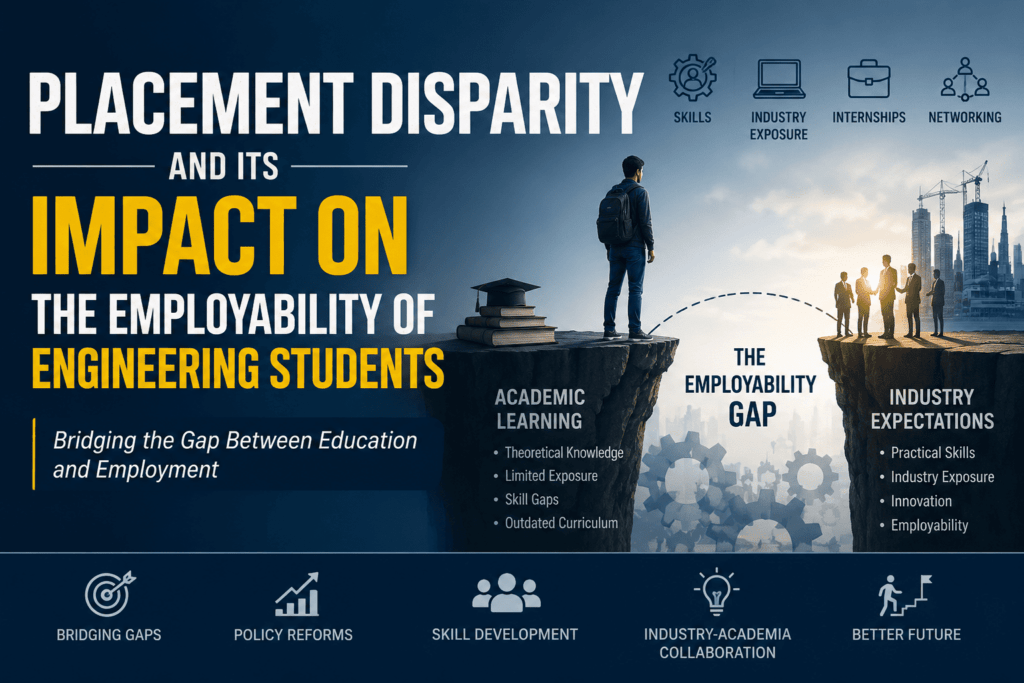
A clear pattern across the reviewed literature is the gap between engineering education and industry expectations. Students often graduate with a sound understanding of theoretical concepts, yet many face difficulties when required to apply that knowledge in practical situations. Employers increasingly look for problem-solving ability, adaptability, and workplace readiness, skills that are not always developed fully within the formal curriculum (Tilak & Choudhury, 2021; Lakshmi, 2025).
The type of institution a student attends also seems to matter. Well-established colleges generally provide stronger placement support, industry partnerships, training programmers, and internship opportunities. Students studying in tier-2 and tier-3 institutions may not receive the same level of industry exposure, which can influence their placement prospects (Gupta et al., 2020; Tilak & Choudhury, 2021).
For many students, preparing for employment involves expenses that are not always easy to manage. Certifications, internships, and additional training programmers often require financial investment. Because of this, students from financially secure families may have access to opportunities that help strengthen their skills and confidence. Others may face limitations despite having similar academic potential (Prakash & Yadav, 2024; Lakshmi, 2025).
Another observation emerging from the study is the growing importance of digital visibility. Employers are increasingly paying attention to LinkedIn profiles, GitHub accounts, and online portfolios while evaluating candidates. Students who actively showcase their work online may gain greater visibility, although awareness and access to these platforms remain uneven (Raghavan et al., 2020; Healy et al., 2022).
Where a student studies can also make a noticeable difference. Urban institutions often provide easier access to internships, networking events, workshops, and company interactions. Students from rural or semi-urban regions may encounter fewer such opportunities, which can affect placement outcomes over time (Chavan et al., 2024).
Policies such as AICTE reforms, NEP 2020, Skill India, and UGC initiatives were introduced with the aim of improving employability. The literature suggests that their impact varies across institutions, largely because implementation is not consistent everywhere (Tilak & Choudhury, 2021).
Taken together, the findings indicate that placement disparity is shaped not only by academic ability but also by differences in access to opportunities, resources, exposure, and institutional support.
Conclusion
The present research paper examined the gap between the placement opportunities and employability among engineering students in India, highlighting the complex factors that influence employment outcomes beyond academic performance. The findings revealed that placement disparity is not the result of a single factor but a combination of institutional, socio-economic, geographical, and technological factors that shape students’ access to opportunities and their readiness for the labor market.
There is a mismatch between engineering education and industry expectations. Engineering programs provide solid theoretical foundations; however, employers place a high value on practical problem-solving abilities, industry exposure, communication skills, and adaptability. The absence of internships, project-based learning, and interactions with industry professionals’
limits students’ ability to apply their academic knowledge effectively, making them less competitive in the job market.
The study revealed that the quality of institutions significantly influences employability outcomes. Students at well-established institutions generally benefit from stronger ties to industry, superior infrastructure, active placement support, and more opportunities for professional development. On the other hand, those from tier 2 and tier 3 institutions often face hurdles that can limit their placement prospects, even if they share similar academic abilities.
Socio-economic background further contributed to placement disparities. Access to additional certifications, training programmers, professional networking opportunities, and digital resources often depends on a student’s financial circumstances. Consequently, students from disadvantaged backgrounds may face barriers on developing the skills and professional profiles increasingly valued by employees.
Another important finding was the growing significance of digital professional visibility. Modern recruitment practices increasingly rely on platforms such as LinkedIn, GitHub, and digital portfolios to assess candidates. Students who actively cultivate an online professional presence are often more visible to recruiters. However, unequal access to digital resources, mentorship, and awareness of professional networking platforms creates a new dimension of employability inequality.
References
- Blom, A., & Saeki, H. (2011). Employability and Skill Set of Newly Graduated Engineers in Policy Research Working Paper, 5640.
- Gupta, A. k., Meher, B. K., & G. L. Puntambekar. (2020). Analysis of Perception of Students on Causes of Unemployment and Underemployment among Educated Mass in India. Journal of Xi’an University of Architecture & Technology, 12(4), 3395 – 3406
- Healy, M., Cochrane, S., Grant, P., & Basson, M. (2023). LinkedIn as a pedagogical tool for careers and employability learning: A scoping review of the literature. Education + Training, 65(1), 106-125.
- Mhaskar, S. (2021, August 25). The Caste of Merit: Engineering Education in India. South Asia: Journal of South Asian Studies.
- Nair, P. R. (2020). Increasing Employability of Indian Engineering Graduates through Experiential Learning Programs and Competitive Programming: Case Study. Procedia Computer Science, 172, 831-
- Prakash, A., & Yadav, I. S. (2024). Disparity in employment in India: evidence from engineering graduates across social groups and gender. REVIEW OF SOCIAL ECONOMY, 327-346.
- Raghavan, M., Kleinberg, J., Barocas, S., & Levy, K. (2020). Mitigating Bias in Algorithmic Hiring: Evaluating Claims and Practices. FAT* ’20 Conference Proceedings (ACM), 469 – 481.
- Raphael, C. (2025). Use of Professional LinkedIn Network for Job Hunting by Graduates of Technical Education and Training Institutions (TETIs) in Tanzania. Journal of Research Innovation and Implications in Education, 9(4), 654-666.
- Adelakun, N. O., & Adebesin, A. A. (2025). Enhancing engineering graduates’ employability through industry-relevant training and placement. Engineering International, 13(1), 99–112.
- Oliver, B. (2015). Redefining graduate employability and work-integrated learning: Proposals for effective higher education in disrupted economies. Journal of Teaching and Learning for Graduate Employability, 6(1), 56–65.
- Souppez, J.-B. R. G. (2025). Engineering employability skills: Students, academics, and industry professionals’ perception. International Journal of Mechanical Engineering Education, 53(1), 125–142.
- Tomlinson, M. (2007). Graduate employability and student attitudes and orientations to the labour market. Journal of Education and Work, 20(4), 285–304.