This paper presents Latent Alignment Theory (LAT), a model viewing UNGA voting preferences as observable signals of preference convergence. It uses network analysis to identify structural voting communities, and pinpoints the normative, threat-based, and economic catalysts that drive latent alignments toward formal alliance formation. The framework is further expanded by the Mandala Mapping Extension, which reveals the structural placement of states inside the alignment map by using Kautilyan mandala logic from the Arthashastra in combination with network topology. Furthermore, the study constructs the Latent Alignment Readiness Index (LARI) for operationalizing LAT and applies it to eleven alliance clusters between 2000 and 2023, for empirical verification. The concept is also validated by three case studies, Layer One is supported by India through strategic abstention and selective alignment, Layer Two is seen in BRICS as a political community, and Layer Three is confirmed by the China-Africa coalition, which has passed the institutionalization threshold through FOCAC and the BRI. Important conclusions drawn from LARI include the QUAD Core scoring 1.00, lowest amongst all coalitions, the ASEAN Cluster’s highest score of 2.75, and the Pressure Paradox in which blocs facing external pressure show the strongest convergence trajectories. The LAT provides a verifiable, quantitative as well as qualitative technique for understanding coalition emergence in multilateral environments by focusing on the pre-formation stage of alliances.
Keywords: Latent Alignment Theory, UNGA voting patterns, network analysis, ideal point estimation, Latent Alignment Readiness Index, geopolitical blocs, alliance formation
1. Introduction
Russia’s 2022 invasion in Ukraine displayed important questions about how international alignments are identified and understood. The contemporary international system is undergoing significant geopolitical change, with emerging alignments developing more rapidly than conventional theories of international relations can adequately explain. An important gap that appears in the literature is the problem of alliance visibility. Already present datasets, including the Correlates of War (CoW; Singer, 1963), primarily document formal security and economic agreements. As a result, informal but important patterns of policy coordination often lie outside conventional analysis. This leads to an unfinished understanding of evolving global power relations. Therefore, this study introduces Latent Alignment Theory (LAT) to call out this limitation. LAT conceives alignment as a continuum of policy convergence. It argues that voting behavior in the United Nations General Assembly (UNGA) delivers a visible indicator of these developing connections. However, a valuable setting for analysing state preferences is offered by UNGA.
Researchers can spot voting communities in temporal voting data and trace pre-formalized voting alliances after applying network analysis. This study fuses computational tools and theories of international relations. We propose LAT as a network science and alliance theory combination framework and provide the Mandala Mapping Extension. The extension modifies Kautilya’s Mandala theory to illustrate gradual concentric structuring of voting alliances. The research further creates a threshold model to show how formal alliances can be caused by factors such as the economic interdependence of nations and the formal alliances of nations. The research is centered on the post-Cold War era, when alliances were highly flexible. Unlike the stark divisions of the Cold War, today’s nations often pursue cooperative agreements in multiple sectors, often while engaging in different and competing foreign relations. Process tracing was carried out as a means of identifying and establishing the boundaries of the flexible alliances of India, BRICS and the China-Africa relationship. The case studies were intended to demonstrate the practical implementation of the LAT framework.
The paper is divided into sections outlining the theory of alliances, the three-tiered LAT framework, and analysis of UNGA voting patterns. The paper ends with the introduction of the Latent Alignment Readiness Index (LARI) which is an attempt to measure the possible development of formal alliances from latent alignment.
2. Literature Review
2.1 Ideal Point Estimation
Lijphart in his foundational model introduced Agreement Index to measure dyadic voting similarity which helped in detecting voting blocs in UNGA. It was purely descriptive in nature as it identified the states voting together but failed to explain the causes. It also did not take into account the changing geopolitics from one UN session to another. (Lijphart, 1963)
Voeten’s model directly addresses this limitation as it applies item-response theory to UNGA roll-call votes. Instead of simply observing the relation between two states, this model tries to find out each state’s underlying foreign policy preference or its “ideal point” by treating every vote as a sign of its ideology and direction. The resulting objective dataset loosely captures the orientation of UN member states towards the US-led liberal order. Crucially it also tracks these positions over time across different sessions. Instead of relying on self-reported positions, treaty text or diplomatic statements, it relies on hard empirical data and thus yields reliable objective conclusions. (Bailey, Strezhnev, & Voeten, 2017).
While Lijphart’s Agreement Index provides a descriptive measure of voting similarity, Voeten promotes the analysis by estimating latent foreign policy preferences through ideal point estimation. Nevertheless, both approaches primarily focus on voting behavior and do not include broader ideological, or geopolitical factors affecting alliance formation. This highlights the need for a complex model capable of moving beyond voting similarity to find out the emergence of geopolitical alliances.
2.2 Network Community Detection
Macon et al. applied network analysis to UNGA voting data by treating countries as nodes and co-voting frequency as the edge weight between them. They found that the voting in UNGA does not happen randomly. Stable and identifiable blocs emerge that can transcend formal regional groupings. They also tested whether the different blocs identified hold across various disaggregated issue areas like human rights, trade, climate finance etc. The groupings which appear repeatedly across various unrelated domains are structural in nature and not just tactical agreements. (Macon, Mucha, & Porter, 2012)
However, despite being computationally sophisticated, theoretically it is weak. It provides no causation for why a particular bloc successfully formed, how they consolidated over time or what converts a voting community into a formal alliance. This is the precise gap this research paper addresses: to use the network map of Macon et al as the empirical foundation for explaining voting preferences, consolidation of various networks and the threshold required for formalization of an alliance. Pomeroy et al. (2019) extended this by layering UNGA votes, speeches, and bilateral agreements, finding that vote-based communities were associated with fewer conflicts.
Although Macon et al. and Pomeroy et al, demonstrate the functionality of network analysis in identifying voting communities and patterns of cooperation. Both studies largely remain vivid. They find out the existence of communities but do not explain how these communities develop into formal geopolitical alliances or identify the conditions under which alignment become institutionalized.
This study addresses this limitation by combining network community detection with voting convergence, bloc unification, and strategic compatibility through the Latent Alignment Readiness Index (LARI), providing a structural approach for identifying emerging geopolitical alliances.
2.3 Economically Induced Alignment
A state forms an alliance with other states to counter a threat which it perceives. This is in contrast to forming an alliance because of the power of another state (Walt, 1987). A recent study by Steinert and Weyrauch (2024) analyzed the impact of China’s Belt and Road Initiative (BRI) on the voting behavior of UN member states in the UNGA. The results reveal Heterogeneous Effects of BRI membership on the UN voting behavior of member states. Importantly, however, several other variables have a more considerable impact on the voting behavior in the UNGA than BRI membership. This means that the economic incentives of BRI membership are not sufficient to bring about alignments on a regular basis.
Voeten (2000) analyzes the perspective of UNGA voting behavior by applying the Nominate Scaling method to the data of UNGA roll call votes for the period 1946-1996. He finds that the voting behavior of countries in the post-Cold War period is one-dimensional, i.e. most countries can be placed on one side of the divide between the Western countries and the counter-hegemonic countries. According to Voeten therefore, by studying UNGA voting in the long term, information can be gathered on the geopolitical preferences of countries. Thus, economic cooperation between two countries does not necessarily translate into political support of the two countries.
Steinert and Weyrauch ask whether economic incentives shape political alignment. Voeten instead reads alignment through UNGA voting patterns. Each captures only one dimension: Steinert and Weyrauch stay with economic incentives, Voeten with voting behavior, and neither brings in strategic or ideological factors. A framework that combines these dimensions would do more to identify emerging geopolitical alliances.
2.4 Ideology, Populism and Alignment
Destradi and Vüllers (2024) conceptualize populism as an ‘anti-establishment, and people-oriented thin ideology’. In terms of foreign policy, this typically leads to a highly negative view of Western foreign policy and foreign policy within the Liberal International Order (LIO). Yet, as with other ideologies, the foreign policy preferences of a country tend to be a more relevant determinant of a country’s international alignment than its economic or security interests. Given the nature of populist foreign policy, populist governments engage in so-called ‘Soft Balancing’ against powerful states. According to Pape (2005), Soft Balancing is a purely diplomatic form of balancing. It is implemented by way of diplomatic coordination between states as well as by means of international institutions, and by economic measures. Unlike in the case of ‘hard balancing’, however, military force is not used. A country’s alignment behavior is thus determined by the degree of shared interest between said country and other states.
Destradi explains alignment through ideological preferences while Pape emphasizes strategic cooperation among major powers. Even though both studies highlight important factors of international alignment, they examine these alignments independently and do not provide a common approach for integrating Ideology, Strategy and Voting behavior. Consequently, the existing literature lacks a combined framework capable of assessing multiple dimensions of alignment simultaneously.
Existing studies have substantially improved our understanding of economic, ideological, strategic and voting based international alignments. However, these studies largely examine these factors in separation and focus on explaining existing alignments rather than finding emerging geopolitical alliances. This study addresses this gap by proposing the Latent Alignment Readiness Index (LARI), which unites voting convergence, bloc convergence, and strategic compatibility into a single analytical framework for identifying latent geopolitical alliances.
3. Theoretical Framework
The theoretical framework developed here responds directly to the gaps identified in the literature reviewed in §2, treaty centric alliance datasets (Singer, 1963) capture only the end-state of cooperation, ideal point models (Bailey et al., 2017) capture preference but not structures formed by those preferences, and network community detection (Macon, Mucha, & Porter, 2012) captures structure but not causal the mechanisms forming those. LAT is built to integrate these three insights into a single multi-functional model.
3.1 Differentiating Formal and Latent Alignment
Traditionally, the study of interstate alignment has been focused on the formal treaties, alliances, and obligations of a formal nature. Liska (1962) regarded alliances as temporary arrangements of congruent interests, while Snyder (1997) saw alliances as formal contracts allowing the use of military force. Walt (1987) argued that states will align themselves in the face of threats, and the threats can be based on power, proximity, or perceived hostility. Oye (1986) suggested that cooperation will occur, or is more likely to occur, when interests are congruent, cooperation is likely to occur in the future, and defection will incur a penalty or cost. These perspectives do not elaborate on the cooperation that is conceived prior to the formal agreements. Many states will and do maintain congruent policies and/or coordinate actions at institutions of global governance and do not formalize or institutionalize that behavior. This paper will define this behavior as latent alignment and describe it as the early convergence of strategy that is largely ignored by empirical datasets on alliances.
3.2 LAT Layer 1: UNGA Votes as Signals of Preference
The first layer of Latent Alignment Theory (LAT) focuses on recognizing underlying foreign policy preferences through voting patterns in the UNGA. UNGA resolutions are mostly non-binding, where states are not legally forced to comply with the outcomes of their votes as these votes rarely entail immediate material costs. They serve as relatively low-cost signals of diplomatic preference, often described as forms of “cheap talks” (Voeten, 2012). While states may occasionally vote strategically, sustained patterns across many resolutions give insights into their broader ideological and political orientations (Voeten, 2012). Therefore, UNGA records function as observable proxies for latent preference structures
To understand these preferences, the study uses ideal points, which estimate a state’s position within a topic area based on their voting records (Bailey, Strezhnev, & Voeten, 2017). States placed closer together in this space are interpreted as presenting greater similarity in their foreign policy preferences, and vice-versa. By transforming voting records into quantitative data of preference convergence, ideal point estimation allows researchers to detect alliances before they become institutionalized by treaties or military pacts. Therefore, Layer 1 provides the foundation for discovering how informal preference convergence may grow into deeper forms of geopolitical cooperation with the course of time.
3.3 LAT Layer 2: Network Community Detection
By using network analysis to identify voting communities, continuous voting similarities within these groups are interpreted as proof of alignment by the LAT. The basic reasoning is that a pattern of similar preferences that may exist before any formal alliance is formed is being exhibited by states that consistently co-occupy the same vote cluster over several sessions and issue areas.
Modularity maximization was employed to segregate blocs through the identification of internal co-voting densities. The resulting modularity score greatly exceeds what would be expected in a random network of comparable size. This means that rather than regional or ideological categories being imposed from outside, communities are created from the voting data itself. Taking into account Macon, Mucha, and Porter (2012), this is processed using the Louvain algorithm, given that stable UNGA voting communities are consistently found to arise throughout sessions and to transcend geographical limitations.
Stable structural proximity is an underlying pattern of coordinated preferences that may exist even in the absence of formal alliances, treaties, or explicit diplomatic commitments, which is demonstrated when states stay in the same community over several sessions and issue areas. As a result, Layer Two acts as a bridge between the institutionalization dynamics hypothesized in Layer Three and the individual preference signals found in Layer One.
3.4 LAT Layer 3: Institutionalization Thresholds
A declining ideal point distance indicates that two states are converging on the preference index, and therefore moving towards latent alignment. However, the convergence alone does not explain whether this alignment will fade, or institutionalize. LAT argues that the significance of ideal point convergence depends on three reinforcing thresholds.
3.4.1 Economic interdependence (T1): When states with converging ideal points develop deeper trade, investment or technological linkages, alignment becomes more costly to reverse.
3.4.2 Norm Convergence and Constructivist Reinforcement (T2): As states get closer in ideal point space, they may also develop a shared understanding of the international order, security or regional governance.
3.4.3 External Economic and/or Security Threats (T3): Threats which often accelerate declines in ideal point distance by encouraging states to coordinate positions and support each other in multilateral forums. Persistent common threats can convert temporary convergence into sustained alignment.
Together these thresholds can determine whether declining ideal point distance remains a short term phenomenon or extends into a trajectory of sustained alignment, and eventual crystallization.
3.5 Mandala Mapping Extension
The Mandala mapping extension (MME) applies Kautilya’s principle of concentric rings, the Rajamandala to the UNGA network topology produced by the LAT analysis. In the Arthashastra, Kautilya conceptualizes the international order as a series of concentric circles around a central power (vijigishu), the immediate neighbors are natural adversaries (Ari), the states beyond them are natural allies (Mitra), and so on in alternating rings of enmity and friendship (Modelski,1964; Boesche, 2003). This extension adapts this geographical logic to a network graph, states are positioned not by geographic proximity, but by their LAT scores, and the resulting structure is interpreted via the concentric rings framework to identify alliances.
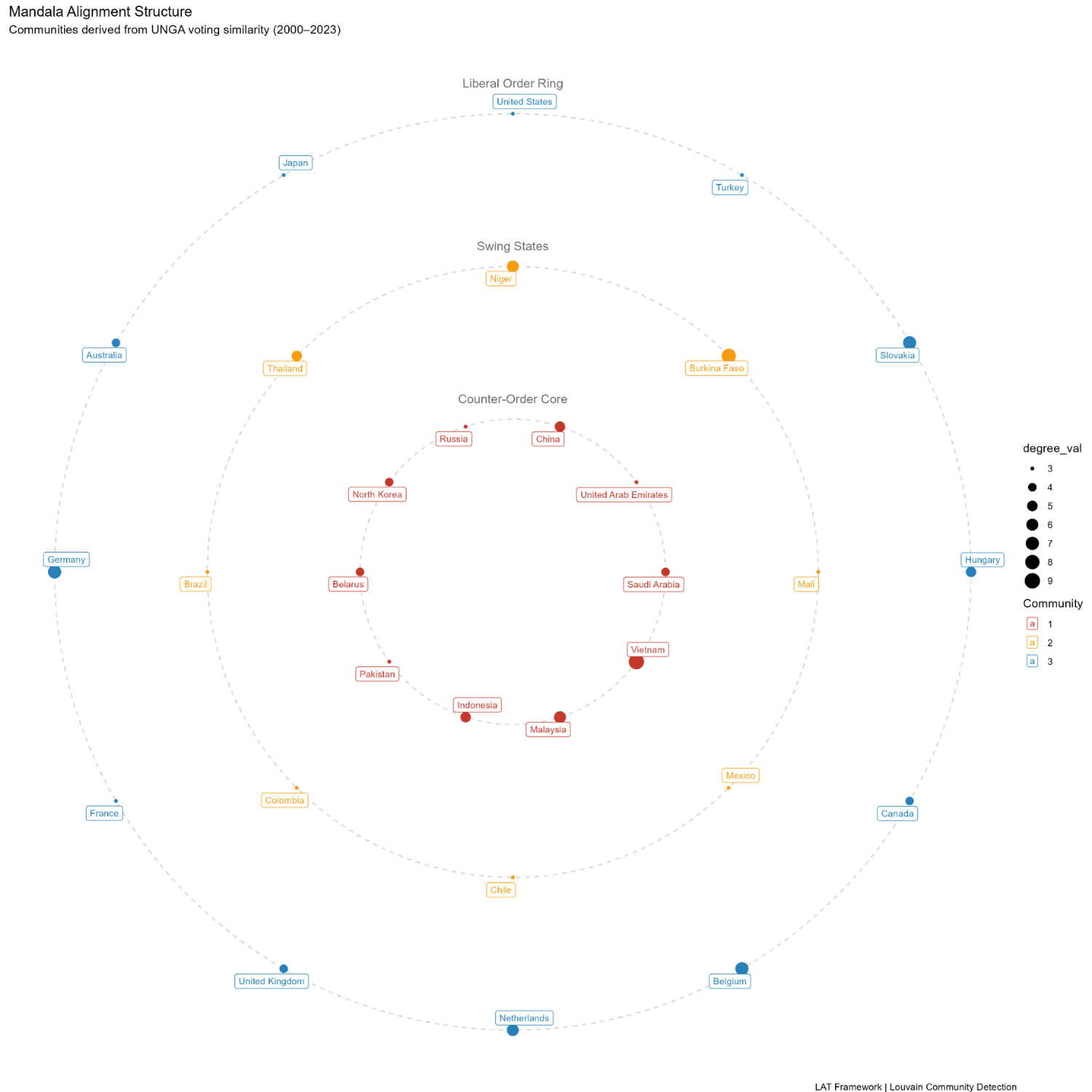
The analytical utility of the MME lies in its capability to reveal ordering within the alignment clusters that the LARI identifies. A high LARI score between two nations places them in the same community; the MME then identifies where that community sits in the broader network.
Note: Click on the images to view them in full resolution.
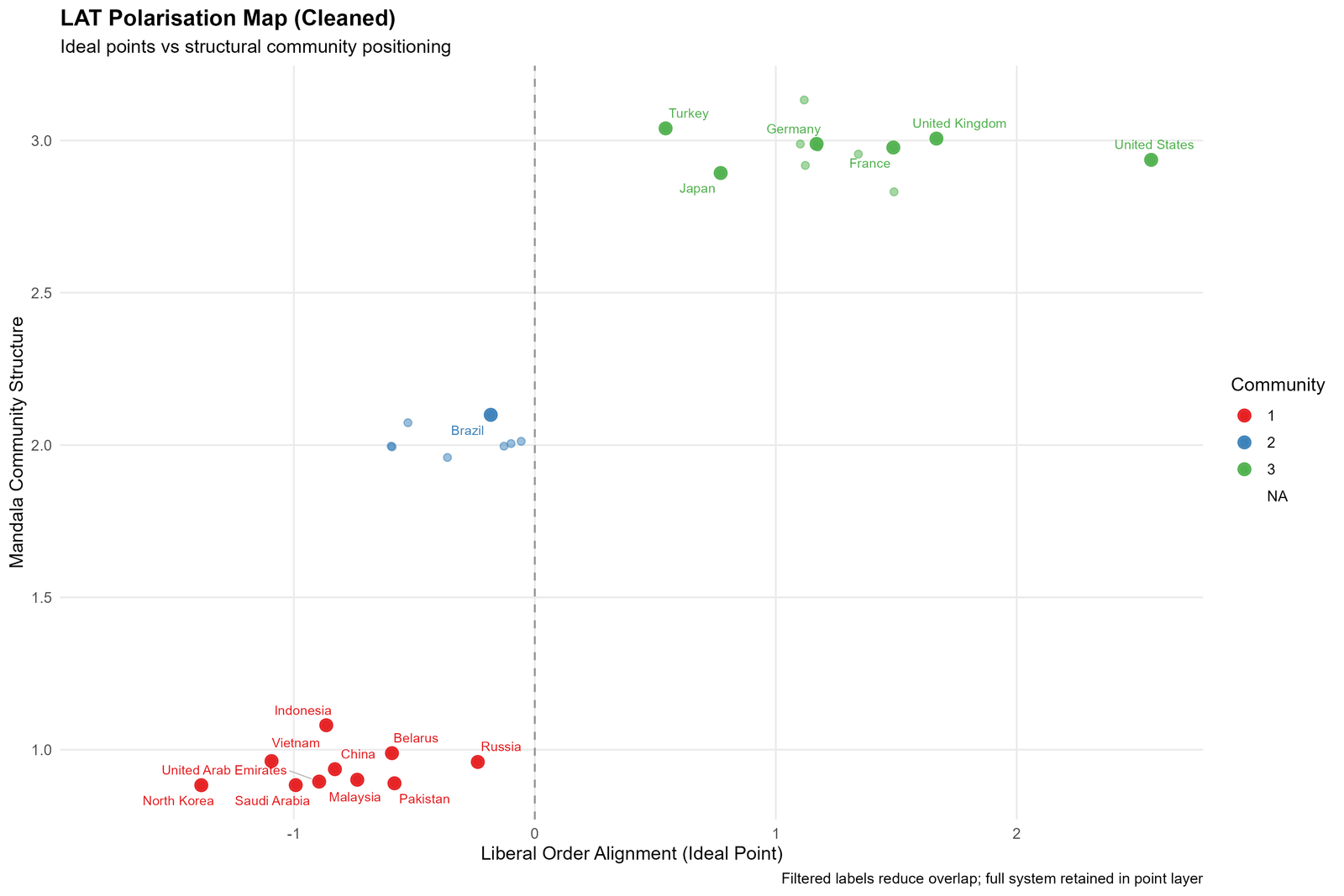
Figure 1 reveals three structural communities; community 3 (liberal order aligned) anchored by western democracies; community 1 (counter order), anchored by China, Russia and their close allies; community 2, containing swing states, whose ideal points oscillate between two poles. The MME identifies the clusters exhibiting the strongest latent alignment; the states which are connected most densely, and most weakly across community borders.
3.5 Hypotheses
Here, each hypothesis tests a specific claim at different stages. The advancement becomes evident as we progress in our hypothetical stance. This helps in testifying where the theoretical framework strengthens and limits its boundaries.
3.5.1 H1-Layer One: Abstention from voting on issues of sovereignty and sanctions is a latent inclination towards hidden preferences of states, which can be used for forecasting alliances. (Bailey et al., 2017)
3.5.2 H2-Layer Two: When unaccompanied by a formal concordat, states still co-vote on shared grievances across several issues. A pattern of shared voting consolidates its network formation.
3.5.3 H3-Layer Three: Economic dependency of states forces an intrinsic bond of shared values, namely, non-interference and south-south solidarity. This shift happens organically, the voting alignment solidifies into an institution.
3.5.4 H4-Mandala Extension: Drawn from Kautilya (Kautilya, 1915) The structured position of a state within the concentric rings of Mandala (Mitra, Ari and Madhyama) is theorized to predict the stability of emerging alliance blocs. The theory represents advanced methodology rather than mere interest estimation. (Boesche, 2003)
4. Layer Based Empirical Testing
4.1 Case Study 1: India and Simultaneous Latent Alignment
India’s UN voting pattern over the past few decades reveals a consistent set of preferences that operate independently of any formal bilateral agreements (Bailey et al., 2017). It is observed from the data that despite its stated commitment to non-alignment. Calibrating its positions across issue domains rather than adhering to any singular bloc, India practices selective alignment. Its sustained abstentions throughout the Russia-Ukraine conflict illustrate this most clearly, with state sovereignty functioning as the organizing principle of its foreign policy.
Cross-cutting alignments are produced by this selectivity. While aligning with Russia and China in opposing unilateral Western sanctions and defending sovereignty India converges with Western powers on counter-terrorism, maritime security, and cybersecurity. Confirming the absence of any comprehensive alignment among them. However, all four actors diverge on climate regulation and WTO trade reform.
In Kautilya’s mandala framework India’s posture finds useful grounding. The role of Aris is occupied by Pakistan and China , or immediate adversaries, while Russia functions as a complex partner whose deepening ties with Beijing complicate the relationship. Udasins in India’s mandala is best understood as the western powers (Mayfield, 2022), detached actors whose engagement with India remains contingent on converging interests rather than ideological affinity.
With India occupying a structurally distinct position in the international system, pursuing calculated independence without anchoring itself to any permanent coalition shows its UNGA voting record is consistent. This pattern satisfies and empirically validates the Layer One Hypothesis.
4.2 Case Study 2: BRICS as a Political Network Community
The BRICS nations have pursued increasingly stable coordination of their political and diplomatic positions on global issues since 2010, consistently presenting a consolidated front across domains of global governance, multilateral economic cooperation, and foreign policy orientation, China and Russia have emerged as the dominant stakeholders of this alignment. The remaining BRICS members, India, Brazil, and South Africa, have reinforced their engagement through summit diplomacy and the articulation of shared economic development objectives, simultaneously. BRICS’s growing significance as an institution for multipolar world order advocacy and collective action among the Global South was highlighted by this deepening cooperation.
BRICS members have maintained a divergence of less than 0.4 since 2008, which has further contracted to approximately 0.2 by 2022 (Hooijmaaijers & Keukeleire, 2016; author calculation from Bailey, Strezhnev & Voeten ideal point data) Measured through ideal point distance analysis of UN voting behavior . Among contemporary great power blocs this positions BRICS as the most ideologically convergent group . Suggesting these states are aligning on foundational questions of international political economy, the sustained compression of this distance reflects a strengthening of normative consensus within the coalition.
Analytically, the current phase of BRICS expansion is best understood as deliberate network widening that precedes formal integration (Hooijmaaijers & Keukeleire, 2016). BRICS is extending its reach and consolidating its geographical footprint prior to crossing the threshold of what might be termed Layer 3 institutionalization by admitting new member states.
4.3 Case Study 3: China-Africa and the Institutionalization Threshold
Rooted in a shared ideological commitment to the principles of the NAM (Non-Aligned Movement), particularly sovereign autonomy and the doctrine of non-interference, sustained convergence is demonstrated by African states and China in their UNGA voting behavior on questions of state sovereignty. This alignment cannot be attributed solely to China’s BRI, rather it is independent of infrastructural investment incentives (Lynch, 2023), and dependent on the broader frameworks of South-South cooperation.
Post-2013 voting trends among major African states, including Kenya, South Africa, and Nigeria, reveal a shift toward greater voting independence within the UNGA (Lynch, 2023). Evolving domestic politics, and differentiated bilateral relationships with global powers such as China and the United States, this divergence is attributable to the interplay of distinct national interests. Consequently, erosion was experienced by collective African coherence on issues spanning human rights and international security.
Smaller states with pronounced BRI dependency by contrast (Djibouti, Zambia, and Ethiopia) exhibit significantly stronger convergence with China on human rights resolutions, with alignment scores approaching upwards of 0.75 (Steinert & Weyrauch, 2024). Revealing that alignment operates across differentiated threshold stages rather than as a uniform phenomenon, these intra-group variations constitute a central empirical finding of this analysis.
This evidence corroborates and extends the findings of Steinert and Weyrauch (2024), who demonstrated that formal BRI membership does not independently produce discernible shifts in UN voting behavior. The degree of economic dependency it generates; often termed as cheque-book diplomacy (Flores-Macías & Kreps, 2013), the operative mechanism is not membership per se.
4.4 Cross-Case Synthesis
The three case studies validate LAT as a progressive empirical framework. Preference visibility through voting patterns of deliberate abstention and selective convergence, Simultaneous Latent Alignment (Bailey et al., 2017; Mayfield, 2022), India confirms layer one. Convergence is normative and a genuine political network driven alignment was born through a mere economic grouping (Hooijmaaijers & Keukeleire, 2016). Thus, BRICS confirms layer two. Africa-China confirms layer three, economic interdependence, constructivist norm convergence, and shared external threat perception together crossed the institutionalisation threshold, producing formal alignment architecture in a measurable and predictable timeframe (Steinert & Weyrauch, 2024). The selected cases are interconnected; India is simultaneously a layer one actor in the layer two framework of BRICS, which in turn lays the foundation for Africa-China testing layer three.
5. The Latent Realignment Readiness Index (LARI)
5.1 Methodology and Criteria
While international alignment is frequently identified through the use of UNGA voting patterns, durable geopolitical alliances are not necessarily indicated by voting similarity alone. States may form voting convergence without developing formal or durable geopolitical partnerships. To address this limitation this study introduces Latent Alignment Readiness Index (LARI), a framework designed to identify latent alignments that may evolve into future geopolitical alliances. C1 (weight: 40%) measures voting agreement across issue areas. C2 (35%) assesses whether states co-cluster within the same voting community over time. C3 (25%) examines ideal point proximity, supplemented by qualitative assessment of economic interdependence, norm convergence, and shared threat perception as thresholds (§3.4). This assessment is further supported by Mandala Community analysis, which provides additional evidence regarding the strategic compatibility of states. The combined score classifies alignments according to their potential and provides a systematic basis for identifying and forecasting emerging geopolitical alliances.
C1 (issue-area voting agreement) is weighted highest because it is the most directly observable behavioral signal, requiring no modeling assumptions beyond vote matching. C2 (bloc coherence) is weighted second because Louvain community detection, albeit robust at UNGA’s scale (Macon, Mucha, & Porter, 2012), still depends on a modularity maximization approximation technique rather than true alliance labels. Lastly, C3 (ideal point proximity and catalysts) is weighted lowest because it combines a programmed quantity (ideal points) with qualitative catalyst judgment, introducing more interpretive latitude than C1 or C2. Scores are further restricted to integers rather than continuous values, since the underlying data does not support the precision a fractional score would imply.
The master table presents LARI scores for eleven alliance clusters examined in this study, computed across 2000-2023. Scores range from 2.75 (ASEAN cluster) to as low as 1.00 (QUAD). No cluster achieves a perfect score of 3.00, which reflects the methodological conservatism built into the three LAT criteria.
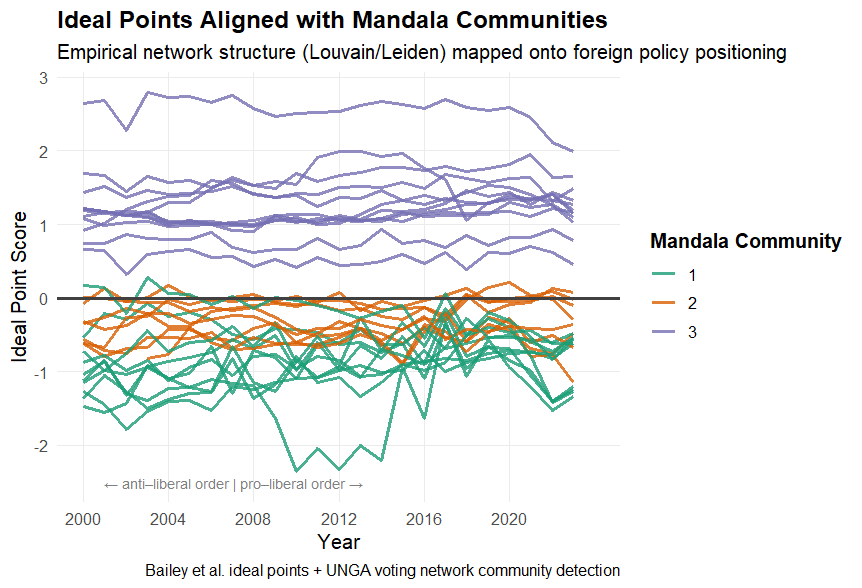
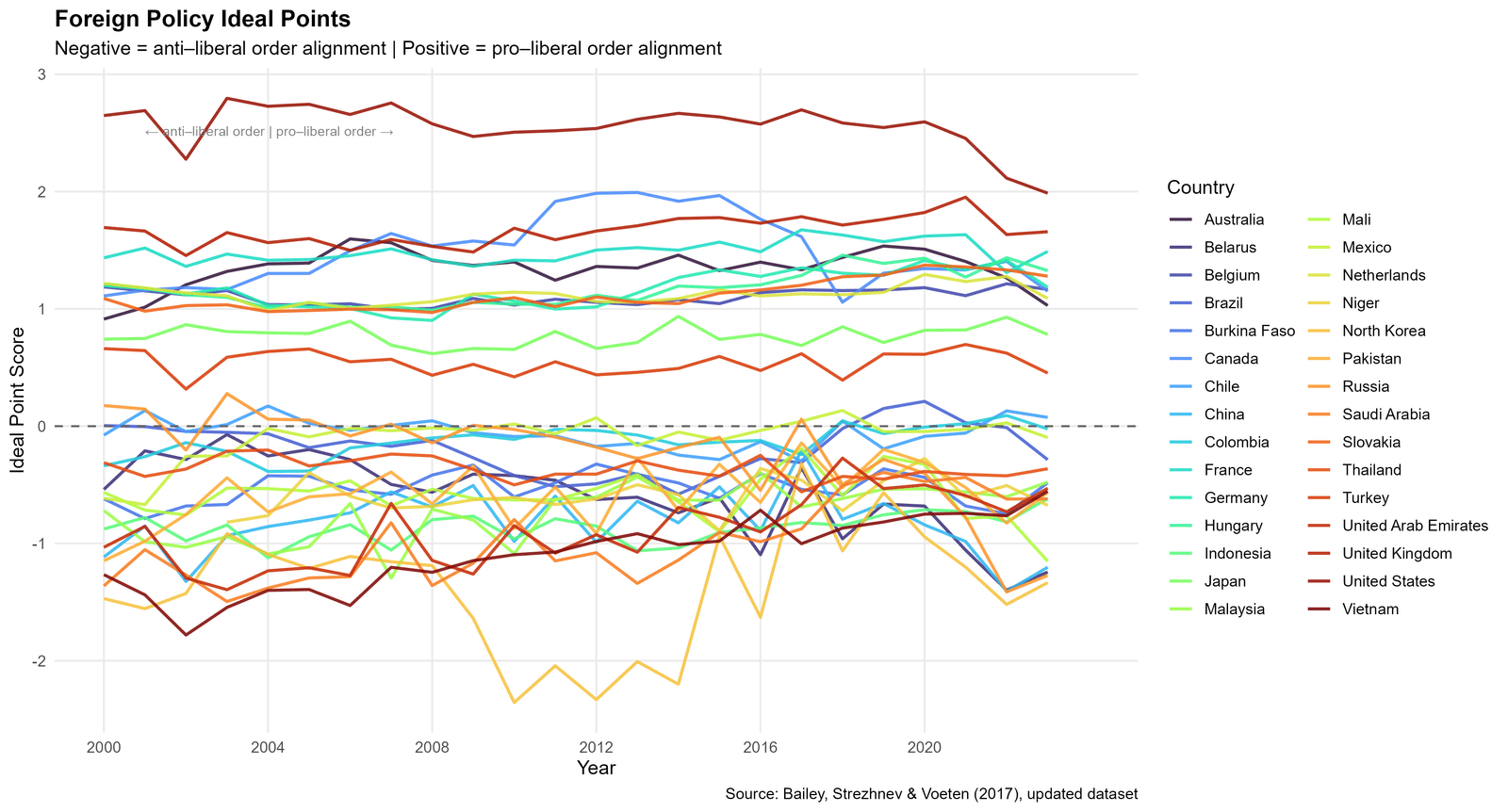
Figure 2: Ideal point trajectories by Mandala community, 2000-2023 (Ideal point scores derived from Bailey, Strezhnev and Voeten (2017)) (Positive scores reflect a pro-liberal alignment, and vice-versa)
Figure 2 establishes the temporal dimension of the structural communities, underlying the LARI scores. Community 2 has remained stable at the negative end of the axis across the full period, while community 3 shows the greatest variation over time, reflecting the ideological cycle of its member’s governments.
5.2.2 LAT Pressure Index
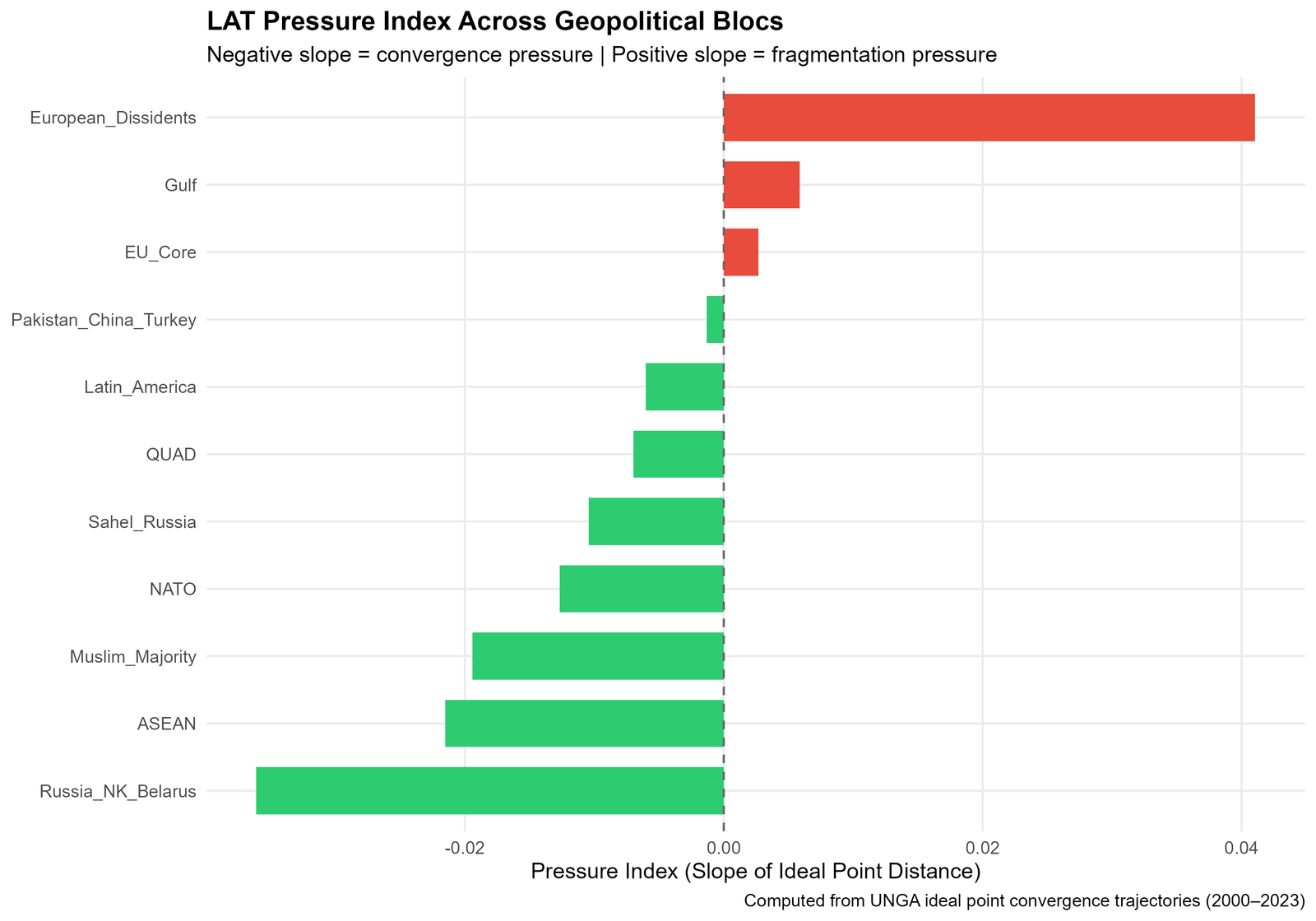
Figure 3:LAT Pressure Index across blocs. (This measures the slope if ideal point distance between bloc members computed from the aforementioned ideal points database) (Negative values indicate convergence and vice-versa)
Before presenting individual cluster scores, it is analytically significant to establish the directional trajectory of each bloc. The LAT Pressure Index (Figure 3) provides this information by computing the slope of ideal point distance trajectory for each bloc over a 23 year time period, it then algorithmically (mean dyadic OLS slope value) sorts it into convergent and divergent.
Reading from Figure 3, the blocs diverge into three groups:
5.2.1.1 Russia-DPRK-Belarus, ASEAN, Muslim Majority, and Sahel Russia: Negative pressure
5.2.1.2 EU core, Pakistan-China-Turkey, Latin America, NATO core, QUAD: Near zero Pressure
5.2.1.3 EU Dissidents, Gulf-China: Positive pressure
This trajectory information is interpretatively important. A cluster with a moderate LARI score, combined with a negative pressure index (eg. Sahel-Russia) is a stronger alignment that its score currently demonstrates. Conversely, a cluster with a high LARI score, but a positive/zero pressure index (eg. EU Core) is a more stable but not accelerating alignment.
5.2.3 ASEAN Sovereignty Cluster
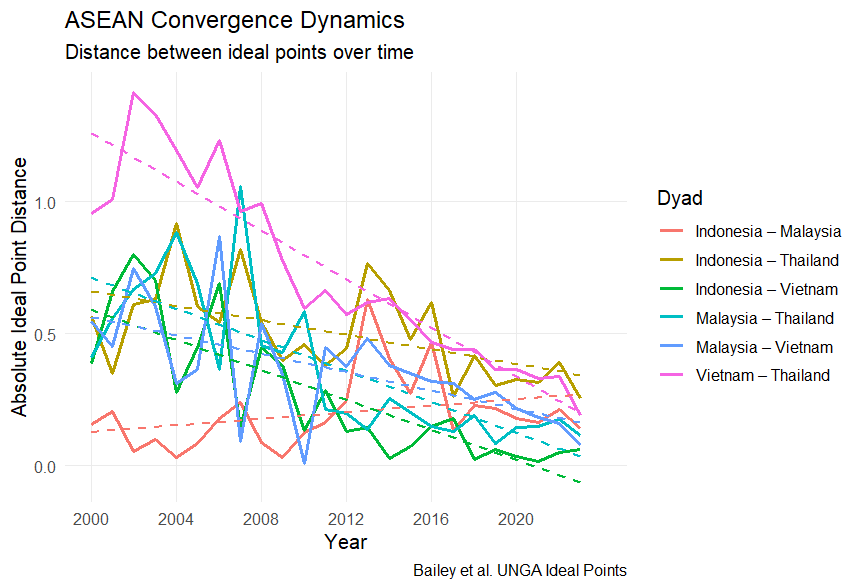
Figure 4:ASEAN Sovereignty Cluster ideal point convergence
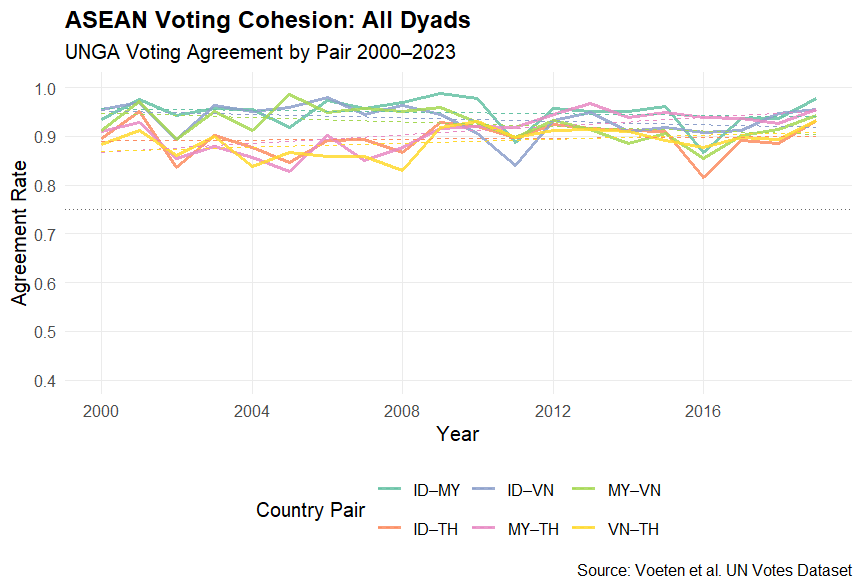
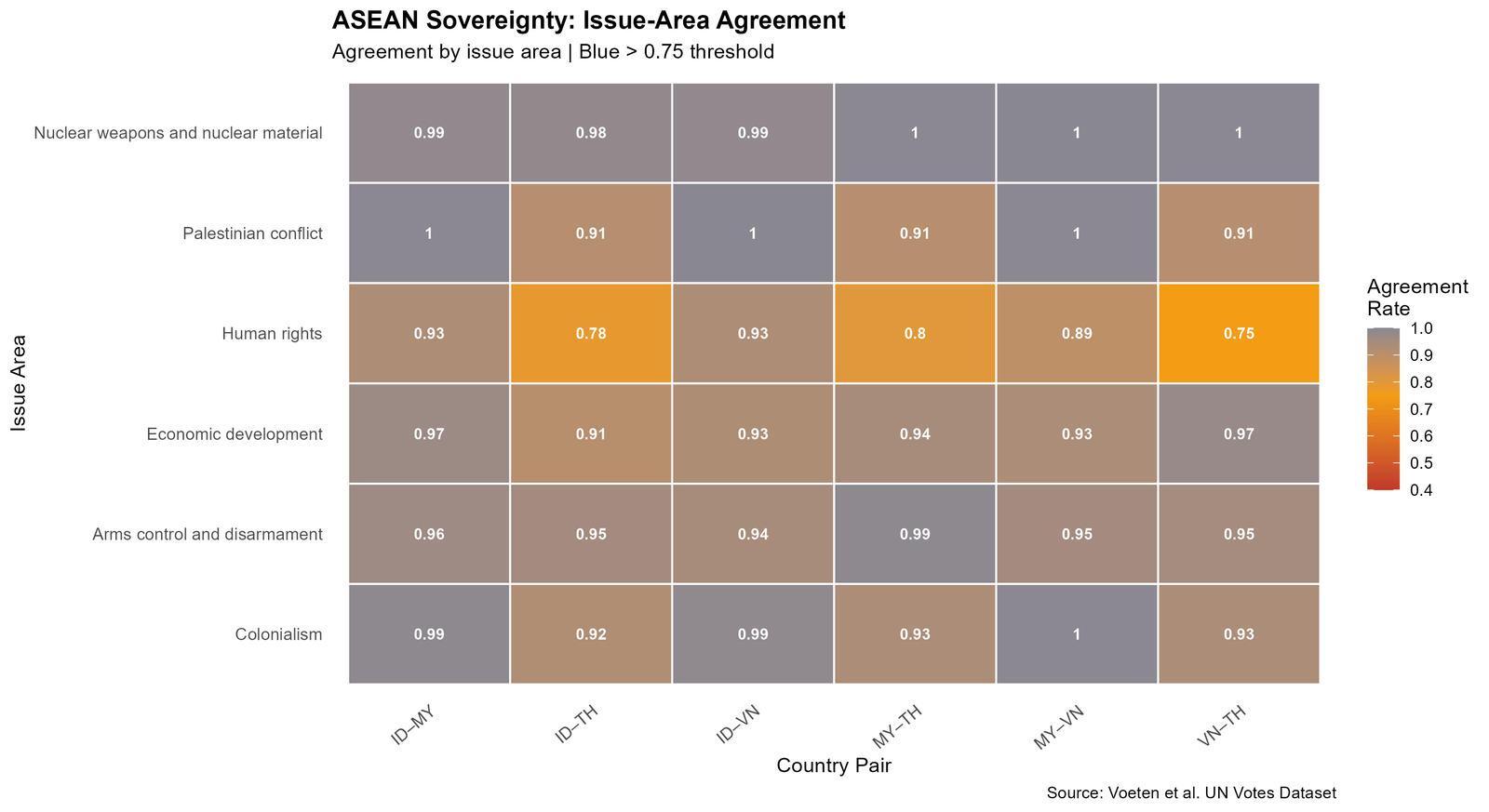
The ASEAN cluster, comprising six Southeast Asian dyads, among Indonesia, Malaysia, Vietnam and Thailand records the highest LARI score in the dataset at 2.75. With a C1 score of 3, reflecting consistent voting agreement well beyond the 0.75 threshold (Figure 5), and with particularly strong co-voting on Human Rights conditionality, and Nuclear material related resolutions (Figure 6), which is the main area where all four states oppose western-led mechanisms.
Figure 5:ASEAN Voting Agreement Trend
Figure 6: ASEAN Voting Issue-Area Agreement
The issue area breakdown (Figure 6) confirms that ASEAN co-voting is not concentrated in a single dyad or category, but is distributed across multiple resolutions topics, specifically economic development, nuclear weapons, and Middle East resolutions, consistent with the new ASEAN way of solidarity on sovereignty related issues.
Furthermore, it scores 3 in C2, as Figure 4 shows low and stable ideal point distances among intra-ASEAN dyads, with convergence pressure confirmed by the pressure index. C3 score however, is 2, reflecting the fact that Vietnam’s BSV ideal point positioning, closer to sovereignty first community 2 (Figure 7 and 14), creates moderate rather than minimal distance from Indonesia, which sits in the intermediary community. Despite this variation, the cluster’s overall score places it in the High category.
Figure 7:Dyad ideal point trajectory
Examining C3 through the three catalysts: the cluster exhibits strong institutional bridging (ASEAN Summit Architecture, ASEAN norm-socialisation), moderate normative convergence (shared sovereignty first positions on human rights conditionality, dependent on other axes), and low shared threat perception (no single shared threat drives the cluster’s cohesion). This pattern of distributed, cross-issue co-voting in a single dyad is consistent with H2 (Layer Two), indicating a structural network signal.
5.2.4 Russia-DPRK-Belarus Cluster
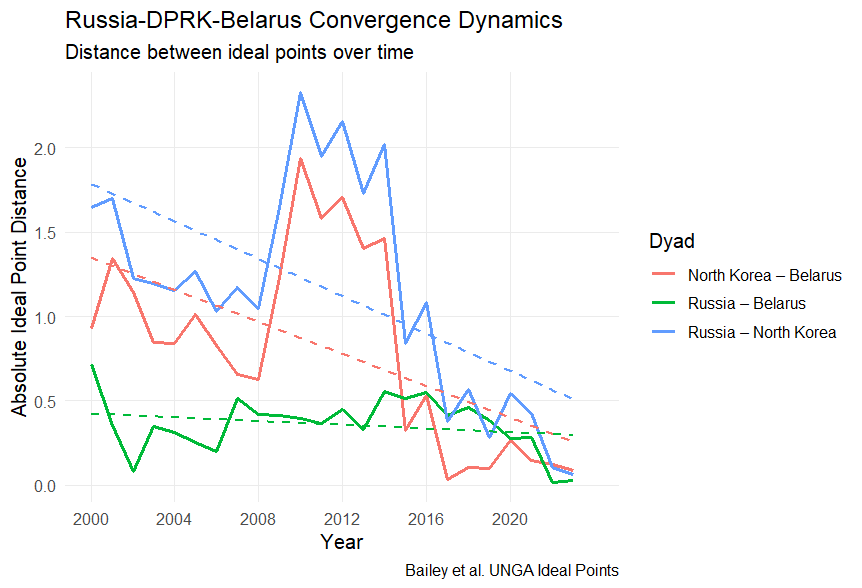
Figure 8: Russia-DPRK-Belarus Ideal point convergence
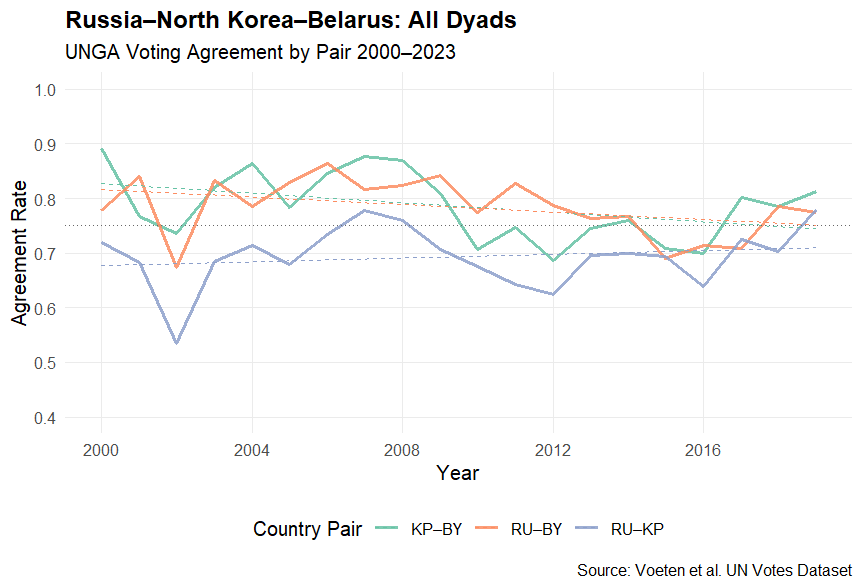
The Russia-DPRK-Belarus cluster scores 2.60. C1 is ranked at 2, reflecting the voting agreement (Figure 9) over 0.75 for the Russia-Belarus dyad, but more variable for the DPRK dyads, where limited GA participation and periodic abstentions produce oscillation around the threshold. C2 is marked as 3, reflecting near identical positioning at the negative extreme of the liberal order dimension and confirming the strongest normative convergence in the dataset. The cluster’s LARI is constrained to 2.60 by the moderate marking in C1, which is seen as a methodologically sound result; as the Russia-DPRK-Belarus relationship is mainly security transactional rather than consistently expressed via multilateral co-voting.
Across the three catalysts; shared threat perception is extremely high, against the US led liberal order and its enforcement mechanisms as existential threats; normative convergence is very high, the sovereignty first multipolar order is consistently reproduced in the UNGA; institutional bridging is moderate, as it is limited to bilateral agreements and the emerging Russia-DPRK military cooperation. The current 2.60 score is likely to increase as Russia-DPRK security relationship becomes stronger. The dominance of shared threat perception over institutional bridging in this cluster’s catalyst profile most directly supports H3 (Layer Three). Here, normative and security convergence precedes formal alliance formation.
Figure 9: Russia-DPRK-Belarus Voting Agreement
5.2.5 Sahel-Russia Cluster
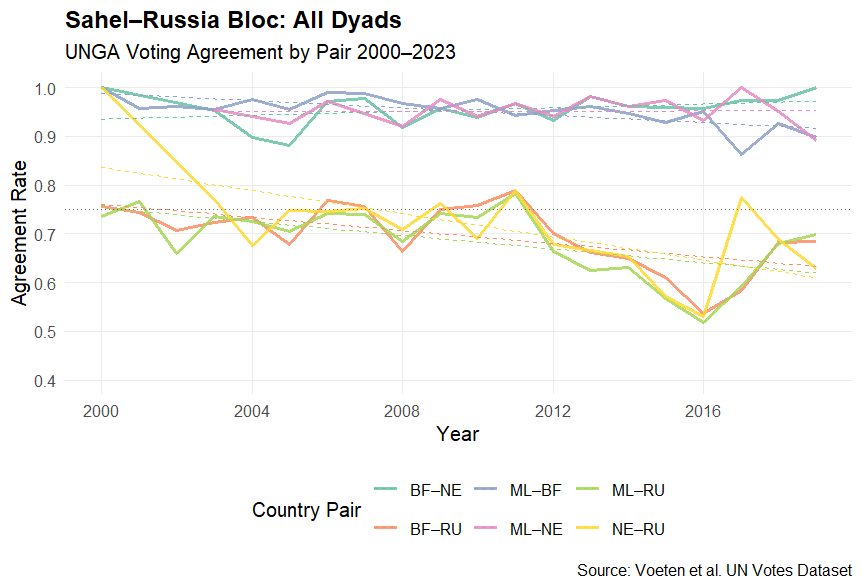
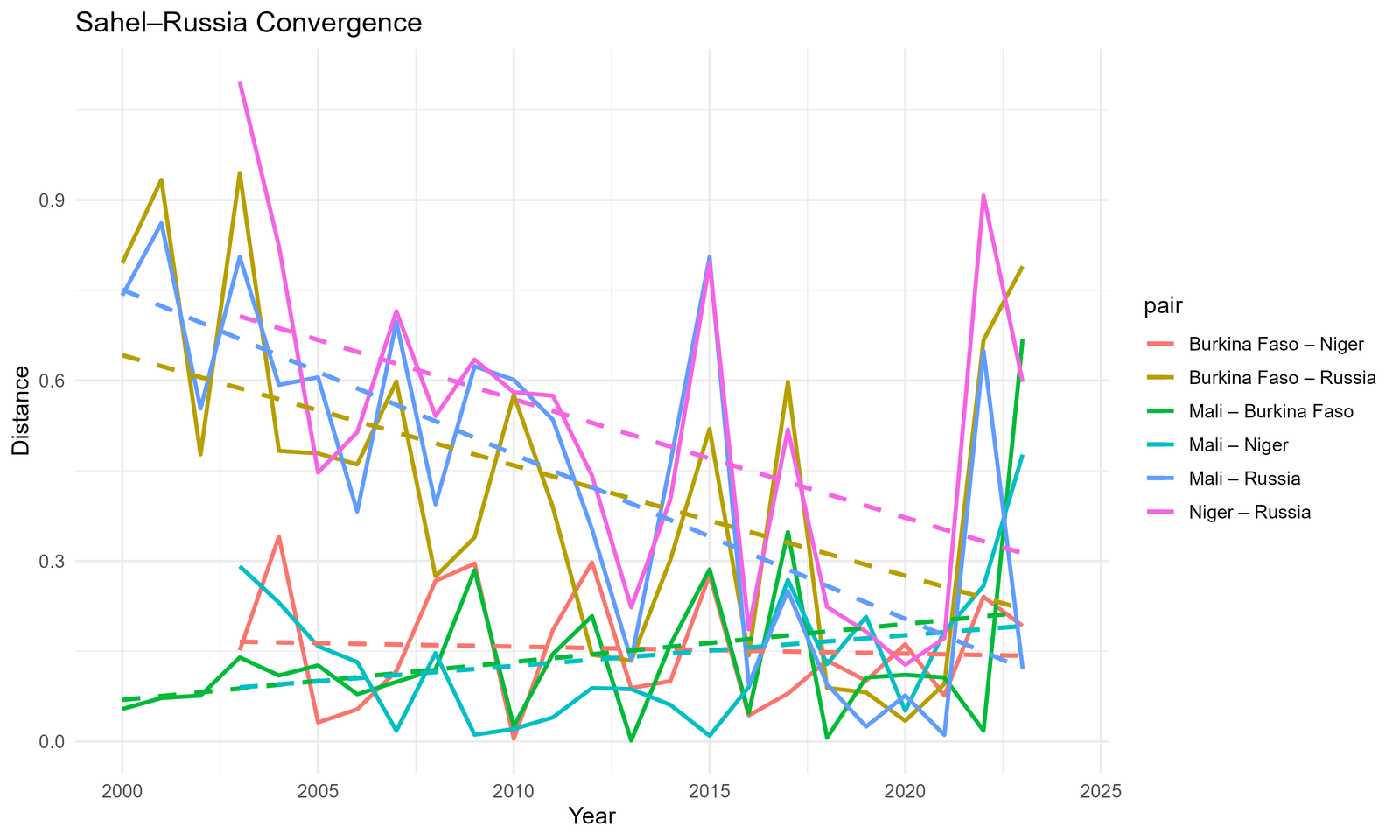
The Sahel-Russia cluster; the intra-sahel dyads among Mali, Burkina Faso and Niger, plus each state’s dyad with Russia, scores an overall 2.60. C1 is medium (2), reflecting the fact that the Sahel-Russia voting agreement (Figure 10), while it has sharply increased in the post covid era, has not yet stabilized above 0.75. When restricted to 2019-2023, all Sahel-Russia dyads would have scored a 3 on C1. This dynamic is precisely what LAT is designed to capture, a latent alignment in active formation rather than already consolidated equilibrium
Figure 10:Sahel-Russia Voting Agreement
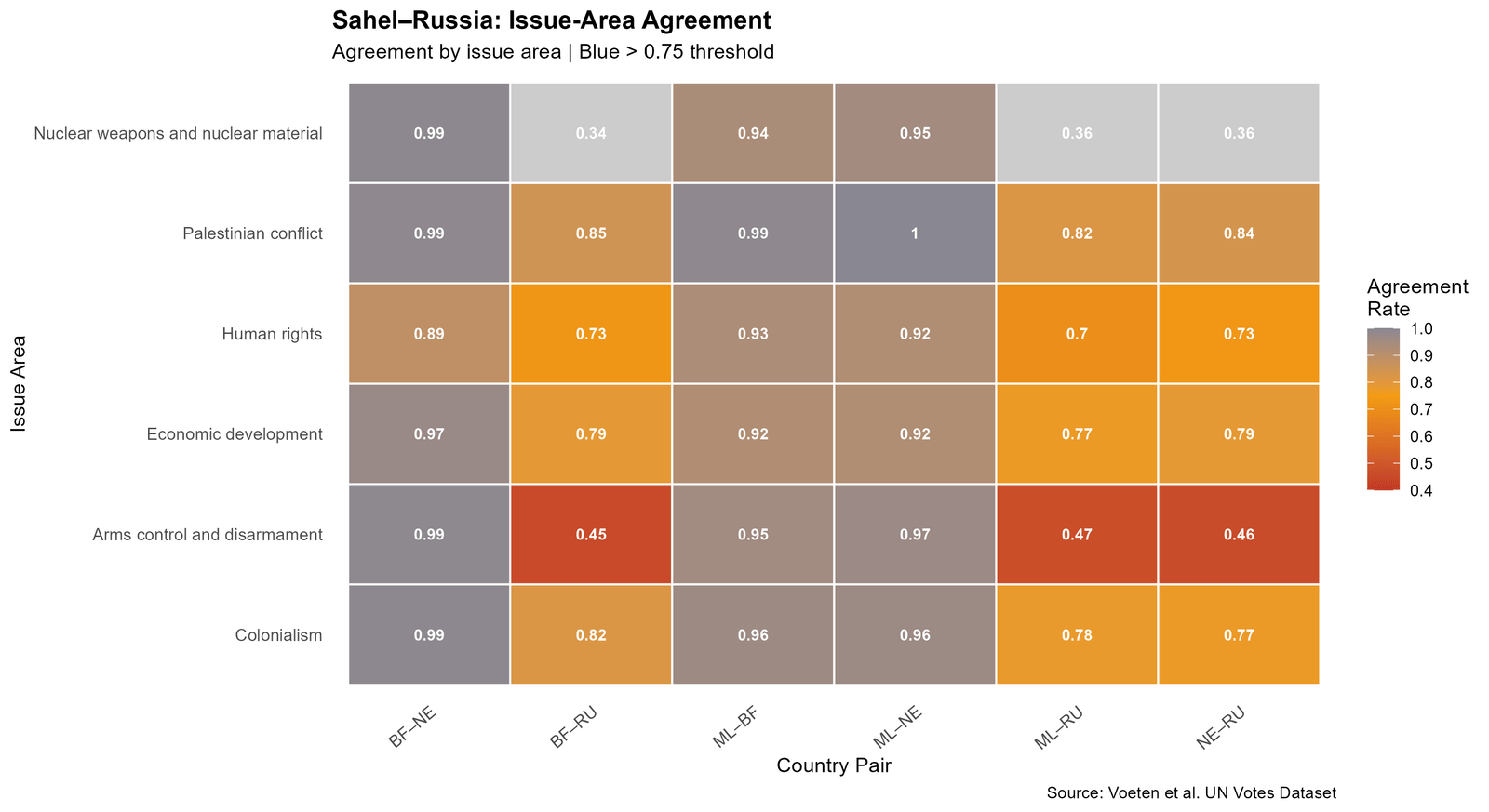
The issue area breakdown (Figure 11) reveals that the Burkina Faso/Niger-Russia agreement rate increment is not confined to one single area, but has risen across almost all categories. Furthermore C2 and C3 are both marked high (3), reflecting close ideal point proximity and one of the strongest convergence pressures in the pressure index.
Figure 11:Sahel-Russia Issue Area Agreement
Across the three catalysts, shared threat perception is very high, all four states identify western security conditionality, French military presence and the enforcement architecture as direct threats (Destradi and Vüllers, 2024; Crisis Group, 2025); the normative convergence is also very high, anti-colonial and multipolar normative frameworks are shared explicitly across all governments, furthermore institutional bridging is moderate, but accelerating, Wagner group/Africa Corps deployment, bilateral security agreements, and the Alliance of Sahel States (AES) framework, all function as institutional bridges. This is the most catalyst rich cluster in the dataset, explaining the rapidity of its convergence trajectory. As the most catalyst-rich cluster in the dataset, Sahel-Russia offers the clearest empirical support for H3, all three institutionalization thresholds (T1-T3) are active simultaneously, which the model predicts should produce the fastest convergence, according to Figure 3.
5.2.6 Gulf-China Cluster
Figure 12:Gulf-China Ideal point convergence
The Gulf-China cluster scores 1.65 overall. C1 is 2, C2 is 1 and C3 is 2. The pressure index shows a positive index for this cluster, indicating fragmentation. The low C2 score also illustrates the high and mixed ideal point distance between the selected Gulf states, and China. Despite growing economic interdependence through BRI adjacent partnerships, Gulf states’ ideal point positions are not converging towards China’s position. This is consistent with Steinert and Weyrauch (2024) finding that BRI produces heterogeneous alignment effects, with Middle Eastern members showcasing weaker convergence with China, when compared to Asian BRI members.
This cluster represents an economic, rather than normative relationship; significant bilateral ties without the ideological convergence producing structural alignment. Across the three catalysts, institutional bridging is present through BRI frameworks; shared threat perception is limited to a great extent, moreover normative convergence is weak, as the Gulf remains a steadfast security partner of the West, and refrains from adopting the sovereignty first orientation. The absence of normative convergence despite economic interdependence isolates T1 from T2. Supporting the theoretical claim in §3.4 that the three thresholds are independently necessary rather than substitutable, which is also assumed in the context of H3.
5.2.7 LAT Spectrum and Forecasting
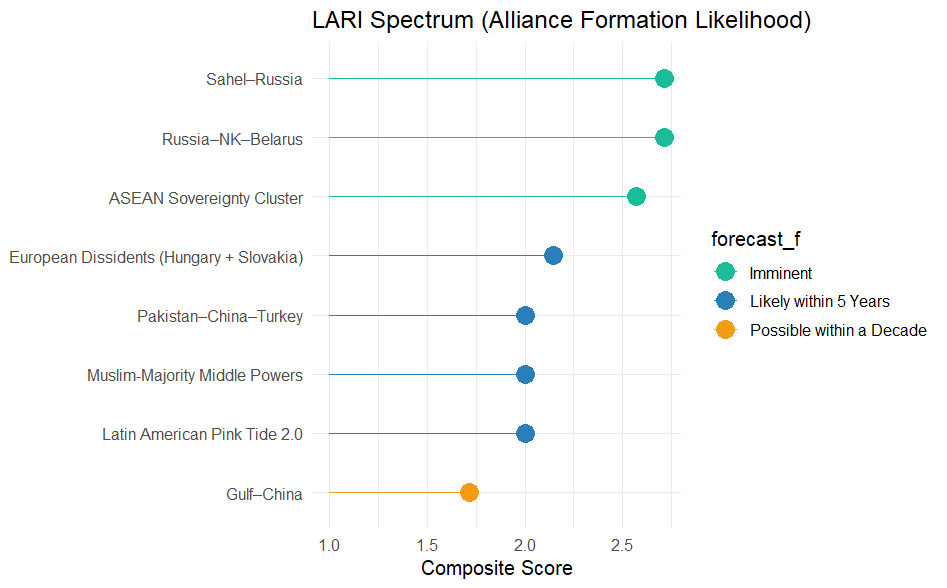
Figure 13:LARI Spectrum
Both the imminent clusters score more than 2.50, exhibit negative pressure index values, and score the highest in C3 across all catalysts. The Likely within 5 years cluster score within the 2.00 to 2.50 range, and have at least two of three catalysts present. The Gulf-China cluster scores 1.65, with a positive pressure index. Its alignment is economically grounded but normatively shallow. Formal alliance formation may be possible, contingent on a major shift in shared threat perception, most plausibly a deterioration in US-Gulf security relations, or development of institutional bridging, stronger than what already exists.
Figure 14:LAT Polarisation Map
Figure 13 provides the final structural summary of the results, mapping all states in the LARI process against their ideal point scores and community classifications. Three cross cluster patterns emerge from reading this map alongside the LARI results.
5.2.8 Remaining Clusters
The unexpected score inversion showcased between QUAD and ASEAN in Table 1 (§5.2.1), may challenge the assumption that institutionalization reflects preferences. It however, suggests that in the contemporary era, institutional salience discourse reflects diplomatic activity rather than functional preference convergence. The LARI is designed, and successfully so, that it may bring this distinction visible.
Furthermore, the three clusters anchored in community 1, including European Dissidents (1.90), Sahel-Russia (2.60) and Russia-DPRK-Belarus (2.60) all exhibit high C3 scores and share ideologically dominant catalysts. Figure 14 shows these states clustered at the negative pole of the axis, with converging trajectories visible in the ideal point overtime chart (Figure 2), with some ASEAN exceptions. This pole of the international order is producing latent alliances whose emergence is not dependent on any single event or leader but on a long term preference convergence that is being reproduced across geographies. Both the Latin American Pink Tide 2.0 and Muslim Majority Middle Powers reflect issue-specific voting solidarity rather than the deep preference convergence, LAT requires as a precursor to durable alliance.
6. Theoretical Implications
We now describe how alliance connections are formed. Whenever a treaty is signed, nations use multilateral institutions to express their preferences. The pre-formal stage of alignment, which formal explanations have ignored, is the subject of latent alignment theory. Although Walt’s (1987) Balance of Threat theory is a well-known study in the literature on alliances, it also ignores the pre-alliance analysis that LAT addresses and instead focuses on events that occur after threats are identified and security calculations are made. (Cranmer & Desmarais, 2011; Bailey et al., 2017).
This study has developed the Latent Alignment Readiness Index, which assesses voting behavior in orderly indications of alignment along three weighted parameters to accomplish an empirical analysis. The high categories include the: ASEAN Cluster (2.75), EU Core (2.65), Russia-DPRK-Belarus (2.6), and Sahel-Russia (2.6). However, when the states are voting, the QUAD Core stands out with a divergent indication of 1.0, which goes beyond stated strategic partnerships. Institutional coordination is most of the time the result of states with same co-voting patterns and decrease in distance of ideal points, although this association needs to be tested across different locations and time frames.
The Pressure Paradox is one of the most contradictory findings. The blocs continue to face the strongest western pressure, where Sahel-Russia, Russia-DPRK-Belarus are among the highest scoring. Rather than falling apart, these blocs continue to solidify because of external pressure. We observed that this pattern is directly measurable in the LAT Pressure Index (Figure 3; Appendix C(4)), where Sahel-Russia and Russia-DPRK-Belarus register as the highest negative slope in values in dataset, that is , the fastest convergence, despite facing a high pressure. This aligns well with Flores-Macias and Krep’s (2013) findings that external pressure acts on the intra-bloc economic and political conditions and coordination. This mirrors Kautilya’s Boesche interpreted logic that shared adversaries accelerate the ring-cohesion among Mitra states.
7. Policy Implications
For those working in foreign policy, the practical implication is hard to ignore. Decades of UNGA voting data sit in public databases, largely unread as strategic intelligence. LAT turns that data into something actionable, a way of seeing where alignment is consolidating before it becomes impossible to miss.
India illustrates the stakes well. Despite years of deepening engagement with Western partners, the US-India dyad sits at C1 score of 1 the lowest possible rating. India’s voting record places it consistently closer to China and Russia than to the United States across every global phase studied (Mohan, 2006). That is not fence-sitting. It is a stable, deliberate foreign policy preference the voting data makes legible long before any formal declaration would.
When QUAD registers Divergent and Sahel-Russia registers High, the conclusion is extremely important analytically; as the coalitions most consequential for the emerging order are not always receiving the most diplomatic energy. Sustained pressure on high-LARI blocs may be reinforcing their coherence rather than weakening it (Layne, 2012).
8. Conclusion and Final Remarks
The three case studies together reveal how patterns of UNGA voting can project different stages of international alignment that are not always captured through formal alliance agreements. Through FOCAC summits and the Belt and Road Initiative, Africa-China cooperation illustrates a higher level of institutionalization, while BRICS reflects an intermediate stage of planned convergence and India’s voting behavior showcases an earlier stage of latent alignment. These findings, together, support LAT by showing that alliances emerge eventually through sustained policy convergence before becoming formalized. Post this, the study contributes to international relations by offering network analysis as a complementary approach to understanding alliance formation in an increasingly multipolar world.
Nevertheless, the framework has certain limitations. Ideal point estimates stay unsettled for states with confined UNGA participation, and LARI recognizes alignment routes rather than predicting when a latent alignment will become a formal alliance. Future research must include UNSC systematic votes further evaluating LARI using historical alliance formation and assess its use across regional and international organizations.
9. Acknowledgment
The authors would like to express their sincere and heartfelt gratitude to all those who contributed to the conceptualization, development, and completion of this research paper.
We are deeply indebted to our non-publishing collaborators, Prakhar Gupta, Rishika Bannerjee, Shivam Saxena, and Sonakshi Rawat, whose sustained intellectual engagement, analytical rigor, and research assistance were instrumental at every stage of this project. Their contributions to data collection, theoretical refinement, and manuscript preparation, though not reflected in formal authorship, were foundational to the successful execution of this study, and we acknowledge their efforts with genuine appreciation.
We further extend our gratitude to the International Institute of SDGs and Public Policy Research (IISPPR) for furnishing the institutional infrastructure, mentorship, and scholarly environment that enabled the conception and execution of this research. The guidance and constructive feedback provided by our faculty advisors and peer reviewers throughout the drafting process were invaluable in strengthening both the theoretical foundations and empirical methodology of this paper.
We also acknowledge the broader community of scholars whose foundational work in ideal point estimation, network community detection, and alliance theory provided the intellectual scaffolding upon which the Latent Alignment Theory (LAT) and the Latent Alignment Readiness Index (LARI) were constructed.
Finally, we thank our families, friends, peers, and mentors for their unwavering encouragement and patience throughout the course of this undertaking. The authors remain open to constructive scholarly critique and hope this study serves as a meaningful contribution to the evolving understanding of contemporary geopolitics.
10. Bibliography
Bailey, M. A., Strezhnev, A., & Voeten, E. (2017). Estimating dynamic state preferences from United Nations voting data. Journal of Conflict Resolution, 61(2), 430–456. https://doi.org/10.1177/0022002715595700
Boesche, R. (2003). Kautilya’s “Arthashastra” on war and diplomacy in ancient India. The Journal of Military History, 67(1), 9–37.
Cranmer, S. J., & Desmarais, B. A. (2011). Inferential network analysis with exponential random graph models. Political Analysis, 19(1), 66–86.
Crisis Group. (2025). Defining a new approach to the Sahel’s military-led states. In Watch List 2025 – Spring Update. Brussels: International Crisis Group.
Destradi, S., & Vüllers, J. (2024). Populism and the liberal international order: An analysis of UN voting patterns. Review of International Organizations. https://doi.org/10.1007/s11558-024-09569-w
Flores-Macías, G. A., & Kreps, S. E. (2013). The foreign policy consequences of trade: China’s commercial relations with Africa and Latin America. Journal of Politics, 75(2), 357–371.
Hooijmaaijers, B., & Keukeleire, S. (2016). Voting cohesion of the BRICS countries in the UN General Assembly, 2006–2014: A BRICS too far? Global Governance: A Review of Multilateralism and International Organizations, 22(3), 389–408. https://doi.org/10.1163/19426720-02203006
Layne, C. (2012). This time it’s real: The end of unipolarity and the Pax Americana. International Studies Quarterly, 56(1), 203–213.
Lijphart, A. (1963). The analysis of bloc voting in the General Assembly: A critique and a proposal. American Political Science Review, 57(4), 902–917.
Liska, G. (1962). Nations in alliance: The limits of interdependence. Johns Hopkins University Press.
Lynch, E. A. (2023). China’s Belt and Road Initiative in East Africa: Finding success in failure? Military Review, 103(3), 111–123.
Macon, K. T., Mucha, P. J., & Porter, M. A. (2012). Community structure in the United Nations General Assembly. Physica A, 391(1–2), 343–361.
Mayfield, T. O. (2022). Indian perspectives: Insights for the Indo-American partnership. The US Army War College Quarterly: Parameters, 52(4), 27–38. https://doi.org/10.55540/0031-1723.3185
Modelski, G. (1964). Kautilya: Foreign policy and international system in the ancient Hindu world. American Political Science Review, 58(3), 549–560.
Mohan, C. R. (2006). India and the balance of power. Foreign Affairs, 85(4), 17–32.
Oye, K. A. (1986). Explaining cooperation under anarchy: Hypotheses and strategies. In K. A. Oye (Ed.), Cooperation under anarchy (pp. 1–24). Princeton University Press.
Pape, R. A. (2005). Soft balancing against the United States. International Security, 30(1), 7–45.
Pomeroy, C., Dasandi, N., & Mikhaylov, S. (2019). Multiplex communities and the emergence of international conflict. PLOS ONE, 14(10), e0223040.
Rudis, B., Hughes, N., & Janssens, F. (2019). unvotes: United Nations General Assembly voting data (R package version 0.3.0).
Singer, J. D. (1963). The Correlates of War Project [Research project]. University of Michigan.
Snyder, G. H. (1997). Alliance politics. Cornell University Press.
Steinert, C., & Weyrauch, D. (2024). Belt and Road Initiative membership and voting patterns in the United Nations General Assembly. Research & Politics, 11. https://doi.org/10.1177/20531680241233784
Voeten, E. (2000). Clashes in the assembly. International Organization, 54(2), 185–215.
Voeten, E. (2012). Data and analyses of voting in the United Nations General Assembly. In B. Reinalda (Ed.), Routledge Handbook of International Organization. https://doi.org/10.2139/ssrn.2111149
Voeten, E., Strezhnev, A., & Bailey, M. (2009). United Nations General Assembly voting data [Data set]. Harvard Dataverse. https://doi.org/10.7910/DVN/LEJUQZ
Walt, S. M. (1987). The origins of alliances. Cornell University Press.
Appendix A: LARI Scoring Rubrics
Criterion 1 Scoring Rubric (Voting and Issue Area Agreement)
Line mostly above 0.75 threshold, flat or rising;
Mostly agreed in 4-6 Subjects
3 (High)
Line oscillates around 0.75, mixed;
Only agreed in 3-4 subjects
2 (Medium)
Line mostly below 0.75, falling or flat;
Agreed in 2 or fewer subjects
1 (Low)
Criterion 2 Scoring Rubric (Bloc Convergence)
Low Distance, Converging or Flat
3 (High)
Medium Distance, Mixed
2 (Medium)
High Distance, or Diverging
1 (Low)
Criterion 3 Scoring Rubric (Ideal Point Distance and Layer 3 Catalysts)
Voting data was obtained from the UNGA Voting Dataset (Voeten, Strezhnev & Bailey, 2009), and accessed via the unvotes package in R (Rudis, Hughes & Janssens, 2019). Roll-call records for all UN member states across sessions starting from 1946 are provided by the dataset itself, including votes (Yes, No, Abstain) and issue-area classifications across six categories (Palestinian conflict, human rights, arms control and disarmament, nuclear weapons, economic development, and colonialism).
Sessions conducted between 2000 and 2023 were focused on in the study, reflecting the post-Cold War period addressed in the selected case studies. To ensure the reliability of comparisons, states with fewer than 30 recorded votes were excluded, as limited participation could produce inconsistent agreement estimates. Resolutions were included irrespective of their final outcome, since analytically significant expressions of preferences within the LAT are constituted by abstentions and negative votes.
C(2) Pairwise Voting Agreement Computation
A pairwise voting agreement score was computed for each dyad as the proportion of resolutions on which both states cast identical votes, assuming both states cast a non-absent vote on that resolution. This produces a raw agreement rate between 0 and 1 for each dyad in each session.
Agreement scores were calculated separately across the six issue-area categories to enable the disaggregated analysis reported in the clusters (§5.2.3-5.2.8). A threshold of 0.75 was required as the minimum agreement rate required for a dyad to qualify for a C1 score of 3. Dyads sustaining agreement rates between 0.60 and 0.75 qualified for a score of 2, and those below 0.60 received a score of 1. Trend lines across sessions were fitted using locally weighted regression (LOESS) to smooth inter-session volatility without suppressing directional shifts.
C(3) Community Detection: Louvain Algorithm
To identify structural voting communities, a weighted undirected network was constructed in which each state constitutes a node and the edge weight between any two states equals their pairwise voting agreement score computed in C(2). The network was constructed using the igraph package.
Community detection was performed using the Louvain modularity maximization algorithm, implemented via igraph’s cluster_louvain function. Modularity maximization identifies community partitions that can maximize the density of within-community edges relative to what would be expected under a random network of equivalent degree distribution. The Louvain algorithm was selected over alternative methods such as Girvan-Newman edge betweenness because of its mathematical efficiency at the scale of the full UNGA membership and its established application to UNGA data in prior literature (Macon, Mucha & Porter, 2012).
Community detection was run independently for each session year to allow community membership to evolve over time. States were assigned to the community in which they held membership for the majority of sessions within the time window, with ties broken by the most recent session assignment. The three-community structure reported in Figure 1 and Figure 14 (liberal order aligned, counter-order, and intermediary swing states) emerged consistently across sessions and was not imposed as a prior constraint.
C(4) Ideal Point Distance and the LAT Pressure Index
Ideal point estimates were sourced directly from Bailey, Strezhnev & Voeten (2017) and their updated dataset. These estimates find each state within a preference space derived from item-response modelling of roll-call votes, where positive scores reflect alignment with the US-led liberal order and negative scores reflect opposition to it.
For each dyad, the Euclidean distance between the two states’ ideal point scores was calculated for each year, producing a time series of ideal point distance. Convergence was defined as a statistically significant negative slope in this distance time series over the 2000-2023 window, estimated via ordinary least squares regression fitted to each dyad’s annual distance.
The LAT Pressure Index reported in Figure 3 aggregates these slopes to the cluster level by taking the mean slope across all dyads within a cluster. A negative cluster-level slope indicates net convergence; a positive slope indicates net divergence or fragmentation. Clusters were then sorted algorithmically by slope to produce the directional ranking displayed in Figure 3. This index functions as the temporal complement to the static LARI score; it captures the direction and rate at which each cluster is moving.
C(5) LARI Scoring and Weighting
The Latent Alignment Readiness Index was constructed as a weighted composite of three criteria scored on a 1-3 integer scale:
C1: Issue-Area Voting Agreement (40% weight): derived from the pairwise agreement computation in C(2), averaged across all dyads within a cluster and across all years in the timeframe.
C2: Bloc Coherence (35% weight): derived from the community detection output in C(3), assessed as the consistency of co-membership within the same Louvain community across sessions.
C3: Ideal Point Proximity and Catalysts (25% weight): derived from the ideal point distance analysis in C(4), supplemented by qualitative research of the three LAT catalysts (economic interdependence, norm convergence, shared threat perception) drawn from secondary sources.
The LARI score for each cluster was computed as:
LARI = (C1 × 0.40) + (C2 × 0.35) + (C3 × 0.25)
Scores were classified as follows: 2.50-3.00 = High; 2.00-2.49 = Moderate; 1.50-1.99 = Weak; below 1.50 = Divergent. The integer constraint on criterion scores reflects methodological conservatism, fractional scoring was considered but rejected on the grounds that the underlying data does not support the precision it implies. The absence of any perfect 3.00 score in the dataset is therefore a feature of the design.