AUTHORS:
Sneha Bansal, Prachi Jha, Soha Rahil Khan, Abhigyan Sarma, Siya Pandita, Shweta, Sourya Sutradhar, Charu Saraf, M. Datta Sai Reddy, Rinda Kawep Jumbuin
ABSTRACT
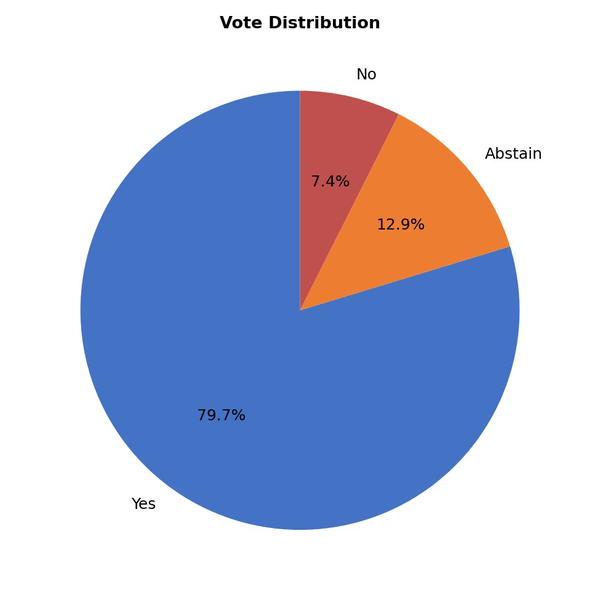
Countries’ political relations are reflected in their voting patterns in global bodies such as the United Nations General Assembly (UNGA). This work traces changes in voting conduct in the UNGA and the implications of these patterns for emerging political alliances among countries, from the East-West divide to the North-South divide post-Cold War. The study accounts for voting activity in 200 countries and regions concerning 5,270 resolutions and 738,764 votes from 1946 to 2025, using descriptive statistics to characterise voting outcomes and a Yes-share ranking proxy to identify patterns suggestive of bloc alignment and voting independence, leaving formal network-based bloc detection to future research. Specific attention is paid to the countries’ “Yes”, “No”, and “Abstain” votes, as well as studying the dynamics of voting behaviour and regional and power differences in voting conduct. The analysis showed that 79.7% of votes were “Yes”, 12.9% were “Abstain”, and 7.4% were “No”. The proportions of Yes votes also increased across sessions, leading to an inclination towards consensus voting. Variations in voting behaviours between developing and developed countries further confirm the presence of different levels of support.
INTRODUCTION
Background and Context:
The United Nations General Assembly (UNGA) has had more than 5,300 recorded votes since 1946, making a unique long-term collection of how countries stand on issues without any words. UNGA voting data is a way to find patterns in international politics and to spot changes in how countries come together or go apart. The consensus has been that these votes are actions. The UNGA occupies a distinctive place in the study of international relations: it is one of the few arenas where nearly every sovereign state must take a public, recorded position on contested global issues. Each vote functions less as an isolated procedural act than as a signal of diplomatic alignment, and the accumulation of such signals across time offers a rare longitudinal record of world politics. Drawing on 738,764 individual country votes cast across 5,270 resolutions and 70 Assembly sessions since 1946, this record spans a period in which UN membership grew from roughly 50 founding states to nearly 200 today, encompassing decolonization, the Cold War, and subsequent geopolitical realignments. When people look at voting using networks, they find groups that have complicated ties to changes in democracy, alliances for protection, and ways to avoid conflicts. Modern models of voting use things like GDP and how similar votes are to show hidden power structures, including groups that were noticed long before they officially formed. Some people say that UNGA voting is more about agreeing on foreign policy than actually working together directly. As more countries have gained influence, patterns such as the growth of trade groups and negotiations over climate change have shaped how alignments form. Read together, these votes trace not merely formal outcomes but the gradual transformation of the Assembly itself from a fragmented, closely contested body into one shaped increasingly by negotiated consensus.
Research Objectives:
The objectives of the study are as follows:
1. To examine the evolution and long-term trends in UNGA voting behaviour from 1946 to 2025.
2. To identify patterns of convergence and divergence in states’ voting behaviour, with particular attention to Yes, No, and Abstain outcomes across UNGA sessions.
3. To examine power-based asymmetries in UNGA voting behaviour between major powers and the broader membership, and assess their persistence over time.
4. To assess how observed voting alignment patterns suggest broader geopolitical blocs within the UNGA.
Research Questions:
The following are the research questions of the study:
1. What is the overall distribution of Yes, No, and Abstain outcomes across all recorded UNGA votes, and what does this distribution suggest about the Assembly’s decision-making dynamic?
2. How has the volume and outcome pattern (Yes/No/Abstain share) of UNGA voting changed across Assembly sessions from 1946 to 2025?
3. Do major powers exhibit systematically different voting behaviour (lower Yes-share) compared to the broader UNGA membership, and has this gap persisted over time?
4. Do countries with similarly high or low Yes-vote shares show consistent, recurring alignment suggestive of geopolitical voting blocs?
LITERATURE REVIEW
A recurring finding across the literature on United Nations General Assembly (UNGA) voting is that states’ positions converge. States that were once dispersed across a resolution’s Yes/No/Abstain options come, over time or across issue areas, to vote together more often than chance would predict. What the literature does not agree on is why this convergence happens. At least four distinct themes of explanatory logics recur across the field: convergence as a product of institutional and security cooperation; convergence as a product of economic dependence and diplomatic alignment; convergence as a product of the procedural architecture through which votes are negotiated, particularly in climate governance; and convergence as a latent structure in the voting data itself, detectable through computational and AI-based methods rather than explained by any single causal theory. These four explanations are not mutually exclusive, but neither are they simply complementary. Each implies a different answer to the question of what a UNGA vote actually represents, and each has been advanced, in places, at the expense of the others. The review below treats each explanatory logic in turn, before closing with a synthesis of how they relate to one another and to the descriptive approach adopted in this study.
Theme 1: Security Cooperation and Institutional Alliance Formation
The International political arena is a web of complexities, made even more complex by the changing nature of government and the state. Understanding a nation’s proclivity within international institutions often involves analysing its voting behaviour.
The first theme, logic, locates the source of voting convergence in security cooperation and institutional alliance-building, the argument being that states vote together because they belong to, or are constructing, a shared institutional or security architecture. Macon et al. (2012) provided an early empirical foundation for this view, applying community detection methods to UNGA voting data from 1945–2008 and showing that agreement patterns in the raw voting record map onto identifiable, persistent voting blocs. Magu & Mateos (2018) extended this network logic further, introducing the concept of a ‘diplomatic path’, a route through which two states with poor bilateral relations can nonetheless coordinate indirectly, by voting through a chain of intermediary states with good relations to both. On this account, voting convergence is not incidental; it is itself a mechanism of diplomacy, observable in the structure of the network.
A second body of work within this explanation examines whether convergence signals a genuine shift in institutional power or merely a stable pattern of coordinated behaviour that leaves underlying power structures untouched. D. Stephen (2017) reviewed the liberal-institutionalist optimism that followed the 1991 dissolution of the USSR and the creation of new institutions such as BRICS and the G20, concluding that this optimism met only partial success in practice. Binder & Lockwood Payton (2021), by contrast, found dramatic voting convergence between IBSA and BRICS states between 1992 and 2011, which they read as evidence of a parallel international mechanism forming outside traditional Western-led structures. These two accounts do not describe different data so much as they disagree about how to interpret the same underlying trend: rising bloc cohesion since 1991 is treated by one as evidence of a genuine, consolidating alternative power bloc, and by the other as a pattern of coordinated voting that has not translated into a proportional redistribution of institutional power.
A third strand concerns what convergence, and its absence, reveals about weaker states specifically, and here the disagreement is sharper still. Garcia-Herrero & Amighini (2023) examined the 2022–2023 Russo-Ukrainian War resolutions and found that trading patterns with China did not explain a country’s favourable vote toward Russia or China; instead, Global South unity was the stronger predictor, suggesting convergence driven by shared political identity rather than economic dependence. Tawat (2025) extended this line of inquiry, arguing that the Global South’s high rate of abstention in the 2022 emergency session reflected decades-long colonial grievance rather than indifference or incapacity, an act of deliberate non-alignment. Morse & Coggins (2024) offer a competing account of the same behaviour. They read abstention by weak states as a form of compelled strategic silence, forced on them by competing pressure from rival great powers, or as a symptom of insufficient state capacity to take a confident position at all. The same observed outcome, abstention, is thus explained in one account as an assertion of agency and in the other as an absence of it. This is not a minor terminological disagreement. It determines whether abstention should be read, in any dataset, as evidence of dissent, of neutrality, or of weakness, and no consensus exists on which reading is correct.
Theme II: Economic Dependence versus Diplomatic Alignment
The second theme logic locates voting convergence in economic dependence, the idea that trade and financial ties between states produce, or are produced by, aligned voting behaviour. This explanation is more contested internally than the first, because the literature within it disagrees not only on the size of the effect but on its direction. Sokolova and DiCaprio (2018) found that Regional Trade Agreements correspond to only a 4% increase in voting convergence, a real but modest effect, suggesting economic ties are a contributing factor among several rather than a dominant driver. Jakubik and Ruta (2023) complicate the causal story further. They show that states with pre-existing diplomatic affinity continue trading with these ‘friends’ during periods of policy uncertainty, sometimes forgoing financial efficiency to do so. This implies that diplomatic alignment can shape trade behaviour just as plausibly as trade shapes diplomatic alignment.
Network-based studies reinforce this bidirectionality rather than resolving it. Magu and Mateos (2018) identified distinct Western (0.487 Jaccard similarity) and Asian-African (0.718 Jaccard similarity) voting communities, and inferred diplomatic pathways, such as the United States potentially engaging North Korea via Japan and Singapore, that reflect historical, cultural, and strategic ties as much as economic ones. Kusari et al. (2026) jointly modelled voting behaviour with GDP and other economic covariates and detected coalitions such as BRICS years ahead of their formal establishment, but note that the coalition itself was constituted through political coordination, not trade volume alone. Perhaps most tellingly, Lupu and Greenhill (2017) show that states embedded in densely clustered intergovernmental organisations experience 36–51% fewer militarised disputes, a security and institutional-signalling effect that is difficult to reduce to economic dependence, and arguably represents diplomatic infrastructure functioning independently of trade incentives.
A further set of studies inverts the causal arrow more explicitly, treating political relationships as the independent variable and trade as the dependent one. Tussie and Saguier (2011) attribute bilateral imbalances between the US, EU, and weaker trading partners to the breakdown of multilateral negotiations, a political and institutional failure as much as an economic one. Campos et al. (2023) go further, quantifying political distance itself as equivalent to a 7.6 percentage-point tariff, arguing that geopolitical rivalry actively suppresses trade rather than trade patterns simply reflecting pre-existing economic logic. Mata et al. (2026) similarly show that differing regulatory philosophies, the EU’s precautionary model versus the US’s science-based model, generate non-tariff barriers rooted in governance norms, not cost structures, while Hakobyan et al. (2023) find that geopolitical proximity shapes food and manufacturing trade with disproportionate costs for emerging economies in Asia and Africa. Collectively, this body of work does not support a clear economic determinism in explaining UNGA alignment. Trade dependency, network embeddedness, and diplomatic relationships appear to reinforce one another, but in several of the most methodologically compelling studies (Jakubik and Ruta 2023; Campos et al. 2023), political and diplomatic relationships precede and determine economic outcomes rather than the reverse. Any account of voting convergence grounded in economic explanation must therefore treat political and economic motivations as co-constitutive rather than assume one is more fundamental than the other.
Theme III: Procedural Architecture and Consensus Design (Climate Governance)
The third theme logic locates voting convergence not in what states want, but in the procedural rules through which their votes are shaped before they are ever cast, an explanation developed most fully in the climate governance literature. The United Nations Framework Convention on Climate Change (UNFCCC) operates on a broadly consensus-based decision-making model, and a substantial body of scholarship has examined what this procedural choice does to negotiation outcomes (Vihma, 2014; Kemp, 2014; Weitzman, 2015). One reading treats consensus as a necessary safeguard of sovereign equality and political legitimacy, because every state, regardless of size or power, must formally assent. Agreement produced under a consensus rule carries a legitimacy that majority-rule agreement would not. A competing reading, advanced most directly by the Centre for International Environmental Law (CIEL, 2026), argues that this same procedural safeguard is precisely what has hollowed out effective climate governance: requiring consensus allows a small number of obstructive states to delay or block ambitious action indefinitely, so that the rule intended to protect equality among states ends up protecting the status quo instead. Kemp (2014) and Weitzman (2015) side closer to the CIEL position, proposing majority-voting alternatives because consensus trades effectiveness for legitimacy. This is a direct disagreement about what ‘convergence’ produced by consensus procedure actually signals: negotiated agreement, or negotiated paralysis dressed as agreement.
A related but distinct strand of this literature examines the distribution of voting power and institutional influence beneath the surface of formal equality. Wegner (2013) applies voting power indices and coalition analysis to show that formal equality among states does not translate into equal influence over negotiation outcomes, with political alliances and institutional arrangements shaping bargaining power well before a vote is taken. Bliznetskaya & Vasilenko (2018) trace the historical evolution of environmental issues within the UN system, showing how climate change gradually emerged as a central governance concern through shifting political priorities rather than a fixed institutional mandate. More recent scholarship examines the integration of climate change into peace and security frameworks, particularly through the UN Security Council (Hardt, 2021; McDonald, 2023). Here again the literature splits: one position holds that reframing climate change as a security issue strengthens the international response by mobilising a more powerful institution, while the opposing position holds that this reframing dilutes climate governance by subordinating it to the geopolitical vetoes and horse-trading that characterise Security Council business. Neither the consensus-versus-majority-rule debate nor the climate-as-security debate bears directly on how convergence in climate-related UNGA votes should be interpreted, as substantive agreement, as procedurally manufactured consensus, or as the visible residue of prior institutional bargaining.
Theme IV: Computational Detection of Latent Voting Structure (AI and Network Methods)
The fourth theme logic does not offer a causal account of convergence at all; instead, it offers a method for detecting convergence directly from the voting data, and treats the question of causal explanation as a separate, and largely unresolved, problem. Yu (2021) and Tan et al. (2021) demonstrate that Bayesian modelling and clustering techniques can identify voting coalitions without relying on predetermined political categories, allowing alliances that evolve across issues and over time to emerge from the data itself. This is presented as an advance in objectivity over theory-first approaches. Rather than assuming a bloc exists because of shared security interests or trade ties, the method lets the bloc reveal itself in the pattern of votes.
But this same data-driven strength is also this explanation’s acknowledged limitation. Because these methods are descriptive by construction, they can detect that a coalition exists without explaining why it formed. The political, economic, or institutional drivers examined in the first three theme logics have to be supplied separately, if at all. In this sense, Theme IV does not compete with Themes I–III so much as it depends on them for interpretation. A cluster detected by spectral clustering or Louvain community detection is a description of convergence, not an explanation of it. A further, less remarked tension concerns transferability. Majumdar et al. (2024) and Tessler et al. (2024) demonstrate genuinely promising applications of generative AI to collective decision-making and consensus-finding, but both are set in domestic deliberative contexts, citizen assemblies and individual-level deliberation, not interstate diplomacy. Neither study addresses whether findings about AI-assisted consensus among individual citizens generalise to an arena like the UNGA, where the units of analysis are sovereign states operating under asymmetric power and competing national interests rather than individual people reasoning together in good faith. The literature has not yet tested whether these benefits survive that shift in scale and stakes.
Read together, these four theme logics are not simply different literatures that happen to study the same institution; they are competing answers to a single underlying question: what does it mean when UNGA voting outcomes converge? The security and institutional literature (Theme I) answers that convergence reflects alliance-building and bloc formation, but disagrees internally on whether this reflects a genuine shift in power or a stable pattern of coordination without power redistribution, and on whether abstention by weaker states signals agency or compulsion. The economic and diplomatic literature (Theme II) answers that convergence reflects trade and financial interdependence. Still, its most careful studies suggest the causal arrow more often runs from diplomacy to trade than the reverse, undermining a purely economic account. The climate governance literature (Theme III) answers that convergence is in part a procedural artefact, a product of consensus-based negotiation rules that manufacture agreement before a vote is ever cast, but disputes whether this procedural convergence should be read as legitimate multilateral achievement or as institutionalised paralysis. The computational literature (Theme IV) declines to answer the causal question at all, offering instead increasingly sophisticated tools for detecting convergence in the data, while leaving its explanation to the other three.
None of these four accounts has been shown, empirically or theoretically, to be more fundamental than the others, and the studies reviewed above do not converge on a single causal story for why UNGA votes converge. This matters directly for the present study. A purely descriptive analysis of Yes/No/Abstain outcomes, of the kind undertaken here, is not positioned to adjudicate between these four explanations. It cannot determine, for any given instance of convergence, whether the underlying driver was security cooperation, economic dependence, procedural design, or some deeper structural alignment visible only through network-based or AI-assisted methods. What a descriptive approach can do, and what this study attempts, is characterise the observable shape of that convergence, its magnitude, its trajectory across seventy years of Assembly sessions, and its distribution across major powers versus the broader membership, so that the task of adjudicating between competing causal explanations can be taken up by the network-based and topic-classified research outlined in the Future Scope section of this paper.
Agreements in the Study
Throughout the literature, studies agree that a country’s regime type is associated with its voting pattern. The emergence of a new world order is clearly visible after 1991, with the USA and Russia’s agreement on major issues increasing until 2008. Economic relationships (trade or finance) are consistently found to produce measurable, if partial, political alignment in UN voting, and network analysis is repeatedly used across the literature to trace the imprint of this economic reality, from the Cold War East–West split to the North–South divide. Most studies also agree that the UN plays an important institutional role in climate governance, and that its decision-making procedures materially affect global climate action, even where they disagree on whether that effect is positive or negative.
Disagreements in the Study
The literature disagrees, most centrally, on how to interpret abstention. One reading treats abstention as a means by which economically and militarily weaker states express dissent without directly challenging dominant powers. This is not always the case, however; in many instances, abstention instead signals that a state regards the underlying conflict as a distant or ‘Western’ problem rather than one in which it has a direct stake, making abstention a declaration of sovereignty and non-alignment rather than a show of weakness. A second disagreement concerns clustering and bloc formation: some studies treat clustering as risk-reducing for member states, while others argue it imposes disproportionate costs on lower-income, economically weaker countries that lack the leverage to shape the terms of the coalitions they join. A third disagreement concerns decision-making procedure itself. Some studies support consensus voting as the legitimate foundation of multilateral cooperation, while others argue that majority voting would make climate negotiations, in particular, faster and more effective.
Major Patterns Across the Study
The most consistent pattern across the literature is that a country’s regime type shapes its voting pattern, and that economic relations are persistently linked to UN voting outcomes, even where the direction of causality is disputed. Despite considerable methodological diversity, network analysis, descriptive statistics, Bayesian clustering, and voting-power indices, studies converge on the existence of power imbalances within the Assembly, with low-income countries consistently bearing more of the cost of alignment than high-income countries. A further pattern is thematic concentration: most studies focus on UN climate governance, voting procedure, and institutional reform, examining how these factors shape international climate negotiation and cooperation specifically, more than any other single issue area.
Research Gaps
The literature addresses the major research gaps. First, they lack of substantive studies to understand isolated security-only national networks, especially in the context of contemporary international crises. Second, a lack of an integrated analysis of how UN voting patterns and decision-making structures shape emerging geopolitical alliances. Third, limited attention has been given to the political and strategic factors influencing alliance formation. Research rarely combines AI with network analysis to examine how geopolitical alliances evolve. Fourth, studies don’t explain why trade gets disrupted by geopolitical fragmentation.
Gaps the study addresses
Despite numerous studies on voting patterns at the UN General Assembly (UNGA), current literature does not offer sufficient evidence regarding the potential persistence of voting alignment asymmetry in power, partly due to the static nature of most research that treats voting blocs as snapshot pictures and reduces Abstain to the binary indicator of agreement vs. disagreement. The current study seeks to fill that gap by empirically analysing a longitudinal database of UNGA votes from 1946 to 2025. Yes/Abstain/No serves as a ternary indicator.
RESEARCH METHODOLOGY
Empirical Method
This study adopts a quantitative, empirical research design to examine emerging geopolitical alliances by analysing voting patterns of the United Nations General Assembly (UNGA). A longitudinal and comparative approach is employed to investigate how voting alignment among member states has evolved over time and whether factors such as security cooperation, trade dependence, climate governance, and technological cooperation influence the formation of geopolitical alliances.
Techniques of Analysis
The main method used in the present analysis is descriptive statistics. Descriptive statistics are used to describe procedures involving organising and summarising the essential characteristics of the data set using frequencies, percentages, averages, and basic graphs, such as bar charts, pie charts, and line graphs. Unlike inferential statistics, the objective of descriptive statistics is not to test hypotheses or make inferences about a population but to describe the data set.
In this report, descriptive statistics were utilised in four ways: frequency and percentage distribution, Aggregation by category, Time-series computation, and ranked comparison
Variables and Data Source
The study is based on secondary data obtained from the United Nations General Assembly (UNGA) voting records. Spatially, the study covers 200 countries and territories participating in the United Nations General Assembly. Temporally, the study covers the period from 1946 to 2025, encompassing 70 United Nations General Assembly sessions.
The dataset comprises 738,764 individual country votes cast on 5,270 resolutions, providing a comprehensive empirical basis for analysing long-term voting patterns and international political alignments.
Variable |
Description/Measurement |
Data Source |
Voting Behaviour |
Voting outcome of member states, measured as Yes, No, or Abstain (1 = Yes, 2 = Abstain, 3 = No) |
UNGA Voting Records (1946-2025) |
Assembly Session |
UNGA session (1,70) representing the temporal dimension of the study. |
UNGA Voting Records (1946-2025) |
Country |
Member state participating in the voting process. |
UNGA Voting Records (1946-2025) |
Resolution ID |
Unique identifier assigned to each UNGA resolution. |
UNGA Voting Records (1946-2025) |
State Code |
Standard country identifier used for data management and comparative analysis. |
UNGA Voting Records (1946-2025) |
ANALYSIS & INTERPRETATION
Graph 1: Distribution of Vote Types
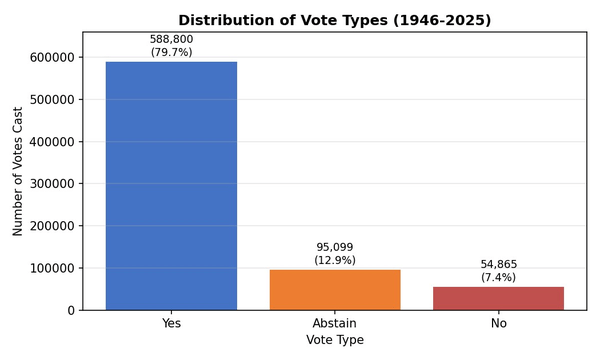
Source: Author’s calculation using the UNGA Voting (1946-2025).
Using UNGA voting data from 1946-2025, the graph shows the overall distribution of voting outcomes. “Yes” votes constitute the largest share (79.7%), followed by “Abstain” (12.9%) and “No” (7.4%).
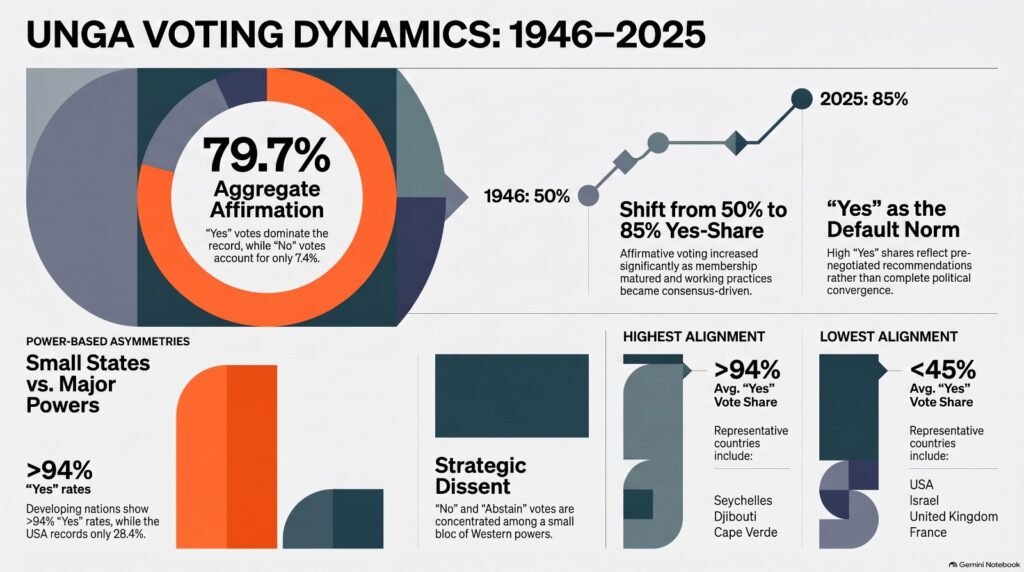
The high proportion of “Yes” votes suggests a general tendency towards affirmative voting in UNGA sessions, but it does not necessarily indicate complete global agreement. This pattern may have several possible explanations: genuine agreement among member states, negotiation and compromise before voting, or the fact that many UNGA resolutions are recommendations rather than legally binding decisions. Therefore, the high share of ‘Yes’ votes should be understood as a pattern of affirmative voting rather than direct evidence of complete consensus. Since resolutions primarily prescribe recommendations and norms rather than establishing legally binding obligations, countries can offer rhetorical support without committing to concrete actions. While this fosters a climate of agreement, the “Yes” vote acts as the default. Consequently, “No” or “abstention” votes are revealing and signal a deviation from this established norm. Voting dynamics often vary by development status. The North-South dimension of conflict, separate from the main US-alignment axis, was shaped by the agenda-setting power of the Non-Aligned Movement and G77. This division was clearly apparent only from the mid-1960s to the mid-1980s (Bailey and Voeten, 2018)
Abstentions are more common among developing countries. Tawat (2023) argues that since the Russia-Ukraine War of 2022, developing countries have been using abstentions to express mild disagreement and resentment that persist against colonialism in the Global South, a war widely regarded as a “European Conflict”. Morse & Coggins (2024) argue that developed nations with less plausible deniability may face political pressure, citing the U.S. pressure on Israel regarding the 2014 Crimea vote as an example.
Ultimately, these patterns provide insight into voting patterns, decision-making processes, and how states navigate political consequences while engaging in negotiation.
Graph 2: Number of Votes Cast per UNGA Session
Source: Author’s calculation using the UNGA Voting (1946-2025).
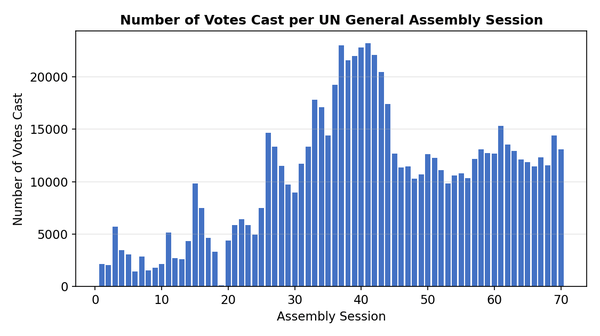
Based on the UNGA voting dataset, it was observed that the total number of votes cast rose sharply from Session 1 (1946) and continued to rise through the 1990s and 2000s, before levelling off between 2010 and 2015. The underlying reasoning is that this metric is structurally tied to the size of UN membership rather than to changes in legislative activity. Membership grew from 51 founding states in 1945 to 193 by 2011, with two major inflexion points: 82 to 126 member states driven largely by the decolonization wave of the 1960s, when dozens of newly independent African and Asian states joined, and by the post-Soviet and Yugoslav breakups of the early 1990s (Britannica, 2026; Library, n.d.). Since each member state casts one vote per resolution, every new admission mechanically raises the total vote count even if the number of resolutions tabled each session stays roughly constant. It was therefore concluded that the observed rise reflects compositional growth in the voting body, not an increase in the Assembly’s underlying legislative workload.
Graph 3: Share of “Yes” Votes by Assembly Session
Source: Author’s calculation using the UNGA Voting (1946-2025)
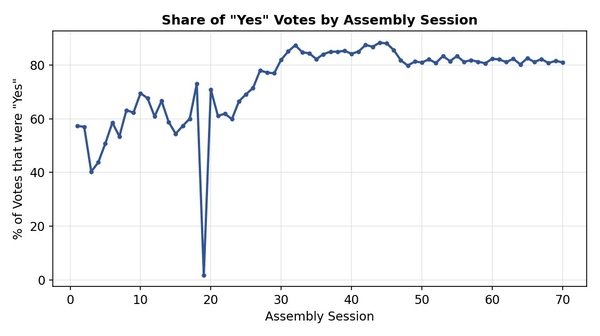
The data illustrates the upward trend in the percentage of “Yes” votes cast across these 70 assembly sessions. While “Yes” votes accounted for 50-60% in the early sessions, this figure rose to 80-85% by the late 1990s and 2000s, reflecting the Assembly’s transition towards a consensus-oriented approach as membership expanded and working practices matured. Overall, this graph shows how the share of “Yes” votes in the UNGA increased over time as the Assembly became more consensus-driven and its membership and working practices matured.
Graph 4: Countries by “Yes” Vote Share (minimum 1000 votes cast)
Source: Author’s calculation using the UNGA Voting (1946-2025).
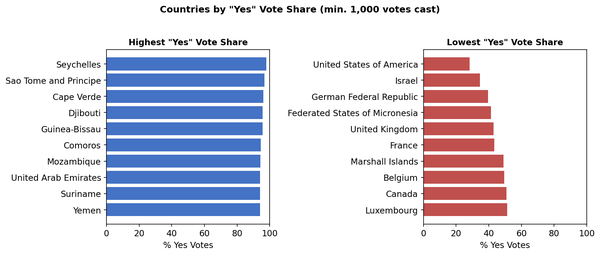
This analysis uses a high-low chart to depict contrast among countries in their share of “Yes” votes. The results show the predominance of high “Yes” vote shares among many developing states- Seychelles, São Tomé and Príncipe, Cape Verde, and Djibouti record more than 94% of resolutions, suggesting a greater tendency to support the majority position within the Assembly, a preference for multilateral cooperation and consensus-based decision-making. Conversely, the lower “Yes” vote shares observed among several major powers- the U.S.A., Israel, the Federal Republic of Germany, the U.K., and France record 28.4% of the voting, indicating a greater willingness to abstain or oppose resolutions when these are perceived to conflict with national interests or established foreign policy.
The US and Israel often vote negatively, owing to the large number of disputed UNGA resolutions. Ironically, the US and Israel tend to vote together on these resolutions. Israel is more isolated than ever. A resolution on statehood in 2025, passed with 142 votes to a handful of dissenters, and almost every Western abstention has flipped to a yes (Satloff, 2025).
This illustrates the diversity of voting behaviour within the UNGA and highlights distinct geopolitical voting patterns. Overall, the findings provide an important foundation for identifying voting blocs and analysing emerging geopolitical alignments through network analysis of UN voting behaviour.
Discussion
Overall, the data supports a clear, well-evidenced pattern rather than a coincidental one: the General Assembly functions primarily as a consensus-ratifying body, where most resolutions are shaped and softened long before they reach a formal vote. Membership growth has not fragmented this consensus. It has deepened it, since the newer, smaller, and developing states that joined through decolonisation and the post-Soviet period are precisely the ones voting with the majority most consistently. Dissent is neither evenly spread nor random. It’s concentrated in a small, recurring bloc of major powers whose disagreements track specific, identifiable issue areas rather than the full range of Assembly business. In that sense, the numbers describe not just how countries vote, but the underlying architecture of alignment and dissent that has defined UN politics for decades
Consensus without Convergence: Country level
Before turning to individual countries, it is worth pausing on what a high aggregate “Yes”-share actually signifies. Three cases show that consensus at the level of vote counts can coexist with a small but structurally stable minority that never converges with the majority position.
First, the 19th UNGA session (1964–65) was immobilised by a financial crisis after the Soviet Union and France refused to fund peacekeeping operations mandated under Article 19 of the UN Charter (United Nations General Assembly, 1964); the Assembly’s response was to avoid contested votes altogether, so the resulting dip in Yes-share reflects procedural avoidance rather than resolved disagreement.
Second, the US and Israel have repeatedly formed a stable two-country dissenting bloc: in 2022 the US voted with only Israel’s support on six resolutions concerning development, Cuba, and Israeli-Palestinian issues (U.S. State Department, 2023), a pattern that persisted even as the Assembly’s aggregate Yes-share climbed to 80–85% (Pigott, 2025).
Third, the 2023 UNGA resolution on the Russia-Ukraine war passed with an overwhelming majority, yet the accompanying wave of Global South abstentions was driven less by disagreement with the resolution’s substance than by longstanding colonial-era grievances and a preference for strategic non-alignment (Garcia-Herrero & Amighini, 2023; Tawat, 2025).
Together, these cases indicate that rising Yes-vote shares capture growing consensus on procedure and participation, not necessarily a convergence of underlying political interests.
CONCLUSION
The findings of this study are presented below in relation to the four objectives outlined at the outset, demonstrating how the analysis addressed each in turn.
1. Long-Term Voting Trends (1946–2025)
The rigorous analysis of UNGA voting patterns. It led us to discover that UN membership gradually increased over time, with the formation of countries through a wave of decolonization in South Asia, Africa and the collapse of the USSR (Soviet Union). Formally, the UN was established with 50 members and by the late 1990s its membership reached nearly 200; with the rising membership, voting records also increased over time. UNGA voting patterns also indicated a major share of “Yes” votes throughout all assembly sessions, with “Abstain” and “No” votes far less common. Overall, the study indicated UNGA voting behaviour evolved to a more consensus-driven procedure, with 79.7% overall “Yes” votes recorded as its growing membership and working practices matured, where a large majority of member states, mostly small and developing countries, often align together and vote with the majority on nearly every resolution. While a smaller group of powers, mostly Western and major powers, more frequently “Abstain” or vote ” No, ” often on resolutions they consider outside the Assembly’s purview. A high Yes vote share does not necessarily mean full global agreement. It partly reflects how resolutions are drafted and negotiated before they ever reach a vote.
2. Convergence and Divergence in Vote Outcomes
The analysis of UNGA voting behaviour from 1946 to 2025 reveals a broad pattern of convergence among states, alongside persistent areas of divergence. The objective was to determine whether states tend to develop similar voting preferences across UNGA sessions, particularly regarding Yes, No, and Abstain outcomes. The findings indicate that the dominant feature of UNGA voting behaviour is a general tendency towards consensus-oriented voting, as reflected in the substantially higher proportion of Yes votes compared with No and Abstain votes. The dataset covers 200 countries and territories and 738,764 individual votes, allowing the study to observe voting behaviour over a long historical period rather than focusing on a particular UNGA session or a limited group of states. The study finds that Yes votes generally increased across UNGA sessions, indicating that affirmative voting became an increasingly prominent feature of UNGA decision-making over the period under examination. The critical finding, however, is that increasing consensus does not necessarily imply complete convergence among states. The continued presence of Abstain and No votes demonstrates that underlying differences in political preferences persist despite the overall movement towards consensus.
3. Power-Based Voting Asymmetries
The analysis of UNGA voting behaviour contains both a broad trend towards consensus and persistent regional and power-based asymmetries. However, the differences identified between developing states and major powers show that this convergence is not uniform across the international system. States occupying different positions in terms of political power and regional grouping continue to display differences in their levels of support, abstention, and opposition. Therefore, the findings suggest that the UNGA represents a combination of collective consensus and continuing geopolitical differentiation. The critical finding is that the increasing overall consensus in UNGA voting has not eliminated power-based differences among states; rather, these differences persist beneath the broader consensus pattern. This indicates that aggregate convergence can coexist with continuing geopolitical asymmetries, suggesting that states’ relative power and regional positions remain important in shaping their voting preferences.
4. Emerging Alignments and Voting Blocs
The findings from UNGA voting patterns show that over time, membership and mature work practices have also increased voting records. Small and developing countries with the highest “Yes” vote shares vote with the majority on nearly every resolution. On the other hand, countries with the lowest “Yes” shares are a small group of mostly Western and major powers, which more frequently abstain or vote “No”, often on resolutions related to Middle East policy, sanctions, or matters they consider outside the assembly’s purview. Overall, the study indicated that the split “Yes” vote share reflects the broader voting-bloc dynamics in the General Assembly, where a large majority of member states (small developing countries) often align while a smaller group of powers (mostly Western and major powers) vote independently, a deviation from a norm in accordance with their foreign policy.
LIMITATIONS
Data limitations:
The dataset (738,764 votes, 5,270 resolutions, 200 countries, 70 sessions) records only vote outcomes (Yes/No/Abstain) with no resolution-topic, region, or subject-matter classification. This means climate-, security-, and trade-specific voting cannot be isolated, and abstention motive (strategic vs. issue-irrelevance) cannot be empirically distinguished. Country comparisons were also restricted to those with ≥1,000 recorded votes to avoid small-sample skew, excluding newly admitted states, and historical entities (e.g., “German Federal Republic”) were kept as originally recorded rather than merged with successor states.
Methodological limitations:
The study relies on descriptive statistics (distributions, session-wise trends, country-level Yes-share) rather than AI- or network-based methods. As a result, “voting blocs” are identified only as a proxy (top/bottom 10 by Yes-share), rather than through formal techniques such as co-voting network construction or community detection (e.g., Louvain clustering).
FUTURE SCOPE OF STUDY
Future research should work on these areas. First, apply network analysis and community detection to identify voting blocs rather than relying on Yes-share proxies empirically. Second, incorporate resolution-topic classification to enable domain-specific analysis of climate, security, and trade voting. Third, map countries to formal UN regional groups to complement the power-based asymmetry findings with true regional analysis. Lastly, use topic-level data to disaggregate abstention motive across state types and issue types.
REFERENCES
Bailey, M. A., & Voeten, E. (2018). A two-dimensional analysis of seventy years of United Nations voting. Public Choice, 176(1), 33–55. https://doi.org/10.1007/s11127-018-0550-4
Binder, M., & Lockwood Payton, A. (2022). With Frenemies Like These: Rising Power Voting Behavior in the UN General Assembly. British Journal of Political Science, 52(1), 381–398. https://doi.org/10.1017/S0007123420000538
Bliznetskaya, E. A., & Vasilenko, E. P. (2018). The formation of the environmental agenda of the United Nations General Assembly (1946-2016). https://cyberleninka.ru/article/n/the-formation-of-the-environmental-agenda-of-the-united-nations-general-assembly-1946-2016/viewer
Britannica. (2026). Member states of the United Nations (UN) | Number, Permanent, & Observers | Britannica. https://www.britannica.com/topic/member-states-of-the-United-Nations-UN-2226365
Campos, R. G., Estefania-Flores, J., Furceri, D., & Timini, J. (2023). Geopolitical fragmentation and trade. Journal of Comparative Economics, 51(4), 1289–1315. https://doi.org/10.1016/j.jce.2023.06.008
(Ciel), C. for I. E. L. (2026). Breaking the Deadlock: Why and How Voting Can Advance the Climate Negotiations Thirty Years On. Center for International Environmental Law (CIEL). https://www.jstor.org/stable/resrep79785
D.Stephen, M. (2017). Global Governance: A Review of Multilateralism and International Organizations. Global Governance, 483-502. https://www.jstor.org/stable/44861138
García-Herrero, A., & Amighini, A. (2026, July 27). What really influences United Nations voting on Ukraine? Bruegel | The Brussels-Based Economic Think Tank. https://www.bruegel.org/analysis/what-really-influences-united-nations-voting-ukraine
Hakobyan, S., Meleshchuk, S., & Zymek, R. (2023). Divided we fall: Differential exposure to geopolitical fragmentation in trade (IMF Working Paper). International Monetary Fund. https://www.imf.org/en/publications/wp/issues/2023/12/22/divided-we-fall-differential-exposure-to-geopolitical-fragmentation-in-trade-542842
Jakubik, A., & Ruta, M. (2023). Trading with friends in uncertain times (IMF Working Paper No. 23/124). International Monetary Fund. https://doi.org/10.5089/9798400244698.001
Kemp, L. (2014). Framework for the Future:The Possibility of Majority Voting within the United Nations Framework Convention on Climate Change (UNFCCC). https://refubium.fu-berlin.de/handle/fub188/19646 (DOI: 10.17169/refubium-23251)
Kusari, C., Roy, S., & Sengupta, S. (2026). Understanding Geopolitical Alignments Through Covariate Augmented Spectral Clustering of Heterogeneous UNGA Voting Data (arXiv:2606.25490). arXiv. https://doi.org/10.48550/arXiv.2606.25490
Library, D. H. (n.d.). Research Guides: UN Membership: Current UN Member States Resources [Research guide]. United Nations. Dag Hammarskjöld Library. Retrieved August 10, 2026, from https://research.un.org/en/unmembers/currentmembers
Lupu, Y., & Greenhill, B. (2017). The networked peace: Intergovernmental organizations and international conflict. Journal of Peace Research, 54(6), 833–848. https://doi.org/10.1177/0022343317711242
Macon, K. T., Mucha, P. J., & Porter, M. A. (2012). Community structure in the United Nations General Assembly. Physica A: Statistical Mechanics and Its Applications, 391(1), 343–361. https://doi.org/10.1016/j.physa.2011.06.030
Magu, R., & Mateos, G. (2018). United Nations General Assembly Vote Similarity Networks. In C. Cherifi, H. Cherifi, M. Karsai, & M. Musolesi (Eds.), Complex Networks & Their Applications VI (pp. 1174–1183). Springer International Publishing. https://doi.org/10.1007/978-3-319-72150-7_95
Majumdar, S., Elkind, E., & Pournaras, E. (2026). Generative AI voting: Fair collective choice is resilient to LLM biases and inconsistencies. EPJ Data Science, 15(1), 24. https://doi.org/10.1140/epjds/s13688-025-00612-3
Mata, F., Jesus, M., & Santos, J. (2026). Food safety standards, regulatory paradigms, and international trade between the European Union, the United States, and other major commercial blocs. Sci, 8(7), 166 https://doi.org/10.3390/sci8070166
McDonald, M. (2023). Immovable objects? Impediments to a UN Security Council resolution on climate change. International Affairs, 99(4), 1635–1651. https://doi.org/10.1093/ia/iiad064
Morse, J. C., & Coggins, B. (2024). Your silence speaks volumes: Weak states and strategic absence in the UN General Assembly. The Review of International Organizations, 19(3), 515–544. https://doi.org/10.1007/s11558-024-09538-3
Pigott, T. (2025, December 12). U.S. No Vote on Anti-Israel UNGA Resolution. United States Department of State. https://www.state.gov/releases/office-of-the-spokesperson/2025/12/u-s-no-vote-on-anti-israel-unga-resolution/
Satloff, R. (2025, September 15). A Snapshot of Israel’s Deepening Diplomatic Isolation: Comparing Key UNGA Votes, 2017-2025 | The Washington Institute. https://www.washingtoninstitute.org/policy-analysis/snapshot-israels-deepening-diplomatic-isolation-comparing-key-unga-votes-2017-2025
Sokolova, M. V., & DiCaprio, A. (2018). Agree to disagree: The spillover of trade policy into United Nations General Assembly voting (UNCTAD Research Paper No. 28). United Nations Conference on Trade and Development. https://unctad.org/publication/agree-disagree-spillover-trade-policy-united-nations-general-assembly-voting
Tan, X., Shaikh, Z., Mello, A., & Creed, F. (2021). The UN General Assembly Voting Coincidence and Clustering Analysis. 2021 IEEE International Conference on Big Data (Big Data), 6035–6037. https://doi.org/10.1109/BigData52589.2021.9671587
Tawat, M. (2025). The Russia–Ukraine war: Understanding the Global South’s vote at the UN and its implications for the current world order. Third World Quarterly, 46(16), 2019–2036. https://doi.org/10.1080/01436597.2025.2549357
Tessler, M., Bakker, M., Jarrett, D., Sheahan, H., Chadwick, M., Koster, R., Evans, G., Campbell-Gillingham, L., Collins, T., Parkes, D., Botvinick, M., & Summerfield, C. (2024). AI can help humans find common ground in democratic deliberation. Science, 386, eadq2852. https://doi.org/10.1126/science.adq2852
Tussie, D., & Saguier, M. (2011). The sweep of asymmetric trade negotiations: Introduction and overview. In S. Bilal, P. De Lombaerde, & D. Tussie (Eds.), Asymmetric trade negotiations. Ashgate. https://www.perlego.com/book/1630815/asymmetric-trade-negotiations-pdf
(PDF) The United Nations Security Council at the Forefront of (Climate) Change? Confusion, Stalemate, Ignorance. (2026, May 22). ResearchGate. https://doi.org/10.18452/23595
United Nations General Assembly. (1964, October 8). Digitallibrary.un.org/record/845205/files/A_5739-EN.pdf. https://digitallibrary.un.org/record/845205/files/A_5739-EN.pdf
U.S. Department of State. (2023). Report to Congress on Voting Practices of UN Members for 2022. https://www.state.gov/wp-content/uploads/2024/04/Report-Voting-Practices-of-UN-Members-2022.pdf
Vihma, A. (2014). Climate of Consensus: Managing Decision Making in the UN Climate Change Negotiations. Review of European, Comparative & International Environmental Law, 24, 58–68. https://doi.org/10.1111/reel.12093
Wegner, W. (2013). Voting Power in Environmental Policy Making. https://ediss.sub.uni-hamburg.de/handle/ediss/4864
Weitzman, M. L. (2015). Voting on Prices vs. Voting on Quantities in a World Climate Assembly. https://www.nber.org/papers/w20925
Yu, Q. (2021). Dynamic Dirichlet process mixture model for identifying voting coalitions in the United Nations General Assembly human rights roll call votes. Journal of Applied Statistics, 49(12), 3002–3021. https://doi.org/10.1080/02664763.2021.1931820