©Authors: Anjali Kar, Kaustav Majumdar, Tajbidur Rahman
Abstract:
The Study and Analysis of United Nations Voting Patterns in the United Nations General Assembly (UNGA) Members demonstrates how the member states cast their votes in the General Assembly, Security Council, Economic and Social Council; reflecting their political alliances, national interests, and diplomatic strategies. The Research focuses on identifying Geopolitical Alliances/Alignments as they emerge, before any formal recognition through treaties or membership. The UN Voting Pattern acts as the only static and primary indicator that is universally used to observe the shift in alliances and state politics. The UN Vote structure works as a chessboard without the King, which is constructively established with time over period for each of the nations respective goals. Thus it is important to differentiate between similarity of votes, the growing political convergence and the formation of formal alliances. The Research analyzes the voting behaviour of the UNGA in the period 2015-2025 in order to find emerging geopolitical alignments by using network analysis. The quantitative analysis is based on the data on voting in the UN General Assembly publicly published in the UN General Assembly Voting Data compiled by Bailey, Strezhnev and Voeten (2017), as well as UN Digital Library data. The annual weighted networks are established by the similarity of votes among the states, and community detection is applied to find alliances that have larger within-community votes. Voting similarity is measured as a structural indicator and changes in it over time are explored through statistical tests.
Keywords:United Nations General Assembly, Voting Patterns, Emerging Alliances, Geopolitical Strategy, Network Analysis, Historical Evolution, Alignment Shifting. |
Introduction:
In 1944, Representatives from the United States of America, United Kingdom, The Soviet Union and China gathered in Washington DC to establish an International Institution/Organization that can work on Peace & Cooperation among Nations. In 1945, Fifty Countries gathered for the “San Francisco Conference” on April 25, 1945 to create the United Nations Charter. Built upon Peace Keeping, Cooperation, Human Rights and Development as key principles. The United Nations officially came into existence on 24 October 1945. The 50 countries at the conference became 50 of the original 51 UN members; Poland signed later, making 51 original members. Currently the UN is occupied at a 193 Member Strength along with the Holy See which represents the Vatican and the Catholic Church & State of Palestine which represents Palestine (they are allowed to participate in discussions and debates but have no voting rights). The UN Consists of 5 Bodies and the General Assembly is the main deliberative body where all the states gather to talk about peace and cooperation, pass resolutions on development, human rights and international law. The Security Council is responsible for maintaining International Peace and decides where and how Human Peace operations are carried out. The Secretariat is the administrative branch of the UN led by the Secretary General, works on managing information to the member states as well acts upon peacekeeping. The International Court of Justice, also known as the World Court settles legal disputes between the member states and the Economic and Social Council (ECOSOC) is the heart of Sustainable Development at the UN helping countries tackle important issues such as Health, Education and Human Rights. The United Nations focuses on Maintaining International Peace and Security, Delivering Humanitarian Aid, Protecting Human Rights, Upholding International Law, Supporting SDGs.
Every year the United Nations General Assembly hosts its session year wide. In 2026, the UN will be hosting its 81st General Assembly Session. The significance of the UN Voting pattern record has grown as the architecture of International alliances has become hard to identify through formal agreements. UNGA voting movements can leave a detectable trace before they are announced, hence helping diplomats and smaller states in anticipating International movements over different issues. The structural behaviour of UN voting pattern interpretation from (1945-1991) has been a variable compared to the Post-1991 period. The world power was divided into two blocs, USSR and USA along with their member states. The USA led the Western bloc while the Soviet Union powered the Eastern bloc.
It was understood heavily that showed how states were under political alliance which led to the emergence of ‘Bloc Voting’ while some other countries such as India, Egypt, Indonesia, Ghana, etc; did not wanted to be on either side as well establishing the Non-Alignment Movement and voted independently respective to their foremost issues and strategies based upon Colonialism, Security Issues, Disarmament, Economic Issues and similar. It’s true at Nature that voting alone does not specify your alliance with a bloc/state, but consistent voting creates higher chances of an informal internal alliance between states respectively. From 1991-2015, there was a major shift from bloc voting to a similar stance with the USA that created a definition showing the United States as the major power during the early 1990s. The similarity soon shifted to an unpredictable situation of wealth and development where Western Countries (comparatively wealthy and more democratic) stayed on the other side of the countries which are not that powerful or have any influence; in simple words they are being pushed by the Western/US strategies. They were known as the ‘Counterhegemonic Bloc.’ Until 2015, both China and Russia grew close alongside G-77 members supporting developing countries while China was a major economic power who has experienced it all and Russia stood by its stance over the idea of a Non-Unipolar power division and to establish a Multipolar International System rather than a US-dominated one. The global financial crisis of 2008 also mattered. The crisis originated in the developed financial system, particularly the United States, and caused serious consequences throughout the developing world. This strengthened criticism of the existing global economic order and G77 countries increasingly demanded; reform of international financial institutions, greater developing-country representation and more equitable economic governance. China and Russia also supported greater multipolarity in global economic governance. Therefore, another area of overlap developed. From 2015-2025, a common agenda was followed by most of the member states where there exists multiple power centres. The past decade showed a collective identity division of the US and its allies obstructed by China, Russia and its members along with other developing states. There was a shift to Multipolar split rather than a Single Western led consensus. Additionally, BRIC emerged as an economic concept in 2001, became a formal political grouping in 2009, and became BRICS with South Africa’s inclusion in 2011. BRICS has been one of the alliances which has significantly criticised traditional Western-led voting blocs in 2024-25 while the G-77 also had a good influence with the largest voting coalition of 100 members in 2025.
Case Study: The Russia Ukraine War in 2022 showed roughly 140+ member countries in favour of Ukraine standing alongside sovereignty and backed the basic rule of peace establishment which is “one country shall not invade another.’ Even though members such as China and India never backed the resolution, while Brazil and Indonesia sometimes supported them. The US followed a Russia-backed stance which was far away from its position in 2022 that introduces us to the internal political behaviour that can influence International Resolutions with the change in Government. The Israel-Gaza War in 2023 also showed similar stances by majority for Humanitarian Aid while US and Israel opposed firstly, but US ended up abstaining its say in 2025.
1. Literature Review:
The United Nations General Assembly Voting has developed over time and events, addressing which our study exhibits different approaches to the similar underlying question “What does common agreement in the assembly tell us about the relationship between different States.” The following below Sections;
1.1 Analyses how alignment patterns have changed historically, particularly post-cold war period.
1.2 Analyses the UN voting data through a formal network method to form a structure that displays alliances.
1.3 Represents how the Internal Domestic Politics can shape state-positions Internationally.
1.4 Addresses whether UN Voting data can be used to identify alliances before their formal institutionalisation.
The United Nations, which started towards the end of the second world war, is an international body that comprises 193 sovereign nations. The main policy making organ of the United Nations is the General Assembly known as the United Nations General Assembly (UNGA). The General Assembly includes all the member states of the United Nations. The General Assembly meets regularly where it discusses current issues of critical importance to the International Community in the form of Thematic Debates organized by the President of the General Assembly. Since 1946, the recorded votes of UNGA on the number of resolutions has created a database of state behaviour on an international level. States have moved forward from the Cold war era alliances creating a shift in Global power dynamics and structure which has formed anticipating importance to learn the diplomatic, economic and security realignments.
The UN voting pattern suggests the accomplished analysis of similarity between agreements and choices among states on various fields of discussions and potentially growing concerns. While the voting cards are obvious and simple [Yes, No, Absent or Abstains from a stance of recognition yet follows]. The UNGA resolutions are generally non-binding, giving states a sense of freedom to be able to take their independent stances on each concern while it gives an accumulated stance of states at a given period over International issues. Voting patterns between states can either show their similar interests or similar interception of disagreement and agreement of shared motive. The paper examines and primarily focuses on Voting Pattern, treating States as ‘Nodes’ and Voting similarities as ‘Edges’ to analyze shifting interests and alliances over time. It will be discussed over the lens of Historical Evolution since 1946. External alignment as a force of restoration and development of internal state dynamics as well as Forecasting emerging alliances through simple analogy of Scaled Symmetrical Changes between Old and newly formed alliances.
1.1 Historical Evolution
Contemporary claims and alignments need to depend on a baseline, to which the Historical footsteps provide a vivid transition and shift of affiliation over time. It’s important to be studied because two states voting in a bipolar structure will have a different insight than the two states voting in a fragmented multipolar environment. Kim, Soo Yeon, and Bruce Russett have discussed the East-West axis, analyzing how it created substantial differences during the Pre-Cold War era and its shift during the Post-Cold War era. Studies gather that the alliances did not completely shift but moved towards a different dimension running between developed/industrialized states and developing countries. Kim and Russett in “The New Politics of Voting Alignments in the United Nations General Assembly”, 1996 examine UN General Assembly voting patterns during the early post-Cold War period and compare them with Cold War voting patterns. They found that the old Cold War bloc divisions were changing and that a major emerging division was increasingly shifting towards North–South (richer vs poorer countries) rather than simply East–West. Similarly, Voeten in his study “Clashes in the Assembly”, 2000 presents a different conclusion where rather than a North-South division, Western grouping was opposed by a “Counter-hegemonic Coalition” which is defined less from an economic position and backed by resistance towards concentration of power in the post cold-war period. Both Kim and Russett & Voeten hold a parallel yet different approach.
Lees, Nicholas in his work “The Endurance of the G77 in International Relations: South–South Ideology and Voting at the United Nations 1970–2015” , 2023 discusses how the cohesion of the G-77 members between 1970-2015 which turned out to have a strong voting unity has helped its member states to grow in income and strategically. He explains a common ground of agreement backed by Southern States whose framework is rooted in the experience of Colonialism, Sovereignty and Inequality. He implied that collective identity has a higher significance even if structural conditions get dissolved. Hence, the studies establish that alignment in the Assembly is neither fixed nor limited to a single dimension and that the collapse of a structural body does not end up forming an unstructured alliance, instead it backs principals that are already being contested by them.
1.2 Network Science Perspective
When the organising axis of UNGA voting is contested, one response is to stop assuming the key factors of collective identity and instead back a structure emerging from the data itself. In record of the same, ‘Network analysis’ provides the machinery for doing so, representing states as ‘Nodes’ and their voting similarity as ‘Weighted Edges’ to find groups through algorithmic procedures to identify alliances that are connected internally. Macon, Kevin T., Peter J. Mucha, and Mason A. Porter in their study “Community Structure in the United Nations General Assembly”, 2010 introduced a multi-layered approach through ‘Modularity Maximization’ which measures how strongly a network is divided into groups and builds structures of different possible ways of dividing the countries into communities. Their study emphasized that the recoverable communities change their composition and structure over time assessing genuine political stances just rather than statistical reflections. Bailey, Michael A., Anton Strezhnev, and Erik Voeten in “Estimating Dynamic State Preferences from United Nations Voting Data”, 2017 for Journal of Conflict Resolution studied the same idea and developed the “Ideal-point Dynamic” which approaches the assembly session individually each time creating a low-dimensional preference of similarity as their core agendas previously stay the same, there are shifts constructed towards decisions because of shifts in discussions and topics. Both the approaches are complementary in Nature rather than competing as they carry different base lines and assumptions.
‘Modularity Maximization’ is known to be held and limited because of Resolution frequency which can lead to prevention of detection of community backed by the Size threshold as discussed by Fortunato, Santo, and Marc Barthélemy in “Resolution Limit in Community Detection’, 2007. Fortunato & Barthélemy provides an important methodological warning stating that; a high modularity score does not necessarily mean that the detected communities represent the complete or true community structure of the network. They emphasize the idea of existence of smaller but meaningful groups inside those communities. Hence, similarly Tiago P. Peixoto in “Efficient Monte Carlo and greedy heuristic for the inference of stochastic block models’, 2014 states that approaches of UN voting analysis can result in change in Conclusion. Backing the ‘Stochastic Block Model’, Peixoto describes how the dense network such as the UNGA can form pairs agreeing on resolutions very easily which makes it hard and precisely misleading if direct measures are taken as the only medium to distribute community and alliances. Therefore, addressing how methodology can structure the findings and it is important to justify the detection procedure for long-term reliability.
1.3 External affairs alignment introspected towards Internal Politics
While Historical Approach and Network Structures explains how alignments configure themselves, neither of the motions explains why the government comes to a particular position in terms of their international stance. A particular idea articulated towards addressing those sources influencing the voting behaviour is essentially & necessary; identifying the mechanism through and by which the aggregate decision is taken in Assembly. Alastair Smith discusses in his study “Leader turnover, institutions, and voting at the UN General Assembly”, 2016 that change in leader massively impacts the UNGA voting stance and results in change of vote, magnitude of which is dependent upon the internal institutional environment. The study examines the shift in the voting pattern as an epicentered benefit in Domestic Region in exchange of External benefits which creates a higher latitude to reorient the foreign policy.
On similar yet distinctive approach, Mohammad Zahidul Islam Khan showcases in his study “Is voting patterns at the United Nations General Assembly a useful way to understand a country’s policy inclinations”, 2020 that when he examined “Voting Records of Bangladesh” respective to its foreign policy for reviewing correspondence through reflection of votes.
He found a broad yet imperfect correspondence while the votes favoured few principle beliefs but the rest of the votes were seen as bloc unity and bilateral relations. He referred that circumstances might turn out to be summarized as common grounds and mutual votes because the states Independently agrees on a particular issue. For eg; Country A can have a strong exchange of power in terms of security with Country B, which can result in Country A voting similar to Country B if a resolution controversial to Country B comes up to maintain the relationship with Country B but that does not mean both the countries share similar political preferences. Furthermore, it establishes a strong argument that Voting behavior has social and institutional foundations as well and are not only responders to systematic pressure.
1.4 Identifying Emerging Alliances
While formal voting behavior can only explain the static alliance interest, focusing on the emerging similarities and dissolving changes can help identify the separation of member states from an alliance and can also be tracked through disagreements over time which caused separation or weakening of agreement. Ideal-Point estimation and Network Community Detection can be used for identifying similar interests of different states and assess whether a compatible alignment is forming through strategic voting and moving forward to cooperation. The emerging trend can showcase a vivid representation of changing commitments and ideologies. There can be seen motives of power affiliation, as well as similar issues of the contemporary world which vary State-wise. Through Voting blocs with potential alliance cooperation states can be directed on the basis of common stance of concerns. Muhammad, A in his work “The geopolitical implications of shifting alliances in a multipolar world”, 2023 addresses the debate of multipolarity and presents forward an argument stating that the redistribution of economic and military capability has produced alignment behaviour that demonstrates power division with significant influence in different aspects of International Relations and hence, makes formal alliance a poor medium of actual alignment as well which to a limited extent makes preliminary method of voting analysis more valuable as it does not try to accumulate a constructive view but generates a partial coordinational. The demand for ‘Prospective Alignment’ needs much more than using UN votes as an indicator because the ideal approach of assuming that the countries are more likely to move towards closer political alignment is far more complicated in the current environment.
States do not simply operate on a baseline objective of ‘Who is officially allied with Whom’ anymore. They are increasingly forming temporary partnerships, as well as maintaining a multipolar relation along with multiple powers maintaining ‘Hedge’ between Major Powers as well.
Synthesis of the Literature:
The Literatures follows a distinct manner of studying United Nations General Assembly Voting Patterns in different perspectives also subjected as themes as alliances have shifted over the years from being binary to non-binary formation with a much more vast and multidimensional structure of projection. North-South region replacing East-West commence, Network science implying minimal data into structure to create observations while emerging alliances hold their ground. Scholars disagree on the components that drive the change while on events agreement has been there over leadership changes as a vital aspect as well. The present conscience of similarities and common goals are purely subjected towards a multi layered abbreviation while if taken as a whole the body of underlying studies confront that there is no absolute evidence whether the contemporary world works on a systematic terminology or a domestically articulated approach. It is well suggested that states can have correlation or direct symmetrical behaviour yet can be observed separately rather than jointly as well. Collectively, the literature establishes that voting structure exists and matters while leaving open both what it is organised around and how confidently it can be interpreted,
2. Research Gap:
Three limitations emerge from the review and together it constructs and defines the gap this study occupies.
2.1 Discusses the internal factors underlying the voting pattern in UNGA.
2.2 Discusses about the Parallel indicators of comparison and how they create a contrast in further reflective studies.
2.3 Studies the correlation of Community detection which is vulnerable to its methodology.
2.1 Network Studies of United Nations General Assembly voting treats the State as a single point in a preference space while the Domestic-Politics study demonstrates that voting positions are often strongly influenced by leadership arrangements and environment within the States.
Both the methods are not aligned into a single study and hence, narrates the uncertainty in a States voting behavioural change. When a country changes its position, it’s hard to amplify the factor which initiated it to be in motion.
2.2 In terms of Comparability, relevant studies draw their analysis on different datasets, covering different timelines and as well operationalising similarity of preferences in different and distinctive ways. Agreement scores, Ideal-point distances, Modularity-based partitions; collectively all of them cannot be studied or compared directly and there is no cumulative result that can be further analysed to develop a new study. Hence, when two studies disagree; it’s hard to interpret whether the disagreement is based on Geopolitics or the way of measurement.
2.3 As Community detection is sensitive to the algorithm/method of analysis chosen and its parameters. The robustness defines the certainty of credible chances of an alliance. For eg; If Community A [USA, UK, France, Germany], Community B [Russia, Belarus, Georgia], Community C [China, India, Japan] are 3 different groups according to a particular method of analysis,, if it stays same using another reasonable method; it declares the result as Robust. It showcases the importance of using multiple approaches to examine a particular bloc to source credible fundamentals and factors in support.
Research Questions:
(i) Do States with higher levels of Voting similarity form statistically identifiable communities within the UNGA Voting Network between 2015 and 2025?
(ii) How did the Cohesion of different Communities and the degree of separation between them changed across the study period?
(iii) Did States voting proximity to China, Russia and the US changed significantly between 2015 and 2025 and if yes, in what direction?
General Objective:
To examine Voting pattern similarity and Constructive output through Longitudinal Network Analysis of United Nations General Assembly (UNGA) voting between 2015 and 2025 and to assess whether such patterns can be trusted as a medium/indicator of Re-alignment and Network formation.
Research Objectives:
(i) To Construct annually weighted Voting-similarity of Networks of UN member states for each year from 2015 to 2025 and demonstrate community structure between them.
(ii) Quantify changes in each States voting similarity with China, Russia and the US across the study period and monitor the statistical changes and significance.
(iii) Measure Internal cohesion and External Separation of analysed communities to test their significance against internal assignments.
Hypotheses:
There are three distinctive hypotheses which have been established and can be identified and explained below in separate sections [H1, H2, H3].
H1(Voting Community Hypotheses): Member States with higher levels of Voting Similarity are more likely to form and construct statistically recognisable communities/groups within the UNGA Voting Network.
H2(Temporal Change Hypotheses): The structure and strength of the UNGA Voting relationships change over a period, producing shifts in the cohesion and separation of voting communities between 2015 and 2025.
H3(Geopolitical Realignment Hypotheses): Voting ties between the member states and the major geopolitical powers do not remain stable across the years from 2015 and 2025 which reflects underlying changes in Geopolitical alignment.
Research Methodology:
This study uses a mixed-methods approach combining quantitative network analysis and qualitative narrative analysis to examine UNGA voting patterns from 2015 to 2025. The quantitative component employs longitudinal network analysis to test three hypotheses; whether identifiable voting communities exist (H1), whether they change over time (H2), and whether voting relationships with major powers have shifted (H3).
The qualitative component examines national narratives from seven key countries to contextualise observed voting patterns. Alliances are not static entities, their relationship grows stronger or weaker and shifts over time. This method reflects the literature which focuses on historical shifts in the UN voting coalitions from the relatively organized Cold War coalitions to more complex post Cold War era.
The data used for this study is taken from the Harvard Dataverse-United Nations General Assembly Voting Data dataset, compiled by Bailey, Strezhnev, and Voeten (2017) and from the UN Digital Library. The different [Yes, No, Abstain, Not Voting] categories for votes are used to organise each country’s position. Standardisation of data is carried out in the lead up to network construction, so that it is consistent across countries and voting records. This research identifies countries that tend to vote in the same direction on most UN resolutions are likely to be more close in political and economic terms. For this, the UN Votes R package, based on the Bailey-Strezhnev-Voeten dataset of voting records is used and the consensus scores are pre calculated. For every pair of countries, an ideological distance is calculated as the absolute difference between their ideal point estimates. This distance is then inverted using the formula Similarity = 1 / (1 + Distance) to ensure that larger values represent greater ideological similarity. For every pair of countries, an agreement score is determined based on how often the two voted the same way. Each of these scores is put into a chart, and then transformed into a system. Community detection was performed using Statistical Inference (Stochastic Block Model) as the primary method, with modularity tracked as a secondary structural indicator. The Stochastic Block Model infers communities by fitting a probabilistic model to the network, grouping nodes that have similar connection patterns. This method identifies groups that are statistically unlikely to arise by chance, rather than simply partitioning based on similarity scores.
To assess statistical significance, permutation tests are conducted using 1,000 random permutations for each year. The empirical p-value is calculated as the number of permuted differences equal to or greater than the observed difference, divided by the total number of permutations. The permutation tests further confirm that the observed community structure is not a product of the algorithm. The quantitative analysis is supplemented by a qualitative analysis of UNGA General Debate statements and Explanations of Vote from seven countries – Russia, USA, China, India, Turkey, Brazil, and South Africa – using the Narrative Policy Framework and Social Identity Theory. The analysis focuses on three themes: convergence in narratives of Western domination; the emergence of Global South leadership; and the role of bridge countries like India and Turkey.
Limitations:
Voting in UNGA offers a substantial indicator of state behaviour, but not a complete reflection of individual vote motivations. Ideal point estimates are statistical constructs and may not perfectly capture state preferences. The study does not represent algorithmically detected communities as formal alliances; findings are interpreted as indications of new patterns of geopolitical alignment requiring contextual interpretation.
Data Analysis & Interpretation:
The Section reports the result for the Annual Network analysis from 2015-2025 and tests each of the ‘Hypotheses’ in individual and distinctive turns. For every table, the evidence is described before it is interpreted while the analysis output is kept under the limitations of what the respective data can support. All the gathered values are hereby taken from credible sources which have been cited.
H1: Voting Community Hypothesis
The first hypothesis proposed that countries with higher voting similarities would form statistically identifiable communities. Annual weighted networks were constructed based on voting similarity, and community detection methods were applied. The results show that two communities were detected in each year from 2015 to 2025. Within-community voting similarity (mean=0.852) was consistently higher than between-community similarity (mean=0.534), with the observed difference (mean=0.318) statistically significant for all years (permutation p<0.001).
Table 1: Within and Between-Community Voting Similarity, 2015-2025
|
Year |
Communities |
Within Similarity |
Between Similarity |
Observed Difference |
Permutation p |
|
2015 |
2 |
0.859 |
0.497 |
0.362 |
< .001 |
|
2020 |
2 |
0.859 |
0.582 |
0.278 |
< .001 |
|
2025 |
2 |
0.898 |
0.708 |
0.190 |
< .001 |
Note: Table 1 presents three benchmark years (2015, 2020, and 2025) to illustrate changes over the study period; the community analysis was conducted annually for the full 2015-2025 period. Observed difference represents within-community similarity minus between-community similarity. Permutation tests were conducted in R using 1,000 random permutations for each year. For each permutation, community assignments were randomized and the difference between within- and between-community similarity was recalculated to generate a null distribution. The empirical p-value was calculated as the number of permuted differences equal to or greater than the observed difference divided by the total number of permutations (1,000). When no permuted difference was equal to or greater than the observed difference, a +1 correction was applied: (0 + 1)/(1,000 + 1) = 0.000999, which was reported as p < .001.
Source: Calculations based on UN digital library; UNGA votes recorded during 2015-2025 session/year.
Figure 1: Within and Between Community Voting Similarity. [Represented below]
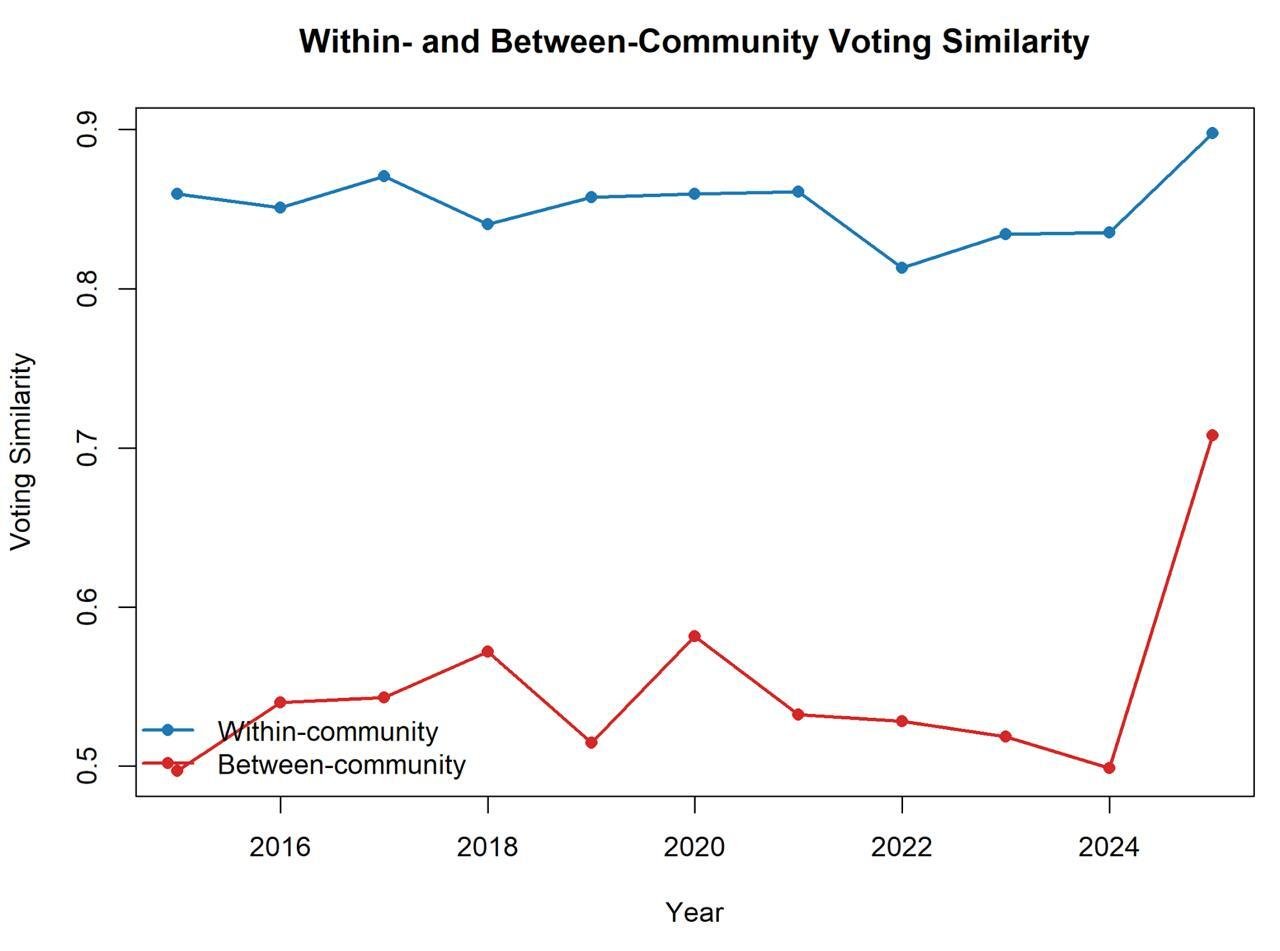
Figure 1: Illustrates the two-community structure of the UNGA voting network across 2015-2025. The graph shows that within-community similarity remains consistently higher than between-community similarity across all three years. Notably, while within-community similarity increases from 0.859 in 2015 to 0.898 in 2025, between-community similarity shows a more substantial increase from 0.497 to 0.708, narrowing the gap between the two measures. This visual trend indicates that the communities remain identifiable but become less sharply differentiated by 2025.
Source: Calculations based on UN digital library
Interpretation:
The results provide consistent support for the Voting Community Hypothesis (H1). Across all years, the network analysis identified two statistically distinguishable communities, and voting similarity was consistently higher among countries within the same community than among countries belonging to different communities. Within-community similarity ranged from 0.813 to 0.898, whereas between-community similarity ranged from 0.497 to 0.708. The observed difference between within- and between- community similarity remained positive in every year, ranging from 0.190 to 0.362.
The permutation tests further indicate that the observed differences were statistically significant in every year (p < .001). For each year, 1,000 random permutations were used to generate a null distribution of the difference between within- and between-community similarity. The null hypothesis for the permutation test is that community assignments are random. The significant p-values indicate that the observed within-community similarity is higher than would be expected under random assignment, confirming that the detected communities are statistically distinguishable. The observed difference was then compared with this null distribution to obtain an empirical permutation p-value. This suggests that the detected communities are not simply the result of random grouping; rather, countries assigned to the same community tend to exhibit systematically greater similarity in their UNGA voting behaviour. This finding is consistent with the understanding that UNGA voting patterns are structured rather than random, reflecting underlying geopolitical alignments (Bailey et al., 2017; Voeten, 2000).
The strongest within-community similarity was observed in 2025 (0.898), while the largest separation between within- and between- community similarity occurred in 2015 (0.362). Notably, although within- community similarity remained high throughout the period, between-community similarity increased substantially in 2025 to 0.708, reducing the difference between the two types of relationships to 0.190. This indicates that the communities remained identifiable but became less sharply differentiated from one another in the final year of the study period, a finding that may reflect the emergence of new alliances or a realignment of existing blocs.
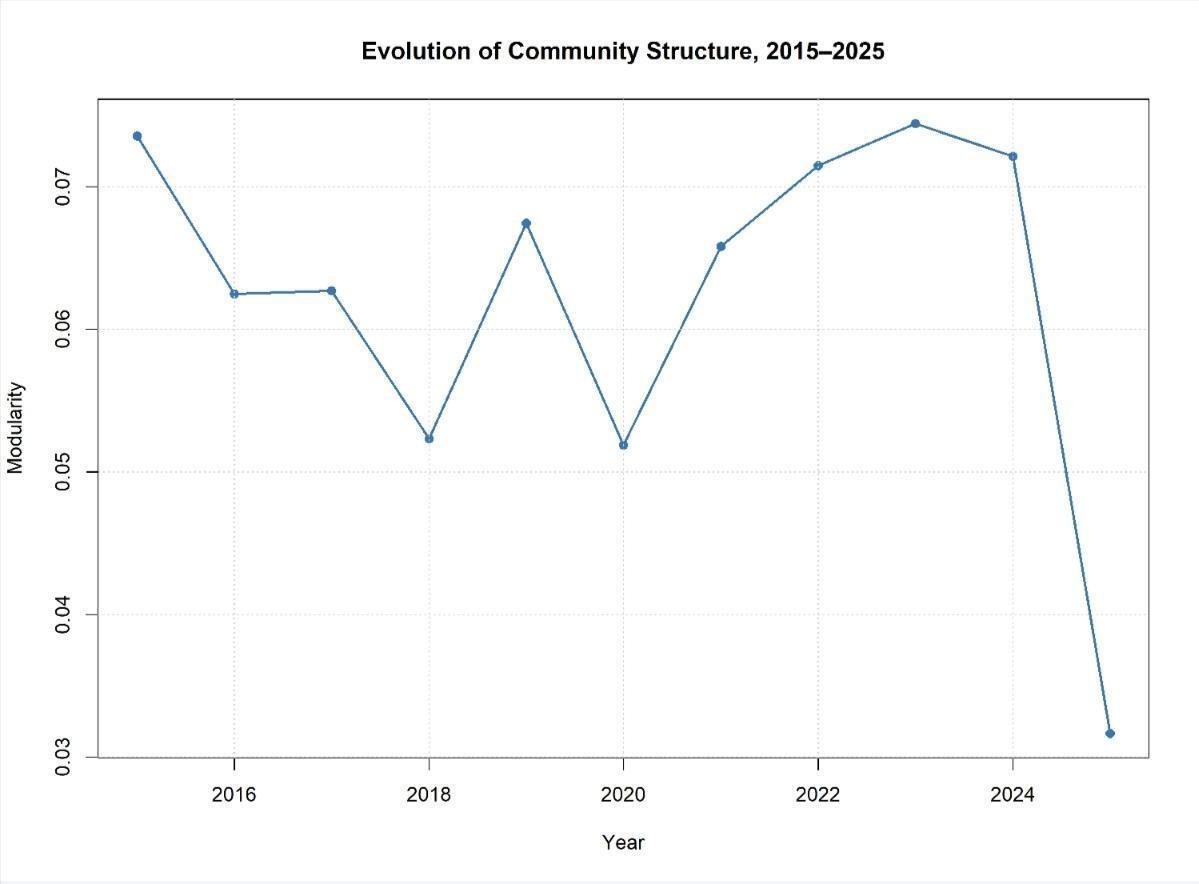
However, the relatively low modularity scores (0.032-0.074) suggest that these communities should not be interpreted as completely isolated or rigid geopolitical blocs. Instead, the findings indicate the existence of statistically identifiable but highly interconnected voting communities within the dense UNGA voting network.
The consistent and statistically significant difference between within- and between-community voting similarity provides strong evidence that countries with higher
voting similarity form identifiable communities in the UNGA network. Therefore, the Voting Community Hypothesis (H1) is supported.
H2: Temporal Change Hypothesis
The second hypothesis proposed that the structure and cohesion of voting communities would change over time. The analysis reveals a significant anomaly in 2025.
Table 2: Temporal changes in UNGA Voting community Structure, 2015-2025
|
Year |
Modularity |
Within-Similarity |
Between-Similarity |
Observed Difference |
|
2015 |
0.074 |
0.859 |
0.497 |
0.362 |
|
2022 |
0.071 |
0.813 |
0.528 |
0.285 |
|
2023 |
0.074 |
0.834 |
0.519 |
0.316 |
|
2024 |
0.072 |
0.835 |
0.499 |
0.336 |
|
2025 |
0.032 |
0.898 |
0.708 |
0.190 |
Source: Calculations based on UN digital library
Figure 2: Evolution of Community Structure, 2015-2025
It tracks the evolution of modularity, within-community similarity, and between-community similarity over the 2015-2025 period. The graph reveals a significant anomaly in 2025, where modularity drops sharply to 0.032 while both within-community and between-community similarity reach their highest levels. This visual pattern indicates a structural shift in the international system, potentially reflecting the emergence of new alliances or a realignment of existing blocs following the Ukraine war.
Source: Calculations based on UN digital library
Interpretation:
The temporal analysis provides evidence that the structure and cohesion of UNGA voting communities changed during the 2015-2025 period. Although the network consistently produced two detectable communities, the strength of their separation varied considerably across years. Modularity fluctuated throughout the period, ranging from 0.052 to 0.074 during most years before declining to 0.032 in 2025. This indicates that the degree to which voting relationships were organised into distinct community structures was not constant over time.
Within-community voting similarity remained relatively high throughout the study period, ranging from 0.813 to 0.898. However, it also exhibited temporal variation, reaching its lowest level in 2022 (0.813) before increasing to its highest level in 2025 (0.898). This indicates that the internal cohesion of the detected communities was not completely stable across the study period, potentially reflecting the disruptive impact of geopolitical events on voting cohesion.
More importantly, between-community similarity also changed over time. It increased from 0.497 in 2015 to 0.582 in 2020, declined during 2021-2024, and then increased sharply to 0.708 in 2025. Consequently, the difference between within and between-community similarity declined from 0.362 in 2015 to 0.190 in 2025. The substantially smaller difference in 2025 suggests that, although the communities remained identifiable, the distinction between them became less pronounced, a finding that may reflect the emergence of new alliances or a realignment of existing blocs.
Overall, these findings demonstrate that UNGA voting community structure was not temporally static. The strength of internal cohesion and the degree of separation between communities varied across the study period, with particularly notable structural changes in 2025. This suggests that the fragmentation caused by the Ukraine war (2022-2023) gave way to a newer alignment characterised by the emergence of clear voting blocs by 2025.
While the analysis confirms that community cohesion and structural separation changed significantly between 2015 and 2025, the full hypothesis requires additional analysis of the community membership changes. Therefore, the Temporal Change Hypothesis (H2) is partially supported based on the current evidence.
H3: Geopolitical Realignment hypothesis
The third hypothesis proposed that voting ties between countries and major geopolitical powers would change over time. The analysis examined changes in voting similarity between major powers and other UN member states from 2015 to 2025. To assess whether the observed changes are statistically significant, paired t-tests were conducted. Following this, a dyadic analysis of voting similarity among the three major powers themselves was performed to examine changes in their bilateral relationships.
Table 3: Changes in Country-Level Voting Similarity with Major Geopolitical Powers, 2015-2025.
|
Major Power |
countries compared |
Mean Change |
median change |
SD |
Min Change |
Max Change |
Direction |
|
China |
190 |
+0.145 |
+0.128 |
0.100 |
-0.528 |
– |
increased |
|
Russia |
189 |
+0.145 |
+0.151 |
0.092 |
-0.396 |
– |
Increased |
|
United States |
188 |
-0.178 |
-0.155 |
0.102 |
-0.613 |
– |
Decreased |
Note: Change is calculated as voting similarity in 2025 minus voting similarity in 2015. Positive values indicate increased similarity, while negative values indicate decreased similarity. The number of countries differs because country pairs with missing/insufficient comparable voting observations were excluded.
Source: Calculations based on UN digital library
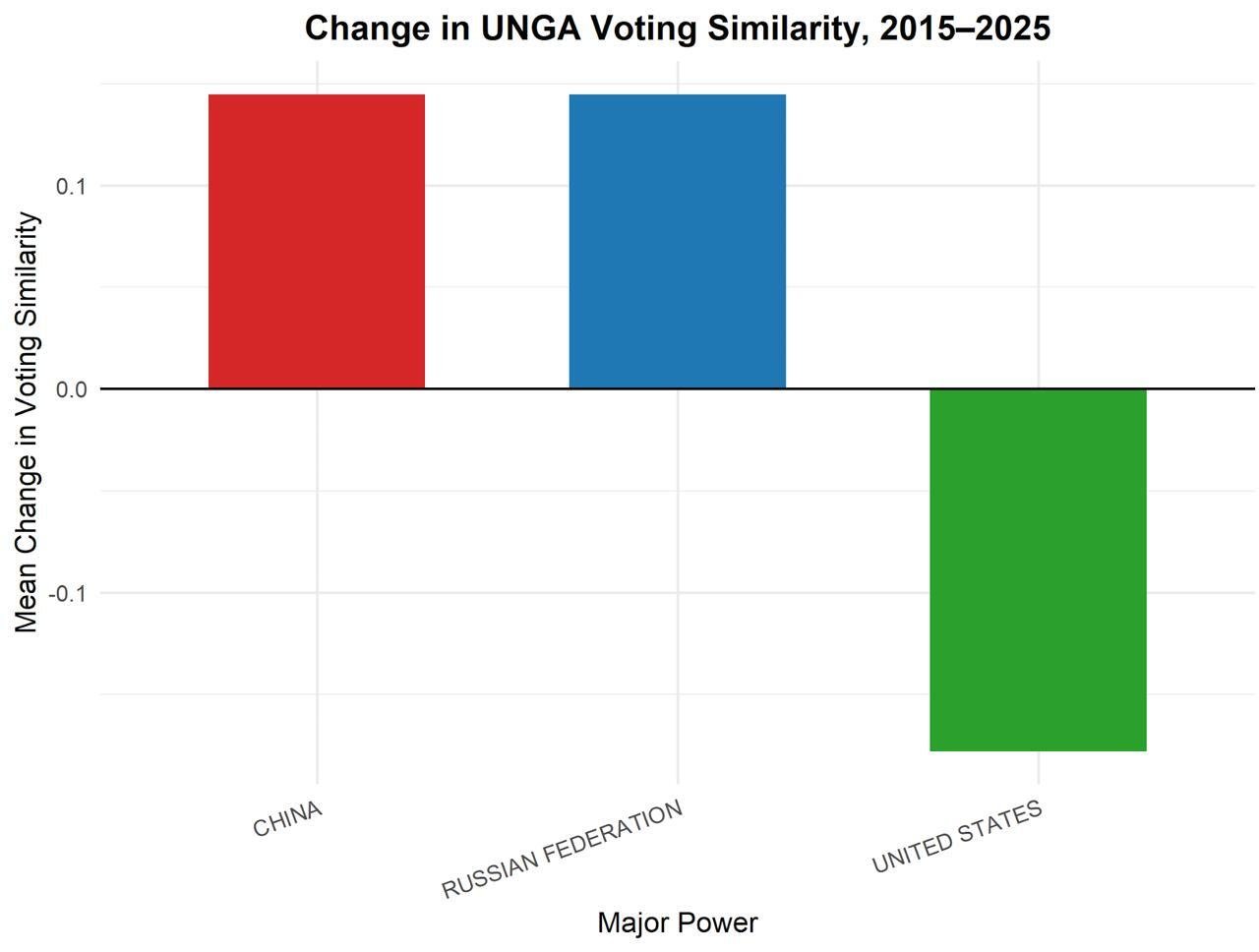
The analysis provides strong evidence of temporal changes in the voting relationships between UN member states and major geopolitical powers. As shown in Table 3, countries’ voting similarity with China increased by an average of 0.145 between 2015 and 2025, while similarity with Russia increased by a similar magnitude of 0.145. In contrast, the average voting similarity with the United States declined by 0.178 over the same period.
Figure 3: below displays the mean change in voting similarity between major powers (China, Russia, and the USA) and other UN member states over the 2015–2025 period. The graph shows a clear divergence: China and Russia exhibit positive mean changes, while the USA shows a negative mean change. This visual pattern suggests that countries’ voting alignment shifted toward China and Russia and away from the USA during the study period, indicating a notable shift in voting alignment.
Source: Calculations based on UN digital library.
Moving Forward,
Table 4: below shows Statistical Significance Tests for Changes in Voting Similarity.
|
Major Power |
Paired t |
df |
Mean Difference |
95% CI |
p-value |
Wilcoxon p-value |
|
China |
19.909 |
189 |
+0.145 |
[0.131, 0.159] |
< .001 |
< .001 |
|
Russia |
21.681 |
188 |
+0.145 |
[0.132, 0.158] |
< .001 |
< .001 |
|
United States |
-23.974 |
187 |
-0.178 |
[−0.193, −0.163] |
< .001 |
< .001 |
Source: Calculations based on UN digital library
These changes were statistically significant for all three geopolitical powers. The paired t-test indicates significant increases in voting similarity with China (t(189) = 19.909, p < .001) and Russia (t(188) = 21.681, p < .001), while similarity with the United States decreased significantly (t(187) = -23.974, p < .001). The corresponding 95% confidence intervals do not include zero, further indicating that the observed changes are unlikely to reflect random temporal variation. Wilcoxon signed-rank tests produced the same conclusion for all three comparisons (p < .001), providing a non-parametric robustness check.
Table 5: below shows the Changes in Voting Similarity Among Major Powers.
|
Country Pair |
2015 Similarity |
2025 Similarity |
Change |
Interpretation |
|
China–Russia |
0.714 |
0.781 |
+0.067 |
Increased |
|
China–USA |
0.156 |
0.042 |
-0.114 |
Decreased |
|
Russia–USA |
0.269 |
0.130 |
-0.139 |
Decreased |
Source: Calculations based on UN digital library.
The dyadic analysis further demonstrates a divergence in the voting relationships among the three major powers. China-Russia voting similarity increased from 0.714 in 2015 to 0.781 in 2025, whereas China-United States similarity declined from 0.156 to 0.042.
Similarly, Russia–United States similarity declined from 0.269 to 0.130. Thus, the observed changes are not limited to the relationships between major powers and other UN member states; the voting relationship among the major powers themselves also changed during the study period.
Taken together, these findings indicate a significant reconfiguration of UNGA voting alignments between 2015 and 2025. The increasing similarity of other countries with China and Russia, combined with declining similarity with the United States, suggests a shift in the distribution of voting affinity among major geopolitical reference points. These changes are consistent with broader geopolitical trends, including the strengthening of the China-Russia partnership and the perceived decline of US global influence.
However, these results should be interpreted as evidence of changes in voting alignment rather than formal geopolitical alliance formation. Voting similarity captures patterns of agreement in UNGA resolutions but does not, by itself, establish formal alliances or identify the causal mechanisms underlying the observed changes. The statistically significant changes in country-level voting similarity with China, Russia and the USA demonstrates a clear divergence in voting alignment between 2015 and 2025. Thus the Geopolitical Realignment Hypothesis (H3) is supported.
Qualitative Analysis: National Narrative.
The qualitative analysis examined UNGA statements from seven countries using the Narrative Policy Framework and Social Identity Theory. The analysis focused on three themes:
Convergence of villains
By 2024-25, Russia, China, Turkey, and South Africa all identified the United States, the collective West, or Israel as their primary villain. Russia’s Lavrov stated “The goal of the strategic defeat of Russia is declared there” (2024). Turkey’s Erdogan declared, “just as Hitler was stopped. Netanyahu and his murder network must be stopped” (2024). South Africa’s Ramaphosa stated, “We South Africans know what apartheid looks like. We will not remain silent and watch as apartheid is perpetrated against others” (2024).
This convergence of ideas from the countries suggests the emergence of a global south alliance narrative against western dominance, which only intensified with the Gaza war acting as a unifying force against anti-western sentiment across multiple regions.
The Rise of Global South Leadership:
China, India, Brazil, South Africa, and Turkey positioned themselves as Global South leaders. India’s Jaishankar declared, “From the era of non-alignment, we have evolved to Vishwa Mitra (a friend to the world)” (2023). Brazil’s Lula stated, “the Global South is the most affected by climate change” (2023). South Africa’s Ramaphosa stated, “Africa and its 1.4 billion people remain excluded from its key decision-making structures” (2024).
This collective claim of the Global South leadership reflects shared vision of a multipolar world order, where developing nations seek to challenge western dominance and claim a greater influence in global governance.
The Role of Bridge Countries:
India and Turkey consistently positioned themselves as the mediators. India’s Jaishankar stated, “India is on the side of peace, dialogue and diplomacy are the only way out” (2022). Turkey’s Erdogan stated, “Since the beginning of the Russia-Ukrainian war, we have been endeavouring to keep both our Russian and Ukrainian friends around the table” (2023). By maintaining dialogue with both Russia and the West, India and Turkey occupy a unique bridging role that prevents complete polarisation and preserves a network for diplomatic engagement in an increasingly divided world.
Discussion:
The results demonstrate that UNGA voting patterns from 2015 to 2025 exhibited a distinguishable but increasingly fluid structure. The findings support the Voting Community Hypothesis (H1), confirming the existence of statistically identifiable voting blocs. Countries within each community demonstrated consistently higher voting similarity than those across communities. However, the relatively low modularity scores and the convergence of within- and between-community similarity suggest that these communities should not be interpreted as rigid or permanent geopolitical blocs.
By 2025, the distinction between within and between-community similarity had narrowed considerably, indicating that political alignments are becoming increasingly interconnected and less polarised. The temporal analysis provides partial support for the Temporal Change Hypothesis (H2), identifying 2025 as a critical juncture. While community cohesion remained stable, the sharp decline in modularity which was accompanied by simultaneous increases in both within- and between-community similarity, suggested a fundamental transformation in voting behaviour. The third hypothesis (H3) offers insight into the direction of this transformation. Between 2015 and 2025, voting similarity with China and Russia increased by an average of 0.145 each, while similarity with the United States declined by 0.178. The increasing convergence in China-Russia voting patterns, alongside their declining alignment with the United States, is consistent with a broader shift in voting relationships.
The qualitative findings support and strengthen the quantitative results. The growing emphasis on Global South leadership, multipolarity, and criticism of Western dominance suggests that changes in voting behaviour reflect evolving political identities and diplomatic views. The convergence of positions on issues such as the Ukraine and Gaza conflicts may explain why countries with otherwise differing interests increasingly align on specific resolutions. However, this issue-based agreement should not be interpreted as evidence of a cohesive Global South bloc; rather, it reflects the emergence of shared narratives that can facilitate cooperation on particular issues without indicating permanent alignment. The cases of India and Turkey further challenge the idea of the network as two fixed blocs, as both countries emphasise dialogue, diplomacy, and engagement with major powers from both sides. Together, these findings suggest that the international system should be understood not as two fixed blocs but as a dynamic and overlapping network of relationships.
While evidence of evolving voting alignments is observable in UNGA patterns, the qualitative narratives provide essential context for understanding the identities and motivations underlying these shifts. Further research examining economic, military, and diplomatic relationships would be necessary to determine whether these evolving voting patterns develop into sustained geopolitical alliances.
Conclusion:
This research shows that the voting practices of the United Nations General Assembly gives a useful insight for developing geopolitical coalitions and the nature of international relations, which is more fluid in present times than earlier. The network analysis confirms the existence of identifiable voting communities as predicted by the Voting Community Hypothesis (H1), but the similarity among the communities, inside and out, is not significantly different. The modularity is modest- these communities are not geographically defined and cannot be interpreted as ‘blocs’. Lastly, the support for the Partial Temporal Change Hypothesis (H2) demonstrates that there has been a dramatic change in the structure of international voting relations in 2025.
As countries increasingly align with China and Russia, and the countries that are less similar with the US become less close, these trends suggest a shift in voting affinity that may reflect broader geopolitical developments. The qualitative results reveal that this trend does not necessarily indicate the formation of a cohesive alternate bloc. The significance of strategic autonomy and flexible diplomacy is in issue specific convergence, especially on Ukraine and Gaza along with the strategic autonomy of bridge countries like India and Turkey, points to a more fragmented and fluid system. The conclusion of this study indicates that the current international framework should be viewed as a network of dynamic and overlapping relationships and not as two distinct geopolitical blocs. The UN voting record provides valuable insights into the formation of emerging alignments, but more research is needed that takes account of economic, military and diplomatic ties to assess if these actually become enduring geopolitical alliances.
References:
- Kim, S. Y., & Russett, B. (1996). The New Politics of Voting Alignments in the United Nations General Assembly. International Organization, 50(4), 629–652.
- Lees, N. (2023). The endurance of the G77 in international relations: South–South ideology and voting at the United Nations 1970–2015. Japanese Journal of Political Science, 24(3), 310–330.
- Voeten, E. (2000). Clashes in the Assembly. International Organization, 54(2), 185–215.
- Macon, K. T., Mucha, P. J., & Porter, M. A. (2010). Community Structure in the United Nations General Assembly. arXiv Preprint (Physics.Soc-Ph).
- Bailey, Michael A., Anton Strezhnev, and Erik Voeten. “Estimating Dynamic State Preferences from United Nations Voting Data.” Journal of Conflict Resolution 61, no. 2 (2017): 430–456.
- Fortunato, S., & Barthélemy, M. (2007). Resolution limit in community detection. Proceedings of the National Academy of Sciences, 104(1), 36–41. https://doi.org/10.1073/pnas.0605965104
- Peixoto, T. P. (2014). Efficient Monte Carlo and greedy heuristic for the inference of stochastic block models. Physical Review E, 89(1), Article 012804. https://doi.org/10.1103/PhysRevE.89.012804
- Smith, A. (2016). Leader turnover, institutions, and voting at the UN General Assembly. Journal of Conflict Resolution, 60(1), 143–163. https://doi.org/10.1177/0022002714532689
- Khan, M. Z. I. (2020). Is Voting Patterns at the United Nations General Assembly a Useful Way to Understand a Country’s Policy Inclinations: Bangladesh’s Voting Records at the United Nations General Assembly. SAGE Open, 10(4). https://doi.org/10.1177/2158244020961117
- Abdulgaffar MUHAMMAD, The Geopolitical Implications of Shifting Alliances in a Multipolar World. Department of Business Administration Ahmadu Bello University, Nigeria, 20.09.2023.