
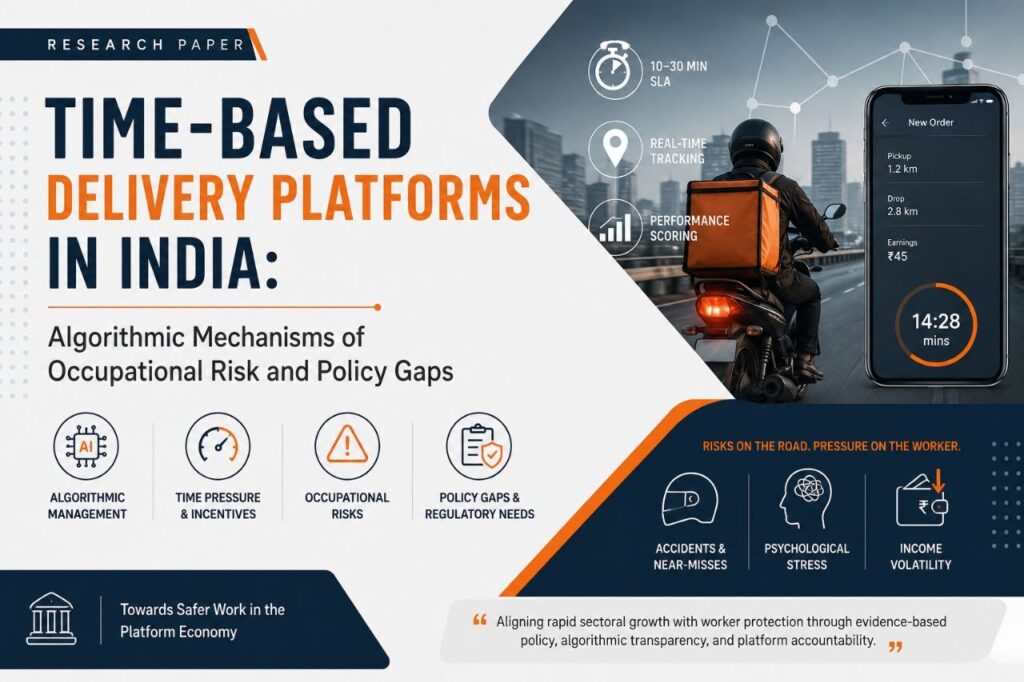
Authors: Niharika Chauhan, Parag Nimbalkar, Oishee Bose, Aviral Goyal
Abstract
India’s quick-commerce sector, valued at approximately US$6.78 billion in 2025, has expanded rapidly, employing an estimated 3–7.7 million gig delivery workers while introducing new forms of occupational risk. This paper examines how time-based delivery models, typically operating within 10–30-minute service-level agreements (SLAs), generate risk through algorithmic management systems that govern task allocation, performance evaluation, and earnings.
Drawing on Labour Process Theory, the study develops a causal framework linking algorithmic incentives to behavioural adaptations and subsequent risk exposure. Using qualitative policy analysis and thematic synthesis of secondary data, including government reports, empirical studies, and documented case evidence, the findings indicate that delivery workers are systematically incentivised to prioritise speed over safety, resulting in increased instances of accidents, near-misses, and psychological stress.
Empirical evidence highlights a high prevalence of unsafe working conditions, including reported accident exposure and frequent near-miss incidents, particularly in dense urban environments. These risks are further intensified by opaque performance systems and income volatility, which constrain worker decision-making and encourage risk-taking behaviour.
The analysis identifies significant regulatory gaps within India’s labour framework, particularly in the Occupational Safety, Health and Working Conditions Code (2020), which does not adequately address platform-mediated work, public-road occupational exposure, or algorithmic accountability.
The paper concludes by proposing targeted policy interventions, including sector-specific safety standards, mechanisms for algorithmic transparency, and enhanced platform liability, aimed at aligning rapid sectoral growth with worker protection. These findings contribute to broader debates on regulating digital labour platforms in emerging economies.
Keywords: algorithmic management, quick-commerce, gig economy, occupational safety.
1. Introduction
India’s quick-commerce sector has expanded rapidly, evolving from a niche urban convenience into a central component of retail logistics. With gross merchandise value (GMV) estimated at approximately US$6.78 billion in 2025 and projected to grow significantly in the coming years, platforms such as Blinkit, Zepto, and Swiggy Instamart have redefined last-mile delivery through ultra-fast fulfilment models promising delivery within 10 to 30 minutes (GlobeNewswire, 2026; Blume Ventures, 2025). This transformation is enabled by a combination of hyperlocal dark-store networks, predictive inventory systems, and real-time routing algorithms, supported by structural advantages such as high population density, relatively low labour costs, and widespread digital payment adoption (Aalia, 2025).
At the core of this model lies a large and expanding gig workforce. Estimates suggest that millions of delivery workers, primarily two-wheeler riders concentrated in metropolitan regions such as Delhi-NCR, Mumbai, Bengaluru, Chennai, and Hyderabad, now form a significant segment of India’s urban labour market. According to NITI Aayog (2022, 2025), the gig workforce is projected to reach 23.5 million workers by 2029–30, accounting for a notable share of the non-agricultural workforce. While this expansion has created new income opportunities, it has also introduced distinct labour dynamics characterised by flexibility, income variability, and limited regulatory protection.
A defining feature of quick-commerce systems is the use of algorithmic management, whereby automated systems govern task allocation, performance evaluation, and earnings. Delivery timelines, typically structured as strict service-level agreements (SLAs), are closely linked to incentive structures, ratings, and platform access (International Labour Organization, 2022). In this configuration, speed is not merely a service attribute but a central determinant of worker income and continuity on the platform. Consequently, delivery workers operate under persistent time pressure, navigating congested urban environments while attempting to meet performance thresholds.
This configuration becomes particularly significant in the Indian context, where road conditions already present substantial risks. Two-wheelers account for a disproportionately high share of accidents, fatalities, and injuries (Ministry of Road Transport and Highways, 2023). Delivery work often occurs during peak traffic hours and under challenging environmental conditions such as heat and air pollution, further intensifying exposure to risk. Emerging empirical evidence suggests that these baseline risks are exacerbated within time-based delivery systems. For instance, reports from The Times of India (2026) document multiple delivery-related accidents in urban centres such as Chennai, while survey-based evidence indicates high rates of near-miss incidents and fatigue among gig delivery workers (Janpahal, 2026; Samal et al., 2025).
Importantly, these risks cannot be understood solely as outcomes of individual behaviour. Rather, they are embedded within the structural design of platform systems. Algorithmic incentives align worker earnings with the ability to meet compressed delivery timelines, effectively encouraging behavioural adaptations such as increased speed, extended working hours, and reduced adherence to traffic norms (International Labour Organization, 2022; Woodcock & Graham, 2020). At the same time, workers are typically classified as independent contractors, limiting their access to labour protections while platforms retain significant control over work processes. This creates a fundamental tension between control and accountability within platform labour systems.
Existing regulatory frameworks in India have begun to recognise gig and platform workers, most notably through the Code on Social Security (2020) and the Occupational Safety, Health and Working Conditions Code (2020). However, these frameworks remain limited in their capacity to address the specific risks associated with platform-mediated delivery work. In particular, regulatory provisions are oriented toward formal workplace settings and do not adequately account for work conducted in public spaces or governed by algorithmic systems (Nasscom, 2024). As a result, key dimensions of occupational risk, such as time-based performance pressures and automated decision-making, remain largely outside the scope of enforceable regulation.
Against this backdrop, this study examines the relationship between time-based delivery models, algorithmic management, and occupational risk in urban India. It advances a mechanism-based analysis that links platform design to worker behaviour and risk exposure, thereby shifting the focus from individual-level explanations to systemic determinants.
2. Research objectives
This study reframes broad descriptive objectives into a set of analytically grounded research questions that enable a mechanism-based inquiry into occupational risk in time-based delivery systems. Rather than listing outcomes, these questions focus on identifying causal pathways linking platform design, worker behaviour, and regulatory gaps.
- How does algorithmic management in quick-commerce platforms, through mechanisms such as delivery timelines (SLAs), rating systems, and incentive structures, generate risk-amplifying behaviours among delivery workers?
- What empirical evidence exists to quantify the physical, psychological, and economic risks faced by delivery workers in urban India?
- To what extent do existing labour and safety regulations, particularly the Occupational Safety, Health and Working Conditions Code (2020), address the risks associated with algorithmic management, and where do critical gaps persist?
3. Review of Literature
The literature on time-based delivery platforms in India is best understood within the broader transformation of labour under digital platforms. Rather than representing neutral “flexibility,” platform work reflects a reorganisation of labour in which control is exercised through algorithmic systems, precarity is normalised, and occupational risk is shifted onto workers (International Labour Organization, 2022; Woodcock & Graham, 2020). In this context, quick-commerce is not merely a logistics innovation but a labour regime that restructures the pace, intensity, and governance of work.
This study draws on platform labour theory and labour process theory, which together highlight the transition from direct managerial supervision to algorithmic control, and from stable employment to contingent, task-based work. Within this framework, the literature can be organised into three interrelated strands: (i) algorithmic management and platform labour, (ii) urban road safety and risk environments, and (iii) labour regulation and occupational safety.
3.1 Platform Labour and Algorithmic Management
The first body of literature examines the structure and implications of algorithmic management within platform-based work. The International Labour Organization (2022) provides a foundational analysis of the gig and platform economy in India, documenting long working hours, income instability, weak contractual protections, and strong dependence on incentive-based earnings. The report highlights how opaque task allocation systems, shifting commission structures, and the threat of deactivation collectively reduce worker autonomy while intensifying pressure to accept and complete tasks rapidly.
From the perspective of labour process theory, these dynamics represent a digitally mediated extension of managerial control. Rather than direct supervision, platforms discipline workers through performance metrics, ratings, and algorithmically enforced deadlines. The application itself becomes a managerial apparatus, shaping behaviour through continuous monitoring and feedback loops. As Jamie Woodcock and Mark Graham (2020) argue, this form of “digital Taylorism” fragments autonomy while intensifying labour extraction.
While this literature effectively captures the structural features of platform control, it remains limited in its ability to link these mechanisms to specific occupational outcomes. In particular, there is insufficient attention to how time-compressed delivery systems translate algorithmic pressure into measurable risks such as accidents, fatigue, and cognitive strain. This gap is especially significant in the context of quick-commerce, where delivery timelines are central to platform design rather than incidental to service delivery.
3.2 Urban Road Safety and Risk Environment
A second strand of literature focuses on the broader urban mobility environment in which delivery workers operate. National-level reports, including those by the Ministry of Road Transport and Highways (2023) and the Transportation Research and Injury Prevention Centre (2023), consistently show that two-wheelers account for a disproportionately high share of road accidents, fatalities, and injuries in India. These findings underscore the inherently high-risk conditions of urban road usage, particularly in densely populated metropolitan areas characterised by congestion, weak lane discipline, and infrastructural constraints.
This body of work is crucial in establishing that delivery workers operate within an already hazardous environment. However, it largely treats riders as generic road users, failing to distinguish between private commuters and workers operating under occupational pressure. This represents a significant limitation. Delivery workers are not only navigating traffic but are doing so under time-bound performance constraints that may incentivise behaviours such as speeding, signal violations, and extended working hours.
As a result, while road safety literature provides an important baseline for understanding exposure to risk, it does not adequately capture the labour-specific dimensions of that risk. The absence of occupation-disaggregated accident data further obscures the extent to which delivery work amplifies vulnerability within the urban transport system.
3.3 Psychological and Cognitive Dimensions of Platform Work
A third body of literature examines the psychological and cognitive implications of platform-mediated work. Evidence compiled by the International Labour Organization (2022) indicates that gig workers frequently experience cognitive overload, stress, and income insecurity due to performance-linked incentives and penalties. These conditions are exacerbated by limited managerial support and the absence of formal grievance mechanisms.
Empirical studies in the Indian context further highlight the mental health implications of delivery work. For instance, research by Jitendra Samal et al. (2025) documents high levels of burnout, anxiety, and depression among app-based delivery workers, linking these outcomes to long working hours and performance pressure. These findings suggest that occupational risk in platform delivery extends beyond physical hazards to include cumulative psychological and cognitive strain.
From a theoretical perspective, platform labour systems create environments in which workers internalise performance pressure. Continuous monitoring, combined with income uncertainty, encourages workers to prioritise efficiency over well-being. In delivery contexts, this manifests in heightened cognitive load, where workers must simultaneously navigate traffic, manage time constraints, and respond to platform demands. Despite these insights, existing research remains limited in its use of validated measurement tools and systematic observation of how time pressure affects safety-critical decision-making.
3.4 Labour Regulation and Occupational Safety
The fourth strand of literature examines legal and regulatory responses to platform work in India. The National Association of Software and Service Companies (2024) Handbook on New Labour Codes, along with analyses of the Code on Social Security (2020) and the Occupational Safety, Health and Working Conditions Code (2020), indicates that while gig workers have been formally recognised within policy frameworks, substantive protections remain limited.
A key limitation lies in the design of existing labour laws, which are primarily structured around traditional employer–employee relationships and fixed workplace environments. The OSH Code, for example, defines safety obligations in relation to “establishments,” thereby excluding work conducted in public spaces such as roads. Similarly, there are no explicit provisions addressing algorithmic management, performance-based penalties, or platform accountability for occupational risk.
This creates a structural mismatch between the nature of platform labour and the scope of regulatory frameworks. While platforms exercise significant control over work processes, they are not held proportionately accountable for associated risks. This reflects a broader phenomenon of regulatory lag, where labour law fails to adapt to emerging forms of digitally mediated work.
3.5 Synthesis and Research Gap
Taken together, the literature reveals three overlapping but insufficiently integrated frameworks:
(i) platform labour and algorithmic management,
(ii) urban road safety and infrastructure, and
(iii) labour regulation and occupational safety.
While each provides valuable insights, there is limited work that synthesises these perspectives into a unified analysis of occupational risk in time-based delivery systems. In particular, key gaps include:
- the absence of micro-level linkages between delivery timelines and accident outcomes
- lack of occupation-specific accident data for delivery workers
- limited empirical evidence on cognitive and behavioural responses to time pressure
- insufficient analysis of how existing legal frameworks can be operationalised for platform work
4. Methodology
This study adopts a qualitative, explanatory policy analysis to examine how ultra short delivery windows in quick commerce reshape occupational risk for two-wheeler delivery workers in urban India. The analysis is structured around three interlinked mechanisms identified in the paper: time-based service level agreements, algorithmic task allocation, and performance linked incentive systems. Rather than estimating causal effects statistically, the study traces how these mechanisms generate physical, cognitive, and psychosocial risks and how far existing policy frameworks are capable of addressing them.
The research is based on structured secondary source analysis. Sources were selected through purposive sampling using three criteria: direct relevance to platform labour, road safety, occupational safety, or labour regulation; empirical, doctrinal, or policy content; and temporal relevance, with preference given to post 2018 material. The core corpus consisted of the ILO report on the gig and platform economy in India (2022), the TRIP road safety report (2023), the Ministry of Road Transport and Highways Road accident data (2023), and the Nasscom Handbook on New Labour Codes (2024). These were supplemented by peer reviewed articles, government publications, NGO and union reports, investigative journalism, and platform policy documents. All sources were catalogued with citation metadata and relevant excerpts to ensure traceability and cross checking.
The policy analysis was conducted as a qualitative document-based gap analysis. First, policy texts were coded thematically under categories including worker classification, occupational safety duties, social security coverage, enforcement mechanisms, and algorithmic accountability. Second, these coded provisions were compared with the operational realities of quick commerce delivery work described in the paper, particularly delivery deadlines, incentive penalties, automated allocation, deactivation threats, fatigue, accident exposure, and income insecurity. This comparison made it possible to assess whether existing legal frameworks address the actual risk environment faced by delivery workers or leave structural gaps unresolved. Third, the analysis used a policy gap lens to identify missing safeguards, especially sector specific OSH standards, mandatory rest provisions, PPE obligations, vehicle fitness checks, and post injury accountability.
To strengthen interpretation in the absence of platform level micro data, the study also used a time stamp trace approach, drawing on publicly available time referenced materials such as worker testimonies, investigative reports, press releases, and news timelines. This allowed the reconstruction of how delivery speed commitments operate in practice and how time pressure affects work behaviour. Analytical reliability was enhanced through triangulation across statistical, legal, and qualitative sources. The study remains limited by the absence of occupation disaggregated accident data and restricted access to proprietary platform data, so findings are presented through cautious inference and cross source validation rather than causal generalisation.
5. Overview of Time-Based Delivery Models
5.1 Concept and Definition
Time-based delivery models are changing the rules of traditional logistics. Rather than just prioritizing cost, these platforms focus on delivering your order quickly, sometimes in 30 minutes, sometimes in as little as 10. This is particularly true in urban cities, where the competition is tough, and everyone wants things urgently. Unlike the old e-commerce model, which aimed to cut costs by combining orders and optimizing inventory, the new platforms make speed and immediate service their top priorities. In Indian urban cities, this approach has become dominant. Food delivery, groceries, and even small errands, if you are living in these cities, you would likely expect fast delivery. Companies such as Zomato, Swiggy, Blinkit, Zepto, and Dunzo have made ultra-fast delivery the standard. This has transformed the way people shop and eat, and it has also changed how gig workers go about their work.
India’s quick commerce market has experienced staggering growth, with sales increasing by over 280% in just two years. The industry’s Gross Merchandise Value (GMV) rose from $500 million in FY 2021-22 to $3.34 billion in FY 2023-24, growing at an annual rate of 73%. Blume’s Indus Valley 2025 report highlights that quick commerce is India’s fastest growing industry segment ever, with a 24x rise in Gross Order Value over just three years. The report demonstrates how India seems to be “leapfrogging modern retail and going directly to quick commerce,” a phenomenon not seen in other developing markets. (Aalia,2025)
5.2 Evolution of Time-Based Delivery in India
You can see how delivery models in India have evolved by looking at three main stages. First came the era of same-day and next-day delivery. Large e-commerce companies and courier services led the way during this time. Speed mattered, of course, but it was not what made them stand out from the rest. Next was the rise of food delivery. Suddenly, getting your food within 30 to 45 minutes became standard. Companies introduced smart technology algorithm-based dispatching, GPS tracking, and flexible pay for delivery workers. This put more pressure on everyone involved and made speed a real priority. Now, we are in the quick commerce era. Groceries and essentials can arrive at your door in 10 to 30 minutes. This is not just a faster version of the old system; it is something entirely new. The process relies on dark stores hidden near neighbourhoods, real-time forecasting, intelligent route planning, and a much stricter selection of products. Experts say this shift is not just about moving goods more quickly; it is about making speed the main attraction. With crowded cities, many people looking for gig work, and widespread smartphone use, India’s urban cities are almost tailor-made for this model to flourish. (BOSTON CONSULTING GROUP & DTDC,2025)
Why Quick Commerce Works in India:
Unlike many Western markets where quick commerce has struggled with profitability, India presents unique conditions that make the model viable:
- Low labour costs: India has among the lowest rider costs relative to average order value (AOV) globally – around 7% compared to 16% in Germany and higher percentages in other Western countries.
- High population density: Indian cities have nearly four times the population density of major global cities, allowing dark stores to serve more customers efficiently.
- Limited car ownership and storage space: With low car ownership (26 cars per 1,000 people compared to 594 in the US) and smaller homes (average 504 sq. ft. compared to 2,164 in the US), Indians face natural limitations on bulk buying and storage.
Evolving consumer behaviour: Urban Indians increasingly value convenience over price for everyday essentials, with 31% now using quick commerce for primary grocery shopping. (Aalia, 2025)
5.3 Platform Architecture and Operational Design
Time-based delivery relies on a combination of digital tools and real-world coordination. Orders are allocated depending on where the riders are, how quickly they can reach the destination, their previous performance, and the current traffic situation. The app keeps constant tabs on the riders, tracking their performance and sending reminders or nudges to help them stay on schedule. What really makes this system unique are the strict deadlines, called service-level agreements, or SLAs, that riders must meet. Failure to meet these deadlines may result in reduced incentives or bonuses, lower customer ratings, or even removal from the platform, either temporarily or permanently. However, faster deliveries are often rewarded through extra pay during busy periods, bonuses, or better access to more orders. Ultimately, speed is not only about satisfying customers. For riders, moving fast is the only way to earn a living. (Negi, V., Negi, M., & Sharma, P., 2025)
5.4 Workforce Structure and Employment Classification
The gig economy is characterized by the re-emergence of task-based, piece-work or gigs. Temporary short-term contracts, and independent assignments with flexible work timings are characteristic features of gig work mediated through digital labour platforms. A recent study by the skills and employment vertical at NITI Aayog estimates that between 2020 and 2021, there were around 77 lakh (7.7 million) workers engaged in the gig economy in India. The gig workforce is expected to expand to 2.35 crore (23.5 million) workers by 2029-30, and gig workers are expected to form 6.7 percent of the non-agricultural workforce, or 4.1 per cent of the total livelihood in India by 2029-2030. Delivery workers in time-based models are classified as independent contractors or gig workers rather than regular employees. Platforms do this to expand quickly and avoid obligations like social security, workplace safety, or labour protections. Researchers and institutions repeatedly highlight a strange pattern: platforms control nearly everything, like work allocation, how much they earn, and performance evaluation, yet when it comes to issues like job risks or protections, they deny it by framing workers as self-employed partners. This tension between control and responsibility lies at the heart of the public policy debate surrounding time-based delivery models. (International Labour Organization,2024)
5.5 Policy Relevance of Time-Based Delivery Models
From a public policy perspective, time-based delivery models raise important questions about:
- The sustainability of speed-driven competition
- The externalization of operational risk onto workers
- The adequacy of existing labour and safety regulations
While these models have certainly created employment opportunities and introduced innovative ideas, they also represent a structural shift in how urban work is organized, making them a critical area for policy scrutiny.
6. Occupational Risk Analysis
6.1 Understanding Occupational Risk in the Gig Economy
Occupational risk in time-based delivery jobs goes beyond typical workplace accidents. It involves physical, economic, psychological, and regulatory risks often intensified by the strict deadlines imposed by the platform’s algorithms. Delivery workers lack the security of a fixed workplace or clear safety guidelines. Instead, they navigate unpredictable city streets, exposed to constant and difficult-to manage risks.
| Dimension |
Traditional E-commerce Delivery |
Food Delivery |
Quick Commerce / Ultra-fast Delivery |
| Typical Delivery Time | Same-day / Next-day | 30–45 minutes | 10–30 minutes |
| Core Value Proposition | Cost efficiency | Convenience + speed | Speed as the primary product |
| Inventory Structure | Centralized warehouses | Restaurant-based | Decentralized dark stores |
| Workforce Control | Moderate | High | Very high (strict SLAs) |
| Risk Exposure | Moderate | High | Very high |
(International Labour Organization,2024)
6.2 Physical and Road Safety Risks
The most visible occupational risk faced by delivery workers is exposure to road accidents. The Indian government’s accident data states that two-wheelers account for far too many crashes and fatalities in cities, especially during heavy traffic or bad weather. Most delivery workers use two-wheelers, and they are on the road when it is most crowded, which means their risk goes way up. Time-based delivery adds even more pressure on the workers. To meet their targets and avoid penalties, workers admit they sometimes speed, weave through traffic, or run red lights. The whole system encourages them to focus on delivery speed, so even if companies say, “Don’t drive recklessly,” that warning does not really stick, as delivering quickly gets rewarded.
India records one of the highest rates of persons killed per lakh population due to road accidents globally. While this data reflects overall road safety conditions rather than delivery-specific outcomes, it establishes a high-risk baseline within which delivery workers operate. Two-wheelers account for a disproportionate share of fatalities, a critical concern given that the majority of delivery workers rely on two-wheelers for mobility.
| Vehicle Type
|
No. of Accidents | Persons Killed | Persons Injured | % Share in Total |
| Two Wheelers | 39,446 | 7,591 | 39,428 | 48.6% accidents, 44% deaths, 53.7% injuries |
| Pedestrian | 19,259 | 4,604 | 16,231 | 23.7%, 26.7%, 22.1% |
| Car/Taxi/Van & LMV | 9,487 | 1,593 | 6,387 | 11.7%, 9.2%, 8.7% |
(Ministry of Road Transport & Highways,2023)
In a national survey conducted by Janpahal (2025), which sampled over 1,000 gig workers from 10 cities in India, it was found that 57% of the workers work for more than 49 hours in a week, and almost a quarter of the workers work for more than 70 hours in a week. More importantly, 27% of the workers have had traffic accidents while at work, while 62% of the workers reported near-miss incidents. Also, the survey reveals that 44% of the workers do not have accident insurance and 62% of the workers did not had health insurance as well. Also 84% of the workers had reported to witness harsh environmental conditions while working and 42% had reported that extreme heat had major impact on their work hence increasing exhaustion. (Janpahal, 2025)
“Recently, one delivery person died while trying to deliver on time. Sometimes we are in faraway places and cannot reach on time. We also sometimes jump traffic signals and ride on pavements. Traffic police usually do not catch us because they are generous toward delivery partners, but we are risking our lives”. (Singh, A.,2026)
6.3 Algorithmic Management and Risk Amplification
A major risk that often goes unnoticed is algorithmic management. Delivery platforms depend on opaque algorithms to assign orders, set delivery deadlines, and evaluate worker performance. Workers have little ability to contest these decisions, even if a late delivery is not their fault, like when there’s heavy traffic or bad weather. Studies and surveys indicate these rating systems are critical for the workers. If a worker gets a poor rating, he could get lower pay or get removed from the platform. Combine that with the need to move quickly and chase after bonuses, and you have a job that’s stressful and exhausting, and encourages people to take more risks just to keep up. (Negi, V., Negi, M., & Sharma, P., 2025)
Algorithmic Controls and Associated Risks
| Algorithmic Feature | Intended Purpose | Resulting Risk |
| Delivery time SLAs | Faster fulfilment | Speeding, signal jumping |
| Performance ratings | Quality control | Stress, income insecurity |
| Incentive bonuses | Productivity | Risk normalization |
| Automated deactivation of worker from platform | Platform efficiency | Job uncertainty |
6.4 Economic and Income-Related Risks
Time-based delivery work is marked by income volatility. Earnings are often composed of multiple components such as base pay, per-delivery fees, bonuses, and surge incentives—many of which are conditional on meeting delivery-time targets. Missed deadlines can therefore result not only in poor ratings on the platform but also in immediate income loss.
Reason for Time-Based Delivery Models Are More Common in India are as follow:
1. Lower Labour Costs Make Speed Economically Viable: India has much lower labour costs for delivery riders compared to Western markets, which directly affects last-mile economics.
- In India, rider costs are ~7% of order value, whereas in Germany they are around 16% nearly 2.3× higher. This means platforms in India can sustain ultra-fast delivery with lower labour expenditure relative to the revenue generated per order.
- In developed countries (e.g., US, EU), minimum wages and rider costs are significantly higher — pushing delivery cost higher and making ultra-fast delivery economically unsustainable without large price premiums or subsidies.
Lower labour cost allows companies to hire large fleets of riders at scale while keeping delivery charges low for consumers, which is far harder in high-wage economies.
2. High Population Density Reduces Delivery Costs: India’s cities are among the most densely populated in the world, which makes cluster-based last-mile logistics (dark stores) efficient:
- High population density means delivery riders can serve more orders in the selected area with shorter distances — reducing time and fuel costs per delivery.
- Compared to typical Western cities (with lower densities and more suburban layouts), Indian cities allow higher order frequency per rider.
Cities with sprawling suburbs (major US/EU cities) struggle to deliver ultra-fast services at scale because riders must travel longer distances with fewer orders per hour.
3. Limited Storage Space & Consumer Behaviour Fit Instant Delivery: Consumer behaviour and household constraints make quick commerce particularly appealing in India:
- Car ownership in India is low — ~26 cars per 1,000 people vs ~594 per 1,000 in the US.
Less personal transport means more reliance on delivery for errands. - Smaller homes with limited storage (~500 sq. ft. vs ~2,164 sq. ft. in the US) encourage frequent “top-up” purchases instead of bulk buying — a habit that aligns with 10–30-minute delivery models.
This contrasts with developed countries, where weekly bulk grocery shopping is the norm and demand for hyper-fast delivery is comparatively lower.
4. Large, Flexible Gig Workforce with Fewer Legal Constraints: India’s vast labour market supplies lakhs of gig workers willing to work on flexible, task-based pay:
- Estimated Indian gig workforce: 7.7–12 million workers, with ~3 million active delivery partners as of 2024–25. This deep labour pool gives platforms access to riders who can quickly scale up for demand peaks without long-term contracts.
- Gig work flexibility is attractive in India due to high unemployment and informal work traditions — people choose platform work to balance income with their other commitments.
In many developed countries, strong labour protections, minimum wages, and social security requirements mean gig labour is more expensive and less flexible, limiting supply elasticity for ultra-fast delivery.
5. Consumer Technology Adoption Amplifies Scale: India’s rapid adoption of low-cost smartphones and seamless digital payments (e.g., UPI with crores of monthly transactions) reduces friction for quick commerce, unlike some advanced markets where youth smartphone adoption alone is not a differentiator given other structural cost.
- Lower data costs and widespread mobile internet enable frequent ordering behaviour that sustains high order volumes.
UPI as a payment backbone minimizes transaction cost and friction, enabling quicker checkout and repeat purchases. (Aalia,2025)
6.5 Health, Fatigue, and Environmental Exposure
Beyond accidents, delivery workers face cumulative health risks arising from long hours, unpredictable schedules, heat, and pollution, all of which build up over time and affect their health. In cities, delivery shifts often go late into the night or happen during harsh weather, which just makes workers more fatigued and less alert while working. Research from Indian cities show a high prevalence of musculoskeletal pain, dehydration, and stress-related symptoms. However, the safety measures put in place by these delivery platforms rarely address these issues. They usually focus on accident prevention and don’t really consider the broader aspects of workers’ health.
A cross-sectional study of 425 app-based male food delivery riders in Tamil Nadu found exceptionally high levels of burnout, anxiety, and depression, demonstrating that occupational stress among this workforce extends beyond physical vulnerability to encompass mental health challenges. The prevalence of low/medium burnout was 89.2%, and high burnout was 10.8%. Similarly, moderate anxiety was observed in 23.7% of participants, with moderate-to-severe/severe anxiety in 12.5%. The prevalence of moderate depression was 26.8%, with moderate-to-severe/severe depression in 16.2%, indicating substantial psychological burden among delivery riders.
These high prevalence rates reflect the cumulative toll of extended work hours, tight delivery deadlines, and environmental exposure. Fatigue resulting from prolonged riding and time pressure can contribute to both psychological strain and compromised physical alertness, setting up conditions in which riders are vulnerable not only to stress but also to poor decision-making in hazardous road environments. (Samal, J., Sathiyarajeswaran, N. S., Radhakrishnan, R., Gaffoor, A. A., Krupalakshme, M., & Thomas, M. B.,2025)
7. Regulatory and Policy Landscape — India
This section evaluates India’s labour and regulatory framework in relation to occupational risks embedded within time-based delivery systems. Using a doctrinal and policy analysis approach, it examines the extent to which existing legal provisions address algorithmic management, time-compressed work structures, and public-space occupational exposure. While recent reforms mark an important step toward recognising gig and platform workers, the analysis reveals a persistent gap between formal recognition and effective governance of platform-mediated work (Nasscom, 2024).
7.1 Code on Social Security, 2020: Recognition Without Regulation
The Code on Social Security (2020) represents a significant shift by formally recognising “gig workers” and “platform workers,” and by enabling the creation of welfare schemes funded through aggregator contributions. This framework aims to provide social protection through insurance, health benefits, and income security (Government of India, 2020a).
However, the Code is primarily welfare-oriented rather than preventive. It does not regulate the organisation of work itself, including delivery timelines, performance metrics, or incentive structures. As a result, while it addresses post-harm vulnerabilities, it leaves the structural drivers of occupational risk, such as time pressure and algorithmic control, largely untouched. Implementation further remains uneven, with significant variation across states and limited clarity on enforcement mechanisms.
From a labour process perspective, this approach effectively shifts responsibility for risk mitigation away from platform design and toward compensatory mechanisms, without addressing how risks are generated in the first place (Woodcock & Graham, 2020).
7.2 Occupational Safety, Health and Working Conditions Code, 2020: Jurisdictional Limitations
The Occupational Safety, Health and Working Conditions (OSH) Code (2020) establishes safety obligations for employers operating within defined “establishments,” including provisions related to protective equipment, training, and workplace safety (Government of India, 2020b). However, its applicability is limited in the context of platform-based delivery work.
A key issue lies in the jurisdictional mismatch between regulatory design and work reality. Delivery work is performed in public spaces—primarily urban roads—rather than within fixed workplaces. At the same time, platforms classify workers as independent contractors, thereby avoiding classification as employers. This dual condition results in a regulatory gap where platforms exercise significant control over work processes but bear limited legal responsibility for associated risks.
Critically, the OSH Code does not address:
- algorithmic management systems
- time-based performance pressures
- fatigue and working-hour limits in gig work
- accountability for platform-driven risk exposure
As a result, general road safety laws, such as those under the Motor Vehicles Act—apply, but they are not designed to regulate occupational risk arising from algorithmically structured work. Enforcement mechanisms further remain limited, as labour inspectorates are oriented toward traditional workplaces rather than digital platforms (Nasscom, 2024).
7.3 Complementary Frameworks and Emerging State Responses
Beyond central labour codes, several complementary legal frameworks and state-level initiatives attempt to address aspects of platform work. The Motor Vehicles Act (amended 2019) introduces provisions for aggregator regulation, particularly under Section 93, but these primarily focus on licensing, compliance, and operational guidelines rather than worker safety outcomes (Government of India, 2019; Ministry of Road Transport and Highways, 2020).
At the state level, initiatives such as Rajasthan’s platform worker welfare framework and proposals in Karnataka signal emerging policy experimentation. These include provisions for welfare boards, insurance schemes, and aggregator contributions aimed at extending social protection to gig workers (NITI Aayog, 2022; Nasscom, 2024). However, implementation remains uneven across states, and such measures largely emphasise post-hoc compensation rather than preventive regulation of work conditions.
Recent policy interventions, including advisory actions discouraging ultra-fast delivery claims and heightened scrutiny of platform practices, indicate growing regulatory awareness (Indian Express, 2026). However, these measures remain largely symbolic, as underlying operational models and incentive structures continue to prioritise speed over safety, leaving core risk-generating mechanisms unaddressed (International Labour Organization, 2022).
7.4 Policy Gap Analysis
The analysis reveals that while India’s regulatory framework has made progress in recognising platform workers, it remains insufficient in addressing the structural dimensions of occupational risk. Four key gaps emerge:
- Absence of Algorithmic Regulation – There are no provisions governing how platforms design and deploy algorithmic systems, including delivery timelines, performance ratings, or penalty mechanisms. As a result, key determinants of worker behaviour remain unregulated (International Labour Organization, 2022; Nasscom, 2024). This absence is particularly significant given the central role of algorithmic management in shaping work intensity and risk exposure.
- Jurisdictional Mismatch – Existing safety laws are designed for fixed workplaces and do not adequately apply to work conducted in public spaces. This creates ambiguity regarding responsibility for occupational hazards encountered during delivery work. In particular, the definition of “establishment” under the Occupational Safety, Health and Working Conditions Code (2020) limits its applicability to platform-based delivery systems (Government of India, 2020b).
- Weak Enforceability and Accountability – Limited enforcement capacity, combined with contractor-based classification, reduces the effectiveness of existing protections. Workers lack accessible mechanisms to challenge penalties, deactivation, or unsafe work conditions, while platforms retain significant control without corresponding accountability (International Labour Organization, 2022; Woodcock & Graham, 2020).
- Data and Transparency Deficit – There is no requirement for platforms to disclose data on accidents, working hours, or performance systems. This limits the ability of policymakers to design evidence-based interventions and monitor compliance. The absence of occupation-specific data further constrains regulatory oversight and policy effectiveness (Ministry of Road Transport and Highways, 2023).
7.5 Implications for Policy Design
Taken together, these gaps indicate that India’s current regulatory approach remains reactive rather than preventive. While social protection mechanisms are evolving, the absence of rules governing platform design and work organisation allows occupational risks to persist.
Addressing these challenges requires a shift toward system-level regulation, including:
- recognition of platform work as a distinct occupational category
- integration of algorithmic accountability within labour law
- extension of safety standards to public-space work environments
Such reforms would enable a more coherent regulatory response that aligns technological innovation with worker protection.
8. Findings and Discussion
This section synthesises the analysis of platform structures, occupational risks, and regulatory gaps to derive four core findings. Rather than restating evidence, it focuses on analytical insights that connect algorithmic management, worker behaviour, and policy limitations. The findings are interpreted through the lens of labour process theory, highlighting how platform design systematically shapes the distribution of risk.
8.1 Key Findings
Finding 1: Algorithmic management structurally generates risk through incentive-driven behavioural adaptation.
Time-based delivery systems link earnings, ratings, and platform access to strict delivery timelines. This creates a behavioural environment in which workers are incentivised to prioritise speed over safety. As a result, practices such as speeding, signal violations, and extended working hours emerge as rational responses to platform incentives rather than isolated individual choices (International Labour Organization, 2022). Evidence from urban contexts, including reported accident cases and high levels of fatigue and burnout, illustrates how these pressures translate into tangible occupational risks (Samal et al., 2025).
Finding 2: Occupational risks are significant but remain under-documented and poorly disaggregated.
Available data indicates high exposure to accidents, near-miss incidents, and psychological stress among delivery workers. However, most official datasets do not distinguish delivery workers from other road users, limiting the visibility of occupation-specific risks (Ministry of Road Transport and Highways, 2023). This lack of disaggregated data constrains both policy design and regulatory enforcement, resulting in an incomplete understanding of the scale and nature of the problem.
Finding 3: Existing labour frameworks recognise platform workers but fail to regulate risk-generating work systems.
While recent labour codes acknowledge gig and platform workers, they primarily focus on social protection rather than the organisation of work. Key drivers of occupational risk, such as delivery timelines, incentive structures, and algorithmic control, remain outside the scope of regulation (Nasscom, 2024). As a result, regulatory frameworks address the consequences of risk but not its underlying causes.
Finding 4: There is a structural mismatch between platform control and regulatory accountability.
Platforms exercise significant control over work processes through algorithmic systems while maintaining a legal classification that limits employer responsibility. This creates a control–liability gap in which workers bear the risks generated by systems they do not control. From a labour process perspective, this reflects a shift toward digitally mediated control without corresponding institutional accountability (Woodcock & Graham, 2020).
8.2 Discussion: Theoretical and Policy Implications
These findings reinforce the central argument that occupational risk in time-based delivery systems is structurally embedded rather than incidental. Labour process theory provides a useful lens for understanding this dynamic: algorithmic management functions as a form of decentralised control, where performance metrics and incentives replace direct supervision while achieving similar outcomes in terms of labour discipline.
In this configuration, risk is redistributed downward. Platforms optimise efficiency and speed, while workers absorb the physical, psychological, and economic consequences of time-compressed work. The persistence of such models in India is further enabled by structural conditions, including high labour supply, weak enforcement capacity, and limited regulatory adaptation.
From a policy perspective, the findings suggest that current approaches remain reactive rather than preventive. Regulatory interventions tend to focus on welfare and compensation rather than addressing how risks are produced within platform systems. As long as delivery speed remains the primary performance metric, risk-taking behaviour is likely to persist irrespective of individual-level awareness or enforcement of traffic rules.
8.3 Implications for Policy Design
The findings highlight the need for a shift toward system-level regulation of platform work, with particular emphasis on the design of algorithmic systems and work organisation. Key implications include:
- Regulating performance metrics: Delivery timelines and incentive structures should be subject to safety-oriented constraints to reduce behavioural pressure.
- Introducing algorithmic accountability: Platforms should be required to disclose and audit decision-making systems that influence worker behaviour.
- Expanding the scope of occupational safety: Regulatory frameworks must extend beyond fixed workplaces to include work conducted in public spaces.
- Strengthening data systems: Mandatory reporting of work-related accidents and conditions is necessary to enable evidence-based policymaking.
These measures are essential to align the rapid growth of platform-based delivery systems with sustainable labour standards and worker protection.
9. Policy Recommendations
Building on the findings (Section 8), this section proposes actionable, evidence-based reforms to address algorithmic risks in time-based delivery systems. While recent labour frameworks have recognised gig and platform workers, they remain limited in regulating the structural drivers of occupational risk, particularly algorithmic management and time-compressed work systems (International Labour Organization, 2022; Nasscom, 2024). The recommendations below are structured across short-, medium-, and long-term horizons, balancing regulatory feasibility with worker protection in a rapidly expanding sector (NITI Aayog, 2022).
9.1 Guiding Principles
-
Preventive Orientation: Focus on regulating risk-generating mechanisms (e.g., delivery timelines and incentives) rather than relying solely on post-harm compensation.
-
Proportionality: Ensure that regulatory measures remain feasible for platforms while delivering meaningful safety improvements.
-
Enforceability: Prioritise digitally trackable compliance mechanisms and measurable outcomes.
-
Stakeholder Alignment: Incorporate perspectives from workers, platforms, and regulatory bodies to enhance legitimacy and implementation.
9.2-Tiered Recommendations
Short-term (6–12 months: Executive Action)
-
Mandatory Reporting Framework
Establish a centralised digital reporting system under the Ministry of Labour & Employment (MoLE), requiring platforms to disclose key operational metrics, including delivery timelines, accident incidents, and grievance data on a periodic basis.
- Rationale: Current policy gaps are reinforced by the absence of reliable, occupation-specific data on delivery work risks (Ministry of Road Transport and Highways, 2023).
- Outcome indicator: Improved transparency and more effective monitoring of worker conditions
-
Interim Safety Protocols
Mandate minimum safety standards, including provision of certified protective equipment and basic fatigue management measures (e.g., system-based alerts for extended working hours).
- Rationale: Existing safety frameworks do not adequately cover platform-based work conducted in public spaces (Nasscom, 2024).
- Outcome indicator: Increased compliance with baseline safety practices among delivery workers
Medium-term (1–2 years: Legislative and Institutional Reform)
-
Amendments to the OSH Framework
Introduce provisions recognising platform-based delivery work as a distinct category within occupational safety regulation. This may include extending coverage to public-space work, introducing guidelines for delivery timelines, and requiring periodic audits of algorithmic systems influencing worker performance.
- Rationale: The current OSH Code does not adequately address risks arising from algorithmic management or work conducted outside traditional establishments (Government of India, 2020; Nasscom, 2024).
- Outcome indicator: Improved regulatory alignment with platform work realities and reduction in risk exposure
-
Institutional Mechanisms for Gig Worker Welfare
Establish a coordinated institutional framework, potentially through a national-level body, to oversee welfare schemes, insurance coverage, and dispute resolution for platform workers.
- Rationale: Fragmented implementation of existing welfare provisions limits their effectiveness (NITI Aayog, 2022).
- Outcome indicator: Expanded access to social protection and improved grievance redressal
Long-term (3+ years: System Integration and Governance)
-
Integrated Regulatory Framework for Platform Work
Develop a comprehensive policy framework that integrates labour, transport, and digital governance perspectives. This may include alignment with road safety systems, standards for algorithmic accountability, and investment in research on platform labour conditions.
- Rationale: Platform-mediated work operates across multiple regulatory domains, requiring coordinated governance (International Labour Organization, 2022).
- Outcome indicator: Improved policy coherence and long-term reduction in occupational risk
10. Conclusion
This study has demonstrated that time-based delivery models in urban India, while driving the rapid expansion of the quick-commerce sector, simultaneously generate significant occupational risks through the structural design of platform systems. Rather than being incidental, these risks emerge from the interaction between algorithmic management, time-compressed delivery expectations, and existing urban infrastructure constraints.
The analysis shows that delivery workers are systematically incentivised to prioritise speed over safety, as earnings, ratings, and platform access are closely tied to performance metrics governed by algorithmic systems. Drawing on labour process theory, the study highlights how platform-based delivery work reflects a form of digitally mediated control in which responsibility for risk is shifted onto workers, even as platforms retain substantial control over work organisation.
The findings further reveal that current regulatory frameworks in India, including the Code on Social Security (2020) and the Occupational Safety, Health and Working Conditions Code (2020), remain limited in addressing these risks. While these frameworks mark an important step toward recognising gig and platform workers, they do not adequately regulate the structural drivers of occupational risk, particularly algorithmic management and work conducted in public spaces.
In response, the study proposes a set of policy interventions aimed at shifting from reactive welfare-based approaches to preventive regulation of platform work systems. These include strengthening data transparency, introducing algorithmic accountability, expanding occupational safety frameworks to cover platform-mediated work, and developing coordinated institutional mechanisms for implementation.
The implications of these findings extend beyond delivery work to broader debates on the governance of digital labour platforms. As platform-based models continue to expand, the challenge for policymakers lies in ensuring that innovation does not come at the cost of worker safety and labour standards. In the absence of regulatory adaptation, the persistence of risk-intensive work structures may undermine both worker well-being and the long-term sustainability of the sector.
This study is subject to limitations inherent in secondary data analysis, particularly the lack of occupation-specific and real-time data on delivery work conditions. Future research could address these gaps through primary data collection, including longitudinal studies and behavioural analysis of delivery workers operating under time-based constraints.
India’s platform economy is at a critical juncture. The direction of regulatory reform will determine whether time-based delivery evolves as a sustainable employment model or remains a system characterised by embedded precarity. Addressing the structural foundations of occupational risk is therefore essential to ensuring that the growth of the digital economy is aligned with principles of safety, equity, and decent work.
References
Aalia, T. (2025). Evolution of quick-commerce in India. Blume Ventures.
Braverman, H. (1974). Labor and monopoly capital: The degradation of work in the twentieth century. Monthly Review Press.
Chelat, N. (2024). Labour codes and platform workers. Economic & Political Weekly, 59(12). https://www.epw.in
GlobeNewswire. (2026, April 20). India quick commerce report 2026: Market to reach $12.97 billion.
https://www.globenewswire.com
Government of India. (2020a). Code on Social Security, 2020.
https://labour.gov.in/sites/default/files/Code_on_Social_Security_2020.pdf
Government of India. (2020b). Occupational Safety, Health and Working Conditions Code, 2020.
https://labour.gov.in/sites/default/files/OSH_Gazette.pdf
Indian Express. (2026, February 1). Nearly 25% gig workers work over 70 hours a week, 27% meet accidents: Survey.
International Labour Organization. (2021). World employment and social outlook: The role of digital labour platforms.
https://www.ilo.org/global/research/global-reports/weso
International Labour Organization. (2022). The expansion of the gig and platform economy in India.
https://www.ilo.org
Janpahal. (2026). Gig and platform workers survey India.
Ministry of Labour & Employment. (2022). Annual report.
Ministry of Road Transport and Highways. (2020). Guidelines on occupational safety applicability.
Ministry of Road Transport and Highways. (2022). Road accidents in India 2022.
https://morth.nic.in
Ministry of Road Transport and Highways. (2023). Road accidents in India 2023.
https://morth.nic.in
NASSCOM. (2024). Handbook on new labour codes.
https://nasscom.in
NITI Aayog. (2022). India’s booming gig and platform economy: Perspectives and recommendations.
https://www.niti.gov.in
NITI Aayog. (2025). Gig economy update: Projections to 2030.
Newslaundry. (2025, November 10). More two-wheelers, gig workers under pressure: 9 bike riders die every hour.
Samal, J., Sathiyarajeswaran, N. S., Radhakrishnan, R., Gaffoor, A. A., Krupalakshme, M., & Thomas, M. B. (2025). Prevalence of burnout, anxiety, and depression among app-based delivery riders.
Sreehari, S. (n.d.). Algorithmic management and labour autonomy in the gig economy. CJR Journal.
https://cjrjournal.in
Times of India. (2026, February 25). 43 delivery agents involved in accidents in Chennai in 2025, of which 4 died.
https://timesofindia.indiatimes.com
Transportation Research and Injury Prevention Centre (TRIP). (2023). Road safety in India: Status report.
Uddin, M. N., et al. (2026). Work-related accidents and predictors among delivery motorcycle riders. PubMed Central.
https://pmc.ncbi.nlm.nih.gov/articles/PMC12983183/
Veen, A., Barratt, T., & Goods, C. (2019). Platform-capital’s ‘app-wage labour’: A labour process analysis. Capital & Class, 43(1), 83–101.
https://doi.org/10.1177/0309816818757184
Woodcock, J., & Graham, M. (2020). The gig economy: A critical introduction. Polity Press.
World Bank. (2014). Road safety in India.