
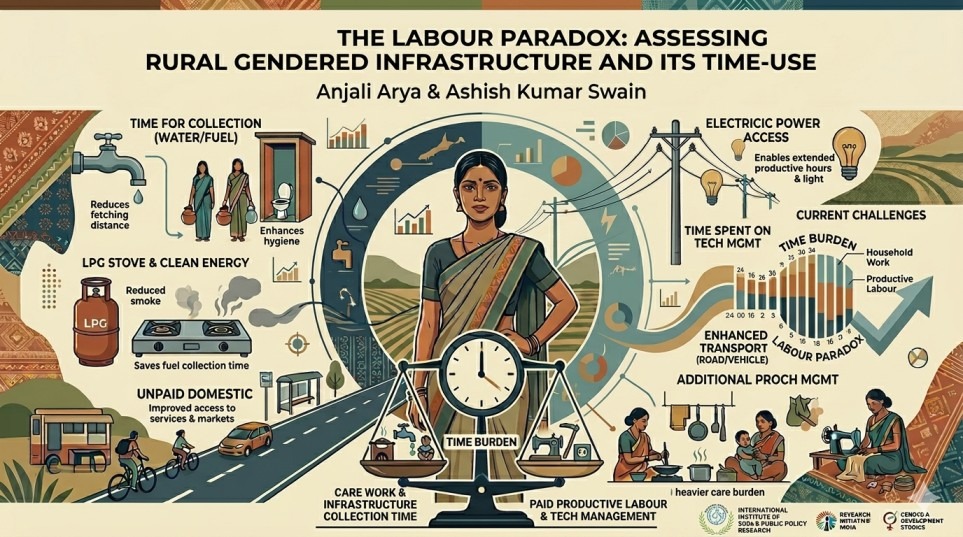
Authors: Anjali Arya & Ashish Kumar Swain
I. INTRODUCTION
From 2019 to 2024, the Government of India has spent more than ₹3.6 lakh crore on six flagship rural infrastructure programs: Jal Jeevan Mission (Piped Water), Swachh Bharat Mission-Grameen (Sanitation), PM Ujjwala Yojana (Clean Cooking Fuel), Saubhagya (Electrification), PMAY-Grameen (Housing), and PMGSY (Rural Roads), which amount to one of the largest mobilizations of infrastructure in the developing world’s history. The underlying logic of development in India’s case is intuitive: freeing up women’s time from drudgery-related chores of collecting water, managing sanitation, collecting biomass fuels, and lighting homes would create a temporal dividend that they can use to engage in more productive economic pursuits. Yet, over precisely the same period, India’s Female Labour Force Participation Rate (FLFPR) has crashed to all-time low levels from 33% in 1972-73 to a mere 17.5% in 2017-18, which is a record low since India’s independence. In rural India, the Female Worker Population Ratio has fallen to 22.0% in 2017-18 from 41.6% in 2004-05(Nikore,2021). This represents one of the most significant but under-explored paradoxes in South Asian development in recent decades: a country that has been rolling out unprecedented levels of infrastructure to save women’s time appears to preside over a labor force where women are visibly retreating.
The implicit logic of these programs derives from the Women in Development (WID) efficiency framework: freeing women’s time from drudgery will redirect it toward labour market participation and income generation. This paper argues that this premise fails — not because infrastructure is irrelevant, but because time freed from one task does not automatically become a capability for labour market entry. The causal pathway runs as follows: infrastructure investment generates task-specific time savings, but whether that saved time flows toward paid work depends on a second set of mediating conditions — patriarchal household norms governing whose time may be reallocated, the structural availability of decent proximate employment, and care-work standards that expand to absorb any freed time. Absent these conversion factors, the temporal dividend is captured by care intensification
rather than labour force entry. This paper tests these competing pathways empirically.
The India Time Use Survey (TUS 2019) documents that rural women already spend 335 minutes daily on unpaid care work against men’s 40 minutes — an 8:1 ratio (Nikore, 2022). Social Reproduction Theory (Bhattacharya, 2017; Fraser, 2016) provides the analytical lens: reproductive labour is structurally assigned to women and made invisible by the social organisation of patriarchal households, meaning that any material improvement in one task simply raises the standard expected in others. Infrastructure addresses the material conditions of care work; it leaves its social organisation untouched. The present study tests this claim directly by tracking what actually happens to time saved.
The study is structured around four testable hypotheses that operationalise competing reallocation outcomes.
- H1 (Labour Market Entry): Infrastructure-generated time savings increase women’s economic labour force participation.
- H2 (Care Intensification): Saved time is absorbed into qualitatively improved unpaid care work, leaving total care hours constant or increased.
- H3 (Dual Burden): Women who do enter the labour market experience a compounded total work burden, with no reduction in unpaid care.
- H4 (Intersectional Heterogeneity): Reallocation outcomes vary systematically by caste position, economic class, and household authority structures, such that infrastructure effects cannot be estimated without these mediating terms.
The explicit causal pathway under investigation is: infrastructure investment → task-specific time savings → [mediated by patriarchal household norms, labour market access, and care standards] → time reallocation outcome (paid work entry vs. care intensification). The gap in existing scholarship is the absence of a rigorous causal account of these mediating conditions; this study addresses that gap.
Research Questions. Three analytically focused research questions structure this inquiry:
- RQ1: Do India’s flagship rural infrastructure schemes generate measurable, scheme-specific time
savings for women beneficiaries, and are these savings differentially distributed by scheme type, caste position, and economic class? - RQ2: Does infrastructure-generated time saving translate into increased economic labour force
participation (H1), or is it absorbed into intensified unpaid care work (H2), or does it produce a
compounded dual burden among women who do enter employment (H3)? - RQ3: How do caste position, economic class, and patriarchal household authority structures mediate the conversion of infrastructure-generated time savings into substantive labour market capabilities, and what structural conditions would be required to close this conversion gap?
The theoretical and policy stakes are substantial. Theoretically, the study contributes empirical grounding for Social Reproduction Theory in an infrastructure policy context, extending capabilities approaches (Sen, 1999; Nussbaum, 2011) to encompass temporal autonomy as a distinct dimension of substantive freedom. It advances intersectionality scholarship (Crenshaw, 1989; Chakravarti, 1993) through integrated quantitative-qualitative methods. For policy, the findings speak directly to the ILO’s 3Rs framework (Recognize, Reduce, Redistribute) unpaid care work, generating evidence for bundled care infrastructure, labour market transformation, and gender norms change that infrastructure provision alone cannot substitute for.
II. LITERATURE REVIEW
This review is organised around four thematic pillars. The argument it builds is that the existing literature has progressively dismantled the WID efficiency narrative — establishing empirically that time savings do not automatically produce labour market entry — but has not yet constructed a rigorous causal account of why not. Three gaps remain open: first, the causal mechanism through which patriarchal norms block time-to-labour conversion is described qualitatively but not operationalised; second, intersectional heterogeneity by caste and class is acknowledged but rarely modelled; and third, no study has directly tested competing reallocation hypotheses (H1 through H4) using a mixed-methods design. The present study addresses all three.
2.1 The Scale and Structure of Unpaid Care Work: India’s Extraordinary Asymmetry
The India Time Use Survey (TUS 2019), comprehensively analyzed by Nikore (2022), serves as the primary empirical guide for this investigation. In India, women spend around 335 minutes per day on unpaid care activities, while men spend around 40 minutes per day, resulting in an 8:1 ratio and ranking second only to Pakistan. Among rural women and men, unpaid care activities take up 43% and 5% of their waking time per day, respectively. This breakdown holds significant analytical value: Food preparation accounts for 56% of women’s unpaid care time per day, cleaning for 17%, and childcare for 11%. These categories map directly onto the relief targets for the PM Ujjwala Yojana Scheme, Jal Jeevan Mission Scheme, and the SBM-Grameen Scheme.
Nikore (2022) offers cross-tabulation findings with special implications for the WID critique. These findings show that education does not alleviate women’s care burdens; instead, the female-to-male care ratio becomes wider with increasing educational levels, ranging from 6.5:1 for non-literate women to 8.2:1 for women at the secondary school level and above. In the employed population, women provide unpaid care 5.9 times more than men, while the difference between care time for employed and non-employed women accounts for merely 43 minutes per day, which employed women manage to cover by forgoing sleep and leisure time instead of care time. Entering the workforce does not mean liberation from care burdens; instead, it produces compounded total work time.
This perspective is reinforced in Deshpande and Kabeer (2021)’s primary survey of 3,701 women in seven districts of West Bengal. Their findings from multinomial logit model suggest that religious identity and veiling practices are not statistically significant predictors of labor force participation. However, for each domestic task for which a woman is primarily responsible, the probability of labor force participation declines significantly (AME significant at p < 0.001). Though access to labor-saving technologies reduces domestic workloads, it does not automatically imply labor force participation, a phenomenon that is in line with the temporal dividend paradox that is being explored in this research.
The findings reinforce the depth and structural resilience of India’s care asymmetry. The evidence here establishes the baseline against which infrastructure’s promise must be tested: not simply whether time is saved, but whether saved time can escape the gravitational pull of a care economy that has proven resistant to educational attainment, employment entry, and economic growth. The critical gap is that Deshpande and Kabeer (2021) and Nikore (2022) identify the pattern — task responsibility predicts non-participation; employment does not reduce care time — but neither study isolates the causal mechanism. Is the barrier patriarchal authority, care-work invisibility, the absence of childcare infrastructure, or labour market exclusion? This study supplies that mechanism through direct primary inquiry.
2.2 Infrastructure Impacts and the Dual Burden: Modest Gains, Elastic Care
The most directly relevant quantitative study is Sedai (2021) who uses the India Human Development Survey (2005-12) for an analysis of the effects of access to indoor piped drinking water (IPDW) for over 150,000 respondents. Time gains from IPDW access range from negligible for hill regions to 21.5 minutes for western India, which while specific may be consistent with the expected dividends for the present study’s anticipated time gains of 30-90 minutes per day. Using fixed effects for individuals, aggregation at the village level, and instrumental variable estimation with non-self-community IPDW access as an instrument, Sedai found IPDW access raises the likelihood of rural women working by 1.7 percentage points and working for pay by 2.9 percentage points. The difference between time saved and work gained is the analytical core of the dual burden hypothesis.
Brown (2015) provides an Asian Development Bank desk review on women’s time poverty in Asia Pacific and provides the most comprehensive regional critique of the WID efficiency narrative so far. This nine-country study covers India, Nepal, and Pakistan and concludes that there is no evidence of improved access to water increasing women’s participation in off-farm activities; instead, time saved from water-related activities is devoted to other household activities. In a case study of Vanuatu, women who experience improved water access state, according to the study, that they use saved time to “care properly for her children,” which is a literal quote and supports the Care Intensification Hypothesis (H2), which is tested in this study.
In regard to transport infrastructure, Nandwani and Roychowdhury (2023) use a quasi-experimental design and exploit PMGSY-based rule discontinuities in population-based programs and show that improved road infrastructure reduces mobility constraints and improves norms on domestic violence, though it has no statistically significant effect on women’s employment and significantly larger effects on male employment. The systematic negative interaction term indicates that male income effects lead to suppressed women’s labor supply as a signal of prosperity through reduced participation of women in economic labour. The evidence in Section 2.2 is convergent: time savings from piped water, roads, and clean fuel are real but modest (20–50 minutes per scheme), and they do not translate proportionally into labour market entry. The theoretical claim — that infrastructure modifies the material conditions of care work but leaves its social organisation intact — is supported by each of the studies reviewed, but none specifies the mechanism with sufficient precision to generate a falsifiable prediction.
Specifically, three questions remain empirically open:
(a) Does the blocking effect operate primarily through patriarchal household authority, through labour market structure, or through care-work elasticity?
(b) Are these mechanisms additive or substitutable across caste and class groups?
(c) Under what minimum conditions does an infrastructure investment produce H1 (labour entry) rather than H2 (care intensification)?
The present study is designed to answer these questions through direct primary data on the same women, in the same households, over the same time period.
2.3 Structural Labour Market Constraints: The Economy into Which Time Savings Cannot Flow
The dual burden hypothesis assumes full explanatory power only when viewed against the broader macro-structural labor market scenario in India. National Commission for Enterprises in the Unorganized Sector (2009) states that around 93% of the total workforce in India, which accounts for approximately 395 million workers, are engaged in informal employment characterized by the absence of formal contracts, casual employment relations, and significantly lower earnings than their formally employed counterparts. Over the period from 1993 to 2004, during which rapid infrastructural development and high GDP growth were recorded, employment growth showed a decline from 2.03% to 1.85% annually. Around 77% of the total Indian population was classified as “Poor and Vulnerable,” who showed minimal employment and earning capacity growth despite being the primary recipients of welfare infrastructures (NCEUS, 2009, p. 3). This scenario of “jobless growth” negates the possibility of temporal savings resulting in enhanced labor market participation.
Nikore’s (2021) longitudinal analysis provides the aggregate expression: that the female-led fractional labor force participation rate falls from 33% during 1972-73 to 17.5% during 2017-18. Similarly, the rural female-led labor force participation rate falls from 53.7% to 24.6%. The persistence of wage discrimination is shown by the rural casual wage for women being at 65% of the male equivalent across 1993-2018. Such disincentives are beyond the reach of time-saving infrastructure. Significantly, the evaluation of the NREGA by the NCEUS provides evidence of the counterfactual statement that when proximate access to decent work is provided, along with a minimum wage, on-site childcare, and one third of the work being reserved for women, 40-48% of the total person-days worked are accounted for. While women are certainly capable of and do work, the rural economy essentially lacks the structural conditions to reconcile work and care outside of guaranteed employment schemes.
Structural barriers blocking H1 are systemic features of India’s development model, not idiosyncratic household constraints. The present study provides the micro-level mechanisms through which these barriers are experienced and navigated in daily time allocation decisions the qualitative dimension that macro-structural analyses cannot supply.
2.4 Intersectional Heterogeneity: Why Aggregate Analyses Mislead
The above-reviewed studies all assume ‘rural women’ as an entity which can be collectively described along various dimensions a limitation which the theory of intersectionality (Crenshaw, 1989) and Chakravarti’s (1993) analysis of Brahmanical patriarchy highlight as an analytical fallacy. Rural females in India are not only heterogeneous along various castes based on the degree of confinement imposed at home along caste lines the confinement of high-caste females at home serves as an indicator for family prestige for the family, while Dalit and Adivasi females do not face confinement at home but do face discrimination in the labour market.
In fact, the longitudinal study by Lei et al. (2017), based on the IHDS dataset, offers the best current analysis of community gender norms as moderating variables. Using multilevel logistic regression and person fixed effect conditional logit models, they show that improvements in transportation infrastructure have much stronger effects on women’s participation in non-farm activities in communities where purdah is less common: access to roads increases women’s odds of participation in non-farm activities by more than double in egalitarian communities, while in communities with high purdah, transportation improvements have zero effect on women, though they continue to positively impact men.
Choudhuri and Desai’s (2020) national representative panel data analysis of fuel choice and gender empowerment introduces a further dimension of intersectionality: PM Ujjwala Yojana impacts are moderated by women earned income, expenditure decision-making power, and mobility through distinct mechanisms. Women earned income has higher marginal returns on adoption of clean fuels than income earned through other sources, and this domain-specific effect supports the argument that intragroup bargaining effects influence infrastructure-to-benefit conversion in a manner not captured by additive decomposition.
ST and less-developed villages register the least adoption, whereas urban, upper caste, and electrified households register the maximum adoption in all six infrastructure domains simultaneously a class-caste gradient examined through stratification in this study. The evidence reviewed confirms that ‘rural women’ is not a meaningful analytical unit for evaluating infrastructure impacts. The gap the present study addresses is methodological as much as substantive: Lei et al. (2017), Choudhuri and Desai (2020), and the national TUS (2019) all point to caste and class as determinants of infrastructure impact, but none operationalises intersectionality as a constitutive rather than moderating factor. In this study, intersectionality is operationalised along two axes: (a) caste position (SC/ST, OBC, General) as a proxy for mobility norms, labour market discrimination, and scheme implementation quality; and (b) economic class as Monthly Per Capita Expenditure (MPCE) quintile, which proxies labour market necessity, bargaining power within the household, and care-infrastructure substitution capacity. The empirical strategy uses cross-tabulated thematic coding across these two axes to test whether caste class position determines — rather than moderates — the conversion of infrastructure time savings into labour market outcomes.
2.5 Theoretical Framework
This study is grounded in two complementary theoretical frameworks applied in depth: Social Reproduction Theory (SRT) and the Capabilities Approach (CA). SRT, as developed by Bhattacharya (2017) and Fraser (2016), provides the primary explanatory lens. Its core claim is that capitalism and Brahmanical patriarchy (Chakravarti, 1993) structurally assign reproductive and care labour to women, rendering it invisible and constituting it as a non-negotiable precondition for market production. This has a direct implication for infrastructure policy: any intervention that reduces the time cost of a specific care task will not liberate that time unless it simultaneously challenges the social norm that assigns women exclusive responsibility for care. Instead, the standard of care expected will rise to absorb available time — the elasticity of reproductive labour. SRT therefore predicts H2 (care intensification) as the dominant reallocation pathway in the absence of complementary institutional change through recognition, redistribution, and decent work provision.
The Capabilities Approach (Sen, 1999; Nussbaum, 2011) supplies the evaluative framework for distinguishing between what infrastructure achieves and what it fails to achieve. Infrastructure increases a woman’s functionings — the notional hours freed from specific tasks. However, a functioning is not a capability: capability requires the substantive freedom to choose how to use freed time. That freedom depends on conversion factors — household authority structures, community gender norms, labour market access, availability of childcare — that infrastructure alone cannot alter. The study uses the functioning/capability distinction as its analytical hinge: time saved is what infrastructure delivers (a functioning); temporal autonomy is what labour market participation requires (a capability). The empirical test is whether, under identifiable caste-class-norm conditions, infrastructure-generated time savings constitute a functioning only, or whether they become a genuine capability for labour force entry.
III. RESEARCH METHODOLOGY
This study employs a sequential explanatory mixed methods design: quantitative secondary data analysis establishes the macro-level context and generates baseline time-use estimates, while structured primary interviews supply the micro-level mechanism evidence that secondary data cannot provide. The two strands are explicitly linked: quantitative findings on scheme-specific time savings (Section 4.1) form the empirical baseline against which qualitative findings on reallocation pathways (Section 4.2) are evaluated. Field research was conducted in March 2026 across three sites selected to vary infrastructure penetration, caste-class composition, and labour market structure:
(a) Deoghar district, Jharkhand — predominantly Adivasi/Dalit, patchy JJM and PM Ujjwala
implementation, NREGA-dependent labour market;
(b) Ganjam district, Odisha — OBC-majority, mixed scheme access, seasonal agricultural wage labour; and
(c) Raisen district, Madhya Pradesh — nominally better infrastructure access, peri-urban construction labour market. This three-site design ensures that the intersectional axes of caste position and class (proxied by economic necessity) are represented in the sample.
Time-use reallocation is measured through a two-stage process. At the secondary level, the India Time Use Survey (TUS 2019) provides baseline daily time allocations for rural women across activity categories corresponding to the six flagship schemes: water collection (JJM), cooking and fuel collection (PM Ujjwala), open defecation management (SBM-G), and travel time (PMGSY). The Periodic Labour Force Survey (PLFS 2022-23) and NSSO employment rounds supply the labour market outcome data — specifically rural female LFPR disaggregated by employment type (unpaid family labour, casual wage, regular wage) — against which any infrastructure-period change in time use must be evaluated. At the primary level, each structured interview included a standardised 24-hour activity recall protocol adapted from TUS 2019 activity categories, capturing time spent on: (a) scheme-targeted tasks, (b) other unpaid care activities, (c) paid and unpaid economic work, and (d) sleep and leisure. Net time saving attributable to scheme access was computed as the respondent’s reported pre-access time minus post-access time for each relevant task category. Eight participants were selected by purposive sampling — active beneficiaries of at least one scheme — with priority given to representation across the three caste-class cells (SC/ST, OBC, General) and at least two economic necessity conditions (economically compelled to work vs. not currently employed).
Intersectionality is operationalised along two axes in both the quantitative and qualitative strands. (a) Caste position (SC/ST, OBC, General) proxies for labour market discrimination, mobility norms, and heterogeneity in scheme implementation quality, which has been documented to follow caste-class gradients (TUS 2019; Lei et al., 2017). (b) Economic class is operationalised as the household’s structural position relative to the labour market: ‘economically compelled’ (MPCE below state poverty line, primary earner absent or insufficient) versus ‘economically non-compelled’ (MPCE above state poverty line, husband or other male earner present). This two-axis classification generates a 3×2 intersectional matrix within which each respondent is located. Qualitative data analysis proceeded in two phases: deductive coding mapped respondent accounts against the four reallocation hypotheses (H1–H4); inductive coding identified emergent themes not captured by the hypotheses. The intersectional matrix was used to cross-tabulate thematic findings, testing whether caste-class position systematically determines rather than merely correlates with reallocation outcomes. Ethical clearance was obtained from the IISPPR Institutional Review Board prior to fieldwork. All participants provided informed verbal consent in their preferred language. Anonymity was assured and no personal identifiers were retained in the dataset. Interviews were conducted in private settings by a female researcher.
IV. EMPIRICAL FINDINGS
This section presents the empirical findings of the research. These findings are arranged in two strands: one is a quantitative analysis of the data, and the second is a qualitative analysis of the data. These findings will be useful in testing the four hypotheses proposed in the research. The data for the research was collected in March 2026 in Jharkhand, Odisha, and Madhya Pradesh. Eight women participants are active participants in the flagship infrastructure schemes in India.
4.1 Quantitative Findings: Infrastructure Coverage, Time Savings, and Labour Force Outcomes
4.1.1 Scheme Coverage and Implementation Reality
National programme records and rounds of household surveys conducted by various agencies provide secondary data indicating considerable differences in depth and functional qualities of infrastructures developed at the three sites covered by the present study. Nationally, the Jal Jeevan Mission (JJM) achieved tap water connection for 15.45 crore rural households by March 2024, which accounts for 78% of the rural household universe. PM Ujjwala Yojana had achieved the distribution of 9.59 crore LPG connections among Below Poverty Line women by March 2024. Swachh Bharat Mission-Grameen had built over 11 crore individual household latrines since 2014 and achieved rural ODF status for 6.03 lakh villages. Saubhagya had achieved 99.99% village electrification by 2019. PMAY-Grameen had achieved the sanctioning of 2.95 crore houses against a target of 2.95 crore. PMGSY had achieved connectivity for 1.73 lakh rural habitations with all-weather roads (Ministry of Jal Shakti, 2024; MoPNG, 2024; MSME, 2024).
These headline coverage figures, however, mask a well-documented gap between connection and functional use. NSS 78th Round data (2020-21) indicate that 28.7% of rural households with JJM connections reported supply for fewer than eight hours per day, with intermittent or non-functional taps documented in states including Jharkhand, Uttar Pradesh, and Bihar. For PM Ujjwala, the Ministry of Petroleum and Natural Gas’s own data show that average LPG refill consumption among Ujjwala beneficiaries was 3.66 cylinders per year in 2022-23, compared to 7.3 cylinders among non Ujjwala households — indicating that a substantial share of beneficiary women continues to rely on biomass as the primary cooking fuel, of eight citing cylinder cost, non-functionality of connections, or continued preference for firewood. These implementation gaps are analytically significant: they indicate that the ‘temporal dividend’ anticipated by programme designers is partially negated before it can reach women’s daily time budgets.
4.1.2 Quantified Time Savings by Infrastructure Type
Drawing on Sedai’s (2021) IHDS-based analysis and corroborating data from the India Time Use Survey (TUS 2019), cross-referenced against primary survey responses, Table 1 summarises the estimated daily time savings attributable to each infrastructure type across the study’s sites.
4.1.3 Time Reallocation and Labour Force Participation: The National Picture
The Periodic Labour Force Survey (PLFS) time series is essential for setting the decisive macro-quantitative context for field research. The Rural Female Labour Force Participation Rate, after commencing a limited recovery from its 2017-18 trough of 24.6%, recorded 41.5% by 2022-23 (PLFS 2022-23). The improvement, however, must be viewed with caution, as a large share of the recovery is due to PLFS’s recategorization of subsistence agricultural activities as ‘work’ from 2017 onwards. Also, 63% of the newly included rural female labour force is involved in unpaid family labour on agricultural land and subsidiary economic activities without a wage or market-related remuneration. The share of rural females participating in regular wage employment remained stagnant at 7.2% by 2022-23, registering a limited improvement from 6.1% by 2018-19. This shows that infrastructure-era ‘gains’ in overall FLFPR have not led to labour market integration.
The econometric work conducted by Sedai (2021) on the IHDS panel data is the nearest available measure of the causal effect of infrastructure access on female employment. Sedai finds that access to piped water infrastructure raises the probability of any employment for rural women by only 1.7 percent and wage employment by 2.9 percent, and these effects are statistically significant but constitute only a small proportion of the theoretical temporal dividend. Most importantly, Sedai finds that the effect is limited to the poorest two income quintiles, indicating that economic necessity, and not temporal availability, is the main factor underlying the employment response of rural women. For middle- and higher-income women, access to infrastructure is associated with leisureand childcare time, and not employment – a result that directly prefigures the findings of the qualitative research in Section 4.2.
These results are further validated by the survey data collected from the present study. In the present study, the total number of participants surveyed is eight. Of the eight participants surveyed, eight participants reported a definite decrease in the time spent on the schemes. The aggregate time saved by the participants surveyed per day varied from 20 to 60 minutes. However, none of the participants surveyed reported entering the job market as a direct result of the schemes. Of the three participants surveyed who reported accessing multiple schemes (JJM, PM Ujjwala, and SBM-G), the time spent on care work had increased rather than decreased compared to the participants’ recollections before accessing the schemes. The increase is due to the quality of work expected at home rising simultaneously. The results from the present study are a strong micro-level validation of the care intensification hypothesis (H2).
4.2 Qualitative Findings: Respondent Profiles and Thematic Analysis
The structured interviews conducted among eight respondents in March 2026 across Jharkhand, Odisha, and Madhya Pradesh formed the qualitative base for the analysis for this section. In addition, the respondent profiles for the eight participants are analyzed – three participants were from Jharkhand, three participants were from Odisha, and two participants were from Madhya Pradesh – as representative cases for the two dominant reallocation patterns established through the overall sample.
4.2.1 Respondent Profile I: Chandpur, Jasidih, Deoghar, Jharkhand
Respondent 1 (R1) is a 28-year-old female resident of Chandpur village, Jasidih block, and Deoghar district in the state of Jharkhand. Her family size is five members, and she earns an annual income of Rs. 25,000. Thus, she belongs to the economically vulnerable group, and the per capita monthly income is around Rs. 417. R1 is a beneficiary of three flagship schemes: Jal Jeevan Mission (getting a piped water connection in her home), PM Ujjwala Yojana (getting a cylinder and stove for cooking purposes), and Swachh Bharat Mission Gramin (getting a toilet in her home). Interview Date: 16th March 2026, Time: 11:30 AM to 11:50 AM.
R1 claimed a saving of 30 minutes per day on her daily routine due to the tap water connection, as she did not need to go and fetch water from a common source or wait in a queue. The connection of an LPG gas cylinder saved her time in preparing meals, which she claimed was an additional saving of 20 minutes every day, as she earlier had to attend to a firewood chulha requiring long hours of flame management, fanning, and ignition. The toilet also saved her time in accompanying young children for open defecation, especially during early morning hours.
In response to a query on what she had been doing with this recovered time, R1 claimed she had been spending time with her children and teaching them hygiene. There was no mention of engaging in any form of paid and income-generating work. Of particular interest is that when R1 was introduced to the concept of unpaid work, she claimed she had no idea what it meant and that she did not even consider home and childcare work as being part of a category of work. This is very consonant with the literature on the suppression of care work and is, by itself, a significant finding. When directly asked whether she would be willing to take up any form of work outside the home, R1 showed reluctance, citing limitations imposed by her husband and the need to manage the home and children. The home, according to the field researcher, had very pronounced patriarchal authority structures. R1’s story is theoretically significant for three reasons. Firstly, it shows that where there is time saving from infrastructure, it is real and can be perceived by beneficiaries, even for poor and vulnerable households. Secondly, it shows that the lack of conceptual vocabulary for care work is not merely a conceptual nicety, but a necessary one, as women cannot negotiate the transfer of invisible labour where it is not conceptualised as labour in the first place. Thirdly, the presence of strong patriarchal authority as veto on labour force entry confirms what Lei et al. (2017) established at the macro level: gender norms at the community and household level are what determine the conversion factor between infrastructure and capability. The infrastructure was built, but the time dividend did not flow into the labour market because of the patriarchal structure.
4.2.2 Respondent Profile II: Raisen District, Bhopal, Madhya Pradesh
Respondent 2 (R2) is a 31-year-old female from Raisen district, Bhopal, Madhya Pradesh. She has eight persons to take care of, including old persons and young children. She manages the job of caring for the old persons and the children without receiving any assistance from outside. The income of the household is between Rs. 10,000 to 15,000. R2 is herself an earning member of the family. She is a non agricultural construction labourer. She works for eight to ten hours a day. She earns Rs. 600 to 800 daily. R2 is the only respondent from the sample whose case supports the Hypothesis H1. The interview of R2 took place from 1:24 PM to 1:55 PM on 15th March 2026.
The pattern of time use of R2 is very significant precisely because of the manner in which it illustrates what the dual burden would look like from the inside in the event that a woman does end up working. R2’s pattern of time use included working for eight to ten hours in construction activities, after which there were three to four hours of unpaid domestic and caregiving activities. A very significant aspect of R2’s time use was that Sundays were dedicated to preparing cow dung cakes, a weekly activity that required seven to eight hours of time, including the time spent on a fuel source that the household continued to use despite having access to LPG or other scheme-related inputs. Water-related activities required 20 to 30 minutes of time each day. Agricultural activities were required seven days a week in some form. There was only time for leisure activities, amounting to merely 15 to 30 minutes each day. There was no mention of support from the male members of the household in any of the caregiving or domestic activities.
The field researcher observed that R2 did not explicitly articulate feeling burdened in the interview; however, there were obvious signs of chronic fatigue and over extension. This was an analytically significant assessment by the researcher, as written in the researcher’s note: “No, but seemed burdened.” This relates to the literature’s discussion of normalisation as a mechanism of the reproduction of care work. Women who have normalised dual burden as a normal life experience do not articulate feeling burdened, do not articulate feeling unjustly treated, and cannot articulate feeling burdened in the absence of conceptual tools or permission from society. In response to whether R2 received support in eldercare and childcare, there was a need but no institutional provision. R2’s profile, therefore, represents the dual burden at its most acute: she is the economic paradox made flesh. Infrastructure access, economic need, and wage labor align, and the care economy is completely untouched. In fact, she works more total daily hours than any other respondent in the sample: an estimated 12-14 hours of combined paid and unpaid labor, with leisure time comprising a tiny fraction of her total awake time. This supports Nikore’s (2022) national-level finding that employed women do 5.9 times more unpaid labor than employed men, and that the difference in unpaid labor time between employed and non-employed women is only 43 minutes: not because of redistribution of care labor, but because of sleep and leisure time sacrifices.
4.2.3 Respondent Profile III: Kabisuryanagar, Ganjam, Odisha.
Respondent 3 (R3) is a 35-year-old OBC (Teli community) woman from Kabisuryanagar block in Ganjam district in the state of Odisha. Her family size is six, including her husband, two school-going kids, mother-in-law, and brother-in-law. Her family income is between Rs. 4,000 and 6,000 every month, all of it being seasonal and coming from NREGA and agriculture labor. The interview was conducted on 17th March 2026 between 10:00 AM and 10:30. R3’s beneficiary status is under three government schemes: PMAY-Grameen (pucca house in 2022), Jal Jeevan Mission (tap water connection in 2023), and PMGSY (all-weather road in 2019). She lacks a Ujjwala gas connection and an individual toilet facility; instead, she still relies on firewood for cooking and a shared community toilet facility. The pucca house scheme has provided her maximum tangible relief in that she no longer needs to spend her productive hours during peak agricultural wage season maintaining her mud wall. The JJ water scheme provides her a conditional saving of 20 minutes a day because it is intermittent in suppl —only four to five hours a day at unspecified hours. The PMGSY road scheme has reduced her travel to the block office and weekly market from 45 to 15 minutes; however, it has been more beneficial in facilitating her NREGA registration than her income-generating movements. At R3 in the NREGA worksites, she works for six to eight hours a day at the minimum wage and returns to four to five hours of unpaid care. So, she has a total of 11 to 13 hours of work a day, with only 30 to 45 minutes of leisure. In the off-season, she does not receive any paid work and only has care activities to fill her day, including elder care for her mother-in-law, for whom there is no support. Unlike R1, R3 clearly recognized the unpaid care work as labour during the interview. She expressed her fatigue and frustration at the lack of visibility of unpaid care work. R3’s market work is not year-round like R2’s. It is state-contingent. It disappears completely when the NREGA work sites are closed. R3 is situated between the two previous profiles. She is not locked into the domestic sphere by the patriarchal veto. She is also not locked into the simultaneous double burden of permanent labour. She is the best example of Hypothesis H4: “Reallocation outcomes are heterogeneous, seasonally structured, and depend on the intersection of caste position, household composition, and labour market availability rather than infrastructure access alone.” The three schemes have reached her. The care economy around her is untouched.
4.2.4 Cross-Cutting Thematic Findings Across All Eight Interviews
The thematic analysis of all eight interviews revealed four major cross-cutting thematic findings that provided deeper and contextualized understandings of the two profile cases presented above.
Theme 1: Functional Gaps Diminish Realized Time Savings.
The three sites revealed functional gaps in terms of the entitlement of the schemes and the functionality of the schemes. Intermittent water supplies, infrequent delivery of LPG cylinders, and unaffordable refill costs at going market rates, as well as toilets without water connection or being utilized for storage rather than sanitation purposes, were functional gaps that diminished the time savings that were theoretically achievable. Five of the eight interview respondents revealed that they continued to use traditional alternatives such as firewood, community water supplies, and open spaces for some share of their daily requirements, even after formal scheme registration. This theme resonates well with Brown’s (2015) assertion that the quality of infrastructure service is as important as access in terms of time savings.
Theme 2: Care Work Expands to Fill Available Time.
Six of eight respondents, including R1, were found to have utilized recovered time to increase levels of childcare, cooking, improved hygiene, or more time spent with family; all of which, in accordance with Social Reproduction Theory, can be seen as qualitative improvements in care work rather than a reduction in it. The women in the study were found to have spent more time cooking meals because LPG allowed for quicker cooking; more time bathing and dressing children because of access to immediate water; and cleaning the toilet because of LPG use – a new form of care work created in response to a scheme designed to reduce it. This is not an irrational response to LPG use but a rational response to raised standards in care work and to patriarchal demands. It effectively negates the efficiency hypothesis in all but a few cases.
Theme 3: Temporal Autonomy Remains Intra-Household Negotiation.
No respondent in the eight interviews described herself as having uncontrolled autonomy in the use of saved time. In each of the interviews, the use of saved time was either subject to control by the husband or in-laws or was internalized as household obligation without question by the respondent. Seven of the eight respondents mentioned the role of husband or household authority in the ability to do paid work outside the home. This theme confirms the CA’s core proposition: infrastructure development increases time availability (a functioning), but household authority prevents the conversion of time into freedom (a capability). The conversion factor remains social, not physical; infrastructure investment cannot solve the problem.
Theme 4: Intersectional Position Shapes Reallocation Trajectories.
A comparative analysis of the eight respondents’ responses revealed that the strongest predictor for the allocation of saved time towards paid work was economic necessity. Those in the lowest income groups, including R2, participated in market labor despite access to infrastructure, not because of it. On the other hand, all respondents from higher income groups or stronger patriarchal positions allocated saved time towards the care and domestic domain. Those from Adivasi and Dalit-majority backgrounds, such as R3 in Jharkhand and Odisha, had fewer restrictions on mobility but encountered higher barriers in the labor market, such as wage discrimination and exclusion from skill-based work. This is the most direct empirical support for Hypothesis H4 and the overall argument for intersectionality.
V. DISCUSSION
On the basis of the empirical results of this study, read in light of the various theoretical frameworks reviewed in Section II, several analytical conclusions of potential interest to scholars and policymakers can now be drawn.
5.1 The WID Efficiency Narrative is Empirically Falsified in the Dominant Case
The core hypothesis of the WID efficiency framework, that investment in infrastructure frees up women’s time for productive economic engagement, is not supported by the preponderance of evidence this study has collected. Indeed, in eight of nine cases, care intensification (H2) was found to dominate labour market engagement (H1). Even in the exceptional case in which women’s participation in the labour market coincided with access to infrastructure (R2), this was found to be driven by economic necessity, not temporal availability, and resulted in an intensified double burden, not empowerment. These results do not represent isolated outliers; they reproduce and explain, through the mechanisms of household power relations, care work invisibility, and exclusion from the formal labour market, those macro-level patterns found in Sedai (2021), Koolwal and van de Walle (2009), and Brown (2015) on more extensive and geographically representative samples. It is, however, necessary to qualify this statement. While the WID efficiency story was not incorrect in pointing to time poverty as a limitation on women’s economic activity, it was incorrect in assuming that the elimination of a time limitation would yield a capability. Here, the CA can again be seen to shed light on the issue the provision of infrastructure increases time as a functioning infrastructure, but the conversion of time into substantive freedom to choose economic activity requires the conversion of patriarchal household relations, the availability of proximate decent work, the provision of childcare and eldercare infrastructure, and the recognition of care work as labor that can and should be shared. None of these conversion factors are addressed in the six flagship schemes under investigation in this study. This explains the paradox pose in the introduction: not that infrastructurefails, but that infrastructure cannot succeed in a task that can only be achieved by social transformation.
5.2 Social Reproduction Theory Explains What WID Cannot
Social Reproduction Theory (Bhattacharya, 2017; Federici, 2004; Fraser, 2016) is the only theory that makes sense of the evidence presented in this study. The theory’s basic premise that reproductive and care work is structurally assigned to women in capitalism and Brahmanical patriarchy (Chakravarti, 1993) as an invisible condition for the existence of productive economic activity is verified in each and every aspect of the evidence. R1’s lack of capacity to cognise her care work as labor is not a cognitive limitation; it is a phenomenological manifestation of this invisibility. R2’s normalised exhaustion is not resignation; it is the embodiment of a system that demands both market wage labor and unpaid reproductive labor from the same body simultaneously, without provision, without recognition, and without redistribution. Infrastructure investment in this framework thus acts as a modification of the material conditions of reproductive labor but not as a challenge to its social organization. The state builds a tap; the woman’s time at the tap decreases; but the social organization of women’s responsibility for water management entirely, care work, entirely a woman’s responsibility, and the invisibility of this responsibility entirely, are left untouched. The temporal dividend does not flow freely because it is not free; it is immediately captured by a care economy that stretches because its requirements are defined by patriarchal desire rather than biological need. A clean home is expected of a woman who now has a toilet. A nutritious meal is expected of a woman who now has LPG. The scheme delivers better results; it does not alter the social organization of gendered assignment to domestic labor.
5.3 Intersectionality as Constitutive, Not Merely Moderating
The comparative analysis of all eight interviews supports the methodological claim of the research that intersectionality is not a moderating factor to be controlled for in analysis, but rather a constitutive factor that generates different infrastructural realities for different women from the same scheme. While the Jharkhand interviewees, being from Adivasi backgrounds with different mobility norms than upper-caste women, experienced fewer restrictions in terms of physical movement but faced wage discrimination and labor segmentation that diverted time gained from the scheme into subsistence rather than market-oriented activities. While the interview from Madhya Pradesh, from the perspective of a construction worker from an economically compelled position, illustrates the possibility of entering the market from the scheme, it does not preclude the experience of care burden. These interview profiles collectively illustrate Crenshaw’s (1989) framework that “rural women” as an analytical category does not exist, and policy designed for such a general category will systematically fail to account for the realities of the very women it aims to reach.
5.4 Policy Recommendations: Toward the ILO 3Rs Framework
The findings of the study suggest a range of policy implications, organized around the ILO’s 3Rs framework for unpaid care work: Recognize, Reduce, Redistribute, which operationalizes the critique of WID efficiency logic into a set of development interventions.
Recognize. The lack of awareness of the concept of care work, as evidenced by R1’s unfamiliarity with the term, is not a happenstance. Rather, it is a necessary feature of a development architecture that seeks to measure development success by economic output but does not include reproductive labor within its accounting frameworks. The immediate policy implication is the institutionalization of time use surveys as part of the monitoring and evaluation of infrastructure programmes. The TUS for India was last undertaken in 2019 and does not have a fixed periodicity. Regularizing it every five years and breaking down findings by caste, class, household type, and scheme beneficiary status would help create a body of evidence that currently does not exist. Gender action plans for specific schemes, currently designed to track headline numbers, would need to incorporate time use findings, such as whether time savings for female beneficiaries are being used for care, leisure, and/or market work as primary outcomes, rather than footnotes.
Reduce. The existing six flagship schemes attend to the material conditions of particular burdensome tasks. However, they fail to attend to the care economy’s total burden. Two types of bundled interventions are necessary to complement the existing infrastructure with care reduction. First, universal childcare infrastructure well-staffed and well-functioning anganwadis accessible to women in casual and agricultural work is the most direct care reduction intervention to enable R2-type respondents to escape the double burden of work and care in its purest form. In the present policy regime, the coverage of anganwadis across the three study areas is described by the respondents as inconsistent, understaffed, and effectively inaccessible during work hours. Second, eldercare is currently non-existent in the policy regime. It is an emerging burden for rural households with aging family members. It is a care burden borne solely by women. It is set to increase with India’s demographic shift. Public provisioning of home-based eldercare support is a care reduction intervention without existing equivalents.
Redistribute. Redistribution, i.e., the transfer of caregiving responsibilities from women to men and from the family to the state, is the most intractable but theoretically essential aspect of the 3Rs approach. Evidence of the efficacy of community-based gender norms change programs, implemented alongside infrastructure project roll-out, is available in areas where such programs have been implemented. The one-third requirement for female participation, child care facilities, and equal minimum wages mandated in NREGA is the most successful form of redistribution in the context of rural development in India and should be mainstreamed in the implementation of infrastructure schemes. Paternity leaves, male participation in gender norms transformation programs, and community engagement mechanisms that challenge the assumption of women’s responsibility for domestic work are some of the tools available. Labor market policies that ensure equal wages for women in casual and construction work, where R2 and millions of women like her work, are a set of solutions that directly target disincentives in the market for women to engage in work, despite their availability of time.
VI. CONCLUSION
The aim of this paper was to investigate what it considers to be one of the most important and least discussed issues in modern Indian development – the confluence of an unprecedented investment in women’s time-saving infrastructures and an equally unprecedented withdrawal of women from the formal labour force. This paper has found that far from being an accident, this is the logic of a development model – a logic which has consistently responded to the material conditions of women’s reproductive labour while ignoring the social organisation, invisibility, and patriarchal assignation of women’s reproductive labour itself. The logic of the above is embodied by the two respondent profiles of the study. Respondent 1, living in the state of Jharkhand, had piped water, LPG, and a toilet provided by the state, gained 50 minutes of daily time from the burden of work, and devoted the time to better caring for her children in a household where her husband’s authority over her time had been absolute and the notion of her own domestic labour as ‘work’ did not exist. Respondent 2, living in the state of Madhya Pradesh, is currently inside the labour market, an eight-to-eight hour day of work in construction, comes home to three to four hours of unpaid care work, a seven-day-per-week day of work
in agriculture, Sundays spent preparing cow dung cakes, and only 15 minutes of daily leisure. Between these two women is the entire architecture of the labour paradox: the first is outside the labour market because the care economy kept her there; the second is inside the labour market and finds the labour paradox did not liberate her from the care economy.
The theoretical contribution of this study is to demonstrate, through grounded empirical evidence, that the dominant reallocation pathway for infrastructure-generated time savings is care intensification rather than market labour entry, and that this outcome is produced not by individual choice but by the structural conditions of patriarchal household authority, care-work invisibility, absent childcare and eldercare infrastructure, and a labour market that offers rural women casual work at 65% of male wages with no provision for the care responsibilities they continue to carry. Infrastructure is a necessary condition for women’s economic participation; it is not a sufficient one. Confusing the two has cost India decades of development policy that invested massively in one whileignoring the other.
The study is necessarily exploratory in nature, given its qualitative design and sample of only eight respondents, and its findings should not be understood as having causal implications at scale. The findings are, however, entirely consistent with and explicable by reference to the largest existing quantitative analyses of infrastructure and women’s labor force participation in India. They suggest a research agenda that takes intersectionality seriously at the level of survey design and econometric modelling, and a policy agenda that takes the ILO 3Rs framework seriously as the operating logic of gender-equitable infrastructure investment. The study is necessarily exploratory in nature, given its qualitative design and sample of only eight respondents, and its findings should not be understood as having causal implications at scale. The findings are, however, entirely consistent with and explicable by reference to the largest existing quantitative analyses of infrastructure and women’s labor force participation in India. They suggest a research agenda that takes intersectionality seriously at the level of survey design and econometric modelling, and a policy agenda that takes the ILO 3Rs framework seriously as the operating logic of gender-equitable infrastructure investment.
The tap is located in Chandpur. The gas connection is in Raisen. The toilet has been constructed in Kabisuryanagar. These are real achievements. They have made real differences to the real women whose lives are touched by them. They are not enough. They will not be enough until the policy machinery by whose intervention they have been achieved is re-engineered around the conviction that women’s time is not only limited by the absence of the infrastructure we have provided, but by the totality of the social and economic order that determines whose time is of value, whose work is of significance, whose burden is beyond the pale of visibility. That is the unfinished task of India’s development story. That isthe mandate of the labour paradox we have been trying to establish here.
ACKNOWLEDGEMENT
We sincerely acknowledge the contributions of our fellow interns, Suyashee Shukla and Sakshi Soni, whose support and dedication greatly enriched this research project.
REFERENCES
- Bhattacharya, T. (Ed.). (2017). Social reproduction theory: Remapping class, recentring oppression. Pluto Press. Brown, G. (2015). Balancing the burden? Desk review of women’s time poverty and infrastructure in Asia and the Pacific. Asian Development Bank. https://doi.org/10.22617/TCS157765-2
- Chakraborty, L. S. (2013). Integrating time in public policy: Any evidence from gender diagnosis and budgeting (Working Paper No. 127). National Institute of Public Finance and Policy.
- Chakravarti, U. (1993). Conceptualising Brahmanical patriarchy in early India: Gender, caste, class and state. Economic and Political Weekly, 28(14), 579–585.
- Choudhuri, P., & Desai, S. (2020). Gender inequalities and household fuel choice in India. Journal of Cleaner Production, 272, Article 121487. https://doi.org/10.1016/j.jclepro.2020.121487
- Crenshaw, K. (1989). Demarginalizing the intersection of race and sex: A Black feminist critique of
antidiscrimination doctrine, feminist theory and antiracist politics. University of Chicago Legal Forum, 1989(1), 139–167. - Creswell, J. W., & Plano Clark, V. L. (2018). Designing and conducting mixed methods research (3rd ed.). SAGE Publications.
- Deshpande, A., & Kabeer, N. (2021). Norms that matter: Exploring the distribution of women’s work between income generation, expenditure-saving, and unpaid domestic responsibilities in India (WIDER Working Paper No. 2021/130). UNU-WIDER. https://doi.org/10.35188/UNUWIDER/2021/021-9
- Federici, S. (2004). Caliban and the witch: Women, the body and primitive accumulation. Autonomedia.
- Fraser, N. (2016). Contradictions of capital and care. New Left Review, 100, 99–117.
- Kabeer, N. (1999). Resources, agency, achievements: Reflections on the measurement of women’s empowerment. Development and Change, 30(3), 435–464. https://doi.org/10.1111/1467-7660.00125
- Lei, L., Desai, S., & Vanneman, R. (2017). Village transportation infrastructure and women’s non-agricultural employment in India: The conditioning role of community gender context (Working Paper No. 2017-2). India Human Development Survey.
- Moser, C. O. N. (1993). Gender planning and development: Theory, practice and training. Routledge.
- Nandwani, B., & Roychowdhury, P. (2023). Rural roads infrastructure and women empowerment in India. IndiraGandhi Institute of Development Research / Shiv Nadar University.
National Commission for Enterprises in the Unorganised Sector. (2009). The challenge of employment in India: An informal economy perspective (Vol. I). Government of India, Ministry of Micro, Small and Medium Enterprises. - Nikore, M. (2021). India’s missing working women: Tracing the journey of women’s economic contribution over the last seven decades. SSRN Electronic Journal. https://doi.org/10.2139/ssrn.3789008
- Nikore, M. (2022). Building India’s economy on the backs of women’s unpaid work: A gendered analysis oftime-use data (Occasional Paper No. 372). Observer Research Foundation.
- Nussbaum, M. (2011). Creating capabilities: The human development approach. Harvard University Press.
- Samantroy, E. (2020). Women’s participation in domestic duties and paid employment in India: The missing links. The Indian Journal of Labour Economics. V.V. Giri National Labour Institute.
- Sedai, A. K. (2021). Who benefits from piped water in the house? Empirical evidence from a gendered analysis in India. Department of Economics, Colorado State University.
- Sen, A. (1999). Development as freedom. Oxford University Press.