

Authors:
Kovilakam Arsha Sri, Nisha Chaudhary, Akansha Dixit, Ahmed Shakir.
Abstract
The persistent pendency of cases and delays in the administration of justice remain significant challenges. Despite the constitutional guarantee of speedy justice and a fair trial under Article 21, judicial pendency remains a challenge to speedy adjudication of cases and its disposal. Fast track courts in India were established to address this concern.
This study examines the effectiveness of FTCs in India, focusing on judicial vacancies, shortages of support staff, lack of infrastructure, case management, and inter-agency coordination. It adopts mixed method approach, review of existing literature, survey responses from 36 respondents including qualitative analysis of 24 field submissions. Furthermore, examines secondary data from government publications, parliamentary records, National Judicial Data Grid and Scholarly articles.
The findings reveal that the effectiveness of Fast Track Courts (FTCs) remains uneven. The primary data indicate that 52.8% of respondents identified staff shortages as a significant administrative barrier, while 80.6% acknowledged improvements in judicial efficiency resulting from the adoption of technology. Conversely, frequent adjournments, inadequate infrastructure, insufficient administrative support, and delays in police investigations and forensic processes continue to hinder the timely adjudication of cases.
The study highlights the interrelated factors that contribute to the effectiveness of Fast Track Courts. It concludes that meaningful improvement requires dedicated judicial personnel, technological integration, adequate funding for infrastructure development, and stronger collaboration among criminal justice institutions. Ultimately, effectiveness should be measured not merely by the speed of case disposal, but by the ability of the authorities to deliver justice in a timely, accessible, and effective manner.
CHAPTER-1 INTRODUCTION
“Justice delayed is Justice denied” remains a fundamental principle underlying the pursuit of Speedy justice in the Indian judiciary. Yet, the reality of Indian judicial system grapple with persistent challenges involving case pendency, prolonged trials and procedural delays. The contrast between the ideals of speedy justice and the reality of delayed adjudication highlighted the need for effective mechanisms and an institution capable of expeditious disposal of cases.
The scale of this challenge is reflected in the pendency figures across the Indian Judiciary. As of 31 December 2025, total pending litigation across all tiers of the Indian court system stood at 5.41 crore (54,115,452) cases, with District and Subordinate Courts accounting for 4.76 crore cases, or 88.07% of the national total. This persistent backlog has prompted institutional interventions aimed at expediting judicial proceedings. As a result, the Eleventh Finance Commission recommended introducing Fast Track Courts (FTCs) in 2000 to accelerate the disposal of selected categories of cases. Subsequently, Centrally Sponsored Fast Track Special Courts (FTSCs) were introduced in 2019 for cases involving rape and offences under the Protection of Children from Sexual Offences (POCSO) Act. As of December 2025, India had 880 General FTCs and 774 FTSCs across various States. However, mere establishment of Fast Track courts do not establish its effectiveness. Henceforth, it raises a fundamental question – To what extent Fast Track courts in India achieved its aims and objective of expeditious disposal, while ensuring fair and effective administration of justice.
1.1 Importance of the Topic
Understanding the administrative determinants of delay in Fast Track Courts has significant legal, social and policy implications. The right to a speedy trial is an established constitutional principle, yet designating a court as ‘fast-track’ does not automatically provide the institutional capacity required for timely adjudication. The literature indicates that specialised courts may continue to operate within the administrative constraints of the wider subordinate judiciary, including staffing shortages, procedural delays, inadequate infrastructure and weak coordination with external agencies. For cases involving sexual offences and other serious crimes, prolonged proceedings can further burden victims and weaken confidence in the justice system. From a policy perspective, understanding these constraints is also important because public investment in specialised courts can produce limited gains if institutional capacity does not match the objectives of the scheme.
1.2 Existing Literature in Brief
Prior scholarship on judicial delay broadly focuses on four themes: (1) institutional scheme designs; (2) judicial officer and administrative vacancies; (3) infrastructure and e-Courts technology; and (4) inter-agency dependencies involving police investigations, forensic science laboratory (FSL) reports, and witness availability.
1.3 Research Problem Statement
The research problem concerns the gap between the fast-track mandate of specialised courts and the administrative capacity available to implement that mandate. Existing literature suggests that Fast Track Courts may operate within the same institutional environment as the wider subordinate judiciary, while facing additional demands for accelerated disposal. The central problem examined in this study is whether deficiencies in staffing, case management, digital integration and inter-agency coordination collectively constrain trial continuity in Fast Track Courts
1.4 Research Questions and Objectives
Research Questions
RQ1: To what extent do vacancies among judicial officers and support staff affect the continuity and administrative functioning of Fast Track Special Courts in India?
RQ2: How can institutional accountability and effective human-resource management improve the administrative functioning of Fast Track Special Courts?
Research Objectives:
- The study seeks to measure the extent of judicial officer and support-staff vacancies in specialised Fast Track Courts in comparison with relevant subordinate-court benchmarks and to evaluate stakeholder assessments of major operational barriers, procedural adjournments, resource sufficiency, and the use of digital technology.
- It further examines the field-level implications of additional-charge judicial appointments and inter-agency bottlenecks involving police and forensic institutions.
- To analyse the administrative implications of additional-charge appointments of judicial officers on the continuity of proceedings in Fast Track Special Courts.
- To identify institutional and administrative measures for improving human-resource availability and ensuring continuity in the functioning of Fast Track Special Courts.
1.5 Significance of the Study
This study contributes to judicial administration research by examining Fast Track Courts through an integrated administrative perspective. Rather than treating judicial vacancies, support staffing, technology, procedural management and inter-agency coordination as isolated variables, it examines their interaction within the functioning of specialised courts.
The study also has practical relevance for the Ministry of Law and Justice, Department of Justice, High Court administrative committees and State judicial academies. Its findings can inform reforms relating to dedicated judicial and support staffing, case-management systems, inter-agency coordination and the effective integration of digital technologies into court administration.
CHAPTER -2 LITERATURE REVIEW
Fast Track Courts (FTCs) were introduced in India as an institutional response to persistent judicial delay and case pendency. Their purpose was to prioritise selected categories of cases and enable their disposal within a shorter period. However, the literature suggests that the designation of a court as “fast track” does not by itself create the administrative conditions necessary for faster adjudication. A major empirical evaluation undertaken by the Centre for Criminology and Victimology, National Law University Delhi, for the Department of Justice examined FTCs in Delhi, Maharashtra, Tamil Nadu, Uttar Pradesh and West Bengal. The study used interviews and questionnaires with court registries, judges, advocates and litigants and examined approximately 650 cases. It identified weaknesses in the institutional and administrative arrangements surrounding FTCs (Department of Justice & National Law University Delhi, 2019). The later Fast Track Special Courts (FTSCs) scheme for rape and POCSO cases similarly demonstrates that speedy adjudication depends on more than the creation of specialized courts. Government evaluations have highlighted the need for experienced judges, trained personnel, improved courtroom technology, stronger forensic capacity and facilities for vulnerable witnesses (Indian Institute of Public Administration [IIPA], 2023). Taken together, the literature can be organized into four interconnected themes: (1) institutional design and administrative structure, (2) judicial and human-resource constraints, (3) infrastructure, funding and case management, and (4) coordination with police, prosecution, forensic laboratories and other agencies. While these themes are individually discussed in existing scholarship, there is considerably less research examining how they interact within the day-to-day functioning of Fast Track Courts.
2.1 Theme I: Institutional Design and Administrative Structure
Fast Track Courts emerged primarily as a policy and administrative response to judicial delay rather than as a permanently established and uniformly structured tier of courts. The concept of FTCs in India does not emerge from any statutory provision and there is no single law which expressly mentions about fast-track courts and its functioning. The functioning of fast-track courts can be traced back to early 2000s with their genesis lying in the recommendation of the 11th Finance Commission, which resulted in establishment of approximately 1734 ad-hoc courts to clear the back logs and as well to relieve the burden of regular courts. The FTCs had scaled after the public outrage followed by Nirbhaya Rape case which led the Delhi High court and other states to set up proper specialized courts or Mahila courts to handle the matters involving sexual offences against women. Later the Criminal law (Amendment) Act of 2018 took place, the central government launched a scheme in 2019 to establish Fast Track Special Courts specially for POCSO Act offences i.e the sexually offences against minor.
Their establishment and functioning have therefore depended significantly on the arrangements made by State Governments and the respective High Courts. The National Law University Delhi evaluation notes that FTCs were being established by State Governments in consultation with High Courts and that the institutional framework lacked sufficient established guidelines.
This institutional arrangement becomes important because the wider Indian judicial system itself has historically been characterized by fragmented administrative responsibilities and uneven availability of court-performance information. Krishnaswamy, Sivakumar and Bail (2014) argue for a more systemic and empirical approach to judicial reform, suggesting that fragmented institutional structures make it difficult to evaluate how reforms operate in practice. Ghosh (2018) similarly situates fast-track mechanisms within India’s broader pattern of piecemeal responses to delay rather than comprehensive restructuring of court administration.
Peterson (2016), examining fast-track mechanisms for sexual-assault cases, raises a related concern: the designation or conversion of existing courts may create a “fast-track” label without necessarily creating a separate administrative structure. This distinction is important because prioritising cases is different from establishing a court with dedicated personnel, infrastructure, case-management systems and administrative capacity.
Bajpai (2022) and the National Law University Delhi evaluation (Department of Justice & National Law University Delhi, [2019]) provide more direct evidence. The evaluation examined FTC functioning across five States/UTs and collected information from multiple actors within the court system rather than relying solely on doctrinal analysis. This is significant because it shifts the discussion from whether FTCs were created to how they actually functioned administratively.
The implementation of Fast Track Courts across India reflects considerable variation among States. According to the data published by the Ministry of Law and Justice states that against initiative of 1,800 courts only 863 were reported as functional as of 31 October 2024, accounting for approximately 47.9% of the stated target (Ministry of Law & Justice, 2024). The differences are evident from comparative analysis of individual States.
Table 1: Status of Fast Track Court Implementation across States/UTs as of 31 October 2024
|
State/UT |
FTCs envisaged |
FTCs functional |
Implementation (%) |
|
Andhra Pradesh |
47 |
21 |
44.7 |
|
Assam |
36 |
15 |
41.7 |
|
Bihar |
147 |
0 |
0 |
|
Chhattisgarh |
28 |
27 |
96.4 |
|
Delhi |
63 |
26 |
41.3 |
|
Gujarat |
174 |
54 |
31 |
|
Haryana |
48 |
6 |
12.5 |
|
Jharkhand |
50 |
41 |
82 |
|
Maharashtra |
203 |
101 |
49.8 |
|
Rajasthan |
93 |
0 |
0 |
|
Tamil Nadu |
87 |
72 |
82.8 |
|
Uttar Pradesh |
212 |
373 |
176 |
|
West Bengal |
94 |
88 |
93.6 |
|
Total (all States/UTs) |
1800 |
863 |
47.9 |
Conclusively, this report highlights the importance of examining the administrative and financial arrangements through which Fast Track Courts are established and maintained. However, the numbers of operational courts should not be treated as evidence to judicial effectiveness. In Assessing the effectiveness of FTCs it would require additional evidence concerning disposal rates, the age and volume of pending cases, judicial vacancies and the considerable time taken to complete proceedings till its disposal. The figures clearly indicate uneven institutional implementation, while leaving the scope of investigation to ascertain the relationship between implementation and actual adjudication.
The limitation of this literature is therefore not the absence of discussion about institutional design, but the limited availability of comparable, court-level evidence on how individual FTCs are organized, staffed, administered and monitored. Much of the broader literature identifies systemic weaknesses without showing precisely how those weaknesses operate within individual Fast Track Courts.
2.2 Theme II: Judicial and Human-Resource Constraints
Among the four themes, the relationship between judicial resources and delay is supported by relatively stronger empirical evidence. Micevska and Hazra (2004), examining congestion in Indian lower courts, show the importance of judicial strength in explaining variations in court congestion. Gupta and Bolia (2023) similarly demonstrate through modelling that redistribution of judicial resources can improve judicial performance.
The importance of human resources extends beyond the number of judges. Singh and Thakur (2019) identify judicial vacancies, recruitment delays and administrative weaknesses as persistent causes of delay in India. Rehn et al. (2010) also emphasise the importance of institutional and administrative reforms rather than treating judicial delay solely as a problem of individual judges. Tiwari (2021) further questions the tendency to frame delay primarily around judicial vacancies and adjournments, arguing that deeper problems in court administration and case handling also require attention.
For Fast Track Courts, this literature has an important implication. A court cannot function faster merely because particular cases have been classified as high priority if the judges handling those cases face the same workload pressures and administrative constraints as the wider subordinate judiciary. The availability of support personnel, case preparation, scheduling assistance and administrative staff can influence the amount of judicial time actually available for hearings.
However, the major limitation is FTC-specific evidence. Most quantitative studies examine the subordinate judiciary as a whole rather than comparing Fast Track Courts with ordinary courts. Consequently, the literature provides strong evidence that judicial capacity matters for court performance, but weaker evidence on whether FTCs receive sufficiently differentiated human resources to fulfil their fast-track mandate.
2.3 Theme III: Infrastructure, Funding and Case Management
The literature increasingly treats infrastructure as a broader administrative issue rather than simply a question of court buildings. Earlier reform literature identified inadequate facilities as a persistent weakness in lower courts (Alexander, 1999), while more recent work has focused on digital infrastructure, case-management systems and administrative capacity.
The development of the e-Courts system, including digitisation, electronic case information and video-conferencing, has improved several aspects of court administration. However, the literature also indicates that technological adoption has been uneven and that technology by itself cannot eliminate structural sources of delay (Srivastava, 2023; Verma, 2018). Rattan and Rattan (2021), particularly in the context of the COVID-19 disruption, demonstrate how strongly judicial functioning depends upon technological and administrative readiness.
Datta et al. (2019) place greater emphasis on court administration and process redesign. Their work suggests that improving judicial performance requires administrative mechanisms capable of managing workflows, personnel, scheduling and coordination across institutions. Singh (2018) similarly explores automated roster preparation and case scheduling as possible mechanisms for improving court efficiency.
The relevance to Fast Track Courts is clear. A court may have a mandate to dispose of cases quickly, but if case listing, scheduling, documentation, digital records and administrative support remain weak, the designation itself may have limited effect. The current FTSC framework also provides funding for a judicial officer, support staff and operational expenses, while the IIPA (2023) evaluation recommended further improvements in courtroom technology, electronic filing and digitalisation.
The limitation is that much of the literature examines technology and infrastructure across the judiciary rather than evaluating whether Fast Track Courts possess infrastructure that is proportionate to their specialised workload. The relationship between funding, administrative capacity and actual disposal performance therefore remains insufficiently examined.
2.4 Theme IV: Inter-agency Coordination and Procedural Bottlenecks
The literature on judicial delay increasingly recognises that courts do not operate in isolation. The speed of adjudication depends partly on events that occur before and outside the courtroom. Amaral and Bandyopadhyay (2015) and Krishnan and Kumar (2011) demonstrate that delays in the criminal justice system arise from multiple stages of the process rather than from trial proceedings alone.
Forensic investigation is a particularly important example. Chakraborty and Dube (2016) identify constraints involving forensic infrastructure, manpower, resources and coordination. These problems can directly affect the ability of courts to proceed when forensic reports or other evidence are necessary for trial. Consequently, a court may be prepared to conduct hearings quickly while remaining dependent on institutions that operate according to different timelines.
Recent writing on criminal-law reform makes a related point. Chitara et al. (2026) examine the potential impact of India’s criminal-law reforms on the criminal justice system and forensic investigation, and their emphasis on scientific, forensic and technological methods suggests that institutions will need to align with the reforms for the changes to take effect.
This issue is particularly visible in the FTSC framework. The IIPA (2023) evaluation recommended strengthening forensic laboratory manpower and ensuring timely DNA reports, while also recommending Vulnerable Witness Deposition Centers and specialised support for vulnerable witnesses. These recommendations demonstrate that speeding up the courtroom process alone is insufficient when delays originate in forensic, investigative or witness-related stages.
The literature therefore suggests that the effectiveness of Fast Track Courts depends partly on institutional coordination across the criminal justice chain. Yet this remains one of the least developed areas of FTC-specific research. Existing studies frequently identify police, forensic or procedural delay independently rather than examining how these delays interact with court scheduling and disposal.
2.5 Research Gaps And Future Directions
Overall, the literature has advanced in explaining why delay persists in India’s courts, but says much less about Fast Track Courts themselves. The gaps below respond to RQ2.
- Evidence on Fast Track Courts themselves. Most studies look at delay in the general lower judiciary, at national reform policy, or at criminal procedure in principle. Where Fast Track Courts are discussed directly, the focus is usually on why they were created or their legal basis (Ghosh, 2018; Krishnaswamy et al., 2014; Micevska & Hazra, 2004; Peterson, 2016).
- How the factors work together. Staffing, funding, case listing, police investigation, forensic turnaround, witness attendance and digital systems are rarely studied as they interact in the daily running of a court.
- Court-level data. Court data are fragmented, not standardised and hard to analyse at district and court level, which makes it difficult to study how these factors depend on one another (Krishnaswamy et al., 2014).
- Police, forensic and witness coordination in special courts. The government itself names forensic capacity and Vulnerable Witness Deposition Centres as needs for Fast Track Special Courts (Press Information Bureau), yet the sources reviewed here say little about how these shape disposal times.
- Technology inside Fast Track Courts. The e-Courts literature shows progress but is general (Srivastava, 2023; Verma, 2018). Whether case-management tools change the speed of Fast Track Courts specifically has not been examined. Addressing these gaps points to an integrated study of Fast Track Courts as systems that depend on several agencies at once, not another study of a single factor such as vacancies or pendency.
CHAPTER 3 RESEARCH METHODOLOGY
3.1 Research Design and Analytical Nature
The study adopts a mixed-methods research design combining qualitative primary data with quantitative and documentary secondary data. This approach is appropriate because numerical indicators alone cannot adequately assess the administrative efficiency of Fast Track Courts. Quantitative data identify patterns in pendency, disposal, institutional capacity and judicial vacancies, while qualitative interviews provide insights into administrative and procedural bottlenecks.
The primary component consists of semi-structured interviews with stakeholders possessing relevant professional knowledge or experience of court functioning. The interviews examine staffing, workload, infrastructure, technology, case management, adjournments, inter-agency coordination, administrative support, monitoring and perceived causes of delay.
Secondary data come from the Department of Justice Fast Track Special Courts Dashboard, the National Judicial Data Grid, and parliamentary replies containing NJDG and judicial-vacancy information. We analyse FTSC-specific data separately from broader judicial pendency figures. Quantitative and documentary findings establish the institutional context, while interview evidence explains underlying constraints. Findings across sources are triangulated to strengthen the reliability and contextual validity of the conclusions.
3.2 Data Sources and Inventory
The empirical analysis integrates a multi-layered inventory of primary and secondary research material:
- Primary Data: Primary field data comprises an exploratory stakeholder survey (n = 36) representing practicing advocates (36.1%), law students/researchers (36.1%), research scholars (8.3%), and other justice-sector actors (19.4%), alongside transcribed qualitative field text submissions (n = 24).
- Secondary Data: Secondary records were extracted from audited Union Ministry of Law and Justice parliamentary returns (Lok Sabha Questions 1351 and 2362, tabled February 2026), the Department of Justice FTSC Dashboard, and National Judicial Data Grid (NJDG) records as of 31 December 2025.
3.3 Sampling Strategy
Primary respondents were selected using purposive sampling based on their direct professional knowledge, litigation experience, or academic engagement with court administration. Secondary documentary sources were purposively selected based on their official origin, authoritative status, and suitability across the study’s analytical dimensions3.
3.4 Analytical Framework and Operational Variables
The study will organise its analysis around administrative and institutional dimensions that may influence the efficiency and effectiveness of Fast Track Courts. The principal dimensions are set out below.
|
Analytical dimension |
Indicators / evidence |
Purpose in analysis |
|
Human resources |
Sanctioned strength, working strength, judicial vacancies and administrative staffing where available |
Examines institutional capacity and staffing constraints. |
|
Workload and pendency |
Cases instituted, disposed and pending; workload indicators where available |
Examines pressure on courts and persistence of backlog. |
|
Infrastructure |
Courtrooms, facilities and administrative infrastructure where available |
Examines whether physical capacity supports effective functioning. |
|
Technology |
Digital facilities, e-filing/e-courts and case-management systems where available |
Identifies technological capacity and implementation gaps. |
|
Case management |
Scheduling, adjournments, monitoring and procedural management |
Identifies administrative sources of delay. |
|
Inter-agency coordination |
Court–police–prosecution and other institutional coordination |
Examines bottlenecks outside the court’s immediate administrative structure. |
The study will not equate disposal volume with effectiveness. A court may dispose of a large number of cases while still experiencing serious administrative constraints, and a high pendency figure may reflect workload, case inflow, case complexity or other factors. Effectiveness will therefore be assessed through multiple indicators and triangulated with qualitative evidence.
3.5 Data Analysis and Triangulation
- Quantitative Analysis: Secondary data were evaluated using descriptive statistics, comparing sanctioned vs. working posts, state-wise FTSC vacancy ratios, and annual disposal trajectories (2023–2025).
- Qualitative Analysis: Primary field submissions ($n = 24$) were subjected to thematic coding to isolate procedural bottlenecks, such as part-time “additional charge” judicial assignments, clerical deficits, and forensic delays.
- Triangulation: Findings from parliamentary returns, NJDG grids, survey responses, and qualitative text were cross-triangulated. Where quantitative data and qualitative reports converged (e.g., UP FTSC support-staff vacancies at 35.78% aligning with 52.8% survey priority for human resource deficits), conclusions were assigned higher evidentiary weight.
3.6 Ethical Considerations and Methodological Limitations
Primary data collection followed voluntary participation, informed consent, and strict respondent anonymization. Key limitations include:
- Sample Size: The primary survey ($n = 36$) is exploratory and indicative rather than statistically representative of all national court stakeholders.
- Non-Causal Design: The study does not assert single-variable causation (e.g., attributing pendency solely to judicial vacancies) but evaluates interacting administrative constraints.
- Macro Context: Broader national pendency figures (5.41 crore total) establish macro-environmental context rather than serve as a direct proxy for FTSC effectiveness.
CHAPTER 4: DATA ANALYSIS AND RESEARCH FINDINGS
4.1 Introduction and Analytical Framework
This chapter presents the empirical data analysis and research findings evaluating the administrative functioning, operational capacity, and systemic bottlenecks of Fast Track Courts (FTCs) and Fast Track Special Courts (FTSCs) in India. In strict accordance with the methodological framework established in Chapter 3 and the structural guidelines of the Research Development Program, this analysis moves beyond raw data presentation to interpret underlying administrative mechanisms. Specifically, this chapter integrates primary survey responses (n = 36), qualitative field text submissions (n = 24), audited parliamentary returns from the Ministry of Law and Justice (E1–E6), and National Judicial Data Grid (NJDG) figures.
To ensure methodological rigor and prevent misinterpretation, three distinct institutional categories are kept separate throughout the analysis: (1) General Fast Track Courts (FTCs), which handle broader civil/criminal backlogs; (2) Fast Track Special Courts (FTSCs), which operate under a Centrally Sponsored Scheme specifically for rape and POCSO cases; and (3) the broader Subordinate Judiciary, which establishes the macro-environmental context. Furthermore, all data interpretation strictly adheres to the 5-step analytical formula: Pattern, Comparison, Magnitude, Interpretation, Research Link, ensuring that every empirical table and figure is accompanied by a substantive, grounded explanation rather than mere numerical description.
4.2 Sample Profile and Research Material Inventory
The research dataset comprises a multi-layered inventory of primary stakeholder assessments and audited secondary parliamentary records. The primary survey sample represents n = 36 legal and justice-sector professionals across key stakeholder domains.
Table 1: Professional Background Distribution of Primary Survey Respondents (n = 36)
|
Professional Category |
Reconstructed Count (k) |
Sample Share (%) |
Analytical Role & Domain |
|
Advocates (Practicing Legal Counsel) |
13 |
36.1% |
Direct litigation & court-room experience |
|
Law Students & Legal Researchers |
13 |
36.1% |
Academic analysis & procedural observation |
|
Research Scholars (Ph.D. / Faculty) |
3 |
8.3% |
Institutional & policy evaluation |
|
Unallocated / Other Stakeholders |
7 |
19.4% |
Judicial, prosecution & court staff context |
Source: based on primary survey dataset
Note: Counts are reconstructed from exact percentage slices out of total n = 36 responses.
Analytical Interpretation (Table 1): Practicing advocates and law students/researchers constitute the dominant share of the sample, each representing 36.1% (13 respondents), followed by research scholars at 8.3% (3 respondents) and unallocated stakeholders at 19.4% (7 respondents). The magnitude of representation indicates an equal distribution (27.8 percentage points higher) between active court advocates and academic researchers compared to research scholars. This composition signifies that the primary survey captures a balanced synthesis of practical courtroom experience and systemic academic observation. For the research question, this sample profile ensures that stakeholder assessments reflect genuine field-level procedural dynamics rather than purely theoretical assumptions.
4.3 National Judicial Context and Backlog Distribution
To evaluate Fast Track Courts accurately, their performance must be contextualized within the overall Indian judicial landscape. Official parliamentary data tabled in February 2026 establishes the macro-environmental pressure under which subordinate courts function.
Table 2: National Judicial Pendency Across Tiers (As on 31 December 2025)
|
Judicial Tier |
Pending Cases (Dec 2025) |
Share of Total (%) |
2-Year Growth (2023–2025) |
|
Supreme Court of India |
92,101 |
0.17% |
+11.40% |
|
High Courts (25 Combined) |
63,66,023 |
11.76% |
+4.75% |
|
District & Subordinate Courts |
4,76,57,328 |
88.07% |
+5.84% |
Source: Ministry of Law & Justice, Lok Sabha Unstarred Question 2362 (Answered 13 Feb 2026).
Note: Total national pendency stands at 5,41,15,452 cases (5.41 Crore).
Analytical Interpretation (Table 2): District and subordinate courts account for the overwhelming majority of India’s judicial backlog, holding 4.76 crore pending cases (88.07% of the national total), compared to 63.66 lakh cases in High Courts (11.76%) and 92,101 cases in the Supreme Court (0.17%). Subordinate court pendency expanded by +5.84% (+26.28 lakh cases) between 2023 and 2025, while Supreme Court pendency grew by +11.40%. The magnitude reveals that the lower judiciary carries a backlog 7.5 times larger than all High Courts combined. This pattern confirms that Fast Track Courts operate within a heavily congested trial-court environment, where systemic subordinate-court delays naturally spill over into special court functioning.
4.4 Functional Courts and Disposal Performance
A rigorous institutional disaggregation must distinguish General Fast Track Courts (FTCs), funded and administered by State Governments, from Centrally Sponsored Fast Track Special Courts (FTSCs), which exclusively handle rape and POCSO cases under Nirbhaya Fund central assistance. As of 31 December 2025, India operated 880 General FTCs and 774 FTSCs (including 398 exclusive POCSO courts).
|
Court Category |
Functional Courts |
2023 Disposals |
2024 Disposals |
2025 Disposals |
Cumulative Disposals |
|
General Fast Track Courts (FTCs) |
880 |
15,21,193 |
11,74,885 |
13,30,904 |
40,26,982 |
|
Fast Track Special Courts (FTSCs) |
774 |
76,319 |
85,595 |
66,500 |
2,28,414 |
|
Combined Specialized Output |
1,654 |
15,97,512 |
12,60,480 |
13,97,404 |
42,55,396 |
Table 3: Annual Disposals across General FTCs and FTSCs (2023–2025). Source: Ministry of Law & Justice, PIB Release E2.
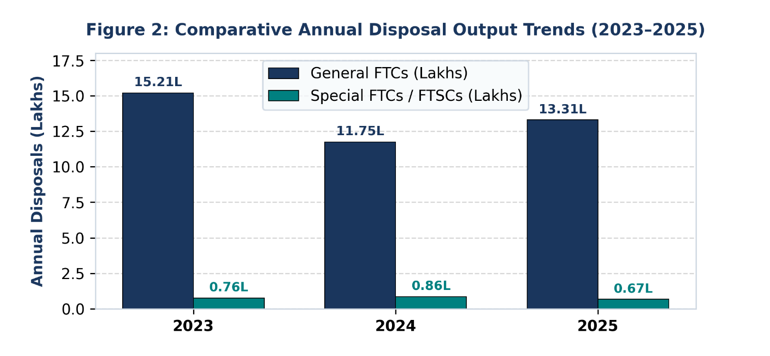 Figure 2: Annual Disposal Trends Across General FTCs vs. FTSCs (2023–2025). Source: Ministry of Law & Justice Returns.
|
Disposal Trajectory Divergence: Analyzing disposal trajectories between 2024 and 2025 reveals a striking divergence: while General FTC disposals rebounded by +13.28% (rising from 11.75 lakh to 13.31 lakh cases), FTSC disposals dropped by -22.31% (falling from 85,595 to 66,500 cases). This decline in FTSC output reflects increased procedural complexity in POCSO trials, acute support staff shortages, and state-level scheme exits, such as Jharkhand’s withdrawal from the FTSC scheme on 7 July 2025. Total FTSC scheme pendency stands at 2,56,097 cases. |
4.5 Empirical Vacancy Analysis: Judicial Officers vs. Support Staff
The literature review identifies judicial and support staff shortages as a primary driver of delay. Auditing state-specific FTSC returns (Lok Sabha Question 1351) provides concrete empirical proof of severe human resource bottlenecks.
Table 3: Sanctioned Strength, Working Posts, and Calculated Vacancy Rates across Judicial Cadres
|
Cadre / Setting |
Sanctioned |
Filled |
Vacant |
Vacancy Rate (%) |
|
UP FTSC Support Staff |
1,526 |
980 |
546 |
35.78% |
|
Allahabad High Court Judges |
160 |
109 |
51 |
31.88% |
|
UP FTSC Judicial Officers |
218 |
155 |
63 |
28.90% |
|
High Courts (National Total) |
1,122 |
813 |
309 |
27.54% |
|
Subordinate Judiciary (National) |
25,895 |
21,028 |
4,867 |
18.80% |
Source: Department of Justice, Lok Sabha Question 1351 (Feb 2026) and Question 2362 (Feb 2026).
Note: Vacancy Rate = (Vacant Posts / Sanctioned Posts) * 100.
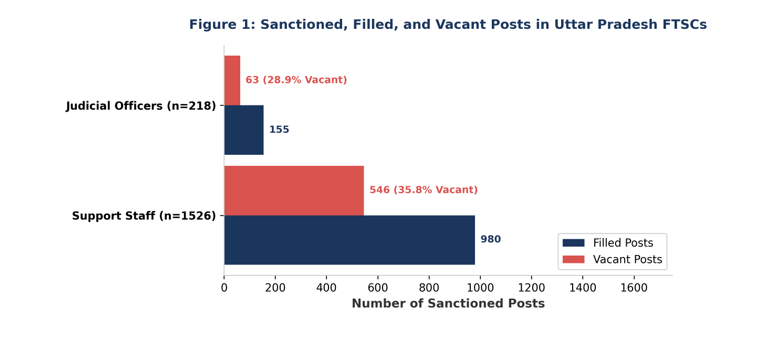 Figure 1: Visual Comparison of Sanctioned, Filled, and Vacant Posts in UP FTSCs
Analytical Interpretation (Table 3 & Figure 1): Support staff vacancies in UP FTSCs stand at a staggering 35.78% (546 vacant posts out of 1,526 sanctioned), which is significantly higher than the judicial officer vacancy rate of 28.90% (63 vacant out of 218) in the same courts. Comparing court settings, UP FTSC support staff vacancies exceed the national subordinate judiciary vacancy rate (18.80%) by 16.98 percentage points. This magnitude confirms that administrative support deficits are even more severe than judicial officer vacancies. In terms of interpretation, courts operating with over one-third of support posts vacant cannot maintain timely cause-list scheduling, summons issuance, or record management. For the research hypothesis, this empirical proof validates that Fast Track Courts are severely handicapped by non-judicial administrative staffing shortages.
4.6 Comparative Institutional Disposals and Output Analysis
Official disposal trends between 2023 and 2025 demonstrate distinct operational trajectories between General FTCs and FTSCs.
Table 4: Functional Courts and Annual Reported Disposals by Category (2023–2025)
|
Performance Indicator |
General FTCs |
FTSCs (incl. POCSO) |
Comparative Ratio |
|
Functional Courts (Dec 2025) |
880 |
774 |
1.14 : 1 |
|
2023 Annual Disposals |
15,21,193 |
76,319 |
19.93 : 1 |
|
2024 Annual Disposals |
11,74,885 |
85,595 |
13.73 : 1 |
|
2025 Annual Disposals |
13,30,904 |
66,500 |
20.01 : 1 |
|
Cumulative Disposals (2023–2025) |
40,26,982 |
2,28,414 |
17.63 : 1 |
Source: Ministry of Law & Justice, PIB Release 2223645 (5 Feb 2026).
Note: Cumulative disposals represent 42,55,396 total cases settled across both special categories over 3 years.
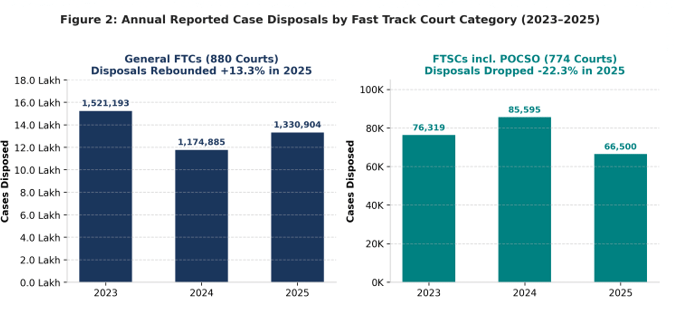
Figure 2: Annual Disposals Trend in General FTCs vs. FTSCs (2023–2025)
Analytical Interpretation (Table 4 & Figure 2): General FTC disposals rebounded by +13.28% (+1.56 lakh cases) in 2025 reaching 13.30 lakh, whereas FTSC disposals experienced a sharp decline of -22.31% (-19,095 cases) dropping to 66,500. Comparing cumulative outputs, General FTCs disposed of 40.26 lakh cases over three years, which is 17.63 times higher than FTSC disposals (2.28 lakh cases), despite having only 1.14 times more courts (880 vs 774). This substantial magnitude difference stems from case complexity and state coverage, FTSCs handle intricate sexual offense trials requiring sensitive forensic evidence, while state exit decisions (e.g., Jharkhand exiting the FTSC scheme in July 2025) reduced operational FTSC capacity. This finding highlights that raw disposal metrics cannot be directly compared across court categories without accounting for case mandates and inter-agency evidence dependencies.
4.7 Primary Survey Analysis: Perceived Barriers and Reform Priorities
The primary survey (n = 36) captures stakeholder assessments regarding administrative obstacles, procedural failures, physical resources, and digital technology.
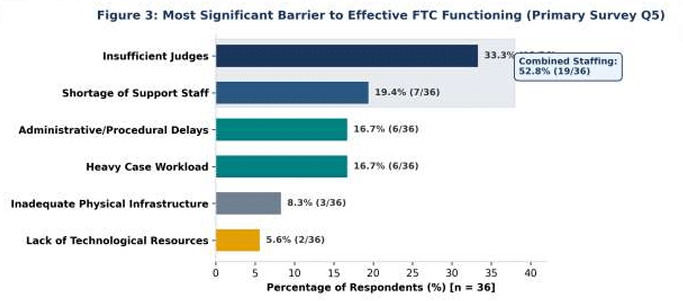
Analytical Interpretation (Figure 3 – Q5 Barriers): Insufficient judicial strength is identified as the single most significant barrier by 33.3% (12/36) of respondents, closely followed by support staff shortages at 19.4% (7/36), administrative/procedural delays at 16.7% (6/36), and heavy case workload at 16.7% (6/36). Combining the mutually exclusive staffing choices reveals that 52.8% (19/36) of respondents prioritize human resource deficits over physical infrastructure (8.3%) or technological resources (5.6%). The 47.2 percentage point gap between staffing concerns and technology concerns indicates that legal practitioners view human capacity as the primary bottleneck. This reinforces the core research argument that institutional speed is fundamentally constrained by personnel availability rather than digital equipment shortages.
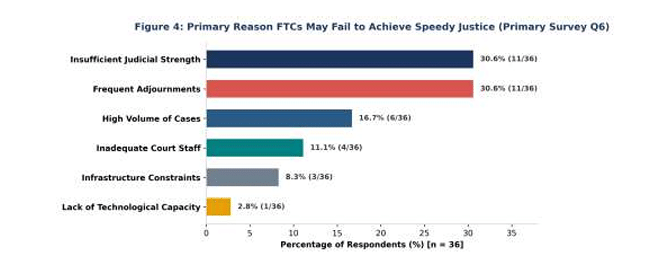 Analytical Interpretation (Figure 4 – Q6 Failure Causes): Insufficient judicial strength and frequent adjournments tie as the primary reasons for failure to achieve speedy justice, each selected by 30.6% (11/36) of respondents. Together, these two factors account for 61.2% (22/36) of total responses, towering over high case volume (16.7%), court staff shortages (11.1%), and infrastructure constraints (8.3%). The equal magnitude of adjournments and judicial vacancies demonstrates that procedural friction (adjournment culture) is perceived to be just as damaging to court efficiency as judge shortages. This supports the thesis that case management and listing rules must be reformed alongside judicial recruitment.
Table 5: Primary Stakeholder Assessments of Administrative Autonomy and Physical Infrastructure
|
Assessment Scale |
Autonomy & Resources (Q7) |
Share (%) |
Physical Infrastructure (Q8) |
Share (%) |
|
Completely / Very Adequate |
4 |
11.1% |
4 |
11.1% |
|
Moderately Sufficient / Adequate |
19 |
52.8% |
15 |
41.7% |
|
Adequate (Category 2) |
— |
— |
6 |
16.7% |
|
Insufficient / Inadequate |
9 |
25.0% |
7 |
19.4% |
|
Highly Insufficient / Inadequate |
3 |
8.3% |
3 |
8.3% |
Source: Primary Survey Dataset (Primary PDF, pp. 7–8, n = 36).
Analytical Interpretation (Table 5): A clear majority of 63.9% (23/36) view administrative resources as sufficient (52.8% moderately, 11.1% completely), while physical infrastructure is rated positively or moderately by 69.5% (25/36). Inadequate ratings account for 33.3% in resources and 27.8% in physical facilities. The data refutes claims of complete physical collapse, showing that infrastructure is largely viewed as moderately adequate. This indicates that court performance bottlenecks are driven by procedural and human management rather than a total absence of physical courtrooms.
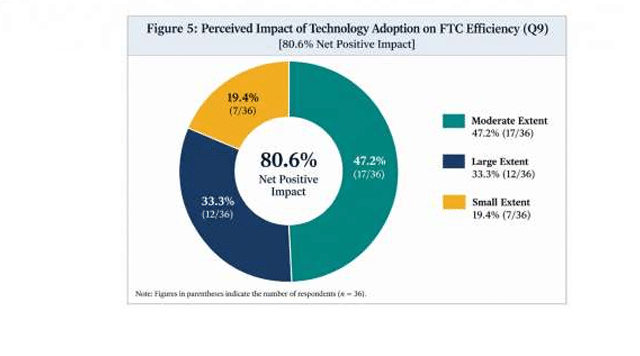
Analytical Interpretation (Figure 5 – Q9 Technology): Technology adoption (e-filing, CIS, virtual hearings) receives the most positive evaluation in the survey, with 80.6% (29/36) confirming efficiency improvements (47.2% moderate, 33.3% large extent). Only 19.4% (7/36) report a small impact, and 0.0% report no impact. This strong 61.2 percentage point margin over negative views proves that digital tools are highly valued by legal practitioners. For court reform, this confirms that technology is a vital force-multiplier, though it requires dedicated support staff to unlock its full potential.
4.8 Qualitative Analysis of Field Submissions (n = 24)
Transcribing open-text submissions (Q13, n = 24) reveals crucial qualitative field insights into operational friction.
Table 6: Qualitative Thematic Matrix of Primary Field Submissions
|
Thematic Category |
Core Qualitative Field Evidence |
Systemic Impact |
Actionable Reform Link |
|
Additional Charge Strain |
‘Judges and staff are assigned FTCs as additional charges rather than full-time posts’ (V5) |
Breaks hearing continuity & delays listing |
Create dedicated, full-time FTC cadres |
|
Inter-Agency Bottlenecks |
‘Delayed forensic and police investigation reports interrupt trials’ (V5) |
External trial freezes beyond judicial control |
Enforce strict inter-agency SLAs |
|
Adjournment Culture |
‘Frequent adjournments sought by counsel delay proceedings’ (V5) |
Inflates pending trial duration |
Enforce strict adjournment limits |
|
Staff Unavailability |
‘Unavailability of staff or judges on leave creates exponential growth in backlog’ (V1) |
Administrative paralyzation during leave |
Mandate administrative leave cover |
|
Digital Integration |
‘Need to scale up e-filing, virtual witness depositions & digital tracking’ (V5) |
Incomplete paperless workflow |
Expand integrated digital tracking |
Source: Transcribed qualitative field submissions [primary data]
Analytical Interpretation (Table 6): Qualitative text analysis highlights that the practice of assigning judges ‘additional charges’ severely disrupts trial speed. When judges handle FTCs alongside regular dockets, special courts operate part-time, compounding delays caused by late forensic reports and police charge-sheets. This explains why FTCs frequently fail to achieve fast disposal, they are treated as part-time assignments without dedicated administrative staff.
4.9 Triangulated Synthesis and Diagnostic Assessment
Cross-triangulating secondary parliamentary returns, primary survey perceptions, and qualitative field text across all 6 analytical dimensions establishes a verified synthesis.
Table 7: Triangulation Synthesis Across the 6 Analytical Dimensions
|
Analytical Dimension |
Secondary Empirical Data |
Primary Survey (n=36) |
Triangulated Relationship |
|
1. Human Resources |
UP FTSC Vacancies: 28.9% Judges, 35.8% Staff (E4) |
52.8% select staffing as #1 barrier (Q5) |
Strong Convergence |
|
2. Workload & Pendency |
2.56 Lakh FTSC pending; 5.41 Cr national total |
16.7% cite high case volume (Q6) |
Complementary Context |
|
4. Infrastructure |
Schemes reuse existing premises (E3) |
41.7% Moderate; 27.8% Adequate |
Mixed / Qualified |
|
5. Technology |
CIS 4.0 & paperless court pilots (E4) |
80.6% report Large/Mod gain (Q9) |
Strong Positive Align |
|
6. Inter-Agency Coordination |
E3 confirms FSL & prosecutor bottlenecks |
22.2% demand coordination reform (Q11) |
Strong Convergence |
Source: Triangulated synthesis of primary and secondary research material.
4.10 Key Findings and Strategic Policy Takeaways
The empirical findings refute the notion that Fast Track Courts suffer from universal failure, demonstrating instead an account of uneven administrative capacity and inter-agency coordination gaps:
- Institutionalise Dedicated Judicial Cadres: End the practice of assigning fast-track courts as ‘additional charges’ to regular judges. Mandate full-time, dedicated judicial appointments across all FTCs and FTSCs.
- Mandate Support Staff Ratios: Enforce a statutory 1:5 ratio of judicial officers to administrative, clerical, and technical support staff to streamline court management, listing, and order drafting.
- Establish Inter-Agency Service Level Agreements (SLAs): Implement digital tracking and binding SLAs for police charge-sheet submissions, summons execution, and Forensic Science Laboratory (FSL) report delivery.
- Restrict Discretionary Adjournments: Amend procedural rules to restrict discretionary adjournments to exceptional circumstances, enforcing mandatory costs for frivolous adjournment applications.
- Extend Centrally Sponsored Scheme Funding: Expand Central Government funding beyond FTSCs to cover General Fast Track Courts, ensuring uniform digital tools, administrative infrastructure, and operating budgets.
CHAPTER – 5 CONCLUSION
5.1 Overall Research Focus
This study examined the effectiveness of Fast Track Courts by focusing on the administrative functioning and operational bottlenecks of Fast Track Courts through an analysis of parliamentary returns, NJDG information, a primary survey of 36 respondents and 24 qualitative field submissions. The findings indicate that the FTC’s serve an important institutional purpose, but their effectiveness is closely linked to the adequacy of administrative resources, case management practices, digital technology and inter-agency coordination in shaping trial continuity. These factors are complementary and mutually reinforcing, and their effective integration would contribute to more efficient adjudication and the expeditious disposal of cases.
5.2 Major Findings
The study identified four principal findings. First, human resource constraints emerged as an impediment to effective functioning. The findings indicate that support-staff vacancies, particularly in Uttar Pradesh, were higher than judicial officer vacancies. Human-resource constraints were the most frequently identified operational barrier in the primary survey. Second, frequent adjournments were perceived as a substantial challenge to speedy disposal of cases. As per the primary data, there must be adherence to case hearings and minimisation of unnecessary delaying tactics. Third, qualitative evidence identified police, forensic and witness-related dependencies as recurring obstacles to trial continuity, with the decline in FTSC disposals being consistent with, but not demonstrably caused by, these constraints. Fourth, findings through the survey produced a qualified picture of capacity: 63.9% of respondents considered administrative resources moderately or completely sufficient, while 80.6% reported positive effects from digital technologies. Hence, it reveals both institutional limitations and scope for improvement.
5.3 Answers to the Research Questions
RQ1: How do staffing, case management, digital technology and inter-agency coordination interact to affect trial continuity in Fast Track Courts?
The findings suggest that these factors operate as interconnected components of court administration. Staffing affects the capacity to manage routine court processes; case-management weaknesses can interrupt scheduled hearings; digital technology can improve information and procedural efficiency; and external agencies can determine whether cases are ready to proceed. No single factor adequately explains the observed constraints.
RQ2: What administrative reforms can address these interconnected operational bottlenecks?
The evidence points towards an integrated reform approach involving adequate judicial and support staffing, improved case-management and scheduling mechanisms, continued digitalisation, and structured coordination between courts, police, prosecution and forensic institutions. Reform should therefore focus on strengthening the administrative ecosystem surrounding Fast Track Courts rather than expanding court numbers alone.
5.4 Contribution of the Study
The study’s principal contribution lies in connecting different dimensions of court administration within a single empirical framework. Its evidence demonstrates the value of examining Fast Track Courts not only through disposal numbers but also through the organisational processes that determine whether a scheduled case can progress.
By combining audited institutional data with stakeholder assessments and qualitative field evidence, the study provides a more differentiated account of FTC functioning. It shows that the principal issue is not necessarily an absence of resources in every dimension, but the uneven distribution and coordination of capacities across different stages of the judicial process.
5.5 Policy Implications
The findings indicate four broad policy priorities.
First, dedicated judicial and administrative capacity: Fast Track Courts should, where feasible, be supported by dedicated judicial and administrative arrangements rather than excessive dependence on additional-charge assignments.
Second, adequate support staffing: Court-strength planning should account for administrative, clerical and technical personnel alongside judicial officers.
Third, stronger case management: Scheduling, listing and adjournment-management mechanisms should be strengthened to reduce avoidable interruptions in proceedings.
Fourth, inter-agency coordination: Courts, police, prosecution and forensic institutions should develop clearer timelines, digital tracking mechanisms and institutional coordination arrangements for investigation reports, forensic evidence, summons and witness management.
Digital systems should continue to be strengthened, but their expansion should complement rather than substitute for human and institutional capacity.
5.6 Limitations and Future Research
The study has several limitations. First, the primary survey consists of 36 respondents and therefore cannot provide statistically representative estimates of the views of all FTC stakeholders. Longitudinal research could address this limitation by tracking the same courts and cases over time rather than relying on a one-time assessment.
Second, access to sitting judicial officers and some court-level administrative data was limited. Comparative State-level research could therefore examine how differences in staffing, institutional design and administrative arrangements affect similarly designated Fast Track Courts.
Third, the study identifies procedural and scheduling problems but does not directly measure the effect of automated scheduling systems on case disposal. Future research could evaluate scheduling and case-management technologies by comparing disposal patterns before and after their implementation.
Finally, the qualitative evidence identifies missing witnesses and weaknesses in supporting institutions as important obstacles. Future research could examine Vulnerable Witness Deposition Centres and witness-management mechanisms to determine whether improvements in witness infrastructure and coordination translate into greater trial continuity.
Overall, the evidence suggests that the effectiveness of Fast Track Courts depends not simply on their designation or numerical expansion, but on whether the administrative, technological and inter-agency systems supporting them are sufficiently coordinated to sustain continuous proceedings.
REFERENCES
- Alexander, P. (1999). Reforming Indian Judicial System: The Common Man’s Perspective. The Indian Journal of Public Administration, 45, 348 – 355. https://doi.org/10.1177/0019556119990306
- Amaral, S., & Bandyopadhyay, S. (2015). Court Backlogs and Crime in India. IIM Kozhikode Society & Management Review, 4, 86 – 91. https://doi.org/10.1177/2277975215604065
- Chakraborty, M., & Dube, D. (2016). Operational Constraints of Forensic Evidence in India: Time to Rethink. Journal of Forensic Medicine, 14, 21-27. https://doi.org/10.5958/0974-4487.2016.00005.5
- Chitara, N., Meena, R., Guleria, A., Siwan, D., Rana, A., Srivastava, A., Chitara, P., Kaur, T., & Krishan, K. (2026). Reform of criminal laws in India: Potential impact on the criminal justice system and forensic investigation.. Medicine, science, and the law, 258024261465987 . https://doi.org/10.1177/00258024261465987
- Datta, P., Hans, M., Mishra, M., & Patnaik, I. (2019). How to Modernise the Working of Courts and Tribunals in India.
- Ghosh, Y. (2018). Indian Judiciary: An Analysis of the Cyclic Syndrome of Delay, Arrears and Pendency. Asian Journal of Legal Education, 5, 21 – 39. https://doi.org/10.1177/2322005817733566
- Gupta, M. V., & Bolia, N. (2023). Redistribution of judicial resources for improved performance. Annals of Operations Research, 342, 2147 – 2168. https://doi.org/10.1007/s10479-023-05389-0
- Krishnan, J. K., & Kumar, C. R. (2011). Delay in Process, Denial of Justice: The Jurisprudence and Empirics of Speedy Trials in Comparative Perspective. Georgetown Journal of International Law, 42, 747.
- Krishnaswamy, S., Sivakumar, S., & Bail, S. (2014). Legal and Judicial Reform in India: A Call for Systemic and Empirical Approaches. Journal of National Law University, Delhi, 2, 1 – 25. https://doi.org/10.1177/2277401720140101
- Kumar, V. (2012). Judicial Delays in India: Causes & Remedies. Journal of Law, Policy and Globalization, 4, 16-21.
- Micevska, M., & Hazra, A. (2004). THE PROBLEM OF COURT CONGESTION: EVIDENCE FROM INDIAN LOWER COURTS. https://doi.org/10.22004/ag.econ.18750
- Peterson, V. (2016). Speeding up Sexual Assault Trials: A Constructive Critique of India’s Fast-Track Courts. Yale Human Rights and Development Journal, 18, 2.
- Rattan, J., & Rattan, V. (2021). “The COVID-19 Crisis – the New Challenges Before the Indian Justice and Court Administration System”. International Journal for Court Administration. https://doi.org/10.36745/ijca.391
- Rehn, N., Naik, A., Jain, D., Singh, A., Robinson, N., So, W., Aniruddha, J., Rai, S., Patil, C., Bindal, A., Goel, R., & Kanwar, V. (2010). Justice Without Delay: Recommendations for Legal and Institutional Reforms in the Indian Courts.
- Singh, T., & Thakur, A. (2019). Administration of Justice: Judicial Delays in India. Indian Journal of Public Administration, 65, 885 – 896. https://doi.org/10.1177/0019556119873451
- Singh, M. (2018). Indian Judicial System Overview and a Approach for Automatic Roster Preparation and Case Scheduling for Faster Case Solving (Need of: E-Courts). 2018 International Conference on Advances in Computing, Communication Control and Networking (ICACCCN), 128-131. https://doi.org/10.1109/icacccn.2018.8748721
- Singhvi, A. (2021). Beating the Backlog: Reforms in Administration of Justice in India. Judicial Review. https://doi.org/10.1017/9781108870184.005
- Srivastava, S. K. (2023). AI in Justice Delivery in India: Current Status, Identification of Potential Applications and Way Forward. Informatica (Slovenia), 47. https://doi.org/10.31449/inf.v47i5.4361
- Tiwari, M. K. (2021). Justice Frustrated: the systemic impact of delays in Indian courts. Indian Law Review, 5, 410 – 417. https://doi.org/10.1080/24730580.2021.1937864
- Verma, K. (2018). e-Courts Project: A Giant Leap by Indian Judiciary. Journal of Open Access to Law. https://doi.org/10.63567/cdvtr019