Authors -“Mahak Taneja” “Diya Jain” “Dhwani Pradhan” “Angela Alwin Noronha”
ABSTRACT
Military conflicts have long been a significant determinant of economic dynamics globally, it has influence growth trade inflation and even the financial stability of several countries. The study examines the implications of major military conflicts and their global spillover effects and impacts
The study contains a mixed method approach and combines both qualitative analysis of case studies with quantitative insights derived from primary survey data. It reveals economies have been particularly vulnerable and dependent upon trade and energy imports from other countries
Overall the study concludes that military conferences are not only geopolitical events but also economics shocks with lasting consequences
1. Introduction
Throughout history, wars have impacted the world’s economy and it’s been about far more than just who wins or loses politically. They’ve influenced how quickly things grow, how easily we buy and sell, and how countries improve. And in our incredibly linked modern world, the economic fallout of a war doesn’t remain within the borders of the fighting countries; it flows outwards. Disrupted supply lines, wobbly financial systems, increasing prices and the general uncertainty surrounding international trade all mean the effects are widespread. At the most fundamental level, war demolishes the actual buildings and roads of a country, and the skills and lives of its people, which immediately means a country can’t make as much. Governments then typically shift funds from things that would make life better for people – education, medical care, and building and improving things – to the military. While that might give a feeling of security now, it’s likely to hold back the economy and the country’s ability to progress over time. When conflict flares in strategically important regions, the entire global economy feels it. The current tensions in the Middle East and elsewhere have made the energy market a very anxious place. India, along with many nations dependent on oil, is exceptionally exposed to these kinds of shocks. When oil costs more, everything to manufacture becomes pricier, which drives up inflation and stresses a country’s import/export balance and the economy overall. Furthermore, issues around the globe and the conflicts they ignite have other consequences for India. The conflict in the Middle East, for instance, has brought about fluctuating oil prices, money leaving India, and a rise in inflation. On top of that, the repatriation of a significant number of Indian workers from conflict zones has repercussions for employment figures, money sent home to families, and the job situation in India itself. Also, India’s status as a major emerging economy makes it especially vulnerable to instability around the world. Changes in trade routes, supply chains, and money flows can have an effect on exports, investment, and the economy as a whole. As conflicts become more common and complicated, their effects on the economy go beyond short-term losses to long-term problems like inflation, inequality, and slower growth. This paper aims to examine the economic ramifications of military conflicts on the global economy, particularly regarding India. It tries to figure out how conflicts affect important economic factors like growth, trade, inflation, and investment. It also looks at how the Indian economy is uniquely vulnerable and how it responds in a world that is becoming more unstable.
2. Literature review and conceptual framework
A conflict is a situation in which economic agents (such as individuals or governments) use resources like money, weapons, or effort that are not only costly to themselves, but also inefficient for society as a whole, in pursuit of personal gains, resulting in a win-loss outcome (Kimbrough et al., 2017). A conflict transitions into a military escalation when:
- Economic tools are used to actively weaken the opponent nation’s ability to fight, such as targeting key industries or supply chains.
- The rising cost of the conflict forces a country to shift its focus from welfare to warfare.
Historical instances of this can be seen during World War II, when the United States and Britain carried out strategic bombing not only on German troops but also on critical targets such as ball-bearing factories and oil refineries to cripple Germany’s military. A more recent example can be observed in the West Asia War (2026), wherein drone attacks on Saudi and Qatari oil facilities disrupted global oil and energy supply.
Merely understanding when a conflict escalates into military aggression without first examining its underlying causes is akin to reading the final chapter before the beginning of the story. Erik O. Kimbrough et al. (2017) address this gap by explaining conflict through various economic models, including the rent-seeking model and the guns-versus-butter framework.
Through the rent-seeking model, we understand that people (or countries) spend resources to capture a prize, not to create value. In this case, the prize is winning the war. For instance, if v is the value of the prize, each player may spend a portion of it, implying that a significant part of the total value is wasted. This means that a large share of resources is dissipated in the process of conflict.
Rationally speaking, if a country has to spend an enormous amount of resources that could have been used elsewhere, it may not seem worthwhile to participate in a war. However, the model suggests that the expected individual gains from winning outweigh the cost incurred, making conflict socially inefficient.
However, the models proposed by Kimbrough et al. (2017) are largely theoretical and assume that countries behave as rational actors seeking to maximise expected gains. In reality, military conflicts are often influenced by political ideology, nationalism, historical grievances, and strategic alliances, which cannot be fully explained through economic incentives alone. Therefore, while these models provide a useful conceptual framework, they may oversimplify the complex motivations behind war.
Therefore, when partaking in a war, a country has to choose between guns (military spending) and butter (civilian goods). The guns-versus-butter framework helps us understand the implications of these choices. Since resources are limited, there exists a trade-off: if a country chooses more guns, it has fewer resources to spend on butter, and vice versa. Thus, war leads to an opportunity cost.
This opportunity cost can therefore affect the economic growth of a nation in both the short run and the long run. In the short run, an increase in military expenditure raises aggregate demand through higher government spending. This leads to an increase in output and employment levels, thereby promoting economic growth. However, in the long run, the effect is more ambiguous. While on one hand, military spending diverts resources away from productive civilian investments such as education, healthcare, and infrastructure, which can slow down economic growth, on the other, it may contribute to growth through technological innovation and military research and development. Therefore, the long-run impact of military spending on growth depends on its level. Low levels of spending may support moderate growth, moderate levels can enhance growth further, while excessively high levels may lead to a decline in growth (Chakraborty, 2026).
A limitation of Chakraborty’s (2026) argument is that it presents the long-run effect of military spending as dependent on its level without clearly distinguishing between defensive military investment and spending during active warfare. The positive effects through technological innovation may not be applicable in countries experiencing prolonged conflicts where infrastructure, human capital, and productive capacity are simultaneously being destroyed. Hence, the conclusions may not be equally relevant across different types of military conflicts.
Chakraborty’s (2026) idea of ambiguity in the long-term effect on growth can be further evaluated in light of Olena Polinkevych (2024), wherein she examined the impact of the Russia–Ukraine war on Ukraine. According to her, military conflict severely damages an economy—both immediately and in the long run—and its effects spread beyond national borders. This suggests that, in the context of large-scale and prolonged conflicts, the long-run effects may be more consistently negative than ambiguous. Though not explicitly mentioned in the paper, we can understand its effects using the AD–AS framework. After the commencement of war, consumption, investment, and exports reduce, an exception being the increase in government expenditure on the military. As a result, the AD curve shifts to the left. Similarly, the AS curve also shifts to the left due to the destruction of capital, reduction in the labour force, breakdown of supply chains, and scarcity of energy and raw materials. This leads to a fall in the output level, that is, a reduction in GDP, and an unusual rise in price levels, as the reduction in supply is often stronger than the fall in demand, resulting in stagflation.
Nevertheless, the findings of Polinkevych (2024) are based primarily on the case of Ukraine, which represents a large-scale invasion involving extensive destruction of infrastructure and displacement of population. As a result, the conclusions may not be directly generalisable to smaller or short-lived military conflicts where the economic consequences may be less severe.
In line with this, and consistent with the global spillover effects highlighted by Olena Polinkevych (2024), the recent U.S.–Israel–Iran war and the closing of the Strait of Hormuz have significantly disrupted global oil supply. About 80% of oil and oil products transiting from the Strait of Hormuz reach Asia, and its closure has created an energy crisis for many countries (Anil Sasi, 2026). The reduction in oil supply further shifts the short-run AS curve to the left, raising prices and lowering growth. This shift in the AS curve is primarily due to the increase in production and transport costs. The AD curve may or may not shift to the left, depending on consumer reaction to this supply-side shock.
Furthermore, the analysis mainly focuses on disruptions in oil supply and their macroeconomic consequences. It does not fully consider the ability of countries to mitigate these shocks through strategic petroleum reserves, diversification of energy sources, or alternative trade routes. Consequently, the actual economic impact may differ across countries depending on their energy dependence and policy responses.
Beyond these macroeconomic and global market effects, the long-term impact of war also extends to the behaviour of economic agents at the firm level. The long-term effect of war is not restricted only to the economy of a nation but also affects its citizens. The study by Yichuan Hu et al. (2026) studies the case of the effect of the Korean War on Chinese firms. A firm was less likely to maintain a relationship with U.S. suppliers if its chairperson’s city of origin suffered severe casualties during the Korean War. Trade wars further worsen this impact by bringing back painful memories, making companies less likely to deal with firms from the specific country.
However, the study focuses specifically on Chinese firms and the historical context of the Korean War. Therefore, its findings may not be universally applicable to firms operating in different institutional, political, or cultural environments. In addition, firms’ trade decisions may also be influenced by factors such as government policies, market conditions, and profitability rather than historical memory alone.
Through the entire literature review, it is clearly evident that military conflict has several economic implications. While Kimbrough et al. (2017) explain the concept through models such as the rent-seeking model and the guns-versus-butter framework, Chakraborty (2026) highlights the trade-off that countries face while partaking in a war. The ambiguous nature of the long-term implications of military conflict highlighted by Chakraborty (2026) can be further analysed using Polinkevych’s (2024) idea of the long-term negative impacts. By using the AD–AS framework, it can be clearly understood how military conflict results in stagflation. Lastly, Yichuan Hu et al. (2026) analyse the economic behaviour of agents post-war, providing evidence that the impact of war is not only immediate but also lasts for several generations. At the same time, each of these studies has certain limitations in terms of assumptions, context, and generalisability. Taken together, they provide a comprehensive yet nuanced understanding of the economic consequences of military conflict, forming the conceptual framework for the present study.
3. Research Methodology
3.1 Introduction
This chapter outlines the research methodology that was adopted to examine The Economic Implications of Military Conflicts on the Global Economy. The methodological framework is designed to ensure the reliability, validity, and robustness of findings.
3.2 Research Design
The study uses a mixed methods approach, integrating quantitative analysis of case studies with qualitative data from interviews. This combination facilitates a thorough analysis of the macroeconomic impacts of military conflicts. A descriptive and analytic design forms the primary basis of the study. The research is descriptive, analytic, and explanatory.
1. DESCRIPTIVE – outlines trends in global economic indicators during periods of conflict.
2. ANALYTIC – evaluates relationships between conflict variables and economic outcomes.
3. EXPLANATORY – it seeks to establish a causal relation between military conflicts and economic changes.3.3
3.3 Research Gap
In the academic research identifying gaps in existing literature is crucial for advancing knowledge and addressing and answer question which is a particular field of study
These research gaps represent the areas where the investigation could be done to depend on the understanding and theories. A researcher by pinpointing these gaps can embark on the study that contributes new insights and perspective along with enriching the body of knowledge.
As we can see through the study of literature review that a great understanding of military conflicts and its effective global economy is been highlighted
But still there are some research gaps on which researchers could study
There is a heavy dependency on secondary data even though it has been driven from reliable and credible sources but it doesn’t capture the changing nature of the conflicts
The areas of concern that remain uncovered in previous research include
Lack of cross-country comparative analysis – The studies mainly focused on the countries affected by the particular war that is being studied rather than comparing the factors that are involved in these war as it may differ for each country
Limited focus on multiple macroeconomic indicators – Many papers concentrate primarily on GDP or economic growth.
However, military conflicts influence many variables simultaneously, such as:
- Inflation
- Unemployment
- Trade
- Exchange rates
- FDI
- Fiscal deficit
Limited analysis of indirect/global spillover effects – Most research studies countries directly involved in war.
However, wars also affect countries that are not participants through:
- Oil prices
- Supply chain disruptions
- Food prices
- Financial markets
- Trade routes
3.4 Data Source
SECONDARY DATA
The research will extensively depend on data from a credible international database.
PRIMARY DATA
The research will be narrowly dependent on data from questionnaire respondents.The respondents were mainly adults aged 30-60 as the rise in prices of gas and oils mostly affected households,daily vehicle users and food businesses.The questionnaire was circulated to friends and family for further circulation to large number of respondents
The question and answers were framed and answered without any biasedness
3.5 Time Frame
Year 2003 & Year 2022-26
3.6 Case study
Russia-Ukraine War
Background
The Russia-Ukraine War, which escalated significantly in February 2022 following Russia’s full-scale invasion of Ukraine, represents one of the most geopolitically and economically consequential conflicts in recent history. While tensions between Russia and Ukraine date back to 2014 (annexation of Crimea), the 2022 escalation triggered widespread global repercussions.
The conflict led to the imposition of severe economic sanctions by Western economies, disruption of trade routes, and instability in global commodity markets, making it a critical case for analyzing the economic implications of military conflicts.
Impact
One of the most immediate economic consequences of the conflict was the disruption of energy supplies. Russia is among the world’s largest exporters of oil and natural gas, particularly to Europe. Sanctions and supply uncertainties led to:
- Sharp increases in global oil and gas prices
- Energy shortages in European economies
- Increased reliance on alternative energy suppliers
The war significantly disrupted global trade networks:
Ukraine, a major exporter of wheat, corn, and sunflower oil, faced production and export constraints
Blocked Black Sea shipping routes created bottlenecks in the global food supply
Increased transportation and insurance costs for international trade
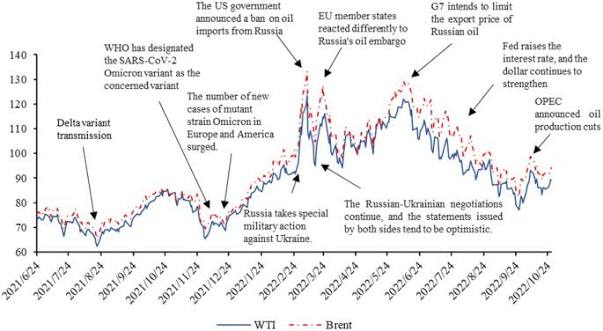
TIMELINE OF EVENTS
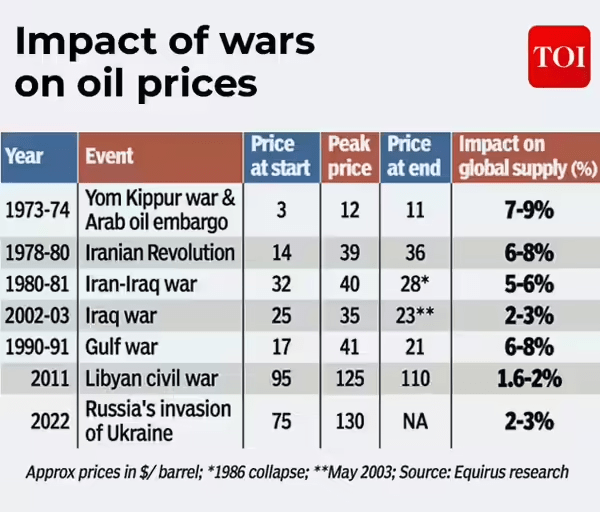
THE INCREASE IN PRICES OVER YEARS DUE TO SEVERAL WARS
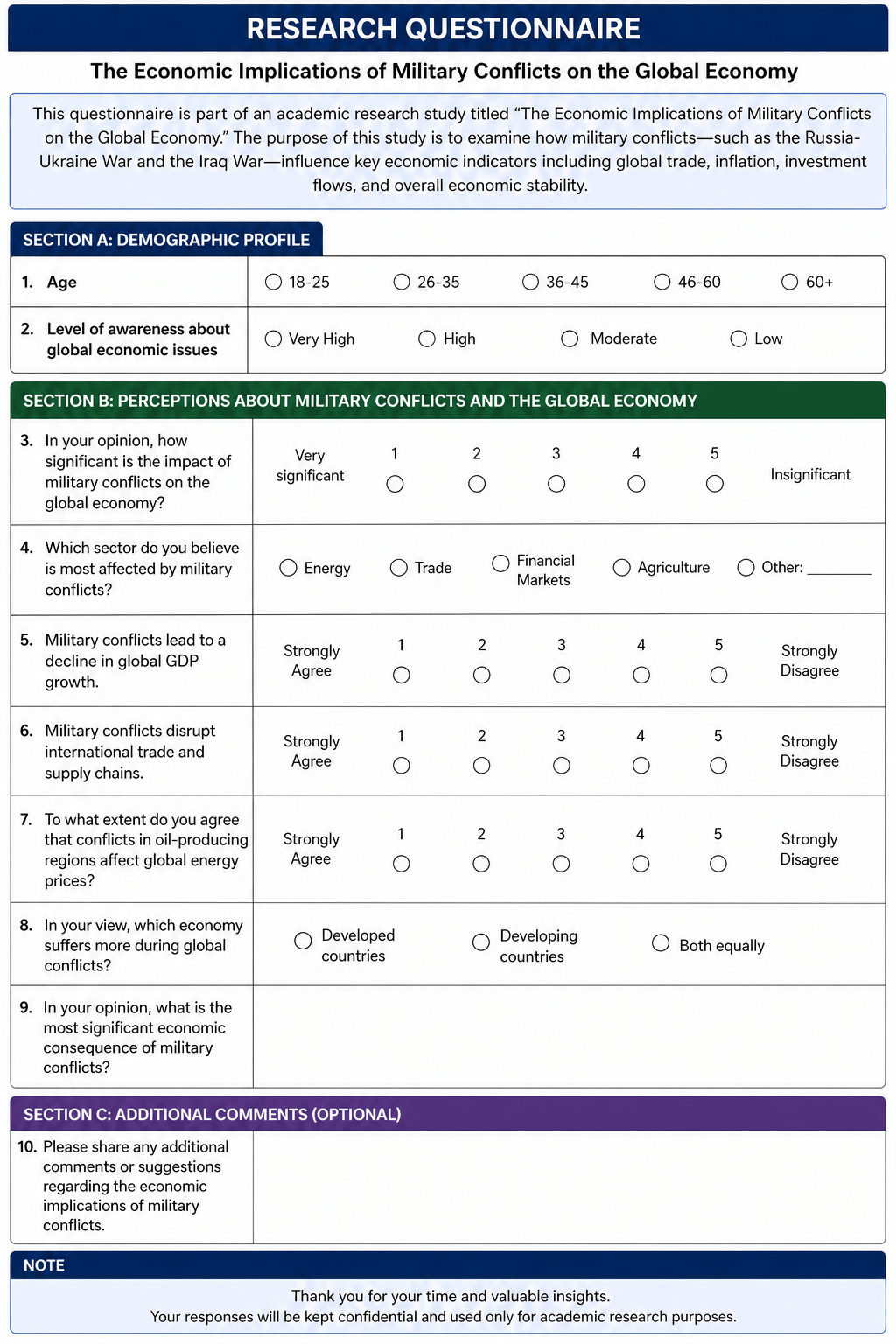
QUESTIONNAIRE
4.Results Analysis
4.1 Case Study – Russia-Ukraine War (2022-2026)
4.1.1 Energy Market Disruptions
The Russia Ukraine War, which escalated into a full scale invasion in February 2022, produced severe and immediate disruption to global energy markets. Russia being one of the world’s largest exporters of crude oil and natural gas meant that the imposition of Western Sanctions would directly lead to price volatility. Global Brent crude oil prices, which stood at approximately $85 per barrel in January 2022, rose sharply to $139 per barrel by March 2022 — an increase of approximately 63.5% within weeks of the invasion.
- European countries, heavily dependent on Russian pipeline gas, faced energy supply shock.
- Germany, Italy and Austria had to shift to alternative suppliers such as liquefied natural gas from the United States and Qatar at a higher cost.
- For India, the nation’s crude import bill expanded significantly during 2022.
4.1.2 Global Trade and Food Supply Disruption
Ukraine is among the world’s largest suppliers of wheat, corn and sunflower oil.
- The blockade of Black Sea shipping routes created economic pressure on Ukraine, as the ports export around 32-33 million tonnes of grain and food.
- Transportation and insurance costs for shipping also increased considerably during this period, raising import costs for food dependent countries across Africa and the Middle East.
- Conflict- driven supply shocks shift the aggregate supply (AS) to the left, raising prices across interconnected countries
4.1.3 Macroeconomic Outcomes: An AD-AS analysis
The macroeconomic consequences of the Russia-Ukraine War can be understood through the AD-AS framework.
- In Ukraine, the destruction of capital infrastructure, displacement of the labour force, collapse of export revenues, and withdrawal of private investment all contributed to a severe contraction of aggregate supply.
- Simultaneously, civilian consumption and investment fell sharply, shifting aggregate demand to the left.
- As the literature review outlined, when the leftward shift in the AS curve is stronger than the leftward shift in AD (as is typical in large-scale conflict) output falls while price levels rise. This dynamic was evident across European economies, which recorded simultaneously slowing growth and elevated inflation during 2022–2023.
- In India, this conflict led to an elevation in Wholesale Price Index(WPI) and Consumer Price Index (CPI) readings in 2022.
4.3 Comparative Analysis: Russia-Ukraine War vs. Iraq War
As per the study of LOUISE FAWCETT (2013) the Iraq war had a long lasting impact on the economy world wide
While both conflicts produced significant economic disruptions, a comparative analysis reveals important differences in the scale, nature, and transmission mechanisms of their global economic effects.
In terms of scale and duration, the Russia-Ukraine War has produced more sustained and structurally significant global spillovers than the Iraq War. Russia’s centrality to global energy supply, particularly for Europe, meant that the conflict’s economic consequences were transmitted rapidly and broadly across interconnected markets. The Iraq War, while generating significant oil price volatility through speculation, did not produce the same degree of direct supply disruption to a globally integrated energy network.
The nature of global spillovers also differed. The Russia-Ukraine War was primarily energy-driven and food-supply-driven in its transmission to the global economy, operating through commodity markets and trade disruption. The Iraq War’s spillovers were more fiscally driven — concentrated in the budgetary and debt positions of the United States and coalition partners — with energy market effects playing a secondary role through speculative channels rather than direct supply constraint.
Both conflicts, however, confirm the rent-seeking model described by Kimbrough et al. (2017): in each case, substantial resources were expended by conflict parties in pursuit of strategic objectives, with significant dissipation of economic value and no commensurate creation of productive capacity. Similarly, both cases demonstrate the guns-versus-butter trade-off at scale — the diversion of fiscal resources toward military expenditure produced measurable opportunity costs in civilian welfare and long-run growth potential.
In the short run, both conflicts stimulated aggregate demand through increased government military spending, consistent with Chakraborty’s (2026) observation regarding the short-run growth effect of military expenditure. However, in the long run — particularly in the case of Iraq and, increasingly, in post-2022 Ukraine — the evidence points toward more consistently negative outcomes, aligning with Polinkevych’s (2024) finding that large-scale, prolonged conflict produces negative long-run economic effects rather than the ambiguous outcomes that smaller-scale military spending may generate
4.4 Primary Data Findings
4.4.1 Respondent Profile
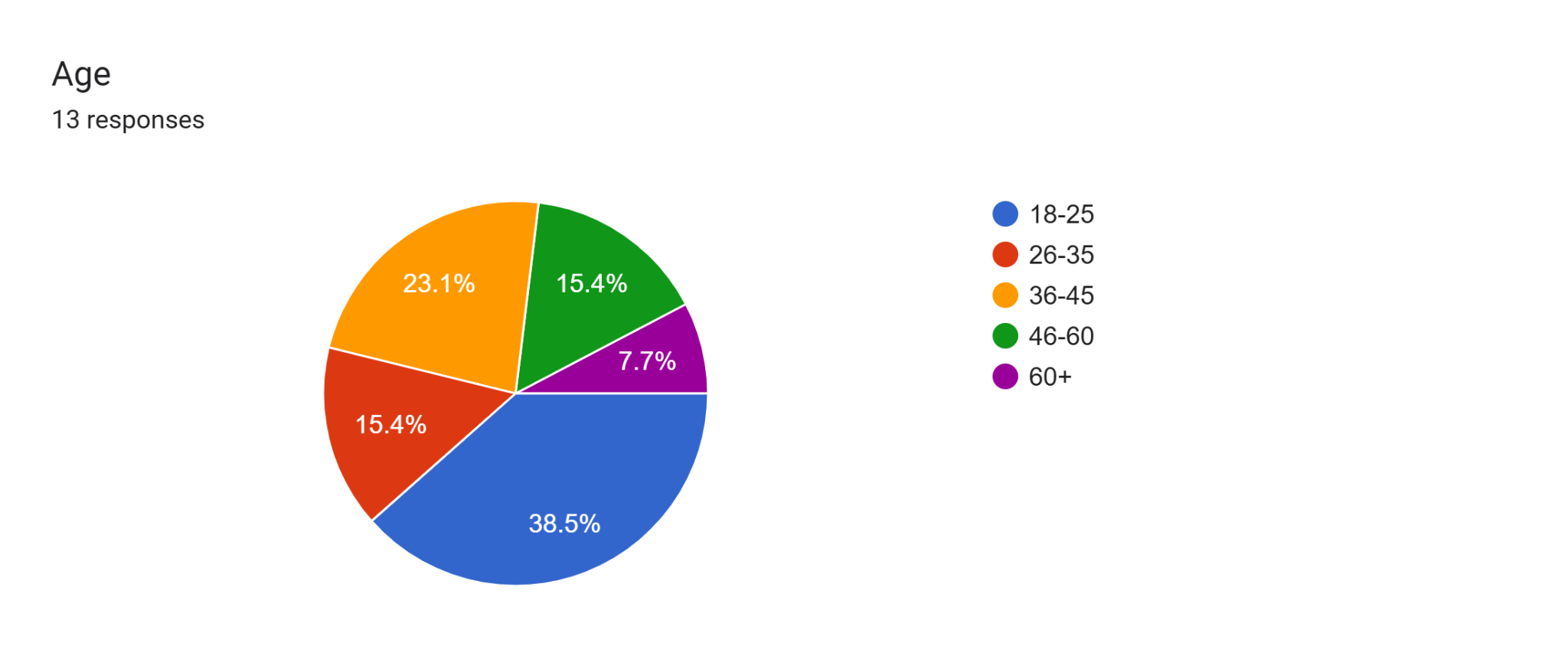
The predominance of younger respondents (18–25) is noted as a potential influence on responses.
4.4.2 Level of awareness about global economic issues
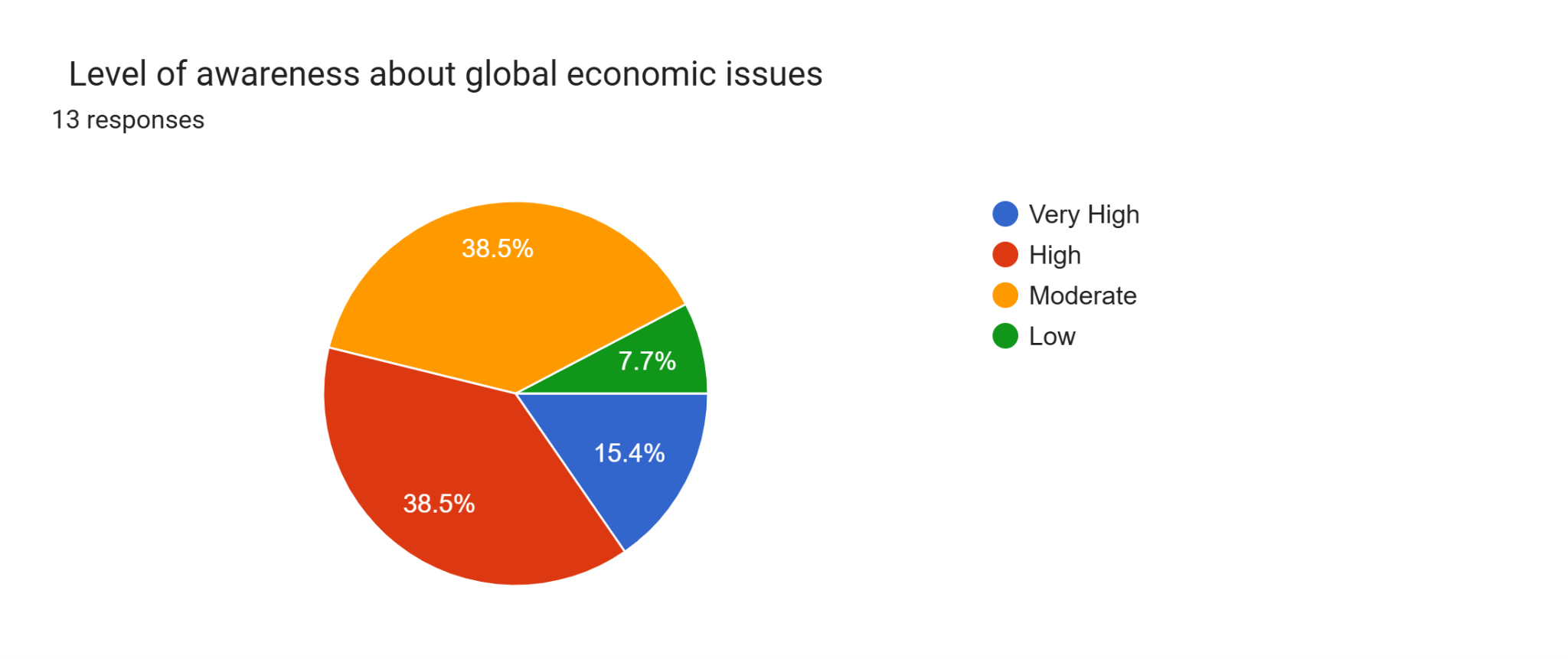
A majority of the respondents reported moderate to high awareness (38.5%) each, with a smaller proportion indicating very high awareness and low awareness.
This suggests that the sample population is generally well informed regarding global economic issues, hence enhancing the reliability of their responses.
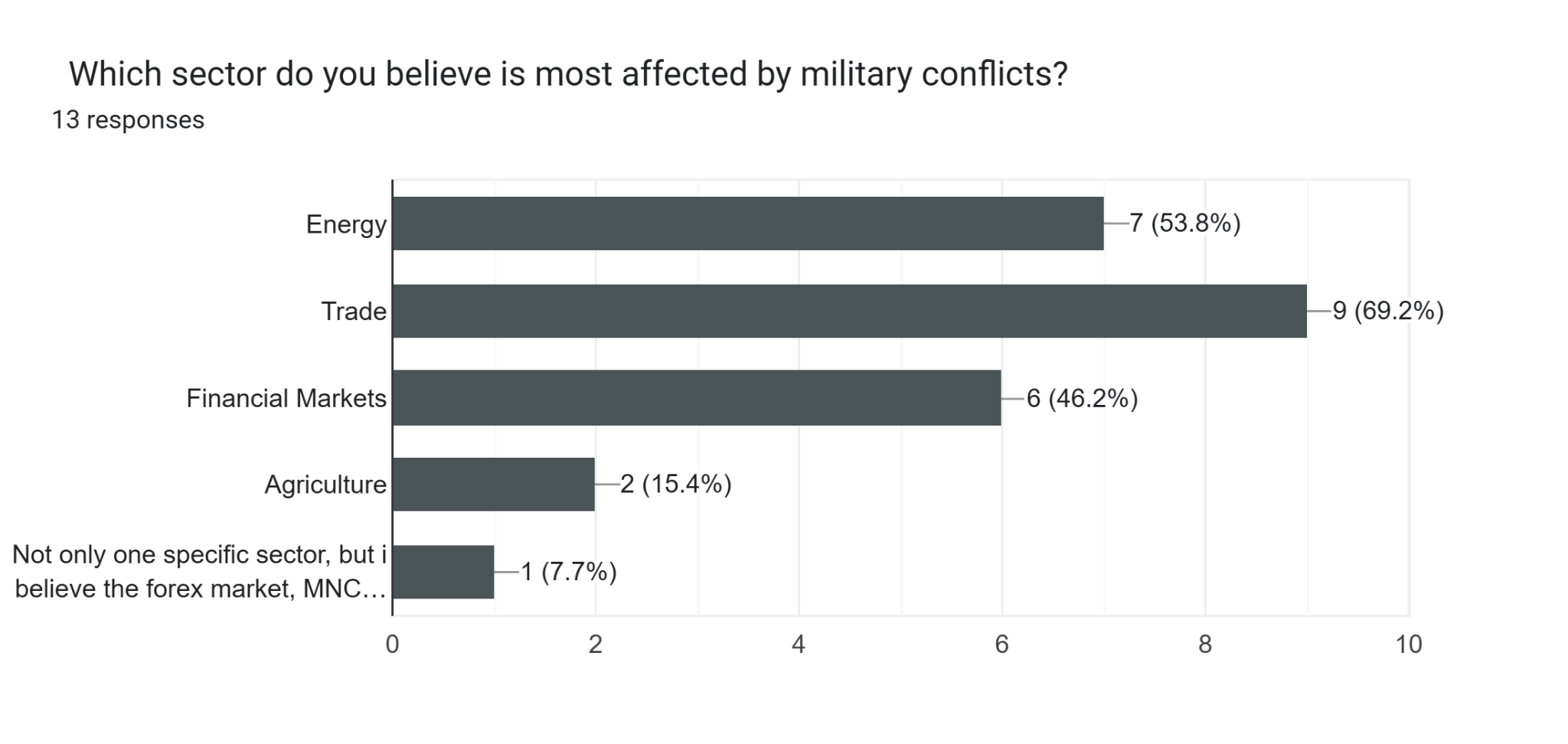
4.4.3 Which sector is most affected by military conflicts?
The responses are primarily concentrated in the trade sector and energy sector, followed by financial markets with a significantly lower response for agriculture and other sectors.
This indicates that respondents perceive trade and energy as the most directly impacted sectors during military conflicts.
4.4.4 Which economy suffers more during global conflicts?
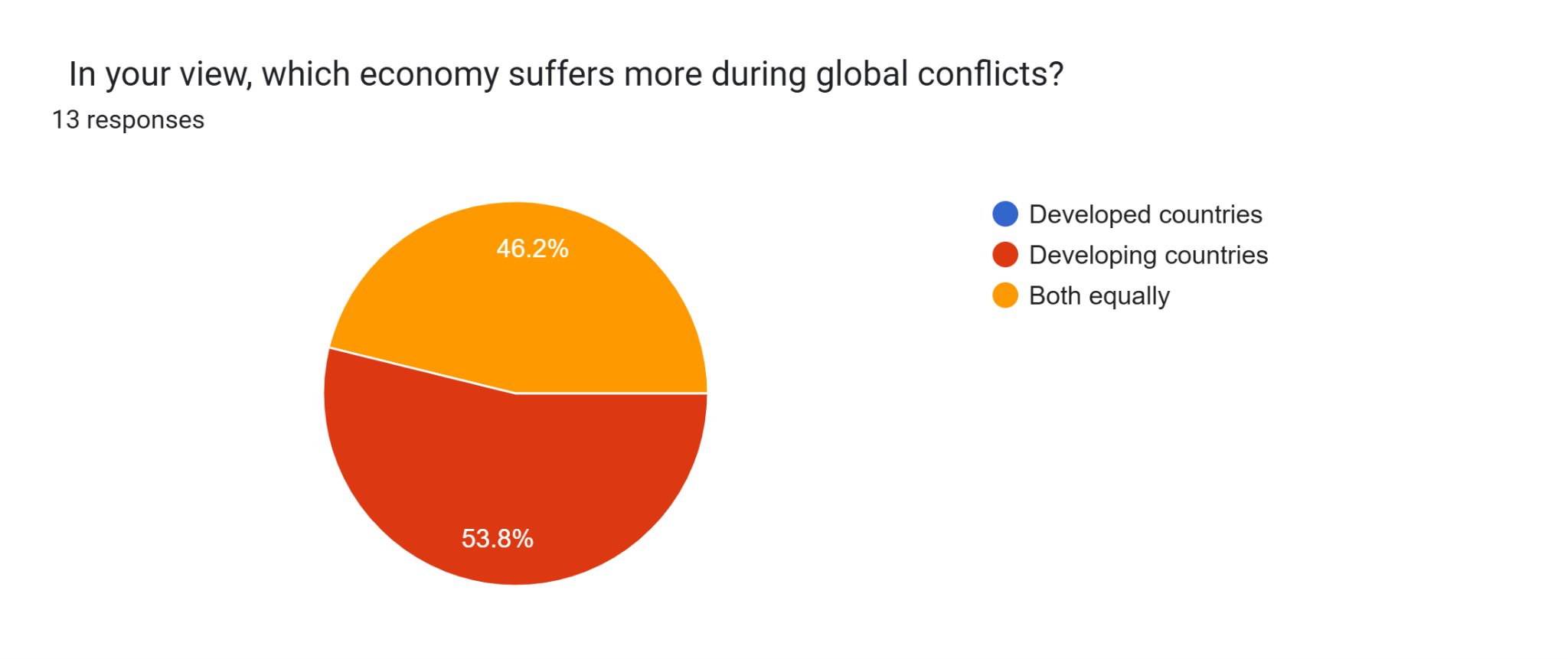
Responses are slightly skewed towards developing countries (53.8%) as being more adversely affected, while a substantial proportion of respondents (46.2%) believe that both developing and developed economies suffer equally during global conflicts.
This suggests that although a marginal majority perceives developing economies as more vulnerable, there is also a strong recognition of the widespread and global nature of economic disruptions caused by military conflicts.
4.4.5 Perceived Most Significant Economic Consequence of Military Conflicts (Open-Ended Responses)
Responses to the open-ended question reveal a clear concentration around a few key economic consequences. A majority of respondents emphasised the destruction of productive capacity, including damage to infrastructure, industries, and human resources, leading to reduced output and slower long-term economic growth.
Another prominent theme was the disruption of trade and global supply chains, with several respondents highlighting its impact on employment and international economic stability. Additionally, respondents noted inflationary pressures, currency volatility, and declining purchasing power, alongside erosion of investor confidence and capital outflows, particularly affecting emerging markets.
A few responses also pointed to energy shortages and resource constraints, reflecting the immediate and visible impact of conflict on essential commodities.
Overall, the responses indicate that respondents perceive military conflicts as having both immediate disruptive effects and long-term structural consequences on economic stability and growth
5.Discussion and conclusions
Overall, military conflict carries economic consequences that extend beyond the battlefield, affecting growth, stability, and development across the world.
In the short run, increased government spending during conflicts may create a temporary boost in growth. However, this is neither sustainable nor stable. The destruction of productive resources, combined with disruptions in global supply chains, leads to a situation called stagflation.
For a country like India, energy dependence and global trade linkages can lead to real domestic consequences even in cases of distant conflict.
Diversion of resources towards military purposes weakens the economic performance of a country over time. Conflicts therefore represent not just a political or strategic decision, but an economic trade-off with lasting consequences.
In the end, while wars serve immediate strategic interests, they tend to result in broader economic losses from a global perspective. This reinforces the idea that stability and international cooperation are not just political goals, but economic necessities in an increasingly interconnected world.
6. Policy Recommendations
- Energy diversification is the most important takeaway from this study. Countries like India, that are heavily dependent on oil imports, face immediate inflationary pressure when faced with global oil disruptions. Diversifying energy sources by increasing the use of renewable energy, natural gas, nuclear energy, and domestic energy production can reduce this vulnerability. In addition, maintaining and expanding strategic petroleum reserves can help cushion the economy against temporary disruptions in global oil supply and sudden price shocks.
- Countries should strengthen domestic supply chains. Overreliance on global trade can turn out to be a weakness during times of conflict. Strengthening essential domestic industries makes an economy more self-sufficient and helps maintain economic stability even when global supply chains are disrupted. At the same time, countries should diversify their import sources and develop alternative trade routes so that dependence on a single region or shipping corridor, such as the Strait of Hormuz, does not severely disrupt economic activity.
- Countries should maintain a balanced fiscal policy. It is noticed in recent times that countries are increasing their spending on defence and military equipment. While this helps safeguard nations during periods of conflict, it is equally essential to ensure that sufficient funds are allocated towards healthcare, education, infrastructure, and research, as these are crucial for long-term economic growth. Governments should also adopt appropriate macroeconomic stabilisation policies, including prudent fiscal management and monetary measures to control inflation and support economic activity during periods of external shocks.
- It is essential for countries to work towards international cooperation and stability. As the world is highly interconnected, conflicts do not remain localised. Strengthening diplomatic relations, ensuring the security of international trade routes, and promoting multilateral cooperation can reduce geopolitical tensions, facilitate smoother trade, maintain stable prices, and support sustained economic progress.
Going through the case studies, theories, and the data makes one thing very clear—military conflicts are not just political events happening in isolation. They lead to economic shocks not only for the countries directly involved but also for other countries across the world.
Russia–Ukraine War shows how deeply connected the global economy has become. A disruption in one nation, especially a strategically important one, hampers trade routes, financial markets, and most importantly, energy prices.
The most dominant pattern observed is that war impacts the supply side more significantly than the demand side, which can be understood through the AD–AS framework.
Another important aspect is the key role of energy markets. Both the case studies analysed oil-producing and oil-supplying nations. A war involving these countries invariably leads to fluctuations in oil prices. Developing countries like India, which are heavily dependent on oil imports, become particularly vulnerable to such increases in oil prices. This raises firms’ cost of production and contributes to higher inflation throughout the economy.
At the same time, the guns-versus-butter trade-off forces governments to redirect their spending towards defence. In the short run, this may lead to an increase in growth; however, in the long run, reduced investment in civilian development slows the nation’s economic growth. Although some theories present a mixed opinion regarding the long-term effects of military spending, the evidence from both case studies indicates a predominantly negative outcome.
Trade relations, once disrupted, cannot be restored easily. Firms and countries become more cautious and may avoid partnerships due to past experiences, geopolitical uncertainty, or fear of future tensions. This can reduce international investment and slow global economic integration over time.
These findings are particularly important for a large and growing economy like India. Being deeply connected to global markets, India is exposed to external shocks such as fluctuating oil prices, rising inflation, capital outflows, supply chain disruptions, and slowing employment growth. Therefore, strengthening energy security, improving supply-chain resilience, maintaining strategic reserves, securing trade routes, and adopting sound macroeconomic policies will be essential for reducing the economic impact of future military conflicts and ensuring long-term sustainable growth.
7.References
Anil Sasi. (2026, April 20). West Asia war: Impact of disruptions on global fuel supply, with potential for coal and N-power switch. The Indian Express. https://indianexpress.com/article/explained/explained-economics/strait-of-hormuz-war-global-oil-lng-impact-10646345/
Arpan Chakraborty. (2026, March 26). The economics of war: Militarization and growth in an AK economy. arXiv.org. https://arxiv.org/abs/2603.23980
Erik O. Kimbrough, Kevin Laughren, Roman Sheremeta. (2017). “War and conflict in economics: Theories, applications, and recent trends”. Page restricted | ScienceDirect. https://www.sciencedirect.com/science/article/pii/S0167268117302044
https://www.cfr.org/global-conflict-tracker/conflict/conflict-ukraine
Oksana Polinkevych. (2023). The economic consequences of military conflicts: The Ukrainian context. Economic Forum. https://doi.org/10.62763/cb/1.2024.28
Yichuan Hu, Chang Li, Shu Lin. (2026). Historical military conflict, current trade tensions, and global supply chains. Page restricted | ScienceDirect. https://www.sciencedirect.com/science/article/pii/S0022199626000115
Rasler, K., & Thompson, W. R. (1985). War and the economic growth of major powers. American Journal of Political Science https://doi.org/10.2307/2111141
Abdel-Khalek, G., Mazloum, M. G., & El Zeiny, M. R. M. (2019). Military expenditure and economic growth: The case of India. Review of Economics and Political Science https://doi.org/10.1108/REPS-03-2019-0025
Ando, S. (2009). The impact of defense expenditure on economic growth: Panel data analysis based on the Feder model. Springer https://doi.org/10.1007/BF03405719
Celi, G., Guarascio, D., Reljic, J., Simonazzi, A., & Zezza, F. (2022). The asymmetric impact of war: Resilience, vulnerability and implications for EU policy. Intereconomics, https://link.springer.com/content/pdf/10.1007/s10272-022-1049-2.pdf
Ganegodage, K. R., & Rambaldi, A. N. (2014). Economic consequences of war: Evidence from Sri Lanka. Journal of Asian Economics https://www.sciencedirect.com/science/article/abs/pii/S1049007813001139
Ruggie, J. G. (1982). International regimes, transactions, and change: Embedded liberalism in the postwar economic order. International Organization https://doi.org/10.1017/s0020818300018993
World Bank. (2022). Europe and Central Asia economic update, Spring 2022: War in the region. World Bank Publications https://scispace.com/papers/europe-and-central-asia-economic-update-spring-2022-war-in-2hir12fy
The Iraq War ten years on: assessing the fallout International Affairs, Volume 89, Issue 2, March 2013, Pages 325–343, https://doi.org/10.1111/1468-2346.12020