Authored by: Kriti Pandey and Midhila Jayan
ABSTRACT:
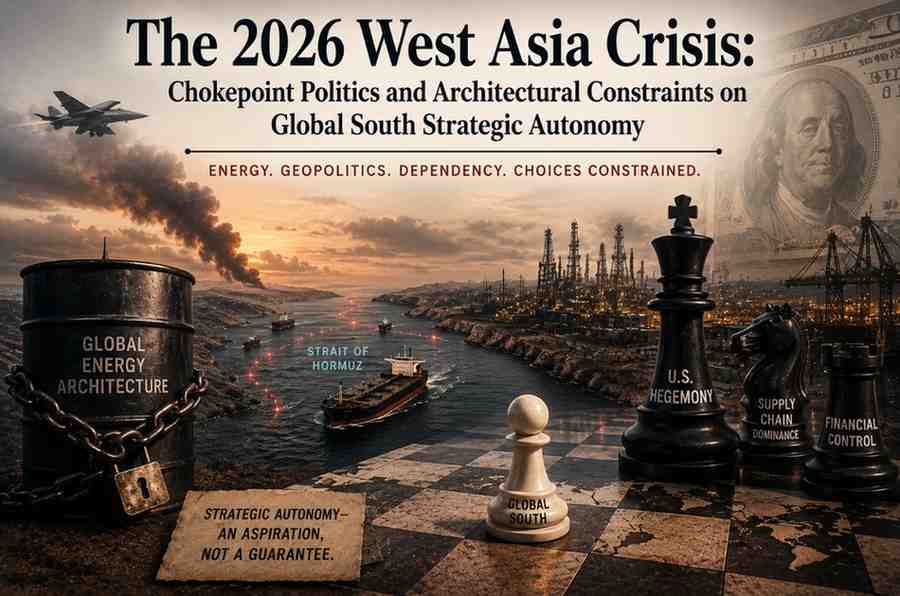
The West Asia crisis of 2026 involved attacks against Iran and disruptions in the Strait of Hormuz that changed how countries secure their energy supplies and diminished the ability of countries importing oil across the Global South to exercise strategic autonomy within the international political economy. The crisis revealed an already-existing structural dependency within the architecture of global energy. This paper uses structural power theory, dependency theory and hegemonic stability theory to investigate the systemic vulnerability of our current international energy system. India is examined as the most analytically significant illustration as it is both a major importer of hydrocarbons and is pursuing multi-alignment with the US, Russia, Iran and China. The paper evaluates whether the vulnerability revealed by the 2026 crisis is structural (systemic dependency) or contingent (policy failure) and argues that the crisis exposes a deep-seated structural condition rather than a correctable policy failure. Based on this assessment, this paper proposes a set of policy solutions to promote resilience and reduce the gap between strategic autonomy as an aspiration and strategic autonomy as a reality, within a formally multipolar yet still US-shaped global order.
INTRODUCTION:
The global energy landscape shifted dramatically due to the 2026 West Asia Crisis, demonstrating how it became a primary theatre of geopolitical coercion, activating vulnerabilities that the architecture of global energy markets had always contained but never so visibly expressed. The origin lies in a deliberate and traceable escalation sequence assembled over several years: the collapse of Joint Comprehensive Plan of Action renegotiations that eliminated the principal diplomatic containment mechanism available to manage Iranian nuclear ambitions within a negotiated framework; the 2025 Twelve-Day War, which normalised calibrated military action between the US-Israeli axis and Iran and established that Iranian retaliation would be measured rather than existential; and the January 2026 internal legitimacy crisis in Iran, in which civilian massacres weakened the Khamenei government’s domestic authority and shifted the US-Israeli strategic calculus toward regime pressure as an achievable objective. The 28 February strikes on Iranian nuclear and military sites were not a reply to Iranian provocations but rather the instigation of an escalatory cascade whose means had been methodically assembled over the previous few years (Colgan, 2010).
What followed exposed a puzzle at the centre of contemporary international relations. States with explicit strategic autonomy doctrines, India most prominently found themselves with effectively no autonomous energy choices during a crisis they had no role in producing. This collapse of autonomy precisely at the moment it was most needed is not adequately explained by conventional accounts of energy insecurity, which treat vulnerability as a correctable supply problem resolvable through diversification and reserve management (Cherp & Jewell, 2014). This paper argues that something more fundamental was activated: a structural condition embedded in the architecture of global energy markets that pre-existed the crisis and was revealed, not created, by it. The central research question of this paper, therefore, is: If the vulnerability revealed by the 2026 crisis is a structural condition inherent to the global energy architecture, or a correctable policy failure of individual importing states?
Two interacting causal mechanisms explain this condition. The first is the architecture of global energy markets itself; chokepoint-dependent transit, dollar-denominated financial settlement, and historically reproduced production concentration which fixes Global South importers into positions of systematic vulnerability regardless of their individual policy choices. The second is residual US hegemonic ordering capacity which persists through financial and supply-chain conditionality even under conditions of nominal political multipolarity, constraining importer options through the control of access to alternatives rather than through direct coercion (Kirshner, 2008; Farrell & Newman, 2019).
This paper argues that the 2026 West Asia crisis represents a deeper collapse of the post-Cold War energy order, one in which security, sovereignty, and development are now tightly bound to the stability of vulnerable infrastructure and maritime chokepoints. It explores how much this crisis has reshaped the energy security calculation of oil-importing countries, particularly in the Global South, and what it indicates regarding the limits of traditional supply security in a militarised, interdependent world (Ciută, 2010). Furthermore, this paper examines whether this vulnerability is a consequence of the long-standing (historical) system of dependency or whether it is due to the failure of previously utilised policies. Finally, the paper discusses how changes will impact future energy sovereignty, regional stability and the ability of developing nations to protect themselves from external geopolitical shocks.
LITERATURE REVIEW:
Understanding how the 2026 West Asia crisis reconfigured energy security and constrained strategic autonomy among Global South oil-importing states requires engaging four bodies of scholarship: energy security studies, power theory, structural dependence and international governance. Each illuminates a distinct dimension of the puzzle. Together they reveal a significant gap that existing literature treats energy vulnerability and hegemonic ordering as separate analytical problems, so the current literature pays very little attention to how structural dependence and residual US power combine to deny autonomous decision-making to the peripheral importers during the crisis situation. This paper addresses that gap by proposing that structural dependence and hegemonic ordering are not parallel phenomena but interacting mechanisms, dependency fixes importers into a position the hegemon retains the capacity to exploit, producing a compounded constraint that neither theory fully captures alone.
The energy security literature sets out the diagnostic baseline but does not satisfactorily explain why vulnerability continues to exist even when diversification efforts are made. Cherp and Jewell (2014) made a major step forward in the debate by going beyond the standard availability-affordability framework and adding resilience and sovereignty as the analytical dimensions of the problem, recognising that vulnerability is not only a matter of logistics but also institutional and political. However, their framework implicitly assumes that energy insecurity is a problem of governance which can be fixed through a change in the policy – a point that the 2026 crisis directly argues against.
Ciută (2010) provides the theoretical grounds for this argument, demonstrating that energy security is a concept which is politically constructed and operates through three different logics: subsistence, war and total security, each one embedding different hierarchies and normative stakes. More importantly, Ciuta reveals that the definition of an energy security problem and its identification with a particular group is a political issue itself. So, for Global South importers who are faced with LPG shortages and inflation, energy security is a subsistence crisis whereas for the states whose policy decisions led to the disruption, it is viewed through the lens of strategic competition. This difference is a very important analytical one: the crisis does not impact all states equally because the notion of energy security was never thought of with peripheral importers in mind.
Power theory provides the framework for explaining why this asymmetry is structural rather than incidental. Barnett and Duvall (2005) offer the most comprehensive taxonomy available, distinguishing compulsory, institutional, structural and productive forms of power. Applied to the 2026 crisis, their framework reveals a multi-layered power event: Iran exercises compulsory power through physical chokepoint closure; the United States exercises institutional power through the sanctions and waiver architecture; the global energy market exercises structural power by fixing importer choices within a constrained option set; and the productive power of market efficiency discourse naturalises dependency as rational economic behaviour rather than political subordination. This taxonomy is essential because it prevents the reductionist reading of the crisis as a bilateral Iran-US confrontation and instead reveals it as a systemic activation of overlapping power relations with structurally differentiated consequences. Critics note that the taxonomy risks overstating structural determinism by underweighting the agency of peripheral states in negotiating within constrained positions, a limitation this paper addresses by treating India’s adaptation strategies as evidence of constrained rather than absent agency.
Farrell and Newman (2019) extend this into the network domain, demonstrating that states occupying central nodes in global economic networks can weaponise that centrality to coerce peripheral actors. Their chokepoint effect denying network access as a coercive instrument describes simultaneously what Iran does geographically and what the United States does financially, connecting the physical disruption of the Strait to the financial disruption of the waiver mechanism within a unified analytical framework.
The structural dependence literature explains why Global South importers had no exit options when these power mechanisms were activated. Dos Santos (1970) establishes dependence as a historically produced structural condition in which one economy is conditioned by the development of another through accumulated architectures of production, trade, and finance not a correctable policy failure but a systemic positioning. Prebisch (1959) identifies the centre-periphery dynamic sustaining this condition, showing that the terms of international economic integration systematically disadvantage peripheral states regardless of individual policy choices. Amin (1972) extends the argument beyond its Latin American origins to demonstrate that underdevelopment is relational produced through integration into the world economy on subordinate terms, not through exclusion. This is directly applicable to India and comparable Global South importers whose deep integration into global energy markets produces rather than resolves their strategic vulnerability.
Alshareef (2023) operationalises these structural arguments contemporaneously, demonstrating that dollar-denominated oil settlement embeds US structural power into every transaction irrespective of bilateral relations between buyer and seller the financial architecture is the invisible chokepoint. Hughes and Long (2015) bridge this structural account to observable IR outcomes, showing that energy dependence generates political leverage for suppliers and for third parties controlling access to alternatives, translating architectural conditions directly into constraints on importer behaviour and diplomatic alignment.
The hegemonic ordering literature explains why alternatives remain inaccessible even under nominal multipolarity. Gilpin (1987) establishes that hegemons construct systemic rules to serve their own interests, meaning the global energy architecture was not designed as a neutral framework but as an expression of US-allied interests. Kirshner (2008) sharpens this at the financial level, demonstrating that dollar primacy generates structural leverage operating independently of military dominance the waiver mechanism is precisely this leverage made concrete. Together, Gilpin and Kirshner produce the paper’s core theoretical contribution: political and economic multipolarity are decoupling. China-Russia vetoes and non-Western diplomatic coalitions represent genuine political diffusion of power, but financial and supply-chain ordering remains US-dominated. Individual diversification cannot resolve this condition because it operates within an architecture the hegemon still shapes. This is where the governance literature becomes essential. Hegemonic stability theory has been criticised for assuming that hegemonic decline produces instability, the 2026 crisis complicates this by showing that financial ordering capacity can persist independently of political preponderance.
Florini and Sovacool (2009) demonstrate that existing global energy governance is fragmented and structurally inadequate to manage systemic supply disruptions, while Woods (2010) warns that post-crisis multilateralism tends to reproduce rather than redistribute existing hierarchies unless institutional design deliberately privileges peripheral state voice. Both papers establish that the policy gap is not technical but political and that closing it requires the kind of systemic governance reform the paper’s concluding section proposes.
METHODOLOGY:
This paper employs a qualitative case study design, using process tracing to examine how the 2026 West Asia crisis reconfigured energy security and constrained strategic autonomy among Global South oil-importing states. Process tracing is appropriate for this paper’s analytical objective: not to measure the magnitude of disruption across a large population of states, but to trace the causal mechanisms through which structural dependence and hegemonic ordering interact to foreclose autonomous choice during crisis conditions. The method moves from theoretical prediction; if structural dependence and hegemonic ordering are the operative mechanisms, then crisis-period state behaviour should reflect constrained choice rather than strategic flexibility to empirical evidence drawn from primary documents and policy records. Evidence is evaluated against two criteria: first, whether state behaviour during the crisis reflects the constrained choice set predicted by the structural argument rather than the strategic flexibility predicted by conventional diversification accounts; second, whether the mechanisms identified; chokepoint closure, waiver conditionality, dollar settlement leverage operated independently of bilateral diplomatic relations, confirming their structural rather than relational character.
India is selected as the primary illustrative case on the basis of analytical significance rather than typicality. Its scale, explicit non-alignment doctrine, and simultaneous entanglement with US, Russian, Iranian and Chinese energy relationships make the structural constraints this paper theorises maximally visible. It interprets primary policy documents such as the RBI circulars, MEA statements and OFAC waivers, IAEA logs (May-Dec 2026) were analyzed. Key causal mechanisms; compulsory chokepoint closure, institutional sanctions architecture, and structural financial hegemony were identified through systematic comparison of state behaviour before and during the crisis against the theoretical prediction. No fieldwork was conducted. The analysis proceeds through systematic examination of publicly available policy records, official government documentation and peer-reviewed secondary literature, with findings derived through logical deduction from established theoretical frameworks rather than primary data collection. The principal limitation is the absence of classified diplomatic communications and confidential government deliberations; this is partially offset through triangulation across multiple independent public sources including think-tank assessments from the Observer Research Foundation and the Institute for Defence Studies and Analyses, which provide India-specific analytical context unavailable in peer-reviewed literature alone.
CAUSATION:
The 2026 West Asia crisis is an extension of the escalating conflict between the U.S. and Israel, who conducted airstrikes on Iranian nuclear facilities and oil facilities, and the Iranian military’s response, which included the use of missiles and the mining of the Strait of Hormuz. This conflict represents decades of tensions stemming from oil-related geopolitical tension and demonstrates how asymmetric dependencies between oil producers and consumers have diminished energy security and strategic autonomy for Global South economies reliant on oil imports. Iran’s trajectory as a revolutionary petrostate from the 1979 Islamic Revolution through decades of sanctions-era isolation produced precisely the institutional conditions Colgan (2010) identifies as structurally predisposing states toward militarised confrontation.
At the proximate level, the crisis was chosen rather than triggered. The collapse of the Joint Comprehensive Plan of Action following the United States’ 2018 withdrawal eliminated the principal diplomatic containment mechanism available to manage Iranian nuclear ambitions within a negotiated framework. Subsequent renegotiation attempts failed to restore a functional agreement, leaving the strategic environment without an institutional off-ramp by late 2025. The Twelve-Day War of 2025 characterised by Israeli strikes on Iranian nuclear and military infrastructure and Iranian missile and drone retaliation performed a crucial preparatory function: it normalised calibrated military action as an instrument of strategic signalling, established that Iranian retaliation would be measured rather than existential, and demonstrated that the escalatory threshold was lower than markets and policymakers had previously priced. Growing internal instability within Iran following the January 2026 civilian massacres simultaneously weakened the Khamenei government’s domestic legitimacy, shifting the US-Israeli strategic calculus toward regime pressure as an achievable objective. Iranian military actions; missile attacks and mine-laying in the Strait of Hormuz, disrupting approximately twenty-one million barrels of daily throughput caused Brent crude prices to surge to $150 per barrel(IEA, 2026). The February 28 strikes accordingly emerged not as a reactive response to Iranian provocation but as the deliberate activation of an escalatory sequence whose preconditions had been systematically assembled over the preceding years.
Colgan’s (2010) theory offers two perspectives on the duality of oil: one is that oil will enhance conflict (through autonomous military capabilities), while the other is that it will diminish the likelihood of conflict (through the creation of trade incentives); an important and critical turning point in this key theme is the role of revolutionary governments, who as a result of revolutionary fervor are likely to act more aggressively than non-revolutionary governments. The data presented support this notion that revolutionary governments engage in more militarized interstate disputes (MIDs); specifically, revolutionary governments that are Petro-Revolutionary are three times more likely to engage in conflict than non-revolutionary Petro-governments. Iran’s revolutionary elite, facing self-imposed isolation from oil-based sanctions, had halved its oil production since 2018 and built a strategic, weaponised chokepoint at Hormuz to leverage its asymmetric position vis-à-vis other states (Colgan, 2010). Farrell and Newman (2019) extend Colgan’s work with an emphasis on the effective use of the command and control capacities inherent to the globalised economy as tools for coercive diplomacy, through which greater leverage can be achieved; this includes the extensive use of supply chains, as well as the global financial system, to exert influence and achieve objectives.
The Strait of Hormuz serves as an appropriate example, since it is defined by a panopticon-type of insight: there is continuous, real-time satellite and Automated Identification System (AIS) tracking of tankers moving through the Strait, which leaves tankers vulnerable to micro-targeting like the U.S. financial sanctions levied against Iran through the Society for Worldwide Interbank Financial Telecommunication (SWIFT). Iran’s asymmetric leverage in this case was derived from its ability to exclude itself from the global economy, and force other import-dependent states to concede to Iran’s demands.The structural amplifiers that converted the strikes into a global energy crisis; chokepoint geography, regional infrastructure cascade, dual corridor collapse did not fall randomly across the international system. They fell disproportionately on states whose structural position within global energy markets had always made them the most exposed. That structural position is the subject of the following section. (Farrell & Newman, 2019).
GLOBAL ENERGY ARCHITECTURE AND STRUCTURAL DEPENDENCE:
The 2026 crisis did not just create vulnerability for Global South oil-importing states, it activated a condition that the architecture of global energy markets had always contained. Three interlocking features of that architecture explain why the crisis fell so disproportionately on peripheral importers: the geographic concentration of production and the chokepoint dependency it generates, the dollar-denominated financial system governing oil trade and the historical reproduction of dependency through accumulated infrastructure decisions. Taken together, these constitute what Dos Santos (1970) defines as structural dependence – a condition in which one economy is systematically conditioned by another through the accumulated organisation of production, trade, and finance. For Global South importers, this conditioning is foundational, embedded in the architecture before any individual policy choice is made.
The most visible expression of this architecture is chokepoint dependency. Approximately twenty-one million barrels of crude oil transit the Strait of Hormuz daily, representing roughly one-fifth of global petroleum liquids consumption. West Asia’s major producers – Saudi Arabia, Iran, Iraq and the UAE collectively dominate global supply, meaning instability in this single region transmits immediately into global price volatility. No alternative corridor exists at equivalent volume and cost within any crisis-relevant timeframe. Cape of Good Hope rerouting adds fifteen to twenty days of transit and significant freight cost; overland pipeline alternatives lack throughput capacity to substitute meaningfully for maritime routes. Critically, approximately eighty-four per cent of Hormuz crude exports are destined for Asian markets, implying the geographic architecture routes the supply of the world’s most import-dependent states through its most contested chokepoint. This is not a contingent risk correctable through diversification. It is the structural condition within which diversification operates. Hughes and Long (2015) demonstrate that geographic concentration of this kind generates political leverage for suppliers and for states controlling access to alternative routes, translating architectural conditions into strategic constraints on importer behaviour before any crisis activates them.
Beneath the geographic architecture lies a financial one that is analytically equally significant and considerably less visible. Global oil trade is priced and settled in United States dollars, meaning the US Treasury and sanctions infrastructure retains leverage over every transaction regardless of the bilateral relationship between buyer and seller. Alshareef (2023) demonstrates this through analysis of the petrodollar system, showing that dollar denomination is not a transactional convenience but a governance architecture reproducing US structural power with each contract settled. Attempts to exit this system – the rupee-rouble bilateral arrangements, yuan-denominated contracts, and shadow tanker networks function only at the margins of dollar oversight, not outside it. They are workarounds operating in the gaps of the architecture, not structural alternatives to it. The implication is direct: a state does not need to physically stop oil from moving to exercise leverage over an importer. It only needs to stop the payment. For Global South importers already facing constrained foreign exchange reserves and limited emergency liquidity, the financial chokepoint compounds the geographic one, producing layered vulnerability that price indices alone do not capture.
The third feature is the historical reproduction of dependency through infrastructure decisions. Gulf states hold approximately forty-eight per cent of proven global petroleum reserves, a concentration not designed to subordinate importers but one that functionally does so by limiting viable alternative suppliers at scale. The historical availability of cheap Gulf crude suppressed domestic energy investment across Global South importing states, locking in import dependency through individually rational short-term decisions that collectively produced long-term structural exposure. Prebisch (1959) identifies the systemic logic sustaining this: the terms of international economic integration reproduce centre-periphery hierarchies across time, narrowing peripheral states’ policy options through the accumulated weight of past integration on unfavourable terms. Amin (1972) sharpens this by demonstrating that underdevelopment is relational, produced through integration into the world economy on subordinate terms, not through exclusion from it. India’s near-ninety per cent crude import dependency, Bangladesh’s foreign reserve exposure to spot market premiums and the Philippines’ near-total reliance on Middle Eastern crude are not independent policy failures. They are expressions of a single structural condition produced by the same global architecture operating across different national contexts.
The global energy market is not a neutral framework through which states pursue energy interests on equal terms. It is a historically produced, politically maintained system concentrating leverage in the hands of producers, financiers and hegemonic states while fixing peripheral importers into systematic vulnerability.
GLOBAL SOUTH DEPENDENCY: INDIA AS AN ILLUSTRATIVE CASE:
The structural condition identified in the preceding sections does not affect all states equally. Within the Global South, a critical distinction separates energy exporters such as Russia and Gulf states, who captured windfall revenues during the crisis, from energy importers, for whom the same architectural disruption produced fiscal stress, inflationary pressure and constrained diplomatic choice. It is this second category that constitutes the paper’s primary unit of analysis. Prebisch (1959) establishes the systemic logic sustaining this division: the terms of international economic integration reproduce centre-periphery hierarchies across time, such that peripheral importers find their policy options narrowed by the accumulated weight of past integration on unfavourable terms. Amin (1972) sharpens this by demonstrating that the condition is relational as Global South importers are subordinated through their integration into global markets, not their exclusion from them. The Philippines’ near-total Middle Eastern crude dependence, Bangladesh’s foreign reserve crisis triggered by spot market premiums, and Sri Lanka’s compounded fiscal exposure all reflect the same structural positioning operating across different national contexts. Individual policy choices differ; the architectural condition producing vulnerability does not.
India exemplifies this importer vulnerability amid the 2026 West Asia crisis. Pant and Super (2015) frame India’s ‘non-alignment conundrum’ as a foreign policy from the 20th-century that is not suited for a rapidly shifting multipolar balance of power, where attempts to manage Iranian, Israeli and US interests through a reactive multi-alignment approach were necessitated by the disruption to Hormuz Strait supply routes. The crisis demonstrated the limitations of a non-alignment approach in the context of a dependence on chokepoints for autonomous diplomatic action.
Khashimwo (2021) outlines key energy security vulnerabilities for India: its dependence on over 85% of its crude from the Gulf, the specific configuration of refinery output to regional crude grades, and low strategic stockpiles that collectively exacerbate the impact of any supply shock with resultant spikes in the current account deficit and inflation. These structural conditions directly shaped India’s crisis-period behaviour. When the Hormuz blockade collapsed Middle Eastern supply and the April 11 waiver expiry simultaneously closed Russian crude access, India’s procurement options narrowed to spot market purchases at significant premium; a constrained choice set, not a strategic pivot. The macroeconomic transmission was direct and severe: eight to nine percent inflation, acute LPG shortages affecting household energy access, and industrial contraction in manufacturing sectors dependent on petrochemical inputs. India’s tanker escort strategy and accelerated green hydrogen investment signal adaptation, but as Amin’s relational subordination argument predicts, these responses operate within rather than beyond the structural condition; they reduce exposure at the margins without altering the architectural dependency that produced it. Most revealingly, India’s calibrated diplomatic restraint throughout the crisis neither joining the US coalition nor publicly aligning with Iran or Russia is best read not as successful non-alignment but as evidence that no alignment option was costless. The structural condition did not eliminate choice. It eliminated costless choice, which for a state with India’s strategic autonomy aspirations amounts to the same thing. Compared to the Philippines, which declared a national energy emergency within days and had no equivalent diplomatic buffer, India’s constrained restraint appears as relative autonomy, yet the structural mechanism producing vulnerability was identical in both cases, confirming that the constraint is architectural rather than country-specific.
DISCUSSION AND POLICY IMPLICATIONS:
The analysis in this paper shows that vulnerability is not merely an individual or national condition but a structural feature of the existing energy and financial order. US-led ordering continues to shape market access, payment systems, and strategic leverage, meaning that exposure is reproduced through the architecture itself rather than only through domestic weakness. In this context, adaptation by importing states is necessary, but it is not sufficient. Measures such as supplier diversification, currency swap arrangements, or rupee-rouble style settlement deals may reduce short-term exposure, yet they remain constrained by the very system they seek to navigate. They are rational responses, but have limitations because they operate within established chokepoints rather than beyond them. This conclusion holds even when competing explanations are considered: domestic policy failures inadequate reserve buffers, slow renewable transition, refinery grade inflexibility undoubtedly amplified India’s exposure, but they do not explain why diversification attempts failed at crisis speed, since the architectural constraints of chokepoint geography and dollar settlement would have bound even a better-prepared importer.
This supports the broader point made by Florini and Sovacool that governance gaps are political, not technical. The problem is not an absence of available tools, but the unequal distribution of power that determines who designs rules, who bears costs, and who benefits from stability. Any serious policy response must therefore address institutional asymmetry, not simply improve managerial efficiency. Policy could move in three directions; First, multilateral chokepoint governance should be developed through binding commitments and stronger Global South representation, rather than relying on great power coordination that would likely reproduce Woods’s hierarchy. The principal implementation challenge is great power buy-in, permanent UNSC members whose strategic interests benefit from chokepoint instability have limited incentive to support binding governance frameworks.
Second, alternative settlement architecture should be treated as a form of structural resilience, not as anti-US positioning. The objective is not confrontation, but insulation from coercive dependence. Progress here faces the dollar’s network effects; the more widely dollar settlement is used, the more costly individual defection becomes, requiring coordinated rather than unilateral movement.
Third, an Asian importer compact could pool shared reserves, coordinate purchasing, and set joint diversification targets. Such cooperation would convert fragmented vulnerability into collective capacity. Political rivalries between India, Japan, and China make formal multilateral importer agreement difficult; a functional starting point would be a bilateral India-ASEAN strategic reserve coordination agreement as a stepping stone.
Thus, these measures would narrow the gap between strategic autonomy as an aspiration and strategic autonomy as a practice. The central lesson is that resilience cannot rest only on national adaptation within a hierarchical system; it requires institutional redesign that redistributes voice, reserve capacity and bargaining power.
REFERENCES
Alshareef, S. (2023). The Gulf’s shifting geoeconomy and China’s structural power: From the petrodollar to the petroyuan? Competition and Change, 27(2), 380–401. https://doi.org/10.1177/10245294221095222
Amin, S. (1972). Underdevelopment and dependence in Black Africa. Journal of Modern African Studies, 10(4), 503–524. https://doi.org/10.1017/S0022278X00022801
Barnett, M., & Duvall, R. (2005). Power in international politics. International Organization, 59(1), 39–75. https://doi.org/10.1017/S0020818305050010
Cherp, A., & Jewell, J. (2014). The concept of energy security: Beyond the four As. Energy Policy, 75, 415–421. https://doi.org/10.1016/j.enpol.2014.09.005
Ciută, F. (2010). Conceptual notes on energy security: Total or banal security? Security Dialogue, 41(2), 123–144. https://doi.org/10.1177/0967010610361596
Colgan, J. D. (2010). Oil and revolutionary governments: Fuel for international conflict. International Organization, 64(4), 661–694. https://doi.org/10.1017/S002081831000024X
Dos Santos, T. (1970). The structure of dependence. The American Economic Review, 60(2), 231–236. https://www.jstor.org/stable/1815811
Farrell, H., & Newman, A. L. (2019). Weaponized interdependence: How global economic networks shape state coercion. International Security, 44(1), 42–79. https://doi.org/10.1162/isec_a_00351
Florini, A., & Sovacool, B. K. (2009). Who governs energy? The challenges facing global energy governance. Global Policy, 1(1), 52–64. https://doi.org/10.1111/j.1758-5899.2009.00006.x
Gilpin, R. (1987). The theory of hegemonic war. The Journal of Interdisciplinary History, 18(4), 591–613. https://doi.org/10.2307/204816
Hughes, L., & Long, A. (2015). Energy and strategic vulnerability. Journal of Strategic Studies, 38(6), 751–780. https://doi.org/10.1080/01402390.2014.1003551
Khashimwo, P. (2021). India’s quest for energy security: Understanding the trends and challenges. Journal of Asian Security and International Affairs, 8(1), 87–116. https://doi.org/10.1177/2347797021989246
Kirshner, J. (2008). Dollar primacy and American power: What’s at stake? Review of International Political Economy, 15(3), 418–438. https://doi.org/10.1080/09692290802075208
Pant, H. V., & Super, J. M. (2015). India’s “non-alignment” conundrum: A twentieth-century policy in a changing world. International Affairs, 91(4), 747–764. https://doi.org/10.1111/1468-2346.12337
Prebisch, R. (1959). Commercial policy in the underdeveloped countries. The American Economic Review, 49(2), 251–273. https://www.jstor.org/stable/1816120
Woods, N. (2010). Global governance after the financial crisis: A new multilateralism or the last gasp of the great powers? Global Policy, 1(1), 51–63. https://doi.org/10.1111/j.1758-5899.2009.00014.x