Authors: Dharavath Preetham Naik, Priyanka Roul, Priyanshi Parmar, Ssargun Kaur, Tanisha Chakraborty
CHAPTER-1: INTRODUCTION
1.1 Background
India has historically maintained one of the highest tariff regimes among major economies. The Make in India initiative, launched in September 2014, aimed to raise manufacturing’s GDP share to 25 percent and create 100 million jobs. From 2018, policy shifted towards Tariff Rate increases, PLI schemes, and domestic content rules to curb imports and boost domestic manufacturing. Manufacturing’s GDP share has, however, stayed largely flat, raising the question of whether tariff increases are linked to the Manufacturing GDP Growth Rate.
1.2 Problem Statement
Rising tariff since 2014 have been promoted to strengthen domestic manufacturing, but their impact has rarely been tested statistically. This report tests the Tariff Rate-Manufacturing GDP Growth Rate relationship using descriptive statistics, correlation, and regression on ten years of secondary data.
1.3 Research Gap
Empirical work on Indian trade policy focuses on the pre-2014 liberalisation era. Studies on Make in India, such as Rawat, Raj and Agarwal (2020) and Maradi (2022), remain largely conceptual and do not statistically test the Tariff Rate’s link to manufacturing.
1.4 Research Objectives
• To examine the Tariff Rate trend, 2014-2024, using descriptive statistics.
• To test the correlation between the Tariff Rate and the Manufacturing GDP Growth Rate.
• To assess, via regression, whether this holds alongside Exports, FDI, and Industrial Production (IIP).
• To evaluate the regression results’ explanatory power.
1.5 Research Questions
• How did the Tariff Rate move between 2014 and 2024?
• Is there a significant correlation between the Tariff Rate and the Manufacturing GDP Growth Rate?
• Does this hold in a regression model alongside Exports, FDI, and Industrial Production (IIP)?
• How much of the Manufacturing GDP Growth Rate do these variables jointly explain?
1.6 Hypotheses
• H0: No significant relationship between the Tariff Rate and the Manufacturing GDP Growth Rate.
• H1: A significant relationship exists between the Tariff Rate and the Manufacturing GDP Growth Rate.
• H0: Exports, FDI, and Industrial Production (IIP) add no significant explanatory power alongside the Tariff Rate.
• H1: Exports, FDI, and Industrial Production (IIP) add significant explanatory power alongside the Tariff Rate.
1.7 Significance of the Study
This study tests the Tariff Rate, the central instrument of Make in India, against the Manufacturing GDP Growth Rate using descriptive statistics, correlation, and regression. The findings provide evidence for policymakers on the effectiveness of tariffs in supporting manufacturing growth.
The study’s empirical approach is one of the strengths of this study. Instead of assessing Make in India on the basis of its policies alone, the study looks into how the changes in the level of protection through tariffs are related to manufacturing outcomes through measurable yearly data and statistics. The incorporation of the role of exports, FDI, and industrial production gives the assessment an economic context.
1.8 Scope of the Study
The study covers 2014-2024 using secondary data from the WDI, WITS, MOSPI, DPIIT, and RBI. The dependent variable is the Manufacturing GDP Growth Rate; the independent variable of interest is the Tariff Rate, assessed alongside Exports, FDI, and Industrial Production (IIP). The findings are based on ten annual observations and should be interpreted as associative rather than casual.
CHAPTER-2: LITERATURE REVIEW
2.1 Introduction:
For decades, trade policy has been regarded as one of the most important tools available to governments to influence industrial development, economic growth and international competitiveness. Among the different trade policy instruments, import tariffs have been the key one, because they matter directly for the relative prices of imported and domestically produced goods. Classical trade theories encourage lower tariffs and more open markets to increase efficiency and consumer welfare, but a number of developing economies have increasingly resorted to strategic protectionist measures to boost domestic industries, reduce import dependence and speed up industrialization (Johnson, 1960).
The trade policy of India has undergone a sea change in the past three decades. The economic reforms initiated in 1991 were a watershed in the direction of trade liberalization, which took the form of tariff rate reductions, elimination of quantitative restrictions and deeper integration with global markets. However, with the inception of the Make in India programme in 2014, the trade policy gradually moved in a different direction. Rather than focusing only on tariff liberalization, the government increasingly used calibrated increases in customs duties in selected sectors such as electronics, machinery, defence equipment, renewable energy components and consumer goods to incentivize domestic manufacturing and reduce excessive dependence on imports (Government of India, 2014)
There is mixed evidence in the existing literature on the effectiveness of tariff protection. A number of studies argue that temporary protection aids industrial development and domestic firms to exploit economies of scale. Prolonged protection can reduce competitive pressures, create inefficiencies and increase production costs. Much of the empirical literature on India has focused on tariff liberalization in the post-1991 reform period, but there is relatively little evidence on the post-2014 period of rising tariff protection under the Make in India initiative.
2.2 Evolution of India’s tariff policy under the Make in India initiative:
Gradually the Indian tariff policy has shifted from generalized trade liberalization to selective strategic protectionism. Tariff reductions were a significant component of India’s economic reforms in the 1990s and early 2000s, aimed at enhancing international competitiveness and integrating the economy into the global trade system. Successive governments lowered customs duties, simplified tariff structures and encouraged export-oriented industrialisation. These reforms resulted in a large increase in trade openness, foreign investment and integration into global value chains (India Policy Forum, 2005–06).
The launch of Make in India initiative in September 2014 was an important transition in industrial policy. It was different from earlier strategies that mainly focused on market liberalization. Make in India aimed to boost domestic manufacturing by promoting investment, infrastructure development, regulatory reform and targeted industrial support. The programme identified twenty-five priority sectors ranging from automobiles and defence manufacturing to electronics, pharmaceuticals, renewable energy and textiles. The main objective of this policy was to increase the contribution of the manufacturing sector to India’s Gross Domestic Product (GDP), create employment opportunities and improve global competitiveness (Government of India, 2014).
At the start of the Make in India initiative, the main focus was on creating a better environment for businesses and attracting foreign investment. However, since then, new policies have continued to use tariffs as part of the country’s industrial strategy. In the Union Budgets between 2018 and 2024, there have been multiple increases in the customs duties that apply to a wide range of imported finished products, as well as decreases in the customs duties applicable to certain raw materials and intermediate inputs so that domestically manufactured products can generate more value added within India. Those tariff adjustments are part of a larger strategy to reduce the number of finished goods imported into India while encouraging greater levels of manufacturing in India.
2.3 Theoretical Perspectives on Tariff Protection and Industrial Development:
Three theoretical perspectives are particularly relevant for understanding the rationale behind India’s recent tariff policy: Protectionism Theory, Infant Industry Theory, and Strategic Trade Theory.
Johnson (1960) indicates that tariffs are used for more than merely collecting tax revenues. As part of his economic theory of protectionism, Johnson claims that tariff policies can be used by governments in international negotiations, to protect strategic industries, change how countries trade with each other and provide assistance to domestic economies. Consequently, tariffs have the potential of acting not only as economic instruments but also as political instruments capable of altering the incentives created by market prices and, therefore, the production decisions made by businesses.
In his work, Bardhan (1971) took the infant industry argument to an advanced level by incorporating the principle of “learning through doing” into the framework of Trade Theory. The model presented by Bardhan demonstrated that improvements in productivity result from cumulative production experience, which means that businesses will become increasingly efficient with expansion of their levels of production. As a result of this, temporary protection will create dynamic efficiency gains by allowing firms to have reduced levels of production costs over time.
According to Krugman and Smith (2007), government trade policy interventions, such as tariffs, production subsidies, research and development assistance, and export promotion, can provide an advantage for domestic firms to gain a comparative edge against foreign competitors, especially for firms that operate within oligopolistic global industries. These types of interventions help domestic firms take advantage of the economies of scale inherent in their respective industries, build technological capabilities, and become more competitive in the international marketplace.
2.4 Empirical Evidence on Tariff Policy and Manufacturing Performance:
The experience of India in terms of examining these relationships is an attractive opportunity as the country’s trade policy has transitioned from broad-based tariff liberalisation in the post-1991 reform era to more selective applications of protective tariffs under the Make in India initiative.
S. Mukherjee and Rupa Chanda (2021) conducted a comprehensive and empirical analysis of India’s tariff policy. The authors found reductions in final goods tariffs created a more competitive market environment for firms by lowering firm mark-ups and increasing market-based competition. Reducing input tariffs reduced production costs of firms, enabling firms to be more profitable. Furthermore, they found that large firms received substantially more benefits (relative to MSMEs) from input tariff reduction compared to smaller firms (micro, small and medium enterprises).
Madhura Maitra’s (2011) research shows that trade liberalization in India increased productivity in both formal and informal manufacturing. Based on data from manufacturing plants, it was determined that decreasing input tariffs helped to boost productivity among formal manufacturers. Additionally, decreasing output tariffs increased the productivity of informal manufacturers. However, this evidence does not provide uniform conclusion regarding effects of tariffs on manufacturing. Studies indicate that lower input tariffs can reduce production costs, improve competition, and raise firm productivity. Whereas protectionist argues that selective tariffs increases may provide domestic industries with time to develop capabilities. These findings can be explained by differences in types of tariffs, firms’ position in global value chains and time period. Lower import tariffs may benefit industries which are depended on imported intermediate goods. So, we can conclude that effect of tariffs are likely to be sector-specific and dependent on whether protection is accompanied by improvements in productivity, technology, and export competitiveness.
2.5 Make in India and Import Substitution:
According to Rawat, Raj, and Agarwal (2020), they conducted a critical examination of Make in India from the perspective of an import substitution strategy. They concluded that while Make in India had improved the environment for doing business in India and improved confidence in investors, there are still significant structural constraints to further industrial development, such as insufficient infrastructure; regulatory difficulties; transportation and logistics constraints; and low levels of competitiveness in manufacturing. They further cautioned not to view Make in India simply as a protectionist programme, and stressed the importance of developing export competitiveness and promoting technological improvements and institutional reforms. Although the authors’ work was primarily conceptual, as opposed to empirical, it provides a foundation for understanding ways in which tariff protections might affect the performance of the industrial sector by identifying the mechanisms through which tariff protections might exert their influence.
Likewise, a volume of collected works edited by Mallikaarjun M. Maradi provides a broad overview of the objectives and implementation of the Make in India program. Furthermore, while the Make in India initiative represents a structural shift in India’s industrial policy direction, the published work, in and of itself, does not evaluate, through empirical means, the effectiveness of the upward movement of customs duties towards the objectives of the program.
Government reports by Make in India and DPIIT primarily describe policy implementation and investment initiatives but provide limited empirical evolution of tariff effectiveness.
While there is a clear consensus among scholars about the strategic goals of Make in India, there is not much quantitative evidence assessing whether these objectives have successfully translated into long-term gains in domestic manufacturing performance.
2.6 Political Economy of Rising Import Tariff:
Contemporary literature also contends that tariff policy should not just be viewed through an economic efficiency lens alone; tariff decisions have become more political, strategic and institutional in nature.
Political economy literature has shown that tariff policy decisions typically stem from the interaction of many factors; including government(s), domestic businesses, labour organizations, and various types of international economic pressure. Tariffs usually have several different functions. They may both generate jobs by giving employment security; stimulate industrial investment; provide bargaining leverage in international trade agreements; and enhance national security.
While this literature provides convincing reasons why some policymakers may raise tariffs, most of the literature is focused more on what motivates policy rather than the actual outcomes of the policy. As a result, there is very little empirical evidence regarding whether or not these increased tariffs for political reasons have been successful in improving the performance of domestic manufacturing in India.
2.7 Critical Synthesis:
There are three broad observations. First, most empirical studies on India’s trade policy are based on the period of tariff liberalization that followed the 1991 economic reforms. The majority of the studies find that the lowering of input tariffs led to increases in productivity, and decreases in production costs due to enhanced competition and more efficient industrial processes, however, the results from these studies cannot necessarily be applied to the post-2014 policy environment which is characterized by the increase of import duties.
Second, the majority of studies of the ‘Make in India’ initiative are either conceptual or focus on policy; while they explore industrial policy reforms in-depth, as well as provide information about investment promotion, manufacturing objectives, and other relevant areas, these studies very rarely apply rigorous econometric techniques to determine the impact of increasing tariffs on the intended results.
Third, political economy studies address the reasons why tariffs have been raised, but they provide limited information on how successful the tariffs have been from an empirical standpoint. This has created a major gap between the policies and their respective economic outcomes.
2.8 Research Gap:
An extensive body of work has been devoted to understanding the trade liberalization process, the tariff reduction that has occurred since 1991, and the relationship between those factors and the Make in India Initiative. However, there are several important gaps in existing literature, especially regarding India’s recent shift toward protectionism in its trade policy.
Many of the empirical studies concerning India focus on examining the effects of tariff liberalization post-1991 as opposed to looking at the impact of the increase in import tariffs after the launch of the Make in India initiative in 2014. For example, both Mukherjee and Chanda (2021) and Maitra (2011) provide compelling evidence for the positive effect that tariff declines have had on firm productivity and overall manufacturing efficiency. However, neither of these studies looks at the most recent time period (i.e., when there has been an overall increase in customs duties and an increase in selective protections).
The literature related to Make in India appears to have a predominant number of studies adopting a conceptual or policy approach which discuss in some detail the goals and framework for execution, the investment environment, and the industrial policy changes that are being implemented but they seldom assess whether tariffs are having a positive effect on the level of domestic manufacturing. Much of the current literature examines the intention of a policy rather than its effect.
Despite growing policy support for higher tariffs under Make in India Policy, there is limited quantitative evidence on whether these measures have improved domestic manufacturing. The present study addresses this gap by examining the relationship between tariff rates and manufacturing GDP while considering imports, exports, industrial output, and FDI.
CHAPTER-3: RESEARCH METHODOLOGY
Using a quantitative, explanatory research design, this study aims to determine how an increase in tariffs on imported goods has impacted manufacturing performance in India as a result of the Make in India policy.
This study utilized secondary data collected from various sources over ten years (2014 – 2024) during which the Make in India policy was implemented. Data on all variables in each of the models in use were obtained from reputable national and international sources such as the World Bank’s World Development Indicators (WDI), the World Integrated Trade Solutions (WITS), the Ministry of Statistics and Programme Implementation (MOSPI), the Department for Promotion of Industry and Internal Trade (DPIIT), and the Reserve Bank of India (RBI).
The dependent variable is Manufacturing Value Added % of GDP which measures how well the Indian Manufacturing Sector has performed. The independent variable is the Applied Weighted Mean Tariff Rate (%) which captures the level of trade protectionism in India.
The Pearson correlation test is carried out in order to find the direction and degree of the linear relationship between the Tariff Rate and Manufacturing Value Added along with finding the relationship among the explanatory variables. The correlation is suitable for use as an initial diagnostic tool, as it provides a simple measure of the association without considering any other variables at that moment. However, correlation is not a test where other variables are controlled and therefore an independent association cannot be found.
The Multiple Linear Regression (MLR) test is thus used in the study as the main method of inference since the manufacturing performance might be associated at the same time with tariffs, exports, FDI and industrial production. The multiple regression allows considering the relationship between the Tariff Rate and Manufacturing Value Added along with taking into account the influence of the other variables included in the research. R² and Adjusted R² measures the explanatory power of the model while the F-test is the test of the overall significance of the model.
Manufacturing GDP = β₀ + β₁(Tariff Rate) + β₂(Imports) + β₃(Exports) + β₄(FDI) + β₅(IIP) + ε
The data that were collected need to first be organised into a unified dataset and then standardised so that they are reported consistently and using the same unit of measure. The monetary variables will be converted into US$ billion (where possible) prior to the analysis, and the dataset will then be checked for any missing values, inconsistencies. Data will be cross-verified for accuracy.
The statistical analysis will be performed systematically and will consist of four primary methods: descriptive statistics, trend analysis, Pearson’s correlation analysis, and Multiple Linear Regression analysis. The fit or predictive capability of the overall model will be evaluated by R², Adjusted R², and the F-test (all three of these methods are coefficients of determination).
Diagnostic tests have been conducted to determine the satisfaction of assumptions related to the regression model. The Variance Inflation Factor (VIF) is applied to determine the presence of multicollinearity among independent variables, whereas the normality of residuals is determined to determine the distribution of errors in the model. The homoscedasticity test determines whether the residuals have constant variances, while the Durbin-Watson test determines the presence of autocorrelation in the annual data. This helps in ensuring that the regression analysis is reliable, especially considering that the study relies on a small sample size for the time series data.
These tests include tests for multicollinearity (using the Variance Inflation Factor (VIF)), normality of the residuals, homoscedasticity of the error terms, and autocorrelation (using the Durbin-Watson statistic). The hypotheses are tested at a level of significance of 5 percent (α = 0.05), with p-values less than 0.05 considered statistically significant.
No human participants are involved in this study as it is entirely based on publicly available secondary data; therefore, there are no ethical concerns. All data sources have been correctly referenced in order to maintain academic integrity and avoid plagiarism. Due to the study using exclusively secondary data, there are some inherent research limitations, including a limited number of annual observations available and the exclusion of other macroeconomic and institutional factors that may also have an effect on manufacturing performance. The methodology still provides a strong, systematic basis for assessing the relationship between import tariffs and manufacturing performance given the Make in India Policy.
CHAPTER-4: RESULTS AND ANALYSIS
This chapter contains the main findings of the study by exploring the factors influencing import tariffs and manufacturing.
| Variable | Unit | Mean | Median | Std Dev | Min | Max | N (non-
blank) |
| GDP Growth Rate | %, real, annual | 6.12 | 6.99 | 4.24 | -5.78 | 9.69 | 11.00 |
| Manufacturing GDP Growth | %, GVA, annual | 6.28 | 7.70 | 4.72 | -1.40 | 12.80 | 11.00 |
| Industrial Production Growth (IIP) | %, annual | 3.50 | 4.20 | 4.72 | -8.40 | 11.40 | 11.00 |
| Manufacturing Output Growth (IIP Mfg.) | %, annual | 3.25 | 4.10 | 5.22 | -9.60 | 12.50 | 11.00 |
| Inflation – CPI | %, annual avg | 5.07 | 4.95 | 1.10 | 3.33 | 6.70 | 11.00 |
| Inflation – WPI | %, annual avg | 3.22 | 2.00 | 4.56 | -3.70 | 13.00 | 11.00 |
| Exchange Rate | INR per USD, annual avg | 71.71 | 70.40 | 7.50 | 61.00 | 83.40 | 11.00 |
| FDI Inflows – Total | USD Billion | 46.84 | 44.40 | 8.32 | 34.60 | 64.40 | 11.00 |
| FDI Inflows – Manufacturing | USD Billion | 17.15 | 17.58 | 3.99 | 12.09 | 21.34 | 4.00 |
| Exports – Merchandise | USD Billion | 349.80 | 313.40 | 72.22 | 262.30 | 453.00 | 11.00 |
| Current Account Balance | % of GDP | -1.13 | -1.20 | 0.84 | -2.10 | 0.90 | 11.00 |
| Trade Balance – Goods | USD Billion (neg=deficit) | -171.21 | -152.90 | 56.48 | -264.90 | -102.60 | 11.00 |
| Manufacturing Imports | USD Billion | 498 | 469 | 126 | 357 | 733 | 10 |
| Manufacturing Exports | USD Billion | 333.676 | 320.019 | 65.62 | 260.327 | 452.684 | 10 |
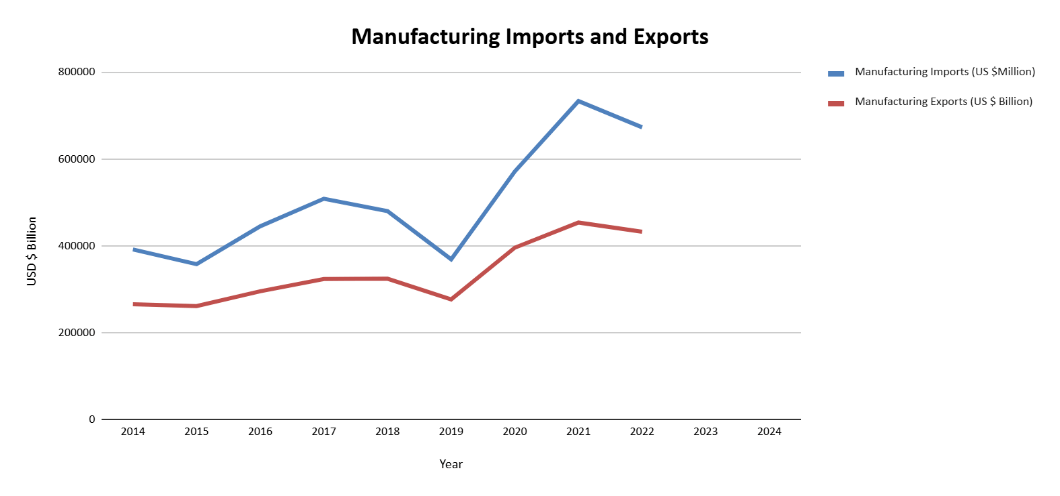
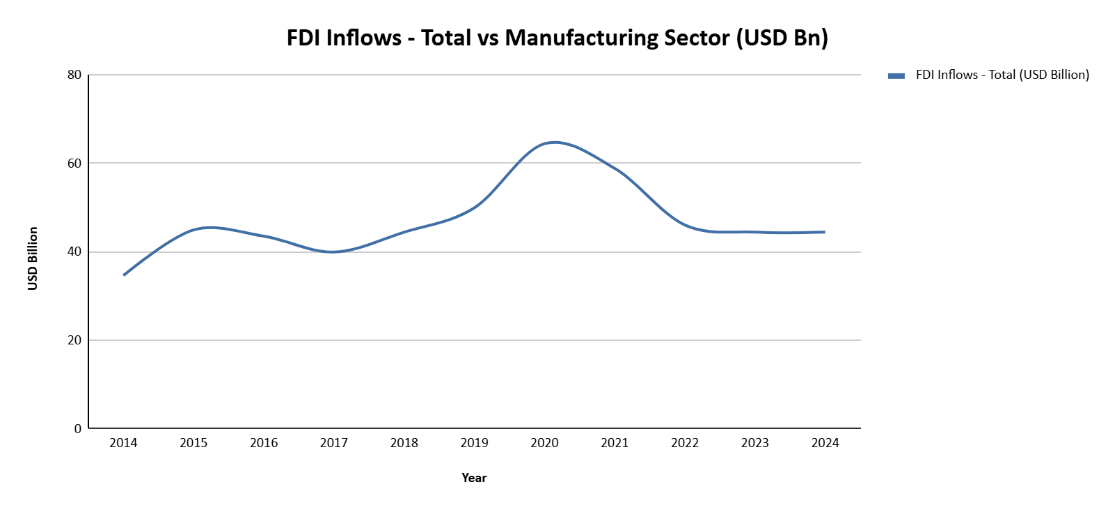
Above table presents the descriptive statistics of the study variables, including their mean, standard deviation, minimum or maximum values.
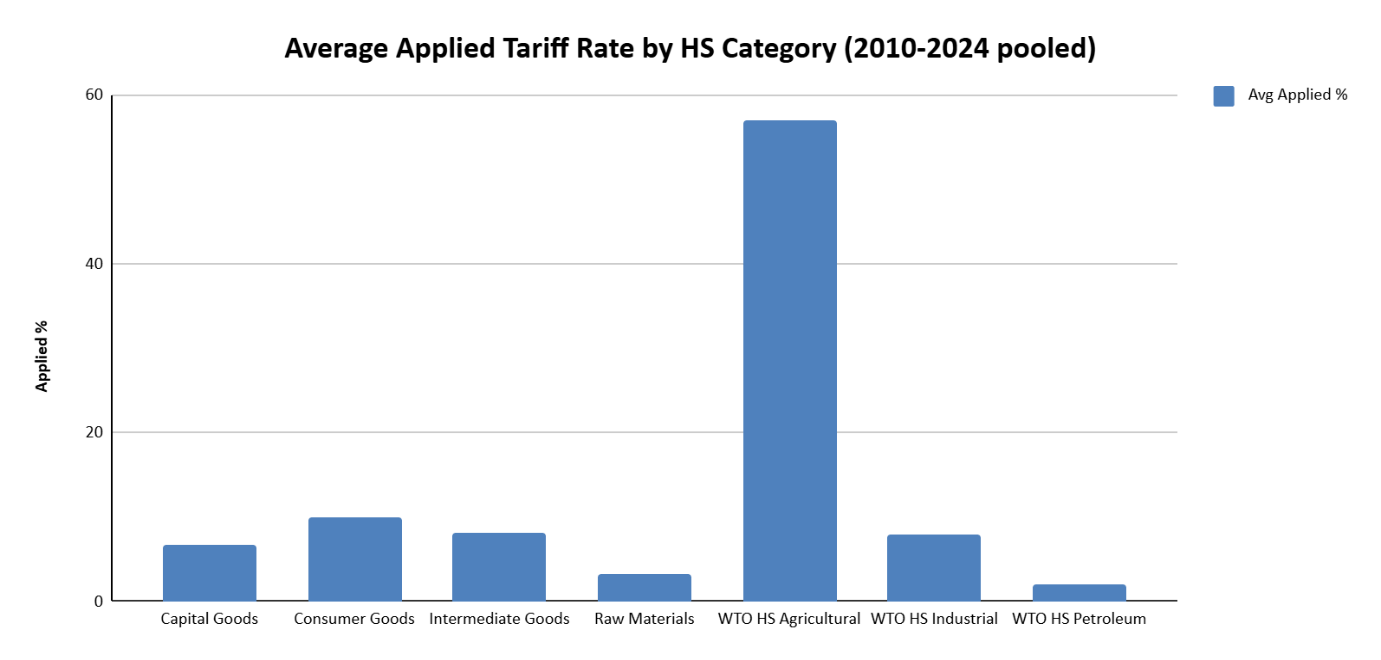
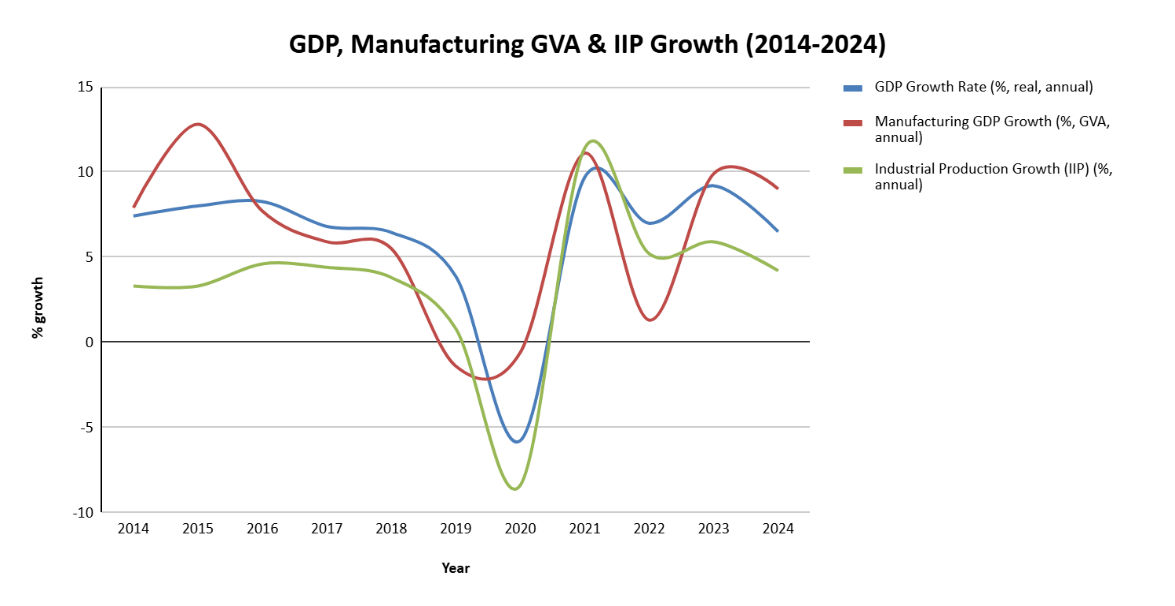
According to the trend analysis, it has been found that India adopted a relatively stricter tariff regime after the launch of the Make in India initiative.
Trend shows a move to a selective protectionist trade regime due to Make in India program. Importance of this is not just about an increase in tariff rates, but about change in trade policy from one of liberalization to one of protecting selected domestic industries. Tariffs imposed on finished products would allow domestic producers to have price protection and produce locally, as per infant industry argument. But tariff on imports of intermediate and capital goods may at the same time increase cost of production for businesses using global supply chains. Thus, the trend cannot be taken as an indicator of improvement in manufacturing without determining whether protection leads to productivity, investments and competitiveness in exports. It adds strength to the analysis.
| Variable | Tariff | Manufacturing GDP | IIP | FDI | Exports |
| Tariff | 1 | 0.31 | -0.23 | 0.13 | -0.72 |
| Manufacturing GDP | 0.31 | 1 | 0.64 | -0.33 | 0.11 |
| IIP | -0.23 | 0.64 | 1 | -0.36 | 0.50 |
| FDI | 0.13 | -0.33 | -0.36 | 1 | 0.08 |
| Exports | -0.72 | 0.11 | 0.50 | 0.08 | 1 |
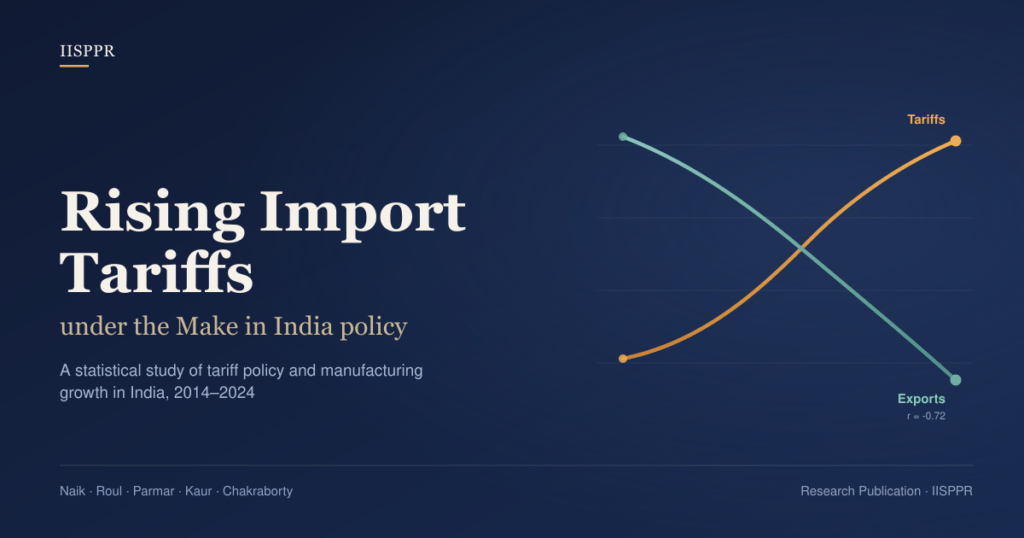
This correlation indicates that the relationship between the Applied Weighted Mean Tariff Rate and Manufacturing Value Added is weakly positive (r = 0.313), this suggests that increasing the tariff system results in an increase in manufacturing performance, but this association is still weak. In addition to that, there is a strong negative correlation between the two variables of Tariff Rate and Merchandise Exports (r = –0.719), indicating that greater tariff rates are correlated with lower exports for the period of analysis. The relationship between Manufacturing Value Added and IIP is found to be moderately strong and positive (r = 0.638); this suggests that the better the industrial production, the better performance of manufacturing. The coefficients suggest that the relationships between explanatory variables are not strong enough (|r| ≥ 0.80), confirming the suitability of these variables for the next stage of Multiple Linear Regression study.
Regression Statistics
| Regression Statistic | Value |
| Multiple R | 0.25 |
| R Square | 0.06 |
| Adjusted R Square | -0.05 |
| Standard Error | 5.07 |
| Observations | 10 |
ANOVA
| df | SS | MS | F | Significance F | |
| Regression | 1 | 14.21792235 | 14.21792235 | 0.5527128781 | 0.478473929 |
| Residual | 8 | 205.7910776 | 25.72388471 | — | — |
| Total | 9 | 220.009 | — | — | — |
An analysis utilizing multiple linear regression (MLR) was performed in order to determine the influence of import tariffs on the manufacturing sector, while taking into account numerous independent variables such as imports, exports, foreign direct investments (FDI) in manufacturing, and industrial output. The tariff coefficient in question turned out to be statistically insignificant and negative (p > 0.05), indicating no significant improvement in Co-efficient Standard
| Error | T Stat | P-value | Lower 95% | Upper 95% | |
| Intercept | 3.46 | 2.42 | 0.04 | 0.41 | 16.37 |
| Not available | 0.64 | -0.74 | 0.48 | -1.96 | 1.01 |
India’s machine manufacturing sector due to increasing tariff rates. The regression model was not statistically significant, indicating that tariff policy alone could not explain changes in Manufacturing Value Added.
CHAPTER-5 DISCUSSION:
The relationship between rising import tariffs and industrial performance reveals a complex and significant divide in the economic landscape. The implementation of selective protectionist measures, particularly under initiatives like “Make in India,” was intended to foster domestic capacity, but the empirical data exposes that this protective tariff regime has, in several instances, resulted in unexpected production cost hikes. This creates a challenging tension that directly addresses the goal of preventing industries from becoming permanently dependent on state support. As outlined in the “Make in India” framework, integrating time-bound measures, such as sunset clauses, with clear maturity metrics, could encourage firms to innovate, reduce costs, and compete globally.
Statistical analysis reveals a weak positive correlation between the Applied Weighted Mean Tariff Rate and Manufacturing Value Added (r=0.313), suggesting that increasing tariffs has a limited impact on manufacturing performance. Conversely, there is a strong negative correlation between tariff rates and merchandise exports (r=-0.719), indicating that higher tariffs are associated with lower exports. Furthermore, a moderately strong positive relationship (r=0.638) exists between Manufacturing Value Added and the Index of Industrial Production (IIP), highlighting that industrial production is a key driver of manufacturing performance.
The results can be analyzed in light of the theory reviewed in the literature review chapter. The moderate positive correlation between tariffs and Manufacturing Value Added is generally in line with the infant industry thesis, where temporary protection can help domestic companies to build productive capacity. Yet, the lack of statistical significance shows that this protection has not resulted in any strong manufacturing effect. On the other hand, the strong negative correlation between tariffs and exports is worrisome from the strategic trade theory standpoint, since increased costs of inputs or competition can harm the competitiveness of companies in foreign markets. Therefore, the results can offer little support for the protectionist approach, and it appears that tariff protection should be combined with productivity and technological advances, as well as exports.
The Multiple Linear Regression (MLR) analysis produced a statistically insignificant and negative coefficient for tariffs (p>0.05), confirming that increasing tariff rates did not lead to significant improvements in the manufacturing sector. Because the overall regression equation was also not statistically significant, the study concludes there is insufficient evidence to prove that tariffs alone drive Manufacturing Value Added. Ultimately, the findings indicate that manufacturing growth in India is influenced by a complex set of root causes that extend well beyond the protectionist effects of import tariffs.
5.1 Policy Implications
The study indicates that import tariffs alone are ineffective in catalysing manufacturing growth in India. Policymakers should recognize that tariff-driven protectionism has a weak correlation with manufacturing value added and a strong negative correlation with merchandise exports. Given that manufacturing output is influenced by complex, multi-faceted factors, the government should shift focus from singular protective measures to broader structural reforms. Therefore, industrial strategy must move away from inward-looking protectionist paradigms toward integrated frameworks that bolster global competitiveness and address root causes of industrial stagnation.
5.2 Limitations
One limitation is the few annual observations that are used in the regression analysis. This is because the study uses a short annual time series from the period of Make in India, making it hard to determine any stable relationship between the variables. The results should thus be taken as suggestive relationships rather than a causation. Also, the annual aggregated data might not reflect any variations in the data by sectors or firms. Future studies should use longer times and higher frequency data such as quarterly or monthly data where available. Data at sectoral and firm level can also help understand the relationship if there is any variation of tariff effect in different industries, firm sizes and import dependent firms. Future studies can also include other variables such as labour productivity, investments in technology, infrastructure, exchange rates and global commodity prices.
CHAPTER-6: CONCLUSION AND POLICY RECOMMENDATION
6.1 Conclusion
This study examined the impact of India’s tariff policy on international trade and domestic manufacturing during 2014–2024, with emphasis on the Make in India and Atmanirbhar Bharat initiatives. Tariff increases after 2018 supported industrial development and complemented schemes such as Production Linked Incentive (PLI). However, higher tariffs also increased input costs for industries relying on imported raw materials and created trade-related concerns.
The study concludes that tariffs alone cannot ensure sustainable industrial growth. Long-term competitiveness requires improvements in infrastructure, logistics, technology, innovation, skill development and ease of doing business. India should maintain a balanced approach by protecting strategic industries while encouraging exports and complying with international trade commitments. Overall, tariff policy has contributed to India’s industrial objectives, but future reforms should remain transparent, evidence-based and aligned with inclusive economic growth.
As per the study, it is clear that the association between import tariffs and the performance of manufacturing industry in India is quite weak. The correlation analysis shows that the relationship between two variables is positively weak for Manufacturing Value Added (r=0.313) and Manufacturing FDI (r=0.131) but negatively weak for the index of Industrial Production (r=-0.228). A strong negative association is found between tariffs and the volume of merchandise exports (r= -0.719). This means that higher import tariffs may harm export performance. In regression analysis, it is found that the explanatory power of tariff policy is quite low (R2 = 0.065) and statistically insignificant (p = 0.478). Hence, tariffs have no role in the growth of manufacturing industry in the country.
6.2 Policy Recommendations
The findings suggest that tariff policy should be implemented effectively to protect strategically important industries while avoiding excessive protection that may reduce export competitiveness. Greater emphasis should be placed on improving industrial infrastructure, logistics, technological innovation, and workforce skills to strengthen the competitiveness of domestic manufacturing. The government should continue promoting high-quality foreign direct investment in technology-intensive manufacturing sectors and ensure that tariff measures are integrated with broader initiatives such as Make in India and Atmanirbhar Bharat. In addition, maintaining consistency with India’s international trade commitments will help achieve a balance between domestic industrial development and export growth.
6.3 Limitations of study
This study is entirely based on secondary data collected from official national and international sources for period 2014-2024. The analysis is limited by the relatively small number of annual observations available for statistical estimation. Although the study focuses on the relationship between import tariffs and manufacturing performance, other important determinants such as technological innovation, labour productivity, infrastructure quality, institutional reforms, and state-level industrial policies were not included in regression model. Moreover, the economic disruptions caused by the COVID-19 pandemic may have influenced the observed trends during the study period.
References:
Bardhan, P. K. (1971). On optimum subsidy to a learning industry: An aspect of the theory of infant-industry protection. International Economic Review, 12(1), 54–70. https://www.jstor.org/stable/2525496
Creswell, J. W., & Creswell, J. D. (2023). Research design: Qualitative, quantitative, and mixed methods approaches (6th ed.). SAGE Publications. https://books.google.co.in/books?hl=en&lr=&id=335ZDwAAQBAJ&oi=fnd&pg=PT16&dq=Creswell,+J.+W.,+%26+Creswell,+J.+D.+(2023).+Research+design:+Qualitative,+quantitative,+and+mixed+methods+approaches+(6th+ed.).+SAGE+Publications.&ots=YEAXJOAsqN&sig=-RrouX6rmVDjKM8ndT-vM5GBv5U#v=onepage&q&f=false
Department for Promotion of Industry and Internal Trade. (2025). Annual report. Government of India. https://www.dpiit.gov.in
Department for Promotion of Industry and Internal Trade. (2025). FDI statistics. Government of India. https://dpiit.gov.in
Field, A. (2018). Discovering statistics using IBM SPSS Statistics (5th ed.). SAGE Publications.
Government of India. (2014). Make in India. https://www.makeinindia.com
Government of India. (2024). Economic Survey 2023–24. Ministry of Finance. https://www.indiabudget.gov.in/budget2024-25/economicsurvey/index.php
Greene, W. H. (2018). Econometric analysis (8th ed.). Pearson. https://www.scirp.org/reference/referencespapers?referenceid=2920183
Gujarati, D. N., Porter, D. C., & Gunasekar, S. (2022). Basic econometrics (6th Indian ed.). McGraw Hill Education. https://www.researchgate.net/publication/387024472_Basic_Econometrics
India Policy Forum. (2005–2006). India policy reforms and trade policy. National Council of Applied Economic Research. https://www.brookings.edu/books/the-india-policy-forum-2005-06/
Johnson, H. G. (1960). An economic theory of protectionism, tariff bargaining, and the formation of customs unions. Journal of Political Economy, 68(3), 256–272. https://www.semanticscholar.org/paper/An-Economic-Theory-of-Protectionism%2C-Tariff-and-the-Johnson/99fd3d6829ec18a8e23fa1171f5a44898edc106b
Krugman, P., & Smith, A. (2007). Empirical studies of strategic trade policy. University of Chicago Press. https://www.researchgate.net/publication/37693922_Empirical_Studies_of_Strategic_Trade_Policy
Maitra, M. (2011). Trade liberalization and productivity in formal and informal manufacturing in India. Journal of Development Economics, 94(1), 128–139. https://www.researchgate.net/publication/333796006_Trade_liberalization_and_productivity_of_Indian_manufacturing_firms
Maradi, M. M. (Ed.). (2022). Make in India: Policy perspectives and industrial development. Springer. https://link.springer.com/chapter/10.1007/978-981-10-7950-4_4
Ministry of Statistics and Programme Implementation. (2025). Official statistics of India. Government of India. https://mospi.gov.in
Mukherjee, S., & Chanda, R. (2021). Input tariff liberalization, output tariff liberalization and firm markups in Indian manufacturing. Economic Modelling, 103, 105602. https://www.sciencedirect.com/science/article/abs/pii/S0264999321001838
Rawat, M., Raj, R., & Agarwal, T. (2020). A critical review of Make in India as an import substitute. SSRN Electronic Journal. https://doi.org/10.2139/ssrn.3629552
Reserve Bank of India. (2025). Database on Indian Economy (DBIE). https://data.rbi.org.in
Saunders, M., Lewis, P., & Thornhill, A. (2023). Research methods for business students (9th ed.). Pearson. https://www.researchgate.net/publication/240218229_Research_Methods_for_Business_Students
Wooldridge, J. M. (2020). Introductory econometrics: A modern approach (7th ed.). Cengage Learning. https://www.cengage.co.in/book-list/print/introductory-econometrics-a-modern-approach-with-mindtap-7e-04
World Bank. (2025). World Development Indicators. https://data.worldbank.org
World Bank. (2025). World Integrated Trade Solution (WITS). https://wits.worldbank.org