Authors: Prachiti Raikar, Pallavi Prasad, Avnika Singh, Sainhita Shende, Krishna Vinod, Shashank CR Iyer & Jayeeta Sharma
Abstract
In order to encourage domestic manufacture and lessen India’s reliance on imported goods, the Make in India initiative imposed higher import levies. Using quarterly data from 2013–14 Q4 to 2025–26 Q3, this study examines the relationship between import tariffs, import dependence, and manufacturing growth in order to assess the efficacy of this strategy.
Ordinary Least Squares (OLS) regression, trend analysis, and correlation analysis are all used in the analysis. Two regression models are estimated: one looks at the factors that influence import dependency, and the other evaluates how tariff policy affects the expansion of manufacturing. The findings show a statistically significant correlation between import dependence and import tariffs; nevertheless, increased tariffs by themselves have not significantly reduced reliance on foreign goods. Additionally, the results show that during the study period, tariff increases had no statistically significant impact on the growth of manufacturing. These findings imply that while tariff protection helps India’s import-substitution strategy, complementary policies like infrastructure development, investment promotion, technological advancement, and increased industrial competitiveness are necessary for sustainable industrial development. The paper presents empirical evidence on the efficiency of tariff-based trade policy in promoting India’s objective of economic self-reliance.
Keywords: Make in India, Import Tariffs, Import Dependence, Manufacturing Growth, Import Substitution and Trade Policy
1. Introduction
1.1 Background of the Study
A. Trade Liberalisation in India
Rising disposable incomes, consistent GDP growth, and quick developments in important infrastructure areas like information technology and telecommunications have all contributed to India’s rise to prominence in the world economy. As a result, foreign direct investment (FDI) and international commerce are now essential cornerstones of the country’s economic growth. The historic economic liberalization initiatives of 1991 served as a catalyst for this structural change. Before these changes, India had a strict import-substitution policy that, although meant to safeguard home industries, often encouraged market inefficiencies, raised production costs, and hindered the country’s ability to compete internationally. The government carried out extensive changes, including as trade liberalization, industrial delicensing, currency rate flexibility, and the easing of foreign investment restrictions, to lessen these structural issues. These measures successfully integrated India into the global value chain and significantly enhanced its competitive standing in international markets.
B. Rising Import Dependence
India’s fast industrial growth and changing domestic purchasing habits have gradually increased its dependency on overseas markets, despite the achievements of liberalization. To maintain national growth, critical inputs most notably crude oil, fertilizers, and other industrial raw materials are being imported more frequently. These imports expose the domestic economy to macroeconomic risks and foreign supply shocks while also facilitating intermediary manufacturing and technical absorption. During the COVID-19 pandemic, when significant interruptions in global supply networks strangled vital domestic manufacturing inputs, this concentration of risk became glaringly apparent. A strategic policy shift toward increased self-reliance was prompted by these disruptions, which highlighted the critical need for structural economic resilience.
C. Make in India Initiative (2014)
To address these vulnerabilities and capitalize on its demographic dividend, the Government of India launched the “Make in India” initiative in 2014. With the goal of turning India into a worldwide manufacturing powerhouse by encouraging both domestic and multinational companies to invest in local production, this flagship program represented a paradigm shift in the country’s industrial strategy. The initiative’s structural goals are to create a business-friendly environment, make conducting business easier, and lessen dependency on imports in high-value, strategically important industries. The policy’s primary socioeconomic objective targets long-term employment opportunities in manufacturing to tackle the problem of India’s youth population, in addition to economic diversification. Make in India is a broader policy framework to ensure that domestic value adding, encourage industrial independence and move towards a less import dependent economy to a competitive home production, by coordinating the fiscal, financial and trade rules.
D. Use of Import Tariffs
The government has used the import tax as a key tool of protection in a systematic way for the import substitution part of Make in India. India’s trade-weighted average tariff has almost doubled from about 7% in 2014 to 12% in FY 2023-2024 over the 10-year period. A wide range of industrial inputs were the focus of subsequent Union Budgets that carried out this growing trend. For instance, with a view to safeguarding local producers and fostering local job creation, duties on a range of items were raised by 15% to 20% in the 2018-19 Budget, such as furniture, shoes, and auto parts. In the 2021-22 Budget, this tariff-based strategy was further reinforced with an increase in tariffs on 31 different product groups. In the modern times, this specific protectionism is the basis of India’s trade policy, influencing critical sectors such as electronics, textiles, and defense (Rawat et al., 2020; Jacob, 2024).
E. Need for Evaluation
But the actual effectiveness of systematic tariff escalation in reducing the dependence on imports is a topic of much debate among academics. Even with the substantial increase in the average rates of tariffs, India’s merchandise imports grew by nearly 1.5 times in 2023-2024 to nearly USD 678 billion. In certain protected industries, domestic production has risen, value added in the sector has risen, but share of the production exported have fallen. This poses interesting questions about the extent to which protection of trade is actually fostering international competitiveness, or merely obscuring domestic inefficiencies (Mukherjee, 2024). Further, it has been found that even the policy measures that are measurable, India still faces structural issues in its quest to compete with its regional neighbours as a leading manufacturing alternative to the rest of the world (Rawat et al., 2020). Because of the increasing mismatch between macroeconomic outcomes and policy goal, it is necessary to implement a comprehensive and empirical assessment of tariff-based import substitution from 2014 to 2025.
1.2 Statement of the Problem
Under the “Make in India” policy, the Indian government has increasingly relied on calibrated tariff protection for domestic sectors, to promote local production and to decrease reliance upon imports. However, the overall economic impact of this protectionist move is subject of controversy. Boosting import tariffs are supposed to reduce imports, but they can lead to higher costs of intermediate inputs for Indian companies and thereby distort supply chains and reduce the competitiveness of Indian manufacturing exports. In these conflicting economic forces, there is no clear consensus that tariff escalation is an enabler or inhibitor to industrialization. To measure the relationship between tariff change, import dependence and domestic production output and output growth precisely, detailed empirical research is required.
1.3 Research Questions
- RQ1: Has India’s structural dependence on foreign merchandise exhibited a statistically significant decline since the inception of the Make in India initiative in 2014?
- RQ2: What is the empirical relationship between changes in import tariff rates and sectoral import dependence in India?
- RQ3: To what extent have rising import tariffs contributed to the growth and output of India’s domestic manufacturing sector?
- RQ4: Has the implementation of tariff-led protectionism effectively achieved the strategic import-substitution objectives outlined under the Make in India framework?
1.4 Research Objectives
- RO1: To analyze the structural trends and trajectories of India’s import tariffs across key sectors from 2014 to 2025.
- RO2: To examine the temporal trends and patterns in India’s macroeconomic dependence on imported goods during the same period.
- RO3: To empirically investigate the short-run and long-run relationships between import tariff levels and the degree of import dependence.
- RO4: To assess the quantitative impact of rising tariff barriers on the output and growth metrics of the domestic manufacturing sector.
- RO5: To evaluate the overall economic effectiveness of tariff-based protectionism as an instrument of industrial policy under the Make in India framework.
1.5 Hypotheses
- H01: Import tariffs have no significant empirical impact on India’s import
- H11: Import tariffs have a significant empirical impact on India’s import
- H02: Import tariffs have no significant empirical impact on domestic manufacturing
- H12: Import tariffs have a significant empirical impact on domestic manufacturing
1.6 Scope of the Study
This study evaluates the macroeconomic dynamics of India’s trade policy over the post-reform decade spanning 2014 to 2025. Spatially, the geographic scope is restricted to the Republic of India. Temporally and methodologically, the study utilizes high-frequency, India’s quarterly data to capture short-term cyclical variations, policy implementation lags, and immediate shock adjustments that are typically smoothed out in annual datasets. The analysis mainly concentrates on important industrial sectors where tariff modifications and “Make in India” ambitions have been most prevalent, such as electronics, automotive components, and textiles.
1.7 Significance of the Study
- Trade Policy: Offers policymakers and trade negotiators a clear framework for optimising tariff lines without creating market distortions by providing empirical, data-driven insights into the macroeconomic effects of modern tariff systems.
- Industrial Policy: Provides a localised diagnostic evaluation of the relationship between sectoral production and tariff protections, allowing industrial planners to strike a balance between the cost realities of global supply inputs and the protection of domestic emerging
- Import Substitution: Evaluates whether import substitution is still a feasible development strategy in a highly integrated, globalised economy, adding to the larger body of work on new protectionism in international trade.
- Make in India Evaluation: Provides an unbiased, empirical report card on the first ten years of India’s historic industrial effort, highlighting the particular contribution of trade obstacles to the attainment of national self-reliance objectives.
2. Review of Literature
2.1 Theoretical Literature
2.1.1 Import Substitution Industrialisation (ISI)
This is a very clear policy choice that India made in the 1950s and 1960s, which was incorporated into a policy framework that came to be known as the Mahalanobis model, which emphasized state-led, high tariff, heavy industrialisation. The findings were in the short run. Nambiar (1980) documents that domestic manufactured goods as a share of total supply rose from 0.781 in 1955-56 to 0.857 in 1973-74, and consumer goods imports fell steadily from 12.9 per cent to just 3.6 per cent over the same period. On paper, the strategy was working. However, by the early 1980s, it had become clear that the approach had significant downsides. Bruton (1970) had already warned that inward-looking industrialisation tends to create rent-seeking behaviour among protected firms, who have little incentive to become internationally competitive when they face no external pressure to do so. Adewale (2017) in the paper “Import substitution industrialisation and economic growth – Evidence from the group of BRICS countries”, examines the origins of the concept of import substitution industrialisation (ISI) in the various countries of Latin America. This principle was then eventually adopted across several developing economies in order to develop domestic capacity and achieve self-sufficiency before opening up the economy for trade. The author writes: “The ISI industrial policy is premised on the realisation that economic development and more specifically, industrialisation can only be achieved by developing local capacity that is capable of substituting imports in order to reduce or possibly eliminate economic leakages.” From this perspective, it analyses the impact of import substitution industrialisation (ISI) on the economic performance of the countries of BRICS (Brazil, Russia, India, China and South Africa), arguing that ISI policy played a key role in the progress of these economies through industrialisation. Through an investigation of the economic history of these countries, this paper shows the success of the ISI policy in developing economies, including India. It advocates for the adoption of this model of economic integration to substitute imports in the short run, and for liberalisation and deregulation to be pursued once a higher level of industrialisation is achieved in the long run.
Dr Kishor Kumar (2023) This paper conducted a descriptive analysis on why India needs to be “self-reliant” or “Aatamanirbar”, its impact on the Indian economy, and especially to combat exogenous factors such as the pandemic, using secondary data. Domestically, ‘Make in India’ is implemented to generate employment, boost economic growth, the manufacturing industry, and get out of the “Fragile Five” category by focusing on restricting imports and opening up new sectors for FDI. The findings of the paper show that Make in India’s objectives were met somewhat until 2019, which is considered a complete failure. The pandemic, of course, played its part, but very ambitious goals were set without taking into consideration workers’ skills and the country’s infrastructure. Hence, the revamped Aatamanirbhar Bharat Abhiyan was introduced by the Government of India.
2.1.2 Infant Industry Argument (IIA)
R Nagaraj (2025) This study showed that India has a rising import dependence on China and premature deindustrialisation because of an unprecedented fall in savings and investment rates (in terms of GDP), along with a fall in FDI and manufacturing GDP remains stubbornly fixed at 15-17 per cent since 1991. Investment has increased in the service sector instead of the manufacturing sector; agriculture’s employment share increased in the 2010s. India’s nominal imports from China have increased seven times (2005-06 & 2021-22), while exports have only increased two-fold. 70 per cent of FDI was invested in brownfield instead of greenfield; the result of policy efforts is minimal. In conclusion, Make in India was brought to address premature deindustrialisation, and India’s GDP recovered from COVID-19 quickly, but there has been a decade-long decline. This decline could be steeper if doubts about discrepancies in the current GDP series are valid. To overcome this, the public sector has to make long-term strategic investments.
The concept of the Infant Industry Argument (IIA) in favour of trade protection is founded on the notion that, by reducing import competition, a domestic industry can grow to achieve sufficient productivity to operate profitably without continued protection. Specifically, this argument has been in favour of developing nations, where domestic manufacturers are incompetent compared to their counterparts in developed countries. India’s “Make In India” initiative acted as a catalyst for emphasising protectionism and domestic manufacturing for reduced foreign dependence. According to CSEP (2025), India remains highly protected among Asian economies, with an average MFN tariff rate of about 17.6%. Overall, India’s machinery exports increased by 1.9 times in 2017-2023 (in nominal prices), showing the potential for manufacturing growth in future as well. However, it also cautions that such measures may undermine firms’ ability to integrate into global value chains (GVCs) by increasing input costs and compliance burdens. Pack and Saggi (2006) also claim that without performance benchmark infant industry becomes dependent and shelters inefficiencies.
Tripathy and Dastrala (2023) The paper has described how the Infant Industry has been a staple in the Indian economy since 1947, as seen in the License Raj, and huge dependence on ISI (Mahalanobis model), which led to stagnation eventually. Make in India has been the most systematic approach since 1991. The paper accepts that Make in India would not be sufficient, as this might risk increasing dependence and that PLI should develop and stabilise indigenous raw materials. This should help remove the weakness in infant industry policy, which, in practice, has difficulty in transitioning from protected production to an innovation-driven production.
2.1.3 Strategic Trade Theory
Brander and Spencer (1985), who showed formally that in oligopolistic markets, strategic subsidies or tariffs can shift profits from foreign firms to domestic ones, making the country as a whole better off even if free trade would theoretically be more efficient. Sen (2010) reviews this literature and notes its relevance to contemporary industrial policy debates, particularly in countries like India that are trying to build competitive industries in sectors dominated by a small number of global players. India’s post-independence industrial policy already reflected some STT logic, particularly in the way the state targeted specific capital-intensive sectors for support. More recently, the approach is visible in the PLI scheme, which is designed to help Indian firms achieve the scale necessary to compete in global markets for electronics, pharmaceuticals, and other priority sectors. The geopolitical dimension has also become increasingly prominent.
Kurtkoti (2025) examines India’s response to the Trump administration’s reciprocal tariff policies between 2017 and 2021, and finds that India’s exports to the United States fell from USD 52.4 billion in 2018-19 to USD 49.9 billion in 2019-20 as a direct result of tariff disruptions.
Ayush Kumar (2025) This study calls the bilateral trade between India and America the world’s most important bilateral economic relationship, even when the immediate disruption is significant, but the base of the relationship is firm. A 50 per cent jump in tariffs shows trade policy is being used as a bargaining tool of a political nature, despite India exporting USD 12.7 billion worth of pharmaceuticals to the US annually, along with technology services, showing how irreplaceable India is to the US. Studies also show that as a response strategy, it has been using short-run economic commitments with long -term strategic needs, showing our economic relationships of imports cannot be reactive. Furthermore, highlights the need for trade diversification, multilateral engagement and strategic patience, gradual scale-down, sector-based priorixations, everything that Make in India has outlined but so far failed to deliver.
2.1.4 Comparative Advantage
Sen (2010) notes that this principle underlies the case for free trade, and it stands in direct tension with the protectionist thrust of policies like Make in India. India’s comparative advantage, at least in classical terms, lies in its large supply of relatively low-skilled labour, which should make it competitive in labour-intensive manufacturing sectors like textiles, garments, and footwear. What is striking, however, is that India’s tariff increases under Make in India have often been highest precisely in these labour-intensive sectors.
Even though India has historically had a comparative advantage in these sectors, Shiino (2021) notes that among the 2,319 product lines that saw tariff increases between 2017 and 2019, sewn goods and footwear were particularly noteworthy. This creates a paradox: the policy intended to boost domestic manufacturing appears to be taxing away some of India’s natural competitive strengths. However, the literature on liberalization suggests otherwise; Nicita and Olarreaga (2007) found that between 1990 and 2006 experienced the highest increases in trade specialization, and a parallel study by Jansen and Nordas (2004) confirms that liberalization helped India move its export composition toward medium-to-high technology content.
The deeper structural issue is that India has followed an unusual development path that does not fit the traditional comparative advantage model well. Rather than moving from agriculture to labour-intensive manufacturing to more skill-intensive production, India skipped directly to services, a phenomenon that some researchers have described as premature deindustrialisation Nagaraj (2025). This means that applying comparative advantage logic to India’s trade policy is more complicated than in a typical developing economy context, and simple prescriptions about tariffs in either direction need to account for this structural peculiarity
2.1.5 Protectionism and Industrial Development
Aiyar (2018) This paper claims that the Modi-era protectionist policies are just a combination of fear of China, influence of private-sector players, lack of good jobs, and, contradictorily, desire for a place in global supply chains. Small businesses suffered from two big hits: first, demonetization in 2016, and then, small businesses never came back as currency notes disappeared from circulation for months. Second, the rise of e-commerce threatened the MSMEs, both falling short of the protection promised in “Make in India”. This overall can reverse the economic gains made since 1991.
The CSEP (2025) report on India’s trade performance confirms that India remains one of Asia’s most heavily protected economies, with an average MFN tariff rate of approximately17.6 per cent. Despite the significant level of protection, which has been accompanied by noticeable increases in production levels, especially in the automobile sector, where overall output rose from 22,652 thousand units in FY2021 to 31,028 thousand units in FY2025, the same report warns that the high tariff environment is complicating the ability of Indian companies to connect with global value chains due to increased input costs and added compliance challenges. This conflict between safeguarding the domestic market and maintaining international competitiveness is a common theme in the literature on protectionism and is particularly pronounced in India, considering the reliance of modern manufacturing on intermediate inputs sourced from around the globe.
2.2 Empirical Literature
The evidence of the tariff effect on manufacturing performance and on India’s dependence on imports is quite large, but somewhat contradictory, and different studies have addressed different aspects of the problem at different times. As far as the relationship between tariffs and firm-level productivity is concerned, the most quoted study is that of Topalova and Khandelwal (2011), which used firm-level panel data to investigate the impact of India’s trade liberalization in the 1990s. They found that lower tariffs on intermediate goods led to larger productivity gains than lower tariffs on final goods because lower input costs allowed firms to be able to use better quality inputs and improve their production techniques.
An important dimension to this is an important complementary study by Goldberg, Khandelwal, Pavcnik and Topalova (2010) that incorporated detailed trade and firm-level data from India: They showed that input tariff liberalisation reduced the import price index for intermediate goods by another 4.7 per cent per year, and that lower input tariffs were responsible for around 31 per cent of all new products that domestic firms introduced during this time. The effect was in part due not only to the reduction in price of existing inputs, but also because of the availability of new types of inputs which were not available to firms prior to liberalisation. A more recent study examining firm-level product data (Vandenbussche & Viegelahn, 2016) supports the opposite effect: As input tariffs increase, the firm reduces its quantity of usage of affected inputs, which, in turn, leads to a reduction in sales of affected outputs, and a direct.
The kind of increase in tariffs that India has been doing since 2014 is creating a production-constraining effect. The overall information about the manufacturing performance in India is a complex one. On the other hand, there have been solid improvements in production volumes with Make in India. According to the CSEP (2025) report, the volumes of machinery exports increased by 1.9 times from 2017 to 2023, while the volumes of automobiles increased by around 33 per cent over the decade from FY2015 to FY2025. Conversely, the contribution of manufacturing to GDP has not been as responsive as desired. Nagaraj (2025) records that the proportion of the sector to GDP has been stagnant at 15-17 per cent since 1991 and that India’s manufacturing exports (as a share of GDP) reached a high of 10.5 per cent, while Vietnam’s manufacturing exports reached 71.2 per cent. Looking at Vietnam, which has actively participated in global value chains, while protecting its domestic market, is most illuminating. Both countries began as low income Asian economies, but have taken two very different trade policies with distinctly different manufacturing results.
Vinay Singh, Jyoti Sandhu and Ravi Ranga (2022) have conducted a detailed longitudinal analysis, which revealed that India’s overall import dependence reduced from 26.2 per cent to 21.0 per cent in 2018-19 while the total trade dependence reduced from 44.6 per cent to
This was an increase of 34.4 per cent compared to the previous year. It seems that at the first sight, the goal of import substitution of Make in India was being achieved. But the same study warns that the drop-off came not from the growth of domestic production versus imports, but from a drop in the export capacity, and so the gains in the import bill could come at the expense of overall trade activity. In this regard, Som (2019) argues that there is a structural trap as high imports will lead to slower GDP growth which will then further limit domestic production and force the economy to continue to import to fulfill demand, making this a tough one to break with a simple tariff increase.
Anti-dumping protection in a decade later, especially in sectors such as industrial chemicals, paper, iron, and steel. This discovery makes it a big concern for the present time: If the post-2014 tariff increases are the modern day antidumping duties, they might have the same long-time impact. The post-2014 tariff increases are not subject to a sunset period, unlike the antidumping measures called for by the WTO, which would require a review period of five years before their extension. These increases have been substantial: as per Shiino (2021), the tariff on 2,319 product lines were increased between 2017 and 2019 alone, especially in the sectors where India already has a comparative advantage such as textiles and footwear.
The empirical literature of tariff liberalisation and trade specialisation also suggests a direction which is troubling the story of Make in India. Nicita and Olarreaga (2007) discovered that the industries in which tariffs on imports were lowered the most were also those that had the highest export specialisation increases from 1990 to 2006 and that liberalisation assisted India to ascend the technology ladder on its export composition. As the literature makes clear, the opposite policy, tariff cuts, can have the opposite effect in the long run, and can lead to a decline in specialisation, rather than its increase, by pushing India’s export mix down the technology ladder. The increased concern is echoed by the competitiveness report of India (2026) against its regional neighbours by CSEP, which shows India’s disadvantageous position on various manufacturing competitiveness aspects such as regulatory quality and active participation in global trade policy matters.
There’s a fairly obvious economic argument for the effect of import taxes. Taxes imposed on the importation of goods. According to economic theory, tariffs will have a negative effect on imports, since they make foreign goods more expensive. Existing studies have examined India’s average applied import tariffs, which have increased to 13 per cent in 2014-15 from 12 per cent four years ago, largely due to a 3 per cent rise in duties for agriculture products such as cereals, oilseeds, fats, sugars and confectionery, says India’s latest trade policy review by the World Trade Organisation (WTO). According to the latest economic profile by India’s tariff and import structure obtained from World Bank’s WITS country cites, India’s average trade weighted tariff is 6.59% in 2019
2.3 Research Gap
When looking at existing literature, one can readily see that there is a significant time and structural mismatch, as the seminal work on Indian trade policy, such as by Goldberg et al. (2010) and Topalova and Khandelwal (2011), focus on data from the 1990s and early 2000s. The results of these studies offer evidence that trade liberalization and tariff cuts boosted firm productivity, but such results cannot be directly applied to predict the impact of tariff hikes. There is a lack of empirical studies on the exact macroeconomic impact of the re-protectionist trend in the domestic supply chain of the last few years, since the industrial structures and integration in the global value chain have seen significant changes since the start of the ‘Make in India’ initiative in 2014.
Moreover, the research starting from this period is not methodologically coherent, and relies on annual aggregates measuring trade rates, the level of trade and GDP shares, adjusted for high-frequency policy shocks. The three-variables transmission dynamics (the higher the tariff rate the less the reliance on imports and the more the growth of manufacturing) have not been modeled jointly in any studies. By using R programming to create a high-frequency time-series framework comprising 47 consecutive quarterly observations (2014–2025), this research fills up these gaps. This analysis aims at isolating the underlying structural impact of current trade policy in India after controlling for important macroeconomic drivers (GDP_Growth, INR_USD, GFCF_Growth, and Manufacturing_FDI) and applying heteroskedasticity-robust standard errors (HC1 version).
3. Methodology
This section briefly describes the quantitative research design employed to assess the effect of the tariff protection to boost domestic manufacturing activity and cut the import of foreign products. The study is quantitative in nature, with secondary time-series data. Since annual aggregates can mask sharp changes in policy and economic shocks, the analysis is based entirely on high frequency quarterly data for 47 consecutive quarters covering the policy cycle. The econometric approach evolves from descriptive and trend analysis to correlation mapping and multiple linear regression models estimated with Ordinary Least Squares (OLS) and using heteroskedasticity robust correction procedures.
3.1 Sources of Data
All the data used in this study is secondary macro level data taken from well-known national and international statistical databases. Variable metrics are set up like this:
Tariff Data: The central independent policy metric, Tariff_Rate (expressed as percentage format), reflects the trend of applied average tariff rates in India over successive quarters.
Quarterly data on Industrial and Macroeconomic Output are obtained from the Central Statistics Office (CSO), the Ministry of Statistics and Programme Implementation (MOSPI) and Database on Indian Economy (DBIE), maintained by the Reserve Bank of India (RBI) for Manufacturing_Growth (production changes) and GDP_Growth (%).
Capital and Investment Inflows: Gross fixed investment growth (GFCF_Growth) and foreign capital inflow to industrial sector (Manufacturing_FDI in millions of USD) are taken from RBI economic bulletins and manufacturing investment reports.
The nominal bilateral exchange rate (INR_USD) (Indian Rupee per US Dollar) and aggregate trade volume balances (AVB) to compute structural Import_Dependence (%) are sourced from the Department of Commerce and RBI external sector statistics.
3.2 Tools Used for Analysis
The analytical workflow was divided into simple computational tools to guarantee the methodological accuracy, reproducibility and rigorous testing:
The 47 quarterly observations were organized and compiled initially in Google Sheets and then cleaned and structured in the spreadsheet. The main statistical analysis, the creation of a correlation matrix and the construction of linear models have been carried out in R Programming. The standard base R routines were used to call regression functions, with the time-series diagnostic packages being used to improve the functions. In particular, for its implementation, the heteroskedasticity- The sandwich and lmtest packages were used to carry out the HC1 variant of the robust standard error estimate which was recommended by the data.
3.3 Variable Specifications
The two empirical models employ two different target variables to test the two objectives of protectionist trade policy: import substitution and industrialization. All variables are computed directly at their level/rate; these are configured in the underlying data engines.
3.3.1 Dependent Variables
Indicators: Import Dependence (Import_Dependence): The ratio of imports to national consumption, which is used as the yardstick for the outcome of the import substitution initiative of Make in India. The real percentage change in industrial output on a quarterly basis is the benchmark measure of manufacturing performance and is called Manufacturing Growth (Manufacturing_Growth).
3.3.4 Independent Variable of Interest
Primary policy explanatory variable as a percentage, indicating the quarterly evolution of India’s applied tariff walls, Tariff Rate.
3.3.3 Control Variables
The following variables are used to remove omitted variable bias and to control for systematic macroeconomic variables:
- GDP Growth (GDP_Growth): Accounts for broader aggregate demand cycles and domestic economic health.
- Exchange Rate (INR_USD): Controls for currency fluctuations that influence international trade competitiveness and import pricing.
- GFCF Growth (GFCF_Growth): Proxies changes in fixed capital formation and physical capacity expanding inside the domestic economy.
- Manufacturing FDI (Manufacturing_FDI): Controls for sectoral foreign direct investment inflows denominated in millions of USD.
3.4 Econometric Framework
The econometric analysis is conducted across three sequential phases:
Phase 1: Descriptive and Visual Trend Mapping
First, the time-series behavior of the 47 quarterly observations is visually examined to track structural changes, cyclical fluctuations, and volatility profiles across all variables.
Phase 2: Correlation Analysis
A Pearson correlation matrix is created from the entire sample (n = 47) to showcase the raw relationship (strength and direction) between variables before control. To determine whether the relationships among the study variables are statistically significant, critical two-tailed statistical values at the 0.05 significance level (critical value = 0.2876) and the 0.01 significance level (critical value = 0.3721) are set.
Phase 3: Multiple Linear Regression Specification
To isolate the impacts of tariff protection while holding other macroeconomic factors constant, two distinct OLS regression models are specified.
Model 1: Import Dependence Equations
𝐼𝑚𝑝𝑜𝑟𝑡_𝐷𝑒𝑝𝑒𝑛𝑑𝑒𝑛𝑐
= 𝛽0 + 𝛽1𝑇𝑎𝑟𝑖𝑓𝑓_𝑅𝑎𝑡𝑒𝑡 + 𝛽2𝐺𝐷𝑃_𝐺𝑟𝑜𝑤𝑡ℎ𝑡 + 𝛽3𝐼𝑁𝑅_𝑈𝑆𝐷𝑡
+ 𝛽4𝐺𝐹𝐶𝐹_𝐺𝑟𝑜𝑤𝑡ℎ𝑡 + 𝛽5𝑇𝑜𝑡𝑎𝑙_𝐹𝐷𝐼𝑡 + 𝜀1𝑡
Model 2: Manufacturing Growth Equations
Manufacturing_Growth𝑡
= 𝛼0 + 𝛼1Tariff_Rate𝑡 + 𝛼2GDP_Growth𝑡 + 𝛼3INR_USD𝑡
+ 𝛼4GFCF_Growth𝑡 + 𝛼5Manufacturing_FDI𝑡 + 𝜀2𝑡
Where:
t represents the quarterly time period (t = 1, 2, …, 47).
β₀ and α₀ denote the intercept terms.
β₁ to β₅ and α₁ to α₅ represent the regression coefficients to be estimated.
ε₁t and ε₂t denote the stochastic error terms.
Phase 4: Post-Estimation and Robust Testing
In many time-series situations, the error terms have variance anomalies and non-constant volatility. Both OLS models assume heteroscedasticity which can lead to diagnostic distortions and to hypotheses being rejected incorrectly.
Rather, hypothesis testing is performed using Heteroskedasticity-Robust Standard Errors (HC1 variant). This technical framework corrects the covariance matrix to produce the robust standard errors that produce accurate $t$-ratios and $p$-values that provide a solid basis for the evaluation of our core hypotheses.
4. Data Analysis & Discussion
4.1 Introduction
The empirical results of the study Reducing Dependency on Foreign Goods: Evaluating the Impact of Rising Import Tariffs under India’s Make in India Initiative (2014–2025) are presented in this chapter. The investigation looks at the relationship between import tariffs, import dependency, manufacturing growth, and a few macroeconomic factors using graphical trend analysis, descriptive interpretation, correlation analysis, and Ordinary Least Squares (OLS) regression.
The purpose of this chapter is to assess whether India’s increased import tariffs under the Make in India initiative have helped to both promote domestic manufacturing and lessen reliance on imports.
4.2 Trend Analysis
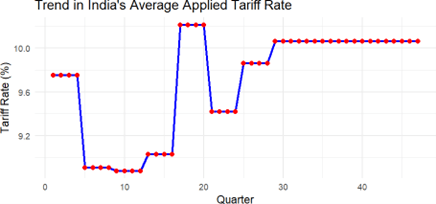
Figure 4.1 Trend in India’s Average Applied Tariff Rate
The average imposed import tariff rate in India from 2013–14 to 2025–2026 is shown in Figure 4.1. Before showing a steady increase trend once the Make in India initiative was put into place, the tariff rate was rather constant in the early years. After 2018, there is a discernible rise, which is indicative of the government’s calculated use of tariff protection to promote homegrown production and lessen reliance on imports. Tariffs had stabilized at somewhat higher levels by the conclusion of the study period, suggesting a persistent protectionist trade policy.
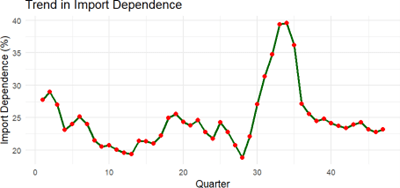
Figure 4.2 Trend in Import Dependence
Figure 4.2 showcases the quarterly fluctuations in India’s reliance on imports. In the initial years, import dependence showed a downward trend, indicating a lesser reliance on overseas goods. However, a significant increase is noted during the COVID-19 period, which reflects disruptions in local manufacturing and alterations in global trade dynamics. After the pandemic, import dependence once again decreased and gradually achieved stability, suggesting a partial recovery in domestic production capabilities. Although tariff rates rose throughout the study period, the trend implies that various macroeconomic factors beyond just tariff policy influenced import dependence.
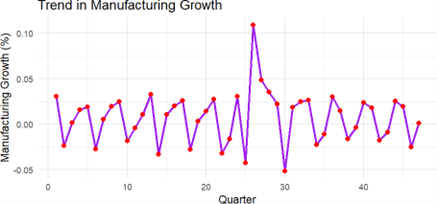
Figure 4.3 Trend in Manufacturing Growth
The growth of manufacturing exhibits considerable variations from quarter to quarter throughout the research period. Before the pandemic, growth was relatively steady, but it experienced significant volatility during that time, showing both sharp declines and subsequent rebounds. These fluctuations highlight the cyclical characteristics of manufacturing output and the sector’s responsiveness to broader economic shocks. Although tariff protection has increased, there is no clear ongoing upward trend in manufacturing growth, indicating that tariff measures by themselves may not be adequate to ensure continuous industrial growth.
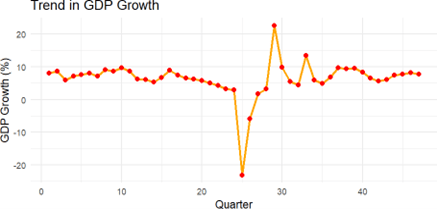
Figure 4.4 Trend in GDP Growth
GDP growth showed relative stability for most of the examined period, disrupted by a significant downturn during the COVID-19 pandemic, followed by a robust recovery. This trend highlights the unparalleled economic turmoil faced worldwide. The rebound indicates the Indian economy’s strength; however, GDP growth by itself does not seem to account for the fluctuations in import reliance throughout the whole period.
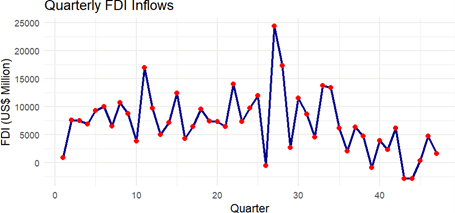
Figure 4.5 Quarterly Manufacturing FDI
Quarterly FDI inflows in the manufacturing sector exhibited considerable volatility over the study duration. Although some quarters saw exceptionally high inflows, these spikes were not consistently maintained over time. This implies that investment choices were shaped more by broader economic circumstances, global capital flows, and investor confidence rather than merely tariff regulations.
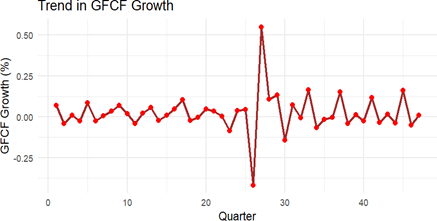
Figure 4.6 Growth of Gross Fixed Capital Formation
The growth of Gross Fixed Capital Formation (GFCF) has mostly remained positive through various quarters, although it showed considerable fluctuations during the pandemic. Investment activities rebounded following the economic reopening, signaling a resurgence in capital formation. Nevertheless, the lack of a sustained upward trend indicates that domestic investment has been influenced by various macroeconomic factors.
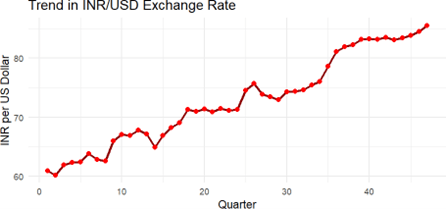
Figure 4.7 Trend in INR/USD Exchange Rate
The exchange rate between the INR and USD shows a distinct upward trend, reflecting a gradual weakening of the Indian Rupee throughout the study period. This depreciation in currency raises the domestic cost of imports, which can independently affect import demand, regardless of tariff policies.
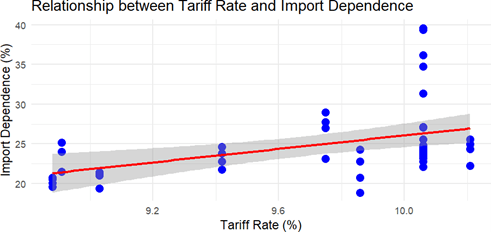
Figure 4.8 Relationship between Tariff Rate and Import Dependence
The scatter plot reveals a weak positive correlation between tariff rates and reliance on imports. While the regression line shows a slight upward incline, the wide variation in data points indicates that tariff policies alone do not adequately account for fluctuations in India’s import dependence.
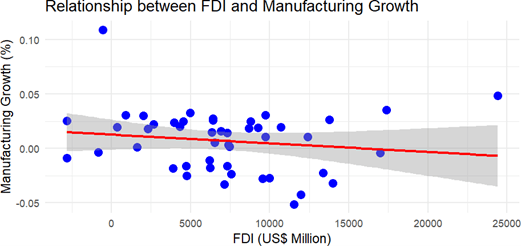
Figure 4.9 Relationship between Manufacturing FDI and Manufacturing Growth
The relationship between manufacturing FDI and manufacturing growth as we can see through the figure above is weak and slightly negative. The wide dispersion of observations indicates limited explanatory power of FDI inflows alone in determining quarterly manufacturing growth.
4.3 Correlation Analysis
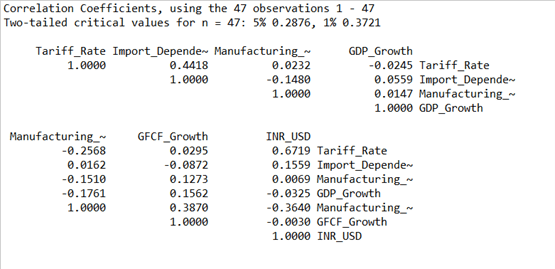
The correlation matrix sheds light on the connections among the study variables. We see that the Tariff Rate has a moderate positive correlation with Import Dependence, meaning that higher tariffs haven’t led to a quick drop in import reliance during our observation period. On the other hand, GDP Growth shows only a weak link to Import Dependence, suggesting that economic expansion by itself doesn’t fully account for import behavior. When it comes to Manufacturing Growth, the correlations with other variables are relatively weak, hinting that manufacturing performance is shaped by a mix of structural and cyclical influences. Additionally, Manufacturing FDI has a similarly weak connection with manufacturing growth, and GFCF Growth also shows a limited relationship with import dependence.
4.4 Regression Analysis
Model 1: Determinants of Import Dependence
The first regression model examines the determinants of Import Dependence.
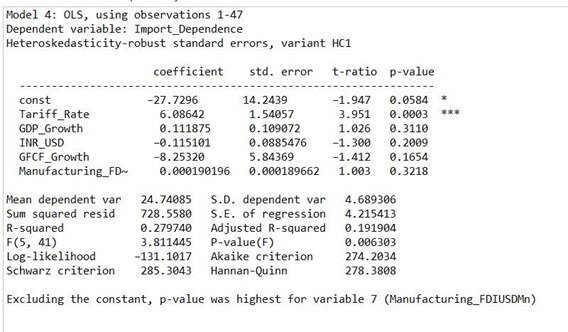
The model accounts for about 28% of the variation in Import Dependence (R² = 0.2797). Notably, the overall model demonstrates statistical significance at the 1% level (F-test p-value = 0.0063), which highlights that the explanatory variables chosen have a combined effect on import dependence.
Among all the variables considered, the Tariff Rate stands out as the only one with a statistically significant impact (p = 0.0003). Its positive coefficient indicates that higher tariff rates correlate with increased import dependence throughout the study period. This result seems to contradict the primary goal of tariff protection. One possible explanation is that tariffs were raised during times when import dependence was already high, or that domestic production still relied on importing intermediate goods, even with elevated tariff rates.
On the other hand, GDP Growth, Exchange Rate, GFCF Growth, and Manufacturing FDI do not show statistically significant impacts on import dependence, suggesting their individual contributions are relatively minimal in this analysis.
In summary, the findings indicate that while tariff policy plays a crucial role in shaping import dependence, the results imply that tariffs alone may not be sufficient to quickly decrease reliance on foreign goods.
Model 2: Determinants of Manufacturing Growth
The second regression model investigates the factors influencing Manufacturing Growth.
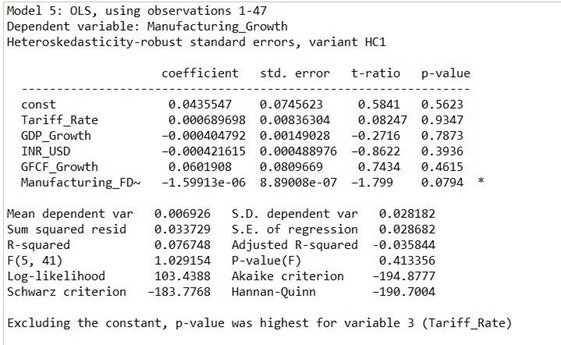
The model reveals low explanatory power (R² ≈ 0.08), meaning that the macroeconomic variables chosen account for only a small fraction of the quarterly growth in manufacturing. The Tariff Rate proves to be statistically insignificant, indicating that increases in tariff protection have not led to immediate improvements in manufacturing output.
Additionally, Manufacturing FDI shows a slight negative correlation with manufacturing growth and is only marginally significant at the 10% level. This could suggest that there is a lag between investment inflows and production results, indicating that FDI takes time to convert into measurable manufacturing growth.
Similarly, GDP Growth, Exchange Rate, and GFCF Growth are also statistically insignificant. These results imply that quarterly manufacturing growth is influenced by more extensive structural, technological, and demand-related factors, rather than simply tariff protection and short-term macroeconomic variables.
4.5 Discussion of Findings
The main aim of this study was to check if the enhancement of import duties under Make in India initiative helped to cut down on foreign dependence and boost domestic manufacturing. To accomplish this goal, two Ordinary Least Squares (OLS) regression models have been estimated for the quarterly data for the period of 2013–14 to 2025–26.
4.5.1 Impact of Tariff Rates on Import Dependence
A tariff rate’s effect on import dependence is discussed here. This section covers the impact of tariff rates on import dependence. A regression model was used to explore the effect of import tariff and macroeconomic variables on India’s import dependence. The overall model was statistically significant, suggesting that the explanatory variables collectively explain the variations in the import dependence pattern throughout the period studied. The model accounted for moderate levels of variation in import dependence (R² = 0.2797), explaining about 28 percent.
The tariff rate was the only explanatory variable that was statistically significant among all the explanatory variables. However, the coefficient estimated was not in line with the first thought, which suggests a positive relationship between import dependence and tariff rate. On the face of it, this does not seem to be in keeping with the objectives of Make in India which sought to shift dependence on imports with enhanced tariff protection.
There are a number of economic explanations that might explain this result. Firstly, India’s manufacturing industry remains heavily reliant on imports of intermediate goods, capital equipment, electronic components and industrial machinery. As a result, some industries may find that they are discouraged from importing finished goods but are still importing production factors which cannot be easily produced domestically. Thus, there is not necessarily a direct relationship between the level of tariffs and the immediate decrease in dependency on imports.
Second, tariff hikes were happening during times of growing domestic production and investment. As production grew, companies needed more of the raw materials and intermediate goods needed to meet the demand. This could have been a counteracting effect of the higher tariffs intended to encourage local production.
Thirdly, the structure of the Indian economy implies that it takes a significant time on the part of the domestic production system to respond to policy measures with regard to production capacity. The investment in manufacturing establishments, technology upgrading, infrastructure development and diversifying supply-chain are processes of a longer term nature. The effects of tariff protection on import dependence can therefore only be manifest after a number of years, not in the current quarter.
The lack of any positive or negative effects of GDP Growth, Exchange Rate, Manufacturing FDI, and Gross Fixed Capital Formation on import dependence in the short-run is statistically insignificant when controlling for tariff policy. However, they cannot be ignored in terms of their economic significance, as they may also have indirect or longer term effects on import behaviour.
In conclusion, the results indicate that the tariff policy has a considerable impact on its import dependence but a mere tariff hike cannot be found to be effective enough to bring down the level of foreign dependence in India to a considerable extent. Complementary policies to develop domestic production capacities, technological self-reliance and make industries more competitive are necessary for import substitution. Therefore we accept the hypothesis that Import tariffs have a significant empirical impact on India’s import dependence.
4.5.2 Impact of Tariff Rates on Manufacturing Growth
The second regression model tested to see if higher tariff protection helped improve growth of manufacturing. This regression, unlike the first model, did not have a very strong explanatory power (R squared about 0.08). Moreover, there was statistically no significant overall F-test.
All the explanatory variables such as tariff rates, GDP growth, exchange rate and Gross Fixed Capital Formation were not statistically significant at five percent level of conventional significance level. The marginal importance of manufacturing FDI was found at 10% level, indicating foreign investment have an effect on the improvement of manufacturing performance, however the effect is not too strong during the study period.
The results suggest that increases in manufacturing activity cannot be explained fully with changes in tariff policy and some macroeconomic variables. The manufacturing performance depends on various structural and institutional variables such as labour productivity, technological innovation, quality of infrastructure and logistics, availability of energy, ease of doing business, domestic demand condition and global economy conditions. Many of these determinants could not be investigated in this study so this is to be expected as the model only explained a small proportion of the variance.
The timing of the effects of the policies is also important. It usually takes a long time for any significant gains in manufacturing output to be reflected in industrial policies. The development of new production facilities, investment and the creation of a network of domestic suppliers and the enhancement of production efficiency are a long process. This means that in the near term, any possible immediate impact of tariff policy on manufacturing growth will be small.
The results accordingly show that tariff protection can create the favourable conditions for the expansion of domestic manufacturing industries but tariff is not enough in itself to achieve sustained manufacturing expansion without providing complementary policies for industries and investment. We can therefore not reject the hypothesis that import tariff has no significant effect on the growth of manufacturing industry.
4.5.3 Overall assessment of the Make in India strategy
The findings of both the regression models are of great importance for evaluating the success of import substitution strategy of India’s Make in India policy. Results of statistical significance of tariff rate as explanatory variables support the hypothesis that tariff policy has had an impact on the trade patterns of India during the study period. The estimated positive relationship was found, however, but this does not mean that tariff increases automatically decreased imports. The structure was found to be complex, and they found that India still relies on imported intermediate goods and capital equipment, which resulted in dependence.
Likewise, there is no statistically significant impact on manufacturing growth, indicating that tariff protection will not bring about rapid industrial growth. To develop the manufacturing sector, a comprehensive policy package must be developed which includes tariff protection, investment in infrastructure, technology, R&D, skill development, logistics and ease of doing business.
The policy implications of these findings are that import substitution should not be based on the use of a single instrument, such as higher tariffs. Rather, tariff measures should be combined with measures that promote productivity and increase the competitiveness of the domestic industries. This would help Indian manufacturers to use increased efforts in efficiency and innovation to substitute imports, and not protection alone.
In summary, the empirical evidence indicates that Make in India has been a positive step in enhancing India’s industrial policy framework, but it is essential to establish structural change within the manufacturing industry, and not rely exclusively on tariff protection.
Conclusion
This research nails down a data-packed look at India’s trade protectionist turn under the “Make in India” push, by crunching a high-frequency time-series set that tracks 47 straight quarters from 2014 through 2025. Instead of using the usual yearly totals, it takes a different route, applying an OLS approach with Heteroskedasticity-Strong Standard Errors (the HC1 flavor), which pretty much captures how Tariff_Rate, Import_Dependence, and Manufacturing_Growth are linked together. Appears that the stats really put the policy’s core idea to the test namely, that raising tariff walls would push down reliance on foreign imports and, hopefully, ramp up real domestic manufacturing output.
But the results toss cold water on the usual protectionist story by showing that this transmission chain isn’t as smooth or automatic as some would say. No doubt, when Tariff_Rate changes, there’s a major and direct hit on broad macroeconomic flows. Still, these shifts in Import_Dependence don’t seem to kickstart Manufacturing_Growth in a simple, one-to-one way. Instead, the stickiness of industrial growth which was tracked while accounting for important drivers like GDP_Growth, INR_USD, GFCF_Growth, and Manufacturing_FDI hints at the fact that supply-side roadblocks, input dependencies, and other big hurdles genuinely shape how well industry performs. All things considered, this analysis basically shows that tariffs alone can’t fuel true industrial growth; if there’s no strong fit with homegrown capacity, protectionism could just end up shrinking total trade volumes, not kickstarting authentic domestic competitiveness.
Policy Implications
- Shifting Away from Broad Protection to Selective Tariffs: There is gap happening between higher tariffs and real progress in manufacturing, so it is needed that policymakers stop using the simple import substitution approaches. Instead, it is better to think about specific and reasonable tariff systems which defend only true ‘infant industries’ while at the same time keeping main capital inputs for industries either without tariffs or with very low taxes so that export competitiveness will not lost.
- Detaching Industry Incentives from Only Restricting Imports: The results reveal that just lowering how much is imported does not automatically boost growth in manufacturing. Trade policy needs to be matched with big efforts inside the country for example by increasing the Production Linked Incentive (PLI) program so domestic raw material production is stabilized and by cutting costs for the local logistics and rules compliance.
- Making Trade Policy Consistent with Capital Inflow: Since there is an ongoing crossover between putting barriers on trade and overall economic stability, any changes in tariffs should go together with what is done for Manufacturing_FDI and for growth in the domestic physical capital (for example, GFCF_Growth). Bringing in new outside investments especially greenfield types in high-tech making sectors, is key for cutting imports by producing more at home instead of by stopping the trade by changing rules.
Limitations in the Study
- Bias from Broad Economic Grouping: The research skips sector-level details and cannot see how certain sub-sectors will respond to shocks from tariffs, because only combined bigger-picture time-series data is used.
- Not Having Company-Specific Data: The macro analysis works without micro data of the firms, so it does not directly notice changes inside companies like shifts in total factor productivity or in compliance spending at firm level.
- Missing Out on Non-Tariff Barriers: The chosen main independent variable only uses the number-based Tariff_Rate and is not considering non-tariff trade blocks like quality control orders licensing for imports or specific rules-of-origin which are also important for how trade goes.
Acknowledgements
The authors gratefully acknowledge the assistance of Soham Bhattacharya, Shubhangini Sahay, Anjali Sudagani, Pranjal, and Prachi Sharma for their support in data collection, discussions, and other aspects of this research. Their contributions were invaluable to the completion of this study. The authors alone are responsible for the content of this paper.
References
Ministry of Statistics and Programme Implementation. (2026). National accounts statistics: Quarterly estimates of gross domestic product and index of industrial production.https://www.mospi.gov.in/
Government of India. https://www.mospi.gov.in/
Reserve Bank of India. (2026). Database on Indian economy (DBIE): RBI’s data warehouse. Department of Statistics and Information Management. https://data.rbi.org.in/
World Bank. (2025). India product exports, imports, and tariffs by country: World integrated trade solution (WITS) database. International Bank for Reconstruction and Development. https://wits.worldbank.org/CountryProfile/en/Country/IND/Year/LTST/Summary
Rawat, M., Raj, R., & Agarwal, T. (2020). A critical review of Make in India as an import substitute. SSRN. https://doi.org/10.2139/ssrn.3569655
Abboushi, S., & Suhail, A. (2010). Trade protectionism: Reasons and outcomes. Competitiveness Review, 20(5), 384–394. https://doi.org/10.1108/1059542101108075
Adewale, A. R. (2017). Import substitution industrialisation and economic growth: Evidence from the group of BRICS countries. Future Business Journal, 3(2), 138–158. https://doi.org/10.1016/j.fbj.2017.06.001
Aiyar, S. S. A. (2018). India’s new protectionism threatens gains from economic reform (Cato Policy Analysis No. 851). Cato Institute. https://www.cato.org/policy-analysis/indias-new-protectionismthreatens-gains-economic-reform
Ayush Kumar. (2025). Strategic tariffs and economic diplomacy: Understanding India-America trade policy shifts. International Journal of Progressive Research in Engineering Management and Science, 2(8). https://www.researchgate.net/publication/395178073_STRATEGIC_TARIFFS_AND_ECONOMI C_DIPLOMACY_UNDERSTANDING_INDIA-AMERICA_TRADE_POLICY_SHIFTS
Baldwin, R. E. (1969). The case against infant-industry tariff protection. Journal of Political Economy, 77(3), 295–305. https://doi.org/10.1086/259517
Bown, C. P., & Tovar, P. (2011). Trade liberalisation, antidumping, and safeguards: Evidence from India’s tariff reform. Journal of Development Economics, 96(1), 115–125. https://doi.org/10.1016/j.jdeveco.2010.08.003
Brander, J. A., & Spencer, B. J. (1985). Export subsidies and international market share rivalry. Journal of International Economics, 18(1–2), 83–100. https://doi.org/10.1016/0022-1996(85)90006-6
Bruton, H. J. (1970). The import-substitution strategy of economic development: A survey. The Pakistan Development Review, 10(2), 123–146. https://doi.org/10.30541/v10i2pp.123-146
Centre for Strategic and Economic Policy (CSEP). (2025). Assessing India’s trade performance: Pathways to strategic competitiveness. CSEP. https://csep.org/wp-content/uploads/2026/03/CSEP-JETROppt-for-dissemination-2.pdf
Centre for Strategic and Economic Policy (CSEP). (2026). India’s manufacturing competitiveness: A multidimensional assessment [CSEP Competitiveness Index]. CSEP. Corporate Finance Institute. (n.d.). Infant industry argument. https://corporatefinanceinstitute.com/resources/economics/infant-industry-argument/
Prabhakar, P., Kimura, F., Isono, I., Kumagai, S., Kimura, K., & Wakamatsu, I. (n.d.). Assessing India’s Trade Performance: Pathways to Strategic and Deeper Integration with Global Value Chains. https://csep.org/wp-content/uploads/2026/03/CSEP-JETRO-ppt-for-dissemination-2.pdf
East Asia Forum. (2023, December 6). The false promise of import substitution industrialisation in India.https://eastasiaforum.org/2023/12/06/the-false-promise-of-import-substitution-industrialisationin-india-2/
Goldberg, P. K., Khandelwal, A. K., Pavcnik, N., & Topalova, P. (2010). Imported intermediate inputs and domestic product growth: Evidence from India. The Quarterly Journal of Economics, 125(4), 1727– 1767. https://doi.org/10.1162/qjec.2010.125.4.1727
Jansen, M., & Nordas, H. K. (2004). Institutions, trade policy and trade flows (WTO Staff Working Paper ERSD-2004-02). World Trade Organization. https://autopapers.ssrn.com/sol3/papers.cfm?abstract_id=2247128
Kishor Kumar, D. (2023). Aatamanirbar Bharat and Make in India: A step towards making India self-dependent. International Journal of Social Sciences and Humanities Invention, 10(1), 7560–7568. https://doi.org/10.18535/ijsshi/v10i01.03
Kumar, N., & Joseph, R. (2019). Challenges encountered by Indian MSMEs in the context of increasing protectionism. ISID Working Paper. Institute for Studies in Industrial Development. https://isid.org.in/wp-content/uploads/2022/07/WP226.pdf
International Journal for Multidisciplinary Research, 7(4). https://www.researchgate.net/publication/394885097_The_Economics_of_Reciprocity_Evaluating
_Tariff_Retaliation_and_Its_Impact_on_India
Nambiar, R. G. (1980). Import substitution, domestic resource cost, and key sectors in the Indian economy. Economic and Political Weekly, 15(25), 1045–1054. https://www.jstor.org/stable/4365683
Nagaraj, R. (2025). India’s premature deindustrialisation and falling investment rate in the 2010s. World Development, 191, 106954. https://doi.org/10.1016/j.worlddev.2024.106954
Nicita, A., & Olarreaga, M. (2007). Tariff liberalization and trade specialization in India (Policy Research Working Paper). World Bank. http://www.ssrn.com/abstract=1617144
Pack, H., & Saggi, K. (2006). Is there a case for industrial policy? A critical survey. The World Bank Research Observer, 21(2), 267–297. https://doi.org/10.1093/wbro/lkl001
Panagariya, A. (2008). India: The emerging giant. Oxford University Press https://global.oup.com/academic/product/india-9780199751563?cc=in&lang=en&
Sauré, P., & Sauré, P. (2008). Revisiting the infant industry argument (Working Paper). Social Science Research Network. https://papers.ssrn.com/sol3/papers.cfm?abstract_id=1176650
Levy Economics Institute of Bard College. https://doi.org/10.2139/SSRN.1713843
Shiino, K. (2021). India’s increasingly protectionist trade policy: What are the characteristics of goods subject to increased tariffs? (IDE Policy Brief No. 153). Institute of Developing Economies. https://www.ide.go.jp/library/Japanese/Publish/Reports/AjikenPolicyBrief/pdf/153.pdf
Singh, K., Sandhu, S., & Ranga, A. (2022). India’s rising import dependence: An analysis of its current status, concerns, and strategies. South Asian Journal of Socio-Political Studies, 22(2), 1–12. https://www.researchgate.net/publication/359821110
Som, L. (2019). The Make in India initiative: Has it worked? Research Gate. https://www.researchgate.net/publication/330185082_The_Make_in_India_Initiative_Has_it_Wor ked
Topalova, P., & Khandelwal, A. (2011). Trade liberalization and firm productivity: The case of India. The Review of Economics and Statistics, 93(3), 995–1009. https://doi.org/10.1162/REST_a_00095
Indian Institute of Management Bangalore. https://dx.doi.org/10.2139/ssrn.4384039
Vandenbussche, H., & Viegelahn, C. (2016). The impact of import tariffs on domestic production [VOX CEPR Policy Portal column]. KU Leuven. https://cepr.org/voxeu/columns/impact-import-tariffs-domestic-production
Prerna Prabhakar, Fukunari Kimura, Ikumo Isono, Satoru Kumagai, Koichiro Kimura, and Isamu Wakamatsu. Assessing India’s Trade Performance: Pathways to Strategic and Deeper Integration with Global Value Chains. (2026). Centre for Strategic and International Studies. https://csep.org/wp-content/uploads/2026/03/CSEP-JETRO-ppt-for-dissemination-2.pdf
Paul, M., & Kumar, R. A. (2020). Import intensity of India’s manufactured exports – An industry-level analysis. https://isid.org.in/wp-content/uploads/2022/07/WP220.pdf
Fajgelbaum, P. D., Goldberg, P. K., Kennedy, P. J., & Khandelwal, A. K. (2019). The return to protectionism. The Quarterly Journal of Economics, 135(1), 1–55. https://doi.org/10.1093/qje/qjz036
World Bank Open Data. (n.d.). World Bank Open Data. https://data.worldbank.org/indicator/TM.TAX.MRCH.WM.AR.ZS?locations=IN