Auhtor: Esthar Mariya Dominic
Abstract
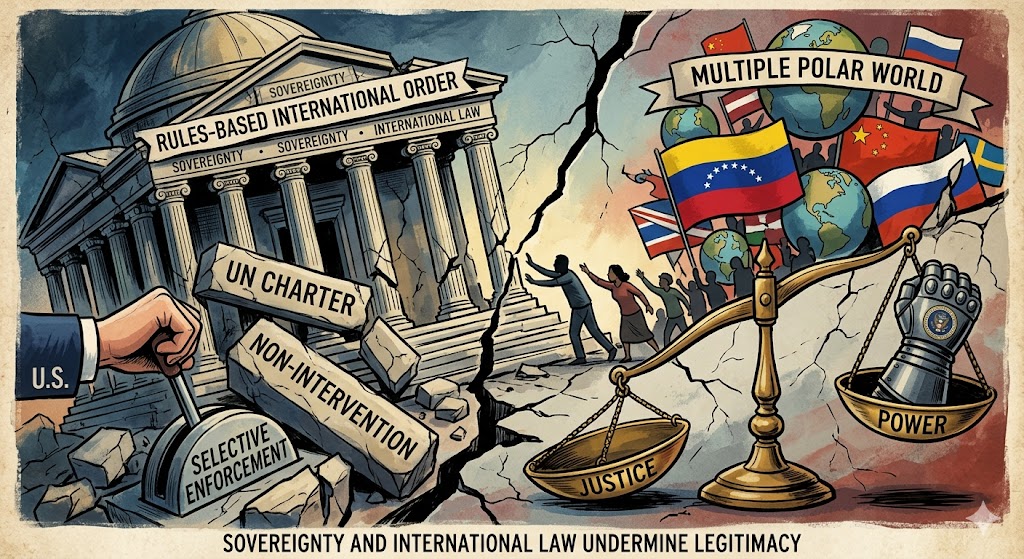
International politics is governed by the rules-based international order (RBIO) post-Westphalian system. The concepts of sovereignty and non-intervention are well-established in the UN Charter and international law. The great power competition in international politics has always dismantled these norms from time to time in the name of national security and establishing democracy in the respective countries. But the US intervention in Venezuela, capturing the sitting President Nicolas Maduro, in the name of Narcoterrorism, is the final nail in the coffin of the rules-based international order. Venezuela, which holds the world’s largest proven oil reserves, constitutes a critical case for examining the interaction between energy geopolitics and international legal norms. Over the past decade, the United States policy towards Venezuela has involved a range of interventions, including unilateral sanctions, diplomatic coercion, and measures targeting the country’s oil sector, justified primarily through discourses of democratic restoration and accountability. This study evaluates the extent to which U.S. interventions in Venezuela conform to, or depart from, the legal and normative foundations of the rules-based international order. Adopting a qualitative case study methodology, the research undertakes a legal-normative analysis of relevant international law, including the UN Charter, customary international law, and principles governing unilateral sanctions. The analysis is situated within a critical liberal institutionalist framework, complemented by realist and Global South perspectives, to assess how power asymmetries shape the interpretation and enforcement of international rules.
The paper argues that while the RBIO remains formally intact, the selective and unilateral application of legal norms in the Venezuelan case contributes to its normative erosion and legitimacy deficit. The findings underscore broader implications for international law, global governance, and the sustainability of a rules-based order in an increasingly multipolar international system.
Keywords:
Rules-Based International Order, Sovereignty, International Law, US intervention, Venezuela
Literature Review (Theoretical Framework): Oil and Venezuela
1. Oil Dependence and the Venezuelan Political Economy
Venezuela relies heavily on oil, which has shaped both its economy and politics since large oil reserves were discovered in the 1900s. Oil revenue makes up a large share of Venezuela’s income and exports, making the country’s economy highly dependent on oil.
People who study this say that relying heavily on oil has made Venezuela vulnerable, in some ways. For example, it has not encouraged the country to develop its own industries and has made it rely too heavily on other countries to buy its oil. Venezuela’s oil dependence is an issue. Venezuela’s economy is still much shaped by oil.
Venezuela is a country that has a lot of oil. People who study this country think that having a lot of oil has actually made it harder for Venezuela to have a strong economy. When the price of oil goes up and down around the world, it affects how much money the government of Venezuela has to spend. This means that the government cannot always plan for the future because it does not know how much money it will have. Venezuela’s economy is very sensitive to what happens outside of the country, especially when the price of oil is low. This makes it hard for Venezuela to deal with times. Venezuela’s economy is still very dependent on oil. This makes it hard to make long-term plans.
2. The Resource Curse, Dutch Disease, and Economic Distortions in Venezuela
Venezuela’s economy has been studied a lot. The idea of Dutch Disease is used to understand what happened to Venezuela. When Venezuela earned a lot of money from oil, its currency became stronger. This made it harder for the farming and manufacturing industries to compete. Over time, this caused problems. Venezuela started to lose its ability to make things and had to import more. This made the country’s ability to produce things on its own even weaker. The Dutch Disease concept is useful to explain what happened to Venezuela’s economy.
People who study this stuff say that the money from oil was usually used to buy things or invest in things that would help the country grow. This made the economy get out of balance. All the money being in the oil business meant that not many people had a chance to participate in the economy, which made things very unequal. This also made Venezuela rely much on selling oil to other countries.
These problems with the economy are often said to be the reasons why Venezuela has been doing so badly for so long. The oil money is a part of the problem and the fact that Venezuela depends so much on oil exports is a major issue.
3. Rentier State Dynamics and Governance in Venezuela
The oil money had an impact on Venezuela and it went beyond just the economy. What happened was that the oil revenues changed the way the government worked and how it treated people. Oil revenues changed everything. The idea of a state is often used to understand why the government is not very accountable to the people. This is because the government got so much money from oil that it did not need to tax the people as much. When the government does not depend on tax money from its people, citizens have less influence over how the government is run. Oil revenues played a key role in this change.
Oil revenues helped governments keep people with subsidies and social programs when oil prices were high. The government also used oil money to help their friends and people who supported them. Some people think this is not a good thing. They think it made the government too powerful and hurt the country’s democracy. Over time the oil money was used to keep the people in charge in power rather than to make the country’s institutions stronger. This made it harder to know what the government was doing. Made the country less free. Rather than improving life for everyone, oil revenues helped consolidate political power. This is why oil revenues are a problem for the country’s democracy and transparency. Oil revenues helped the people in charge stay in power. They did not help the country become more democratic.
4. Resource Nationalism and the Role of PDVSA
Venezuela’s oil sector is really important when you talk about resource nationalism. This is especially true after the government got control under Chavismo. The state owned oil company, Petróleos de Venezuela S.A. (PDVSA) is seen as a tool for the government to have control over oil resources. People think
that when the government got control over Petróleos de Venezuela S.A. (PDVSA) changed what the company was trying to do.
People who support resource nationalism think that the government being in charge of oil allowed the money from oil to be used for things that help people. Others say that the government getting too involved hurt PDVSAs ability to do its job, manage its money and plan for the future. Some studies show that oil production went down, many skilled workers left and the equipment and buildings fell apart. These problems are connected to the issues with how the national oil company’s run. The national oil company, PDVSA, faced a lot of challenges.
5. Sanctions, External Pressure, and Energy Geopolitics
People are writing a lot about how international sanctions are affecting Venezuela’s oil sector and how the country manages its resources. The United States and other countries have put sanctions on Venezuela to limit the government’s access, to money from oil sales and to try to change the way they do things. Experts say that these sanctions have had some surprising and unexpected results. Venezuela’s oil sector is still feeling the effects of these sanctions.
Sanctions have not made the government of Venezuela weaker. Instead they have made the government stronger by reducing the ability of countries to watch what Venezuela is doing. This has led to secret trading between people. The government and security people have control over the money from oil sales. This has made it harder to know what the government is really doing with the money. Venezuela still has a lot of oil. This oil is very important to other countries. These countries are trying to get what they want from Venezuela by being friendly and offering them money and other things. Venezuela’s oil is still a part of how countries interact with each other.
6. Gaps in the Literature on Oil and Venezuela
Venezuela’s oil governance is still not fully understood, with a lot of research. One problem is that many studies look at either the problems that come with having a lot of oil or the effects of sanctions. They do not look at how these things work together over time. Another issue is that the current ways of thinking about this topic often do not consider how important it is for a government to be seen as legitimate when it comes to making changes and fixing institutions in the oil sector. Venezuela’s oil governance is an issue and we need to look at it in a more complete way.
We need to look at how Venezuela’s doing compared to other countries that rely on oil and are going through big changes. What happens to these countries when they get sanctioned and then the sanctions are lifted? We do not know enough about what happens to the institutions in these countries after the sanctions are gone.
Venezuela has a lot of oil. We want to know how this oil can help the country get back on its feet instead of making things worse. Venezuela’s oil wealth is a deal and we need to understand how it can be used to help the country recover.
In Sum, Venezuela’s economy and politics have been really affected by oil. The country relies much on oil, which makes the economy go up and down a lot. When oil prices change around the world Venezuela’s economy gets hurt.
What happens is that oil money makes other sectors weaker and it is not fair to everyone so some people have a lot and others do not have much. Venezuela’s oil has really changed the country.
The oil income had an effect on the government. It made the government less accountable to the people. This is because the government did not need to collect taxes from the people. As a result the people in power had control over everything. The money from oil was often used to keep those in power in control rather than to strengthen the country’s institutions. The government had a lot of control over PDVSA, which’s the state oil company and this made oil and politics very connected. The people in charge of PDVSA were not very good at their jobs so the amount of oil produced went down. Oil income is still a part of the problem and it affects the government and the people.
Studies also suggest that international sanctions did not significantly weaken the regime but instead reduced transparency and strengthened informal control over oil revenues. However, there is still limited understanding of how oil dependence, governance, and sanctions interact over time, especially in terms of recovery and institutional reform.
LITERATURE REVIEW (EMPIRICAL STUDIES)
Central to any analysis of Venezuela’s geopolitical landscape is Petróleos de Venezuela, S.A (PDVSA), which was established in 1976 after the nationalization of the Venezuelan oil industry. PDVSA is the state-owned oil and natural gas company that dominates the country’s economy in many ways. Since the early 20th century, Venezuela’s development path has been used as a main case study for the so-called “resource curse” and the “rentier state” model. This review try to bring together empirical evidence about sectoral displacements, political budget cycles, the technical decline of PDVSA, the impact of unilateral coercive measures (UCMs), and also the normative implications of Operation Absolute Resolve in January 2026.
The empirical literature points to the “resource curse” as a major reason for Venezuela’s weak economic performance, even though the country has very large oil reserves. Gregory Wilpert (2003) argued that the 1943 Hydrocarbons Act tied the government’s finances too closely with oil, which then caused “Dutch Disease”, this is where other sectors of the economy are pushed out. Agricultural output went down from about one-third of GDP in the 1920s to only 6% by the 2000s, while industrial production dropped from 50% of GDP in 1990 to around 24% by 1999. This strong dependence on oil rents created what is called a “fiscal illusion,” where governments spend a lot during boom times but later fall into a debt rent spiral when prices decline. As a result, foreign debt increased from 9% of GNP in 1970 to 53% by 1994. Alejandro Marquez-Velazquez (2019) continues this discussion by looking at Political Budget Cycles (PBC) in Venezuela. His study shows a negative relationship between real GDP per capita adjusted for terms of trade and real oil prices over a period of 55 years. He argued that high oil prices allowed governments, especially during the Chavista period, to centralize power and adjust spending to improve re-election chances, while ignoring long- term economic diversification and making the resource curse even worse.
PDVSA’s decline is often explained by the loss of workers after political conflicts in the early 2000s. Following the 2002–2003 strike, many employees were fired, including engineers and managers. This reduced the company’s experience and made oil production more difficult. Since Venezuela’s oil is heavy and hard to process, losing skilled workers likely played a role in lower production levels over time. Oil output eventually fell a lot compared to the late 1990s.
At the same time, PDVSA’s infrastructure began to deteriorate. Refineries and pipelines were not properly maintained, and some facilities operated far below capacity. Fixing these problems would have required large investments, which the company did not have. The departure of foreign oil companies also reduced access to technology and support. Overall, even though Venezuela still had large oil reserves, PDVSA struggled to use them effectively, contributing to the country’s broader economic problems.
The Empirical Impact of U.S. Sanctions (2015–2025)
Many studies say that U.S. sanctions make a big problem for Venezuela’s economy. These sanctions was very strong shock and made the crisis go faster. One report by Luis Oliveros (2020) says that the crisis already started before 2017, but sanctions have stopped Venezuela from getting money and credit. Because of this, oil production goes down very fast, faster than before. PDVSA lost about 31 billion dollars between 2017 and 2020. Other studies also say that Venezuela loses too much oil money, even more than the country’s GDP, which make economy very weak.
Sanctions also affect people’s lives very badly. Venezuela uses oil money to buy most of its food and medicine from other countries. When the oil sector was banned in 2019, the country could not import enough food and medicine. This make shortage and very high inflation. Even if humanitarian help was allowed, banks were afraid to work with Venezuela and stopped many payments. Because of this, public services do not work well, and many people become poor. Reports say that more than 86% of people live in poverty now.
The 2026 Geopolitical Shift: Operation Absolute Resolve
Operation Absolute Resolve in January 2026 was a very serious event in world politics. Some writers say it breaks the rules of international law. Richard Falk writes that the U.S. takes President Maduro by force, and this shows that strong countries do not always follow rules. He says that the law is used only when it is good for powerful states. Many legal experts also say this action was not allowed by UN rules, because countries should not use force against other countries.
Some analysts say the U.S. uses old ideas like the Monroe Doctrine to explain this action. This policy tries to stop other big countries like China and Russia from gaining influence in the region. Before the operation, there was military action, such as ships and air attacks, and many people died. Some scholars say this was very dangerous and illegal because there was no permission from the United Nations. This situation makes international law look weak and unclear for the future.
Market Realities and the Cost of Recovery
Even the big action in 2026 did not change the oil market very much. Some economists say the reaction was small. This is because Venezuela already produced very little oil before, less than 1% of the world’s oil. Also in 2025, there was too much oil in the world market. Because of this, oil prices stay almost the same, around 60 dollars per barrel. Some analysts say there was little fear in the market for a short time, but no big problem happened, so the price did not go up a lot.
The main problem now is how to fix Venezuela oil sector in the future. Many reports say it cost very high amount of money to increase oil production again. Even to add small amount of oil requires many billion dollars and a long time. To go back to the old production level would require much more money and many years. Venezuela also have very big debt to other countries and banks. This makes investors not want to put money there. Because of debt and high costs, oil recovery looks very difficult.
Methodology and Research Design
Research Design
This study follows a qualitative research design. The main aim is to understand how U.S. intervention in Venezuela affects the idea and practice of a rules-based international order. Since the research deals with international law, political behaviour of states, and norms such as sovereignty and non-intervention, it does not require numerical data. Therefore, a qualitative approach is more suitable than a quantitative one.
The study is conducted as a thematic case study. This means that one country is studied in depth to identify key themes and patterns related to the research problem. Venezuela is selected as the case because it holds the world’s largest proven oil reserves and has been subject to strong U.S. sanctions, diplomatic pressure, and political intervention. This makes Venezuela an important case for examining how international rules are applied, ignored, or selectively enforced in real-world politics.
Research Method
The study is based entirely on secondary data. No fieldwork, surveys, or interviews are conducted. Instead, the research relies on existing documents and written materials that are relevant to the topic.
The method used is legal and normative analysis, which helps examine whether
U.S. actions toward Venezuela align with international law, especially principles such as state sovereignty and non-intervention. Along with this, thematic analysis is used to identify recurring ideas across different sources. These themes include unilateral sanctions, power politics, selective rule enforcement, and humanitarian impact.
To ensure balance, the study considers different perspectives — including liberal, realist, and Global South viewpoints — so that the interpretation is not limited to one school of thought.
Data Sources
The research uses a wide range of secondary sources.
International legal documents such as the United Nations Charter, principles of sovereignty and non-intervention, and relevant UN resolutions form the legal base of the study.
Official sources include U.S. government policy statements, sanctions-related documents, and reports released by international organizations, especially the United Nations. These help in understanding official justifications and policy intentions.
Academic books and journal articles on international law, rules-based international order, U.S. foreign policy, and oil politics are used to provide theoretical and analytical support.
In addition, writings by Global South scholars are included to offer critical perspectives that challenge dominant Western interpretations.
Reports from human rights organizations and international law bodies are used to assess the humanitarian and legal consequences of sanctions and intervention.
Tools and Analytical Framework
The study uses qualitative analytical tools, mainly textual analysis and thematic analysis. Legal texts, policy documents, and official statements are carefully read and compared to identify common patterns and themes such as sovereignty, non- intervention, unilateral sanctions, and selective enforcement of international rules. The analysis is guided by liberal institutionalism, which views the international order as based on shared rules and institutions, and realist theory, which explains how powerful states may prioritise national interests over international norms.
The study also works with the assumption that U.S. actions toward Venezuela are influenced not only by democracy or human rights concerns but also by strategic and economic interests, particularly oil and regional influence.
No statistical or software tools are used, as the research does not involve numerical data.
Limitations of the Study
The study has certain limitations. Since it relies only on secondary sources, it does not include direct insights from policymakers or experts. The focus on a single case — Venezuela — limits the ability to generalize the findings to other countries. Interpretation of legal and political texts may also reflect the researcher’s understanding, despite efforts to remain objective. Lastly, U.S.–Venezuela relations are continuously changing, which may affect the long-term relevance of the findings.
FINDINGS
1)Orinoco Belt Assessment Unit
Figure 1:USGS Orinoco Belt Assessment Unit
Figure 2: Venezuela Crude Oil Production
The data on Venezuelan crude oil (1999 to 2025) shows a continuous, structural decline from 2017 to 2021, rather than cyclical adjustments. From 1999 to 2007, production fluctuated within a relatively narrow band of approximately 2.8-3.4 million barrels per day (mbd), suggesting a stable productive capacity despite episodic shocks. Between2008 and 2013, the output moved towards a lower but stable mean of roughly 2.6–2.7 mbd, and entered a plateau phase. This indicates capacity constraints. From 2017, we can see a structural and continuous decline in production till 2020, falling from above 2.5 mbd to a trough near 0.4–0.5 mbd.
From 2021 to 2025, there is an incline in the production from 0.5 mbd to 1.0 mbd, showing a limited recovery.
1. IEA Oil 2020 Report
The IEA Oil 2020 report shows an outline of a global oil supply forecast through 2025, assuming that sanctions on producers like Venezuela remain unchanged. It suggests that the reduction in Venezuelan oil output is seen as a core obstacle on global supply and not a temporary disruption. The report shows that the global oil market can handle this loss without major issues, with non-OPEC producers, particularly the U.S., counteracting the loss. Venezuela’s reduced oil output is treated as a persistent element in baseline forecasts, indicating a lasting decline in productive capacity driven by prolonged sanctions. These sanctions have restricted Venezuela’s access to global markets, investment, and essential inputs, becoming a durable influence on production rather than a temporary disruption.
This highlights the persistent effects of sanctions on Venezuela’s oil sector, which is unable to recover to pre-sanction levels, and shifts global oil supply dynamics.
2. The U.S. Charges Against Nicolás Maduro and Strategic Implications for Venezuela’s Oil Industry
In early January 2026, U.S. forces launched a major operation that led to the capture of Venezuelan President Nicolás Maduro and his wife, Cilia Flores. This move came after years of accusations against Maduro, including charges of narco- terrorism, cocaine trafficking, and illegal arms possession, which had first been brought against him in a 2020 federal court case in Manhattan. Maduro has consistently denied the allegations, calling the operation a kidnapping and insisting on his innocence. Nevertheless, the U.S. pressed ahead with the charges, framing them as part of its broader fight against drug trafficking in the region. Alongside the criminal charges, the U.S. made clear its plans to take control of Venezuela’s vast oil reserves—home to nearly a fifth of the world’s total proven crude. Despite these reserves, Venezuela’s oil production has fallen sharply, from a peak of 3.5 million barrels per day to just 1 million today. With this decline in output, the U.S. intends to restore Venezuela’s oil industry with investments from American oil companies. This operation is not just about legal charges; it’s part of a bigger geopolitical struggle over Venezuela’s natural resources and represents a significant shift in the global oil market, with the U.S. aiming to revitalize Venezuela’s nationalized oil sector. At its core, this situation underscores how politics, sanctions, and resource control are deeply intertwined in shaping modern international relations and economic strategies.
3. Historical Cases of U.S. Sanctions
Joseph S. Nye’s 2009 article, “The Future of American Power: Dominance and Decline in Perspective,” explores how global power dynamics are shifting in the 21st century. Nye argues that while the U.S. still holds significant power, its dominance is increasingly challenged by emerging nations like China and India. He emphasizes that global interdependence has made unilateral actions less effective, and the U.S. must adapt to this new reality. Nye introduces the concept of soft power, which is about influence through attraction rather than coercion, and he suggests that this is becoming just as important, if not more, than traditional hard power (like military and economic strength). Although U.S. military power remains important, Nye believes that America’s future ability to lead will depend on its soft power—including cultural influence, diplomacy, and strong global partnerships. For those studying U.S. foreign policy, Nye’s work offers key insights into how American power might evolve, especially in relation to resource control and international governance. This approach helps explain why the U.S. may use a combination of both hard and soft power in actions like sanctions or interventions, as seen in cases like Venezuela, where global influence is shaped by complex geopolitical shifts
4. Oil production in Venezuela
Venezuela’s oil potential
The kind of oil Venezuela is sitting on — heavy, sour crude — requires special equipment and a high level of technical prowess to produce. International oil companies have the capability to extract and refine it, but they’ve been restricted from doing business in the country.
The United States, the world’s largest oil producer, has light, sweet crude, which is good for making gasoline but not much else. Heavy, sour crude like the oil from Venezuela is crucial for certain products made in the refining process, including diesel, asphalt and fuels for factories and other heavy equipment. Diesel is in tight supply around the world — in large part because of sanctions on Venezuelan oil.
Venezuela’s oil is predominantly heavy, sour crude, especially within the vast Orinoco Oil Belt (Orinoco Petroleum Belt), making it dense, viscous, and sulfur- rich, requiring specialized, costly extraction and refining; while some lighter grades exist, the bulk is extra-heavy bitumen similar to Canadian oil sands, often blended with lighter diluents for transport. Key grades include Hamaca (Heavy) and Merey (Heavy), with Boscan being extra-heavy.
-
A New Twist on the Monroe Doctrine
The 2026 U.S. military operation in Venezuela, which led to the capture of President Nicolás Maduro, reflects a modern take on the Monroe Doctrine. Originally introduced by President James Monroe in 1823, the doctrine warned European nations to stay out of the Western Hemisphere, essentially making the
U.S. the dominant power in the region. Today, the doctrine is being updated to address the rising influence of countries like China and Russia in Latin America, particularly in Venezuela, which holds vast oil reserves. The operation not only showed the U.S.’s military superiority over Russian and Chinese weaponry, but it also highlighted the growing role of electronic warfare, where the U.S. was able to disrupt Venezuela’s communications and infrastructure. By capturing Maduro, the
U.S. aimed to cut off Venezuela’s ties to China and Cuba while pushing to reopen the country’s oil industry to global markets. This would potentially lower oil prices and shift the balance of power in the region. Ultimately, this operation is less about just Venezuela and more about reasserting U.S. dominance in the Western Hemisphere—echoing the Monroe Doctrine’s original idea but with a 21st-century focus on global competition, resources, and technological warfare.
8) World-wide proven oil reserves
The above image shows the worldwide proven crude oil reserve as of 2023. The image shows that the global proven oil reserve stands at approx 1.73 trillion barrels. Here we can see Venezuela, Saudi Arabia, Iran, and Canada hold more than half of the world’s oil. Here we can see Venezuela holds 303.22 billion barrels (Bbbl).
ANALYSIS AND DISCUSSION
-
Realism and Resources: The Strategic Denial of Oil
Beyond official narratives of “democratic restoration,” Venezuela presents a case that aligns closely with realist interpretations of international relations.
Realism tells us that for great powers, survival depends on controlling key resources.
Venezuela isn’t just a political rival; it is the custodian of the world’s largest proven oil reserves, roughly 300 billion barrels.
From this perspective, U.S. policy looks less like law enforcement and more like “strategic denial.” The goal isn’t necessarily for the U.S. to own Venezuelan oil, but to ensure that rivals like China and Russia cannot control it. By imposing sanctions on PDVSA (the state oil company), Washington effectively removed a massive competitor from the energy board.
The Data:
The economic impact of this strategy is visible in the production numbers. As detailed in energy market analyses, Venezuela’s oil output has suffered a “structural collapse.”
Production plummeted from a peak of over 3 million barrels per day (bpd) in the late 1990s to less than 1 million bpd in recent years.
This suggests that the “Rules-Based Order” is often operationalized as a “Resource-Based Order” in the contemporary world, where economic warfare is used to choke the lifelines of adversaries, regardless of the humanitarian cost.
2. The Institutional Crisis: Unilateralism vs. The UN Charter
The Liberal Institutionalist framework relies on the idea that all states, big or small, play by the same rulebook, primarily the UN Charter. The Venezuelan crisis, however, highlights a breakdown in this order: the rise of Unilateralism.
Under Article 2 of the UN Charter, states are sovereign and equal. Yet, by recognizing an interim government and bypassing the sitting president, the U.S. sidestepped the United Nations entirely. The real friction point here is the use of “secondary sanctions”punishing third-party countries for trading with Venezuela.
The Indian Perspective:
Suhasini Haidar, the Diplomatic Editor, has frequently argued that these sanctions force neutral nations to sacrifice their “Strategic Autonomy.” India, for instance, didn’t stop importing Venezuelan oil because of a policy disagreement with Caracas; it stopped to avoid getting hit by U.S. financial penalties. As Haidar points out, when U.S. domestic law starts overriding international trade laws, it leaves developing nations with little choice but to comply, eroding the very sovereignty the UN is supposed to protect.
3. Constructivism: The “Narcoterrorist” Narrative
International politics isn’t just about guns and oil; it is also about the stories we tell. Through the lens of Constructivism, we can see how the U.S. redefined the conflict by changing the identity of its adversary.
When the U.S. Department of Justice indicted Nicolás Maduro for “narcoterrorism” and placed a $15 million bounty on his head, they weren’t just prosecuting a crime; they were constructing a new reality. By labeling a sitting head of state as a common criminal, they stripped him of Sovereign Immunity, the diplomatic shield that usually allows leaders to talk even during war.
The Global South Fear:
This move set a chilling precedent. Stanly Johny, the International Affairs Editor, has analyzed this trend as a re-emergence of an “imperial script.” He argues that if a superpower can unilaterally label a foreign leader a “terrorist” or “criminal” to justify intervention, then no leader in the Global South is safe. It transforms international law from a shield for the weak into a sword for the strong.
4. Synthesis
Any international system works only as long as states believe that the rules apply in a reasonably consistent manner. Once that belief weakens, the system may continue to exist on paper, but it loses authority in practice.
The Venezuelan case reflects this problem clearly. Venezuela was punished in the name of democracy and accountability, while similar democratic shortcomings in allied states were largely ignored.
This selective application of rules inevitably undermines trust in the rules-based international order.
What the Trump administration did to Venezuela was often portrayed as a sharp break from the past, but in many ways it was not new. U.S. intervention in oil-rich regions, the use of sanctions, and the willingness to bypass multilateral processes have long been features of American foreign policy, from the Cold War in Latin America to interventions in the Middle East.
Trump’s approach differed less in substance than in style. He was more direct, less diplomatic, and far more open about using economic pressure as a tool of coercion. The underlying logic, however, remained familiar.
This continuity matters because it suggests that the problem is structural rather than personal. When rules are enforced selectively over time, trust does not collapse overnight, but it slowly erodes. Venezuela, in this sense, is not an isolated case but part of a broader pattern where power and strategic interests shape how international norms are applied. The danger for the international system is that once states stop trusting the rules, they begin to see them as optional, and the idea of a rules-based order itself becomes increasingly fragile.
5. Data Collection, Case Studies & Findings
- Data Collection Strategy and Reliability
To rigorously assess the hypothesis that Venezuela’s survival mechanisms challenge the “rules-based international order,” this research employs a mixed- methods approach. Given the
opacity of official state metrics, where the Central Bank of Venezuela (BCV) frequently delays or suppresses inflation data, a triangulation strategy was adopted.
- Quantitative Data: Aggregated from secondary sources, including the Organization of the Petroleum Exporting Countries (OPEC) Monthly Oil Market Reports (MOMR) and the International Monetary Fund (IMF) World Economic Outlook. This ensures that production and GDP figures reflect independent auditing rather than potentially politicized state
- Qualitative Case Evidence: Derived from maritime tracking databases (e.g., Lloyd’s List Intelligence) and investigative reports on sanctions evasion to reconstruct the logistical networks of the “Shadow Fleet.”
- Socio-Economic Indicators: Sourced from the Encuesta Nacional de Condiciones de Vida (ENCOVI), an independent academic survey conducted by UCAB, serving as the only reliable proxy for official census data since 2014.
5.2 The Collapse of the Rentier Model (Quantitative Analysis)
The data reveal a stark correlation between the tightening of international rules (sanctions) and the collapse of Venezuela’s formal economy. As illustrated in Figure 1 (see charts above), the trajectory of oil production mirrors the contraction of GDP, validating the state’s structural over-dependence on hydrocarbon rents.
Table 1: Chronology of Decoupling (2013–2024)
Source: Compiled from OPEC
Secondary
Sources and the US Treasury Dept.
| Year | Avg. Production (mbpd)* | Key Geopolitical Event | Economic Consequence |
| 2013 | 2.38 | Maduro Presidency Begins | Baseline production; high oil prices mask
inefficiencies. |
| 2015 | 2.28 | E.O. 13692
Declared |
US declares
“extraordinary threat”; investment cools. |
| 2017 | 1.91 | Financial Sanctions | Restricted access to US debt
markets; default on bonds. |
| 2019 | 0.79 | Oil Embargo (PDVSA) | Total exclusion from US markets; exports diverted to
Asia. |
| 2020 | 0.51 | Secondary Sanctions | Historic low; reliance on
“Shadow Fleet” becomes systemic. |
| 2022 | 0.68 | Chevron License (GL 41) | Partial return of formal Western
activity due to Ukraine War. |
| 2024 | 0.88 | Sanctions Snapback | Stabilization of “grey market” exports (~60% of total). |
*mbpd = Million Barrels Per Day.
Finding: The “Maximum Pressure” campaign (2017–2020) successfully degraded Venezuela’s capacity to participate in the formal global economy (GDP contraction of ~75%), but failed to induce the political collapse predicted by liberal institutional theory.
These tankers are often registered in countries such as Liberia or Panama and are controlled through shell companies, making it difficult to trace their real ownership.
The Process
First, tankers entering Venezuelan waters switch off their Automatic Identification Systems (AIS), preventing real-time tracking. Oil is then transferred at sea through ship-to-ship operations, usually near Malaysia or along the West African coast. After this, the cargo is moved to vessels that appear legally compliant.
Finally, the oil is relabelled under names such as “Malaysian Blend” or “Bitumen Mixture.” This disguises its Venezuelan origin and allows it to be sold to independent refineries, particularly in China.
Case Study B: The Iran–Venezuela Swap Agreement (2021)
By 2021, Venezuela faced serious shortages of diluents, which are necessary for transporting heavy crude from the Orinoco Belt. To address this problem, it entered into a formal swap agreement with Iran.
Under this arrangement, Iran supplied condensate, while Venezuela provided heavy crude in return. This exchange allowed both countries to continue oil production despite international restrictions.
Strategic Significance
This agreement reflects a form of cooperation among sanctioned states. Since both Iran and Venezuela are subject to US sanctions, their transactions take place outside the Western financial system. As a result, the rules and monitoring mechanisms of that system have limited influence over such deals.
This case highlights how cooperation between sanctioned countries can reduce the practical impact of international economic pressure.5.4 Socio- Economic Findings: The Humanitarian Cost
The disconnect between the regime’s survival and the population’s welfare is the most critical finding. Figure 2 (see charts above) illustrates the inverse relationship between oil revenue and poverty rates.
Table 2: Comparative Socio-Economic Indicators
Source: IMF WEO (2024) & UCAB ENCOVI (2023/24).
| Indicator | Pre-Crisis (2013) | Crisis Peak
(2019/20) |
Current (2024) |
| Oil Revenue | ~$85 Billion | ~$5 Billion | ~$19 Billion |
| Poverty Rate | 33.1% | 96.2% | 82.0% |
| Inflation | 40.6% | >65,000% | ~50-190% |
Critical Observation: The most important finding from this data is the clear gap between the government’s ability to survive and the living conditions of ordinary people. While the state has managed to remain in power, the welfare of the population has continued to decline. Figure 2 shows a clear inverse relationship between oil revenues and poverty levels: as oil income fell, poverty increased sharply.
A comparison of key socio-economic indicators further highlights this trend. Before the crisis in 2013, oil revenues were around $85 billion and poverty affected about one-third of the population. At the peak of the crisis in 2019–20, oil revenues dropped to nearly $5 billion, while poverty rose to more than 96 percent. Although revenues have partially recovered to around
$19 billion in 2024, poverty remains extremely high at over 80 percent. Inflation also remains unstable, reflecting continued economic insecurity.
The most striking point is that while oil revenues collapsed by nearly 94 percent at the height of the crisis, poverty levels almost tripled. Instead of weakening the political system, sanctions appear to have had an unintended effect. By damaging the broader economy, they increased people’s dependence on government-controlled welfare programmes such as CLAP food boxes. This reduced the space for independent civil society action and made large-scale public resistance more difficult
CONCLUSION
The crisis in Venezuela illustrates how oil, power, and intervention intersect to challenge the foundations of the rules-based international order. While framed in the language of democracy and law enforcement, U.S. actions reveal the enduring primacy of strategic and economic interests when vital resources are involved. The inability of international institutions to meaningfully constrain or adjudicate this intervention signals a deeper transformation in global governance.
For scholars and policymakers alike, Venezuela serves as a cautionary case: unless rules are applied consistently and collectively, the RBIO risks becoming a rhetorical façade masking a return to power-centric international politics.
This paper examined U.S. intervention in Venezuela to understand what it reveals about the current condition of the rules-based international order. Using Venezuela as a case study—given its immense oil wealth and prolonged exposure to sanctions and coercive diplomacy—the analysis shows a growing gap between the principles that formally govern international politics and how power actually operates in practice.
At the heart of this gap lies the selective application of international rules. While sovereignty and non-intervention remain central to the UN Charter, the Venezuelan case demonstrates how these norms can be bent, reinterpreted, or ignored when they conflict with the strategic interests of powerful states. U.S. sanctions, diplomatic pressure, and ultimately the 2026 military operation were justified in the language of democracy, accountability, and security, yet they unfolded largely outside multilateral legal frameworks. For Venezuela, the consequences have been severe: economic collapse, deep humanitarian suffering, and a long-term weakening of its oil sector, despite holding the world’s largest proven reserves.
Looking through a realist lens, Venezuela’s experience is not surprising. Control over energy resources and the desire to limit the influence of rivals such as China and Russia have clearly shaped U.S. policy choices. From this perspective, the rules-based order functions less as a neutral system of law and more as a flexible instrument of power. Liberal institutionalist expectations— that international institutions would constrain unilateral action—appear increasingly fragile, while constructivist insights help explain how narratives such as “narcoterrorism” were used to delegitimize a sitting head of state and lower the political cost of intervention.
REFERENCES
Bull, H. (1977). The anarchical society: A study of order in world politics. Columbia University Press.http://slantchev.ucsd.edu/courses/ps240/03%20Anarchy,%20Hierarchy,%20and%20Sovereignty/Bull%20-%20The%20Anarchical%20Society%20(Ch%201-3).pdf
Council on Foreign Relations. (2023). Venezuela’s crisis. https://www.cfr.org/backgrounder/venezuela-crisis
Energy Information Administration. (2023). U.S. imports of crude oil from Venezuela. https://www.eia.gov
Galtung, J. (1969). Violence, peace, and peace research. Journal of Peace Research, 6(3), 167–191. https://doi.org/10.1177/002234336900600301
Keohane, R. O., & Nye, J. S. (2012). Power and interdependence (4th ed.). Longman. Krasner, S. D. (1999). Sovereignty: Organized hypocrisy. Princeton University Press. Mearsheimer, J. J. (2001). The tragedy of great power politics. W. W. Norton & Company. OPEC. (2023). Annual statistical bulletin. https://www.opec.org
Organization of American States. (2019). Resolution on the situation in Venezuela. https://www.oas.org
Reuters. (2024). Venezuela’s PDVSA oil sales abroad hit $17.5 billion in 2024. https://www.reuters.com
Reuters. (2026, January 24). U.S. has taken oil seized from Venezuelan tankers, Trump says. https://www.reuters.com
Ruggie, J. G. (1998). What makes the world hang together? Neo-utilitarianism and the social constructivist challenge. International Organization, 52(4), 855–885. https://doi.org/10.1162/002081898550770
Sachs, J. D., & Warner, A. M. (2001). The curse of natural resources. European Economic Review, 45(4–6), 827–838. https://doi.org/10.1016/S0014-2921(01)00125-8
Strange, S. (1988). States and markets. Pinter Publishers.
United Nations. (1945). Charter of the United Nations. https://www.un.org/en/about-us/un- charter
United Nations General Assembly. (1962). Permanent sovereignty over natural resources
(Resolution 1803 [XVII]). https://digitallibrary.un.org
United Nations Security Council. (2025). Debates on the situation in Venezuela. United Nations Official Records.
Waltz, K. N. (1979). Theory of international politics. Addison-Wesley.
Financial Times. (2019, January 29). Why Venezuela matters so much to the US oil industry. https://www.ft.com
Financial Times. (2023, October 18). US eases sanctions on Venezuela in bid to boost global oil supply. https://www.ft.com
Guardian Staff. (2019, February 4). Venezuela crisis: Why the US is so interested in regime change. The Guardian. https://www.theguardian.com
Guardian Staff. (2022, November 27). Venezuela’s oil sector hopes for revival as US sanctions ease. The Guardian. https://www.theguardian.com
New York Times. (2019, January 24). The roots of Venezuela’s crisis. https://www.nytimes.com
New York Times. (2023, October 18). U.S. relaxes sanctions on Venezuela, allowing oil exports. https://www.nytimes.com
New York Times. (2024, April 10). Venezuela’s oil exports rise as sanctions enforcement loosens. https://www.nytimes.com
Washington Post. (2019, February 2). Why Venezuela has become a flash point in global politics. https://www.washingtonpost.com
Washington Post. (2023, October 19). Biden administration lifts some Venezuela sanctions amid oil concerns. https://www.washingtonpost.com
Wall Street Journal. (2020, March 27). U.S. indicts Venezuela’s Nicolás Maduro on narco- terrorism charges. https://www.wsj.com
Wall Street Journal. (2023, November 3). Venezuela’s oil flows return as geopolitics reshape energy markets. https://www.wsj.com
Congressional Research Service. (2022). Venezuela: Background and U.S. Relations. https://www.congress.gov/crs-product/R44841
Douhan, A. (2021). Report of the Special Rapporteur on the negative impact of unilateral coercive measures on the enjoyment of human rights, Alena Douhan, on her visit to Venezuela. UN OHCHR.
Escribano, G. (2026). Venezuela’s oil: evolution, scenarios and international repercussions. Real Instituto Elcano. https://www.realinstitutoelcano.org/en/analyses/venezuelas-oil-evolution- scenarios-and-international-repercussions/
Falk, R. (2026). The US attack on Venezuela and the collapse of international law. Al Jazeera.
Johny, S. (2026, January 5). Tragedy and farce: On the U.S. and Venezuela. The Hindu. https://www.thehindu.com/opinion/editorial/tragedy-and-farce-on- the-us-and-venezuela/article67706423.ece
Marquez-Velazquez, A. (2019). Developing countries’ political cycles and the resource curse: Venezuela’s case. Journal of Latin American Studies.
Oliveros, L. (2020). The Impact of Financial and Oil Sanctions on the Venezuelan Economy. Washington Office on Latin America (WOLA). https://www.wola.org/2020/10/new-report-us-sanctions-aggravated-venezuelas- economic-crisis/
Rodríguez, F. (2019). Sanctions and the Venezuelan Economy: What the Data Says. https://franciscorodriguez.net/wp-content/uploads/2023/10/quantifying- 1.pdf
United Nations. (1945). Charter of the United Nations. https://www.un.org/en/about-us/un-charter/full-text
Weisbrot, M., & Sachs, J. (2019). Economic Sanctions as Collective Punishment: The Case of Venezuela. Centre for Economic and Policy Research (CEPR).