
Authors: Apoorva Singh and Sujauddin
Abstract
One of the most discussed issues in current International Relations is the transformation of the international system from a largely unipolar order into an increasingly multipolar one.
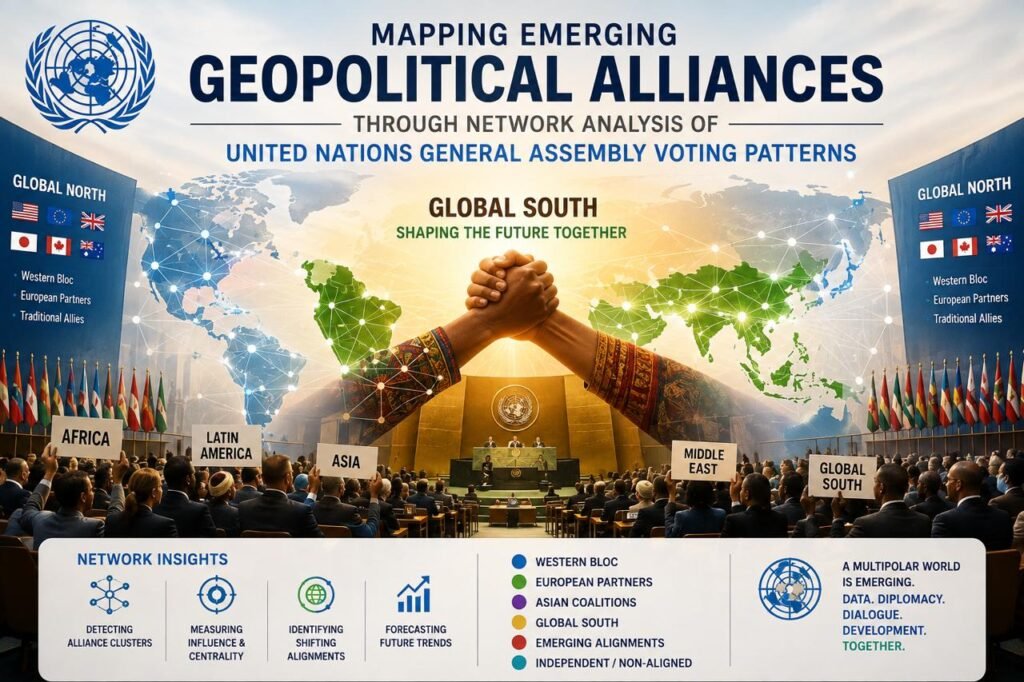
Traditional approaches to polarity have focused on material indicators such as military capabilities and economic power. This study takes a behavioral approach and investigates whether states’ diplomatic behavior in the United Nations General Assembly (UNGA) is evidence of an emerging multipolar order. The research uses voting records of the UNGA as a comprehensive longitudinal dataset and applies Social Network Analysis (SNA) to map patterns of diplomatic alignment, alliance formation, and geopolitical realignment among the 193 member states.
The study uses roll-call votes in the UNGA to construct voting similarity matrices and applies network metrics such as degree centrality, eigenvector centrality, and betweenness centrality, as well as the Leiden and Louvain community detection algorithms, to detect alliance clusters, bridge states, and changing cooperation patterns. The analysis also performs temporal comparisons across the post-Cold War, post-9/11, and contemporary geopolitical eras to explore structural changes in the international diplomatic network. In addition, the study examines issue-specific voting patterns on security, sovereignty, human rights, decolonization, development, and environmental governance to assess whether coalition structures remain consistent across different policy domains.
The results indicate that the current international system has emerged as an asymmetric form of multipolarity, rather than a revival of rigid bipolarity or a continuation of uncontested unipolar pre-eminence. The agenda-setting power of a cohesive Euro- Atlantic institutional core remains important, while the counter-network centred on China and Russia has increased in structural prominence. Meanwhile, new and middle powers such as India, Brazil, Indonesia, South Africa, Saudi Arabia, and Türkiye are taking on strategically crucial brokerage roles that connect competing geopolitical clusters through issue-specific diplomatic hedging rather than fixed alliance commitments. The findings also show how major geopolitical shocks—including the 2003 Iraq War, the 2014 Crimea crisis, and the Russia–Ukraine conflict—have accelerated network configuration by strengthening some alignments while encouraging strategic neutrality among many Global South states.
The study finds that contemporary multipolarity is best understood as a dynamic, networked system of overlapping coalitions, institutional persistence, and strategic autonomy rather than clearly defined power blocs. This research provides a new empirical framework for measuring the distribution of global power beyond traditional material capabilities by merging International Relations theory with network science. It contributes to ongoing discussions on polarity, alliance politics, and global governance. It also demonstrates the usefulness of computational network analysis for understanding the shifting architecture of international diplomacy and provides foundation for future AI-assisted real-time monitoring of geopolitical realignments.