Authors: Bhavesh Chadha, Shaun Daniel, Tanya Kumari and Rachaita Sarkar
Abstract
Since the launch of the “Make in India” initiative in September 2014, the Government of India has implemented higher import tariffs as a key strategy to reduce dependence on foreign goods, support local industries, and boost domestic manufacturing. This approach contrasts with the trade liberalization policies that were introduced after India’s 1991 economic reforms. This study examines India’s import tariff policies since 2014, assessing their impact on lowering import dependence and enhancing domestic production, while also addressing unintended outcomes such as rising trade deficits, conflicts with the World Trade Organization (WTO), and retaliatory measures from trade partners.
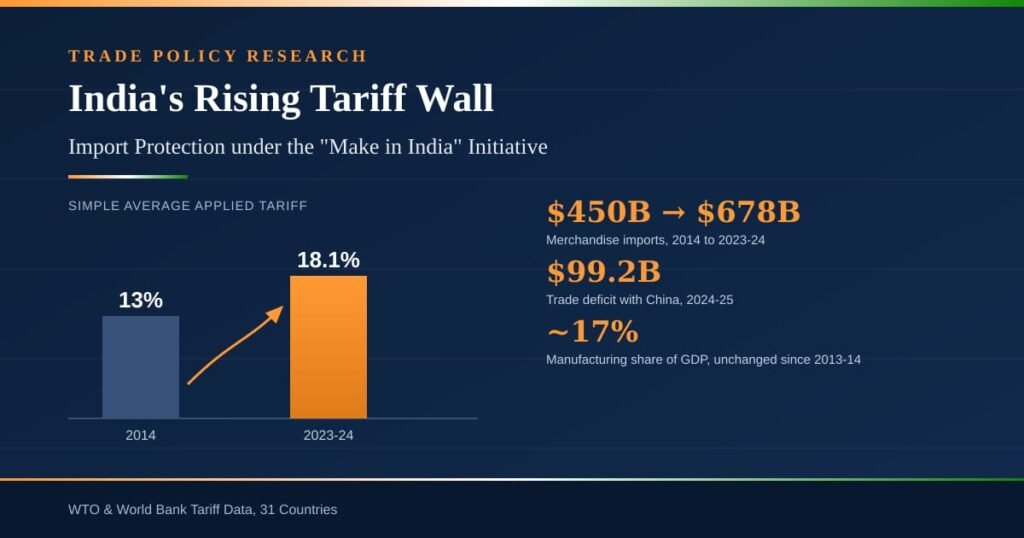
Key Findings: The average import tariffs in India increased more than double, from around 7% (tradeweighted) in 2014 to 12% in 2023-24, with the simple average rising from 13% to 18.1%. Tariffs were raised on about one-third of over 12,000 tariff lines. Despite these increases, merchandise imports grew from $450 billion in 2014 to $678 billion in 2023-24. The trade deficit with China reached $99.2 billion in 2024-25, while manufacturing’s contribution to GDP remained approximately 17%, well below the target of 25%. The mobile phone sector was the most successful, with domestic production rising from $3 billion to $26 billion, a 767% increase, and imports falling by 65%. However, sectors like medical devices, defence equipment, and advanced chemicals showed limited progress even with tariff protection. Several major disputes emerged, including a WTO ruling against India on ICT tariffs in April 2023. Although the tariff increases provided short-term benefits to certain domestic industries, the broader goals of reducing import dependence and promoting sustainable manufacturing growth have not been achieved. A more balanced approach combining targeted tariff increases with essential structural reforms is suggested.
Keywords: Make in India, Import Tariffs, Trade Policy, Manufacturing, Production Linked Incentive (PLI), Trade Deficit, World Trade Organization (WTO).