©Authors: Vinit Purohit, Mehar Uz Zoha, and Khushi Agarwal.
Abstract
On the eve of independence, the Indian subcontinent with its riveting issues in subsistence adopted socialistic tendencies which over the period of time translated into a significant transformation since the economic liberalization of 1991, moving from a predominantly multilateral orientation towards an increasingly diversified strategy involving Free Trade Agreements (FTAs) and Comprehensive Economic Partnership Agreements (CEPAs). This evolution raises an important question: Does increased market access under CEPAs necessarily translate into sustained trade expansion and broader economic gains for India?
In the contemporary scenario of trade tariff wars and shrinking democracy, the study offers a statistical analysis by examining India’s CEPA strategy through three interconnected dimensions: Trade expansion, Economic gains and Realized outcomes, specifically addressing the distinction between the benefits anticipated before and the outcomes actually observed afterwards. The study adopted a quantitative, empirical and comparative research design based entirely on secondary evidence. Five agreements are purposely selected to represent earlier and newer generations of India’s trade agreements: the India–Japan CEPA, India–South Korea CEPA, India–Mauritius CECPA, India–UAE CEPA and India–Oman CEPA.
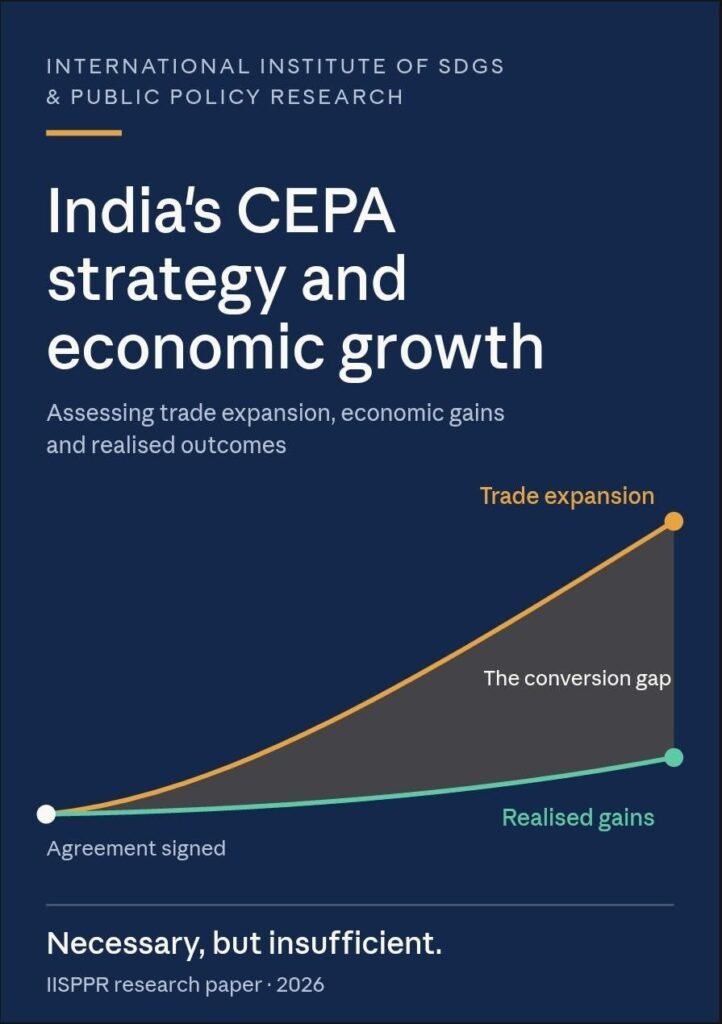
The study is guided by the proposition that tariff liberalization is a necessary but insufficient condition for achieving the full benefits of a CEPA. The study contributes to the existing literature by integrating prospective and post-implementation perspectives that have often been examined separately. Its findings are therefore interpreted as an assessment of outcomes associated with the selected agreements rather than as estimates of their exclusive causal effects. The study aims to fulfil the objective of ‘Strategic Indispensability’ as outlined in the Economic Survey 2026–27, with the future envisioned under the ‘Katho Upanishad’ with ‘Shriya’ (long-term vision).
Keywords:
India’s CEPA Strategy, Comprehensive Economic Partnership Agreements, Trade Expansion, Export Competitiveness, Trade Liberalisation, Market Access, Trade Balance, Economic Growth.
Introduction
Imagine a local manufacturer from Ahmedabad, the Manchester of India, running a household cotton garment factory who has been given an opportunity to sell his clothing in an international market with lower or negligible tariffs and is able to keep pace with the competition from neighbouring countries. Sounds fancy and idealistic, but the scenario remains far behind reality, where theoretical trade agreements become complicated in a practical world. The manufacturer may lack the production capacity to meet international demand, face difficulties in complying with rules of origin, encounter non-tariff barriers, or simply lack adequate information about the foreign market. In such a situation, the signing of a trade agreement creates market access, but market access alone does not guarantee that the opportunity will be converted into exports or wider economic gains. This distinction lies at the heart of the present study.
India’s approach to international trade agreements shifted drastically with the economic liberalization of 1991. In the initial phase, India relied substantially on multilateral institutions, particularly the World Trade Organization (WTO), reflecting a socialistic economic climate.
However, difficulties in advancing multilateral negotiations, together with the increasing importance of regional and bilateral economic arrangements, encouraged India to place greater emphasis on Free Trade Agreements (FTAs) and Comprehensive Economic Partnership Agreements (CEPAs). These agreements have progressively moved beyond conventional tariff reduction and now encompass wider issues such as services, investment, market access, supply-chain resilience, industrial development, rules of origin and, increasingly, geopolitical considerations.
Earlier agreements with countries and regional groupings such as ASEAN, Japan and South Korea were strongly associated with tariff liberalization and regional economic integration.
However, more recent agreements, including those with the United Arab Emirates (UAE), Australia and the European Free Trade Association (EFTA), reflect a wider strategic approach. Recent literature characterizes this as a shift towards a more pragmatic and relationship-driven trade policy, in which economic objectives intersect with industrial policy, supply-chain diversification and geopolitical strategy.
The rationale for entering into CEPAs is compelling. By reducing tariffs and improving market access, such agreements can potentially increase bilateral trade, stimulate exports, attract investment and generate employment and welfare gains. Quantitative studies provide evidence of these potential benefits. For instance, research on the India–Japan CEPA using trade-intensity analysis and a Computable General Equilibrium model suggests that tariff reductions could generate positive welfare effects and increase bilateral trade.
However, projected gains should not automatically be equated with realized gains. This is one of the most important concerns emerging from the existing literature. A model may estimate what could happen under a particular set of assumptions, whereas actual trade outcomes are shaped by domestic productive capacity, global economic conditions, exchange rates, commodity prices, geopolitical developments and the competitiveness of firms. Consequently, a reduction in tariffs can create an opportunity without necessarily ensuring that domestic producers possess the capacity to exploit it.
The India–UAE CEPA provides an especially useful contemporary case. As a member of India’s newer generation of trade agreements, the UAE agreement illustrates the changing scope of India’s trade policy. Studies have reported substantial potential for bilateral trade expansion, while other analyses have pointed to increases in merchandise trade and non-oil exports following implementation. Yet interpreting these developments requires caution. The UAE functions not only as a final consumer market but also as an important commercial and re-export hub connecting India with markets in the Middle East, Africa and Europe. Therefore, an increase in bilateral trade cannot by itself establish that the agreement has generated equivalent improvements in domestic productive capacity, employment, investment or economic welfare.
The effectiveness of a CEPA therefore depends not only on the concessions negotiated between governments but also on the ability of domestic firms and institutions to utilize those concessions. The literature identifies several conditions that can influence this process, including competitiveness, infrastructure, productive capacity, market information, non-tariff barriers, rules of origin and integration into international production networks. The relationship can consequently be understood as a chain: negotiated market access must first be converted into domestic utilization, which can generate an export response, followed by trade expansion and, potentially, wider economic effects.
Against this background, the present study examines India’s CEPA strategy with coherence, rather than assuming that an increase in bilateral trade represents policy success; it seeks to compare expected benefits with outcomes observed after implementation. The study compares earlier agreements involving Japan and South Korea with newer agreements involving Mauritius, the UAE and Oman. This comparative approach makes it possible to examine whether India’s newer generation of economic partnership agreements appears to address some of the structural difficulties associated with earlier agreements.
The central objective, therefore, is not merely to determine whether India’s CEPAs have increased trade. It is to examine whether negotiated market access has been effectively utilized, whether trade expansion has translated into broader economic gains, and whether realized outcomes correspond with the benefits anticipated at the time of negotiation. By making this distinction, the study seeks to contribute to a more comprehensive assessment of India’s evolving trade strategy and the conditions under which CEPAs can move beyond tariff liberalization to support export diversification, productive capacity, investment, employment and sustained economic growth.
Literature Review
India’s approach to international trade agreements has evolved significantly since the economic liberalisation of 1991. While India initially placed greater emphasis on the multilateral trading system and the World Trade Organization (WTO), its trade policy has increasingly incorporated bilateral and regional agreements, including Free Trade Agreements (FTAs) and Comprehensive Economic Partnership Agreements (CEPAs) (Dhar, 2022; Sharma, 2026). This shift reflects not merely a move from multilateralism towards bilateralism, but a broader recalibration of trade policy in response to changing economic and geopolitical conditions.
Recent literature suggests that India’s trade agreements increasingly extend beyond tariff reduction and regional integration to encompass objectives such as market access, investment, supply-chain resilience, industrial development, and strategic or geoeconomic interests (Sharma, 2026; Gurjar, 2026).
The existing literature can broadly be organised around four inter-connected themes. First, scholars examine the evolution and strategic rationale of India’s FTA and CEPA policy. Second, empirical studies have questioned how trade agreements affect bilateral trade, exports, economic output, employment and welfare. Third, post-implementation assessments of earlier agreements provide evidence that increased trade does not necessarily translate into proportionate export gains or improved trade balances. Finally, the literature increasingly highlights the domestic and institutional conditions that determine whether negotiated market access can actually be utilised. Together, these studies reveal an important distinction between the potential gains predicted at the time of negotiation, observed trade expansion and broader economic gains attributable to CEPA.
Theme 1. Evolution of India’s FTA and CEPA Strategy
Dhar (2022) provides an important starting point for understanding the evolution of India’s trade agreement strategy. His assessment of India’s FTAs with ASEAN, South Korea and Japan focuses particularly on whether the objectives associated with these agreements were realised after implementation. The study finds that tariff liberalisation positively affected the merchandise trade, but the gains were not equally favourable for India across all areas. For ASEAN, bilateral trade increased, accompanied by a significant increase in India’s trade deficit. Similarly, India’s position in the South Korean market remained relatively limited, while the India–Japan relationship did not experience the expected strengthening and India’s trade deficit with Japan widened. Thus, Dhar shows that securing preferential market access is only one part of the process — firms having the capacity to use that access effectively is another.
Dhar’s analysis also shows that India’s trade policy subsequently moved into a new phase of bilateral trade agreements from 2021, after deciding not to join the Regional Comprehensive Economic Partnership (RCEP). The India–UAE CEPA and India–Australia Economic Cooperation and Trade Agreement (ECTA) represented important elements of this renewed engagement. Dhar notes that the UAE agreement was broader in scope than several earlier agreements, including provisions relating to areas such as the digital economy and government procurement. This indicates that India’s newer agreements were not conceived solely around tariff reduction but increasingly involved wider economic and regulatory considerations. Sharma (2026) takes this argument further, describing India’s recent shift in trade policy from a WTO-centred approach towards a more pragmatic and relationship-driven FTA strategy. She distinguishes between an earlier generation of agreements involving ASEAN, Japan and South Korea and a newer generation involving partners such as the UAE, Australia and the European Free Trade Association. Compared to the earlier trade agreements, the newer agreements cover a wider range of issues. They place greater emphasis on services and investment, and also address areas such as rules of origin, supply-chain resilience, market diversification and domestic industrial development. Thus, Sharma suggests that India’s CEPA strategy is not simply an expansion in the number of trade agreements, but a change in trade policy in response to the limitations experienced under earlier agreements.
Gurjar (2026) takes a broader geo-economic view of India’s trade policy. He argues that India considers both economic and geopolitical factors when deciding whether and how to pursue trade agreements. Gurjar connects India’s rejection of RCEP and its emphasis on ‘Atmanirbharta’ with concerns surrounding China. At the same time, India has pursued FTAs with strategically important partners. According to him, these developments are closely associated with India’s broader economic and geopolitical strategy. India’s newer FTA partners — including the UAE, Australia, the UK and EFTA — are consequently viewed not only as markets but also as strategically significant partners.
Taken together, this literature shows that India’s CEPA strategy has evolved in both scope and purpose. Earlier agreements were primarily associated with tariff liberalisation and regional integration, whereas newer agreements increasingly combine trade objectives with investment, industrial development, supply-chain resilience and strategic considerations. This evolution is directly relevant to the present study because it raises the question of whether these broader objectives have translated into actual trade expansion and measurable economic gains.
Therefore, assessing India’s CEPA strategy requires moving beyond the existence or design of agreements to examine their realised outcomes and the extent to which their expected economic benefits have materialised.
Theme 2. Potential Trade and Economic Gains from CEPAs
A second strand of literature examines the potential economic gains generated by CEPAs, particularly through quantitative modelling. Bhattacharyay and Mukhopadhyay (2015) examine the India–Japan CEPA using trade-intensity analysis and a Computable General Equilibrium (CGE) model. Their findings indicate that India–Japan bilateral trade was relatively small despite the size and global importance of both economies, suggesting considerable scope for further expansion. The CGE simulations suggest that tariff reductions would lead to a small increase in output in both countries, with stronger growth projected in India’s exports to Japan than in Japan’s exports to India. Overall, the simulations indicate positive net welfare gains for both economies (Bhattacharyay & Mukhopadhyay, 2015). However, the study makes an important point beyond these positive projections. The authors argue that tariff reductions alone may not be enough to realise the full potential of the agreement — non-tariff barriers and other behind-the-border constraints can restrict trade, while structural reforms are necessary if both economies are to capture the projected gains. Lower tariffs can create new market opportunities; however, firms still need to be competitive enough to take advantage of them. Production capacity and institutional support also influence how much a country can benefit from the agreement.
The India–UAE CEPA literature provides similar positive expectations but employs different methodological approaches. Ismail and Ahmed (2025) use a CGE framework based on the GTAP database. Their results indicate gains in manufacturing output in both countries, increased demand for unskilled labour in India, higher global exports across commodity groups and substantial increases in bilateral exports. They conclude that tariff liberalisation under the CEPA could generate welfare gains for both countries, while cautioning that sensitive-list provisions and possible misuse of rules of origin could influence the magnitude and distribution of these gains (Ismail & Ahmed, 2025).
Overall, these studies suggest that CEPAs could have positive effects on trade and economic outcomes. However, their methodologies measure different dimensions of economic gain. CGE models estimate changes in output, employment, exports and welfare under specified assumptions, while gravity-based analysis estimates potential bilateral trade. Consequently, the literature establishes that CEPAs can generate substantial economic opportunities, but does not by itself establish whether those predicted gains will actually materialise after implementation (Saeel & Chandran, 2025).
Theme 3. From Potential Gains to Realised Outcomes
The distinction between expected and realised outcomes is therefore central to the literature. However, Dhar (2022) offers a different perspective from the positive projections found in the model-based studies. His analysis of ASEAN, South Korea and Japan suggests that increased trade following liberalisation did not necessarily result in proportionate export gains or stronger positions for Indian exporters in partner markets. In other words, trade expansion occurred, but the distribution and composition of that expansion mattered.
This creates an important analytical contrast with Bhattacharyay and Mukhopadhyay’s prospective India–Japan analysis. The latter estimates positive effects under a modelled tariff-reduction scenario, whereas Dhar’s later post-implementation assessment raises questions about whether the broader trade relationship subsequently developed in line with such expectations. The difference between these findings does not simply reflect the different approaches used by the studies; rather, it demonstrates the distinction between a counterfactual modelled outcome under specified assumptions and an observed outcome shaped by actual economic, institutional and geopolitical conditions.
The India–UAE CEPA provides an especially valuable case for examining this distinction because it belongs to India’s newer generation of agreements. Sharma (2026) reports substantial growth in India–UAE merchandise trade and non-oil exports following implementation, presenting the UAE agreement as evidence of the changing nature of India’s trade strategy. However, the rise in bilateral trade cannot be attributed to the CEPA alone.
Global demand, commodity prices, exchange rates, domestic production and geopolitical developments may also have influenced trade.
T
hus, higher bilateral trade shows expansion, but does not by itself prove that the CEPA caused broader economic growth. This is particularly relevant for the UAE, which acts not only as a final market but also as a major commercial and re-export hub linking India with markets in the Middle East, Africa and Europe. Saeel and Chandran (2025) similarly emphasise the UAE’s role as a gateway and supply-chain hub. Therefore, assessing the quality of India’s export expansion requires consideration of sectoral composition, domestic value addition and the extent to which exports represent final demand rather than intermediary or re-export activity.
Theme 4. Determinants of CEPA Effectiveness
Across the literature, one common conclusion emerges: tariff liberalisation is a necessary but insufficient condition for realising the benefits of a CEPA.
Bhattacharyay and Mukhopadhyay (2015) emphasise structural reforms and the removal of non-tariff and behind-the-border barriers. Ismail and Ahmed (2025) draw attention to sensitive lists and rules of origin, while Saeel and Chandran (2025) emphasise comparative advantage, trade complementarity and sectoral competitiveness. Dhar (2022), meanwhile, points towards India’s domestic competitiveness and inadequate integration into international production networks as important explanations for the disappointing performance of earlier agreements.
This suggests a broader causal mechanism:
Negotiated market access → domestic capacity to utilise preferences → export response → trade expansion → wider economic effects.
The agreement is only one part of the process. If domestic producers lack competitiveness, adequate infrastructure, productive capacity or market information, they may not be able to fully use the preferential access provided by the agreement. Conversely, where trade liberalisation is supported by domestic industrial policy and firms possess the capacity to respond, the same market access may generate stronger export outcomes.
Sharma’s (2026) analysis is particularly relevant in this respect because she connects India’s newer FTA strategy with domestic industrial policies. Newer CEPAs are therefore likely to work better when domestic production policies complement the market access secured through trade negotiations. This provides a possible explanation for why India’s newer generation of agreements could produce different outcomes from earlier FTAs, although this proposition requires systematic empirical testing.
Research Gap
The literature therefore reveals three important patterns. First, there is considerable agreement that India’s trade strategy has evolved from an earlier emphasis on regional integration and tariff liberalisation towards a broader CEPA strategy incorporating investment, services, supply chains, industrial policy and geopolitical considerations. Sharma (2026) and Gurjar (2026) particularly emphasise this strategic transformation.
Second, quantitative studies generally identify significant potential gains from CEPAs. The India–Japan CGE analysis predicts positive effects on exports, output and welfare, while the India–UAE literature identifies potential gains in output, employment, welfare and bilateral trade. However, these studies predominantly examine potential or simulated outcomes, rather than establishing whether the predicted gains are subsequently realised.
Third, evidence from implemented agreements presents a more complex picture. Dhar (2022) demonstrates that increased trade under earlier agreements did not necessarily produce proportionate improvements in India’s export position. This indicates that trade expansion and economic gain are not synonymous. A CEPA may increase the volume of trade while simultaneously widening a trade deficit, generating uneven sectoral effects or producing limited gains in domestic productive capacity.
These observations reveal several gaps in the existing literature. First, the literature remains divided between studies of potential effects and studies of realised trade outcomes, with limited integrated analysis connecting expectations with outcomes observed after implementation. Second, post-implementation assessments tend to focus heavily on merchandise exports, imports and trade balances, while broader economic dimensions such as investment, employment, productivity, domestic value addition, services and welfare receive less integrated treatment. Third, although recent literature identifies a qualitative shift in India’s CEPA strategy, there is insufficient comparative evidence establishing whether the newer generation of agreements is actually producing more favourable outcomes than the earlier generation. Finally, the link between growing trade and a stronger economy is still unproven. Increased bilateral trade cannot automatically be equated with economic growth; its developmental significance depends on the composition of trade, domestic value addition, productivity, employment, investment and the distribution of gains.
The central gap, therefore, lies in the need to move beyond asking whether a CEPA increases trade towards examining whether negotiated market access is converted into sustained trade expansion and broader economic gains, and whether those realised outcomes correspond with the benefits anticipated when the agreement was negotiated.
The present study seeks to address this gap by examining India’s CEPA strategy through three connected dimensions: trade expansion, economic gains and realised outcomes. Rather than treating an increase in bilateral trade as sufficient evidence of success, the study distinguishes between the trade potential identified in the literature, the trade expansion observed following implementation, and the broader economic effects associated with that expansion.
This approach is particularly relevant to the comparison between India’s earlier agreements with partners such as Japan and South Korea and its newer CEPAs, particularly the India–UAE CEPA. The earlier literature provides evidence of both unrealised expectations and structural constraints, while newer studies indicate stronger potential and early signs of trade expansion. Examining these strands together can help determine whether India’s revised CEPA strategy represents a meaningful improvement over the earlier generation of FTAs or merely a continuation of the challenge associated with converting preferential market access into export competitiveness.
The study therefore positions itself at the intersection of trade-policy evaluation and economic-growth analysis. Its central concern is not simply whether India has signed effective trade agreements, but whether the market access negotiated through those agreements has been effectively utilised and translated into durable economic gains for India. Such an assessment can contribute to understanding the conditions under which CEPAs can move beyond tariff liberalisation to support export diversification, productive capacity, investment, employment and ultimately broader economic growth.
Methodology
1. Research Design
The study uses a comparative explanatory design based on secondary evidence. Its purpose is to examine what happened after selected Indian trade agreements were implemented, rather than treating the signing of an agreement or an increase in bilateral trade as evidence of success by itself. The analysis therefore brings together three related aspects: the expansion of trade, the wider economic effects associated with that expansion, and the difference between benefits anticipated before or around implementation and outcomes observed afterwards.
The comparison covers India’s agreements with Japan and South Korea as earlier cases and India–Mauritius CECPA, India–UAE CEPA, and India–Oman CEPA as newer cases. This design is suited to the research gap identified in the literature review, which calls for greater integration between studies of potential gains and evidence on realised outcomes. The comparison also allows the study to examine whether the newer generation of agreements appears to address some of the difficulties associated with earlier agreements.
2. Nature of Research
This study is quantitative, empirical, and comparative. It uses observable trade and economic indicators to examine changes associated with the selected agreements. At the same time, published studies and official documents are used to establish what benefits were expected and to interpret the changes seen in the data. The approach does not assume that higher bilateral trade automatically means higher economic growth. The literature review indicates that trade may expand while export competitiveness, sectoral outcomes, or domestic productive capacity remain uneven — as demonstrated by Dhar’s (2022) assessment of India’s ASEAN, South Korea, and Japan agreements, where tariff liberalisation increased trade volumes without producing proportionate export gains for India.
Similarly, Bhattacharyay and Mukhopadhyay (2015) caution that tariff reductions alone are
unlikely to translate into full economic gains without accompanying structural reforms and firm-level competitiveness. The study therefore considers trade expansion alongside broader indicators of economic gain, rather than treating the two as equivalent.
3. Sample and its Technique
The unit of analysis is the selected India–partner trade agreement and the economic outcomes associated with it. Five agreements have been selected purposively: the India–Japan CEPA, India–South Korea CEPA, India–Mauritius CECPA, India–UAE CEPA, and India–Oman CEPA.
The cases were selected because they allow the study to compare earlier and newer generations of India’s economic partnership agreements and because relevant evidence is available or identified in the literature review. The analysis will use the post-implementation performance of each agreement, together with the relevant pre-implementation or expected-outcome evidence. The precise observation period for each case will depend on the availability of comparable data.
4. Data Sources
The research relies on secondary data and documentary sources. The main evidence is drawn from official trade and economic statistics, government and agreement-related documents, reports of relevant international institutions, and scholarly studies identified in the literature review. Specifically, the study draws on:
● Department of Commerce, Government of India / DGCI&S (Directorate General of Commercial Intelligence and Statistics) — bilateral trade, export, and import data
● UN Comtrade Database — cross-verification of bilateral trade flows and commodity-level trade composition
● World Integrated Trade Solution (WITS), World Bank — tariff, trade composition, and revealed comparative advantage data
● RBI (Reserve Bank of India) database — foreign direct investment and balance-of-payments data
● Ministry of Statistics and Programme Implementation (MoSPI) — employment and sectoral output data
● ITC Trade Map — sectoral export performance and market diversification indicators
Official CEPA/FTA texts and government press releases — agreement provisions and expected-outcome benchmarks Data collection focused on information needed to compare expected and realised outcomes. This includes bilateral trade, exports, imports, and trade balance, along with available evidence on investment, employment, productivity, domestic value addition, and sectoral performance. The literature review was also used to identify projected or potential outcomes reported in earlier studies. The study used these findings as the basis for the expected-versus-realised comparison rather than reproducing the original models.
5. Variables Used
The analysis is organised around trade and broader economic outcomes rather than relying on a single measure of CEPA effectiveness. Where relevant, the following measurement methods are applied:
Trade indicators
● Trade Balance = Exports − Imports
● Bilateral Trade Growth Rate = [(Trade in year t − Trade in year t−1) / Trade in year t−1] × 100
● Export/Import Growth Rate = same formula applied separately to exports and imports
● Sectoral Trade Composition = share of a given sector’s exports (or imports) in total bilateral exports (or imports), expressed as a percentage
Broader economic indicators
● Revealed Comparative Advantage (RCA), following Balassa’s formula:
RCA = (X_ij / X_it) / (X_wj / X_wt), where X_ij is country i’s exports of product j, X_it is country i’s total exports, X_wj is world exports of product j, and X_wt is total world exports.
● Trade Intensity Index = (X_ij / X_it) / (M_wj / M_wt), used to assess the relative importance of the partner market for India’s exports
● Investment, employment, productivity, and domestic value addition are tracked using available official time-series data (pre- and post-implementation), compared descriptively rather than through a single standardised formula, given data availability constraints noted in the Limitations section.
A further analytical dimension is the comparison between expected and realised outcomes. Expected outcomes refer to gains identified or projected in the literature and relevant policy material, while realised outcomes refer to changes observed after implementation, measured using the indicators above. The study also compares the selected earlier and newer agreements on these dimensions.
6. Ethical Considerations
This study did not involve human participants, interviews, or personally identifiable information. It uses secondary information from public and published sources. Therefore, the main ethical requirements concern accurate reporting, appropriate citation, and responsible interpretation of the evidence.
Particular care will be taken to avoid presenting projected or modelled gains as realised outcomes. Similarly, an increase in bilateral trade will not be described as a direct effect of a CEPA without considering other factors that may have influenced the observed change.
7. Limitations
The study has several limitations. First, it depends on secondary data, and the availability and consistency of indicators may differ across agreements and years. This may limit direct comparison for some broader economic measures.
Second, the study cannot by itself establish that changes in trade or economic indicators were caused exclusively by the relevant CEPA. Other domestic and international developments may have contributed to the observed outcomes. The findings will therefore be interpreted as an assessment of outcomes associated with the agreements rather than as a definitive causal estimate of their effects.
Third, the newer agreements have had less time to generate observable outcomes than the older agreements.
Finally, some dimensions identified in the research gap, such as productivity, domestic value addition and welfare, may not be available in sufficiently comparable form across all five cases. Where this occurs, the analysis will rely on indicators for which reasonably comparable evidence is available rather than creating unsupported estimates.
Data Analysis
The data analysis evaluates the performance of five selected India trade agreements — India–Japan CEPA, India–South Korea CEPA, India–Mauritius CECPA, India–UAE CEPA and
India–Oman CEPA. The analysis focuses on bilateral trade, exports, imports, trade balance and sectoral composition. The comparison is designed to distinguish between simple trade expansion and whether such expansion has translated into stronger Indian exports and broader economic gains, consistent with the variables specified in the methodology.
1. Bilateral Trade Performance
Table 1: Bilateral Trade Before and After / Latest Available Period
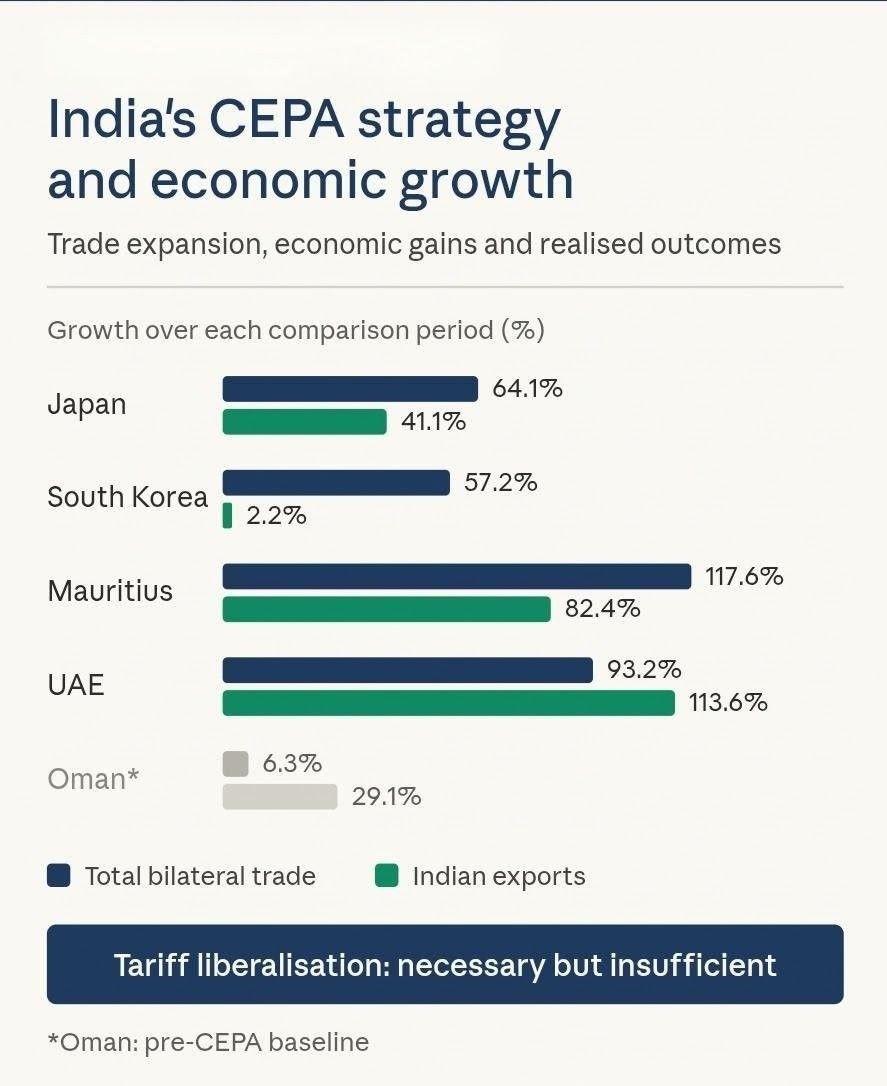
*Oman figures are pre-CEPA, because the India–Oman CEPA was signed only in December 2025. Source: Compiled from Ministry of External Affairs, Ministry of Commerce & Industry and DGCIS data.
The data indicate that bilateral trade expanded across all five cases over the respective comparison periods. The largest absolute increase is observed in the India–UAE relationship, where bilateral trade increased from US$43.3 billion in 2020–21 to US$83.65 billion in 2023–24, representing an increase of approximately 93.2%. India–Japan trade increased by 64.1%, from US$15.33 billion to US$25.15 billion, while India–South Korea trade increased by approximately 57.2%, from US$17.11 billion in 2010 to US$26.89 billion in 2024–25. India–Mauritius recorded the largest percentage increase in total bilateral trade among the comparable cases, with total trade increasing from approximately US$3.44 billion in 2020–21 to US$7.49 billion in 2024–25, an increase of about 117.6%.
The data therefore show a clear pattern of trade expansion, but the magnitude of expansion varies considerably across partners. This supports the study’s central argument that higher bilateral trade should be treated as an indicator of trade expansion rather than as sufficient evidence of overall CEPA effectiveness.
2. Export and Import Performance
Table 2: Growth in Exports and Imports
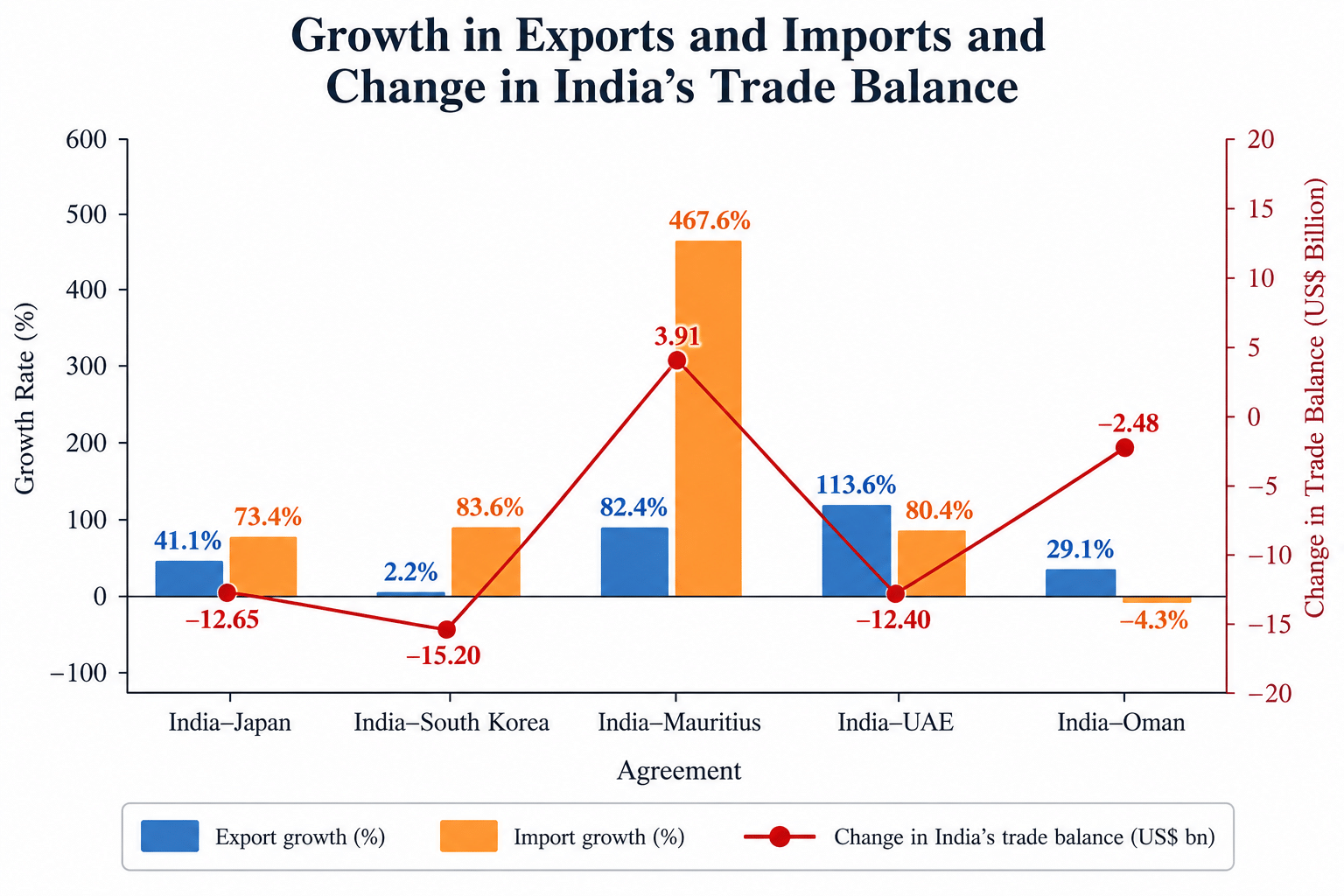
*Oman figures are pre-CEPA, because the India–Oman CEPA was signed only in December 2025. Source: Compiled from Ministry of External Affairs, Ministry of Commerce & Industry and DGCIS data.
A comparison of exports and imports produces a more complex picture than total trade figures alone. In the India–Japan case, exports increased by 41.1%, but imports increased by a substantially higher 73.4%. Consequently, India’s trade deficit increased from approximately US$3.54 billion to US$12.65 billion.
The India–South Korea case shows an even stronger divergence. Indian exports increased only marginally, from approximately US$5.67 billion in 2010 to US$5.8 billion in 2024–25, representing growth of around 2.2%. In contrast, imports increased from approximately US$11.44 billion to US$21 billion, an increase of approximately 83.6%. The resulting trade deficit therefore widened considerably.
The India–UAE case presents a different pattern. Indian exports increased from US$16.68 billion in 2020–21 to US$35.63 billion in 2023–24, an increase of approximately 113.6%, while imports increased by approximately 80.4%. Despite the stronger growth in exports, India’s trade deficit remained substantial, increasing from approximately US$9.94 billion to US$12.40 billion.
Mauritius is the strongest case in terms of India’s trade surplus. Indian exports increased from approximately US$3.13 billion in 2020–21 to US$5.70 billion in 2024–25, while imports increased from approximately US$0.32 billion to US$1.79 billion. Although imports grew at a much faster percentage rate, India continued to record a trade surplus, which increased from approximately US$2.81 billion to US$3.91 billion.
Thus, the export–import analysis demonstrates why total bilateral trade cannot be used as the sole measure of success. Japan, South Korea and the UAE recorded substantial trade expansion while also maintaining significant Indian trade deficits.
3. India–Japan CEPA
The India–Japan data show that bilateral trade increased from US$15.33 billion in 2020–21 to US$25.15 billion in 2024–25, representing growth of approximately 64.1%. Indian exports increased from US$4.43 billion to US$6.25 billion, whereas imports increased from US$10.90 billion to US$18.90 billion.
The pattern indicates that trade expansion was driven more strongly by imports than exports. India’s trade deficit consequently widened from approximately US$6.47 billion in the immediate comparison-year calculation using the reported figures to approximately US$12.65 billion in 2024–25.
The finding is consistent with the earlier evidence identified in the literature review, which noted that India’s market position in Japan did not strengthen to the extent expected and that the trade deficit widened.
The data therefore suggest that the Japan CEPA successfully expanded bilateral commercial activity but did not produce a proportionate improvement in India’s export position.
4. India–South Korea CEPA
The India–South Korea case presents a particularly important contrast between trade expansion and export performance.
Bilateral trade increased from approximately US$17.11 billion in 2010 to US$26.89 billion in 2024–25, representing an increase of nearly 57.2%. However, India’s exports remained almost unchanged, increasing from approximately US$5.67 billion to US$5.8 billion. Imports, in contrast, increased from US$11.44 billion to approximately US$21 billion.
This means that the increase in bilateral trade has been accompanied by a substantially greater increase in imports than exports. India’s trade deficit therefore increased from approximately US$5.76 billion to US$15.20 billion. The result provides strong evidence for the distinction between trade expansion and export competitiveness. Although bilateral trade has expanded considerably since the implementation of CEPA, the growth has not been evenly distributed in India’s favour.
5. India–Mauritius CECPA
The India–Mauritius case shows a comparatively favourable trade-balance outcome. According to DGCIS data reported by the Government of India, India’s exports to Mauritius increased from US$3.125 billion in 2020–21 to US$5.699 billion in 2024–25, while imports increased from US$315 million to US$1.788 billion. Total bilateral trade consequently increased from approximately US$3.44 billion to US$7.49 billion, representing growth of about 117.6%.
India’s trade surplus increased from approximately US$2.81 billion to US$3.91 billion over the same period. This makes Mauritius different from Japan, South Korea and the UAE, where increased trade was accompanied by persistent or widening deficits.
The major Indian export categories include salt, sulphur, plastering materials, cotton, iron and steel, electrical machinery, mineral fuels, plastics and related products. Major imports from Mauritius include articles of iron or steel, medical and surgical equipment and electronic/recording equipment. The data therefore indicate that the CECPA has been associated with a substantial expansion in bilateral trade while India has retained a positive trade balance.
6. India–UAE CEPA
The India–UAE case records the strongest absolute trade expansion among the agreements analysed.
Bilateral trade increased from US$43.3 billion in 2020–21 to US$83.65 billion in 2023–24, an increase of approximately 93.2%. Indian exports increased from US$16.68 billion to US$35.63
billion, while imports increased from US$26.62 billion to US$48.03 billion.
The increase in exports is particularly significant, with Indian exports more than doubling during the comparison period. However, imports also remained substantially higher than exports, and India’s trade deficit increased from approximately US$9.94 billion to US$12.40 billion.
At the same time, the composition of trade shows evidence of diversification. Non-oil trade reached US$57.8 billion in FY2023–24, accounting for more than half of total bilateral trade. The India–UAE Economic Survey also identifies the UAE as India’s second-largest export destination in FY2023–24, with Indian exports of approximately US$35.6 billion. Therefore, the UAE CEPA is associated with substantial trade expansion and stronger Indian export growth, although the persistence of a trade deficit indicates that increased exports have not yet eliminated India’s import dependence within the bilateral relationship.
7. India–Oman: Pre-CEPA Baseline
The India–Oman case requires separate treatment because the CEPA was signed only on 18 December 2025 and officially came into force on 1 June 2026.
Before the CEPA, bilateral trade increased from US$9.99 billion in 2021–22 to US$10.61 billion in 2024–25, representing an increase of approximately 6.3%. Indian exports increased from US$3.15 billion to US$4.07 billion, while imports decreased slightly from US$6.84 billion to US$6.55 billion. The trade deficit consequently narrowed from approximately US$3.69 billion to US$2.48 billion.
These figures provide an important baseline for future evaluation of the Oman CEPA, but they cannot be used to claim that the CEPA has already produced these outcomes.
8. Expected versus Realised Outcomes
The analysis also compares projected benefits with observed trade outcomes. Earlier modelling studies predicted positive effects from tariff liberalisation. For India–Japan, CGE modelling projected positive effects on output, exports and welfare, while India–UAE modelling identified potential gains in manufacturing output, employment, exports and welfare.
The observed data demonstrate that these potential benefits have not necessarily translated uniformly into realised outcomes. For example, India–Japan experienced a 64.1% increase in bilateral trade, but imports grew by approximately 73.4%, compared with export growth of 41.1%. Similarly, India–South Korea recorded nearly 57.2% growth in total trade, but Indian exports increased by only approximately 2.2% over the comparison period.
The India–UAE case provides stronger evidence of export expansion, with Indian exports increasing by approximately 113.6% between 2020–21 and 2023–24. Nevertheless, imports also increased by approximately 80.4%, and India continued to record a bilateral trade deficit.
These patterns demonstrate the distinction between potential gains predicted by economic models and realised outcomes observed in actual trade data. They also support the literature review’s argument that tariff liberalisation alone cannot guarantee the full realisation of projected gains.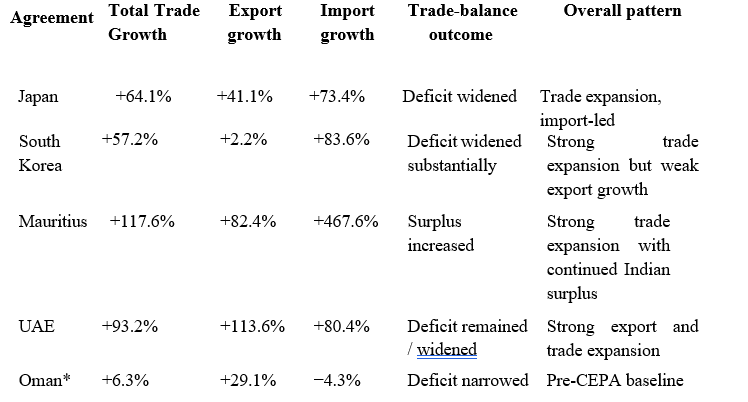
*Oman figures are pre-CEPA, because the India–Oman CEPA was signed only in December 2025. Source: Compiled from Ministry of External Affairs, Ministry of Commerce & Industry and DGCIS data.
The comparative evidence shows that trade expansion has occurred across all selected relationships, but its quality and distribution differ significantly. The UAE shows the strongest combination of absolute trade expansion and export growth among the major post-CEPA cases. Mauritius also demonstrates substantial trade expansion while maintaining a positive Indian trade balance. In contrast, Japan and South Korea demonstrate that a large increase in bilateral trade can coexist with weak export performance and widening trade deficits.
The comparison therefore indicates that the success of a trade agreement should not be evaluated using bilateral trade growth alone. Export growth, import dependence and the trade balance provide additional information about whether increased market access is translating into outcomes favourable to Indian producers.
9. Key Analytical Interpretation
The data reveal three major patterns.
First, bilateral trade has expanded substantially across India’s major CEPA relationships, particularly with the UAE and Mauritius. However, the magnitude of expansion differs considerably across partners.
Second, higher bilateral trade does not automatically imply improved export competitiveness. The Japan and South Korea cases demonstrate that imports can grow faster than exports, resulting in wider trade deficits despite significant increases in total trade.
Third, the newer agreements show mixed but potentially stronger outcomes. The UAE demonstrates significant export growth and diversification, while Mauritius maintains a growing trade surplus. However, the newer agreements cannot yet be conclusively judged superior because their implementation periods are shorter and external factors also influence observed trade outcomes.
Overall, the data support the study’s central proposition that negotiated market access is only the first stage of the trade-growth process. The broader economic impact depends on India’s ability to utilise that access through competitive domestic production, export diversification, productive capacity and integration into international value chains. This is consistent with the research framework established in the paper.
Discussion
The findings of the study demonstrate that India’s Comprehensive Economic Partnership Agreements (CEPAs) have contributed to substantial expansion in bilateral trade, but the nature and distribution of this expansion vary considerably across partners. The results support the central argument of the study that trade expansion cannot, by itself, be treated as evidence of broader economic gains or improved export competitiveness.
Across the selected cases, bilateral trade increased substantially. India–Japan trade grew by 64.1%, India–South Korea by 57.2%, India–Mauritius by 117.6%, and India–UAE by 93.2% during the respective comparison periods. However, the export–import composition presents a more complex picture. In Japan, imports grew by 73.4% compared with export growth of 41.1%, while in South Korea exports grew by only 2.2% compared with import growth of 83.6%. Consequently, India’s trade deficits widened in both cases.
These findings are consistent with the literature reviewed in the study. Dhar (2022) similarly found that India’s earlier FTAs with ASEAN, South Korea and Japan increased merchandise trade without necessarily producing proportionate improvements in India’s export position.
This suggests that preferential market access alone does not guarantee stronger export performance. The finding is also consistent with research arguing that tariff reduction must be accompanied by domestic competitiveness, productive capacity and the ability of firms to overcome non-tariff and behind-the-border barriers.
The newer agreements present somewhat more favourable but still mixed outcomes. The India–Mauritius CECPA recorded a 117.6% increase in bilateral trade while India’s trade surplus increased from approximately US$2.81 billion to US$3.91 billion. The India–UAE CEPA also produced strong export growth, with Indian exports increasing by 113.6%. Nevertheless, India’s trade deficit with the UAE remained substantial and increased during the comparison period.
This provides some support for recent literature suggesting that India’s newer generation of agreements has a broader strategic orientation, incorporating market diversification, investment, services, supply-chain resilience and industrial development. However, the evidence is not sufficient to conclude that newer agreements are definitively more successful than earlier ones. Their implementation periods are shorter and their outcomes are also influenced by external economic and geopolitical factors.The comparison between expected and realized outcomes is particularly important. Earlier modeling studies predicted positive effects from the India–Japan and India–UAE agreements in areas such as trade, output, employment and welfare. The observed data, however, show that these potential gains have not materialized uniformly. Japan and South Korea demonstrate that increased bilateral trade can coexist with weak export growth and widening deficits, while the UAE provides stronger evidence of export expansion but continues to record a trade deficit.
The findings therefore suggest that the effectiveness of a CEPA depends on India’s ability to utilize the market access negotiated through the agreement. Domestic competitiveness, productive capacity, infrastructure, market information, rules of origin and integration into international value chains can influence whether preferential access translates into sustained exports. This reinforces the literature’s argument that tariff liberalization is a necessary but insufficient condition for achieving the full benefits of trade agreements.
The India–Oman case further highlights the need for caution in evaluating newer agreements. Since the CEPA entered into force only in June 2026, the available data represent a pre-CEPA baseline and cannot be interpreted as evidence of the agreement’s impact.
Overall, the study indicates that the success of India’s CEPAs should not be assessed through bilateral trade growth alone. Export performance, import dependence, trade balance and sectoral composition provide a more meaningful assessment of whether market access is benefiting Indian producers. At the same time, the study cannot establish that the observed changes were caused exclusively by the CEPAs, because other domestic and international factors may have influenced trade outcomes.
Thus, the evidence points towards a conditional relationship between trade agreements and economic gains: CEPAs create opportunities, but domestic economic capacity determines how effectively those opportunities are converted into exports and broader economic benefits.
Conclusion
The present study examined India’s evolving CEPA strategy by distinguishing between three interconnected but analytically different outcomes: Trade expansion, Economic gains and Realized outcomes. The central question hovered around examining the wider aspects of these agreements beyond bilateral trade exchanges. The comparative evidence from India–Japan, India–South Korea, India–Mauritius, India–UAE and India–Oman demonstrates that these outcomes cannot be treated as synonymous.
The analysis establishes a clear pattern of bilateral trade expansion across the selected cases, which reinforces the study’s central proposition that an increase in bilateral trade cannot, by itself, be interpreted as evidence of improved export competitiveness or overall trade-policy success.
The Mauritius case presents a more favourable outcome. Bilateral trade more than doubled, while Indian exports increased substantially and India’s existing trade surplus expanded from approximately US$2.81 billion to US$3.91 billion. The UAE case also demonstrates a relatively strong export response: Indian exports increased by approximately 113.6%, more than doubling during the comparison period. Nevertheless, imports remained higher than exports and the bilateral trade deficit persisted. The composition of India–UAE trade also indicates diversification, with non-oil trade accounting for a substantial share of bilateral commerce.
These findings are broadly consistent with the tension identified in the literature. Earlier studies have demonstrated that tariff liberalization can generate substantial potential gains, while post-implementation assessments have shown that increased trade does not necessarily produce proportionate improvements in India’s export position. The present analysis provides empirical support for this distinction. The Japan and South Korea cases particularly demonstrate that projected benefits and increased commercial activity do not automatically translate into favourable outcomes for Indian exporters.
The newer generation of agreements appears more promising in certain respects, particularly when considering the UAE and Mauritius cases. The UAE demonstrates strong export expansion alongside substantial overall trade growth, while Mauritius combines significant trade expansion with a growing Indian trade surplus. Nevertheless, the evidence is insufficient to conclude that newer CEPAs are definitively superior to earlier agreements. Their implementation periods are shorter, and observed trade outcomes are influenced by factors beyond the agreements themselves, including global demand, commodity prices, exchange rates, domestic production and geopolitical developments.
The India–Oman case further illustrates the importance of temporal caution. Since the
India–Oman CEPA was signed in December 2025 and entered into force only in June 2026, the available 2024–25 figures constitute a pre-CEPA baseline rather than evidence of the
agreement’s impact. Future research will therefore be required to determine whether the agreement produces a sustained improvement in Indian exports, trade balance and broader economic outcomes.
Overall, the evidence suggests that the effectiveness of a CEPA depends on more than negotiated tariff concessions. Market access represents only the first stage of a longer process: domestic firms must possess the competitiveness, productive capacity, infrastructure and market capabilities necessary to utilize that access. The literature similarly identifies domestic competitiveness, non-tariff barriers, rules of origin and integration into international production networks as important determinants of realized benefits.
The study therefore concludes that CEPA success should not be measured by bilateral trade growth alone. Export performance, import dependence, trade balance, sectoral composition and, where data permit, investment, employment, productivity and domestic value addition must also be considered. The findings support a more nuanced understanding of India’s trade strategy: CEPAs can create significant economic opportunities, but the conversion of negotiated market access into durable economic gains depends fundamentally on India’s domestic capacity to utilize those opportunities. Thus, the broader developmental significance of India’s CEPA strategy lies not merely in how much India trades with its partners, but in what India exports, how competitively it exports, what domestic economic capacity is created in the process, and how widely the resulting gains are realized.
References
Research papers
Bhattacharyay, B. N., & Mukhopadhyay, K. (2015). A comprehensive economic partnership between India and Japan: Impact, prospects and challenges. Journal of Asian Economics. https://doi.org/10.1016/j.asieco.2015.06.006
Dhar, B. (2022, December 9). Assessing India’s free trade agreements (Briefing Paper No. 57). Madhyam. https://www.madhyam.org.in/assessing-indias-free-trade-agreements/
Delhi Policy Group. (2022). Challenges in negotiating the India-UAE CEPA. https://www.delhipolicygroup.org/publication/detail/challenges-in-negotiating-the-india-uae-cepa-2451
Economic Research Institute for ASEAN and East Asia. (2025). India–ASEAN–Japan cooperation for diversified resilient supply chains. ERIA. https://share.google/oVXq3vntYdu0g47Tk
Gurjar, S. (2026, May 1). The role of trade in India’s geoeconomic strategy (ORF Occasional Paper No. 542). Observer Research Foundation. https://www.orfonline.org/research/the-role-of-trade-in-india-s-geoeconomic-strategy
Ismail, S., & Ahmed, S. (2025). Economy-wide impacts of India–UAE CEPA: A CGE analysis.
Indian Economic & Social History Review. https://doi.org/10.1177/00194662241251511
Saeel, N., & Chandran, B. P. S. (2025). Trade potential of India UAE Comprehensive Economic Partnership Agreement (CEPA). Journal of Economic Cooperation and Development, 46(1), 27–54. https://doi.org/10.5281/zenodo.16871602
Sharma, P. (2026, June 12). From WTO to FTAs: India’s evolving trade priorities amid institutional breakdown and geopolitical fragmentation. Ananta Centre. https://anantacentre.in/from-wto-to-ftas-indias-evolving-trade-priorities-amid-institutional-breakd own-and-geopolitical-fragmentation/
Government websites and official documents
Ministry of Finance, Government of India. (2026). Economic Survey 2025–26. Government of India.
Government of India, Ministry of Commerce and Industry. (2024). Bilateral trade between India and UAE (Lok Sabha Unstarred Question No. 3492).
https://commerce.gov.in/wp-content/uploads/2024/12/LS-USQ-No.3492-dated.-17.12.2024.pdf