Authors:
Laiba Noor, Shourya Sharma, Chitraksh Teotia, Shambhavi Khurana, Vidushi Kaushik, Haran Raj C
1. Introduction
India and the United States are two influential countries in the modern international politics and the relationship between India and USA has changed significantly in the last 20 years. Their collaboration covers cooperation in the field of defence, economic relations, counterterrorism, technological development and regional security. Nevertheless, the two nations have adhered to their own strategic paths and interests, and their histories and views on the international order have helped to create separate foreign policy agendas, despite the profound ties they have developed. Thus, increased bilateral cooperation does not automatically mean the same views on the multilateral arena. It is important to observe their voting on U.N. General Assembly (UNGA) issues in order to gain insight into how far their foreign policy preferences align or clash in the international arena.
The UNGA is an important platform on which members’ countries state their view on various international issues such as international security, armed conflict, nuclear disarmament, human rights, economic development and environmental protection. The voting behaviour in this institution provides an empirical tool for comparing states’ policy preferences and determining points of agreement and disagreement. Foreign Policy Similarity Index (S-Index) is a measure to understand the extent of convergence between India and the United States in their voting behaviour at the UNGA in this context. These patterns can be analysed to determine the difference between the impact of diplomatic engagement and the individual foreign policy considerations that would impact on each country’s choices as they make them independently.
This study examines the level of similarity in India and US foreign policy, based on the pattern of their voting in the UNGA between 2000 and 2020. Over these two decades, there have been many milestones in the bilateral relationship such as shifting dynamics of cooperation in the field of nuclear energy, defence, counter-terrorism, strategic significance of the Indo-Pacific region, etc. Meanwhile, nuclear issues, bilateral ties with Russia and Iran, economic governance, and other matters of international order have loomed large in the relationship. This context is important for studying if a greater convergence in multilateral voting behavior has been achieved with the growth of bilateral cooperation.
The study aims to compare and contrast issue-wise difference and similarity of the two countries, analyse the year-wise variation in the S-Index and understand the year wise trend in both countries. The study also uses the quantitative analysis of voting similarity along with a qualitative discussion of foreign policy and strategic dynamics to give a more in-depth understanding of India-US foreign policy alignment. It suggests bilateral cooperation and multilateral voting convergence should be studied within the framework of international relations as interrelated but separate aspects: States can cooperate in order to achieve common goals, but not necessarily in a consensus on any particular issue.
1.1 Research Question
How has the development of bilateral relations between India and the United States from 2000 to 2020 corresponded with changes in their voting agreement in the United Nations General Assembly (UNGA)?
1.2 Research objectives
1. To measure the similarity between Indian and US foreign-policy preferences through their UNGA voting patterns from 2000 to 2020.
2. To examine how India-US voting similarity changed across the selected period.
3. To examine whether voting similarity on international-security issues differed from overall voting similarity.
1.3 Significance of the study
The study is significant because it has quantified the India-US relationship in terms of their voting patterns in the UN General Assembly (UNGA) from 2000 to 2020. This study takes a multilateral approach, as the bilateral aspects are usually discussed in terms of diplomatic relations, strategic cooperation, military cooperation and economic cooperation, but this study takes a different view of how bilateral developments relate to similarities in the two countries’ voting behaviour. This study allows for an analysis of voting patterns over a 21-year span that reveals long-term trends and variations of the degree of convergence and divergence between the patterns.
The research also to some degree helps to understand the correlation between bilateral cooperation and foreign policy autonomy. Although India and the USA have been strengthening their strategic ties, the two nations still have some differences regarding issues in the international arena such as development, economic governance, international security, decolonisation, human rights and nuclear policy. It is useful to look at the differences to understand why greater diplomatic ties do not always lead to joint stances in multilateral institutions. The study thus underscores the role of national interests, historical experiences, and foreign policy priorities on the voters’ behavior.
In addition, the issue-wise analysis gives a greater depth of understanding regarding the areas of relative consensus or divergence between India and the United States. The research identifies these patterns and provides information on the areas within the policy where common interests can help facilitate cooperation, and where structural and/or strategic differences are still significant. This also facilitates the identification of general trends in bilateral relations from fluctuations in voting coalitions on certain policy issues.
On the international relations level, the research makes a valuable contribution to the analysis of multilateral diplomacy and the changing international order. The necessity for India to pursue strategic autonomy in keeping with the interests of developing countries, and the United States’ global strategic and economic goals, should be seen in the context of their respective positions in the UNGA. The study of their voting patterns provides a quantifiable means to understand the way in which two nations with growing bilateral relations engage in bilateral commonality and divergent priorities in a multilateral institution.
Lastly, this research offers a foundation for further research on the connection between diplomatic engagement and the alignment of multilateral voting. It provides a longitudinal, quantitative approach which could be used for future comparisons with other countries, other periods or specific policy areas. While the patterns observed do not prove an independent causal connection between bilateral cooperation and voting similarity, they offer insights into the nature and degree of convergence and divergence of India and the United States over the period of analysis.
1.4 Research Gap
All the existing literature that was reviewed establishes that UNGA voting can provide an observable measure of foreign-policy preferences, but also shows that voting similarity varies across issues, methods and time. The reviewed studies fall into three groups. Studies of overall UNGA voting patterns and their measurement (Rai 1972; Kim and Russett 1996; Signorino and Ritter 1999; Voeten 2000, 2013; Bailey et al. 2017; Plouffe 2025) and country-level voting studies (Khan 2020; Mosler and Potrafke 2020; Jang and Chen 2019) examine voting across the Assembly or for other states, such as Bangladesh, the United States and the ASEAN countries, rather than for India and the United States. However, political and quantitative approaches have rarely been brought together to systematically test whether the deepening India-US relationship translated into similar behaviour in a multilateral setting. Existing large-scale studies also tend to overlook the dyadic detail of a specific relationship, while security-related votes are often combined with overall UNGA voting, making it difficult to identify whether strategic convergence is reflected specifically in security issues. This study addresses this gap by using the S-index to measure India-US voting similarity and focusing on issue-wise UNGA resolutions. This allows the study to examine not just whether the two countries became closer overall, but to capture their dyadic voting behaviour over time.
2. Literature Review
2.1 The Foreign-Policy Preferences Revealed through the Voting of the United Nations General Assembly
The study of voting behaviour in the United Nations General Assembly (UNGA) has a long history in the field of international relations (IR). Rai (1972) has suggested that voting in the UNGA is a form of public opinion on a state’s position on international affairs, thus making it possible to make comparisons of foreign policy orientation between states. Likewise, Kim and Russett (1996) showed that overall international and economic conditions influence voting alignment in the UNGA, and highlighted the value of the issue areas in understanding voting alignment. In another study, Voeten (2000) explored the dimensions on which the UNGA votes after the Cold War, and demonstrated that the attitudes of states could be interpreted in the broader light of international divisions, such as their distance from Western States and the United States. Read together, these studies show that votes are informative, but that what they reveal depends on conditions and on the issues voted on, which limits the value of a single aggregate comparison.
More recent scholarship, including Voeten (2013) and Bailey et al. (2017), has reinforced the use of UNGA voting as an indicator of policy preferences while identifying its limitations at the same time. Bailey et al. (2017) use a dynamic ideal-point model to estimate state preferences from UNGA roll-call votes. Their model understands that preferences of states can vary over time because the UNGA agenda also evolves, and so a strict vote-by-vote agreement may not be a complete reflection of state preferences. The authors prove voting in the UNGA can possibly be used to learn about states’ positions on some common dimensions, but those dimensions change over time. This provides a methodological comparison for the present study, which uses the S-index of Signorino and Ritter (1999) to measure observed voting similarity rather than estimating ideal points.
A more persistent limitation concerns what a vote can be taken to mean. Political dimensions, including agenda effects, as well as the non-binding nature of UNGA resolutions, are also part of Voeten’s account of how they have influenced the outcomes of the UNGA. Voting can sometimes be a diplomatic signal and not necessarily a commitment for concrete policy actions because UNGA resolutions are frequently non-binding. Moreover, abstentions and absences pose statistical problems as they can not always be equated with ‘no opinion’. Voeten (2013) distinguishes abstentions from absences; abstentions can indicate disapproval or a deliberate choice to withhold support, whereas absences may arise from domestic disruption or a lack of representation. Plouffe (2025) similarly treats these as distinct categories when comparing voting behaviour. Together, these studies indicate that UNGA voting reveals a country’s foreign policy preferences, but does not capture their entire foreign policy. Khan (2020) further shows that changes in voting coincidence can reflect the content of resolutions rather than a fundamental change in policy. The present study therefore examines similarity between India and the United States in international-security voting, without equating it with full foreign-policy alignment.
2.2 Measuring Foreign-Policy Similarity
The choice of similarity measure is itself a point of methodological debate. Voeten (2013) distinguishes rank-based measures, such as Kendall’s tau-b, from distance-based measures such as the S-index. Kendall’s tau-b compares the ordering of states’ vote choices across resolutions, whereas the S-index measures the distance between their recorded positions. Signorino and Ritter (1999) argue that correlation and similarity are not interchangeable and develop the S-index as an alternative measure of policy similarity. Another important measure for the present research is the S-index, which allows a dyadic analysis of similarity between two states. It scales the distance between their voting positions from -1, indicating complete disagreement, to +1, indicating identical positions. In a three-category specification, abstentions are placed between yes and no votes, while absences are treated separately rather than as abstentions. Plouffe (2025) applies both a two-category S-score, using yes and no votes, and a three-category score that includes abstentions. He also compares these scores with ideal-point estimates developed by Bailey et al. (2017). This comparison shows that S-scores describe observed agreement, while ideal-point models seek to estimate underlying preferences and account for agenda effects; the two approaches therefore answer different questions.
However, the literature notes that a similarity score should not be viewed as a representation of full agreement in foreign policy. Risse (2024) combines UNGA voting data with manual coding of 1,178 arms control resolutions to identify substantive support for arms control. His approach complements the methodological concerns raised by Voeten (2013): a distance between two states does not, by itself, show whether either supports stronger arms control. Taken together, these studies support combining a dyadic similarity measure with attention to resolution content, rather than treating an aggregate score as evidence of agreement across all security questions. For this reason, the present study uses the S-index to examine India-US voting similarity over time, while analysing international-security-related resolutions separately. Annual scores capture year-over-year trends rather than a static 20-year average, while issue-specific data isolates alignment on security from broader voting patterns. These scores remain measures of observed voting behaviour; referencing literature on bilateral relations is necessary to interpret the political significance of these patterns.
2.3 Diplomatic relations between India and the U.S.A. and the Issue of Strategic Convergence
The wider literature on relations between India and the USA gives us a useful framework to analyse their vote in the UNGA. Ganguly, Scobell and Shoup (2006) and Tellis (2005) all describe growing strategic cooperation alongside continuing differences. The former trace the evolution of cooperation while identifying disagreements over nuclear policy between Pakistan and Iran; Tellis places the partnership within changing geopolitical conditions in Asia. Together, these arguments suggest a coalescence of interests rather than an expectation that New Delhi would follow Washington on every issue. India’s strategic autonomy therefore remains relevant to whether closer bilateral relations produce similar positions at international institutions. The US-India civil nuclear agreement has been an important development in the relationship.
Tellis (2006) examines the proposed nuclear cooperation and its implications for India’s nuclear programme. The initiative announced in 2005 was followed by the Nuclear Suppliers Group waiver and congressional approval of the 123 Agreement in 2008 (US Department of State 2008). These developments expanded access to civilian nuclear cooperation without India joining the Nuclear Non-Proliferation Treaty (NPT). They provide a reason to examine whether cooperation was accompanied by changes in nuclear and disarmament voting, but do not themselves establish that such convergence occurred. Schaffer (2009) and Thakkar (2021) qualify this expectation by distinguishing bilateral cooperation from multilateral agreement. Schaffer identifies the difficulty of working together in global governance, while Thakkar links continuing UN differences to India’s strategic autonomy, ties with developing countries, use of abstentions and positions on nuclear disarmament and country-specific resolutions. Reading the strategic-partnership literature, these studies suggest that cooperation and disagreement can coexist: shared regional interests need not to remove differences over the international nuclear order or India’s wider diplomatic relationships. This makes issue-specific and temporal variation central to the analysis rather than an exception to an otherwise uniform partnership. However, this literature sets out the context rather than testing it: it does not systematically examine whether closer relations were accompanied by similar multilateral voting, which is the gap this study addresses.
2.4 Temporal Variation in India-US Voting Similarity
The literature on temporal and issue-level variation makes the same point from different angles. Bailey et al. (2017) elaborate on how voting preferences can change over time, partly because the issues on the UN General Assembly agenda also change. This means that voting similarity cannot always be treated as a fixed measure of foreign-policy alignment. Mosler and Potrafke (2020) similarly find that voter consistency of the US fluctuates from issue to issue and over time. In their study of voting at the UNGA from 1949 to 2019, they identify political convergence between the United States and Western allied states, as well as distinct voting patterns on Middle Eastern issues across US presidencies. Jang and Chen (2019) show that countries can be highly similar on some issues but quite different on others. They find that ASEAN countries exhibit high national cohesion on some international issues and high national dispersion on others during 1991-2018. Together, these studies suggest that voting similarity is both time and issue specific. This makes a longitudinal analysis of India-US voting between 2000 and 2020 more useful than relying on a single overall score.
3. Research Methodology
3.1 Research Design
We used comparative and longitudinal quantitative research design to compare similarities and differences in voting behavior of India and the United States in the United Nations General Assembly (UNGA) between the years 2000 and 2020. This time span of 21 years is long enough to study both continuities, and the changes in the voting patterns of the two countries across different phases of international politics. The time frame covers major events in global history, such as the effects of the attacks of 9/11, the Iraq war, the global financial crisis of 2008, the emergence of China and shifts in the global balance of power. The developments have set a relevant backdrop for studying the convergence or divergence of India and the USA’s stances on international issues over time. In addition, the longitudinal design allows the study to go beyond comparing the voting patterns at one point in time, and examine the change in voting alignment over 21 years. Therefore, the period 2000-2020 can be used as a starting point to examine the general trend and the consistency and variation between the two countries’ voting in the UNGA.
3.2 Nature of Research
The nature of the study is quantitative and empirical research to measure the similarity between India and the United States in their UNGA voting behavior from 2000 to 2020. The data used is secondary data from UNGA voting records, including Yes, No and Abstain votes on resolutions. The study uses the S-index, agreement, and disagreement rates, descriptive statistics, and linear regression to measure voting similarity and examine changes over time. Voting patterns are also examined across different issue areas to identify differences in the level of similarity between the two countries.
3.3 Sample and its Technique
The study’s sample is the UNGA voting records of India and the United States from 2000 to 2020 with the unit of analysis being a Yes/No vote for the same. Resolutions within the study period are considered when voting records are available for both countries and their votes can be compared. Of the 1,682 resolutions in the study period, eight on which one country was not recorded as voting were excluded, leaving 1,674 for comparison; a further 419 resolutions on which either country abstained were then excluded, so that the S-index is calculated on 1,255 comparable Yes/No resolution pairs. No human respondents are involved, as the study relies on secondary data.
3.4 Data Collection
Data was collected from the United Nations Digital Library and includes country names, voting decisions, resolution details, dates, subject categories and agenda descriptions. The dataset covers the UNGA voting records of India and the United States on 1,682 resolutions between 2000 and 2020, which were classified into nine issue areas (Table 4). This data was checked, organized and classified by issue area.
3.5 Variables Used
- Voting Decisions: Votes are classified as Yes, No and Abstain. Non-voting records are excluded.
- Year and Issue Category: The year (2000 – 2020) is used to analyze trends, while resolutions are grouped by selected issue areas, including international security, nuclear and weapons issues.
- S-index: The main outcome measure assesses voting similarity on a scale from −1 to +1, where +1 indicates complete agreement and −1 indicates complete disagreement. It is calculated from Yes and No votes as S = (A − D) / (A + D), where A is the number of resolutions on which India and the United States cast the same vote and D is the number on which they cast opposite votes. Resolutions on which either country abstained or did not vote are excluded from the calculation. The annual S-index is calculated from the resolutions of each year, and the issue-wise S-index from the resolutions in each issue category.
3.6 Ethical Considerations
- Data Source: Uses publicly available UNGA voting records and academic literature.
- Privacy: No human participants or personal information are involved.
- Academic Integrity: All sources are properly acknowledged and cited.
- Accuracy: Findings are reported objectively and interpreted cautiously.
- Responsible Interpretation: Voting similarity is not treated as a complete measure of India-US foreign policy relations.
4. Data Analysis
Introduction
The chapter provides a study of the voting behavior of India and the United States in the United Nations General Assembly (UNGA) from 2000 to 2020. It looks at the degree of agreement and disagreement between vote choices and changes in them over time in both countries. The analysis also takes account of differences between issue areas to make sure that voting similarity was uniform across subjects. The results are analyzed through S-index, descriptive statistics, comparisons based on issues, and linear regression.
4.1 Data Overview
These data include 1,682 resolutions passed by India and the United States from 2000 to 2020. One of the countries was not recorded as voting on eight resolutions, which were excluded, and 1,674 resolutions were then available for comparison. 419 resolutions were also excluded due to abstentions in voting by either country.
Table 1 – Resolutions Excluded Due to Non-Voting by One Country
|
Resolution |
Year |
Non-Voting Country |
|
A/RES/56/7 |
2001 |
India |
|
A/RES/60/112 |
2005 |
United States |
|
A/RES/61/119 |
2006 |
India |
|
A/RES/63/13 |
2008 |
India |
|
A/RES/65/272 |
2011 |
United States |
|
A/RES/69/14 |
2014 |
India |
|
A/RES/69/186 |
2014 |
United States |
|
A/RES/71/11 |
2016 |
India |
Source: UNGA voting records from the United Nations Digital Library.
The S-index is used to indicate the level of agreement between the two countries’ votes. The range of its values is from −1 to +1, where higher values mean more consensus and lower values mean more dissent. If the value is zero, there is no difference between the number of agreements and the number of disagreements. Year-wise and issue-wise results enable to highlight the areas in which India and the U.S. were at similar standpoints and where they diverged on voting preferences. The linear regression analysis is used to evaluate the S-Index’s average change in value over time, and how much of that is contributed by time as a variable.
4.2 Descriptive Statistics
Table 2 – Overall Statistical Findings through S-Index
|
Study Period |
2000-2020 |
|
Total Resolutions |
1682 |
|
Resolutions Excluded (Non-Voting) |
8 |
|
Resolutions Excluded (Abstentions) |
419 |
|
Total Agreements |
198 |
|
Total Disagreements |
1057 |
|
Mean Annual S-Index |
-0.686255 |
|
Median Annual S-Index |
-0.666667 |
|
Standard Deviation of Annual S-Index |
0.080666 |
|
Overall Agreement Rate |
15.78% |
|
Overall Disagreement Rate |
84.22% |
Source: Authors’ calculations based on UNGA voting records from the United Nations Digital Library.
Within our sample size of 1682 voting resolutions conducted in the UNGA from 2000 to 2020, out of which 427 were excluded due to abstentions or non-voting instances by either country, the mean annual S-Index (ranging from +1 to -1) was calculated to be -0.686255, with a median annual S-Index of -0.-0.666667, which means that the average level of voting similarity between India and the US is very low and the two countries have had considerable disagreements within the 20 years. The standard deviation of annual S-Index was calculated to be 0.080666, which signifies that voting similarity between the two countries varied substantially less from year-to-year.
4.3 Temporal Distribution
Table 3 – Year-Wise Agreement Analysis through S-Index
|
Year |
Eligible Resolutions |
Agreements |
Disagreements |
S-Index |
Agreement Rate (%) |
Disagreement Rate (%) |
|
2000 |
48 |
8 |
40 |
-0.6667 |
16.67 |
83.33 |
|
2001 |
49 |
7 |
42 |
-0.7143 |
14.29 |
85.71 |
|
2002 |
57 |
10 |
47 |
-0.6491 |
17.54 |
82.46 |
|
2003 |
59 |
10 |
49 |
-0.6610 |
16.95 |
83.05 |
|
2004 |
56 |
6 |
50 |
-0.7857 |
10.71 |
89.29 |
|
2005 |
56 |
7 |
49 |
-0.7500 |
12.50 |
87.50 |
|
2006 |
69 |
6 |
63 |
-0.8261 |
8.70 |
91.30 |
|
2007 |
63 |
6 |
57 |
-0.8095 |
9.52 |
90.48 |
|
2008 |
62 |
8 |
54 |
-0.7419 |
12.90 |
87.10 |
|
2009 |
50 |
6 |
44 |
-0.7600 |
12.00 |
88.00 |
|
2010 |
48 |
6 |
42 |
-0.7500 |
12.50 |
87.50 |
|
2011 |
50 |
10 |
40 |
-0.6000 |
20.00 |
80.00 |
|
2012 |
53 |
10 |
43 |
-0.6226 |
18.87 |
81.13 |
|
2013 |
47 |
6 |
41 |
-0.7447 |
12.77 |
87.23 |
|
2014 |
58 |
10 |
48 |
-0.6552 |
17.24 |
82.76 |
|
2015 |
55 |
11 |
44 |
-0.6000 |
20.00 |
80.00 |
|
2016 |
57 |
14 |
43 |
-0.5088 |
24.56 |
75.44 |
|
2017 |
74 |
12 |
62 |
-0.6757 |
16.22 |
83.78 |
|
2018 |
87 |
15 |
72 |
-0.6552 |
17.24 |
82.76 |
|
2019 |
81 |
15 |
66 |
-0.6296 |
18.52 |
81.48 |
|
2020 |
76 |
15 |
61 |
-0.6053 |
19.74 |
80.26 |
Source: Authors’ calculations based on UNGA voting records from the United Nations Digital Library.
Interpreting the year-wise agreements and disagreements between the two countries, the S-Index stays moderately negative in all the years, with minor peaks and troughs till 2013, after which the agreement rate rose to an all time high in 2016 at 24.56%, after which it remained controlled till 2020. The overall disagreement rate between two countries is 84.22% which signifies that in the majority of voting resolutions, both the countries differ in their stances.
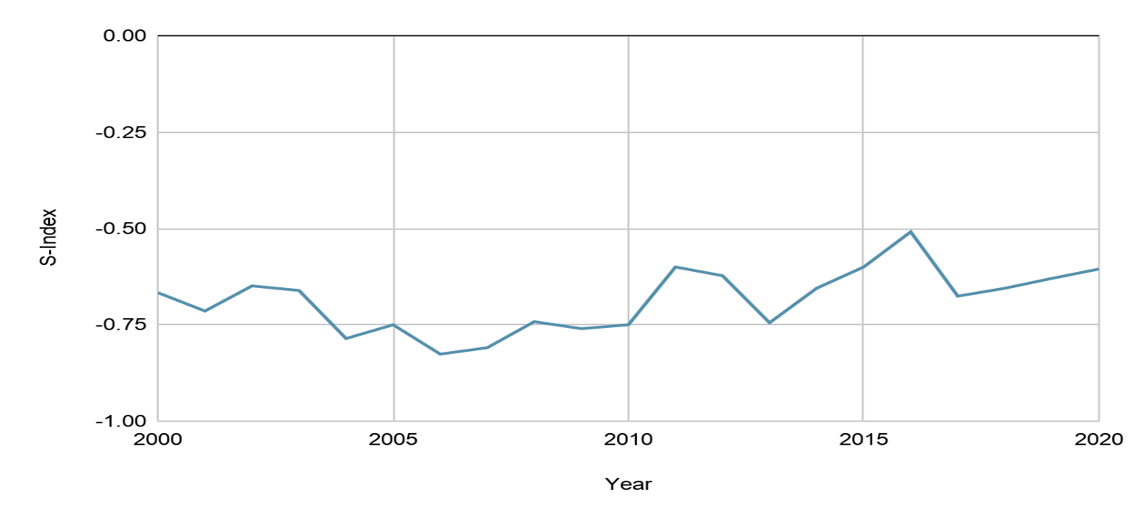
Source: Authors’ calculations based on UNGA voting records from the United Nations Digital Library.
Fig 1- Year-Wise Agreement Mapping through S-Index
4.4 Variable-Wise Analysis
Table 4 – Issue-Wise Agreement Analysis through S-Index
|
Issue |
Eligible Yes/No pairs |
Agreements |
Disagreements |
S-Index |
Agreement Rate (%) |
Disagreement Rate (%) |
|
International Security & Conflict |
133 |
17 |
116 |
-0.7444 |
12.78 |
87.22 |
|
Nuclear & Weapons |
289 |
83 |
206 |
-0.4256 |
28.72 |
71.28 |
|
Human Rights |
376 |
44 |
332 |
-0.7660 |
11.70 |
88.30 |
|
Environment & Climate |
69 |
35 |
34 |
0.0145 |
50.72 |
49.28 |
|
Development & Economic Issues |
44 |
0 |
44 |
-1.0000 |
0.00 |
100.00 |
|
International Law & UN Affairs |
41 |
10 |
31 |
-0.5122 |
24.39 |
75.61 |
|
Health & Humanitarian Affairs |
9 |
2 |
7 |
-0.5556 |
22.22 |
77.78 |
|
Decolonisation & Self-Determination |
246 |
6 |
240 |
-0.9512 |
2.44 |
97.56 |
|
Social & Cultural Issues |
48 |
1 |
47 |
-0.9583 |
2.08 |
97.92 |
Source: Authors’ calculations based on UNGA voting records from the United Nations Digital Library.
Segmenting all the included resolutions into issue-wise subheadings according to their agenda and context, and calculating both the countries’ issue-wise voting similarity, it is found that India and the US completely disagree on development and economic issues with an S-Index of -1. Both the countries also significantly disagree on issues related to decolonization & self-determination and social & cultural issues. The disagreement rates for the other issues are also considerably high, and this could be an implication of the different geopolitical and historical backgrounds that both the countries hail from. As India is a third-world country that had been colonized in the past by British rule, which is developing at a rapid rate as one of the leading economies in Asia and the world, its priorities and stances on various issues vary extensively as compared to a developed economy like the US in a unipolar world. India emphasizes on increased economic and institutional support to developing countries, non-exclusivity in nuclear weapon production and usage monopoly, acknowledgement of its diverse culture and ethnicities as well as greater say in the United Nations and international organization, the US seeks to maintain the pre-existing structures to maintain disproportionate influence in international matters such as its power in the United Nations like its permanent membership and its ‘Veto’ powers in the UN Security Council, its control over international trade and investment, its military and nuclear prowess. Interestingly, voting similarity between India and the US was greater on Nuclear & Weapons issues than on International Security & Conflict issues, challenging the assumption that strategic and defence cooperation necessarily translates into greater alignment across all security-related matters. However, for environment & climate related issues, India and the US have a higher agreement rate of 50.72% and a positive S-Index of 0.0145. This signifies that both the countries are more aligned on issues pertaining to environment & climate which reflects their collective effort from 2000 to 2020 to address climate change, global warming and environmental degradation.
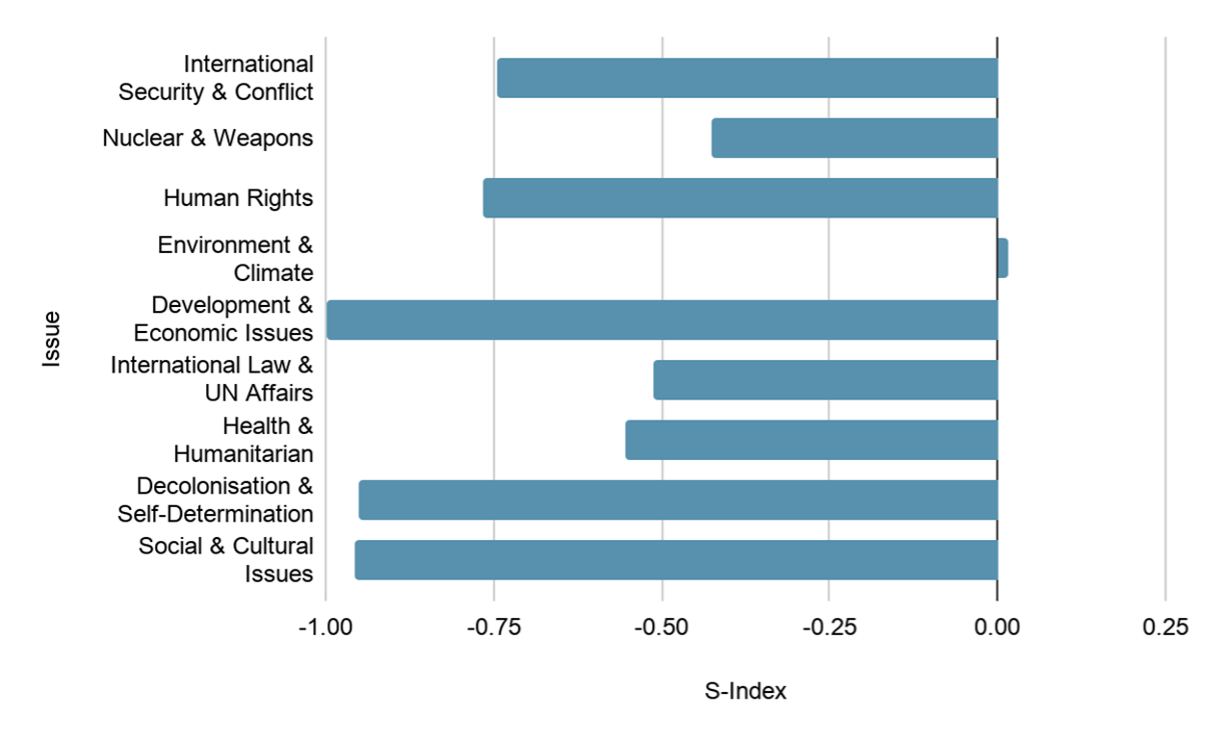
Source: Authors’ calculations based on UNGA voting records from the United Nations Digital Library.
Fig 2 – Issue-Wise Agreement Mapping through S-Index
4.5 Statistical Results
Table 5 – Regression Analysis of Agreement through S-Index
|
Parameter |
Value |
|
Regression Trend Coefficient (β) |
0.006381 |
|
Regression R-squared (R2) |
0.240908 |
Source: Authors’ calculations based on UNGA voting records from the United Nations Digital Library.
The regression trend coefficient (β) measures the average change in the annual S-index associated with each additional year, which is calculated as 0.006381. This is descriptive evidence that the estimated trend of agreement between the two countries over the study period is positive, and the S-Index, on average, became less negative. The regression R-squared (R2), which measures the proportion of variation in the annual S-index that is accounted for by the fitted linear relationship with time, was calculated as 0.240908, which signifies that approximately 24.09% of the observed variation in annual S-index scores is accounted for by the linear time trend. While these results suggest a gradual movement towards greater voting alignment, the coefficient alone does not establish statistical significance. The findings are therefore interpreted as descriptive evidence of a positive trend rather than conclusive evidence of a statistically significant change or a causal effect of bilateral cooperation.
4.6 Diagnostic Checks
The following diagnostic and robustness checks are performed:
The results need to be considered alongside the characteristics of the voting data. The numbers of 1,255 comparable resolutions are used for comparison 427 non-voting and abstaining observations (eight non-voting resolutions and 419 resolutions with abstentions) have been excluded. Specific methods of handling abstentions could affect the level of similarity calculated, however, especially if one country voted for a resolution and the other country abstained.
The year-wise results should also be checked for high or low S-index values which might be out of the trend. Likewise, varying patterns may suggest that voters’ similarity between India and the United States is dependent on the categories of issues. The regression results can be used to determine if the observed trend is consistent with an overall pattern or is due to specific years. Such checks should not be a basis for deciding on robustness but rather be viewed against the actual statistical results.
4.7 Key Findings
Some key findings from the data analysis of the UNGA voting similarity of India and US between 2000 and 2020 are:
- The average level of voting similarity between India and the US is very low and the two countries have had considerable disagreements within the 20 years.
- Voting similarity between the two countries has varied substantially less from the average level in each year.
- Both the countries completely disagree on development and economics related issues and have high disagreement rates in all other issues except for environment and climate issues.
The estimated trend of agreement between the two countries over the study period is positive, which means disagreements between India and US have declined on an average.
5. Discussion
5.1 Overall Trends in the India-US UNGA Voting Similarity (2000-2020)
To analyse the United Nations General Assembly (UNGA) voting data, the S-Index has been used to measure similarity/distance between foreign-policy positions and enable comparison between India and the US, as supported by the work of Signorino & Ritter (1999). According to the data analysis, the year-wise distribution of the S-Index of the two countries’ UNGA voting similarity stays mostly consistent with an average of -0.686255 throughout the study period.
Additionally, a regression analysis was conducted to examine the trend of UNGA voting similarity between the two countries, as supported by the findings of Bailey, Strezhnev & Voeten (2017), who discussed how state preferences and voting dimensions change over time. This analysis furthermore shows that from 2000 to 2020, a positive long-term trend in similarity in the UNGA voting behaviour of the two countries is estimated. This suggests a gradual upward movement in the S-Index representing greater voting similarity over time, with the average change in the annual S-index to be 0.006381. These findings coincide with increased dialogue, cooperation and collaboration between the two countries across the two decades. However, changes in bilateral relations do not necessarily correspond directly with voting behaviour within UNGA.
5.2 Evolution of India-US Bilateral Relations and Voting Patterns
5.2.1 Early Engagement and Strategic Convergence (2000-2007)
The beginning of the study period starts with the year 2000, when Bill Clinton visited India to initiate and discuss cooperation between the two countries with Prime Minister Atal Bihari Vajpayee. At the time, the major concerns were the tensions created between the two countries regarding the sanctions imposed on India after its 1998 nuclear tests named ‘Pokhran-II’, particularly given India’s refusal to sign the Treaty on Non-Proliferation of Nuclear Weapons (NPT) which came into force in 1970. Concerns about a possible war between Pakistan and India were also rising given that Pakistan had also conducted a series of nuclear tests in 1998.
In the subsequent years, the George W. Bush administration eased relations with India by providing relief on sanctions, easing nuclear related restrictions on India and cooperating in civilian nuclear activities. In 2004, the India-US relationship improved drastically, as the countries cooperated on shared interests in counterterrorism, economic trade, science and technology, space, and ensuring a stable balance of power in Asia. In 2005, a full civilian nuclear energy cooperation was launched between the two countries and a Ten-Year Defence Framework was also signed.
Despite these diplomatic advances, the S-Index became increasingly negative from -0.6610 in 2003 to -0.8095 in 2007, which indicates decreasing similarity in voting co-existing with increasing cooperation. This was also addressed in the work of Ganguly, Scobell & Shoup (2006) who stated that India-US strategic cooperation expanded but differences continued surrounding nuclear policy and regional geopolitics. The divergence highlights the distinction between cooperation based on shared strategic interests and voting decisions shaped by broader national interests and positions on international issues.
5.2.2 Civil Nuclear Cooperation and Growing Diplomatic Engagement (2008-2016)
A major development occurred in 2008, with the conclusion of the bilateral civil nuclear cooperation agreement, commonly known as the 123 Agreement. Through this agreement, India received a waiver from the Nuclear Suppliers Group (NSG), which permitted nuclear trade with India despite its non-membership in the NPT treaty. India additionally committed to separate civilian and military nuclear facilities under the rules of the International Atomic Energy Agency (IAEA) within this agreement. According to Tellis (2006), the civilian nuclear cooperation had important implications for India’s nuclear programme and the strategic relationship between India and the US.
In 2010, the newly elected US President Barack Obama visited India, offering support for India’s aspiration for a greater global role, including a possible permanent membership in a reformed UN Security Council. Cooperation expanded as several education, economic trade and investment, agriculture, health and energy dialogues were introduced as well as collaboration in defence and maritime security. This coincides with an improvement in the S-Index, which increased to -0.6000 in 2011.
In 2015, Prime Minister Narendra Modi invited Barack Obama as the chief guest for India’s 66th Republic Day, making him the first American President to be invited as such. This was followed by the renewal of the Ten-Year Defence Framework, alongside multiple defence exercises, as the US continued to supply India with aircrafts, helicopters and other military equipment. The S-Index subsequently reached −0.5088 in 2016, its highest value during the study period. This movement indicates a stronger degree of convergence according to the numerical direction of the index, although its substantive interpretation must remain consistent with the index’s definition.
5.2.3 Strategic Cooperation and Emerging Trade Tensions (2017-2020)
Despite continued strategic engagement, India-US relations encountered tensions during Donald Trump’s presidency. The administration’s ‘America First’ state policy placed greater emphasis on reducing trade imbalances and increasing US market access. Trump scrutinised India’s trade tariffs and market barriers and went on to impose tariffs on steel and aluminium imports into the US, after which India imposed retaliatory tariffs on select US goods.
Disagreements also emerged when the US withdrew from the Iran nuclear deal and reimposed sanctions on Iran and India. This coincided with the S-Index decreasing to about -0.6552 in 2018, moving away from its value in 2016. Nevertheless, the S-Index did not change drastically as cooperation in other areas continued, such as the signing of the 2019 Industrial Security Annex which strengthened the framework for industrial security cooperation.
These developments demonstrate that bilateral relations during the period involved both cooperation and disagreement. Although strategic engagement continued, differences in trade policy, sanctions, and foreign policy priorities remained relevant to the broader relationship. The year-wise changes in the S-Index provide a basis for examining whether these developments coincided with changes in UNGA voting similarity, but they do not independently establish a causal relationship. This was also reflected in the work of Schaffer (2009), who stated that India and the US face challenges in cooperating within global governance, even while developing a closer bilateral partnership.
5.3 Issue-Wise Parameters of Voting Disagreement
5.3.1 Development and Economic Issues
Development and Economic issues emerged as the area of greatest disagreement between the two countries in the issue-wise analysis, which coincides with the findings of Kim and Russet (1996) where they stated that international and economic conditions greatly influence UNGA voting behaviour. India and the US’s voting decisions have differed on multiple resolutions on the agenda of ‘International Trade’, where India voted in support of a new international economic order and condemnation of unilateral economic measures as a means of political and economic coercion against developing countries, while the US voted against it. This arises from differences between the economic progress of India and the US. India being a third world country is still a developing economy while the United States’ authority as a considerable economic power has been well established.
The US has disproportionate influence over international bodies like the World Trade Organisation, the US dollar functions as the world’s primary global reserve currency and main medium for international trade, and the majority of the multi-national corporations prevalent across the world are US-based. Therefore, both the countries have extreme differences over the global trade system and economic order. The US government has objected to India’s market access, intellectual property ownership, tariffs and investment restrictions, and price controls while India has objected to US protectionism, trade-remedy actions and first-world biases in international economic order. However, this has not stopped bilateral trade and investment between the two countries.
However, such differences have not prevented the expansion of bilateral trade and investment. The coexistence of economic cooperation and disagreement in multilateral forums suggests that shared commercial interests do not necessarily produce similar voting positions on development and economic resolutions within the UNGA.
5.3.2 Social and Cultural Issues
Social and Cultural Issues also reveal great differences in the voting behaviour of India and the US. India and the US have voted differently on multiple issues, such as ‘Advancement of Women’ and ‘Racial Discrimination’. While India voted for elimination of all kinds of discrimination against women, elimination of racism and racial discrimination, the US voted against it. India holds a diverse population with multiple ethnicities, languages, cultures, religions and has a community-oriented and collectivistic society, the US holds a comparatively individualistic population. India is faced with many different societal issues due its unique cultural background and thus its alignment with the US is likely to be different.
On an international level, people-to-people connections have provided an important foundation for bilateral engagement. Cooperation has been prevalent in this area due to a large Indian-American population residing in the US, as well as numerous Indian students pursuing education in the country, alongside frequent tourism between the two countries. However, there has been a lot of friction regarding migration, especially H-1B visa restrictions which has affected the lives of many Indian professionals and families. US officials have also periodically raised concerns about religious freedom, civil liberties or specific policies in India.
These issues illustrate how close social connections can coexist with disagreements over domestic governance and international norms. Consequently, the presence of strong societal links does not necessarily ensure convergence in UNGA voting on social and cultural matters.
5.3.3 Decolonisation and Self-Determination Issues
Majority of the misalignment in Decolonisation and Self-Determination, stems from the difference between the historical origins of both the countries. India and the US disagree on various agendas such as ‘Self-Determination of Peoples’, ‘Question of Palestine’, and ‘Decolonization’. While India voted for dissemination of information regarding decolonization, peaceful settlement of the question of Palestine, and condemnation of use of mercenaries as a means of violating human rights, the US voted against it. This reflects the findings of Voeten (2000), where he stated that post-Cold War UNGA voting reflects broader international divisions, including states’ distance from Western countries and the US.
India’s experience of British colonial rule contributed to its longstanding emphasis on national sovereignty, anti-colonial solidarity, self-determination, and the interests of developing countries. Its foreign policy tradition has also stressed strategic autonomy and non-alignment, particularly in relation to competing global power blocs.
Thus, decolonisation and self-determination of people is central to India’s global agenda, which has affirmed regional pride and upliftment of developing nations. The United States, meanwhile, has approached international affairs through its own strategic priorities and assessments of the international order. This is vital to consider while examining the India-US relationship according to Tellis (2005), as changing geopolitical conditions in Asia and growing strategic cooperation can provide a comprehensive understanding of the same. The US has increasingly viewed India as important to the Indo-Pacific balance and in recent years, both the countries have shared concerns regarding China. However, India has avoided a formal alliance with the US against China and resisted being seen as part of a containment bloc.
These differences in historical experience and foreign policy orientation help explain why strategic cooperation does not always translate into similar positions on resolutions concerning decolonisation, self-determination, and sovereignty. India’s emphasis on independent decision-making can lead it to adopt positions that differ from those of the United States, even when the two countries share wider strategic interests.
5.3.4 International Security and Conflict Issues
With regard to International Security and Conflict issues, despite alignment against international terrorism, defence cooperation, nuclear treaties between the two countries, India and the US are still misaligned to a great extent. India and the US converge on agendas like measures to eliminate international terrorism, transparency of military expenditures, state responsibility in cyberspace and against treaty compliance of nuclear disarmament, however, they diverge on various agendas like tensions between Cuba and the United States, illegal Israeli actions, and financing of the United Nations Interim Force in Lebanon. India had refused to sign the Nuclear Non-Proliferation Treaty regarding it as discriminatory because it recognises different categories of nuclear-weapon and non-nuclear-weapon states. This position contributed to conflicts and increasing tensions between the two countries, particularly following India’s 1998 nuclear tests. Although subsequent civilian nuclear cooperation marked a major improvement in bilateral relations, differences over nuclear governance and non-proliferation continued to influence their respective approaches to international security.
The US has also expressed disapproval of India’s friendly relations, defence ties and trade with Russia, and threatened to impose sanctions on significant transactions between the two countries. India’s energy imports and connectivity plans with Iran also oppose US foreign alignment and sanctions policy. On the other hand, India has also expressed disapproval of military and financial support to Pakistan by the US given India’s hostile relations with Pakistan.
These disagreements demonstrate that cooperation in counterterrorism and defence does not eliminate differences in strategic priorities. The two countries may share concerns about particular security threats while maintaining distinct positions on nuclear policy, sanctions, regional conflicts, and the wider international security order.
5.3.5 Human Rights, Health and Humanitarian Affairs, International Law and UN Affairs, and Nuclear and Weapons Issues
The findings on each issue show differences between India and the United States in human rights, health and humanitarian affairs, international law and UN affairs and nuclear and weapons‑related matters. These topics touch on questions of sovereignty, international obligations, domestic policy, security priorities and the way multilateral norms are understood. Specific agendas of difference include assistance to refugees, the right to food, affordable health care for all, poverty migration, multilaterals in areas of disarmament, conventional arms control at regional level, placement of weapons in outer space and the UN budget.
Differences in rights and civil liberties may show how India and the United States handle international scrutiny and domestic governance differently. In health and humanitarian affairs, the priorities of each country and how they see international duties can shape voting positions. Disagreements on law and UN affairs may come from different ideas about the power of multilateral institutions, how international rules are applied and how decision‑making power is shared in the global system. Likewise nuclear and weapons‑related resolutions show competing priorities about deterrence, disarmament, non‑proliferation and national security.
Although these broad categories cover kinds of resolutions, their overall pattern points out that bilateral strategic cooperation may not make India and the United States vote the same way in every policy area. As also stated by Jang and Chen (2019), voting alignment is issue-dependent and states can show consensus on certain issues while divergence on others.
5.3.6 Areas of Relative Convergence: Environment and Climate Issues
In stark contrast, India and the US have near parity alignment on Environment & Climate by a slight margin, with a positive S-Index of 0.0145. This can be attributed to their shared interests in clean, renewable energy, pollution control, energy access, efficiency and research. Both India and the US signed the Paris Climate Agreement, which was adopted in 2015 and entered in force in 2016, which was a legally binding international treaty on climate change adopted by 195 parties at COP21 in Paris.
However, misalignment in this particular area may arise after the US announced its intention to withdraw from the Paris Agreement in 2017, and the withdrawal formally took effect in November 2020 under the Trump administration. This development illustrates how changes in national leadership can alter international climate commitments and create uncertainty in multilateral cooperation.
Overall, the relative convergence identified in environment and climate suggests that shared interests can create opportunities for similar voting positions. Nevertheless, differences in development priorities, climate finance, historical responsibility, and international obligations continue to influence the two countries’ approaches to climate governance.
5.4 Interpreting Bilateral Cooperation and Multilateral Voting Alignment
Overall, the findings suggest that improvements in India-US relations did not necessarily translate into greater similarity in India and United States voting behaviour within the United Nations General Assembly. Despite the expansion of engagement, defence cooperation, civilian nuclear cooperation and economic relations disagreements continued to outweigh areas of convergence across several issue categories. This was also addressed by Voeten (2013) where he stated that UNGA voting reveals preferences but is affected by political dimensions, changing agendas and non-binding nature of resolutions. Changes in leadership and the development of bilateral agreements formed an important part of the political context but India and the US did not eliminate the differences arising from national interests, historical experiences and foreign policy priorities.
The issue-wise findings further demonstrate that the degree of India and United States voting convergence varied across policy areas. India and the US displayed greater alignment on environment and climate while development and economic issues emerged as the area of greatest disagreement in the analysis. Differences were also evident in cultural matters, decolonisation and self-determination, international security, human rights and questions relating to international law and nuclear governance. This coincides with the findings of Thakkar (2021) who examined how continuing India-US UN differences are connected with India’s strategic autonomy, developing-country relationships, abstentions, nuclear disarmament and country-specific resolutions.
These patterns highlight the distinction between India-US bilateral relations and multilateral alignment. Bilateral cooperation is often driven by shared interests, economic opportunities and security concerns whereas voting in the UNGA also reflects wider positions on sovereignty, development, international norms and the structure of the global order, as also stated in the work of Khan (2020) that changes in voting coincidence need to reflect any fundamental changes in the country’s policy orientation, rather than the resolution content itself. As a result, countries can cooperate closely in selected areas while continuing to disagree on multilateral resolutions. This demonstrates the coexistence of deepening bilateral engagement, persistent multilateral disagreement, temporal variation and issue-specific alignment within one bilateral relationship.
Finally, the observed trends should be interpreted as evidence of changes in India and United States voting patterns rather than proof that specific diplomatic developments caused those changes. The findings therefore underline the importance of examining both the context and the issue-specific dimensions of foreign policy when assessing India-US voting behaviour in the United Nations General Assembly, between 2000 and 2020.
6. Conclusion
6.1 Key findings
- The evaluation of similarity of India and US policies in the United Nations General Assembly voting shows that the growth of bilateral cooperation does not always lead to significant convergence in multilateral decision making in the UNGA as a whole from 2000 to 2020.
- India and the United States have expanded their cooperation in the field of defence, counterterrorism, nuclear energy and regional security, but at the UNGA their voting behaviour remained influenced by differences in national interests, historical experiences and strategic priorities. The results thus reveal the complex dynamics between them, a dynamic in which cooperation and disagreement have emerged simultaneously.
- An analysis of the S-Index shows that the index stayed negative for most of the years, with an average reported value of around −0.6863. The regression analysis, however, shows that there is a long-term positive trend with an estimated average change of 0.006381 per year. This indicates a trend towards more convergence in voting, although it was not high. This trend should be understood in the context of the changes that have taken place over a period of more intimate diplomatic relations, such as in the field of civilian nuclear cooperation, and defence relations. However, the changes in the index also show that there was not always an increase in voting similarity when bilateral relations improved. The results should thus be read as confirmation of an interplay of votes, not as proof of a direct causal effect of diplomatic cooperation on votes.
- The issue-wise analysis also shows that there was a wide degree of foreign policy convergence on different issues of international concern. The lack of agreement was most pronounced in the case of development and economic issues, which, in turn, mirrored the different economic positions and concepts of the countries regarding trade, market access, protectionism and the international economic order.
- There were also disparities in social and cultural issues, the decolonisation and self-determination of nations, international security and conflict, human rights, international law and United Nations affairs, and nuclear and weapons-related issues. The differences stem from the fact that India has also been a developing country and has a preference for autonomy and independent decision-making, while the U.S. has strategic commitments and international policy agendas.
- In the issue-wise results of the study, there was a relative convergence around the environment and climate, with some differences noted on climate finance, historical responsibilities and multilateral commitments. It is a clear indication that mutual interests can be the basis for collaboration as long as there is disagreement elsewhere on international governance. Likewise, their shared anxiety about terrorism and regional security have fostered a degree of security cooperation while leaving some issues about nuclear policy, ties with Russia and Iran, and U.S. involvement in South Asia unresolved.
In general, the study points to the need of differentiating the strength of bilateral relations from the level of foreign policy similarity in multilateral institutional structures. India and the USA might be more likely to cooperate in areas where their strategic and economic interests align, but they don’t need to give up on their own foreign policy agendas. The S-Index analysis can be used to analyse this relationship quantitatively and the issue-specific results show that convergence is selective rather than uniform. The study is therefore part of a larger picture of how great and emerging powers engage in international cooperation while at the same time protecting their strategic interests.
6.2 Future research direction
The results are reported only for the 2000-2020 time period and for the voting behavior and policy categories selected for the study. Further research might be able to involve analysis of future years, include other major powers in the India–US voting similarity as a comparative, or dig deeper into individual resolutions to draw out the issues that drive convergence and divergence. This research would aid in determining if the positive trend seen over the course of the study is reflective of a more gradual alignment of multilateralism or a more limited trend influenced by certain international events.
References
- Bailey, M. A., Strezhnev, A. and Voeten, E. (2017). Estimating Dynamic State Preferences from United Nations Voting Data. Journal of Conflict Resolution, 61(2), 430-456.
https://doi.org/10.1177/0022002715595700 - Dreher, A., Nunnenkamp, P. and Thiele, R. (2008). Does US Aid Buy UN General Assembly Votes? A Disaggregated Analysis. Public Choice, 136(1-2), 139-164.
https://link.springer.com/article/10.1007/s11127-008-9286-x - Ganguly, S., Scobell, A. and Shoup, B. (eds.) (2006). US-Indian Strategic Cooperation into the 21st Century: More than Words. Routledge.
https://www.routledge.com/US-Indian-Strategic-Cooperation-into-the-21st-Century-More-than-Words/Ganguly-Scobell-Shoup/p/book/9780203946749 - Jang, J. and Chen, Y.-C. (2019). Divergence amid Consensus in Southeast Asian Foreign Policy: Roll Call Voting Analysis across International Issues in the United Nations General Assembly (1991-2018). Asian Affairs: An American Review, 46(2-3), 47-62.
https://www.tandfonline.com/doi/full/10.1080/00927678.2019.1685268 - Khan, M. Z. I. (2020). Is Voting Patterns at the United Nations General Assembly a Useful Way to Understand a Country’s Policy Inclinations: Bangladesh’s Voting Records at the United Nations General Assembly. SAGE Open.
https://journals.sagepub.com/doi/10.1177/2158244020961117 - Kim, S. Y. and Russett, B. (1996). The New Politics of Voting Alignments in the United Nations General Assembly. International Organisation, 50(4), 629-652.
https://www.cambridge.org/core/journals/international-organization/article/abs/new-politics-of-voting-alignments-in-the-united-nations-general-assembly/55701DCA4D7A7706041F2853AF8BD191 - Mosler, M. and Potrafke, N. (2020). International Political Alignment during the Trump Presidency: Voting at the UN General Assembly. International Interactions, 46(3), 481-497.
https://www.tandfonline.com/doi/full/10.1080/03050629.2020.1719405 - Plouffe, M. (2025). The Public and the Assembly: Foreign Public Opinion and Voting in the UNGA. Economic and Political Studies, 13(3), 243-263.
https://www.tandfonline.com/doi/full/10.1080/20954816.2025.2456736 - Rai, K. B. (1972). Foreign Policy and Voting in the UN General Assembly.International Organisation, 26(3), 589-594.
https://www.cambridge.org/core/journals/international-organization/article/abs/foreign-policy-and-voting-in-the-un-general-assembly/568BC2CA51E00B0701C1BB9AA8B6F27B - Risse, T. (2024). External Threats and State Support for Arms Control. Journal of Peace Research, 61(2), 214-227.11. Schaffer, T. C. (2009). The United States, India, and Global Governance: Can They Work Together? The Washington Quarterly, 32(3).
https://academic.oup.com/jpr/article/61/2/214/8364830?__cf_chl_tk=DlJXL8cK2TTb.1f7QoDIrNGBpVcig3uGhI2W2U6S0T8-1795709641-1.0.1.1-L9W89k67quFGHHDVhnzmWjC9FbfJAOm_xh4D9B2WXBc - Signorino, C. S. and Ritter, J. M. (1999). Tau-b or Not Tau-b: Measuring the Similarity of Foreign Policy Positions. International Studies Quarterly, 43(1), 115-144.
https://www.tandfonline.com/doi/abs/10.1080/01636600903035118 - Tellis, A. J. (2005). India as a New Global Power: An Action Agenda for the United States. Carnegie Endowment for International Peace.
https://academic.oup.com/isq/article-abstract/43/1/115/1798090?redirectedFrom=fulltext - Tellis, A. J. (2006). Atoms for War? U.S.-Indian Civilian Nuclear Cooperation and India’s Nuclear Arsenal. Carnegie Endowment for International Peace.
https://carnegieendowment.org/research/2005/07/india-as-a-new-global-power-an-action-agenda-for-the-united-states - Thakkar, C. (2021). India and the United States: Friends Elsewhere, Foes at the UN. Stimson Center, 15 April.
https://carnegieendowment.org/research/2006/06/atoms-for-war-us-indian-civilian-nuclear-cooperation-and-indias-nuclear-arsenal - US Department of State (2008). U.S.-India Civil Nuclear Cooperation Initiative. Fact sheet.
https://www.stimson.org/2021/india-and-the-united-states-friends-elsewhere-foes-at-the-un/ - Voeten, E. (2000). Clashes in the Assembly. International Organization, 54(2), 185-216.
https://www.cambridge.org/core/journals/international-organization/article/abs/clashes-in-the-assembly/4F638AC73870394253E43626CC4A359C - Voeten, E. (2013). Data and Analyses of Voting in the UN General Assembly. In B. Reinalda (ed.), Routledge Handbook of International Organization, pp. 54-66. Routledge.
https://www.taylorfrancis.com/chapters/edit/10.4324/9780203405345-5/data-analyses-voting-united-nations-erik-voeten