AUTHORS:
AMRITA SARANGI, ANIRUDDHA SINGH, DIYA BORA, MONA SINGH, MRIGANKO MAJUMDER, NAMRATA DAS
ABSTRACT
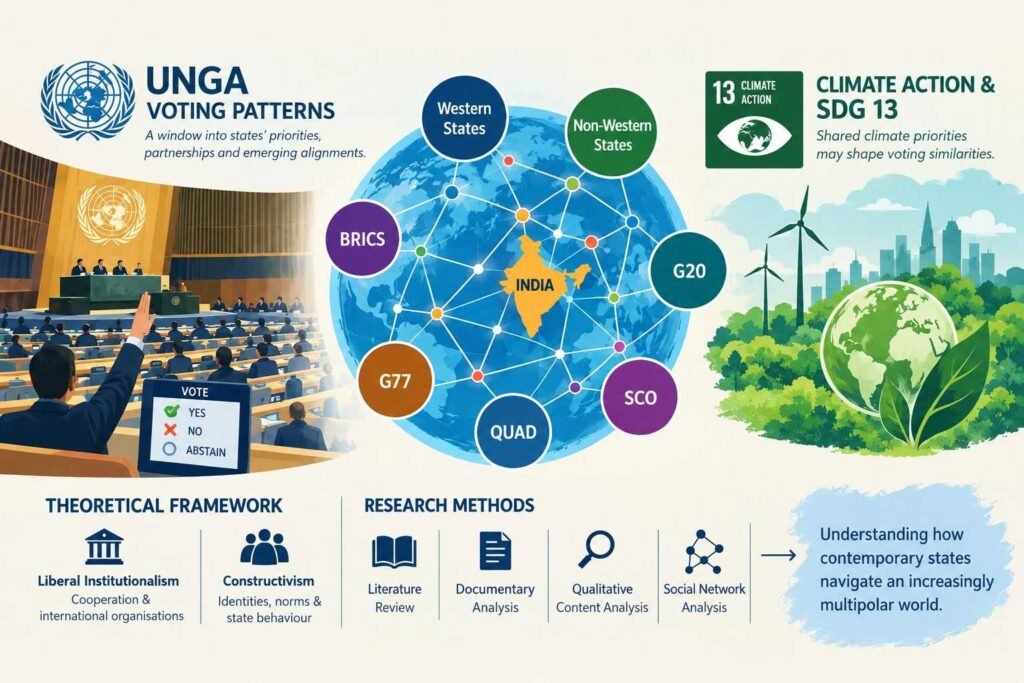
The contemporary international political landscape is characterized by increasing complexity. States now form flexible partnerships, collaborating on select issues while retaining autonomy in others, rather than adhering strictly to a single bloc or alliance. One effective method for observing these evolving relationships is to analyse voting behaviour in the United Nations General Assembly (UNGA). Voting records on political, economic, security, and environmental issues reveal states’ current priorities and partnerships. This study investigates whether patterns in UNGA voting behaviour can identify the emergence of new alliances and assesses the influence of climate-related priorities on these patterns. This study focuses particularly on India, whose strategic autonomy and engagement with both Western and non-Western states make it a useful case for examining patterns of diplomatic alignment through UNGA voting. The research also examines whether similarities in countries’ climate-related priorities, particularly those reflected in SDG 13, are associated with similarities in UNGA voting behaviour. The analytical framework draws on key international relations theories, including liberal institutionalism, which emphasizes the role of international organizations and cooperation, and constructivism, which highlights the influence of identities and norms on state behaviour. These theoretical perspectives are applied to investigate the motivations underlying voting patterns and alliance formation. Specifically, the study asks whether states with similar approaches to climate action also exhibit comparable voting patterns at the UNGA. The research is based on a systematic review of academic literature and documentary analysis, supported by qualitative content analysis and comparative examination of UNGA voting behaviour. Social Network Analysis is used as a framework for examining countries as interconnected actors and for identifying voting clusters, central actors, and possible emerging patterns of diplomatic proximity. However, the study recognises that voting similarity does not necessarily represent a formal alliance, as voting decisions may also be shaped by strategic interests, diplomatic relationships, economic considerations, and issue-specific factors. By bringing together UNGA voting, geopolitical alignment, and SDG 13, this research seeks to address a gap in existing literature and provide a clearer understanding of how contemporary states navigate an increasingly multipolar international order.
KEYWORDS
Alliance, geopolitics, climate action, United Nations, power, alignment & cooperation.
INTRODUCTION
The international political system has changed a lot since the end of the Cold War. The world is no longer shaped only by the rivalry between two major powers. The rise of countries such as China and India, along with the continuing influence of Russia and other regional powers, has made international politics more complex and multipolar. In this situation, countries are increasingly trying to maintain relationships with different powers instead of depending completely on one side. Their foreign-policy decisions are often influenced by their political, economic, security, and developmental interests. The United Nations General Assembly (UNGA) provides a useful way to study these changing relationships. Since all 193 member states have the right to vote, UNGA voting records can help us understand where countries have similar or different foreign-policy positions. At the same time, voting in the UNGA does not always mean that two countries are formal allies. Countries may vote similarly because of shared interests, diplomatic relationships, regional connections, or agreement on a particular issue. Therefore, UNGA voting can be used as an indication of diplomatic proximity rather than as direct proof of an alliance. India is an important example in this changing environment. It maintains relationships with both Western and non-Western countries and is also part of groupings such as BRICS, G77, G20, the Quad, and the Shanghai Cooperation Organisation. This reflects India’s approach of strategic autonomy and multi-alignment, where it tries to work with different partners while keeping enough freedom to make decisions according to its own interests. Climate change provides an additional issue through which these patterns of alignment can be examined. Although SDG 13 provides a common framework for climate action, countries differ in their economic conditions, development needs, and national priorities. This raises the question of whether countries with similar climate-related priorities also demonstrate greater similarity in UNGA voting behaviour This study therefore brings together UNGA voting patterns, geopolitical alignment, and SDG 13. Social Network Analysis is used to look at countries as connected actors and to identify possible voting clusters, central countries, and emerging patterns of cooperation. The study does not assume that similar voting automatically means a formal alliance. Instead, it looks at voting patterns as one way of understanding how countries relate to each other in an increasingly multipolar international system. It also explores whether these relationships are influenced mainly by traditional geopolitical interests or whether issues such as climate action and sustainable development are becoming important factors in international alignment.
1. CONTEXT OF THE PAPER
1.1 THE CHANGING INTERNATIONAL POLITICAL ORDER
The international political system has undergone significant changes since the end of the Cold War. During the Cold War, international politics was largely structured around the rivalry between the United States and the Soviet Union. The end of this rivalry did not, however, lead to a permanently unipolar system. Instead, the growing economic and political influence of countries such as China and India, the continued importance of Russia, and the increasing role of regional powers have contributed to a more complex and interconnected international order. These developments have made international alignments less straightforward, as countries increasingly balance their relationships with major powers according to their own political, economic, and security interests (Ikenberry, 2011; Acharya, 2014). The emergence of a more multipolar international system has also changed the way states approach international cooperation. Rather than aligning permanently with a single major power, countries increasingly engage with multiple political, economic, and security groupings. This development has made contemporary international relations more flexible and issue-based. Countries may cooperate with one group on economic issues while maintaining different positions on security, environmental, or political matters. Therefore, examining how countries position themselves within international institutions can provide useful insights into the changing structure of global politics.
1.2 UNITED NATIONS GENERAL ASSEMBLY AND INTERNATIONAL ALIGNMENTS
One useful way of observing these changing international alignments is through the United Nations General Assembly (UNGA). The UNGA consists of all 193 UN member states, with each country having one vote. Its voting record provides a large body of observable evidence through which researchers can examine similarities and differences in countries’ foreign-policy preferences. Scholars have extensively used UNGA voting patterns to identify voting blocs, measure political proximity between states, and examine changes in international alignments (Voeten, 2013; Kim & Russett, 2012). UNGA voting therefore provides an empirical basis for studying how states position themselves on major international issues. However, voting behaviour should not be treated as a perfect measure of foreign policy or geopolitical alignment. The subject and wording of individual resolutions can influence voting decisions, while abstentions and absences may have different meanings from explicit opposition (Voeten, 2013). Consequently, UNGA voting is more appropriately understood as an indicator of foreign-policy preferences and diplomatic proximity rather than as direct evidence of formal alliance membership.This distinction provides the basis for the network approach adopted in this study, where repeated similarities in voting behaviour are examined as indicators of diplomatic proximity rather than as proof of formal alliances. This distinction is particularly important in the contemporary international system, where countries increasingly maintain relationships with multiple competing powers.
1.3 UNGA VOTING AND CONTEMPORARY GEOPOLITICAL CRISES
The importance of UNGA voting becomes particularly visible during major international crises. A notable example is the UNGA resolution adopted in March 2022 following Russia’s invasion of Ukraine. The resolution received 141 votes in favour, five against, and 35 abstentions. Although a large majority of states supported the resolution, countries including India, China, Pakistan, and South Africa abstained (United Nations, 2022). This voting pattern demonstrates that countries do not necessarily follow a single Western or non-Western bloc when responding to major geopolitical developments. Instead, their decisions may reflect a combination of strategic interests, diplomatic relationships, economic considerations, security concerns, and historical partnerships. Thus, even countries that share broader political or economic relationships may adopt different positions on individual international issues. The Ukraine vote therefore illustrates the increasingly complex nature of international alignment. It also demonstrates why analysing UNGA voting through a network perspective can be useful. Rather than treating these countries as members of fixed geopolitical blocs, network analysis allows their voting relationships to be examined across multiple resolutions and issue areas.
1.4 INDIA AS AN EMERGING POWER IN THE INTERNATIONAL SYSTEM
This complexity becomes particularly relevant when India is placed at the centre of the analysis. India’s voting record at the UNGA demonstrates a relatively consistent foreign-policy trajectory while also reflecting its ability to maintain relationships with different groups of countries. Das (2017), in her analysis of India’s UNGA voting record, finds that India has maintained a comparatively stable policy trajectory across its seven decades of UN membership and has often acted as a common thread among different coalitions of developing countries. India’s position therefore cannot be understood simply as an extension of either the Western or the Russia–China bloc. Instead, its voting behaviour reflects a broader effort to preserve strategic flexibility while participating actively in different international groupings. India’s engagement with both Western and non-Western groupings makes its UNGA voting behaviour particularly useful for examining strategic autonomy and patterns of multi-alignment.
1.5 INDIA’S VOTING ALIGNMENTS ACROSS INTERNATIONAL GROUPINGS
India’s relationship with BRICS provides another example of its multi-dimensional approach to international relations. It is important to note that Brazil, Russia, India, China, and South Africa did not function as a formal BRICS group during the early decades of the United Nations. India’s relationship with BRICS provides a useful example of how formal international groupings may overlap with, but should not be equated with, UNGA voting alignment. Research on UNGA voting indicates that the countries that later formed BRICS showed areas of voting convergence, although significant differences remained across issue areas (Ferdinand, 2014; Das, 2017). However, research on UNGA voting indicates that the countries that later formed BRICS had increasingly compatible positions on several international issues, particularly from the early 2000s onwards (Ferdinand, 2014; Das, 2017). Ferdinand (2014), examining UNGA voting between 1974 and 2011, finds increasing voting cohesion among BRICS countries, although differences remained on issues such as nuclear disarmament and human rights. This demonstrates that membership in an international grouping does not necessarily produce uniform voting behaviour , although important differences remain on issues such as nuclear disarmament and human rights. This suggests that BRICS cooperation does not necessarily translate into complete agreement across all international issues. India’s position within this grouping is particularly relevant because its voting behaviour has remained comparatively stable even as its relationships with other major powers have changed. Das (2017) finds that India’s policy preferences at the UNGA have shown a high degree of consistency, while its positions have also contributed to convergence among BRICS countries. At the same time, India maintains close relationships with the United States and European countries. Das (2017) finds that India’s policy preferences have generally demonstrated greater similarity with European countries than with the United States in the UNGA. This illustrates that India’s diplomatic relationships cannot be reduced to a simple BRICS-versus-West framework. This variation reinforces the need to examine voting relationships empirically rather than assuming alignment based solely on formal partnerships. This makes India an important case for understanding how emerging powers navigate a changing international system without committing themselves permanently to one geopolitical camp.
1.6 INDIA AND REGIONAL ALIGNMENTS
India’s regional relationships provide another important dimension to its international voting behaviour. Das (2017) finds that, for much of the period examined, India’s voting patterns were comparable with those of its South Asian neighbours within the South Asian Association for Regional Cooperation (SAARC). This suggests that geographical proximity and shared regional interests can contribute to similarities in international voting behaviour. However, such similarities should not automatically be interpreted as evidence of a unified regional bloc. Differences among South Asian countries concerning security, economic interests, domestic politics, and foreign-policy priorities can result in varying voting positions across individual resolutions and issue areas. Therefore, examining voting behaviour across several countries and different issue areas is important for determining whether observed similarities represent stable geopolitical alignments or temporary, issue-specific cooperation.
1.7 CLIMATE CHANGE AND SDG 13 IN INTERNATIONAL GOVERNANCE
The changing international system also needs to be examined in the context of global challenges such as climate change. In 2015, the United Nations adopted the 17 Sustainable Development Goals (SDGs) under the 2030 Agenda for Sustainable Development. The SDGs transformed sustainable development from a primarily development-oriented agenda into a universal framework for addressing economic, social, and environmental challenges. Climate change occupies an important position within this framework through SDG 13: Climate Action. SDG 13 focuses on strengthening resilience and adaptive capacity to climate-related hazards, integrating climate measures into national policies, and improving education, awareness, and institutional capacity concerning climate change. It is also closely connected with other goals, particularly SDG 7 on affordable and clean energy, SDG 9 on industry and innovation, SDG 12 on responsible consumption and production, and SDG 17 on global partnerships. Although the SDGs provide a common international framework, their implementation varies significantly across countries. Beisheim (2023) argues that governments frequently adapt the SDGs to existing political priorities rather than implementing them as a uniform transformative agenda. Similarly, Banik (2022) highlights that sustainable development involves political choices because governments must balance economic growth, environmental protection, social welfare, and domestic political interests. SDG13 performance is measured using a multidimensional approach rather than using only one climate related indicator. This study uses the Multidimensional Climate Action Index (MCAI) which is an index based on the Alkari Foster counting method that helps to measure climate performance using different indicators. The MCAI includes four main dimensional Resilience, Actions, Education and Commitment. Resilience shows how well a country can deal with the effects of climate change, such as economic losses and deaths caused by climate related extreme events. Actions covers efforts related to climate mitigation and policies, such as reducing greenhouse gas emissions, improving energy efficiency, using renewable energy, and other climate policies. Education focuses on climate awareness and participants in climate relating initiatives. Commitments refers to financial and international efforts made to address climate change. Overall, the framework includes 14 partial indicators across these four dimensions. Each indicator is converted into a binary source where a score of 1 means satisfactory performance, while 0 means unsatisfactory performance and the benchmark is generally based on a relevant policy target wherever one is available. In situations when there is no specific policy target, the EU27 average is used as the benchmark to assess performance. For example, the EU 27 average is used as a reference for indicators such as economic losses and fatalities from climate related extreme events. Some of the EU27 benchmarks used in the study are Euro 843.78 per capita for economic losses from climate related extremes, 0.18 fatalities per 1,000 inhabitants, a 33% reduction in average CO2 emissions per kilometer from new passenger cars, and 16% reduction in the GHG intensity of energy consumption. For the remaining indicators, specific EU or country level policy targets are used where applicable. Equal weights are given to all four dimensions and also to the indicator within each dimension and also to indicators within each dimension. The individual indicator scores are 1st combined to calculate the score for each dimension. These dimension scores are then combined to obtain the overall SGD 13 performance score. The cut off point for satisfaction performance is 05. A score above 0.5 is considered satisfactory. In cases where data is missing, a value of 0.5 is assigned so that the missing observation does not change the performance decision. Therefore, the SDG 13 performance variable gives a broader major of climate performance by considering resilience, climate action, education and awareness, and commitment. It is more comprehensive than using only one indicator, such as CO2 emissions, and also makes the measurement process easier to understand and reproduce. This suggests that climate policy is not solely an environmental issue but is also connected to political and economic decision-making. Differences in climate performance may therefore reflect variations in domestic priorities, institutional capacity, economic structures, and international commitments. Understanding these differences alongside UNGA voting behaviour may provide insights into whether countries with similar approaches to climate action also demonstrate similarities in international diplomacy.
The UN resolution on climate protection highlights that climate change cannot be addressed by individual countries alone and therefore requires collective international action. Nations are expected to reduce greenhouse gas emissions and address the adverse impacts of climate change through coordinated efforts. The resolution also links climate action with sustainable development and emphasizes the international framework Convention on Climate Change (UNFCCC) and the Paris Agreement. Examining countries’ voting patterns on climate related issues provides a more specific understanding of international cooperation. It helps identify areas of voting convergence among countries as well as differences in the positions adopted by major geopolitical actions.
2. DIFFERENT VIEWPOINTS ON ALLIANCES
2.1 CONCEPTUALISING INTERNATIONAL ALLIANCES
International alliances play a significant role in shaping global politics by enabling states to cooperate in addressing common security, political, and economic challenges. Traditionally, alliances have been associated with military cooperation, such as NATO, but contemporary international cooperation extends beyond formal military alliances to include political, economic, regional, and issue-based partnerships. “Contemporary international politics also demonstrates that cooperation and competition can coexist across different issue areas. States may cooperate economically while adopting different positions on political, security, or environmental questions. This makes observable patterns of international voting useful for examining whether diplomatic relationships are stable across issues or vary according to specific policy areas. This competition has encouraged both powers to strengthen partnerships with other countries and has contributed to the emergence of new patterns of international alignment.
2.2 BALANCE OF THREAT THEORY AND ALLIANCE FORMATION
Alliance formation has been widely studied within international relations, with security concerns traditionally regarded as one of the primary motivations behind cooperation among states (Walt, 1987; Snyder, 1984). Walt’s (1987) Balance of Threat Theory argues that states form alliances primarily in response to perceived threats rather than simply balancing against the most powerful state. According to this perspective, countries consider factors such as aggregate power, geographical proximity, offensive capabilities, and perceived intentions when determining potential threats. States may therefore cooperate with countries that can help them counter common threats and achieve similar strategic objectives. Similarly, Snyder (1984) argues that alliances are formed to improve national security but can also create risks such as abandonment and entrapment. States therefore need to balance the benefits of cooperation against the possibility of becoming excessively dependent on their allies or being drawn into conflicts that do not directly serve their interests. These theoretical perspectives help explain why countries continue to strengthen strategic partnerships despite geopolitical tensions. However, contemporary international relations indicate that security is not the only factor influencing alignment. Economic interests, political values, development priorities, environmental concerns, and institutional relationships can also shape patterns of international cooperation.
2.3 UNGA VOTING AS AN INDICATOR OF INTERNATIONAL ALIGNMENT
To examine geopolitical alignments empirically, several studies have relied on voting behaviour in the United Nations General Assembly. The UNGA Ideal Points dataset developed by Voeten (2013) provides a systematic means of measuring similarities and differences in countries’ foreign-policy preferences through their voting behaviour. UNGA voting data can therefore be used to examine diplomatic proximity and identify patterns of cooperation that may not be visible through formal alliance structures. Countries that consistently vote similarly may demonstrate common foreign-policy preferences even when they do not share a formal alliance. However, the relationship between voting similarity and formal alliance formation should be treated carefully. Similar voting does not necessarily mean that countries are military allies or share identical interests. Voting decisions can also be influenced by diplomatic negotiations, economic relationships, regional affiliations, strategic interests, and issue-specific considerations. Although Walt’s (1987) and Snyder’s (1984) theories provide important explanations for why states form alliances, and Voeten’s (2013) UNGA dataset provides a means of empirically examining foreign-policy proximity, limited research has fully integrated these perspectives to investigate how UNGA voting patterns can identify emerging geopolitical alliances.
2.4 MULTILATERAL COOPERATION AND THE SUSTAINABLE DEVELOPMENT GOALS
International cooperation is not limited to traditional military or geopolitical alliances. States also cooperate through broader multilateral frameworks that address shared global challenges. In this context, the Sustainable Development Goals provide a useful framework for examining whether common policy priorities are reflected in states’ behaviour within multilateral institutions such as the United Nations General Assembly. The adoption of the 17 SDGs in 2015 established a universal framework for addressing shared economic, social, and environmental challenges. For this study, SDG 13 is particularly relevant because climate action requires cooperation beyond national borders and provides an issue area through which differences and similarities in state priorities can be examined. SDG 13 focuses on climate adaptation, resilience, policy integration, institutional capacity, and international cooperation. Rather than treating climate policy as a separate area of diplomacy, this study uses it to examine whether similarities in climate-related priorities are associated with similarities in UNGA voting behaviour. This creates a link between domestic policy priorities and patterns of international diplomatic alignment.
2.5 POLITICS OF SDG IMPLEMENTATION
Although the SDGs provide a common framework, their implementation has increasingly been understood as a political process rather than a purely technical one. States often resist external intervention in their political and economic priorities and consequently adapt international development frameworks according to domestic circumstances. Beisheim (2023) argues that governments frequently modify the implementation of SDGs to fit existing political priorities rather than pursuing comprehensive transformative sustainability. Similarly, Banik (2022) argues that sustainable development involves political negotiations because governments must balance competing priorities, including economic development, environmental concerns, social welfare, and electoral considerations. This demonstrates that the implementation of SDGs is shaped by domestic political institutions and national interests. India’s adoption of the SDGs after 2015, for example, occurred within a broader period of economic and political transformation. Russia, meanwhile, did not develop a single comprehensive national sustainable development strategy directly based on the SDGs, instead relying on several existing policy documents that were subsequently connected to SDG commitments. These differences demonstrate that political will, institutional capacity, economic structures, and domestic priorities influence how states approach international development commitments. However, existing literature provides comparatively limited insight into whether differences in domestic climate priorities are reflected in states’ behaviour within multilateral institutions. This creates a useful basis for examining whether countries with similar climate priorities also demonstrate greater similarity in UNGA voting behaviour.
2.6 INDIA, RUSSIA, AND CLIMATE-RELATED COOPERATION
India and Russia provide a useful example of how geopolitical relationships may intersect with voting behaviour in multilateral institutions. Research has identified areas of convergence between the two countries on issues such as sovereignty, non-intervention, counter-terrorism, and institutional reform (Sharma & Atri, 2023). Such convergence provides a basis for considering whether broader diplomatic relationships are also reflected in UNGA voting patterns. Nevertheless, the climate challenges facing the two countries differ significantly. India’s challenge is associated with rapid economic development, high total emissions, and considerable climate vulnerability. Russia’s challenges are more strongly connected with fossil-fuel dependence, carbon-intensive economic structures, and a transition strategy that relies significantly on forests and future technologies (Purushothaman & Philip, 2023). These differences demonstrate why countries may share broad principles on climate justice while maintaining different domestic approaches to climate policy. This raises an important question concerning whether similarities in climate-related commitments are reflected in their international voting behaviour.
2.7 CLIMATE DIPLOMACY AND INDIA’S STRATEGIC ALIGNMENTS
Research on India’s foreign policy highlights its attempt to balance economic development with climate commitments, while emphasising climate justice and the principle of Common but Differentiated Responsibilities. India’s participation in multiple international groupings also illustrates its strategy of maintaining flexibility across different diplomatic relationships. This makes India a useful case for examining whether formal memberships correspond with actual patterns of voting similarity in the UNGA. However, existing research on India has generally examined climate diplomacy through the lenses of strategic autonomy, international negotiations, and climate governance. Comparatively less attention has been given to India’s actual voting behaviour on climate-related resolutions within the United Nations General Assembly. This represents an important intersection between the literature on alliances and the literature on UNGA voting. Examining India’s voting behaviour can help determine whether its climate diplomacy and broader geopolitical relationships are reflected in patterns of voting similarity with other countries.
2.8 EMERGING PERSPECTIVES ON ALLIANCE FORMATION
Overall, the alliance literature demonstrates that international alignment cannot be explained through a single factor. Traditional theories emphasise security threats and strategic interests, while more recent perspectives highlight economic interdependence, institutional cooperation, shared political identities, environmental concerns, and issue-specific partnerships. The existence of multiple and overlapping international groupings demonstrates that contemporary states may participate in different networks of cooperation simultaneously. India’s relationships with both Western and non-Western states provide a useful case for examining whether these overlapping relationships are reflected in UNGA voting patterns. Therefore, rather than viewing international politics exclusively through formal alliances, this study approaches alignment as a pattern that can be observed through repeated similarities in state behaviour. UNGA voting provides an empirical basis for identifying such patterns through network analysis, while climate-related priorities provide an additional dimension for examining whether issue-specific similarities are associated with broader diplomatic proximity.
3.UNITED NATIONS VOTING LITERATURE
3.1 NORTH–SOUTH POLITICS AND VOTING PATTERNS IN THE UN GENERAL ASSEMBLY
The transformation of voting alignments in the United Nations General Assembly (UNGA) from the Cold War’s East–West divide towards a broader North–South divide reflects an important shift in global politics. During the Cold War, voting behaviour within the UNGA was strongly influenced by ideological competition between the United States and the Soviet Union. Following the end of the Cold War, however, developing countries increasingly used multilateral institutions to advance their political, economic, and developmental interests (Kim & Russett, 1996). Participation in forums such as the United Nations provided developing states with greater opportunities to influence international agendas, particularly in areas concerning sustainable development, economic equality, and global governance (Najam, 2005; Lees, 2023; Walsh et al., 2022). Consequently, recent scholarship increasingly recognises developing countries not as marginal participants but as important actors capable of shaping international negotiations through coalition-building and collective diplomacy.
Coalitions such as the Group of 77 (G77) and the Non-Aligned Movement (NAM) have enabled developing countries to coordinate their positions and strengthen their bargaining power within international negotiations (Najam, 2005). These coalitions demonstrate that voting patterns in the General Assembly cannot be understood solely through individual national interests. Instead, voting behaviour may also be influenced by shared developmental priorities, regional affiliations, historical experiences, and the broader politics of North–South relations (de Oliveira et al., 2025). The continuing relevance of these coalitions indicates that collective political identities and shared understandings of the international system can contribute to sustained voting cohesion.
Environmental and climate-related resolutions provide an additional issue area through which North–South differences can be examined. Developing countries frequently emphasise economic development, equity, climate justice, sovereignty, and Common but Differentiated Responsibilities (CBDR), while developed countries may place greater emphasis on universal environmental commitments and implementation (Pattberg et al., 2022; Wewerinke-Singh, 2022). These differences are relevant to this study because they allow climate-related priorities to be compared with broader patterns of UNGA voting alignment.
Environmental negotiations therefore extend beyond technical discussions concerning climate change. They also reflect political realities and competing interpretations of international responsibility. This makes environmental diplomacy an important lens through which voting patterns and coalition politics within the UNGA can be examined. The relationship between environmental governance and international politics is particularly relevant to the Sustainable Development Goals (SDGs), adopted by the United Nations in 2015. SDG 13, which focuses on Climate Action, calls for strengthening resilience to climate-related hazards, integrating climate measures into national policies, improving institutional capacity, and strengthening international cooperation.
These differences are particularly relevant when examining climate-related voting behaviour. Countries may share concerns about climate change while adopting different diplomatic positions because of their development priorities, economic interests, or strategic relationships. Conversely, voting convergence may reflect broader geopolitical or institutional relationships rather than climate priorities alone. This distinction is central to the network approach adopted in this study.
The literature on UNGA voting further demonstrates that voting records can reveal underlying foreign-policy preferences rather than simply representing responses to individual resolutions. Bailey, Strezhnev, and Voeten (2017) demonstrate how UNGA voting records can be used to estimate countries’ foreign-policy preferences over time. Lees (2023) similarly highlights the long-term cohesion of the G77 and connects this cohesion with an enduring South–South political identity. Together, these studies suggest that voting alignments are influenced not only by converging policy interests but also by collective identities and shared understandings of the international order.
Nevertheless, this perspective does not fully account for the strategic considerations that may influence state behaviour. Governments may vote in particular ways because of diplomatic incentives, foreign assistance, economic relationships, or broader geopolitical calculations rather than solely because of genuine policy agreement. Therefore, voting cohesion should not automatically be interpreted as evidence of purely ideological agreement. This distinction becomes particularly important when examining contemporary international politics, where states increasingly participate in multiple overlapping political and economic groupings.
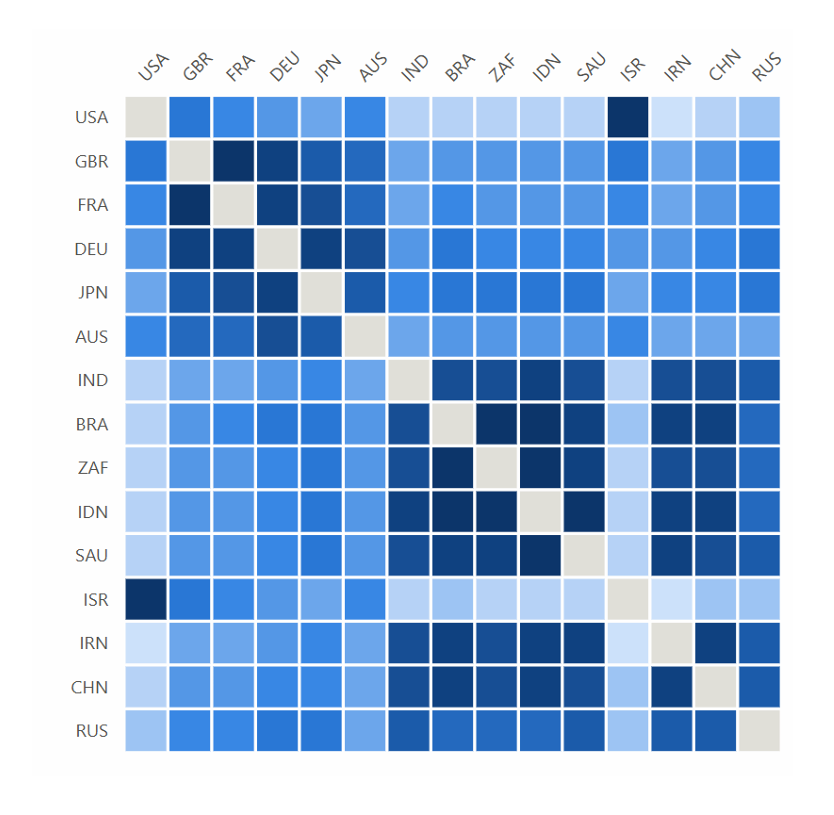
Countries are represented using standard codes, such as USA for the United States and GBR for the United Kingdom. The darker shades indicate stronger levels of voting agreement between countries, while lighter shades represent lower agreement. The graph therefore provides a visual representation of similarities and differences geopolitical actors. These patterns help identify areas of voting convergence and divergency within the United Nations General Assembly. In particular, the voting patterns of India, China, Russia and Western countries provide useful insights into the extent to which geopolitical relationships are reflected in UNGA voting behavior. However, voting convergence does not necessarily indicate a formal political alliance, as countries may adopt similar positions due to shared interests, issue specific concerns, or common policy objectives. Thus alignment in UNGA voting can reflect both broader geopolitical relationships and practical cooperation on particular international issues.
3.2 GLOBAL NORTH POLICY OF STRATEGIC VOTE PROCUREMENT
The post-Cold War period is often characterised as an era in which multilateralism and democracy became increasingly interconnected. Liberal institutionalist scholarship argues that multilateral institutions can constrain hegemonic power while simultaneously encouraging cooperation among states (Carter & Stone, 2015). Ruggie (1992) maintains that multilateral institutions influence state behaviour by establishing generalised principles of conduct, while Ikenberry (2001) argues that dominant powers may bind themselves to international institutions in order to preserve a stable international order. Extending this liberal perspective, Mousseau (2003) suggests that cooperation among democratic states is encouraged not only by shared political institutions but also by liberal market norms that facilitate trust and peaceful interaction. However, this liberal interpretation has been challenged by scholarship emphasising the importance of strategic interests and material incentives. Carter and Stone (2015) argue that strategic considerations can frequently outweigh shared democratic values in shaping voting behaviour. This raises an important question regarding whether states cooperate within multilateral institutions because of shared political norms or because of strategic calculations and material incentives. Carter and Stone (2015) examine vote buying within the UN General Assembly and find evidence that the United States has used foreign aid as a diplomatic instrument to secure support on strategically important UN votes. Their findings suggest that external incentives can influence voting behaviour even among states that share similar political institutions and values. This challenges the constructivist expectation that democracies will naturally align because of shared identities and norms (Wendt, 1999). Instead, voting behaviour may reflect a combination of diplomatic pressure, economic incentives, strategic interests, and political relationships. These findings highlight an important limitation in interpreting UNGA voting patterns. Countries that vote similarly may not necessarily share identical ideological positions or form a formal political alliance. Voting convergence may result from foreign aid, economic relationships, security partnerships, diplomatic negotiations, regional interests, or common strategic objectives. Consequently, UNGA voting should be understood as an indicator of foreign-policy proximity rather than definitive evidence of formal alliance membership. These findings also suggest that contemporary voting patterns may involve multiple overlapping relationships rather than a simple division between competing blocs. This development indicates that the contemporary UNGA may not be characterised by a simple division between Western and non-Western states. Instead, states can occupy multiple overlapping networks of cooperation depending on the issue being considered. Such flexibility is particularly important when examining climate-related resolutions because voting similarity on environmental issues may differ from alignment on security or economic issues
3.3 BRICS, THE NON-ALIGNED MOVEMENT, AND THE CHANGING DYNAMICS OF COALITION POLITICS
The literature on South–South cooperation indicates that coalition politics within the United Nations has undergone significant changes since the end of the Cold War. Earlier research examined organisations such as the Non-Aligned Movement (NAM) and the Group of 77 (G77) as mechanisms through which developing countries coordinated positions and increased their influence within international institutions (Acharya, 2018; Hurrell, 2006). Their continued relevance demonstrates that shared political identities and common interests can contribute to voting cohesion within the UNGA. More recent scholarship suggests that BRICS has created another platform for coordination among emerging economies and has contributed to cooperation on issues including global governance, sustainable development, and institutional reform (Stephen, 2014; Stuenkel, 2017; Diko & Sempijja, 2021). For UNGA research, its relevance lies in examining whether participation in such groupings corresponds with measurable similarities in voting behaviour. The distinction between NAM and BRICS is important. NAM emerged primarily in the context of superpower rivalry and emphasised strategic autonomy and non-alignment. BRICS, in contrast, has adopted a more proactive approach towards reforming global financial and political institutions and promoting a more multipolar international order (Stuenkel, 2017; Ikenberry, 2011). Nevertheless, scholars differ regarding the extent to which emerging powers seek to transform the existing international order. Hurrell (2006) argues that emerging powers largely seek greater influence within the existing liberal international order rather than its complete replacement. Stephen (2014), by contrast, argues that the rise of emerging powers represents a gradual redistribution of authority that challenges traditional Western dominance. Acharya (2018) similarly suggests that the diffusion of global power has created new centres of influence and expanded opportunities for collective diplomacy. These developments have important implications for UNGA voting. States increasingly participate in overlapping coalitions such as the G77, NAM, BRICS, and regional organisations, allowing them to pursue issue-specific partnerships while maintaining broader developmental and strategic objectives (Karns & Mingst, 2022; Thakur, 2017). Recent empirical research suggests that these coalitions have become increasingly relevant in shaping collective positions on sustainable development, climate governance, international security, and institutional reform (Lees, 2023; de Oliveira et al., 2025). Thus, contemporary coalition politics cannot be understood simply through permanent blocs. Instead, international alignment may involve multiple and overlapping relationships in which states cooperate on particular issues while maintaining independent positions on others. This provides an important basis for analysing UNGA voting as a network of relationships rather than simply as a collection of bilateral alliances.
3.4 STRATEGIC AUTONOMY, MULTI-ALIGNMENT, AND INDIA’S VOTING BEHAVIOUR IN THE CONTEMPORARY UNGA
Recent scholarship suggests that India’s engagement with the United Nations can no longer be understood solely through the traditional concept of non-alignment. Earlier approaches portrayed Indian diplomacy as an attempt to remain equidistant from competing power blocs. Contemporary scholarship instead increasingly characterises India’s foreign policy through strategic autonomy, selective partnerships, multi-alignment, and issue-based cooperation rather than rigid bloc politics (Diko & Sempijja, 2021; Cogo Morales, 2025; Gagan & Kumar, 2025). This perspective is particularly relevant to UNGA voting because it suggests that India’s voting relationships may vary across issues rather than consistently follow a single geopolitical bloc. This transformation reflects India’s response to an increasingly multipolar international system in which no single power dominates all dimensions of global politics. India maintains relationships with multiple centres of power rather than aligning exclusively with one coalition. Such multi-alignment provides an important context for examining whether India’s UNGA voting behaviour forms consistent clusters with particular groups of states or changes according to the issue under consideration. BRICS provides one example of the overlapping partnerships within which India operates. However, participation in a grouping does not necessarily imply uniform voting behaviour. Existing research on UNGA voting therefore provides a basis for testing whether India’s relationships within such groupings correspond with measurable voting similarity (Diko & Sempijja, 2021; Cogo Morales, 2025). These competing perspectives suggest that India’s voting alignment should be examined across multiple resolutions rather than assumed from its formal partnerships. Analysing voting patterns across different issues can help determine whether India’s alignment with particular countries is relatively consistent or instead depends on the subject of individual resolutions. India’s responses to recent international crises further illustrate the issue-specific nature of its foreign policy. Its positions may reflect national security, economic interests, diplomatic relationships, and broader Global South considerations (Taneja, 2025). Such variation reinforces the importance of examining actual UNGA voting behaviour rather than inferring alignment from diplomatic partnerships alone. This represents an important shift from the traditional understanding of Indian non-alignment. During the Cold War, non-alignment primarily involved maintaining distance from competing power blocs. Contemporary strategic autonomy, in contrast, enables India to engage simultaneously with multiple coalitions without becoming permanently tied to any one of them. Consequently, India’s UNGA voting behaviour may reflect a combination of historical partnerships, strategic interests, domestic priorities, and issue-specific diplomatic calculations (Nurullayev & Papa, 2023; de Oliveira et al., 2025). Recent scholarship therefore increasingly presents India as a pivotal actor within a contested and increasingly multipolar multilateral order. Rather than functioning simply as a traditional non-aligned state or as a strategic partner of the West, India increasingly pursues strategic autonomy through multi-alignment and issue-based diplomacy (Hall, 2021; Chacko, 2022; Jaishankar, 2020; Pant & Saha, 2024; Taneja, 2025; Dar & Janbaz, 2024). This makes India particularly relevant for examining whether UNGA voting relationships form stable geopolitical clusters or flexible, issue-specific networks
3.5 ENVIRONMENTAL DIMENSIONS OF THE IRAN–ISRAEL CONFLICT AND THEIR IMPLICATIONS FOR UNGA VOTING PATTERNS
Recent scholarship increasingly recognises that environmental and climate-related concerns can interact with broader political, economic, and security interests. For this study, the relevance of this literature lies in understanding whether environmental and climate priorities may contribute to similarities in states’ diplomatic behaviour within multilateral institutions. Research on contemporary conflicts also demonstrates that UN institutions are arenas in which states respond to competing geopolitical and normative interests. Studies of regional conflicts highlight how divergent national interests can influence positions within multilateral institutions (Haider, Usman, & Ali, 2026; Ge & Zhang, 2025). This supports the broader argument that UNGA voting should be analysed as a product of multiple political influences rather than a direct reflection of a single policy preference. Environmental concerns can also influence international diplomacy by linking environmental governance with security, development, and humanitarian issues. Research on environmental consequences of conflict and environmental peacebuilding demonstrates that environmental issues increasingly intersect with broader international governance debates (Gunawan, Ghiffara, & Akbar, 2025; Sommer & Fassbender, 2024). For this study, this literature is relevant insofar as it suggests that environmental concerns may become part of wider diplomatic preferences. The climate–security literature further demonstrates that environmental conditions can influence political stability, resource competition, migration, and interstate relations (Ide, 2023; UNEP, 2022; IPCC, 2023). These links suggest that climate-related concerns may interact with broader foreign-policy priorities and therefore potentially influence diplomatic behaviour. These developments suggest that climate justice, sustainable development, and environmental concerns may increasingly influence diplomatic positions within international institutions. However, the extent to which such concerns are reflected in UNGA voting patterns remains an empirical question. However, the existing literature largely examines these issues separately. Research on armed conflict tends to focus on geopolitical and security consequences, while climate literature frequently concentrates on environmental governance, adaptation, mitigation, and vulnerability. Studies of UNGA voting, meanwhile, primarily examine foreign-policy preferences, geopolitical blocs, strategic interests, and diplomatic relationships. Comparatively limited research directly connects climate-related priorities with patterns of UNGA voting and diplomatic network alignment. This gap provides the basis for examining whether climate-related similarities are associated with broader patterns of voting proximity. This limitation is particularly important for understanding the potential relationship between SDG 13 and international voting behaviour. If climate performance, vulnerability, or policy commitments are associated with particular patterns of diplomatic cooperation, countries with similar SDG 13-related characteristics may demonstrate greater voting proximity in relevant UNGA resolutions. Alternatively, weak or inconsistent relationships would suggest that strategic, geopolitical, or other domestic interests remain more influential than climate priorities in shaping voting behaviour. Taken together, the literature suggests that climate and environmental priorities can intersect with international diplomacy, but their relationship with UNGA voting remains insufficiently explored. This provides a basis for examining whether similarities in SDG 13-related characteristics are associated with voting proximity between states and whether such relationships form identifiable patterns within UNGA voting networks.
RESEARCH GAP EMERGING FROM THE UNGA VOTING LITERATURE
Overall, the literature on UNGA voting demonstrates that international voting behaviour is influenced by multiple factors, including North–South politics, shared political identities, strategic interests, material incentives, coalition membership, and issue-specific diplomatic considerations. Research on BRICS, NAM, G77, and India’s strategic autonomy further demonstrates that contemporary international alignments are increasingly characterised by overlapping and flexible relationships rather than rigid geopolitical blocs. At the same time, the literature on environmental diplomacy and climate security demonstrates that climate change has become increasingly connected to international security, development, and diplomatic relations. However, these two areas of scholarship remain largely separate. The central gap is therefore the limited integration of UNGA voting behaviour, SDG 13 performance, and Social Network Analysis. Existing research has examined UNGA voting to identify foreign-policy preferences and geopolitical alignments, while separate studies have evaluated national climate performance and climate diplomacy. Comparatively little research examines whether countries with similar levels of climate-action performance also demonstrate greater similarity in their UNGA voting behaviour. The present study addresses this gap by examining the relationship between SDG 13 performance and UNGA voting similarity through a Social Network Analysis framework. This approach allows countries to be examined as interconnected actors rather than as isolated cases and makes it possible to identify clusters, central actors, and patterns of emerging alignment. In doing so, the study seeks to determine whether contemporary international alignments are driven primarily by traditional geopolitical and strategic interests or whether shared performance and priorities concerning climate action also contribute to the formation of international diplomatic networks.
RESEARCH METHODOLOGY
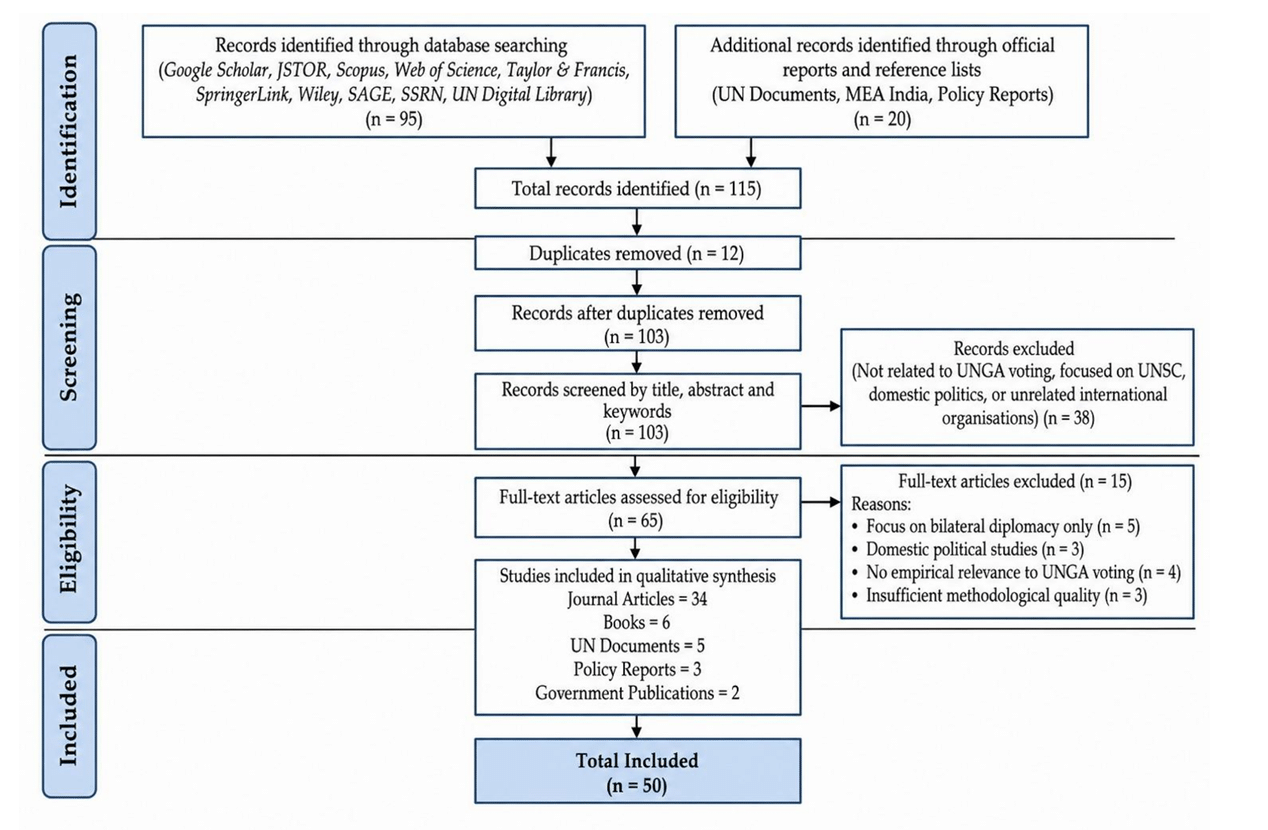
The present study adopts a mixed-methods research design, combining qualitative thematic analysis with quantitative Social Network Analysis (SNA) based on a systematic review of academic literature, documentary analysis, and voting record datasets. The objective is to understand the factors that shape voting patterns in the United Nations General Assembly (UNGA), with particular emphasis on India’s voting behaviour in an evolving international order. Rather than viewing UNGA votes as isolated diplomatic events, the study examines them within the wider political context shaped by North–South relations, strategic autonomy, coalition politics, environmental governance, and the emergence of multipolarity. Voting behaviour in the General Assembly is rarely driven by a single consideration. Instead, it reflects the interaction of historical experiences, foreign policy priorities, geopolitical interests, and institutional commitments. A qualitative approach, complemented by graph-theoretic network visualisations, is therefore considered most appropriate, as it allows these interconnected dimensions and relational structural positions to be explored in greater depth than would be possible through quantitative or qualitative analysis alone. To build a comprehensive body of literature and relational data, a systematic search strategy was adopted using a range of academic databases, digital voting archives, and official documentary sources. The principal databases consulted include Google Scholar, JSTOR, Scopus, Web of Science, SAGE Journals, Taylor & Francis Online, SpringerLink, Wiley Online Library, SSRN, the Voeten et al. UN General Assembly Voting Data repository, and the United Nations Digital Library. These databases were selected because they contain a substantial collection of peer-reviewed research on international relations, foreign policy, global governance, multilateral diplomacy, and United Nations studies. In addition to academic publications, official documents issued by the United Nations, the United Nations General Debate Archive, and the Ministry of External Affairs, Government of India, were examined to provide primary evidence on voting records, explanations of vote, and India’s diplomatic positions. The search was guided by keywords that reflected the central themes of the research. These included “United Nations General Assembly voting,” “India UNGA voting,” “UN voting patterns,” “North–South politics,” “Global South,” “strategic autonomy,” “multi-alignment,” “coalition politics,” “BRICS,” “G77,” “Non-Aligned Movement,” “G20,” “SAARC,” “China and the UN,” “European Union voting,” “United States and UN voting,” “West Asia,” “environmental governance,” “climate diplomacy,” “Sustainable Development Goals,” “Russia–Ukraine,” “multipolarity,” and “Social Network Analysis UNGA.” Boolean operators such as AND, OR, and quotation marks were employed to refine the search and retrieve studies that addressed multiple dimensions of UNGA voting behaviour. The review focused primarily on literature published between 2000 and 2025, while giving particular attention to studies produced from 2020 onwards. This time frame was chosen because it captures both the evolution of post-Cold War voting alignments and the more recent transformations associated with the rise of emerging powers, renewed geopolitical competition, climate diplomacy, and issue-based coalitions in the United Nations. Restricting the review to this period also ensured that the analysis remained relevant to contemporary debates surrounding India’s foreign policy and the changing nature of multilateral diplomacy. The initial search yielded approximately 95 records from the selected databases and official sources. After duplicate records were removed, the remaining publications were screened on the basis of their titles, abstracts, and keywords to assess their relevance to the objectives of the study. Studies that focused exclusively on Security Council politics, domestic electoral behaviour, bilateral relations unrelated to the United Nations, or international organisations outside the UN system were excluded at this stage. The remaining publications were subsequently subjected to a detailed full-text assessment to determine their suitability for inclusion in the review. The inclusion criteria were designed to ensure that the selected literature directly contributed to understanding voting behaviour in the United Nations General Assembly. Preference was given to peer-reviewed journal articles, academic books, official UN publications, policy reports, and recognized voting datasets that examined India’s foreign policy, strategic autonomy, coalition politics, North–South relations, or broader patterns of multilateral diplomacy. Studies addressing the role of BRICS, the Group of 77 (G77), the Non-Aligned Movement (NAM), the G20, SAARC, China, the United States, the United Kingdom, and the European Union were included where they provided meaningful insights into international alignments within the UNGA. Similarly, research focusing on environmental governance, climate negotiations, sustainable development, West Asia, and the Russia–Ukraine conflict was incorporated because these issue areas have increasingly become important arenas in which contemporary voting alignments are negotiated and contested. Conversely, publications were excluded if they concentrated primarily on domestic political developments, bilateral diplomacy without reference to UNGA voting, or theoretical debates lacking empirical relevance to the research objectives. Studies with limited methodological rigour or those that did not contribute directly to understanding multilateral voting behaviour were also omitted from the final review. Following the screening and eligibility process, approximately 50 studies were retained for detailed analysis. These comprised peer-reviewed journal articles, scholarly books, official United Nations documents, government publications, policy reports, and established voting datasets. Together, these sources provide the theoretical foundation as well as the empirical evidence upon which the subsequent analysis is based. A summary of the literature selection process is presented through a PRISMA-style flow diagram, illustrating the stages of identification, screening, eligibility assessment, and final inclusion of studies.
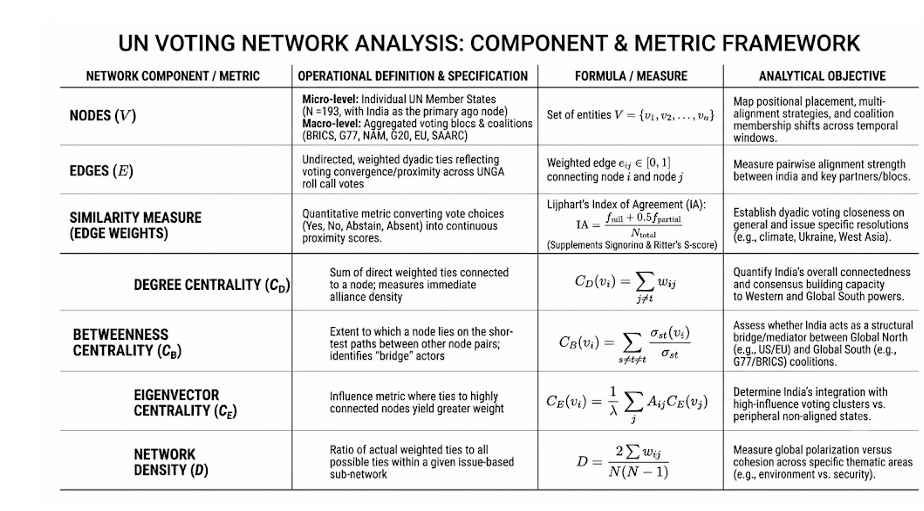
To complement the qualitative synthesis, the study explicitly constructs a Social Network Analysis (SNA) framework to model diplomatic voting proximity and coalition structures within the UNGA:
● 1. Specification of Nodes: In the constructed network models, the nodes represent individual UN Member States (with India as the primary focal node, alongside key global actors including the United States, China, the United Kingdom, Russia, and individual EU member states) as well as aggregated institutional blocks and voting coalitions (such as BRICS, G77, NAM, G20, and SAARC).
● 2. Specification of Edges: The edges (links between nodes) represent undirected, weighted dyadic relationships defined by voting alignment proximity across roll-call votes in the UNGA. The edge weights quantify the degree of voting convergence between any two actors over specific temporal windows and thematic issue areas.
● 3. Similarity Measures and Network Construction: Voting alignment is operationalised using Lijphart’s Index of Agreement (IA) alongside state-of-the-art affinity measures derived from spatial voting models (such as Signorino and Ritter’s $S$-score or ideal point distance estimates). On individual voting events, identical votes (Yes–Yes, No–No, or Abstain–Abstain) receive a full agreement weight, partial concurrence (Yes–Abstain or No–Abstain) receives half weight, and opposing votes (Yes–No) receive zero weight.
The aggregate similarity matrix is generated using the formula: f_full + 0.5 * f_partial IA = ———————— N_total.
Where N_total represents the total number of shared roll-call votes evaluated. Node centrality metrics—including Degree Centrality (measuring immediate alliance density), Betweenness Centrality (identifying India’s position as a diplomatic bridge between the Global North and Global South), and Eigenvector Centrality (reflecting connectedness to dominant global voting blocs)—are calculated to map structural shifts in multi-alignment. The formal operationalization of these network parameters, mathematical formulations, and their corresponding analytical objectives are summarized.
The selected material was analysed using qualitative content analysis supported by comparative document analysis and SNA visualization output. Rather than treating individual studies in isolation, the analysis sought to identify recurring themes, areas of convergence, and points of disagreement across the literature. Particular attention was given to concepts such as strategic autonomy, South–South solidarity, environmental justice, coalition politics, geopolitical competition, multilateralism, network density, bridging centrality, and the changing distribution of power within the international system. This thematic and network-oriented approach made it possible to relate broader theoretical debates to actual patterns of voting in the General Assembly. A comparative perspective forms an important component of the research. India’s voting behaviour is examined alongside that of selected Global North actors, namely the United States, the United Kingdom, and the European Union, as well as China and major multilateral coalitions including BRICS, G77, NAM, G20, and SAARC. In addition, selected issue-based case studies relating to environmental governance, climate diplomacy, sustainable development, West Asia, and the Russia–Ukraine conflict are used to explore how different geopolitical contexts influence voting behaviour. These cases have not been chosen merely because they are contemporary issues; rather, they represent policy areas in which competing strategic interests, developmental concerns, and ideological commitments are most visible within the UNGA. Taken together, this mixed-methods framework enables the study to move beyond a simple description of voting outcomes. It allows India’s voting behaviour to be understood within the wider context of shifting international alignments, changing patterns of coalition politics, and the transition from a predominantly unipolar to an increasingly multipolar world order. By integrating evidence from academic scholarship, official UN documents, empirical network measures, and comparative case studies, the research provides a comprehensive basis for analysing both continuity and change in India’s diplomatic engagement within the United Nations General Assembly.
Selection criteria of the regions
Case selection was done in a purposive manner with the criteria being geopolitical importance, different foreign policy approaches, strategic autonomy relevance for India, involvement in large coalitions, climate policy relevance, and availability of roll call voting data from UNGA. India would be the focus case whereas China and Russia would be the major non-Western and emerging powers while the United States and European Union would be the Western ones. This does not assume that these players are part of solidified blocs but to see whether their voting behavior forms stable networks. The selection of India as the focal country for the analysis rests on the fact that it is essential for the study to examine how an influential Global South state manages its geopolitical pressures. The choice of India as a case for the analysis is justified since India’s foreign policy strategy consists of both strategic autonomy and membership of Global South institutions along with the involvement of the rising powers group such as BRICS and at the same time growing ties with the Western countries. Therefore, it would be possible to analyze India not only as a part of one geopolitical grouping but as an intermediary state among different voter groups. China serves as one of the rising powers of global significance and is chosen as a suitable non-western comparator. The inclusion of China makes it possible for the study to test how India’s voting pattern is similar to that of another major Asian power in areas such as sovereignty, development, climate governance, and changes in the international order. India and China serve as an interesting pair for comparison in that the two countries are both members of multiple Global South and multilateral organizations, yet have strategic rivalries at the same time. This is due to the unique geopolitical position of Russia and the strategic relationship that has existed between Russia and India for long. Russia offers a different case of comparison from China since while India’s strategic relationship with China has been characterized by both cooperation and competition, that of India and Russia has been based on cooperation. In this regard, the inclusion of Russia allows one to find out if strategic relationships do affect UNGA voting networks, especially in the event of changing geopolitical tensions. The US is a significant world power that can be used to determine how far India has gone in its voting behavior from the Western power hub. The EU, on the other hand, will provide the institutional and normative contrast that is especially important in climate governance and sustainable development.
US CLIMATE CHANGE, SDG 13 AND GEOPOLITICAL ALIGNMENT
Climate change has transformed from a primarily environmental concern into a geopolitical priority that shapes international diplomacy, economic partnerships and national security strategies (IPCC, 2023; United Nations, 2015). Under the UN Sustainable Development Goal 13 (SDG 13: Climate Action), countries are urged to take action against greenhouse gas emissions, build resilience to climate impacts and incorporate climate considerations into national policies (United Nations, 2015). As states pursue varying degrees of climate ambitions, their domestic policies begin to affect their standing in international negotiations and voting blocs within the UN General Assembly (UNGA) (Tørstad et al., 2020). The United States has been one of the most influential actors in climate diplomacy due to its status as one of the world’s largest economies and greenhouse gas emitters (UNEP, 2023). The country played a central role in negotiating the Paris Agreement, which has become the foundation of the contemporary global climate regime (UNFCCC, 2015). However, the Trump administration’s decision to withdraw the US from the Paris Agreement created uncertainty regarding American climate leadership (UNFCCC, 2021). The Biden administration’s return to the Paris Agreement in 2021 enabled the United States to re-establish its role in global climate governance and strengthen cooperation with traditional allies (United Nations, 2021). This shift in US climate policy has had diplomatic implications, particularly for its alliances and strategic partnerships, which can be examined through changes in UNGA voting behaviour (Voeten, Strezhnev, & Bailey, 2009). The UN General Assembly is a valuable source for analysing international relations because it records how countries formally express their positions on issues such as climate change, security, human rights and development (Voeten et al., 2009). Using Social Network Analysis (SNA), researchers can identify clusters of countries that consistently vote together and detect emerging geopolitical alliances (Macon et al., 2012). Applying SNA to the UN voting database can reveal voting blocs centred around the United States, including NATO members, European Union states, Japan, Australia and South Korea, as well as compare them with US strategic competitors such as China, Russia, Iran and members of BRICS to determine whether climate-related priorities influence diplomatic alignment (Maoz, 2011; Macon et al., 2012). The present paper aims to utilise the UN voting database to investigate whether countries demonstrating stronger performance on SDG 13 indicators tend to vote similarly to the United States in the United Nations General Assembly. Specifically, the study seeks to determine whether US allies form a cohesive voting bloc associated with climate-oriented foreign policy positions and whether comparable patterns exist among US rivals. By integrating SDG performance data with UN voting records, the research will assess whether climate action has become an important determinant of international alignment alongside traditional security and economic interests (United Nations, 2015; Voeten et al., 2009).
CASE STUDY 1: PARIS AGREEMENT AND US CLIMATE LEADERSHIP (2015–2024)
The Paris Agreement, adopted in 2015 under the United Nations Framework Convention on Climate Change (UNFCCC), is one of the most ambitious global climate treaties. It commits participating countries to hold the increase in global average temperature to well below 2°C above pre-industrial levels while pursuing efforts to limit warming to 1.5°C (UNFCCC, 2015). The United States played a leading role during the negotiations owing to its economic influence and status as one of the world’s largest greenhouse gas emitters (UNEP, 2023). However, the Trump administration’s withdrawal from the Agreement in 2020 raised concerns about global climate governance and US leadership (UNFCCC, 2021). The Biden administration’s decision to rejoin the Agreement in February 2021 marked a renewed commitment to multilateral climate diplomacy (United Nations, 2021). This policy transition provides an opportunity to examine whether shifts in US climate commitments influenced diplomatic alignment within the United Nations General Assembly. Using Social Network Analysis of UN voting data before and after US re-entry into the Paris Agreement can reveal whether countries with similar climate ambitions increased their voting similarity with the United States (Voeten et al., 2009; Macon et al., 2012).
CASE STUDY 2: RUSSIA–UKRAINE WAR AND CLIMATE-BASED DIPLOMATIC ALIGNMENT (2022–PRESENT)
The Russia–Ukraine war has significantly reshaped international relations, with the United States leading diplomatic efforts to mobilise support for Ukraine through the UN General Assembly (United Nations Digital Library, 2022). The conflict has also affected global climate policy by highlighting energy security concerns, encouraging many countries to accelerate investments in renewable energy, green hydrogen and low-carbon technologies (IEA, 2022). Consequently, climate and energy policy have become increasingly intertwined with geopolitical strategy. This case study examines whether climate-related priorities have influenced diplomatic alignment during the conflict. Through Social Network Analysis of UNGA voting data, the research can compare the voting behaviour of NATO members, EU states, Indo-Pacific allies, BRICS countries and other major actors to determine whether climate cooperation reinforces existing geopolitical alliances or creates new diplomatic networks (Voeten et al., 2009; Macon et al., 2012).
EMERGING GEOPOLITICAL ALIGNMENT BETWEEN THE EU AND SIDS ON CLIMATE ACTION: UNGA VOTING PATTERN
The link between the European Union (EU) and Small Island Developing States (SIDS) is a new form of issue-based geopolitical alignment in the realm of multilateral climate governance. While there may not be any formal alliance of voting among the EU and SIDS, their common concerns about climate change mitigation, adaptation, resilience, and climate finance have made it possible for them to come together diplomatically and voting wise. SIDS have previously relied on collective diplomacy by the Alliance of Small Island States (AOSIS) due to their material limitations (Betzold et al., 2012). On the other hand, the European Union has attempted to enhance its role as an international climate actor via alliance and cooperation with developing nations (Bäckstrand & Elgström, 2013). One such instance is the UN General Assembly Resolution A/RES/80/138 “Protection of global climate for present and future generations of humankind” passed on 15 December 2025. Unlike most climate resolutions which get adopted without a vote, this resolution went for a vote and was passed by a margin of 181 votes to one against and no abstentions. The US was the only nation which voted against the resolution, while all the EU member nations and almost all the SIDS who participated in the vote supported the resolution (United Nations General Assembly [UNGA], 2025a, 2025b). It is clear that there is convergence between the EU and SIDS when it comes to voting on climate change. The diplomatic position of the EU was also well-coordinated, with Denmark providing the explanation of vote of the EU and its member states concerning their commitment to the Paris Agreement and climate change mitigation, climate change adaptation, and the goal of limiting global warming to 1.5°C (European External Action Service [EEAS], 2025).
CASE STUDIES OF EMERGING EU-SIDS GEOPOLITICAL ALIGNMENT IN UNGA VOTING
CASE STUDY 1: CLIMATE ACTION RESOLUTION (A/RES/80/138)
One of the most important instances of convergence between the EU and SIDS is UNGA Resolution A/RES/80/138, “Protection of global climate for present and future generations of humankind,” which directly addresses SDG 13 (Climate Action). Enacted on 15 December 2025, this resolution was put to the vote, and 181 votes were cast in favor, one vote against, and there were no abstentions (United Nations General Assembly [UNGA], 2025a). A vast majority of the EU member states and the participating SIDS supported the resolution, illustrating a high level of convergence regarding international efforts concerning climate change. The United States was the only state voting against the resolution. The EU’s stance was also well coordinated institutionally. Denmark presented the position of the EU on behalf of the European Union and its member states with emphasis on the significance of the Paris Agreement, the 1.5°C goal, mitigation and adaptation (European External Action Service [EEAS], 2025). It is clear that the EU members can coordinate their stance and present it in the UN forum.However, the vote by itself is unable to show the extent of the EU’s influence on SIDS because the resolution has been overwhelmingly supported universally.
CASE STUDY 2: ANTIGUA AND BARBUDA AGENDA FOR SIDS (A/RES/80/136)
The next example is Resolution A/RES/80/136, “Follow-up to and Implementation of the Antigua and Barbuda Agenda for Small Island Developing States: A Renewed Declaration for Resilient Prosperity”. It concerns sustainable development and resilience of SIDS and was passed on 15 December 2025 by a roll call vote of 182 votes in favor, one against, and no abstentions (UNGA, 2025b). This particular example is especially relevant, as the evidence not only involves the voting. The list of additional sponsors included several EU member countries such as Denmark, France, Germany, Italy, Netherlands, and Sweden along with SIDS Palau and Tuvalu (UNGA, 2025c). In this regard, the cooperation between the EU and SIDS can be analyzed at two stages – sponsorship and voting. Together, these cases suggest an emerging EU-SIDS issue-based geopolitical alignment around climate action, sustainable development and SIDS resilience.
INDIA-RUSSIA RELATIONS AND RESPECTIVE ROLES ON SDG 13 PERFORMANCE
In 2015 the United Nations adopted the 17 Sustainable Development Goals (SDGs), which led to the evolution of sustainable development from a development agenda under Millennium Development Goals (MDGs) to a universal governance framework under the 2030 Agenda. Climate change holds a central position within this framework through SDG 13, while also connecting goals such as energy (SDG 7), industry (SDG 9), consumption (SDG 12), and global partnerships (SDG 17). SDG 13 targets urgent calls for action on climate change across three registers: strengthening resilience and adaptive capacity to climate hazards (13.1), integrating climate measures into national policy (13.2), and improving education, awareness, and institutional capacity on mitigation and adaptation (13.3), alongside the means of implementation targets on climate finance (13.a) and capacity building mechanisms (13.b) (Goal 13 | Department of Economic and Social Affairs, n.d.). Although the SDGs have a common framework, their implementation has been increasingly observed as a political process rather than a purely technical one, as the United Nations member states tend to reject any foreign intervention in their political or economic priorities and national development strategies. These priorities and strategies are however an important factor behind the highly divergent patterns of SDG implementation. This explains the usage of ambiguous language and flexibility clauses like “respecting national policies and priorities” (Beisheim, 2023). Sustainable development requires political negotiations as governments have to balance priorities such as competing economy, environmental concerns, and even electoral processes. It reflects political choices within and across the states rather than representing a universally reflected agenda (Banik, 2022). Within the United Nations framework, India and Russia converge on issues relating to sovereignty, non-intervention, counter terrorism, and institutional reform. These common positions have reinforced bilateral trust and enabled both the states to coordinate their diplomatic strategies across multilateral platforms (Sharma & Atri, 2023). Climate change is likely to become a defining factor in shaping future bilateral cooperation that goes beyond traditional security concerns as potential collaboration between the two countries can be expected in areas such as renewable energy, technology transfer, disaster management, Arctic shipping routes, and climate adaptation. India and Russia strongly value the principles of Common But Differentiated Responsibilities (CBDR), and argue that wealthy industrialised nations should bear greater responsibility for climate concerns because of their historical emissions records. India has progressively expanded its domestic climate commitments through its Nationally Determined Contributions (NDCs), while maintaining a firm stance that developed countries bear primary historical responsibility for greenhouse gas emissions. However, both the countries face the challenge of reducing emissions while maintaining economic growth, energy security, and social stability. They require stronger adaptation, disaster-risk management, technology transfer, and international cooperation. India’s SDG 13 challenge is primarily the combination of rapid development, high total emissions, and extreme climate vulnerability, whereas Russia’s challenge is more strongly linked to fossil-fuel dependence, carbon-intensive economic structures, and a transition strategy that relies substantially on forests and future technologies (Purushothaman & Philip, 2023).
RESEARCH GAP
Overall, the existing literature analyse diplomatic relations qualitatively like climate governance and environmental policy within the BRICS framework, or use economic indicators to evaluate environmental performance, but very limited research combines UN General Assembly voting data with Social Network Analysis to examine whether climate-related voting under SDG 13 has altered India-Russia diplomatic alignment. Addressing this gap would contribute to both the literature on international cooperation and the emerging application of network analysis in foreign policy.
INDIA-CHINA ECONOMIC INTERDEPENDENCE AND STRATEGIC RELATION
Even though India and China have serious political and security tensions, they continue to depend on each other economically. Both countries maintain strong trade relations, remain connected through global supply chains, and benefit economically despite their strategic rivalry. Although they compete strategically, they are still important trading partners and are closely connected through regional production networks and global supply chains. Instead of completely economic decoupling from China, India has adopted a policy of managed interdependence, which aims to maintain economic engagement while reducing excessive bet, over 80% of the river’s water volume is generated in India due to heavy monsoon rainfall and numerous tributaries. According to diplomatic experts, most of China’s proposed dams are run-of-the-river projects that generate electricity without large reservoirs and therefore have limited capacity to block or divert the river’s flow for long periods. Moreover, the Brahmaputra’s destructive floods are largely driven by heavy monsoon rainfall and the swelling of Indian tributaries, limiting China’s ability to significantly control the drive’s strategic dependence on China through diversification of trade, investment, and supply chains. Since the 2020 border tensions, India has adopted a more security-oriented approach to its economic relationship with China. The government introduced stricter screening of foreign investments from neighbouring countries, particularly from neighbouring countries, particularly in strategically sensitive sectors, while continuing to promote domestic manufacturing through initiatives such as the Production Linked Incentive (PLI) Scheme. India has also diversified its economic partnerships to reduce dependence on Chinese imports and strengthen supply chain resilience. However, rather than completely severing economic ties, India has balanced economic cooperation with national security concerns by reducing vulnerability while preserving mutually beneficial trade and maintaining strategic flexibility (Bhowmick, 2026).China has announced a US$16.7 billion Medog Hydropower Project on the Yarlung Tsangpo (Brahmaputra) River in Tibet, with a proposed capacity of 70GW, raising concerns in India and Bangladesh over its possible downstream impacts. As an upstream country, China plays an important role in several transboundary river systems shared with India, including the Yarlung Tsangpo (Brahmaputra), Ganges and Indus rivers (IANS, 2026). The concept of “water wars” has emerged in the Yarlung Tsangpo-Brahmaputra river system (Chellaney, 2012, as cited in Rahman). The Brahmaputra originates in western Tibet, enters India through Arunachal Pradesh, flows across Assam, and finally enters Bangladesh as the Jamuna (Rahman, 2017). Although much of the river basin lies in Tir’s downstream flow (IANS, 2026). The India-China border dispute remains one of Asia’s most sensitive geopolitical issues. It is deeply rooted in historical boundary demarcation carried out during the British colonial period, particularly the McMahon Line established under the 1913-1914 Shimla Convention. The rugged Himalayan terrain and the limited surveying technology available at the time resulted in inaccurate maps and an imprecisely defined border, leading to different interpretations of the boundary by India and China (Marton, 2024). Over the years, both countries have strengthened their military presence and infrastructure along the Line of Actual Control (LAC), making the region highly sensitive. The 2020 Galwan Valley clash demonstrated how quickly tensions can escalate into conflict and negatively affect diplomatic relations between the two countries. The Himalayas border dispute is not only about territorial claims but also about security, national interest, and regional influence (International Crisis Group, 2023). Most existing discussions of China’s hydropower projects on the Yarlung Tsangpo-Brahmaputra River focuses on the geopolitical concerns and the possible risks to India. However, there is comparatively less research examining the difference between China’s perceived “water power” and its actual ability to control the flow of water reaching India. This gap is important because most of China’s projects are run-of-the-river dams, while the Brahmaputra receives a large amount of water from India’s tributaries, especially during the monsoon season. Therefore, this study examines whether China’s hydropower projects can actually pose a significant threat to India’s water security, or whether the perceived threat is influenced more by the broader India-China rivalry. It seeks to assess whether China has the physical ability to significantly control the Brahmaputra’s flow or whether geographical and hydrological factors limit such control.
CONCLUSION
This research highlights a fundamental shift in how nations relate to one another at the United Nations General Assembly (UNGA). Countries are no longer bound to rigid, all-or-nothing geopolitical camps. Instead, today’s global politics functions more like a fluid web of relationships, where states choose their partners based on the specific challenge at hand. By applying Social Network Analysis (SNA) to UNGA voting networks—cross-referencing network centrality and cluster density with real-world progress on Sustainable Development Goal 13 (SDG 13: Climate Action)—this study fills a crucial gap in international relations research: it uncovers how domestic climate priorities actually shape—or fail to shape—diplomatic behavior on the world stage. What becomes clear is that shared climate urgency can build real diplomatic bridges. We see this strongly in the voting alignment and shared resolution sponsorship between the European Union (EU) and Small Island Developing States (SIDS) on critical climate measures (such as resolutions A/RES/80/138 and A/RES/80/136). Yet, as vital as climate action is, it hasn’t completely rewritten the rules of traditional geopolitics. Emerging powers like India demonstrate that states can champion climate justice and stand firmly with Global South and BRICS partners on principle, while still maintaining flexible, independent relationships with Western nations. Ultimately, climate priorities add an important new layer to global diplomacy, but national security, economic survival, and strategic autonomy still carry immense weight. Understanding the modern international order is no longer about forcing countries into labeled blocs, but about recognizing the pragmatic ways they cooperate on different issues to protect their future.
REFERENCES
5. Banik, D. (n.d.). https://doi.org/10.1007/s44177-022-00019-z
6. Beisheim, M. (n.d.). https://doi.org/10.18449/2023RP07 to
11. Das, A. (2017). A fine balance: India’s voting record at the UNGA. Observer Research Foundation.
21. Ide, T. (2023). Environmental peacebuilding. Cambridge University Press.
22. Ikenberry, G. J. (2001). Getting hegemony right. The National Interest, (63), 17–24.
35. Purushothaman, U., & Philip, R. (2023). DOI 10.24833/2071-8160-2023-2-89-176-197.
37. Sharma, R. K., & Atri, G. (2023). DOI 10.24833/2071-8160-2023-2-89-49-64.
42. Taneja, K. (2025). The multiple layers of the Gaza ceasefire.
43. Taneja, K. (2025). There’s a new negotiating table in town: Middle East.
58. Voeten, E. (2021). Ideology and international institutions. Princeton University Press.