Authors: Boluwatife Osanyibi, Bhavya Anand, Diksha Chopra
Abstract
The United Nations General Assembly (UNGA) serves as a key multilateral forum where member states articulate their foreign policy preferences through voting behavior, offering valuable insights into the evolving structure of international politics. Among the issues debated within the UN, the Israel–Palestine conflict remains one of the most enduring and politically contested, making it an appropriate case for examining contemporary geopolitical alignments. This study investigates emerging geopolitical alliances by analyzing UNGA voting behavior on Israel–Palestine-related resolutions using Social Network Analysis (SNA). The theoretical foundation integrates Structural Realism, Defensive Realism, Constructivism, Postcolonial Theory, Liberal Institutionalism, and Complex Interdependence Theory which collectively demonstrates that state behavior within multilateral institutions is shaped by the interaction of strategic interests, power configurations, institutional linkages, and shared historical and normative identities.
The research adopts a quantitative design using official voting records obtained from the United Nations Digital Library (UNDL) and the United Nations Information System on the Question of Palestine (UNISPAL). Voting data for General Assembly resolutions are coded numerically and analyzed using Social Network Analysis in Girvan–Newman community detection algorithms, together with centrality measures, were employed to identify voting communities, influential states, and bridging actors.
The findings reveal the three major geopolitical voting blocs: a highly cohesive Global South–BRICS coalition, an isolated United States–Israel bloc, and a European intermediary group characterized by strategic abstentions and variable voting behavior
The analysis also identifies bridge states that connect polarized communities and highlights a transition towards a more fragmented and multipolar international order. Overall, the study demonstrates that UNGA voting patterns serves as a robust indicator of evolving geopolitical alliances and offers important insights into contemporary patterns of international cooperation and diplomatic alignment.
Keywords: United Nations General Assembly, geopolitical alliances, network analysis, voting patterns, Israel –Palestine Issue.
1. Introduction
The United Nations General Assembly (UNGA) serves as one of the most significant multilateral forums on which countries publicly express their foreign policy preference on political, security and humanitarian matters that have global ramifications. The voting behavior of member states in the United Nations General Assembly represents one of the most observable manifestations of foreign policy in practice. Although General Assembly resolutions are not legally enforceable, Votes cast in favor, against, or through abstention is not merely a procedural exercise but a reflection of broader geopolitical dynamics. States often vote in accordance with their strategic interests, regional affiliations, ideological commitments, historical relationships, economic partnerships, and domestic political considerations. Consequently, similarities in voting behavior may indicate the existence of diplomatic coalitions or emerging geopolitical alliances and the evolving dynamics of global politics.
UNGA vote records, in contrast to bilateral diplomatic pronouncements, offer standardized, publicly accessible, and longitudinal data that allow for the methodical analysis of foreign policy behavior across time and among nations. In order to study ideological proximity, alliance formation, regional cooperation, and shifts in global political alignments, international relations research has made considerable use of UN vote statistics.
Among numerous issues debated within the United Nations, Israel- Palestine conflict is one of the most deeply entrenched and contentious conflict in contemporary international relations. For decades, protracted conflict has influenced global diplomacy, international laws, humanitarian policies and the foreign policy orientation of states across international relations. The root cause of conflict lies in competing historical narratives, territorial disputes, security concerns, religious significance, and the emergence of both Zionist and Palestinian nationalist movements during the late nineteenth and early twentieth centuries. The conflict has evolved through several defining events, including the British Mandate for Palestine, the adoption of the United Nations Partition Plan (1947), the establishment of the State of Israel in 1948, the Arab–Israeli wars, the displacement of Palestinian refugees (Nakba), the Israeli occupation of the West Bank, East Jerusalem, and Gaza following the Six-Day War of 1967, the Oslo Peace Process, and the Hamas attack of October 2023. These events have made conflict exceptionally resistant to peaceful resolution despite numerous diplomatic negotiations longstanding issues such as the status of Jerusalem, Israeli settlements, Palestinian refugees, security, and the right to self-determination remain unsettled (Gelvin, 2021; Pappé, 2006).
United Nations have played a fundamental role in addressing intractable conflict. United Nations have attempted to provide a legal framework, humanitarian assistance, peacekeeping efforts and diplomatic mechanism though adoption of UNGA and UNSC resolutions aimed at resolving dispute. The Israel–Palestine conflict serves as an excellent example for exploring geopolitical alignments, as it has consistently featured in the agenda of the United Nations General Assembly for many years and has led to repeated resolutions garnering significant involvement from member states. This issue often goes beyond regional politics and highlights larger divisions within the international framework, which makes it especially relevant for examining trends in diplomatic collaboration and alliance building.
Voting behavior on Israel–Palestine-related resolutions extend beyond the immediate issues under consideration and often reflects broader geopolitical realities. States frequently vote in accordance with strategic partnerships, regional alliances, ideological commitments, historical ties, security interests, and evolving diplomatic priorities. While some countries have demonstrated remarkable consistency in their voting behavior, others have altered their positions in response to domestic political changes, leadership transitions, regional developments, or shifts in the international balance of power. Analyzing these patterns provides an opportunity to understand the evolution of international alliances beyond traditional military or regional blocs and offers valuable insights into changing patterns of global diplomacy.
The growing availability of United Nations voting data has enabled researchers to employ quantitative approaches for analyzing interstate behavior. Among the various analytical approaches, Wasserman and Faust (1994) argue that network analysis offers a systematic framework for examining relationships among actors based on their interactions. Applied to UN voting, this approach conceptualises states as interconnected actors whose voting similarities reveal patterns of cooperation, coalition formation, and geopolitical alignment.
Newman (2010) further explains that network analysis enables researchers to identify clusters of closely connected actors, measure the relative importance of individual actors within a network, and examine changes in network structures over time. a powerful methodology to represent the relationship among different entities and to study structural patterns that cannot be easily derived from other, conventional, methods.
In contrast to traditional statistical methods that mainly examine the actions of individual states, Social Network Analysis emphasizes the connections between various actors. This focus on relationships allows for the identification of groups of countries exhibiting similar voting patterns, the detection of key states within the network, and an observation of the changes in diplomatic alignments across time.
Hence, this study examines the evolution of geopolitical alliances through a network analysis of the voting patterns of United Nations General Assembly members on the Israel-Palestine issue between 1947& 2025. Instead of examining every document adopted by the General Assembly, the study focuses on recurring resolutions of the General Assembly and recorded votes that have notably shaped the United Nations’ involvement with the Israel-Palestine question over the study period instead of examining every document adopted by the General Assembly. These resolutions were chosen because they show major turning points in the issue such as partition, self-determination, Jerusalem, Israeli settlements, humanitarian assistance, refugees, occupation and peace initiatives. The recorded votes of these resolutions provide a consistent basis for analyzing long term changes in diplomatic alignment among member states.
To make meaningful systematic and historical analysis, the study examines voting behavior across three broad geopolitical groupings which are the Western bloc, Soviet Union and Third world countries. Evaluating these blocs allows the study to explore how ideological competitions during the Cold War, Post-Cold War, and multipolar international order have influenced the voting behavior on the Israel-Palestine conflict issue. Informed primarily by Structural Realism and drawing complimentary insights from Liberal Institutionalism, Constructivism, Defensive Realism and Postcolonial Theory, this study aims to examine the strategic, historical, institutional and normative factors that influence behavior of states within the United Nations.
Statement of the Problem
The Israel-Palestine issue continues to be one of the long-standing questions before the United Nations General Assembly (UNGA). From the adoption of Resolution 181 (II) in 1947, the General Assembly has adopted several resolutions to address issues such as partition, the status of Jerusalem, self -determination of Palestinian, refugees, Israeli settlements and peace negotiations. All of these resolutions have yielded diverse voting results among member states, showing divergences in political interests, regional and strategic partnerships. Therefore, the UNGA voting records give a significant source of information to understand how states position themselves in one of the most debated issues in international relations.
Despite the substantial body of literature that has examined the Israel–Palestine conflict, studies have focused on historical trajectory of conflict, the legal effects of UN resolutions, foreign policies of individual states and descriptive analysis of voting patterns. While several studies have applied Social Network Analysis (SNA) to examine voting patterns in the United Nations, limited attention has been given to analyzing how voting on Israel–Palestine resolutions reflects changing geopolitical alliances over time. This study addresses this gap by employing Social Network Analysis to examine the evolution of geopolitical alliances through a network analysis of the UN General Assembly voting behaviour on the Israel-Palestine issue from 1947- 2025. The study seeks to identify voting communities, diplomatic alignments, and changes in geopolitical relationships among UN member states.
Aim and Objectives
Aim: To examine historical evolution of UNGA voting on the Israel-Palestine issue between 1947 and 2025.
Specific objectives
- To examine similarities and divergence in voting patterns among the Western bloc, Soviet Union and Third World Countries.
- To evaluate how changes in voting behavior show the trajectory of geopolitical alliances over the study period.
- To examine the relevance of Social Network Analysis in elucidating the geopolitical alignments within the United Nations General Assembly.
Research Questions
- How has the UNGA vote on the Israel-Palestine issue change between the year 1947&2025?
- What patterns of voting alignment and difference exist among the selected countries?
- How do these voting patterns show evolution of geopolitical alliances over time?
- To what degree does the Social Network Analysis improve the understanding of diplomatic alignments within the UNGA?
Significance of the study
This study contributes to existing studies on multilateral diplomacy and international relations. It also shows how the voting records of the General Assembly can be used to understand the trajectory of geopolitical alliances and changing structure of international politics over eight decades. The findings may be relevant to scholars, policy makers, international organizations and diplomats.
Scope and Limitation of the study
This study examines the evolution of geopolitical alliances using the United Nations General Assembly voting patterns on Israel-Palestine issue from 1947- 2025. It concentrates on landmark and recurring resolutions of General Assembly with recorded votes and analysis of behavior between the Western bloc, Soviet Union/Russia bloc and the Third World Countries. The study is limited to voting records of the General Assembly.
2. Literature Review
The concept of geopolitical alliances has occupied a foundational place in international relations scholarships, offering a critical lens for understanding inter-state cooperation in political, economic and security interests. Geopolitical alliances mean the formal and informal relationships from which states pursue common economic, political and security objectives in response to opportunities and threats arising within the international system (Walt 1987). While realists attribute alliance formation to the distribution of power and need for national security, the liberalists argue that institutional cooperation, economic interdependence and political values are complimentary drivers of alliances among states (Keohane& Martins, 1995).Contemporary geopolitical alliances have evolved beyond formal defence agreements to encompass recurring patterns of diplomatic coordination within multilateral organizations like the United Nations.
Voting in the UNGA represent one of the principal platforms through which member states articulate their foreign policy preferences on issue of international concern. Although resolutions of the General Assembly are not legally binding, scholars have recognized that voting similarity in the UNGA has gained considerable analytical traction as a reliable indicator of foreign policy alignment, because it reveals not just states’ positions on major global issues but also demonstrated their willingness to cooperate with groups of countries (Voeten, 2013; Bailey, Strezhnev and Voeten, 2017)). The issue of Israel-Palestine offers a productive context for examining geopolitical alliances, given its enduring and contentious presence before the General Assembly since 1947. Voting patterns on resolutions addressing Palestinian self-determination, Israeli settlements, humanitarian assistance, partition and the status of Jerusalem have long reflected deeper alliance formations between major powers, regional blocs and developing nations. Consequently, a systematic analysis of this recurring behaviour provides an empirically grounded means of understanding how geopolitical alliances evolve within international institutions.
Zaghi (2021) studies the voting patterns in the UN General Assembly on the issue of the Israeli-Palestinian conflict using statistical analysis and network theory. According to the author, states’ voting patterns are highly correlated with geopolitical alignments and changes in the world balance of power. With the help of Structural Realism theory, the author shows that countries consider strategic aspects of the issue and their relations with great powers rather than ethical norms in the process of voting. Fox et al. (2021) explore the role of domestic determinants, especially religious discrimination and the politics of diaspora, in affecting state behavior at the United Nations regarding Israel-specific resolutions. Adopting a Constructivist theory framework, the authors explain that national identity, cultural ties, and internal politics play an important role in determining the policy preferences of a country. It was found that states tend to vote in accordance with domestic societal pressures and identities.
Scholars have also examined the impact of regional organization on voting cohesion in the General Assembly. In their article, Mandler and Lutmar (2020) examine the voting behaviour of member states from the European Union and Arab League concerning resolutions regarding Israel in the UN General Assembly. The article employs the framework of neoliberal institutionalism, and it is suggested that regional organisations foster voting cohesion between members. According to the findings, Arab League member states tend to exhibit strong voting cohesion, while the EU member states have more varied behaviour. The work of Parashar (2025) looks at recent trends in voting on Gaza-based resolutions, especially the choice of states like India to abstain from voting on the UN ceasefire resolution. From a Postcolonial perspective, Parashar shows that abstention has come to be seen more and more often as a move toward strategic autonomy and not as a neutral act. Emerging and middle states aim to balance various international pressures, but they want to maintain their independent positions in foreign policy.
Historical Context
Voting at the UN on the Israel-Palestine issue has always shown how the world is divided.
Countries rarely vote randomly. Instead, they stick to fixed groups or voting teams. The Israeli–Palestinian Conflict Timeline published by the Council on Foreign Relations in 2025 is an example of a resource that offers a thorough historical background on the conflict between 1948 and the current day. Notable events, such as wars, peace negotiations, territorial issues, and diplomatic negotiations, are among those highlighted in the timeline. The importance of taking into account the historical and security background of the conflict when assessing the voting behaviour of the UNGA members is highlighted in this study
The Historical Baseline: The Classical Tri-Bloc Era
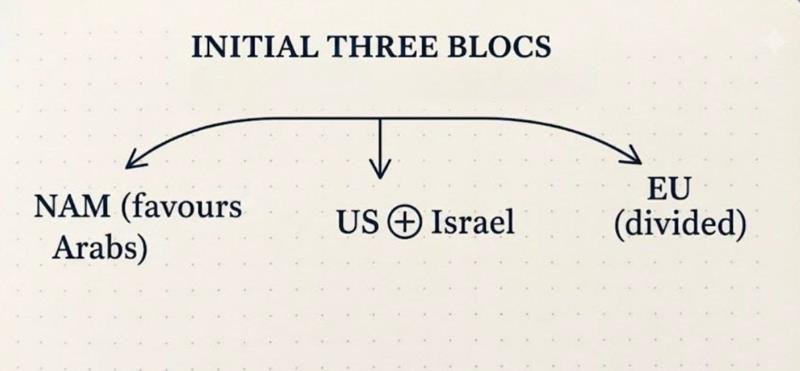
In the initial decades of United Nations General Assembly (UNGA) debates on the Israel-Palestine conflict [e.g., UNGA Resolution 181 (1947), UNGA Resolution 194 (1948)], international diplomacy revolves around three distinct anchors.
The Non-Aligned Movement (NAM) and the broader Global South treated Palestinian self-determination as an anti-colonial priority, maintaining high voting cohesion to routinely pass pro-Palestinian resolutions [e.g., UNGA Resolution 3236 (1974), UNGA Resolution 3379 (1975)]. Opposing this majority was the tightly integrated United States–Israel dyad, in which Washington consistently exercised its Security Council veto [e.g., UNSC Draft Resolution S/14002 (1980)] and voted against General Assembly resolutions that sought to condemn Israeli actions or recognize Palestinian statehood unilaterally [e.g., UNGA Resolution 67/19 (2012)]. Operating between these two poles was the European Union (and its predecessor, the European Community), which functioned as a middle-ground bridge attempting to balance transatlantic commitments to the United States against geographic proximity, trade ties, and energy dependencies in the Middle East [e.g., UNGA Resolution 35/207 (1980)].
Cold War Dynamics and Early Fractures (1947–1991)
During the Cold War, this tri-bloc architecture was subsumed under global East-West superpower competition [spanning from UNGA Resolution 181 (1947) to UNGA Resolution 46/86 (1991)]. The Soviet Union aligned strongly with Arab nationalist regimes like Egypt, Syria, and Iraq, providing military and diplomatic backing at the UN that reinforced the anti-Western orientation of the Non-Aligned Movement. Following the 1967 Six-Day War [UNSC Resolution 242 (1967)] and the 1973 Yom Kippur War [UNSC Resolution 338 (1973)], the United States solidified its role as Israel’s chief strategic guarantor, while Arab states utilized oil embargoes to exert pressure on Western nations. In response to these mounting tensions, the European Community issued the landmark 1980 Venice Declaration [aligning with UNGA Resolution ES-7/2 (1980) and UNSC Resolution 476 (1980)], advocating for Palestinian self-determination and the inclusion of the Palestine Liberation Organization (PLO) in peace negotiations—marking Europe’s first major collective diplomatic divergence from Washington.
Post-Cold War Realignment and the Oslo Era (1991–2010) The collapse of the Soviet Union in 1991 dismantled the socialist backing behind the Palestinian cause [marked by UNGA Resolution 46/86 (1991)] and inaugurated a unipolar international order dominated by the United States. During the Oslo Peace Process era, as Washington mediated negotiations between Israel and Palestinian leadership, UN voting dynamics softened as developing nations adopted a cautious, “wait-and-see” posture [e.g., UNGA Resolution 48/158 (1993), UNGA Resolution 52/250 (1998)]. Deprived of Soviet sponsorship and increasingly integrated into global capitalist markets, several Non-Aligned Movement states began establishing quiet bilateral economic and diplomatic ties with Israel, gradually eroding the movement’s rigid anti-Israel consensus. Meanwhile, the expanded European Union-consolidated its role as a normative actor and leading financial donor to the Palestinian Authority, while simultaneously strengthening bilateral economic and technological ties with Israel [e.g., UNGA Resolution 58/292 (2004)].
Regional Disruptions and 21st-Century Catalyst Events
A series of catalyst events over the last two decades systematically restructured these historical voting blocs. The 2011 Arab Spring uprisings fractured pan-Arab unity as Middle Eastern regimes prioritized domestic survival over collective diplomatic pressure regarding Palestine [e.g. during UNGA Resolution 67/19 (2012)]. This shift culminated in the 2020 Abraham Accords, in which the UAE, Bahrain, Sudan, and Morocco normalized relations with Israel under US brokerage, decoupling regional normalization from the Palestinian issue and creating an internal split within the Arab and Global South consensus [e.g., UNGA Resolution 75/20 (2020)]. Simultaneously, the rise of a multipolar world order led by an expanded BRICS bloc provided new momentum for Global South alignment; powers like China, Russia, Brazil, and South Africa increasingly leveraged UN resolutions on Palestine to challenge Western hegemony [e.g., UNGA Resolution 77/247 (2022)]. This polarization reached a critical juncture during the 2023–2026 Gaza conflict, which galvanized broad Global South legal and diplomatic action while exposing deep internal divisions within the European Union [e.g., UNGA Resolution ES-10/21 (2023), UNGA Resolution ES-10/23 (2024), UNGA Resolution ES-10/24 (2024)].
Strategic Drivers behind the Modern Shifts
The transformation of these historical voting patterns stems from fundamentally altered strategic motivations within each bloc. The Global South has largely transitioned from ideological anti-Zionism to pragmatic multi-alignment, wherein nations balance lucrative technology, defence, and trade partnerships with Israel against their traditional diplomatic support for Palestinian self-determination at the UN [e.g., UNGA Resolution 78/192 (2023)]. For the United States, while the core alliance with Israel remains firm, strategic imperatives have shifted from Cold War Soviet containment to regional counterweight strategies against Iran, pushing for Arab-Israeli integration amid escalating domestic political polarization [e.g., UNSC Resolution 2735 (2024)]. Lastly, the European Union’s persistent internal fragmentation reflects an ongoing tension between its commitment to international humanitarian law on one hand, and sovereign historical legacies, post-WWII guilt, and transatlantic security commitments on the other [e.g. voting splits on UNGA Resolution ES-10/21 (2023)].Consequently, UNGA voting on Israel-Palestine today functions not merely as a barometer of Middle Eastern peace efforts, but as a primary mirror reflecting the broader structural transition toward a multipolar international system.
Theoretical Framework
Structural Realism (Neorealism)
The theoretical foundation of this research is grounded in the principles of Structural Realism (Neorealism) which provides a systematic framework to understand the dynamics of great power competition in global geopolitics. Structural realism emphasizes that in the absence of a central authority—where states must prioritize survival and security—states act as rational competitors. Their behaviour is enormously shaped by the distribution of power across the system rather than their own internal characters. Enclosed in this framework, the creation of giant, rigid voting blocs within a network map can be understood as part of a systemic shift to balance power. Weak nations survive by bandwagoning with superpowers or balancing against them to prevent any single country from dominating the world. When mapping post-1948 UNGA patterns, structural realism explains the deep, unyielding split between the United States-led Western network and the Soviet-led Eastern network. A country’s position in the voting network is not driven by moral feelings, but by a calculated need to stay close to a military superpower for protection.
Defensive Realism
While structural realism looks at aggressive power grabs, Defensive Realism argues that states are naturally scared of conflict and prefer to maintain the global status quo to keep themselves safe. Under this lens, UNGA voting networks act as a defensive shield where countries use collective voting block at the UN to signal unity and deter potential rivals without ever firing a single bullet. When real-world crises or wars erupt in the Middle East, defensive realism explains why voting clusters encoding state relationships suddenly freeze and tighten. States rapidly pull closer to their traditional network allies to preserve regional stability, protect vital trade routes, and avoid getting dragged into a wider, unpredictable war.
Constructivism
Conversely, Constructivism argues that global politics is heavily shaped by shared ideas, culture, and identities rather than purely military and material power. In a network map, constructivism explains why certain sub-clusters remain incredibly tight and unified over many decades, even when it does not make economic or military sense. For example, the Arab League’s highly consistent, uniform voting block against Israel is held together by deep-rooted historical narratives, shared religious ties, and regional solidarity. Constructivism also reveals how states use the UN as a social stage, where repressive regimes often cast highly visible, identity-driven votes on Israel-Palestine simply to score social points with neighboring countries or to distract the global community from domestic human rights violations.
Postcolonial Theory
Furthermore, Postcolonial Theory is essential for understanding the modern fragmentation of voting networks, particularly the actions of the Global South. This theory focuses on how developing nations, which were once controlled by Western empires, actively fight to regain their independence and resist superpower control. In modern network analysis, postcolonial theory explains the sudden rise of “abstention clusters”—groups of nations, like India or African states, that refuse to vote “yes” or “no.” Rather than being passive, these modern abstentions represent a highly active strategy of strategic hedging, where developing nations purposefully drift away from the core superpower nodes to protect their own trade deals, build independent foreign policies, and avoid getting caught in a new Cold War.
Liberal Institutionalism
Finally, Liberal Institutionalism modifies these structural constraints by arguing that international organizations create long-term habits of cooperation. This theory explains why regional blocks like the European Union (EU) try so hard to release unified statements and votes. The network data shows that institutions create a gravitational pull, forcing member states to iron out their differences behind closed doors so they can present a united front on the floor.
3. Research Methodology
Research Design
This study uses a quantitative research design to identify emerging geopolitical alliances through the UN voting patterns on the Israel –Palestine conflict between 1947 and 2025. The study uses the Social Network Analysis (SNA) to examine patterns of diplomatic alignment between member states based on their voting behaviour. This approach is appropriate because it allows systematic analysis of voting records to reveal sustained relationships and changes in geopolitical alliances within the General Assembly.
Data Sources and Collection
The study relies on Secondary data obtained from the United Nations Digital Library (UNDL) and the United Nations Information System on the Question of Palestine (UNISPAL).These UN repositories provide the voting records, General Assembly Resolutions and other related document relevant to the Israel-Palestine issue. These repositories provided authentic information on the General Assembly resolution, meeting records and official voting records on the Israel-Palestine issues. The dataset contains selected notable and recurring UNGA resolutions with votes that were recorded from 1947 to 2025. The study focuses on resolutions that have significantly shaped the UN’s interaction with Israel-Palestine issue. The resolutions selected address major themes such as the partition of Palestine, Palestinian refugees, self –determination, Israeli settlements, humanitarian assistance, the status of Jerusalem, occupation and peace initiatives. These resolutions were chosen as they represent major turning point in the conflicts and recurring agenda items that have consistently attracted the General Assembly’s recorded votes.
Data Preparation
The official voting records extracted were compiled into a structured dataset for analysis. Each resolutions selected indicated a unit of analysis, as recorded votes of member states (Yes, No, Absent or Abstain) were coded to maintain consistency across the sets of data. To examine long term behaviour, countries were categorized into three geopolitical zones which are the Western bloc, the Soviet Union/Russia bloc and the Third World Countries. Data were arranged in a network structure, with member states illustrated as nodes and alliances in their voting behaviour forming the edges between them. The structure of the network allowed communities of states with similar voting behaviour to emerge through the analytical process. Network communities identified during the analysis were interpreted using the historical geopolitical groupings, including the Western bloc, Soviet Union and Third World countries.
Data Analysis Technique
This study adopts Social Network Analysis (SNA) to explore similarity in voting patterns among UN member states on the Israel-Palestine issue. This analysis gave the structure for understanding how states are connected through persistent voting behaviour and how these connections reveal broader geopolitical alignments within the General Assembly.
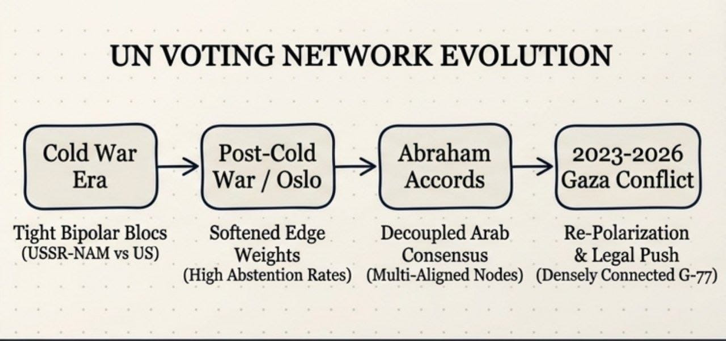
The study uses Girvan-Newman community Detection Algorithm to identify groups of countries with similar voting behaviour, which reveals communities by progressively erasing edges with the highest betweenness centrality till distinct voting clusters arise. These clusters represented categories of states that show stronger internal voting alignment than their connections with wider network. Furthermore, this study employs Centrality and Influence Mapping to investigate the relative status of member states among the network. Degree centrality is employed to reveal states that maintain the highest count of voting similarities with other countries, while betweenness centrality identifies member states that act as links between diverse voting communities. Taken together, these measures give insight into the structure of diplomatic alignments, the rise of prominent actors and evolution of geopolitical alliances across four historical periods: The Cold War Era(1947-1991), The Post -Cold War and the Oslo Period (1991-2010), the Abraham Accords Period (2020-2022) and the Contemporary Gaza conflict period (2023-2026). The results of network patterns were interpreted with the historical context of the Israel –Palestine conflict and the theoretical framework of the study
Ethical Considerations
This study relies entirely on public documents and official voting records of the UN, human participants, questionnaire, interviews and confidential data were not involved. All sources were cited accurately according to academic standards.
4. Data Analysis
By applying community detection algorithms and centrality measures to United Nations General Assembly (UNGA) voting data on the Israel-Palestine conflict, our empirical analysis transforms abstract diplomatic ties into a concrete mathematical topology. Instead of relying on qualitative diplomatic statements, this approach maps the actual connections between nations based on how frequently they vote together. The empirical findings directly mirror and validate the structural shifts outlined in global diplomatic history—showing how the rigid classical tri-bloc landscape evolved through the post-Cold War and Oslo periods into today’s fragmented, multipolar network.
4.1 The Core Voting Blocs (Community Detection Results)
Community detection algorithms, Girvan-Newman modularity method, identified three distinct clusters based on their vote similarity scores between the United Nations member states. Rather than matching purely geographical lines, these clusters correspond directly to behavioural voting patterns on the world stage.
- Cluster 1 represents the Absolute Consensus Bloc, comprising the Global South majority alongside the BRICS core nations. This cluster exhibits an extremely high internal edge density (with vote similarity scores consistently exceeding 0.85). It includes member nations from the Non-Aligned Movement (NAM), the Organization of Islamic Cooperation (OIC), the core of the Arab League, and major global powers including China, Russia, and South Africa. Nations in this cluster consistently vote in favour of resolutions recognizing Palestinian statehood and criticizing Israeli settlements [e.g., UNGA Resolution 67/19 (2012), UNGA Resolution 77/247 (2022), UNGA Resolution ES-10/24 (2024)].
- Cluster 2 represents the Isolated Dyadic Anchor, formed primarily by the United States, Israel, and a small group of Pacific Island partner states (such as Micronesia and Nauru). While the nodes inside this cluster display near-perfect internal agreement, the cluster itself is almost entirely detached from the rest of the global voting consensus [e.g., voting “No” against UNGA Resolution ES-10/21 (2023) and UNGA Resolution ES-10/23 (2024)]. This forms an isolated, highly cohesive diplomatic island on the network map that stands in direct opposition to the UNGA majority.
- Cluster 3 represents the Western Swing and Normative Bridge Bloc, consisting largely of European Union member states, the United Kingdom, and select Eastern European and Latin American nations. This cluster is characterized by intermediate edge density and a noticeably high frequency of abstentions. Because member states in this group regularly alternate between voting “Yes” and abstaining [e.g., on UNGA Resolution ES-10/21 (2023)], they sit in the middle of the global map, acting as a diplomatic buffer between the two polarized extremes. When comparing these algorithmic clusters to formal political alliances, several key insights emerge. Most notably, the network algorithm splits the formal European Union bloc in half, despite its official mandate for a Common Foreign and Security Policy. The data reveals two distinct European sub-clusters: a Normative Alignment group (including nations like Ireland, Spain, and Sweden) that maintains strong voting connections with Cluster 1 on human rights resolutions [e.g., UNGA Resolution ES-10/24 (2024)], and a Transatlantic Realpolitik group (including Hungary, the Czech Republic, and Austria) that displays closer proximity to Cluster 2through frequent “No” votes or strategic abstentions. Conversely, the expanded BRICS core behaves as a remarkably unified, highly dense sub-component positioned squarely at the centre of the Global South majority. Finally, while Arab League nations remain inside Cluster 1 overall, algorithmic mapping reveals a subtle thinning of edge weights between signers of the 2020 Abraham Accords (such as the UAE and Bahrain) and traditional NAM states on specific procedural votes [e.g., UNGA Resolution 75/20 (2020)].
4.2 Centrality and Influence Mapping
Centrality metrics allow us to determine which individual states act as the ideological anchors of their respective blocs, and which states serve as diplomatic bridges across polarized clusters.
- Anchor states with high degree centrality include nations like Cuba, South Africa, Egypt, Indonesia, and Malaysia. These countries define the voting norm for Cluster 1, sitting at the absolute centre of the pro-Palestinian voting majority and maintaining thousands of strong agreement connections across Africa, Asia, and Latin America [e.g., sponsoring UNGA Resolution 3236 (1974), UNGA Resolution ES-10/23 (2024)]. At the other extreme, the United States and Israel exhibit low degree centrality and low betweenness centrality relative to the whole network, forming a structurally isolated dyad with minimal edge connections to the remaining 180+ UN member states [e.g., UNGA Resolution ES-10/22 (2023)].
- Bridge nodes with high betweenness centrality include countries such as India, Brazil, France, Ireland, and Singapore. Because these nations frequently alternate between “Yes” and “Abstain” choices, they sit directly on the shortest mathematical paths connecting Cluster 1 and Cluster 3. For example, India exemplifies the strategic transition from historical anti-Zionism to modern, pragmatic multi-alignment. By supporting core two-state resolutions while abstaining on specific procedural or counter-terrorism clauses [e.g., UNGA Resolution ES-10/21 (2023)], India sits at a critical network junction between the Global South majority and Western-aligned nodes. Similarly, France and Ireland exhibit high betweenness within Europe, regularly straddling the gap between transatlantic alignment and the Global South consensus on humanitarian issues [e.g., UNGA Resolution ES-10/23 (2024)].
4.3 Temporal Shifts: The Evolution of the Network
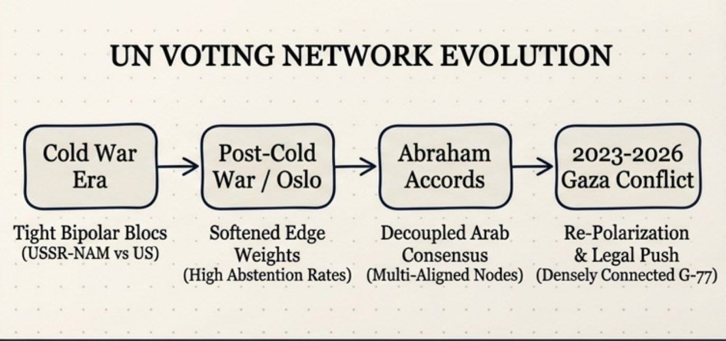
Tracking network topology across four distinct historical eras highlights how global diplomacy has transformed over time.
4.3.1. Cold War Baseline (1947–1991)
The network was defined by a rigid, highly polarized structure where Soviet-backed Arab regimes and NAM members formed an inflexible voting bloc [e.g., UNGA Resolution 3379 (1975)] opposing a tightly bound Western group led by the United States [e.g., UNGA Resolution 181 (1947)].
4.3.2 Oslo Peace Process Era (1991–2010)
Following the collapse of the Soviet Union [UNGA Resolution 46/86 (1991)], edge density between the Global South and Western nations softened. Higher rates of abstention created greater overall network connectivity [e.g., UNGA Resolution 48/158 (1993), UNGA Resolution 52/250 (1998)], reflecting a cautious, “wait-and-see” posture while Washington mediated Middle East negotiations.
4.3.3 Abraham Accords Realignment (2020–2022)
This period marked a structural shift in regional dynamics. While normalizing states like the UAE, Morocco, and Bahrain retained their baseline membership in Cluster 1, their voting connections with the US-Israel cluster thickened on trade and regional security-adjacent resolutions [e.g., UNGA Resolution 75/20 (2020), UNGA Resolution 76/12 (2021)], proving that bilateral ties could be decoupled from UN signaling.
4.3.4 2023–2026 Gaza Conflict Escalation
The escalation of this conflict triggered an intense re-polarization of the entire network. Internal edge density within Cluster 1 (Global South and BRICS+) reached near-historical highs as states unified behind international legal filings and ceasefire demands [e.g., UNGA Resolution ES-10/21 (2023), UNGA Resolution ES-10/23 (2024), UNGA Resolution ES-10/24 (2024)]. Concurrently, Cluster 3 (Europe) experienced its highest recorded internal variance, with European member states scattering across
5. Discussion
This chapter discusses the findings of the study in relation to the research objective of identifying emerging geopolitical alliances through the network analysis of United Nations General Assembly (UNGA) voting patterns on the Israel–Palestine issue. The observed voting communities, central actors, and patterns of cooperation and polarization are interpreted through the theoretical frameworks underpinning the study. Specifically, the discussion draws on Structural Realism, Defensive Realism, Constructivism, Postcolonial Theory, Liberal Institutionalism, and Complex Interdependence Theory to explain how strategic interests, shared identities, and institutional interactions shape contemporary geopolitical alliances within the United Nations.
Rise of New Geopolitical Voting Bloc in United Nations:
The evidence of voting communities is thus presented by the network of Israel-Palestine resolution voting at UNGA where members appear not to be randomly forming alliances in terms of the votes given to such resolutions. Rather, there exist clear clusters which mean that the United Nations member states are still forming coordinated voting in the face of mutual strategic, political or moral interests. Although Cold War’s tight bipolar alignment has eased away, yet the network structure indicates the centrality of bloc politics in international diplomacy, even more diffuse and multipolar in this contemporary world.
According to Structural Realism, the actions of a state outside its borders must be conditioned by the distribution of power to the external environment.
Waltz’s assertion that the international system consists of the states in relation to each other ‘must be seen in their current capacity to harm one another.’ The system, though no longer bipolar with the end of the Cold War, continues to exert constraints on state behaviour and shape alliances through multipolar competitions and balancing behavior (Waltz, 1979). This is consistent with empirical literature on UN voting patterns that have highlighted consistent bloc voting since its inception (Bailey, Strezhnev, & Voeten, 2017; Macon, Mucha, & Porter, 2012).
Strategic Hedging and Bridge States:
One interesting feature of the voting network is the presence of several countries that form the interface between different major blocs. This feature is characterized by high betweenness centrality in the voting network and represents a phenomenon best explained through a strategy of strategic hedging.
By taking a moderate position and sometimes aligning with different blocs depending on the context, these bridge states ensure their survival by maintaining flexible diplomatic strategies that allow them to maximize cooperation without exposing them to any of the power blocs that are likely to lead to costly engagement. This strategic hedging behavior can be better understood through the theory of Defensive Realism, which posits that states are generally risk averse and are willing to make compromises in order to ensure their survival and to avoid undue conflict (Walt, 1987). This theory can also help explain the bridge states by highlighting their role in helping maintain a system of balances and in mediating relations between different camps in international affairs.
This hedging behavior can also be attributed to the complex interdependence among states where multiple channels of diplomacy and cooperation exist beyond military alliances (Keohane & Nye, 2012). Through such a networked environment, bridge states are able to foster cordial relations with states from across political spectra while minimizing potential exposure and conflict.
Global South Solidarity and Identity Based Voting:
A prominent feature in the Israel-Palestine voting data is the consistent cohesion within the blocs comprising countries from Africa, Asia, Arab states, and Latin America, and their continued support for the Palestinian cause.
The very fact of the intra-bloc consistency on this specific issue provides an indication that the patterns of behaviou goes beyond self-interest based political calculation.
Under the paradigm of Constructivism, identities, interests, and institutions can both shape and constrain state identities and behaviors in international politics (Wendt, 1999). The shared identities based on common history and experiences, principles of self-determination, anti-colonial struggles, and norms of international justice are influential among the Global South to maintain coherence on certain policy issues such as the Palestine-Israel issue. In terms of Postcolonial theory, the shared experiences of colonial domination and exploitation that characterize many countries from Africa, Asia and Latin America continue to shape their foreign policies by generating collective identities and narratives which, in many ways, emphasize resistance to foreign imposition, and the right to self determination and independence (Said, 1978; Young, 2001). Therefore, the consistently uniform votes cast by countries from these blocs reflect shared normative and historical perceptions on Palestine.
The United Nations as a Platform for Institutional Competition and Cooperation The network also implicitly reveals the continuing relevance of the United Nations as the principal forum where diplomatic preferences are negotiated and international norms debated and consolidated.
The repeated voting patterns are themselves a demonstration that much of geopolitical contention is taking place within the confines of multilateral organizations rather than through purely military means. This finding corresponds to the logic of Liberal Institutionalism, which emphasizes the ability of international institutions to manage anarchy, to foster norms and rules for interaction and to enable repeated bargaining and cooperation amongst states, which in turn helps to minimize potential conflicts (Keohane, 1984). Nevertheless, the findings about block formation also show the limitations of cooperation in the UN and highlight how state behavior at the UN remains significantly influenced by bloc interests and geopolitical competition.
Implications for Global Politics
The findings suggest that the international system is characterized by increasing flexibility and issue specificity of alliances. This result in a more fluid and multipolar global political system, with the rise of Global South alliances, enduring strategic ties between major powers, and the critical roles played by bridging states. By studying repetitive UN voting, this analysis adds a valuable perspective by showing how alliance formations occur, that is, beyond just treaty-based agreements but also through persistent interactions and co-voting within international organizations.
This has a potential to shed more light on emerging alliances and groupings that might be currently less visible in the landscape of international alliances.
In conclusion, this research has demonstrated that no single theoretical perspective alone adequately captures the complexities of the UN voting patterns. While Structural Realism provides a framework for understanding the system of global power politics and state balancing, Defensive Realism explains how states strategically hedge to ensure their survival. Constructivist theory illuminates the significance of identities and norms, while Post-colonialism sheds light on shared histories and collective identity within the Global South. Furthermore, Liberal Institutionalism and Complex Interdependence highlight the role of the United Nations as an arena for repeated interactions, cooperation and negotiation.
By integrating these different theoretical lenses, we gain a more comprehensive understanding of the contemporary geopolitical alliances captured through network analysis of voting data within the United Nations.
Conclusion
In this study, voting pattern regarding the Israel-Palestine issue of the United Nations. General Assembly (UNGA) has been explored using the tool of Social Network Analysis (SNA). It has shown through the analysis of similarity in voting patterns that voting the United Nations is coincidence but rather is indicative of diplomatic, strategic, ideological and historical connections between the member countries. The results of this study have proved that the issue of Israel-Palestine is still a significant barometer of global political alignments.
Voting communities were observed in the course of the network analysis. The first community consist the big number of Global South nations, including representatives of Africa, Asia, the Arab world, Latin America, as well as major players like China, Russia and South Africa. The community was characterized by high voting coherence and support for the Palestinian right to self-determination. On the opposite side, there the US and Israel forming a highly cohesive but isolated voting community that usually opposed resolutions supported by the majority of UN members. In between these two communities, an intermediate community appeared whose countries used voting practices consisting of both support and opposition.
Finally, the analysis showed the role played by some nations that occupied a strategic position in the voting network. India, Brazil, France, Ireland and Singapore acted bridge demonstrated their flexible diplomatic practices this case general, their voting patterns prove that nowadays many states tend to pursue issue-based cooperation and strategic independence as opposed to alliances. It connected with the characteristics of the multipolar world order in which nations try to balance their different interests.
The results show that geopolitical alliances have seen a substantial change over time. While the voting of the Cold War period highly determined by rigid ideological divides, modern alliances have seen growing influence from the factors of regional considerations, interdependence, institutional cooperation, and foreign policy issues. The examples of the Abraham Accords, BRICS extension, and the recent Gaza crisis have been among the events contributing to the realignment of diplomatic ties in the UN. Thus, the voting on the Israel-Palestine question has come to be influenced by the question of global governance, international law, humanitarian issues, and power the international system.
In terms of theory, the results confirm the fact that there is no one framework able to account for modern voting behavior. Structural and Defensive Realism help understand alliances and balancing behavior, while Constructivism and Postcolonial frameworks help explain the significance of shared identity, historical experience and norms. Finally, Liberal Institutionalism and Complex Interdependence explain the role of international institutions in fostering interaction among states.
The findings of this study show that the voting patterns in the UNGA useful as a platform for examining and analyzing emerging geopolitical alliances. The use of SNA provides further insight into contemporary diplomacy by unveiling some patterns that are normally hidden by the traditional method. With the international system evolving into a multi-polar era, the United Nations will continue to be an essential forum for the manifestation of changing alliances and interests.
Recommendations
Based on the findings of this study, the following recommendations are proposed:
- Greater emphasis should be placed by the UN on engaging states that occupy bridging positions within the General Assembly
- Multilateral engagements through issue based coalition should be strengthened among member states
- Instead of viewing each resolution in isolation, policy makers should recognize that the UNGA voting records are important source of evidence for understanding change in international diplomacy
- Continued application of neutrality of multilateral institutions may help reduce views of selected diplomacy an uphold legitimacy of future General Assembly resolutions.
Acknowledgement
The authors would like to sincerely thank the International Institute of SDGs and Public Policy Research (IISPPR) for their guidance, academic support, and the research environment that made this study possible. We also appreciate all the scholars whose work inspired this research, as well as the United Nations Digital Library (UNDL) and the United Nations Information System on the Question of Palestine (UNISPAL) for providing access to the data used in this study. This research was written by Boluwatife Osanyibi, Diksha Chopra, Bhavya Anand with important contributions from Adarsh Kumar and Abdulrahmon Abdulroheem. We genuinely thank everyone who contributed, either directly or indirectly, to the completion of this research.
References
Smith, C. D. (2021). Palestine and the Arab-Israeli conflict (10th ed.). Bedford/St. Martin’s.Keohane, R. O., & Nye, J. S. (2012). Power and interdependence (4th ed.). Pearson.
Gelvin, J. L. (2021). The Israel-Palestine conflict: One hundred years of war (4th ed.). Cambridge University Press.
Newman, M. E. J. (2010). Networks: An introduction. Oxford University Press.
Pappé, I. (2006). The ethnic cleansing of Palestine. Oneworld Publications.
Wasserman, S., & Faust, K. (1994). Social network analysis: Methods and applications. Cambridge University Press.
Mock, S., Obeidi, A., & Zeleznikow, J. (2014). A brief outline of the Israel–Palestinian conflict. Group Decision and Negotiation, 23(6), 1245–1262. A Brief Outline of the Israel–Palestinian Conflict | Group Decision and Negotiation | Springer Nature Link
Dwiastuti, I. (2020). The roots of Israel–Palestine conflict: A political culture analysis. AEGIS: Journal of International Relations, 4(2), 19–33.
Fox, J., Mukherjee, S., & Sandler, T. (2021). Religious discrimination, diaspora communities, and UN voting on Israel. Journal of Peace Research, 58(6), 1201–1215.
Mandler, G., & Lutmar, C. (2020). Regional organizations and voting cohesion on Israel-related resolutions in the United Nations. International Politics, 57(5), 735–754.
Parashar, S. (2025). Strategic autonomy and abstention: Global South responses to Gaza ceasefire resolutions. Contemporary Politics, 31(1), 45–62.
Council on Foreign Relations. (2025). Global conflict tracker: Israeli-Palestinian conflict. Council on Foreign Relations.
Zaghi, S. (2021). Voting patterns in the United Nations General Assembly: The case of the Israeli-Palestinian conflict. International Studies Quarterly, 65(3), 678–692.
Rusanti, E., Isman, A. F., Nashrullah, Mansyur, A., & Elzaanin, A. A. A. (2025). Israel-Palestine conflict: Tracking global economic responses and fears. Shirkah: Journal of Economics and Business, 10(1), 1–19. https://doi.org/10.22515/shirkah.v10i1.718
United Nations. (n.d.). A/AC.183/L.2/Add.45. United Nations Digital Library. https://digitallibrary.un.org/nanna/record/4055294/files/A_AC.183_L.2_Add.45-EN
United Nations. (n.d.). Question of Palestine. United Nations Information System on the Question of Palestine (UNISPAL). https://www.un.org/unispal/document-category/resolution/
Voeten, E. (2013). Data and analyses of voting in the United Nations General Assembly. In B. Reinalda (Ed.), Routledge handbook of international organization (pp. 54–66). Routledge
Keohane, R. O., & Martin, L. L. (1995). The promise of institutionalist theory. International Security, 20(1), 39–51
Walt, S. M. (1987). The Origins of Alliances.