Authors: Roohani Kumar, Debrup Hazra, Sakshi Gupta, Tanish Mittal, and Rhea Ruth Subash
Abstract
The international system and world order has seen a transition from a unipolar world dominated by the United States to a multipolar world, where many countries have started to play a role. China, for example, has become a significant part of this transition. Through initiatives such as the Belt and Road Initiative, economic partnerships, and active participation in international organizations, China has expanded its global influence. The voting patterns in the United Nations General Assembly (UNGA) help us understand the changing patterns of cooperation and negotiation among states. Existing literature has discussed China’s growing influence and UN voting patterns. However, there has been limited research examining China’s coalition and cohesion with different states across different issue areas, or whether states change their voting behaviour depending on the issues under consideration. This paper focuses on understanding how countries align with China across different issue areas within the UNGA and what these voting patterns reveal about the emerging multipolar world. The paper adopts a mixed-methods approach, combining the analysis of UNGA voting records with a qualitative examination of China’s foreign policy and diplomatic strategies. The findings demonstrate that states are more likely to align and vote with China on issues such as sovereignty, colonialism, the Middle East, and economic development. However, they are less likely to align on issues related to security and nuclear disarmament. Ultimately, the study finds that China’s influence in the UNGA is shaped by flexible and issue-specific partnerships rather than a fixed political bloc, highlighting the changing nature of global politics.
Keywords: China; United Nations General Assembly (UNGA); Voting Cohesion; Voting Behaviour; Social Network Analysis; Coalition Formation; Multipolarity; Global South.
Acknowledgements
The authors would like to express their sincere gratitude to the International Institute of SDGs and Public Policy Research (IISPPR) for providing them with the platform, resources, and collaborative environment to undertake this research during the internship tenure. The authors are deeply indebted to all the mentors, teachers, coordinators, and their HR at IISPPR for everyone’s invaluable guidance, constructive feedback, and continuous encouragement throughout this project.
1. Introduction
The transition of the international system from a largely unipolar world to a world that is becoming increasingly multipolar has once again brought into focus questions about the formation of alignments by states in international organisations. The end of the Cold War gave us the dominance of the United States and the liberal international order. However, the emergence of China as a superpower has created new dynamics in terms of cooperation, competition, and alliances that defy conventional notions of global governance. Instead of merely relying on military alliances, China has increased its international influence through partnerships, economic diplomacy, multilateralism, and South-South cooperation. This situation has created considerable discussion about whether the increasing influence of China is creating a new geopolitical bloc or a flexible issue-based alignment within international organisations (Acharya, 2018; Doshi, 2021; Shambaugh, 2013).
In particular, the General Assembly of the United Nations (UNGA) represents a very useful platform for studying emerging trends of international cooperation. Due to its nature of being the only deliberative body, in which all sovereign states have equal voting rights, the UNGA can be used as an all-encompassing database on the diplomatic preferences of states in various areas of politics, economy, and security. General Assembly voting patterns represent an important signal of diplomatic affinities, policy preferences, and coalitions in the international arena (Voeten, 2013). Scholarly work has shown that China has been able to build its diplomatic power in multilateral organizations by means of efforts such as the Belt and Road Initiative (BRI), the Asian Infrastructure Investment Bank (AIIB), the Forum on China–Africa Cooperation (FOCAC), and generally its involvement with the Global South. On the other hand, scholarship analysing UN General Assembly (UNGA) voting behaviour has found converging interests between China and developing nations on matters relating to sovereignty, development, and non-intervention (Bailey, Strezhnev, & Voeten, 2017; Fung, 2022). The problem is that most of this work uses aggregate indices of voting similarity, which assume that diplomatic alliances do not change their coherence based on different policy domains. These works offer useful information about long-term patterns of cooperation, yet fail to recognize that alliances can have various levels of coherence, contingent on the nature of the matter in question.
The study seeks to fill this gap by investigating whether the China-centred voting bloc is able to sustain its cohesion over various issue areas in the United Nations General Assembly or whether the coalition arrangements tend to break down depending on the politics and strategies involved in each policy issue area. Rather than viewing diplomacy as a monolithic entity, the study takes a look at the behaviour of China’s voting coalition over several issue areas such as sovereignty and human rights, economic development, and security issues. In order to answer this research question, an appropriate research methodology will be to use a combination of quantitative and qualitative research approaches that involve analysis of the voting pattern of China at the UN General Assembly with regard to the chosen countries in the context of China’s foreign policy and multipolarity and coalition formation literature. From the quantitative perspective, voting similarity between China and the chosen countries will be studied in different topic areas, thus allowing the researcher to distinguish the differences in the coherence of the coalition structure. The observed voting similarities will then be interpreted from the perspective of China’s foreign policy approach and strategic partnership and norms of behaviour in multilateral organizations.
In this regard, there are three key ways in which this study contributes to the academic literature. Firstly, this study builds on the current body of literature through its adoption of an issue-based analysis of voting behaviour at the UNGA as opposed to an aggregate form of analysis. Secondly, it illustrates the benefits of using Social Network Analysis alongside traditional qualitative foreign policy analysis in analysing the cohesiveness of coalitions in international organizations. Thirdly, through examining whether China’s diplomatic alliances form a coherent geopolitical bloc or network of issue-based alliances, the study makes a contribution to the wider discussion around multipolarity today.
2. Literature Review
The development of China’s diplomatic power in the UN General Assembly (UNGA) has been subject to much academic discussion in relation to coalition building, voting behaviour, and the advent of a multipolar international system. The existing literature has examined China’s foreign policy, the impact of economic and political alliances, as well as UNGA vote alignment in an effort to understand the changing geopolitical dynamics. However, the bulk of this literature has made use of aggregated measures of vote similarity and thus has not provided a clear understanding of variation in coalition cohesion among different issue areas. This section reviews the key literature on the topic and identifies the research gap that has been observed in this study.
2.1 Multipolarity
The rise of China as a significant global power has made it a prominent research interest and put its position into contestation with that of the United States. There is significant debate on the emergence of a multipolar world order that this study aims to deduce based on China’s voting coalitions on various issue areas in the UNGA. This places the concept of multipolarity at the forefront of both theoretical and empirical research, multipolarity as a system wherein several different states possess comparable levels of influence (Waltz, 1979). While the post-Cold War period was widely understood as an era of American unipolarity, recent scholarship argues that the diffusion of power following the global financial crisis and the rise of emerging powers has accelerated the emergence of a more complex multipolar world order.
Recently, with China’s rapid rise, India’s growing influence, emergence of other regional and subregional powers, and the diffusion of economic and political influence have revived debates regarding whether the international system is now transitioning towards multipolarity (Acharya, 2018). Scholars disagree on both the nature and implications of this transition. Realist scholars like Mearsheimer (2001) argue that when distribution of material capabilities shifts, strategic competition is then generated which leads to balancing behaviour and the formation of rival power centres. On the other hand, liberal institutionalists believe that international institutions and economic interdependence reduce security dilemma and encourage cooperation within multipolar systems (Keohane, 1984). Constructivist scholars have a different perspective. They argue that not only material power, but also shared norms, identities, and perceptions of legitimacy shape polarity and state interactions (Wendt, 1999). Acharya (2018) similarly argued that we can understand the emerging international order as more of a “multiplex” world, wherein there exist multiple centres of authority and overlapping networks of cooperation rather than absolutely rigid bipolar or unipolar structures.
These theoretical debates have important implications for alliance formation. Walt (1987) argued that states form alliances primarily to balance against perceived threats rather than simply against concentrations of power. Recent scholarship suggests that contemporary international alignments are increasingly characterised by flexible strategic partnerships and issue-specific coalitions rather than formal military alliances. Instead of committing to rigid alliance structures, states cooperate selectively based on shared strategic, political, and economic interests within multilateral institutions. Such flexible arrangements enable states to adapt to changing geopolitical circumstances while maintaining strategic autonomy. This trend reflects the growing importance of informal cooperation and minilateralism in shaping contemporary international politics (Cannon & Rossiter, 2022).
Consequently, patterns of diplomatic cooperation in forums such as the United Nations General Assembly (UNGA) have become important indicators of these evolving geopolitical alignments. Studies which use UN voting data demonstrate that voting similarity among nations can reveal their shared political preferences and show coalition formation among states, although such alignments often vary over time and across issues (Voeten, 2013). Despite a lot of theoretical literature on multipolarity, relatively little research looks at whether emerging geopolitical coalitions remain equally cohesive across different issue areas within the UNGA. Most existing studies are dependent on measures of aggregate voting similarity, which can hide important variations between policy domains like human rights, cybersecurity, nuclear policy, etc. Examination of issue specific voting networks can, thus, give a more nuanced assessment of whether multipolarity is being reflected in stable political blocs or more flexible, issue-dependent partnerships.
2.2 China’s Foreign Policy
China’s foreign policy has considerably evolved since the late twentieth century, which reflects how it transformed from a domestic development focused regional power to a rising player on the world stage. Shambaugh (2013) argues that China has been able to become an influential participant in global governance through its expanding economic and diplomatic presence, however, its international influence is still constrained in some areas. Doshi (2021), on the other hand believes that China’s foreign policy under the leadership of Xi Jinping is a part of a long-term strategy that aims to reshape the US-led global order. While there are differences in interpretation among various scholars, most broadly agree that Chinese foreign policy has shifted from Deng Xiaoping’s values of taoguang yanghui (which is famously mentioned as “bide your time, hide your capabilities”), towards more global engagement and a proactive approach.
According to Medeiros (2009), Chinese foreign policy has become diversified due to the combination of economic statecraft, diplomatic activism, and participation in international organisations. Christensen (2015) mentions that China intends to build up the trust of its neighbours as it tries to extend its strategic influence at the same time. Such initiatives as Belt and Road Initiative (BRI), Shanghai Cooperation Organisation (SCO), BRICS, and the Forum on China–Africa Cooperation (FOCAC) have immensely helped China establish political and economic relations with the countries in Asia, Africa, Latin America, and Middle East. This has reinforced its image as a leading partner of the Global South.
The increasing participation of China within the United Nations has been widely analyzed by researchers. Contrastingly, Foot (2020) argues that Beijing has increasingly been involved in the creation of normative structures within the international organizations in such areas as sovereignty, development, and human rights. Fung (2019) underlines the growing importance of China within the United Nations in terms of its diplomacy and involvement in peacekeeping activities, financial assistance, and building coalitions between developing countries. These findings imply that China is becoming more successful in garnering support in diplomacy in multilateral forums, even though its level of success and effectiveness is open to debate.
Although the literature provides substantial evidence of China’s growing diplomatic influence, most studies assess this influence using aggregate measures of voting similarity or overall diplomatic alignment within the United Nations. Comparatively little attention has been given to whether China-centred voting coalitions remain equally cohesive across different issue areas such as human rights, climate change, cybersecurity, nuclear disarmament, and development. While general metrics often depict a mostly monolithic block of Chinese diplomatic alignment within multilateral forums, contemporary scholarship suggests that China’s coalition-building strategy is increasingly issue-dependent and characterized by what Loke and Guo (2025) conceptualize as “coalitional hegemony”. Examining issue-specific variations in coalition cohesion can therefore provide a more comprehensive understanding of China’s coalition-building strategy and offer new evidence on whether China’s growing influence reflects the emergence of a stable multipolar order or a pattern of flexible, issue-based alignments.
2.3 Understanding UN Voting Behaviour
Scholars and thinkers, for a long time believed that the voting behaviour in the United Nations General Assembly is shaped by fixed and rigid political alliances. However, the recent studies suggest that voting behaviour is actually dynamic, flexible and shaped by financial incentives, economic partnerships, leadership changes, and diplomatic considerations.
Data from 738,000 votes on 5,270 resolutions reveal that the UNGA is normally cooperative, with almost 80% of votes cast as “Yes”, 13% as abstentions, and only 7% as “No” (UN General Assembly Voting Patterns Report, 2025). Although these figures suggest significant consensus, they often neglect underlying political negotiations, and competing strategic and diplomatic relations. Studies reveal that countries going through changes in political leadership are more likely to align and vote with the United States (Dreher and Jensen, 2013). However, Dreher and Sturm (2012) argued that financial support and incentives from the World Bank leads countries to align more with the G7 countries. Similarly, Adhikari et al. (2022) found that economic sanctions also influence whether targeted states actually align or resist the dominance of major powers. However, Mirrer and Sundquist (2025) challenge the notion that financial aid automatically translates into political influence, showing that Chinese loans do not directly buy UNGA votes but instead reflect changing diplomatic relationships and emergence of new world order.
Furthermore, Binder and Payton (2022) found that rising powers, particularly the BRICS countries, have started to challenge Western dominance, whereas García Herrero et al. (2024) observed that lower-income countries generally align more with China while wealthier regions continue to align with the United States. Thus, these studies indicate that economic development and shifting political leaderships increasingly shape voting alignments. Similarly, research on human rights voting highlights the strategic rather than ideological nature of state behaviour. Primiano and Xiang (2016) found that China has supported almost 79% of UNGA human rights resolutions since 1971, exceeding the global average, while Brazys and Dukalskis (2017) showed that such type of support gets challenged when issues affect China’s sovereignty or domestic political interests. Morse and Coggins (2024) further demonstrate that many weaker states strategically abstain or remain absent from voting to avoid the political costs of taking sides and to ensure their stand on a safer side.
We can also understand the voting patterns, cohesion and how countries align with China in the UNGA based upon ideological and normative principles. China has shown great support in the matters of sovereignty and non-interference in internal affairs. Takahashi (2025) argues that China’s stance on sovereignty has been one of the major norms connecting China with Third World and Global South countries in the UNGA since China joined the organisation in 1971. This relationship was visible in the early years of China’s UN membership, where China voted more often with Third World countries than with the Communist bloc, showing that its coalition was not based only on communist ideology (Chai, 1979).
This normative alignment can also be seen in human rights voting. Primiano and Xiang (2016), analysing UNGA human rights resolutions since 1971, found that China voted in favour of human rights resolutions in 79% of cases, compared with a global average of 75%. However, they also found that China’s voting behaviour changed according to its domestic political concerns. This suggests that countries’ alignment with China cannot be just simply based upon the support for the Chinese political system or the communist ideology. Instead, it may reflect shared positions on different or particular principles, especially sovereignty and non-interference. At the same time, the evidence shows that such normative alignment has limits and can change across different issues, making China’s UNGA cohesion more flexible than a fixed ideological bloc.
2.4 Network Analysis in Political Science
Political science’s turn toward Social Network Analysis (SNA) reflects a methodological critique of how international relations has modelled state behaviour at the UN General Assembly (UNGA). Conventional approaches treat votes as independent outcomes of attributes such as regime type or GDP; ideal-point estimation (Bailey, Strezhnev, & Voeten, 2017) tracks aggregate ideological placement but not the relational structure of coalitions, which states cluster together, and how tightly.
Maoz (2011) supplies the theoretical bridge for a network alternative, reconceiving international politics as coevolving networks in which voting behaviour is shaped by structural position rather than attributes alone. Macon, Mucha, and Porter (2012) construct weighted networks from 1946– 2008 roll-call votes, showing the dominant split shifting from an East–West to a North–South axis after the Cold War — confirming that community-detection methods recover real geopolitical blocs from data. Pomeroy, Dasandi, and Mikhaylov (2018) extend this into multiplex settings, combining votes with speech text to estimate “affinity blocs.” Voeten’s (2000, 2013) work anchors issue-based polarization claims: human rights and sovereignty questions produce the sharpest splits, reproduced as a stark two-community structure with China anchoring a Global South cluster around non-interference.
2.4.1 Issue-Area Heterogeneity
Human rights and sovereignty resolutions remain the most polarized domain and the closest empirical approximation of a stable, two-community network structure (Voeten, 2000), reflecting a recurring contest between sovereignty-based strategies championed by China-aligned states and a Western emphasis on transparency and humanitarian access, with this divide reproducing itself across successive resolutions.
Cybersecurity and digital governance present a messier picture; scholarship treats bloc cohesion here as genuinely open. Raymond and Sherman (2023) document how China and Russia have used the OEWG and the First Committee to advance a “cyber sovereignty” framing as part of broader “authoritarian multilateralism.” In the 2018–2019 UNGA cybercrime votes, states such as Brazil, India, Mongolia, Singapore, and Jamaica crossed over to support China/Russia-aligned resolutions, though unevenly across the Global South, leaving this cluster looser and more volatile than the human-rights one.
Development and global-economy resolutions show the opposite pattern: high, stable cohesion. The G-77’s long-standing coordinating role is well established, and China’s “right to development” framing aligns with the material interests of developing states, making this the domain with the greatest density and the clearest single-hub structure. Hard security and nuclear disarmament is the domain where the literature most consistently documents fragmentation along regional and alliance lines. Mathy (2023) finds that regional normative pressure, rather than alignment with a global patron state, increases the likelihood that a state commits to the TPNW, and nuclear-armed states and their allies break uniformly against the treaty regardless of their Global South sympathies elsewhere — consistent with disarmament networks dissolving into regional sub-clusters.
Together, this literature offers a theoretical rationale (Maoz, 2011) and an empirical toolkit for treating China’s UNGA coalition as a network phenomenon, with cohesion ranging from tight (development) to moderate (human rights) to loose (cybersecurity) to fragmented (disarmament). What remains underexplored is a systematic comparison of density, modularity, and centrality within a single China-anchored bloc across issue areas, since most studies aggregate votes, obscuring how cohesion expands and contracts as the agenda shifts — the gap this thesis addresses.
2.5 Gaps in Existing Literature
The four strands of literature reviewed in the preceding sections collectively establish the conceptual and methodological foundation for this study, simultaneously exposing gaps it seeks to address. Theories in International Relations explain how flexible coalitions emerge in a changing global order; works on China’s foreign policy shows Beijing’s deliberate coalition building through multilateral institutions and South-South cooperation. Studies on voting behaviour supply the empirical datasets and quantitative tools for measuring state alignment; and network-analysis scholarship demonstrates that community-detection techniques can identify voting blocs. Considered together, these bodies of work leave two gaps unaddressed.
The existing scholarship reveals two principal gaps. First, while research acknowledges that voting behaviour varies across issue areas, studies tend to either examine a single domain or draw crossdomain comparisons from incompatible datasets and methodologies, making systematic comparison unreliable. No study has applied a consistent network-analysis framework to examine how the China-anchored coalition’s cohesion issue varies across multiple issue domains simultaneously. Second, quantitative and qualitative approaches remain largely unintegrated; network studies identify voting patterns without adequately explaining their political drivers, while foreign policy scholarship theorises coalition building without testing claims against voting data. Pomeroy, Dasandi, and Mikhaylov (2018) partially address this through multiple network construction, however, their focus remains conflict prediction rather than coalition cohesion. This study addresses both gaps.
This study adopts a mixed-methods approach, combining quantitative network analysis of UNGA voting records with qualitative assessment of China’s approach in diplomatic strategy and foreign relations. This integration enables the study to effectively identify structural patterns of coalition cohesion across key issue-areas and explain the political and strategic dynamics that produce them.
3. Research Methodology
To address the research questions, this study employs a mixed-methods approach combining quantitative analysis of UNGA voting data with qualitative interpretation of China’s foreign policy.
3.1 Research Question
Building on the gaps identified in the preceding review of literature, this study is structured around three questions. Primarily, it seeks to analyse the internal cohesion of the China-anchored voting coalition, the variation across key issue areas in the United Nations General Assembly agenda and what these reveal about the emergence of a multipolar order. Two subsidiary questions arise directly from the literature. First, does the coalition cohesion prove significantly higher on sovereignty and human rights resolutions than on nuclear disarmament and development? Second, does the divergence reflect the members’ strategic and material interests rather than normative disagreement with China’s diplomatic position? Together, these research questions shape the analytical framework used to comprehensively examine the cohesion, variation and significance of the China-anchored voting bloc.
3.2 Research Design
This study adopts a mixed-methods explanatory research design to examine the cohesion of China’s voting coalition across different issue areas within the United Nations General Assembly (UNGA). The quantitative component employs Social Network Analysis (SNA) to identify patterns of voting alignment and measure the structural cohesion of China-anchored coalitions, while the qualitative component interprets these patterns in relation to China’s foreign policy objectives and broader diplomatic strategy.
This approach is appropriate because quantitative network analysis can identify which states vote together and how coalition structures vary across policy domains, but it cannot explain the political motivations behind these patterns. Qualitative analysis therefore complements the quantitative findings, and integrating both approaches provides us with a more comprehensive understanding.
3.3 Quantitative Analysis
For quantitative analysis, datasets from official UNGA roll-call voting records available through the United Nations Dag Hammarskjöld Library and the UN Digital Library have been used. These official datasets contain the voting records of all 193 UN Member States from 1946 onwards and record whether each country voted “Yes,” “No,” “Abstain,” or was absent on every recorded resolution. The resolutions will be grouped into issue areas such as sovereignty, colonialism, the Middle East and economic development to analyse how the cohesion of the China-anchored voting coalition varies across different issues. Voting cohesion and alignment will be measured by comparing the voting similarity of other member States with China’s voting position across each issue area.
Furthermore ,the study also uses AidData’s Global Chinese Development Finance Dataset (Version 3.0), which provides information on China’s overseas development finance, while World Bank Open Data reveal country-level economic indicators such as GDP per capita and income classification. Bilateral trade data from the United Nations Comtrade Database will also be used to examine whether stronger economic partnerships with China actually result in closer voting alignment in the UNGA. These datasets will serve as explanatory variables to help us understand patterns of coalition rather than to measure and analyse the cohesion itself.
3.4 Social Network Analysis
Social Network Analysis (SNA) models a system as nodes connected by edges, using density, centrality, and modularity to describe relational structure rather than relying on individual actor attributes. This suits the present study better than conventional voting-similarity or ideal-point models for three reasons. First, the inquiry is relational, not attributive: it concerns coalition cohesion, which density and modularity capture directly, whereas ideal-point models (Bailey, Strezhnev, & Voeten, 2017) explain individual positions rather than group cohesion. Second, the inquiry is comparative across issue domains, and separate networks per domain make cohesion directly comparable, since similar average agreement can still mask very different bloc structures. Third, an emerging multipolar order is itself structural, implying multiple hubs or fractures, which community-detection methods (Macon, Mucha, & Porter, 2012) identify empirically.
Accordingly, UNGA roll-call data are disaggregated by issue area (human rights, cybersecurity, development, hard security). For each domain, a weighted network is built with states as nodes and voting-agreement scores as edges. Density measures coalition solidarity around China; modularity (Louvain algorithm) determines whether the network divides into distinct blocs; and eigenvector centrality assesses whether China anchors the coalition or regional sub-hubs emerge. Results are compared across domains and validated against qualitative accounts of coalition behaviour.
3.5 Qualitative Analysis
After the quantitative analysis of the study, qualitative information will be used to make sense of the observed voting behaviour based on the foreign policy of China. This qualitative analysis will consist of analysing official government papers, statements made by the Ministry of Foreign Affairs, Belt and Road Initiative documents, BRICS declarations, and academic literature. Through this, the study can go beyond statistics to connect the structures of the network to larger geopolitical ambitions.
4. Data Analysis and Discussion
The indication of the analysis is that the China-anchored coalition is not a monolithic voting bloc but an issue-dependent network whose cohesion varies across policy domains. Read together, the UNGA voting data and supporting economic indicators suggest that coalition strength is highest where strategic, normative, and developmental interests converge, providing evidence for a flexible pattern of multipolar alignment rather than a rigid alliance structure.
4.1 Overall Voting Alignment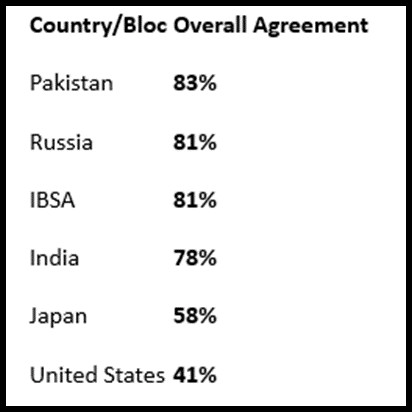
Figure 1
Figure 1 shows aggregate agreement with China ranging from 83% (Pakistan) to 41% (United States), with four of the six comparator states exceeding 75% agreement. This level of convergence is higher than would be expected from independent voting behaviour and indicates a group of states that align with China frequently. The distribution appears to be discontinuous rather than a continuous one: the seventeen-point gap between Japan and the United States is significantly larger than any other adjacent interval, which suggests that there is a structural divide between aligned and non-aligned clusters rather than a smooth ideological spectrum. India’s overall agreement of 78% is particularly noteworthy as well; despite its Quad membership and continuing border disputes with China, India aligns closely with China on sovereignty and development issues while diverging on security-sensitive resolutions.
This pattern reflects strategic autonomy rather than bloc membership and demonstrates why aggregate voting agreement alone cannot explain coalition behaviour. The United States’ consistently low agreement is consistent with Bailey, Strezhnev and Voeten (2017), whose dynamic ideal-point estimates place the United States and China at opposite ends of the principal dimension of UN voting.
4.2 Domain Specific Patterns
| Issue Area | Pakistan | India | Russia | IBSA | Japan | USA |
| Middle East | 98% | 97% | 72% | 96% | 67% | 6% |
| Nuclear/Arms | 66% | 50% | 39% | 62% | 45% | 14% |
| Colonialism | 94% | 92% | 69% | 93% | 61% | 3% |
| Human Rights | 86% | 85% | 70% | 79% | 29% | 6% |
| Economic Development | 84% | 85% | 76% | 86% | 44% | 9% |
| Disarmament | 72% | 59% | 52% | 69% | 48% | 18% |
Compiled from the UN Project Comparison Data
Figure 2
Disaggregating the voting data reveals a clear gradient of cohesion across issue areas. Resolutions relating to the Middle East and Colonialism produce the highest scores across all comparator states, which also show great internal cohesion. This suggests that these issues form the foundational bedrock of the China-anchored coalition. These resolutions deal with reaffirming ideas of sovereignty, territorial integrity and non-intervention, principles that carry relatively low political cost and consequences while resonating strongly with Global South states. Human Rights and economic development display high but more differentiated cohesion. Russia occupies a mid-range position on human rights, reflecting documented differences over particular human-rights mechanisms, while Japan records its sharpest decline, illustrating that this remains the clearest axis of Western–Chinese normative competition.
Economic Development, by contrast, shows broad convergence across developing states. This pattern is consistent with both China’s development-finance footprint and the longstanding development agenda of the G-77, suggesting that material incentives reinforce, rather than replace, shared normative preferences.
Cohesion weakens substantially on Disarmament and nuclear and arms control. Russia’s decline relative to other issue areas, India’s reduced agreement owing to its nuclear-weapon status, and Japan’s comparatively resilient position all indicate that national security interests outweigh broader coalition dynamics. The coalition therefore appears highly cohesive when resisting external intervention but considerably less cohesive when agreement on security governance is required.
4.3 Network Interpretation
Although this study does not construct a complete network of all UN member states, conceptualising voting agreement as a relational network highlights important structural characteristics. The coalition appears to be most cohesive on issues of sovereignty and becomes increasingly fractured on nuclear governance and arms control. These findings suggest that China’s diplomatic influence is best understood as an adaptive, issue-specific network rather than a permanent geopolitical alliance.
4.4 Economic Context and Qualitative Interpretation
The economic evidence complements the voting analysis. Countries with deep economic engagement with China frequently exhibit higher voting convergence, particularly on development-related resolutions. However, the relationship should not be interpreted as a simple exchange of aid for votes. China’s development partnerships appear to reinforce long-term diplomatic relationships while aligning with the development priorities of many Global South states. Qualitatively, the observed patterns are consistent with China’s long-standing emphasis on sovereignty, non-interference and South–South cooperation. Strong cohesion on issues of colonialism, the Middle East and development reflects shared
normative commitments as well as material interests.
The observable fractures within the coalition regarding security matters underscore the significance of strategic autonomy. India’s conduct exemplifies this relationship: it engages in cooperation with China when their developmental and sovereignty interests align, while preserving its independence in matters pertaining to nuclear policy and national security. Rather than being a rigid entity, the coalition functions as a dynamic diplomatic network, with its membership and cohesion varying in response to specific issue areas.
5. Discussion
The findings support a qualified reading of an emerging multipolar order: coherent in resistance, fragmented in construction. On sovereignty, decolonisation, and Middle East resolutions, the China-anchored coalition functions as a coherent blocking majority against Western preferences, but fragments when resolutions require agreement on alternative security arrangements, particularly Nuclear and Arms Control. Regrouping the six issue domains by political character — oppositional (Middle East, Colonialism, Human Rights) versus constructive (Disarmament, Nuclear/Arms Control) — shows average agreement collapse from 85.9% to 58.6%, a 27.3-point gap reproduced across all six states and domains. This asymmetry is the study’s central empirical contribution, giving the “coherent in resistance, fragmented in construction” characterisation a precise quantitative anchor.
This pattern extends a long empirical and theoretical record. Chai (1979) found the identical split in 1970s UNGA voting, with China aligning with the Third World on colonial issues but diverging on arms control as its own nuclear status created friction with constraining proposals. Takahashi (2025) and Draguljić and Anspach (2025) find the same low-cost/highcost split within the PRC–Third World coalition and the G-77 broadly. Cooley, Nexon, and Ward (2019) explain why: contesting an order is cheaper than building an alternative one, which requires costly agreement over new goods. Cohesion on oppositional issues thus reflects low-cost negative coordination, while fragmentation on constructive issues reflects the cost of positive agreement once material interests — Russia’s arms exports, Pakistan’s
nuclear posture, India’s strategic autonomy — diverge, making this a “shallow-resistance” coalition: durable enough to obstruct, not yet capable of building. Contemporary multipolarity is thus marked by adaptable, issue-specific coalitions rather than rigid blocs. India does not fully commit to any coalition but aligns with China while preserving independence, illustrating how middle powers hedge among competing centres of influence.
This behaviour exemplifies how middle powers navigate and hedge among various competing centres of influence. From a methodological standpoint, this study highlights the importance of conducting analyses that focus on specific issues. Aggregate voting similarity alone would obscure the substantial variation observed across policy domains. Examining separate issue areas therefore provides a more nuanced understanding of coalition cohesion within the UNGA. Two limitations should be noted: only six comparator states were considered, and available economic data cannot fully disentangle material incentives from normative convergence. Future research could extend this to all UN member states using weighted voting networks and community-detection techniques. Overall, China’s coalition is best understood as an adaptive, issue-dependent network whose cohesion depends on converging strategic, economic, and normative interests rather than permanent bloc discipline.
6. Conclusion
In this research, the question was raised concerning the consistency of the preference of China-based coalition within the UN General Assembly voting process with respect to various issues under discussion or the changing nature of such a coalition, depending on the specifics of certain policy areas. Using the mixed methods design based on both quantitative voting pattern analysis and qualitative approach rooted in the foreign policy of China and the theory of multipolarity, the research reveals that China’s coalition is not fully consistent or fully inconsistent. The cohesion of China’s coalition depends on particular issue areas.
The results of the empirical analysis demonstrate that the greatest voting cohesion is exhibited on issues such as sovereignty, colonialism, the Middle East, and economic development, which is a result of similar experiences and priorities of the majority of the developing countries as well as their endorsement of the principles of non-interference and South-South cooperation. On the contrary, voting cohesion is very low on issues associated with nuclear policy and security in general, due to states’ preference for their strategic interests to diplomacy. In addition to empirical results, the study helps address certain existing discussions regarding the essence of modern-day multipolarity. Variation of voting cohesion, found in the study, lends credence to scholarly opinion that modern international order features issue-specific overlapping coalitions and not polarized or bloc systems. Thus, increasing influence of China in international diplomacy signifies an increasing ability of the country to build alliances on specific political issues and not formation of a bloc system similar to that of the Cold War era.
Methodologically speaking, the research provides an example of how important it is to conduct a detailed issue-based analysis of voting behaviour in the UNGA combined with qualitative analysis of the foreign policy and diplomatic strategy of the countries involved. The findings also contribute to broader theoretical debates in International Relations. From a neorealist perspective, the issue-specific variation in China’s coalition demonstrates that states do not form permanently aligned blocs, but adjust their behaviour according to changing distributions of interests and security priorities. At the same time, the strong cohesion observed on sovereignty, colonialism, and non-interference reflects a constructivist dimension, in which shared historical experiences, norms, and identities shape patterns of cooperation. The findings therefore suggest that contemporary multipolarity cannot be understood solely through material power competition or the emergence of rival great-power blocs. Rather, it is characterised by flexible and overlapping coalitions in which material interests and shared norms interact.
China’s growing diplomatic influence consequently reflects not simply the formation of an alternative pole, but its capacity to facilitate issue-specific alignments within an increasingly pluralistic international order. However, there are some drawbacks of the research. First of all, the analysis was limited to voting behaviour in the General Assembly and thus it does not take into account any informal negotiations, diplomacy, or strategies used before voting. Secondly, the research was conducted based only on a limited number of comparator states and not on all UN membership.
Future research could address these limitations by constructing a comprehensive voting network involving all UN member states and extending the analysis across a longer time period to identify changes in China’s coalition-building over time. Further studies can be done through constructing a full voting network of all the UN members, using longer historical comparisons, or adding other criteria such as speeches and cooperation in addition to voting. Such a mixed-source analysis would provide a more comprehensive assessment of whether China’s influence reflects durable alignment or primarily issue-specific coalition building.
In summary, this research shows how the China-led coalition stands out as a crucial development within current multilateral diplomacy. Nevertheless, its effectiveness is situational in nature, since it depends on the interaction of various interests, economic links, and norms of the participating countries on different issues. Such results confirm the understanding that the developing multipolar world is not characterized by fixed geopolitical blocs but rather adaptable forms of cooperation.
References
Acharya, A. (2018). The end of American world order (2nd ed.). Polity. https://books.google.com.qa/books?id=nxJSDwAAQBAJ
Adhikari, B., Jeong, J. M., & Peksen, D. (2022). Compliant or defiant? Economic sanctions and United Nations General Assembly voting by target countries. International Interactions, 48(3), 397– 422. https://doi.org/10.1080/03050629.2022.2059478
AidData. (2023). Global Chinese Development Finance Dataset (Version 3.0). https://www.aiddata.org/data/aiddatas-global-chinese-development-finance-dataset-version-3-0
Bailey, M. A., Strezhnev, A., & Voeten, E. (2017). Estimating dynamic state preferences from United Nations voting data. Journal of Conflict Resolution, 61(2), 430–456. https://www.jstor.org/stable/26363889
Benati, S., & Capurri, A. (2026). The Alignment index and its application to voting at the United Nations General Assembly. Quality & Quantity, 1–33.
https://doi.org/10.1007/s11135-026-02814-x
Binder, M., & Payton, A. L. (2022). With frenemies like these: Rising power voting behavior in the UN General Assembly. British Journal of Political Science, 52(1), 381–398. https://doi.org/10.1017/S0007123420000538
Brazys, S., & Dukalskis, A. (2017). Canary in the coal mine? China, the UNGA, and the changing world order. Review of International Studies, 43(4), 742–764.
https://doi.org/10.1017/S0260210517000067
Cannon, B. J., & Rossiter, A. (2022). Locating the Quad: Informality, institutional flexibility, and future alignment in the Indo-Pacific. International Politics, 59(4), 583–602.
https://doi.org/10.1057/s41311-022-00383-y
Chai, T. R. (1979). Chinese policy toward the Third World and the superpowers in the UN General Assembly, 1971–1977: A voting analysis. International Organization, 33(3), 391–403. Cambridge University Press.
https://doi.org/10.1017/S0020818300032215
Christensen, T. J. (2015). The China challenge: Shaping the choices of a rising power. W. W. Norton & Company.
https://wwnorton.com/books/The-China-Challenge/
Cooley, A., Nexon, D. H., & Ward, S. (2019). Revising order or challenging the balance of military power? An alternative typology of revisionist and status-quo states. Review of International Studies, 45(4), 689–708.
https://doi.org/10.1017/S0260210519000019
Doshi, R. (2021). The long game: China’s grand strategy to displace American order. Oxford University Press.
https://global.oup.com/academic/product/the-long-game-9780197645482?cc=in&lang=en&
Draguljić, G., & Anspach, N. M. (2025). Southern solidarity? A mixed-methods analysis of the G77 in the United Nations General Assembly. Global Studies Quarterly, 5(1), Article ksaf027.
https://doi.org/10.1093/isagsq/ksaf027
Dreher, A., & Jensen, N. M. (2013). Country or leader? Political change and UN General Assembly voting. European Journal of Political Economy, 29, 183–196.
https://doi.org/10.1016/j.ejpoleco.2012.10.002
Dreher, A., & Sturm, J.-E. (2012). Do the IMF and the World Bank influence voting in the UN General Assembly? Public Choice, 151(1), 363–397.
https://doi.org/10.1007/s11127-010-9750-2
Foot, R. (2020). China, the UN, and human protection: Beliefs, power, image. Oxford University Press.
https://global.oup.com/academic/product/china-the-un-and-human-protection-9780198843740?cc=in&lang=en&
Fung, C. J. (2019). China and intervention at the UN Security Council: Reconciling status. Oxford University Press.
https://global.oup.com/academic/product/china-and-intervention-at-the-un-security-council-9780198842743?cc=in&lang=en&
García Herrero, A., Storella, T., & Weil, P. (2024). China’s influence at the United Nations: Words and deeds (Bruegel Working Paper). Bruegel.
https://www.bruegel.org/working-paper/chinas-influence-united-nations-words-and-deeds
Johnston, A. I. (2008). Social states: China in international institutions, 1980–2000. Princeton University Press.
https://press.princeton.edu/books/paperback/9780691134536/social-states?srsltid=AfmBOoqYfHmSWmvzn7cXM_T1LC_tXSEBt5YAlMJ7g6h1LAzqY_z9ptCh
Keohane, R. O. (1984). After hegemony: Cooperation and discord in the world political economy. Princeton University Press.
https://www.jstor.org/stable/j.ctt7sq9s
Loke, B., & Guo, X. (2025). China’s coalition-building in the Indo-Pacific: Strategies of connectivity and association. Australian Journal of International Affairs, 79(3).
https://doi.org/10.1080/10357718.2025.2471351
Macon, K. T., Mucha, P. J., & Porter, M. A. (2012). Community structure in the United Nations General Assembly. Physica A: Statistical Mechanics and its Applications, 391(1), 343–361.
https://doi.org/10.1016/j.physa.2011.06.030
Maoz, Z. (2011). Networks of nations: The evolution, structure, and impact of international networks, 1816–2001. Cambridge University Press.
https://doi.org/10.1017/CBO9780511762659
Mathy, E. (2023). Why do states commit to the Treaty on the Prohibition of Nuclear Weapons? The Nonproliferation Review, 30(1–3).
https://doi.org/10.1080/10736700.2023.2175994
Mearsheimer, J. J. (2001). The tragedy of Great Power politics. W. W. Norton & Company.
https://wwnorton.com/books/9780393349276
Medeiros, E. S. (2009). China’s international behavior: Activism, opportunism, and diversification. RAND Corporation.
https://www.rand.org/pubs/monographs/MG850.html
Mercator Institute for China Studies (MERICS). (2025). Friends moving apart? China and Russia at the United Nations. MERICS.
https://merics.org/en/comment/friends-moving-apart-china-and-russia-united-nations
Mirrer, A., & Sundquist, J. (2025). Do Chinese loans buy votes in the UN General Assembly? SSRN. https://doi.org/10.2139/ssrn.5560879
Morse, J. C., & Coggins, B. (2024). Your silence speaks volumes: Weak states and strategic absence in the UN General Assembly. The Review of International Organizations, 19(3), 515– 544.
https://doi.org/10.1007/s11558-024-09538-3
Pomeroy, C., Dasandi, N., & Mikhaylov, S. (2018). Multiplex communities and the emergence of international conflict. PLOS ONE, 13(11), Article e0206564.
https://doi.org/10.1371/journal.pone.0223040
Primiano, C. B., & Xiang, J. (2016). Voting in the UN: A second image of China’s human rights. Journal of Chinese Political Science, 21(3), 301–319.
https://doi.org/10.1007/s11366-016-9399-x
Raymond, M., & Sherman, J. (2023). Authoritarian multilateralism in the global cyber regime complex: The double transformation of an international diplomatic practice. Contemporary Security Policy, 44(4), 505–530.
https://doi.org/10.1080/13523260.2023.2269809
Shambaugh, D. (2013). China goes global: The partial power. Oxford University Press.
https://global.oup.com/academic/product/china-goes-global-9780199860142?cc=in&lang=en&
Takahashi, T. (2025). Two questions of sovereignty: China and the Third World countries in the United Nations General Assembly (1971–1990). Global Studies Quarterly, 5(1), ksaf024.
https://doi.org/10.1093/isagsq/ksaf024
United Nations Dag Hammarskjöld Library. (2025). United Nations General Assembly voting data: Resolutions 1 (11 December 1946) to 80/246 (30 December 2025) (Version 5). United Nations.
https://digitallibrary.un.org/record/4060887
United Nations. (n.d.). UN Comtrade Database.
https://comtrade.un.org/
Voeten, E. (2000). Clashes in the Assembly. International Organization, 54(2), 185–215.
https://www.jstor.org/stable/2601296
Voeten, E. (2013a). Data and analyses of voting in the United Nations General Assembly. In B. Reinalda (Ed.), The Routledge handbook of international organization (pp. 54–66). Routledge.
https://www.taylorfrancis.com/chapters/edit/10.4324/9780203405345-5/data-analyses-voting-united-nations-erik-voeten
Walt, S. M. (1987). The origins of alliances. Cornell University Press.
https://cornellpress.cornell.edu/book/9780801494185/the-origins-of-alliances/
Waltz, K. N. (1979). Theory of international politics. McGraw-Hill.
https://www.academia.edu/28686609/_WALTZ_KENNETH_Theory_of_International_Politics
Wendt, A. (1999). Social theory of international politics. Cambridge University Press.
https://www.cambridge.org/core/books/social-theory-of-international-politics/0346E6FDC74FECEF6D2CDD7EFB003CF2
World Bank. (n.d.). World Bank country and lending groups: Income classifications.
https://datahelpdesk.worldbank.org/knowledgebase/articles/906519-world-bank-country-and-lending-groups
World Bank. (n.d.). World Bank Open Data.
https://data.worldbank.org/