Authors: Sukanyaka Das, Mariyam Fatma, Gauri Sharma, Anupama Dutta, Nidhi Rathi
Abstract
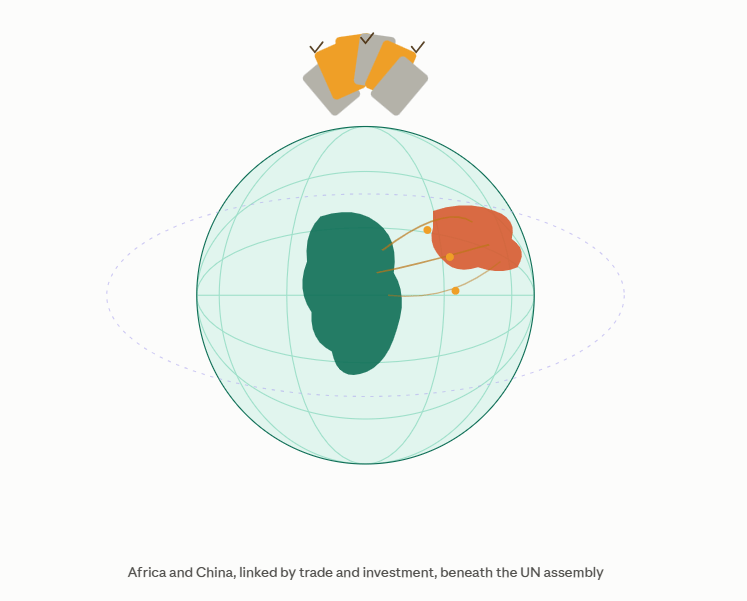
This study examines whether China’s Belt and Road Initiative (BRI) is associated with changes in African states’ voting alignment with China and with the cohesion of voting relationships among African states in the United Nations General Assembly (UNGA). Using a balanced panel of 45 African states observed from 2013 to 2024 (540 country-year observations), the study combines fixed-effects panel regression, a staggered difference-in-differences (DiD) design, and Social Network Analysis (SNA). The empirical strategy distinguishes formal BRI participation from material economic engagement through Chinese foreign direct investment (FDI), development finance, and bilateral trade. The results show positive associations between voting alignment and each major indicator of Chinese economic engagement. In the fixed-effects specification, the reported coefficients are positive for BRI participation, FDI, development loans, debt-to-GDP, and bilateral trade, while GDP per capita is not statistically significant. The reported DiD estimate is also positive, suggesting a post-accession increase in voting alignment among BRI participants relative to the comparison group. Network measures indicate greater connectivity among African states over the study period, including higher reported network density and identifiable voting communities. These findings support the view that material economic engagement is relevant to diplomatic alignment, but they do not by themselves establish that China caused changes in African foreign-policy preferences. Selection into BRI cooperation, domestic political change, African Union and G77 coordination, issue-specific voting incentives, and relations with other major powers may affect both economic engagement and voting behavior. The DiD results additionally depend on the parallel-trends assumption, while UNGA voting similarity is an imperfect proxy for political influence. The study therefore interprets the evidence as a robust pattern of association rather than definitive proof of Chinese causal influence. Its principal contribution is to connect bilateral voting alignment with bloc-level coalition dynamics and to show why network analysis can complement, rather than replace, conventional country-level analysis.
1. Introduction
Since the launch of the Belt and Road Initiative in 2013, China’s economic engagement with Africa has expanded through infrastructure finance, trade, investment, and development lending. This expansion has generated a central international-relations question: does sustained economic engagement also become politically consequential in multilateral institutions? The United Nations General Assembly provides an especially useful setting because roll-call voting creates an observable record of states’ positions across a wide range of international issues.
Existing research has frequently examined whether individual African states vote more closely with China when they receive Chinese finance, investment, or trade. That bilateral perspective is important, but it leaves a second question insufficiently addressed: whether common exposure to Chinese economic engagement is associated with changes in the relationships among African states themselves. The political consequence of the BRI may therefore operate at two levels: bilateral alignment with China and bloc-level coordination among African states.
The present study asks three related questions. First, is formal BRI participation associated with higher UNGA voting alignment with China? Second, do material forms of Chinese economic engagement—particularly FDI, development finance, and bilateral trade-show stronger relationships with voting alignment than formal participation alone? Third, did the structure of African voting relationships become more cohesive during the 2013–2024 period?
The distinction between association and causation is central. A positive coefficient on Chinese economic engagement cannot, by itself, demonstrate that China caused a state to change its foreign-policy preferences. States may select into BRI cooperation because of prior diplomatic preferences, economic needs, infrastructure requirements, or domestic political incentives. African states may also coordinate their UNGA votes because of regional institutions, common historical experiences, or issue-specific interests. The analysis therefore treats the econometric results as evidence about conditional relationships and uses DiD as an additional identification strategy rather than as automatic proof of causality.
The paper makes two contributions. Empirically, it extends a largely bilateral literature by combining country-level panel analysis with network measures of African-African voting relationships. Theoretically, it brings economic statecraft and soft-power explanations into conversation with realist, dependency, complex-interdependence, and coalition-formation perspectives. This makes it possible to ask not only whether Chinese engagement coincides with alignment toward China, but also whether the broader African voting network changes in ways that are consistent with stronger regional coordination.
2. Literature Review
2.1 China’s Economic Engagement with Africa
The literature establishes that China’s presence in Africa is multidimensional. Chinese activity includes aid, concessional and commercial finance, FDI, construction, trade, and infrastructure development. Brautigam (2009) emphasizes the long-term character of Chinese economic engagement, while Alden (2007) places infrastructure and investment within a broader China–Africa geopolitical relationship. Dreher and Fuchs (2015) and Dreher et al. (2018) demonstrate that different forms of Chinese financing have different allocation patterns.
This distinction matters for the present study. Formal BRI participation can be an institutional or symbolic indicator, while FDI, loans, and trade represent continuing material relationships. A state can sign a cooperation agreement without receiving large-scale investment in a particular year, while another state may have substantial Chinese economic exposure without the same formal status. The study therefore treats formal participation and material engagement as analytically distinct.
2.2 Economic Statecraft and Soft Power
Economic Statecraft Theory suggests that governments can use economic instruments to pursue political objectives (Baldwin, 1985). Finance, trade, and investment may create incentives for diplomatic reciprocity. Soft Power Theory (Nye, 2004) provides a different mechanism: repeated economic interaction may create trust, attraction, or perceptions of partnership rather than operating primarily through coercion.
The empirical implication is not that every economic relationship should produce automatic voting compliance. Rather, sustained and meaningful engagement should be associated with a greater probability of diplomatic convergence if these mechanisms matter. The present analysis therefore expects material economic indicators to be more informative than a simple membership dummy if the mechanism operates through accumulated economic interaction.
2.3 Competing Explanations: Realism and Dependency
Realist approaches caution against treating economic ties as sufficient explanations of foreign-policy choice. African governments retain strategic autonomy and may cooperate with China when that relationship advances domestic, regional, or security interests. A country can therefore accept Chinese finance while disagreeing with Beijing on particular UNGA resolutions.
Dependency theory provides a competing mechanism. If external finance or debt exposure constrains policy autonomy, economic dependence could narrow the range of diplomatically feasible choices. Yet the supplied regression results show that debt-to-GDP has a much smaller coefficient than FDI, loans, and trade. This does not validate or reject dependency theory by itself; it suggests that aggregate debt exposure should not be treated as synonymous with Chinese political leverage.
2.4 Complex Interdependence and Coalition Formation
Complex Interdependence Theory (Keohane & Nye, 1977) highlights multiple channels of interaction among states. Economic ties can create repeated contacts among governments, firms, institutions, and regional actors. Coalition Formation Theory (Riker, 1962) shifts attention to the collective level: African states coordinate through regional and broader developing-country institutions, including the African Union and the G77.
Consequently, an increase in voting cohesion could reflect shared strategic interests or institutional coordination rather than Chinese influence. The network analysis is therefore interpreted as evidence of changing coalition structure, not as direct evidence that China engineered those coalitions.
2.5 UNGA Voting and Existing Empirical Evidence
UNGA voting records offer a systematic indicator of foreign-policy positioning. Bailey, Strezhnev, and Voeten (2017) provide an influential ideal-point approach for estimating dynamic state preferences from UN voting. Studies of Chinese aid and financing have linked aspects of Chinese engagement to recipient voting behavior, while other research emphasizes selective and issue-specific alignment.
The literature therefore contains competing expectations. Economic-statecraft accounts predict a positive relationship between Chinese economic engagement and voting alignment. Realist accounts predict that the relationship will be conditional on national interests. Dependency accounts predict stronger alignment where vulnerability is greater. Regional-institutional explanations predict that African voting cohesion can rise independently of China. The present study treats these as competing interpretations of the same empirical patterns.
2.6 Critical Synthesis and Research Gap
Three gaps motivate the analysis. First, many studies use formal BRI participation as a binary indicator even though economic exposure varies greatly across countries and years. Second, bilateral comparisons between individual African states and China cannot reveal whether African states are simultaneously becoming more similar to one another. Third, the post-2020 period deserves attention because the pandemic, debt restructuring, changes in Chinese overseas finance, and intensified great-power competition may alter the relationship between economic engagement and diplomacy.
The study also identifies a measurement gap. UNGA voting similarity does not distinguish between agreement with China because of Chinese influence and agreement produced by independent or shared interests. High-stakes resolutions may therefore be valuable for future work, but the supplied dataset does not provide a separately verified high-stakes subset. The paper consequently does not claim to estimate an effect that has not been separately modelled.
3. Research Questions and Expectations
RQ1: Is formal BRI participation associated with higher African states’ voting alignment with China in the UNGA?
RQ2: Are material economic indicators-Chinese FDI, development loans, and bilateral trade-more strongly associated with voting alignment than formal BRI participation?
RQ3: Did African voting relationships become more cohesive between 2013 and 2024?
RQ4: To what extent can the observed patterns be distinguished from alternative explanations such as domestic politics, regional coordination, and pre-existing diplomatic preferences?
The principal expectation is that greater material economic engagement will be positively associated with voting alignment. A second expectation is that BRI accession will be followed by an increase in alignment relative to the comparison group, subject to the assumptions required by the staggered DiD design. A third expectation is that the African voting network will become more connected over time. These are empirical expectations, not predetermined causal effects.
4. Methodology
4.1 Research Design
The study uses a quantitative longitudinal design combining panel econometrics and Social Network Analysis. The two components answer different questions. The panel models estimate relationships between Chinese engagement and an individual country’s voting alignment with China. The network analysis describes how voting relationships among African states are structured and how that structure changes over time. The network component is therefore complementary to, rather than a substitute for, the econometric models.
4.2 Sample and Data
The supplied manuscript reports a balanced panel of 45 African states for 2013–2024, producing 540 country-year observations. The dependent variable is an annual UNGA voting-alignment score with China, based on the ideal-point approach of Bailey, Strezhnev, and Voeten (2017) and the Harvard Dataverse. Chinese FDI is attributed in the manuscript to the American Enterprise Institute/China Global Investment Tracker; development-loan data are attributed to the China Africa Research Initiative; GDP and debt indicators are drawn from World Bank and related international statistics; and trade data are drawn from the United Nations Statistics Division. The BRI participation indicator is described as an author-compiled measure based on formal cooperation-agreement status.
4.3 Variable Operationalization
The dependent variable is the annual voting-alignment score. BRI participation is a binary indicator of formal cooperation-agreement status. Chinese FDI, development-loan volume, and bilateral trade are treated as material exposure indicators. Debt-to-GDP and GDP per capita are included as controls. Keeping formal participation separate from material engagement is important because a membership indicator may capture diplomatic signaling while the economic variables capture the depth of continuing interaction.
4.4 Fixed-Effects Panel Model
The core specification is estimated using pooled OLS, fixed effects (FE), and random effects (RE), with the Hausman test used to select between FE and RE: a b1 b2 b3 b4 b5 b6 m_i t_t e_it. Voting_it = + BRI_it + FDI_it + Loan_it + Trade_it + Debt_it + GDPpc_it + + +
Country fixed effects control for time-invariant characteristics such as geography, historical relationships, and persistent diplomatic orientation. Year effects absorb common shocks. The FE estimates should therefore be interpreted as within-country relationships conditional on the included covariates, not as proof that an increase in Chinese engagement mechanically causes a change in voting.
4.5 Staggered Difference-in-Differences
Because countries entered formal BRI cooperation in different years, the study uses a staggered DiD framework. The manuscript identifies the Callaway and Sant’Anna (2021) estimator as the preferred approach because it avoids problematic comparisons between already-treated units and newly treated units when treatment effects are heterogeneous.
The key identifying assumption is parallel pre-treatment trends: absent BRI accession, treated and comparison countries would have followed similar voting-alignment trajectories. The supplied manuscript notes that this assumption is only partially testable for early joiners because their pre-treatment window is short. Accordingly, the DiD estimate is treated as suggestive quasi-experimental evidence rather than definitive causal identification.
4.6 Social Network Analysis
For each year, African states are represented as nodes and pairwise voting similarity as weighted edges. The supplied manuscript reports network density, degree centrality, betweenness centrality, eigenvector centrality, and Louvain community detection. These measures describe whether the network becomes more connected, which states occupy central positions, and whether identifiable voting communities emerge.
A crucial interpretive boundary is maintained: network cohesion is not itself evidence of Chinese direction. African states may become more cohesive because of AU/G77 coordination, common regional interests, issue convergence, or changing international conditions. SNA demonstrates structural change; it does not independently identify the cause of that change.
4.7 Robustness and Diagnostic Strategy
The supplied analysis reports VIF, Breusch–Pagan, Wooldridge, Pesaran, and Jarque–Bera diagnostics. These tests are retained as diagnostic evidence, but the revised manuscript avoids saying that they make the causal results “trustworthy” in a broad sense. They address particular statistical concerns; they do not solve treatment-selection bias, omitted-variable bias, reverse causality, or violations of the DiD identification assumptions.
5. Empirical Findings
5.1 Descriptive Statistics
The reported descriptive statistics show substantial cross-country variation in economic exposure and voting alignment. The mean voting-alignment score is 0.71, with a reported minimum of 0.42 and maximum of 0.93. Mean Chinese FDI is reported as US$2.86 billion and mean Chinese development loans as US$1.94 billion. Mean debt-to-GDP is reported as 46.5%, while mean trade with China is US$8.34 billion.
These figures establish heterogeneity that is useful for panel analysis. They do not, however, demonstrate that economic engagement produced the observed voting patterns.
5.2 Reported Correlations
The supplied correlation matrix reports positive pairwise associations between voting alignment and BRI participation (0.641), Chinese FDI (0.728), Chinese loans (0.703), debt-to-GDP (0.428 in the displayed table), and trade with China (0.691). FDI and trade are themselves strongly correlated (0.811). Because the manuscript does not provide p-values for the correlation matrix, the revised text does not describe these coefficients as statistically significant. They are descriptive associations.
The supplied VIF test reports a maximum VIF of 3.4, supporting the view that severe multicollinearity is not evident in the reported specification, although it does not establish causal validity.
5.3 Fixed-Effects Regression
The reported fixed-effects results are reproduced below. BRI participation has a coefficient of 0.058 (SE 0.019, p=0.002); Chinese FDI 0.127 (SE 0.027, p<0.001); Chinese loans 0.084 (SE 0.024, p<0.001); debt-to-GDP 0.021 -0.013 (SE 0.010, p=0.036); trade with China 0.095 (SE 0.028, p=0.001); and GDP per capita (SE 0.008, p=0.103).
The substantive pattern is clear: material engagement indicators have positive coefficients, with FDI showing the largest reported coefficient among the main economic variables. Formal BRI participation is also positive, but smaller. The appropriate interpretation is that, conditional on country and year effects and the included covariates, years with greater measured Chinese economic engagement are associated with higher reported voting alignment. The coefficients do not demonstrate that Chinese investment directly changed voting preferences.
5.4 Difference-in-Differences
The supplied DiD table reports a treatment-group coefficient of 0.034 (SE 0.014, p=0.014), a post-BRI-period coefficient of 0.046 (SE 0.016, reported p=0.016), and a treatment×post coefficient of 0.071 (SE 0.020, reported p=0.020). The interaction is therefore positive in the supplied results.
The revised interpretation deliberately follows the reported table rather than the stronger wording in the original manuscript. The result is consistent with a post-accession increase in voting alignment among treated countries relative to the comparison group, but its causal interpretation depends on the parallel-trends assumption and on the quality of treatment timing and control-group construction. Because the manuscript does not present a full event-study or pre-trend graph, the DiD result is described as suggestive rather than conclusive.
5.5 Social Network Results
The supplied network analysis reports that network density increased from 0.41 in 2013 to 0.82 in 2024. It also identifies Ethiopia, Kenya, Egypt, Nigeria, and South Africa as highly central actors in 2024. Betweenness centrality is reported as highest for Ethiopia (0.39), followed by Kenya (0.35), Egypt (0.33), South Africa (0.29), and Nigeria (0.27). Eigenvector centrality is reported as highest for Ethiopia (0.94), followed by Egypt (0.91), Kenya (0.90), Nigeria (0.87), and South Africa (0.85).
Louvain community detection identifies three reported groups: Community A (19 countries) with strong BRI participation and high voting similarity; Community B (14) with moderate Chinese economic engagement; and Community C (12) with mixed diplomatic alignment and diversified partnerships. These patterns indicate structural differentiation and increasing connectivity. They should not be read as proof that BRI participation caused community membership because the community algorithm is based on voting relationships and the study does not estimate a network-level causal model linking BRI exposure to community assignment.
5.6 Robustness Diagnostics
The supplied diagnostics report a maximum VIF of 3.4, a Breusch–Pagan p-value of 0.31, a Wooldridge p-value of 0.28, a Pesaran p-value of 0.19, and a Jarque–Bera p-value of 0.11. Taken at face value, these diagnostics do not indicate severe multicollinearity, heteroskedasticity, serial correlation, cross-sectional dependence, or pronounced non-normality under the tests used.
However, diagnostic tests cannot substitute for a credible identification strategy. They do not address whether countries that choose BRI cooperation were already on a different diplomatic trajectory, nor do they establish the parallel-trends assumption required by DiD.
5.7 Data-Quality and Reporting Checks
Several reporting inconsistencies in the supplied manuscript require caution. First, the descriptive table reports a debt-to-GDP maximum of 912%, which should be checked against the underlying country-year data before publication. Second, the original manuscript alternates between different table and section labels; these have been standardized in this revision. Third, the correlation discussion previously called coefficients statistically significant without displaying p-values; the revised text reports them only as associations. Fourth, the DiD interaction was described in one place as p<0.001 although the table reports p=0.020; the revised manuscript follows the table and reports p=0.020. Finally, some original figure labels contain apparent date or transcription errors. These should be checked against the underlying analysis files before submission.
Table 1. Descriptive statistics reported in the supplied manuscript
Variable |
Mean |
Std. Dev. |
Minimum |
Maximum |
| Voting alignment | 0.71 | 0.11 | 0.42 | 0.93 |
| Chinese FDI (US$ bn) | 2.86 | 1.95 | 0.15 | 8.74 |
| Chinese loan (US$ bn) | 1.94 | 1.41 | 0.00 | 6.28 |
| Debt-to-GDP (%) | 46.5 | 17.8 | 12.3 | 912 |
| Trade with China (US$ bn) | 8.34 | 6.82 | 0.74 | — |
| GDP per capita (US$) | 3,845 | 2,610 | 502 | 11,943 |
Table 2. Fixed-effects panel regression results
Variable |
Coefficient |
Std. Error |
t |
p |
| Constant | 0.412 | 0.083 | 4.96 | <0.001 |
| BRI participation | 0.058 | 0.019 | 3.05 | 0.002 |
| Chinese FDI | 0.127 | 0.027 | 4.70 | <0.001 |
| Chinese loan | 0.084 | 0.024 | 3.50 | <0.001 |
| Debt-to-GDP | 0.021 | 0.010 | 2.10 | 0.036 |
| Trade with China | 0.095 | 0.028 | 3.39 | 0.001 |
| GDP per capita | -0.013 | 0.008 | -1.63 | 0.103 |
Table 3. Difference-in-Differences results
Term |
Coefficient |
Std. Error |
Reported p-value |
| Treatment group | 0.034 | 0.014 | 0.014 |
| Post-BRI period | 0.046 | 0.016 | 0.016 |
| Treatment × Post | 0.071 | 0.020 | 0.020 |
Table 4. Reported centrality measures
Country |
Betweenness |
Eigenvector |
| Ethiopia | 0.39 | 0.94 |
| Kenya | 0.35 | 0.90 |
| Egypt | 0.33 | 0.91 |
| South Africa | 0.29 | 0.85 |
| Nigeria | 0.27 | 0.87 |
Table 5. Reported robustness and diagnostic checks
Diagnostic |
Reported result |
Interpretation |
| VIF | Maximum = 3.4 | No severe multicollinearity indicated |
| Breusch–Pagan | p = 0.31 | No evidence in reported test |
| Wooldridge | p = 0.28 | No evidence in reported test |
| Pesaran | p = 0.19 | No evidence in reported test |
| Jarque–Bera | p = 0.11 | Residuals not strongly non-normal in reported test |
6. Discussion
6.1 What the Statistical Evidence Does and Does Not Show
The combined results point to a consistent empirical pattern: African states with greater measured Chinese economic engagement tend, within the reported models, to display higher voting alignment with China. FDI, development loans, and trade have larger reported coefficients than the formal BRI-membership indicator. This distinction is theoretically important because it suggests that accumulated material relationships may be more informative than the symbolic act of signing a cooperation agreement.
At the same time, the results do not establish a single causal mechanism. Economic engagement can be both a cause and a consequence of diplomatic closeness. China may invest more in countries that already vote in ways favorable to Beijing, while African governments may deepen economic ties with China because of their own development strategies. Country fixed effects reduce bias from time-invariant differences, but they cannot remove time-varying confounders. The DiD design adds leverage by comparing changes around staggered accession, yet its interpretation remains conditional on parallel trends and treatment selection.
6.2 Interpreting the Findings Through International-Relations Theory
The strongest connection to Economic Statecraft Theory is the positive relationship between material engagement and voting alignment. If economic resources create incentives for diplomatic reciprocity, the larger coefficients on FDI, loans, and trade are consistent with that expectation. However, the evidence does not reveal whether the mechanism is explicit bargaining, anticipated future benefits, dependence, or convergence of interests.
The results provide qualified support for Soft Power Theory. Sustained economic interaction may create familiarity and goodwill, but UNGA voting cannot distinguish attraction from material incentive. The finding that debt-to-GDP has a smaller coefficient than FDI or trade also complicates a simple dependency interpretation.
Realist and regional-institutional explanations remain plausible because African governments can use China instrumentally while pursuing independent objectives. The increase in network cohesion may therefore reflect African collective agency as much as Chinese influence. Complex Interdependence Theory helps explain why bilateral and network-level outcomes can coexist: economic engagement may create multiple channels of contact that make coordination among African states easier without requiring China to direct that coordination.
6.3 Alternative Explanations
At least five alternative explanations deserve explicit consideration: selection into BRI cooperation; African Union and G77 coordination; domestic political changes; relationships with the United States, European Union, Russia, Gulf states, or other partners; and issue composition of UNGA resolutions. These factors could affect both Chinese engagement and voting behavior.
These explanations do not invalidate the observed associations, but they define the limits of inference. The strongest defensible conclusion is that Chinese economic engagement is an important correlate of African voting alignment during 2013–2024, while the relative causal weight of Chinese influence versus domestic, regional, and geopolitical factors remains unresolved.
6.4 Bilateral Alignment versus African Coalition Formation
The network findings add a second layer to the analysis. Rising density and the emergence of communities suggest that African states became more connected in their voting relationships during the study period. This is substantively different from saying that each country separately moved toward China. A country can become more similar to China while also becoming more similar to its African peers.
This distinction is central to the paper’s theoretical contribution. Coalition Formation Theory suggests that shared interests and institutions can produce bloc-level coordination. The network results are compatible with that argument, but they do not identify whether Chinese economic engagement was the initiating force. China may have acted as an accelerant by creating common economic circumstances, while African regional institutions and governments remained the principal organizers of collective diplomacy.
6.5 Transition from Empirical Results to Theory
Taken together, the econometric and network evidence suggests a layered relationship rather than a single causal chain. At the bilateral level, material economic engagement is associated with greater alignment with China. At the network level, African voting relationships also appear more cohesive. Economic Statecraft and Soft Power help explain why sustained engagement could coincide with bilateral convergence, while Complex Interdependence and Coalition Formation help explain why the broader network may change as well. Realist and regional explanations remain necessary because neither model demonstrates that China displaced African states’ own strategic calculations.
7. Policy Implications
For China, the findings suggest that the political consequences of economic diplomacy may arise from sustained material relationships rather than formal BRI branding alone. For African governments, the results highlight the importance of maintaining policy autonomy while managing external economic partnerships through diversification, transparent negotiation, and careful debt assessment. For African regional institutions, increasing network cohesion suggests an opportunity to strengthen transparent consultation and coordinated diplomacy while preserving national discretion. For researchers, the study demonstrates the value of moving beyond bilateral measures to examine coalition structures.
8. Limitations and Data Biases
The first limitation is measurement. UNGA voting similarity is a proxy for diplomatic alignment, not a direct measure of influence, dependence, or policy agreement. Two states can vote alike because they share regional interests or respond similarly to an international crisis. The measure also covers only the UNGA and cannot capture bilateral bargaining, executive diplomacy, regional organizations, or other multilateral forums.
The second limitation concerns omitted variables. The dataset includes several economic indicators and basic controls, but it does not fully measure leadership changes, regime type, domestic political coalitions, AU coordination, G77 coordination, security relationships, or relations with other major powers. These omitted factors could affect both Chinese engagement and voting behavior.
The third limitation is treatment selection. BRI accession is not randomly assigned. Countries may join because they already have strong political or economic ties with China, because they need infrastructure finance, or because governments see participation as beneficial for development. Fixed effects reduce time-invariant selection bias but cannot eliminate time-varying selection.
The fourth limitation is the DiD identification assumption. The analysis depends on parallel pre-treatment trends, yet early BRI joiners have limited pre-treatment observations within the 2013–2024 window. The supplied manuscript does not provide a complete event-study diagnostic. The DiD result should therefore be treated as supportive but not definitive evidence of causality.
The fifth limitation is network measurement. The manuscript reports network density and centrality measures, but the exact edge-construction rule, similarity threshold, and sensitivity of communities to alternative thresholds are not fully documented in the supplied version. The network findings should therefore be interpreted as descriptive structural evidence until these methodological details are verified.
Finally, the source manuscript contains data-reporting inconsistencies, including the unusually high reported debt-to-GDP maximum and a discrepancy between the displayed DiD p-value and the stronger significance claim in the prose. These are explicitly disclosed rather than silently corrected. Before journal submission, the underlying dataset and statistical output should be audited so that every table, figure, coefficient, p-value, and source description can be traced to the analysis file.
9. Conclusion
This study examined whether China’s BRI is associated with African states’ voting alignment with China and with changes in the structure of African voting relationships in the UNGA from 2013 to 2024. Across the supplied panel, DiD, and network results, the central empirical pattern is positive: greater Chinese economic engagement is associated with greater voting alignment, and the African voting network is reported to have become more cohesive over time.
The most important substantive finding is the distinction between formal BRI participation and material economic engagement. FDI, development finance, and trade have larger reported relationships with voting alignment than the BRI participation indicator. This suggests that the political significance of the BRI may lie less in formal membership and more in the depth and continuity of economic relationships.
The second contribution is conceptual. African states can move closer to China while simultaneously becoming more closely connected to one another. The network results are therefore consistent with a broader process of African diplomatic coordination, although they do not establish that China caused that coordination.
Overall, the evidence is best understood as supporting a meaningful association between Chinese economic engagement and African diplomatic alignment, while leaving the precise causal mechanism open. Future research should strengthen identification with longer pre-treatment periods, event-study tests, more detailed controls for regional coordination and other external partners, alternative voting measures, and independently verified high-stakes resolution samples.
10. References
Alden, Chris. (2007). China in Africa. London: Zed Books.
Baldwin, David A. (1985). Economic Statecraft. Princeton, NJ: Princeton University Press.
Hausman, Jerry A. (1978). “Specification Tests in Econometrics.” Econometrica, 46(6), 1251–1271.
Keohane, Robert O., & Joseph S. Nye. (1977). Power and Interdependence. Boston: Little, Brown.
Riker, William H. (1962). The Theory of Political Coalitions. New Haven, CT: Yale University Press.
Shambaugh, David. (2013). China Goes Global: The Partial Power. Oxford: Oxford University Press.