Gaurav Singh
Hansraj College, University of Delhi
Prepared for IISPPR Research Internship (Policy Research Division)
April 2026
ABSTRACT
India’s cities are undergoing rapid demographic and spatial transformation, with over 600 million people projected to reside in urban areas by 2031. This growth has concentrated successive policy cycles on “grey” infrastructure—concrete, asphalt, and steel-dominated construction that offers political legibility at the cost of long-run ecological dysfunction. This paper offers a systematic assessment of that trajectory. It maps the quantifiable environmental externalities generated by conventional grey construction—including disrupted hydrological cycles, escalating Urban Heat Island (UHI) intensities, and embedded carbon loads—against the restorative capacities of nature-based Green Infrastructure (GI) solutions. Drawing on environmental economics, urban political ecology, and Amartya Sen’s Capability Approach—frameworks applied here in an integrated rather than sequential analytical sequence—the paper argues that GI constitutes a structural requirement for climate-resilient urban futures. The paper additionally examines the role of Artificial Intelligence (AI) and Internet of Things (IoT) technologies in scaling GI governance across Indian municipalities, while critically assessing the implementation barriers these tools face in under-resourced municipal contexts. The analysis identifies persistent governance failures—fragmented institutional mandates, absent natural capital accounting, and maintenance deficits—as the primary barriers to GI adoption, and concludes with a technology-informed policy architecture designed to address them.
INTRODUCTION
India’s urban population is among the fastest-growing in the world. Between 2001 and 2021, approximately 91 million urban residents were added, and the National Commission on Population projects that nearly 600 million people will inhabit Indian cities by 2036 (Ministry of Housing and Urban Affairs, 2021). This rate of growth exceeds the adaptive capacity of most existing planning frameworks, compelling large-scale infrastructure investment at considerable speed and scale.
The institutional response has been predominantly grey: the Smart Cities Mission, AMRUT, the Pradhan Mantri Awas Yojana (Urban), and successive national urban development programmes have channelled substantial public investment into roads, drains, flyovers, and concrete utilities. From a political economy perspective, this preference is understandable. Grey infrastructure produces visible outcomes within electoral cycles and generates measurable economic outputs in ways that constructed wetlands or urban forests do not.
However, the long-run environmental costs of this approach are substantial. The built environment accounts for approximately 40% of global greenhouse gas emissions (United Nations Environment Programme, 2022). At the urban scale, consequences compound over time: Delhi’s mean summer temperatures have risen measurably over the past two decades, with UHI intensity now among the most severe in South Asia (Council on Energy, Environment and Water, 2023); Kanpur, Patna, and Surat have experienced serious monsoon flooding attributable to impervious surface expansion and the degradation of natural floodplains (National Disaster Management Authority, 2019). These outcomes reflect a planning paradigm that systematically externalises ecological costs onto economically vulnerable urban populations.
Green Infrastructure (GI) offers an alternative framework. Rather than engineering around natural processes, it enlists them. Urban forests, constructed wetlands, permeable pavements, bioswales, green roofs, and riparian buffer zones collectively retain stormwater, reduce ambient temperatures, sequester carbon, and restore biodiversity within city limits. The IPCC has identified nature-based solutions as among the most cost-effective pathways for urban climate adaptation globally (IPCC, 2022).
This paper addresses two related questions: why does GI remain peripheral to mainstream Indian urban policy despite a robust evidence base, and what institutional and technological interventions can shift it toward the centre? The central argument is that GI’s marginalisation reflects a governance failure rooted in institutional incentive structures and absent natural capital accounting, and that AI and IoT-enabled tools can make GI administratively legible, financially accountable, and politically sustainable in Indian cities.
LITERATURE REVIEW
2.1 Environmental Economics: The Hidden Price of Concrete
The core insight of environmental economics is that market prices systematically under-represent the true social cost of environmentally damaging activities. Grey infrastructure exemplifies this. When a municipal corporation paves a floodplain, the transaction excludes downstream flooding costs, the public health burden of construction-generated particulate matter, the loss of groundwater recharge, and the long-run cost of heat-related illness. These are negative externalities—costs imposed on third parties who have no voice in the contracting decision (Pigou, 1920, as applied in UNEP, 2022).
The ecosystem services framework offers a corrective approach. Preserved or constructed wetlands, mangrove groves, and urban forests provide quantifiable services: storm surge attenuation, carbon sequestration, water filtration, and habitat provision. The Economics of Ecosystems and Biodiversity framework estimates that each dollar invested in urban GI generates between two and six dollars in ecosystem service returns over a 20-year horizon (TEEB, 2011). This reframes GI as a fiscally rational investment rather than an environmental subsidy. India’s public works accounting systems, which operate primarily on capital expenditure logic without lifecycle cost modelling, are structurally unable to capture this value.
It is worth acknowledging that ecosystem service monetisation carries methodological limitations. Valuation estimates vary considerably across ecological contexts, and critics have noted that assigning monetary values to ecological functions risks reducing complexity to a set of exchangeable instruments (Norgaard, 2010). The TEEB estimates cited above should therefore be understood as indicative rather than definitive projections.
2.2 Urban Political Ecology: Why Governments Build Grey
Urban political ecology examines how power relations shape the physical form of cities. The persistence of grey infrastructure in India reflects several interlocking political dynamics. Large infrastructure contracts—roads, flyovers, drainage systems—are sites of rent extraction and political patronage in ways that distributed, low-intensity green installations are not (Gandy, 2014). A bioswale network generates no concentrated procurement value; a concrete stormwater channel does. This creates structural incentives for grey investment even where greener alternatives exist.
Engineering and bureaucratic cultures within most Indian Urban Local Bodies (ULBs) are deeply invested in conventional hard infrastructure. Green infrastructure requires inter-departmental coordination between urban horticulture, public works, water utilities, and municipal planning—a form of horizontal governance that most ULBs are structurally unprepared to deliver. This is not merely a technical capacity problem; it reflects an institutional culture shaped by decades of centralised, siloed public works planning.
Proponents of grey infrastructure argue that it remains indispensable for cities undergoing India’s rate of urbanisation—that hard infrastructure is necessary for basic service provision at scale. This perspective merits engagement. The analytical response offered here is not to reject grey systems wholesale, but to demonstrate that the current balance between grey and green is far from optimal, and that systematic underestimation of grey infrastructure’s long-run costs distorts this balance in planning decisions.
2.3 The Capability Approach: Infrastructure as Human Development
Amartya Sen’s Capability Approach shifts the evaluation of development from aggregate economic outputs to the substantive freedoms that people have to live lives they have reason to value (Sen, 1999). Applied to urban infrastructure, it asks whether cities enable residents to be healthy, mobile, safe from climate hazards, and able to participate in public life.
Grey infrastructure’s distributional effects are asymmetric. Informal settlements—home to an estimated 65 million urban Indians—are disproportionately located in flood-prone and heat-exposed areas. These communities absorb grey infrastructure’s externalities most intensely while receiving its benefits last. GI, by contrast, offers co-benefits that are spatially distributed: urban forests cool entire neighbourhoods; permeable surfaces protect whole catchments; urban gardens expand local food access. The Capability Approach also shifts the evaluative lens from technical performance to welfare outcomes, providing normative grounding for placing distributional impacts—not only aggregate efficiency—at the centre of infrastructure assessment.
2.4 Analytical Framework Integration
The three frameworks reviewed above are applied here in an integrated rather than sequential analytical sequence. Environmental economics provides the cost-benefit logic for identifying why grey infrastructure is systematically over-invested in relative to its true social costs. Urban political ecology explains the political and institutional mechanisms through which this cost misrepresentation is reproduced in planning decisions. The Capability Approach provides the normative criteria against which the distributional outcomes of both infrastructure types can be evaluated.
This triangulation supports a multi-level analysis: what infrastructure costs (economics), why current preferences persist despite those costs (political ecology), and who bears the welfare consequences (Capability Approach). Applied together, the frameworks address a limitation common to single-lens urban infrastructure analyses, which tend either to ignore political economy or to lack normative grounding for distributional claims.
2.5 Empirical Evidence on Green Infrastructure: Global and Indian Cases
The empirical record on GI performance is consistent across diverse urban contexts. Singapore’s “City in a Garden” strategy has contributed to measurable reductions in ambient urban temperatures over several decades. In Medellín, Colombia, the Corredores Verdes project reduced temperatures along 18 arterial roads by up to 2°C (World Bank, 2025). In Pune, India, an integrated stormwater management pilot demonstrated a 35% reduction in peak runoff during the 2019 monsoon (NEERI, 2022). In Bengaluru and Chennai, lake restoration and mangrove integration have produced localised cooling and flood attenuation effects, though implementation has typically followed rather than preceded major flooding events—a pattern that itself reflects the governance failures analysed in Section 4.3.
METHODOLOGY
This paper adopts a secondary policy analysis methodology, integrating published environmental impact data with institutional analysis of India’s urban governance framework. The analytical approach is structured around a policy gap framework that identifies three categories of failure: (a) evidence gaps, where empirical data on GI performance is absent or inaccessible to decision-makers; (b) accountability gaps, where ecological costs of grey infrastructure are not captured in public accounts; and (c) institutional gaps, where the horizontal coordination required for GI delivery does not exist.
Evidence selection followed three criteria. First, only empirical studies published or officially released since 2015 were used for quantitative performance claims, to ensure relevance to contemporary Indian urban conditions. Second, governance diagnostic evidence was drawn primarily from official government documents—AMRUT 2.0 Guidelines (MoHUA, 2021), Smart Cities Mission reports, and NDMA urban flooding guidelines (2019)—supplemented by peer-reviewed urban governance literature. Third, comparative international cases were selected on the basis of climatic or institutional comparability to Indian conditions: Medellín (tropical climate, Global South governance context) and Singapore (dense urban tropics), rather than affluent Northern European cases with limited transferability.
The principal limitation of this methodology is reliance on secondary data. Performance figures for GI interventions vary substantially across climatic zones, soil types, and implementation quality. Quantitative claims presented in this paper should therefore be read as indicative estimates reflecting documented cases, not universal benchmarks.
FINDINGS AND ANALYSIS
4.1 Comparative Environmental Performance: GI vs. Grey Infrastructure
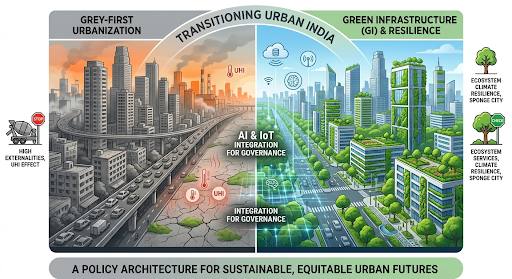
When empirical performance data are placed in systematic comparison, green infrastructure’s advantages are consistent across multiple environmental dimensions. The performance ranges in Table 1 reflect documented variability across climatic conditions, implementation quality, and maintenance standards. The stormwater retention figure of up to 90% represents optimally designed sponge-city systems in high-rainfall contexts; typical Indian urban GI installations currently achieve considerably lower rates given maintenance deficits and design limitations.
Table 1: Comparative Environmental Performance of Grey vs. Green Infrastructure
|
Performance Dimension |
Grey Infrastructure |
Green Infrastructure |
|
Stormwater Retention |
5–15% of rainfall absorbed |
Up to 90% retention in optimally designed systems |
|
Urban Heat Island Reduction |
Amplifies UHI by 2–4°C |
Reduces ambient temperature by 1–3°C |
|
Carbon Lifecycle |
Net emitter (~8% of global CO2) |
Net sequester over 15–20 year horizon |
|
Biodiversity Value |
Near zero; habitat destruction |
Supports urban biodiversity corridors |
|
20-Year Asset Value |
Depreciates; maintenance costs rise |
Appreciates; ecosystem services increase |
|
Groundwater Recharge |
Blocks recharge; depletes aquifers |
Actively recharges aquifers |
Note: Compiled from NEERI (2022), CEEW (2023), UNEP (2022), IPCC (2022). Performance ranges reflect documented variability across climatic zones, implementation conditions, and maintenance quality. Upper-bound estimates represent optimally designed and maintained systems; Indian municipal contexts typically fall toward the lower end of documented performance ranges.
4.2 AI and Technology Integration: Opportunities and Constraints
A new generation of AI-enabled planning and monitoring tools offers the prospect of making GI administratively legible, financially accountable, and technically optimised. However, realising this potential depends on addressing substantial implementation barriers specific to the Indian municipal context.
4.2.1 AI-Driven Urban Heat Island Prediction and Targeting
Machine learning algorithms trained on satellite thermal imagery and land surface temperature data can generate high-resolution UHI risk maps for Indian cities (NASA JPL, 2024). These tools can identify specific neighbourhoods where GI investment would deliver the greatest thermal relief per unit of expenditure, transforming GI planning from generalised aspiration to spatially precise intervention. Several Smart Cities Mission projects have begun piloting such approaches, though systematic national deployment remains limited.
4.2.2 IoT Sensor Networks for Sponge City Monitoring
IoT-enabled sensor networks offer a direct solution to GI’s maintenance deficit. Soil moisture sensors, water level gauges, and temperature probes embedded in GI installations can transmit real-time performance data to municipal dashboards, while AI analytics can detect early signs of system failure before performance deteriorates (Bhamare et al., 2019).
The implementation barriers, however, are considerable. Most Indian ULBs operate under significant constraints on capital budgets, technical staffing, and digital infrastructure. A 2022 assessment of municipal digital capacity across Tier-2 and Tier-3 Indian cities found that fewer than 30% of ULBs had the in-house technical capacity to manage real-time digital monitoring systems (Anand, 2025). Digital inequality—differential access to technical expertise between large metropolitan corporations and smaller municipalities—risks concentrating the benefits of AI-enabled GI governance in already better-resourced cities, widening rather than narrowing inter-city resilience gaps. Modular deployment strategies, shared state-level dashboards, and capacity-building partnerships with academic institutions can mitigate these constraints, but require deliberate policy design and funding that current national urban programmes have not adequately provided.
4.2.3 Data Analytics for Natural Capital Accounting
AI-assisted natural capital accounting tools, such as the Urban InVEST platform developed by the Stanford Natural Capital Project (Stanford Natural Capital Project, 2024), can generate ecosystem service valuations at the asset level. A constructed wetland can, in principle, be assigned a quantified annual service value—stormwater retention, carbon sequestration, recreational amenity—that can be entered into public accounts alongside its capital cost. The administrative precondition for this is standardised data collection protocols and trained personnel across ULBs, neither of which currently exists at scale in India.
4.3 The Governance Gap: Why the Evidence Has Not Been Enough
Despite compelling empirical evidence for GI’s effectiveness, it remains peripheral to mainstream Indian urban infrastructure planning. This is not primarily a knowledge problem; it is a governance problem. Four structural failures explain the persistent gap between evidence and policy practice.
Fragmented institutional mandates mean that no single institution holds an integrated GI mandate across Indian ULBs. Urban forestry falls under state forest departments; stormwater management under public works or engineering departments; parks under municipal horticulture wings. Bengaluru illustrates this starkly: the city lost over 79% of its lake area between 1973 and 2016, in part because lake management responsibilities were distributed across at least four separate agencies with no coordinating mandate (Ramachandra, 2022). With no single department accountable for cumulative outcomes, ecological loss proceeded incrementally without triggering a governance response.
Absent lifecycle cost accounting ensures that procurement consistently favours grey alternatives. A concrete stormwater channel wins competitive bids over a bioswale network because procurement frameworks do not account for reduced downstream flooding costs, lower long-run maintenance burdens, or groundwater recharge value. This is a structural accounting failure, not a technical judgment.
Maintenance deficits compound the problem. Vegetative GI systems fail rapidly without adequate horticultural budgets and maintenance personnel. Chennai’s post-2015 flood lake restoration programme saw several restored water bodies re-encroached upon or degraded within three years because no dedicated maintenance budget or enforcement mechanism was established (NDMA, 2019). This failure pattern reinforces institutional scepticism about GI’s reliability, sustaining grey investment preferences in a self-reinforcing cycle.
Capacity and knowledge gaps within engineering departments, trained in conventional civil infrastructure, mean that the ecological expertise required for GI design and management rarely exists in-house within Indian ULBs. This creates dependence on external consultants and fragmented project-by-project implementation without institutional learning or standard-setting.
DISCUSSION
The preceding analysis points to a consistent diagnosis: green infrastructure’s marginalisation in Indian urban planning is not a product of insufficient evidence but of structural governance conditions that systematically favour grey investment. Environmental economics demonstrates that grey infrastructure’s costs are systematically underestimated; urban political ecology explains why those cost misrepresentations are reproduced in institutional decisions; and the Capability Approach identifies who bears the welfare consequences. Addressing the underlying problem requires intervention at the institutional level, not only at the level of evidence or technology.
The AI and IoT tools discussed in Section 4.2 can alter part of the political economy of GI by making performance visible and value quantifiable. Maintenance budgets become more defensible when real-time sensor data demonstrates system performance. Cross-departmental coordination becomes more tractable when shared digital platforms provide common metrics. Private investment becomes more feasible when ecosystem service valuations are incorporated into public accounts.
However, these tools do not resolve the underlying political incentive structures that the urban political ecology literature identifies. AI-assisted UHI mapping does not create a constituency for GI investment; natural capital accounting does not eliminate the rent-extraction advantages of concentrated grey procurement. Technology functions as a governance enabler, not a governance substitute. This distinction is analytically important: overstating the transformative potential of AI and IoT risks reproducing the same optimism bias that has characterised Smart Cities Mission implementation, where digital infrastructure investment frequently outpaced the institutional capacity to use it.
The hybrid model—integrating GI components into the existing grey urban fabric rather than replacing it wholesale—remains the viable short-to-medium term strategy for Indian cities. This approach acknowledges the infrastructure debt already accumulated in grey systems, while creating conditions for GI to become the default in new development and major retrofitting programmes.
POLICY RECOMMENDATIONS
The following interventions are proposed based on the governance diagnosis developed in this paper.
Natural Capital Accounting Mandate: Require lifecycle ecosystem service valuations in public infrastructure procurement at the municipal level, making the long-run costs and benefits of grey and green options directly comparable in bid evaluation.
Hybrid Retrofitting Programme: Prioritise integrating GI components—permeable paving, bioswales, urban tree cover—into existing grey infrastructure networks, particularly in areas identified as high thermal-risk by AI-assisted UHI mapping.
Tax and Regulatory Incentives: Deploy targeted municipal mechanisms—property tax rebates, floor area ratio incentives—to encourage private-sector GI integration in commercial and residential developments.
Mandatory Cross-Departmental GI Coordination: Establish a designated GI coordination mandate within each ULB, with budgetary authority spanning urban forestry, stormwater management, and public works functions.
AI-Enabled GI Planning and Monitoring Platform: Develop a national GI performance platform integrating satellite UHI mapping, IoT sensor feeds, and ecosystem service accounting, with tiered access and technical support for smaller municipalities.
National Centre for Urban Green Infrastructure: Establish a dedicated institutional body to develop GI design standards, training programmes, and procurement frameworks adapted to Indian climatic and governance conditions.
CONCLUSION
India’s urban infrastructure choices over the next two decades will shape its climate trajectory, public health outcomes, and fiscal resilience for the longer term. The evidence reviewed in this paper demonstrates that grey infrastructure generates substantial environmental externalities whose costs fall disproportionately on lower-income urban populations, while GI consistently delivers superior long-term environmental and economic outcomes where adequately designed and maintained.
The governance barriers that have prevented GI from scaling are partially addressable through AI and IoT tools, but only if those tools are deployed within reformed institutional structures that assign clear GI mandates, require lifecycle cost accounting, and fund maintenance adequately. Technology cannot substitute for institutional reform; it can, however, make reform more tractable by making performance legible and costs transparent.
The policy architecture proposed here does not require dismantling existing institutions. It requires integrating AI planning tools, reforming procurement criteria, creating fiscal incentives, and building cross-departmental coordination capacity. The objective is to establish GI as a foundational infrastructure investment—which the evidence shows it to be—rather than as an environmental enhancement peripheral to mainstream urban development (IPCC, 2022).
REFERENCES
http://Ministry of Housing and Urban Affairs. (2021). AMRUT 2.0 Guidelines. Government of India.
http://Sen, A. (1999). Development as Freedom. Oxford University Press.