Authors:
Shivalaya Sharma , Krishnaa Bhagavathi , Dhriti Jha
Introduction
Healthcare is a fundamental component of human development and social welfare. However, ensuring affordable and equitable access to quality healthcare remains a major challenge in India due to high out-of-pocket expenditure, inadequate healthcare infrastructure, and unequal distribution of medical facilities, particularly in rural and economically weaker regions. The World Health Organization’s concept of Universal Health Coverage (UHC) emphasizes that all individuals should have access to quality healthcare services without suffering financial hardship (World Health Organization, 2023).
Against this backdrop, the central research question of this study is:
To what extent has Ayushman Bharat advanced Universal Health Coverage (UHC) in India, and what challenges limit its effectiveness and long-term sustainability?
To address these challenges, the Government of India introduced the National Health Policy (2017), which laid the foundation for strengthening healthcare accessibility and increasing public health expenditure. Building on this policy, Ayushman Bharat was launched in 2018 as India’s flagship healthcare initiative to move the country closer to Universal Health Coverage through a comprehensive, integrated, and need-based approach.
The programme consists of two key components: Health and Wellness Centres (HWCs), which strengthen primary healthcare services, and the Pradhan Mantri Jan Arogya Yojana (PM-JAY), which provides health insurance coverage of up to ₹5 lakh per family annually for secondary and tertiary hospitalization. As one of the world’s largest government-funded healthcare programmes, Ayushman Bharat contributes to India’s progress toward Sustainable Development Goal 3 (Government of India, 2017; National Health Authority, 2023). Available evidence also suggests that the scheme has helped reduce out-of-pocket healthcare expenditure, although financial burdens continue for many households.
To strengthen healthcare delivery further, the Ayushman Bharat Digital Mission (ABDM) was launched in 2021 to create a robust digital health ecosystem through ABHA IDs and portable electronic health records. While this initiative has improved continuity of care, it has also raised concerns regarding data privacy, registration inconsistencies, and regional disparities in access to digital healthcare services.
Despite its ambitious vision, Ayushman Bharat continues to face several implementation challenges, including regional inequalities, infrastructural gaps, limited public awareness, delayed reimbursements, and persistent out-of-pocket expenditure in certain cases. These challenges raise important questions about the programme’s effectiveness in achieving equitable healthcare access and its long-term sustainability (NITI Aayog, 2021).
This study therefore evaluates the effectiveness of Ayushman Bharat in advancing Universal Health Coverage in India by examining its objectives, implementation, achievements, and challenges. It also analyses the programme’s policy implications and proposes recommendations to enhance its efficiency, inclusiveness, and long-term sustainability. The paper is organized into sections covering the study objectives, literature review, research methodology, analysis, findings, and policy recommendations.
Objectives of the Study
The primary objective of this study is to critically evaluate the effectiveness of Ayushman Bharat in progressing toward Universal Health Coverage (UHC) in India. UHC is defined by the World Health Organization (WHO) as ensuring access to essential health services of sufficient quality without financial hardship. In this context, the study moves beyond a descriptive understanding of the scheme and instead examines whether Ayushman Bharat has been able to operationalise the core dimensions of UHC—accessibility, affordability, and quality—in practice.
A key objective is to assess the extent to which Ayushman Bharat has improved equitable access to healthcare services, particularly for economically vulnerable and marginalised populations.
While the scheme claims coverage of nearly 55 crore beneficiaries through the Pradhan Mantri Jan Arogya Yojana (PM-JAY), this study will evaluate whether increased insurance coverage has translated into actual utilisation of healthcare services, especially in underserved and rural regions where structural barriers to access persist.
Another objective is to examine the scheme’s effectiveness in reducing financial risk protection, which is a central pillar of UHC. Drawing on government data and reports from institutions such as the National Health Authority (NHA) and WHO, the study will analyse whether PM-JAY has meaningfully reduced out-of-pocket expenditure and prevented catastrophic health spending, or whether gaps in coverage continue to shift costs onto households.
The study also aims to evaluate the quality dimension of healthcare delivery under Ayushman Bharat. This includes assessing whether increased utilisation under the scheme is accompanied by adequate healthcare standards, or whether systemic constraints—such as infrastructure limitations, uneven hospital empanelment, and administrative delays—affect service quality and outcomes.
Finally, the study will identify structural and implementation-level constraints that limit the scheme’s ability to fully achieve UHC. These include disparities in state-level implementation capacity, awareness gaps among beneficiaries, and dependence on private sector participation, all of which may influence equity and efficiency in healthcare delivery.
Analytical Insights
This study treats Ayushman Bharat not merely as a welfare expansion programme, but as a policy instrument whose effectiveness must be judged through measurable outcomes in access, affordability, and quality. The objectives therefore shift the focus from coverage statistics to realworld health system performance, highlighting whether the scheme is structurally capable of delivering Universal Health Coverage in practice rather than in design.
Literature Review
Ayushman Bharat is widely presented in the literature as India’s flagship attempt to move toward universal health coverage (UHC) by combining primary care expansion through Health and Wellness Centres and financial protection through Pradhan Mantri Jan Arogya Yojana (PM-JAY). The WHO defines UHC as ensuring that all people can access needed health services without financial hardship, and this definition remains the main benchmark for evaluating the scheme (World Health Organization [WHO], 2010). This definition provides the conceptual foundation for evaluating whether Ayushman Bharat has succeeded in improving healthcare accessibility, affordability, and quality. Accordingly, this study asks: To what extent has Ayushman Bharat contributed to achieving Universal Health Coverage in India?
Existing literature, such as Lahariya (2018), argues that Ayushman Bharat marks a major shift in Indian health policy because it simultaneously addresses two longstanding weaknesses in Indian healthcare—limited access to essential services and catastrophic health expenditure. However, the literature consistently suggests that the scheme’s impact depends less on policy design alone and more on implementation capacity, governance, and the strength of public health infrastructure.
A recurring theme is the gap between ambition and system readiness. Angell et al. (2019) argue that although AB-PMJAY is a bold reform, India’s low public health spending, uneven workforce distribution, and weak stewardship mechanisms limit its ability to deliver true UHC. They emphasize that universal coverage cannot be achieved through insurance alone; it also requires strong public-sector leadership, regulation of providers, and functioning referral systems. This is especially important because Ayushman Bharat relies heavily on purchasing care from a mixed public-private system, yet quality and access still vary sharply across states. Similarly, Kamath and Brand (2023) caution that excessive emphasis on hospital insurance may unintentionally divert attention from strengthening primary healthcare, despite primary care forming the foundation of effective health systems.
Affordability constitutes the second core dimension of UHC. Although PM-JAY substantially reduces the cost of inpatient hospitalisation for eligible households, existing research indicates that financial protection remains incomplete. NITI Aayog (2021) highlights that a substantial “missing middle” remains outside both public and private insurance coverage. Likewise, the National Family Health Survey-5 (IIPS & ICF, 2021) shows that out-of-pocket expenditure continues to account for a significant share of healthcare spending despite gradual improvements. Government reports demonstrate the rapid expansion of PM-JAY through increasing Ayushman cards, hospitalisations, and claims (National Health Authority, 2023), suggesting greater financial protection for covered beneficiaries. However, these indicators primarily reflect inpatient care and do not adequately address outpatient consultations, medicines, diagnostics, or transport costs, which continue to impose financial burdens on many households (Ministry of Finance, 2023). Consequently, existing evidence suggests that increased insurance coverage does not necessarily eliminate financial hardship.
Quality and equity are the next dimension we look into. Donabedian’s (1988) Structure–Process–Outcome framework provides a useful theoretical basis for assessing healthcare quality by examining whether health systems possess adequate infrastructure, deliver care according to appropriate clinical processes, and ultimately whether patient outcomes meet quality standards. This framework complements the WHO conception of UHC by recognising that expanding coverage alone is insufficient if healthcare services remain ineffective or inequitable (Donabedian, 1988). Kamath and Brand (2023) identify persistent concerns regarding fraud, uneven access, and limited evidence linking increased utilisation to improved health outcomes. This matters because quality is a core dimension of UHC, not just coverage volume. Similarly, India’s UHC Service Coverage Index remains below the global average (WHO, 2023), indicating that improvements in coverage have not yet translated into uniformly high-quality healthcare delivery. These studies suggest that healthcare quality remains a critical but underexamined component of Ayushman Bharat’s overall effectiveness.
Overall, the literature suggests that Ayushman Bharat is a transformative but incomplete step toward UHC in India. While substantial evidence exists regarding programme expansion, insurance coverage, and financial protection, much of the existing scholarship evaluates these dimensions in isolation. Fewer studies assess Ayushman Bharat holistically through the broader objectives of Universal Health Coverage by simultaneously examining accessibility, affordability, and quality within a single analytical framework. Addressing this gap is important because evaluating only one dimension of UHC may obscure trade-offs between healthcare access, financial protection, and service quality. AB-PMJAY has indeed expanded coverage and created a major platform for financial protection, but it has not fully solved structural problems of low public expenditure, uneven access, and variable quality (Angell et al., 2019; Kamath & Brand, 2023). By synthesising evidence across the three dimensions discussed above, the study provides a comprehensive policy assessment of Ayushman Bharat’s contribution toward achieving Universal Health Coverage in India rather than evaluating any single programme outcome.
Research Methodology
This study employs a mixed-methods policy analysis to assess whether Ayushman Bharat which comprises the Pradhan Mantri Jan Arogya Yojana (PM-JAY) and Health and Wellness Centres (HWCs) has advanced Universal Health Coverage (UHC) in India. UHC is examined through three interrelated dimensions: accessibility, affordability and quality, as conceptualised in the World Health Organization framework. The methodological design integrates the quantitative secondary data analysis with qualitative policy review in order to capture both measurable outcomes and the institutional context shaping programme implementation.
The use of secondary data as the principal empirical basis is justified by the national scale and public character of Ayushman Bharat. Given that the programme operates across diverse administrative settings and over a broad temporal span, secondary sources offer the most appropriate means of examining aggregate trends, regional variation, and system-level patterns. Official statistics, survey datasets, programme documents, and published evaluation reports provide a substantively relevant evidence base for analysing changes in access, financial protection, and service delivery. This approach is particularly suitable for policy research, where the objective is not only to describe implementation but also to evaluate patterns observable at population level.
The quantitative component draws on officially published secondary datasets to examine trends in utilisation, coverage, out-of-pocket expenditure, and other indicators associated with UHC. The qualitative component undertakes a structured reading of policy documents, government reports, and scholarly literature to assess implementation design, institutional capacity and documented barriers to effective delivery. The combination of these methods facilitates triangulation and enables a more balanced assessment of the relationship between policy design and observed outcomes.
At the same time, the study recognises the limitations inherent in secondary data analysis. Administrative records may be affected by inconsistent reporting, variation in data quality across states, underreporting and changes in measurement over time. Survey-based sources may be subject to recall bias, sampling constraints and temporal lags. In addition, the available indicators often capture programme activity or coverage rather than direct health outcomes, which limits the extent to which findings can be attributed solely to Ayushman Bharat. Any observed improvement in access or financial protection may also reflect broader structural changes, concurrent policy measures or state-specific interventions rather than the scheme alone.
Accordingly, the study adopts a cautious interpretive approach and avoids claims of direct causality. Instead, it assesses whether the available evidence indicates meaningful associations between Ayushman Bharat and progress towards UHC. This framework allows for a more rigorous and academically defensible analysis by acknowledging confounding influences, inter-state heterogeneity and the structural conditions under which policy effects are realised.
Data Sources
Data is sourced from credible, authenticated repositories to ensure validity and reliability:
Table 1
Data Sources and Relevance to UHC.
| Source | Relevance to UHC |
| National Health Authority (NHA) Annua
Report 2022-23 |
PM-JAY enrolment,claims and beneficiary data |
| NFHS-5(IIPS and ICF,2021) | OOPE, maternal and child health indicators |
| WHO Global Health Observatory(2023) | UHC Service Coverage Index-India benchmark |
| Economic Survey of India2022-23(MoF) | Health financing and fiscal allocation trends |
| Lancet/IJMR peer-reviewed studies | Independent evaluations of AB impact and quality gaps |
Analytical Framework
The study applies the WHO UHC Framework (2010) as its primary evaluative lens, supplemented by Donabedian’s (1988) Structure–Process–Outcome model to systematically assess healthcare quality at structural and delivery levels. Key analytical parameters include:
(a) reduction in out-of-pocket expenditure (OOPE) as a measurable proxy for affordability — India’s OOPE stood at approximately 62% of total health expenditure per NFHS-5, among the highest globally; (b) beneficiary enrolment, claims settlement rates, and hospital empanelment density for accessibility; and (c) patient satisfaction scores and treatment outcome data for quality assessment. This triangulated, multi-indicator framework guards against single-metric bias and aligns with internationally recognised health policy evaluation standards.
Scope and Limitations
The study focuses on the period 2018–2023, covering five years post-launch of PM-JAY, thereby capturing both early implementation challenges and medium-term outcomes. Geographic scope is national, with state-level disaggregation undertaken where data permits, to reveal inter-state disparities in UHC progress — particularly between high-performing states such as Kerala and Tamil Nadu versus lagging states in northern and central India. Key limitations include: reliance on self-reported NFHS data susceptible to recall bias; potential underreporting of OOPE in government surveys; and the methodological challenge of isolating PM-JAY’s causal impact from concurrent health initiatives such as the Ayushman Bharat Digital Mission (ABDM). These constraints are explicitly acknowledged and mitigated through systematic cross-source triangulation and sensitivity analysis where applicable.
Analytical Insights
The mixed-methods design adopted in this study reveals a critical tension at the heart of Ayushman Bharat’s UHC ambition: while the programme demonstrates measurable gains in financial access — with over 500 million beneficiaries enrolled and more than 28.6 million hospitalisations authorised (NHA, 2023) , while documented quality disparities between public and empanelled private hospitals indicate that enrolment figures alone are insufficient evidence of genuine UHC attainment. Furthermore, India’s UHC Service Coverage Index of 61 (WHO, 2023) — below the global average of 68 — signals systemic gaps that extend beyond insurance coverage to primary healthcare infrastructure and workforce adequacy. This methodology, by linking data simultaneously across accessibility, affordability, and quality dimensions, is uniquely positioned to expose these structural deficiencies and generate evidence-based recommendations for meaningful policy reform.
Overview
Universal Health Coverage (UHC), as defined by the World Health Organization (WHO), denotes a state in which every individual can access the full spectrum of quality health services — from health promotion and prevention through to treatment, rehabilitation, and palliative care — without suffering financial hardship. Achieving UHC demands simultaneous progress across three interconnected dimensions: accessibility (the ability to reach care), affordability
(protection from catastrophic health expenditure), and quality (the efficacy and safety of services received). In India’s context, these dimensions have historically been compromised by fragmented public infrastructure, high out-of-pocket expenditure (OOPE), and stark urban-rural disparities.
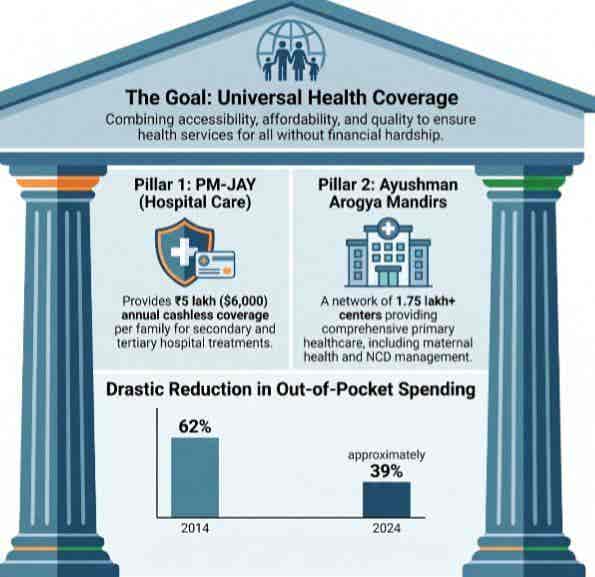
Launched on 23 September 2018, Ayushman Bharat (AB) represents the Indian Government’s most ambitious structural response to this challenge. Framed within the National Health Policy 2017 and aligned with the Sustainable Development Goals (SDGs), the scheme comprises two operational pillars: (i) Pradhan Mantri Jan Arogya Yojana (PM-JAY), the world’s largest government-funded health assurance scheme, and (ii) Ayushman Arogya Mandirs (AAMs), formerly known as Health and Wellness Centres (HWCs), designed to strengthen primary healthcare delivery at the grassroots.
Architecture of the Scheme
PM-JAY — Financial Risk Protection: PM-JAY provides annual cashless health coverage of
Rs. 5 lakh per family for secondary and tertiary care hospitalisation, targeting approximately
12 crore households (roughly 55 crore individuals) drawn from the bottom 40 percent of India’s population. Eligibility is determined through deprivation and occupational criteria derived from the Socio-Economic Caste Census (SECC) 2011. In a significant policy expansion, the Union Cabinet approved in September 2024 the extension of PM-JAY benefits to all citizens aged 70 years and above — irrespective of income — covering approximately 6 crore senior citizens through the newly introduced Vay Vandana Card.
Ayushman Arogya Mandirs — Primary Care Backbone: The second pillar involves the transformation of existing sub-centres and primary health centres into AAMs, which are designed to deliver comprehensive primary healthcare services including noncommunicable disease (NCD) management, maternal and child health, mental health, and palliative care. As of 2024, over 1.75 lakh functional AAMs had been established across the country, with a particular emphasis on rural and underserved communities. This component critically addresses the long-standing neglect of primary care in prior health insurance models.
Key Performance Indicators (as of early 2025)
Table 2
Key Performance Indicators of PM-JAY
| Metric | Figure | Source |
| Beneficiary families targeted | 12 crore (approx.55crore individuals) | NHA/AB-PMJAY |
| Annual coverage per family | Rs. 5 lakh (approx.. USD 5,985) | NHA,2024 |
| Hospital admissions facilitated | 6.8 crore (as of Jan 2025) | Standing Committee, 2025 |
| Ayushman cards issued | 36.4 crore | Standing Committee, 2025 |
| Empanelled Hospitals | 32,320 | NHA, Oct 2025 |
| Savings in OOPE | Over Rs. 1.25 lakh crore | Govt. estimates, 2024 |
| OOPE as %of health spending | Declined from ~62%(2014) to ~39%(2024) | National Health Accounts |
| Functional AAMs (HWCs) | Over 1.75 lakh | MoHFW, 2024 |
Critical Analysis against UHC Dimensions:
1. Accessibility
AB-PMJAY has made commendable strides in expanding formal healthcare access. As of January 2025, over 36.4 crore Ayushman cards had been issued, resulting in 6.8 crore hospital admissions — a scale unmatched by any prior public health insurance programme in India. The scheme’s portability feature, enabling treatment across state boundaries, has facilitated interstate patient mobility; data shows states like Chandigarh (19%), Uttar Pradesh (13%), and Gujarat (11%) as top in-migration destinations for treatment. The empanelment of 32,320 hospitals — spanning both public and private facilities — has nominally extended the healthcare network. However, the scheme’s accessibility gains are qualified by significant structural gaps. The CAG of India and the 2023 Parliamentary Standing Committee on Health have both noted that empanelled hospitals are, on average, small (average bed strength of 48), and suffer from inadequate infrastructure, equipment, and specialist staffing. Most healthcare professionals remain concentrated in urban private sectors, perpetuating rural shortages. Furthermore, PM-JAY’s exclusive focus on secondary and tertiary hospitalisation excludes outpatient and preventive care, which constitutes a large share of India’s actual disease burden and OOPE. This creates a structural blind spot in achieving meaningful access to care.
2. Affordability
Perhaps the most tangible achievement of Ayushman Bharat has been in improving financial risk protection. India’s OOPE as a share of total health expenditure declined substantially — from over 62 percent in 2014 to approximately 39.4 percent in 2024, according to National Health Accounts data. The scheme is estimated to have saved beneficiaries over Rs. 1.25 lakh crore in out-of-pocket costs. A 2023 Karnataka-based clinical study (Kamath et al., 2024) found that ABPMJAY patients incurred zero OOPE across all four major cardiac surgeries examined, compared to significant residual expenditure among privately insured and uninsured patients — demonstrating meaningful financial risk protection at the individual level. Despite this, the scheme’s affordability architecture has critical vulnerabilities. Annual fund allocations averaging Rs. 6,000–7,000 crore between 2018 and 2023 have been deemed insufficient by the Standing Committee to cover all 33 states and UTs comprehensively. High-cost and chronic treatments exceeding Rs. 5 lakh remain excluded, leaving catastrophic expenditure risks intact for patients with complex conditions. The so-called ‘missing middle’ — households not poor enough to qualify for PM-JAY subsidies yet not affluent enough to afford private insurance — remains entirely unprotected. According to NITI Aayog, approximately 400 million Indians remain without any health insurance coverage.
3. Quality of Care
Quality remains the most contested and under-evaluated dimension of Ayushman Bharat’s UHC performance. The scheme’s emphasis on expanding beneficiary numbers and hospital empanelment has not been matched by adequate quality assurance mechanisms. The CAG and Standing Committee have raised concerns about the limited diagnostic and surgical capacity of many empanelled facilities. Treatment trends — where haemodialysis (14%) and fever management (4%) dominate claims since 2018 — suggest that the scheme is being utilised predominantly for routine or chronic-care management rather than high-complexity procedures, raising questions about whether it is genuinely augmenting healthcare quality or subsidising care that patients would have sought regardless. The digital ecosystem, while progressing, also has gaps: although 6 in 10 citizens have an Ayushman Bharat Health Account (ABHA) number and 50 crore health records are linked, only 38 percent of health facilities and 26 percent of health personnel are registered on the integrated system — limiting the potential for data-driven quality monitoring.
Analytical Insights
Taken together, the evidence suggests that Ayushman Bharat represents a structurally significant, but functionally incomplete, step toward Universal Health Coverage. The scheme has demonstrably expanded formal insurance coverage among India’s poorest quintiles, achieved measurable reductions in OOPE, and brought primary care infrastructure closer to underserved populations. However, its design-level limitations — an exclusive focus on hospitalisation-based secondary and tertiary care, insufficient funding, the unaddressed ‘missing middle’, and weak quality assurance in empanelled facilities — collectively prevent it from fulfilling the WHO’s comprehensive UHC mandate. The scheme achieves breadth of reach at the cost of depth of protection. Unless these structural gaps are addressed through increased public health expenditure (the NHP 2017 target of 2.5% of GDP remains unmet), integration of outpatient and preventive care, and robust quality monitoring, Ayushman Bharat risks being a partial advancement towards UHC rather than its realisation.
Core Analysis (UHC Framework)
Accessibility
Ayushman Bharat improves access to healthcare by reducing the financial burden on poor and vulnerable households, which helps move India closer to Universal Health Coverage (UHC). Under Pradhan Mantri Jan Arogya Yojana (PM-JAY), eligible families can get hospital care up to ₹5,00,000 per year without paying at the time of treatment. Ayushman Arogya Mandirs also strengthen basic health services at the village and block level, so people do not have to travel far for routine care (National Health Authority, 2024).
The scheme covers families based on official socio-economic data and removes limits on family size, age and gender. It also uses teleconsultation and mobile medical units to reach people in remote and underserved areas, making it easier for them to get care (Press Information Bureau, 2025). In UHC terms, this means more people can get needed services without facing high costs.
Studies show that Ayushman Bharat has improved access and financial protection for many beneficiaries. But use of the scheme is still uneven because of low awareness, weak health infrastructure and a limited number of empanelled hospitals in some regions (National Health Authority, 2024; Press Information Bureau, 2025). Many eligible households remain outside the system because their data is outdated and rural and tribal areas often lack doctors, labs and proper referral links.
Digital tools such as the Ayushman Bharat Digital Mission (ABDM) are also helping to improve access. ABDM creates a common digital system for health records, listed facilities and health professionals, which helps speed up registration and reduces delays when patients visit hospitals (Ministry of Electronics and Information Technology, 2024). This makes the health system work more smoothly and supports better continuity of care.
Overall, Ayushman Bharat has strengthened accessibility by lowering cost barriers and expanding coverage, but its contribution to UHC is still limited by weak local health systems and uneven implementation (National Health Authority, 2024).
Affordability
Affordability in healthcare refers to the ability of individuals and households to access necessary health services without facing financial hardship, forming a core pillar of Universal Health Coverage (UHC) alongside availability and quality. In India, where weak public healthcare infrastructure compels a large section of the population to depend on expensive private healthcare, high out-of-pocket expenditure (OOPE) continues to be a major barrier to equitable healthcare access. To address this challenge, the Government of India launched Ayushman Bharat–Pradhan Mantri Jan Arogya Yojana (PM-JAY) in 2018 as a financial risk protection mechanism for economically vulnerable populations.
The scheme provides health insurance coverage of ₹5 lakh per family per year for secondary and tertiary hospitalization to nearly 50 crore beneficiaries identified through SECC 2011 data, without requiring any premium contribution from beneficiaries. PM-JAY covers hospitalization expenses, diagnostics, medicines, and pre- and post-hospitalization care across empanelled public and private hospitals, while Ayushman Bharat Health and Wellness Centres (HWCs) strengthen affordability further by delivering comprehensive primary healthcare and reducing dependence on costly tertiary care. As of 2024, PM-JAY has facilitated more than 6 crore hospital admissions worth over ₹80,000 crore, and studies by NITI Aayog and independent researchers indicate a reduction in catastrophic health expenditure among enrolled households, particularly in states such as Chhattisgarh, Jharkhand, and Andhra Pradesh.
The National Health Accounts (2021–22) also show a decline in OOPE as a share of total health expenditure from 62.6% to around 47%, partly attributable to schemes like PM-JAY.
Its cashless and paperless framework has improved access to private healthcare for Below Poverty Line (BPL) families that were previously excluded due to financial constraints. However, several limitations persist, including inclusion-exclusion errors, low awareness among beneficiaries, uneven empanelment quality, informal top-up charges by private hospitals, fraud in claims processing, and supplier-induced demand. Moreover, PM-JAY largely excludes outpatient care, medicines, and diagnostics—the major contributors to OOPE in India—while women and marginalized groups continue to face barriers due to low digital literacy and limited accessibility. The ₹5 lakh coverage ceiling is also often inadequate for complex procedures in metropolitan hospitals, pushing families back into financial distress.
Therefore, although PM-JAY represents a landmark intervention in reducing financial catastrophe associated with healthcare, its effectiveness in ensuring true affordability under UHC depends on broader structural reforms, including strengthening public health infrastructure, expanding outpatient coverage, improving governance, and investing in primary healthcare through HWCs, so that the scheme evolves into a genuinely equitable and sustainable healthcare model rather than merely subsidizing private healthcare providers.
Quality
Within Ayushman Bharat, the Pradhan Mantri Jan Arogya Yojana (PM-JAY) component is closely linked to the quality dimension of Universal Health Coverage (UHC), as it finances secondary and tertiary hospital care through empanelled hospitals, while Health and Wellness Centres (HWCs) focus on preventive and primary healthcare. To assess whether the scheme is improving healthcare quality, Donabedian’s structure–process–outcome framework is particularly useful because it evaluates healthcare infrastructure, the delivery of care, and the resulting patient outcomes. This framework suggests that PM-JAY has expanded access and formalised healthcare delivery, but evidence of consistent improvements in safe, effective, and equitable care remains uneven.
From a structural perspective, PM-JAY has significantly expanded hospital empanelment and administrative coverage, creating a wider network of providers for insured treatment. The scheme uses package rates, digital claims systems, and public-private partnerships to improve access to hospital services. However, structural quality still differs widely across states and facilities due to uneven infrastructure, shortages of trained medical staff, and varying regulatory capacities. As a result, although access to hospital care has increased, the ability of healthcare institutions to consistently provide reliable and high-quality treatment remains uncertain.
At the process level, PM-JAY has improved cashless treatment authorisation and formalised service delivery for beneficiaries, thereby reducing financial barriers to care. Nevertheless, concerns remain regarding the appropriateness and effectiveness of treatment. Fixed package rates and private-sector participation may encourage supplier-induced demand, unnecessary procedures, or selective treatment behaviour, especially where monitoring systems are weak. This highlights that expanded healthcare utilisation alone does not ensure quality; effective care also depends on timely treatment, clinical consistency, and patient safety. India’s relatively low UHC service coverage index further indicates that expanded insurance coverage has not automatically translated into uniformly improved service quality.
Outcome evidence under PM-JAY also remains limited. Although the scheme has reduced upfront hospital expenditure for many beneficiaries and increased access to institutional care, measurable improvements in mortality, readmission rates, continuity of care, and patient satisfaction are not yet clearly established. Overall, Ayushman Bharat has strengthened healthcare access in India, but without stronger regulation, outcome monitoring, and publicsector quality assurance, it risks achieving numerical expansion without fully ensuring effective and equitable healthcare outcomes.
Equity and Inclusion
Equity and inclusion are fundamental principles of universal health coverage (UHC). Equity refers to fairness in access to healthcare services regardless of income, gender, caste, disability, or geographic location, whereas inclusion emphasizes the active participation and coverage of marginalized and vulnerable populations. In the context of Ayushman Bharat, these principles assess whether the scheme effectively reduces disparities in healthcare access and financial protection.
Ayushman Bharat promotes equity primarily through PM-JAY, which provides cashless health insurance coverage of ₹5,00,000 per family per year to poor and vulnerable households identified through the Socio-Economic Caste Census (SECC) 2011 database (National Health Authority, 2024). The scheme imposes no restrictions on family size, age, or gender, thereby enhancing inclusiveness.
Empirical evidence indicates that Ayushman Bharat has improved financial protection and increased hospitalization among economically disadvantaged populations. Women, Scheduled Castes, Scheduled Tribes, and rural households have accounted for a substantial share of beneficiaries, while portability provisions have facilitated access for migrant workers.
Despite these achievements, several limitations remain. The reliance on outdated SECC 2011 data excludes many newly poor households. Low awareness, uneven distribution of empanelled hospitals, and social barriers such as digital illiteracy continue to restrict effective access. Furthermore, PM-JAY primarily covers hospitalization and offers limited protection against outpatient and pharmaceutical expenses.
Overall, Ayushman Bharat has strengthened equity and inclusion by reducing financial barriers for vulnerable populations. However, implementation gaps and structural inequalities restrict its effectiveness. Updating eligibility data, expanding healthcare infrastructure, and improving beneficiary awareness are necessary to advance the goal of universal and equitable healthcare coverage.
Achievements of the Scheme
The Ayushman Bharat Programme, which was launched in 2018, ensures changes in policy implementation which will bring India closer to its pursuit of UHC. Through its two interlinked components of health (Ayushman Arogya Mandirs) for primary health care and wealth (PMJAY Pradhan Mantri Jan Arogya Yojana) for secondary and tertiary healthcare – the programme targets the core dimensions of the UHC – population coverage, service coverage and financial risk protection (Ministry of Health and Family Welfare, 2024).
According to 2024 official data records, 7.79 crore hospitalisations had been authorised and Rs 1,07,125 crores of financial coverage, the programme marks an important accomplishment of achieving the targets.
Expansion of programme to achieve UHC
PM-JAY initially targeted 10.74 crore families from the bottom 40% of the society who are underprivileged (Ministry of Health and Family Welfare, 2024). As of 2026 over 43.52 crore
Ayushman cards have been issued in the country (Update on Progress of AB-PMJAY and ABDM, n.d.-b) . This also includes 1.14 crore Ayushman Van Vandana cards for the senior citizens who are aged 70 years or above.This indicates that the scheme has gone beyond the original target mark as each family has multiple card holders. Apart from this the incentives linked to National Accreditation Board for Hospitals and Healthcare Providers (NABH) or equivalent certifications encourage higher quality of health care – additional payments are provided for certified facilities.
Increasing Healthcare Accessibility
With growing networks and infrastructure, accessibility of healthcare has become easier for the people. As of December 2025 – 1,82,944 Ayushman Arogya Mandirs have been operationalized, providing comprehensive primary healthcare services encompassing preventive, promotive and basic curative care. Under PM-JAY, 36,229 hospitals are empanelled, of which 19,483 are public and 16,746 are private, which indicates a balance of government and private sector participation. This network allows the beneficiaries to access secondary and tertiary care in rural-public hospitals and urban-private hospitals which improves equity and reduces travel problems.
Strong Digital Health Foundation (ABHA)
The Ayushman Bharat Digital Mission was launched in September 2021, which was created to support the development of an integrated and a citizen centric national digital health ecosystem.
As of 11th March, 2026 more than 86 Crore Ayushman Bharat Health Accounts have been created and more than 90 crore Health records are linked to patients ABHA. This indicated a strong step towards digitalisation and sustainable practice of saving paper. Apart from that this ensures that all records of the patient are organised and readily available if required.
Analytical Insights
The Ayushman Bharat Programme has achieved the ethos of the policy which states that no one should be denied treatment because they cannot pay. By linking so many people to empanelled hospitals and giving them cashless coverage of the costs, it has turned healthcare from a lastminute crisis into something people can plan for. The scale of cards, admissions, and linked digital records shows that the system is now functioning at a mass level.
Challenges and Gaps
Coverage and Awareness Constraints
Incomplete and uneven beneficiary coverage limits the extent to which findings can be generalised to all eligible households. The performance audit reports that, as of November 2022, 7.87 crore households were registered under PMJAY, representing about 73% of the original target of 10.74 crore families, and only 2.08 crore households were actually identified from the SECC‑2011 database as envisaged in the guidelines
(CAG, 2023). Survey evidence from Bihar, Haryana and Tamil Nadu shows that only 26.9% of SECC‑eligible households were even aware of PMJAY; awareness was particularly low in Bihar (9.84%) and Haryana (12.41%), and substantially higher in Tamil Nadu (58.6%) (Dash et al., n.d.). Among those who were aware, completion of the e‑card process was also highly variable, at 14.4% in Bihar and 65.8% in Haryana, compared with 82.6% in Tamil Nadu (Dash et al., n.d.). These gaps mean that effective coverage is much lower than formal eligibility, and the study may understate unmet need among eligible but uninformed or unregistered groups.
Service Availability and Quality Gaps
Second, limitations in the availability and quality of empanelled health‑care providers constrain the scheme’s contribution to effective service coverage. The CAG audit documents large state‑level disparities in empanelled hospital density, ranging from 1.8 empanelled health‑care providers per one lakh beneficiaries in Bihar and around 3–5 in Assam, Maharashtra and Uttar Pradesh, to 26.6 in Goa (CAG, 2023). In several states, empanelment occurred without physical verification, and some hospitals did not fully comply with minimum requirements on infrastructure, fire safety, biomedical waste management and key specialties. Because the present analysis primarily uses enrolment and utilisation indicators, it cannot fully capture these geographic and quality constraints and may overestimate “effective” access to appropriate care.
Financial Protection and Governance Issues
Third, the evidence on financial protection is limited by persistent out‑of‑pocket payments and governance weaknesses within PMJAY implementation. The audit records instances in Himachal Pradesh, Jammu and Kashmir and Meghalaya where beneficiaries were still charged for treatment in empanelled hospitals, contrary to the scheme’s cashless design (CAG, 2023). In the three‑state survey, of 108 households that reported needing hospitalisation, only 33 used PMJAY, while 75 (around 10.25% of all aware households) needed care but did not use the scheme, mainly due to lack of knowledge about how and where to access services. Additionally, 40.23 lakh claims worth ₹6,052.47 crore were under process, and 39.57 lakh pre‑authorisations exceeded the stipulated 12‑hour turnaround, alongside excess and inadmissible payments and weak recovery of penalties. These system‑level issues are difficult to incorporate fully into outcome measures and likely produce an optimistic picture of financial risk protection.
Digital Health and Data Constraints
Finally, the rapid rollout of the Ayushman Bharat Digital Mission (ABDM) and ABHA‑linked records introduces further limitations related to data quality, privacy and trust. ABDM aims to create an interoperable National Digital Health Ecosystem under the Digital Personal Data Protection Act, 2023 and the Health Data Management Policy, but early analyses highlight risks of formal rather than meaningful consent, possible re‑identification of “de‑identified” data, vulnerabilities linked to Aadhaar and mobile‑based authentication, and reported incidents of fake Ayushman cards and fraudulent claims (Mukherjee, 2025). These factors may distort administrative data, disproportionately discourage participation among vulnerable groups and restrict access to reliable, privacy‑secure longitudinal data for evaluation. Consequently, the long‑term effects of Ayushman Bharat on equitable utilisation, financial protection and public trust in the health system may not be fully reflected in the present assessment.
Policy Recommendations
To bridge existing gaps and ensure that Ayushman Bharat effectively achieves its goal of Universal Health Coverage (UHC), the following policy interventions are recommended:
Strengthening Financial Risk Protection and Benefit Packages
- Increase Public Health Funding: The government must fulfill its commitment to raise health expenditure to 5% of GDP by 2025 to reduce reliance on private providers.
- Expand Benefit Coverage: To prevent “medical poverty,” packages should be expanded to include outpatient (OPD) care, pre- and post-hospitalization costs, and oral healthcare, which currently represent significant OOPE blind spots.
- Integrate Indirect Costs: Essential non-medical costs, such as transport allowances, should be integrated into the PMJAY.
Enhancing Operational Efficiency and Quality Control
- Adopt Strategic Purchasing: institutionalize dynamic cost surveillance via the Ayushman Bharat Digital Mission (ABDM) to ensure reimbursement rates reflect realtime hospital costs.
- Centralize Procurement: Replicate the Tamil Nadu model (TNMSC) for bulk procurement of generic drugs and diagnostics to eliminate stock-outs that force patients to pay out-of-pocket.
- Stricter Private Sector Regulation: Strictly enforce the Clinical Establishments Act to standardize costs.
Promoting Equity and Health Literacy
- Gender-Targeted Strategies: Move beyond gender-neutral subsidies toward direct interventions that address male-biased household resource allocation, particularly for elderly women.
- Localized Awareness Campaigns: Implement region-specific Information, Education, and Communication (IEC) initiatives using radio and village leaders to improve awareness of empanelled hospitals and entitlements
- Infrastructure and Navigation Support: Prioritize last-mile connectivity and road infrastructure in conflict-affected or mountainous regions like Jammu and Kashmir while providing frontline assistance to help beneficiaries navigate the hospital system.
Conclusion
The evaluation of Ayushman Bharat (AB-PMJAY) reveals a program that has made monumental strides in expanding financial risk protection while facing significant structural and social hurdles. On the success side, the scheme has demonstrated an ability to reduce Out-of-Pocket Expenditure (OOPE) for high-cost tertiary procedures, such as heart surgeries and obstetrics/gynaecology (OBG) surgeries, effectively preventing medical poverty for millions of vulnerable households.
This research paper examined the effectiveness of Ayushman Bharat in achieving UHC in India by analyzing its impact on financial protection, healthcare accessibility, service delivery, and inclusiveness.
The study found that Ayushman Bharat has significantly reduced the financial burden of hospitalization for economically weaker sections by providing cashless treatment coverage. It has improved access to secondary and tertiary healthcare facilities, particularly for lowincome households who previously struggled to afford medical treatment. The expansion of Health and Wellness Centres has also strengthened primary healthcare by focusing on preventive, promotive, and comprehensive healthcare services.
However, despite these achievements, several challenges continue to hinder the full realization of Universal Health Coverage. Regional disparities in healthcare infrastructure, shortage of trained medical personnel, unequal participation of private hospitals, digital illiteracy, and lack of awareness among beneficiaries remain major obstacles. In many rural and remote areas, healthcare accessibility is still limited. Furthermore, concerns regarding fraudulent claims, overburdened public hospitals, and variations in quality of care highlight the need for stronger governance and monitoring systems.
Implications and Significance
The findings of this study demonstrate that Ayushman Bharat represents a transformative step toward equitable healthcare in India. Its emphasis on financial risk protection aligns closely with the broader objectives of Universal Health Coverage by ensuring that individuals are not pushed into poverty because of healthcare expenses.
However some findings underscore that financial coverage does not equate to equitable access. Deep-seated gender disparities persist, largely due to male-biased household resource allocation. This suggests that gender-neutral subsidies are insufficient to address ingrained social biases.
Furthermore, the urban-centric distribution of facilities—where 75% of healthcare infrastructure is in cities despite the majority of the population being rural—signifies that geographic barriers remain as deterministic as financial ones. With robust and stricter policy regulations the scheme can not only act as a healthcare initiative, but also as an instrument of socio-economic development.
Future Directions
- To achieve sustainable Universal Health Coverage (UHC), India should strengthen Ayushman Bharat through the following priority reforms:
- Strengthen primary healthcare infrastructure by expanding Health and Wellness Centres, improving rural healthcare facilities, and ensuring adequate availability of trained healthcare professionals and essential medicines.
- Reduce regional disparities by increasing healthcare infrastructure and empanelled hospitals in underserved and remote areas through region-specific planning and resource allocation.
- Improve reimbursement mechanisms by ensuring timely claim settlements, transparent reimbursement processes, and simplified administrative procedures for empanelled hospitals.
- Address digital health inequalities by expanding digital literacy programmes, improving internet connectivity, and ensuring equitable access to ABHA-enabled digital health services.
- Expand outpatient (OPD) coverage and include essential diagnostics, medicines, and pre- and post-hospitalization services to further reduce out-of-pocket expenditure.
- Strengthen regulatory oversight through regular audits, stronger monitoring systems, fraud prevention measures, and effective grievance redressal mechanisms to improve accountability and quality of care.
Final Thoughts
Ayushman Bharat has made substantial progress toward advancing Universal Health Coverage in India by improving healthcare affordability and accessibility for vulnerable populations. While the scheme has not yet completely achieved the ideal of universal and equitable healthcare, it has laid a strong foundation for future healthcare reforms. ABPMJAY represents a game-changing shift in India’s health governance, moving the state from a passive payer to a strategic buyer of services. However, the path to 2030 requires moving beyond an insurance-centric model toward a comprehensive “health assurance” framework. True healthcare freedom will only be realized when the program effectively reconciles administrative efficiency with public accountability, ensuring that the most marginalized populations—particularly rural women and the elderly—are no longer left behind.
References
Comptroller and Auditor General of India. (2023). Report no. 11 of 2023: Performance audit of Ayushman Bharat–Pradhan Mantri Jan Arogya Yojana (PM-JAY). Government of India.
Dash, A., Kumar, P., & Singh, R. (n.d.). Awareness and utilization of PM-JAY among eligible households in Bihar, Haryana, and Tamil Nadu.
Donabedian, A. (1988). The quality of care: How can it be assessed? JAMA, 260(12), 1743– 1748.
Government of India. (2017). National Health Policy 2017. Ministry of Health and Family Welfare.
International Institute for Population Sciences, & ICF. (2021). National Family Health Survey (NFHS-5), 2019–21: India report. Ministry of Health and Family Welfare.
Kamath, R., & Brand, H. (2023). A critical analysis of the world’s largest publicly funded health insurance program: India’s Ayushman Bharat. International Journal of Preventive Medicine, 14, Article 20.
Lahariya, C. (2018). Ayushman Bharat program and universal health coverage in India. Indian Pediatrics, 55(6), 495–506.
Ministry of Electronics and Information Technology. (2024). Ayushman Bharat Digital Mission and digital health initiatives. Government of India.
Ministry of Finance. (2023). Economic Survey 2022–23. Government of India.
Ministry of Health and Family Welfare. (2024). Annual report 2023–24. Government of India.
Mukherjee, S. (2025). Health data, hidden risks: Privacy concerns in the Ayushman Bharat Digital Mission and the National Digital Health Ecosystem. International Journal of Multidisciplinary Educational Research, 14(11), Article 3.
National Health Accounts Technical Secretariat. (2024). National health accounts estimates for India 2021–22. Ministry of Health and Family Welfare.
National Health Authority. (2023). PM-JAY annual report 2022–23.
National Health Authority. (2024). Ayushman Bharat Pradhan Mantri Jan Arogya Yojana.
NITI Aayog. (2021). Health insurance for India’s missing middle.
Press Information Bureau. (2025). Government initiatives under Ayushman Bharat and PMJAY.
Government of India.
Standing Committee on Health and Family Welfare. (2025). Report on the review of Ayushman Bharat–Pradhan Mantri Jan Arogya Yojana. Parliament of India.
World Health Organization. (2010). Health systems financing: The path to universal coverage.
WHO Press.
World Health Organization. (2023a). Universal health coverage.
World Health Organization. (2023b). UHC service coverage index—India. Global Health Observatory.
World Health Organization India. (2024). Universal health coverage in India.