
Authors: Ananya Sharma, Disha Khanna, Suhani Mahajan, Aadhya Sharma, Manshi Kumari, Shreyosi Niyogi, Sakshi
Abstract
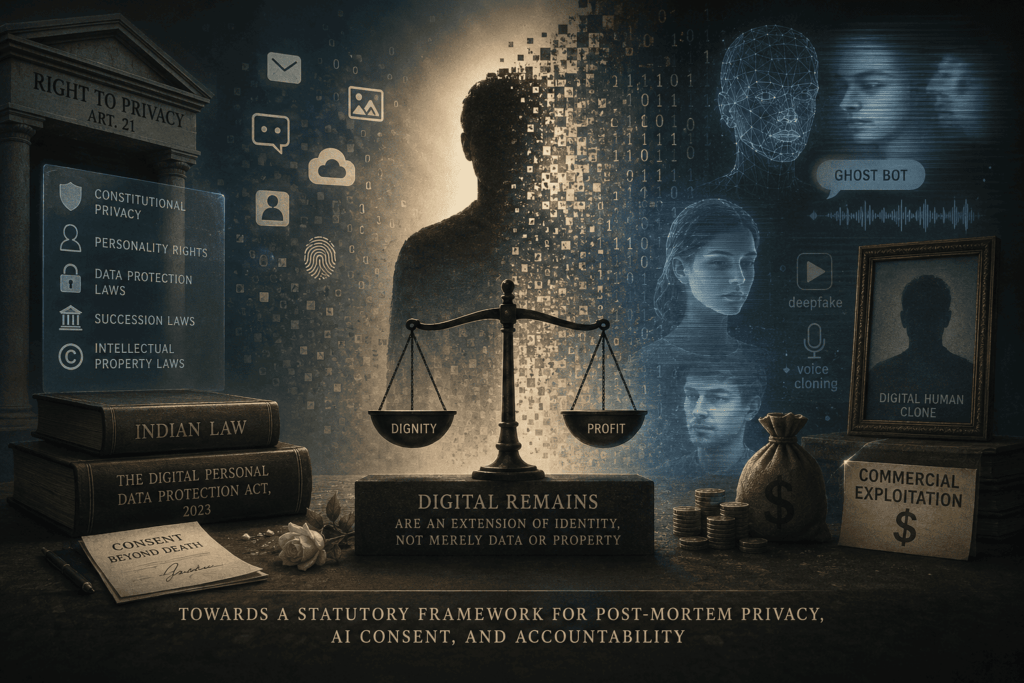
Developments in digital technology and artificial intelligence (AI) have altered the way in which personal information is created, stored, and used, bringing up many issues relating to post-mortem privacy, dignity, and identity. These technologies can be used to create an identity for someone dead: deepfakes, voice cloning, ghost bots, and digital human clones. But there is no well-defined legislative regime for regulating privacy after death and the commercial use of digital remains in India. There exist only scattered principles of constitutional privacy, right of personality, data protection laws, succession laws, and intellectual property laws.
With a doctrinal and comparative legal research approach, this essay examines the extent to which the laws in India are sufficient to ensure privacy rights after death and to control the commercial exploitation of dead persons through AI technologies.
The paper emphasizes that digital remains need to be seen as an extension of one’s identity and not merely as property or personal data. The legal framework at present, as the paper suggests, is inadequate to deal with AI-generated avatars and the commercial use of images of deceased individuals.
The paper suggests that there be a statutory regime that takes into consideration the limited privacy and personality rights after death, consent in relation to AI and responsibilities of both digital platforms and AI creators.
Keywords: Digital remains; post-mortem privacy; digital identity; personality rights; artificial intelligence; Digital Personal Data Protection Act, 2023.
Research Questions
- What are digital remains, and how have emerging technologies transformed digital identity after death?
- Should post-mortem privacy be recognised as a legally enforceable dimension of the right to privacy?
- What is the existing legal framework governing digital remains in India?
- Why does India require a comprehensive legal framework governing post-mortem digital identity?
- What specific challenges do AI technologies pose to consent, dignity, and personality rights in the post-mortem context?
Introduction
The rapid development of digital technologies has completely changed the process of creation, storage, and interaction with personal data. Digital letters, digital social media accounts, cloud digital files, biometric digital information, financial digital information, and other types of digital data are considered digital remains of the individual that survive after his death (Harbinja, 2017). However, in contrast to physical property, digital remains usually are managed by technological platforms or even third parties, which creates specific issues related to ownership, succession, privacy, and personality rights. Digital identities of people have acquired such aspects of individuality as autonomy, reputation, and dignity.
However, with the appearance of artificial intelligence, the problem arises of its use for the resurrection of a person after death. The application of technologies like deepfakes, voice cloning, ghost bots, and digital human twins is possible with the help of already created digital remains. These technological opportunities can be used not only for the memorialization of people or historical purposes but also for identity manipulation, commercialization of digital identity, etc. (Harbinja, 2017).
Present Indian legislation offers piecemeal protection from such emerging issues. Though in Justice K.S. Puttaswamy (Retd.) v. Union of India (2017), the Supreme Court recognized the right to privacy under Article 21 of the Constitution as a fundamental right, it did not clarify if constitutional principles of dignity and autonomy apply to the post-mortem digital identity of an individual. (Justice K.S. Puttaswamy (Retd.) v. Union of India, 2017). Similarly, the Digital Personal Data Protection Act, 2023 allows for the appointment of a representative who can exercise some rights after the death or incapacitation of the data principal, but it does not provide for post-mortem privacy as a right nor regulate AI-based digital representations of individuals. Personality rights jurisprudence is also centred around living individuals and provides limited protection from the commercial exploitation of digital identities of deceased individuals. (ICC Development (International) Ltd. v. Arvee Enterprises, 2003; Titan Industries Ltd. v. Ramkumar Jewellers, 2012)
While there is previous literature addressing the issue of digital inheritance, online account management, privacy, and data protection, relatively less literature has considered the issue of AI-based commercial exploitation of digital remains within the Indian legal regime. The literature on the subject tends to analyse either constitutional privacy, personality rights, succession law, or data protection in silos, without considering how they work together in regulating AI-generated posthumous identity. (Harbinja, 2017)
Given this backdrop, this paper seeks to explore if the existing Indian legal framework offers adequate safeguards for the protection of post-mortem digital identity against commercial exploitation through the use of AI. Using doctrinal and comparative legal approaches, the interplay of issues such as constitutional right to privacy, personality rights, data protection laws, law of succession, intellectual property, and AI regulations is analysed. With comparative insights from the laws of the United States of America, the European Union, and the United Kingdom, this paper attempts to suggest legal principles which can be incorporated into the Indian Constitutional framework.
Literature Review
Keywords: Digital remains; post-mortem privacy; digital identity; personality rights; artificial intelligence; deepfakes; digital human twins.
Theme 1: Digital Remains and Post-Mortem Privacy
Recent literature on the topic has gone beyond defining digital remains simply as social media profiles to include emails, cloud storage services, biometric data, financial transactions, and behavioural information. According to Harbinja (2017), digital remains should not only be seen as transferable property but rather as an extension of the person’s identity that needs legal recognition because of its link to dignity and autonomy.
Harbinja, McVey, and Edwards stress the lack of proper governance because, despite the provision of such contractual means as legacy contacts or memorialized accounts by technology companies, they cannot substitute for legal regulation. (Harbinja, McVey, & Edwards, 2025). Morse and Birnhack call this situation “the posthumous privacy paradox” because, even though a lot of people want to have control over their digital information even after their death, there are very few who have arranged things ahead of time. (Morse & Birnhack, 2022). Thus, it is clear from the above-mentioned analyses that successful regulation can only occur through enforceable legal rights and defaults.
The writing shows a disagreement about how digital remains should be seen legally. (Harbinja,2017) looks at digital remains mostly through the ideas of identity, dignity, and freedom, saying they can’t be fully understood as things that can be passed on. This way of thinking focuses more on the personal link between a person and their digital self. On the other hand, work about digital inheritance and what happens after someone dies focuses more on how to handle digital items after death. (Morse and Birnhack,2022) For example point out the difference between what people expect to keep control of their stuff and how little that is actually written down or protected by law.
These ways of looking at things go together. Are not the same. A way that sees remains as property might offer clearer ways to pass them on and manage them, but it could also make digital identity seem like just a money-making thing. A way that looks at privacy helps protect dignity and freedom. It might not deal with the money side of a dead person’s image. The current writing shows that digital remains are in an area between property, privacy and personal rights. This unclear way of classifying them becomes very important when artificial intelligence turns simple digital remains into things that can be used for money.
Theme 2: Artificial Intelligence, Digital Resurrection and Commercial Exploitation
AI has revolutionised the nature of digital remains from passive digital archives into active digital identity. In their review paper, (Harbinja, 2017) and (Hollanek & Nowaczyk-Basińska 2024) examine ghost bots, which utilise a dead individual’s digital communications to construct an artificial identity. They argue that such technological advancement poses challenges related to issues of autonomy, dignity, consent, and commercialisation. They call for legal instruments enabling people to stop the reconstruction process by an AI program even after their death.
Similarly, Cunneen et al. provide the idea of Human Digital Remains (HDR) through behavioural data, biometric identifiers, avatar, digital twin, and AI-generated identities (Cunneen et al., 2025). Unlike previous research that has mainly centred their work on the issue of privacy, they highlight the importance of the economics of digital identity and argue that AI can lead to the formation of a commercial market for posthumous identity without any legal regulations.
A big change in the writing is the move from keeping remains to making new versions of a person after they are gone. Earlier work on remains mostly looked at how to handle, pass on, keep, and protect information that stays after someone dies. Recent writing about ghost bots, avatars after death, and digital human twins shows that artificial intelligence changes what the problem is. AI doesn’t just keep a record; it can make new content that seems to talk, act, or represent the person who is gone.
This change makes a difference in the ideas that are already in the legal writing. The old way of thinking about after-death privacy is mainly about protecting information that already exists. AI-made identity is about making new versions from a person’s old digital signs. (Harbinja ,2017) and (Hollanek & Nowaczyk-Basińska, 2024) talk about worries about being in charge of your life, giving permission, and using technology properly. (Cunneen et al. 2025) Also point out the money and management problems with remains and digital human twins. The writing is now more and more aware that AI changes digital remains from something that stays in place into something that can be worth money.
The writing has not yet fully answered whether current rules about privacy, being yourself owning things, or protecting data can manage this change. The problem is not just whether information about someone who has died should be protected. It is also whether the law should control making, who owns, how it is allowed, and how it is used for money in an AI-made version of a person.
Theme 3: Challenges of Governance and Emerging Research Trends
One of the recurring themes in the literature is the fragmented nature and technological obsolescence of existing laws. Although there is an opinion that privacy and data protection laws can be expanded to cover deceased individuals, there is another opinion that personality/publicity rights are a better starting point for the reasons that these laws take into account the commercial value of personality.
However, despite all of these differences, there are three crucial gaps in existing knowledge. First, the interrelation between constitutional privacy, personality rights, succession law, intellectual property, and regulation of AI is not discussed. Second, there is no research conducted into the commercial exploitation of AI-generated recreations, especially in India. Third, there is not enough empirical work done on enforcement, platform compliance, and user experiences. These gaps are especially critical for the country, as legislation and the judiciary in India are still developing in this area.
Literature Review Conclusion
The literature says three things about digital remains. First, people think that digital remains are more than things that can be passed on because they are still connected to the person who died, and that affects their identity, dignity, and autonomy. Second, artificial intelligence has changed how we think about remains because it can make new versions of people after they die using things like ghost bots, voice cloning, deepfakes, and digital human twins. Third, the laws we have now to deal with remains are not very good because they are split up into different areas like privacy, data protection, personality rights, succession, intellectual property, and publicity rights, and they do not work well together. The literature also shows that people do not agree on what to do. Some people think we should focus on privacy and dignity while others think we should focus on the value of a person’s identity. Some people think the companies that make technology should be responsible, while others think we should just focus on the rights of the person who died and their family. This shows that we do not have a way to deal with artificial intelligence making new versions of people after they die.
The biggest problem is that we do not have a way to bring all these different ideas together. People have not really looked at how the laws in India about privacy, personality rights, succession, data protection, intellectual property, and artificial intelligence can work to stop people from making money off of artificial intelligence versions of people who have died. This study is trying to fix this problem by looking at remains as a special kind of legal problem that needs many different areas of knowledge and by looking at what other countries do to find ideas for a law in India.
Research Gap
There is considerable academic work that has greatly helped in gaining knowledge about digital legacies, post-mortem privacy, digital inheritance, and platform governance. Scholars have written extensively about the legal nature of digital assets after death, privacy and data protection in relation to deceased individuals, and ethics related to memorialization using artificial intelligence technology. These pieces of literature together highlight the importance of digital identity even after death. But most of this work has not considered how these concepts are connected through the constitutional notion of privacy, personality rights, laws of succession, intellectual property, and AI governance.
The issue of AI-based commercial exploitation of the digital identity of the deceased individual, especially in India, has not been researched in great detail. Scholars are well aware of the threat posed by new technologies like deepfake, voice cloning, ghost bots, and digital human twins, but the legal aspects of their use have been neglected. This gap becomes particularly noticeable in the context of the legal framework in India, whereby the current provisions related to constitutional privacy, personality rights, succession laws, and the Digital Personal Data Protection Act, 2023 are not cohesive enough and do not directly apply to the regulation of AI-based post-mortem identity.
This paper seeks to fill this gap using a comprehensive doctrinal analysis that focuses on the interplay between constitutional privacy, data protection, succession laws, intellectual property, and AI governance. With comparative insights gained through an analysis of practices in the United States, the European Union, and the United Kingdom, the paper highlights principles that could form the basis of an Indian legal framework.
Research Methodology
The doctrinal legal research method is used for this analysis since it will determine the sufficiency of the current legal framework that governs post-mortem digital identity and the commercialization of AI through the analysis of constitutional provisions, statutory laws, case laws, and legal principles.
In this study, digital remains refer to digital property, online accounts, biometrics, behaviour and identity created using AI technology. Primary sources, which are constitutional provisions, statutes, case laws, and government reports, will be used, backed by secondary sources like scholarly articles, books, Law Commission reports, and commentaries.
The comparative study conducted includes the USA, the European Union, and the UK, with an aim to explore diverse ways to deal with post-mortem digital identity. The paper does not promote borrowing of foreign laws but seeks to uncover the principles which can be useful for the construction of the domestic legal framework in India.
Given the fact that post-mortem digital identity involves several branches of law, the present study will consider constitutional privacy, personality rights, succession law, data protection, intellectual property rights, and governance of artificial intelligence collectively. The research takes a reformist approach in terms of exploring the shortcomings of the current legal framework and making recommendations on the regulation of AI representations of deceased persons.
Main Analysis
1. Digital Remains, Privacy, and their Legal Status
The accelerated digitization has brought about a change in the way people handle personal data in relation to its creation, storage, and interaction. Emails, accounts on social media, cloud storage, biometrics, banking and financial details, among others, form digital remains that often outlive a person. Unlike physical possessions, such digital remains are usually governed by technological companies and raise issues relating to ownership, succession, privacy, contractual relationships, and use for commercial purposes. While they become ever more relevant, Indian law does not acknowledge digital remains as a separate legal concept but regulates them on the basis of piecemeal property, privacy, succession, contract, and data laws.
Digital remains are not only economically valuable, but they also represent the identity of a person and thus are concerned with the issues of dignity and autonomy. As noted by Harbinja (2017), it becomes especially significant considering the development of artificial intelligence.
Current AI technology can be used to make voice clones, deepfakes, and digital avatars, among others, from the digital footprints left behind by the deceased. This is different from traditional digital archives, which do not produce new works that can be commercially exploited as advertisements and in entertainment, among others. Thus, there is an increase in the economic value of the posthumous identity.
A narrow view of digital remains as either being purely property or simply personal data fails to take into account the interests involved in identity reconstruction through AI technology. The commercial value of the digital remains is also ignored. A better way would be to have digital remains treated as having proprietary and personality interests.
2. Indian Constitutional and Statutory Framework
The constitutional basis for informational privacy in India was laid down in the case of Justice K.S. Puttaswamy (Retd.) v. Union of India (2017), where privacy as a fundamental right was identified under Article 21 and related to concepts like dignity, autonomy, and informational self-determination. (Justice K.S. Puttaswamy (Retd.) v. Union of India, 2017). Even if the decision was made for living people, the above-mentioned constitutional principles constitute the theoretical basis for determining whether it is possible to afford some sort of protection to post-mortem digital identity.
There is also still much lacking from the statutory perspective. The Digital Personal Data Protection Act, 2023, allows the nomination of an individual by a data principal to exercise her/his rights after his/her death or lack of capacity, yet this law does not acknowledge post-mortem privacy as a legal right of its own nor regulate artificial intelligence-based digital identities. Furthermore, this statute does not offer any regulation concerning issues like ownership, licensing, and control over AI creations or disputes between nominees, heirs, and digital platforms.
This issue is even more important considering the fact that generative AI generates digital representations instead of analysing pre-existing personal information. This means that technologies like voice cloning and digital avatars are not covered by the regulatory assumptions under the current framework. However, even though both the constitutional privacy rights and the Digital Personal Data Protection Act, 2023 offer some protection, neither one fully covers the use of AI-generated posthumous identity for commercial purposes.
3. Personality Rights and Commercial Exploitation in India
India does not have any specific statutory provision that addresses the issue of personality rights, unlike some other jurisdictions. Protection of such rights has been done by way of judicial pronouncements, which have recognized that a person’s name, picture, voice, image, and other attributes have both personal and commercial significance.
Publicity rights were recognized to protect the commercial aspect of an individual’s personality in the case of ICC Development (International) Ltd. v. Arvee Enterprises. (ICC Development (International) Ltd. v. Arvee Enterprises, 2003). It was reiterated in Titan Industries Ltd. v. Ramkumar Jewellers, wherein the court prevented unauthorized commercial exploitation of the pictures of celebrities. (Titan Industries Ltd. v. Ramkumar Jewellers, 2012)
Such doctrinal incongruity becomes increasingly hard to justify in the current era. As much as there is commercial and dignified value attached to the individual identity during his or her lifetime, such values do not cease to exist just because technology facilitates their exploitation after death.
5. Comparative Approaches to Posthumous Identity
Comparative study reveals that none of the jurisdictions has established a comprehensive law for posthumous digital identity. The relevant aspects are regulated by the legal systems in question through the interplay of privacy laws, personality rights, data protection, intellectual property, and publicity rights. Despite having a different tradition in each case, these laws can be instrumental in framing the Indian law in this context.
(a) United States
In terms of commercial exploitation of a person’s identity, the United States is the only country that takes the most commercially oriented path by virtue of its Right of Publicity, which considers the name, picture, voice, and likeness as commercially valuable assets. In Haelan Laboratories, Inc. v. Topps Chewing Gum, Inc., the court held that publicity rights were independent of privacy rights. Several states, including California and Tennessee, have recently passed laws, including the ELVIS Act, to regulate artificial voice cloning and digital likeness of individuals. (Haelan Laboratories, Inc. v. Topps Chewing Gum, Inc., 1953), (Ensuring Likeness Voice and Image Security Act, 2024).
The American model highlights the significance of understanding the economic value of the identity, but has received criticism for its focus on property rights, especially of celebrities, at the expense of considerations of dignity and privacy.
(B) European Union
For the European Union, the problem of digital identity is mostly dealt with through the lens of data protection law. The GDPR protects only living natural persons, while according to Recital 27, dead persons are excluded, leaving the Member States free to adopt their own laws. (Regulation (EU) 2016/679, 2016, recital 27). This results in different levels of protection around Europe and existing data protection laws having difficulties in dealing with AI-generated digital identities which go beyond traditional personal data processing.
The European model shows the inadequacy of data protection when regulating post-mortem digital identity and AI-generated reproductions.
(C) United Kingdom
There is no statutory law on the right of publicity in the UK; rather, there are privacy, intellectual property, copyright, passing-off, and contract laws in place. Though these may offer some form of protection, they have proven to be incomplete and insufficient in dealing with AI-generated replicas and other innovations.
The UK experience serves to demonstrate how limited the reliance upon common law solutions can be without proper legislation.
Comparison of the Laws Across Jurisdictions
None of these jurisdictions address all of the issues. The United States provides adequate protection on the commercial value of the person’s identity but is at risk of excessive commodification. EU has good privacy protection throughout life but inadequate protection after death.
Instead of taking up any particular model, India needs to design its own unique model by incorporating constitutional safeguards of dignity and autonomy, restricted personality rights that are survivable, regulation of the digital replica of personality in respect of AI, and guidelines regarding consent, licensing, and enforcement.
5. Artificial Intelligence, Digital Remains, and the Developing Legal Issues
AI has brought about significant changes in digital remains by creating digital personas that are interactive and commercially useful. Through analysis of photographs, videos, voice clips, texts, and behavioural data, AI can generate realistic avatars, voice clones, deep fakes, and similar digital representations of the deceased.
These technologies not only pose privacy threats but also have implications regarding issues of representation of beliefs, unauthorized performance, use in advertisements, and simulated conversation using chatbots, among others.
An important question of law is that of ownership and control. Given that AI-generated personalities are created out of existing data and are novel digital identities, confusion is bound to arise over which party holds the rights – heirs, nominees, digital executors, technology platforms, or AI developers. There is no clarity on this matter under Indian law.
AI technology also undermines the traditional concept of informed consent. People can consent to the use of their data during life without thinking about the possibility of their identity being created by AI after death. Therefore, the regulation of AI-generated identities will require legal protection which goes beyond regular data protection.
6. Critical Analysis and Need for Reform
In summary, although Indian law controls various facets of post-mortem digital identity through privacy laws under the Constitution, personality rights, succession law, and the Digital Personal Data Protection Act, 2023, none of these laws sufficiently provide protection from AI-generated posthumous digital identity. This fragmented regulatory framework results in uncertainties about ownership, consent, commercial exploitation, and enforcement.
It is difficult to justify the application of actio personalis moritur cum persona in situations where AI allows a deceased individual’s identity to have continued economic value and relevance even after death. Even though personal rights normally end at death, the dignity and autonomy values of the Constitution still apply to posthumous commercial exploitation.
Consequently, legislative reforms must acknowledge the right to post-mortem digital identity through:
- A statutory definition of digital remains encompassing digital assets, biometric data, behavioural data, digital avatars, voice clones, and any other form of digital identity created through artificial intelligence (AI);
- Limited rights to post-mortem privacy and personality rights that can be exercised by legal successors or digital executors for a certain period of time;
- AI-generated consent regimes that allow an individual to decide whether and how his/her identity should be digitally reproduced after he/she dies;
- Statutory acknowledgment of digital executors who have the right to manage digital assets and protect posthumous rights;
- Obligations imposed on technology firms to guarantee transparency, verification of consent, and removal of AI-generated reproductions that were unauthorized; and
- Licensing and regulatory regimes that govern the use of legitimate commercial applications.
This would not only offer greater legal certainty but also respect constitutional values of dignity and autonomy without interfering with technological developments.
Conclusion
This analysis demonstrates whether the Indian legal framework is sufficient to protect the post-mortem digital identity from commercial exploitation using AI technology. The findings of the paper indicate that digital remains are not mere personal data or digital assets. They are the extension of identity which can be reconstructed through the help of technologies such as deepfakes, voice cloning, ghost bots, and digital human twins. Thus, many legal issues arise concerning privacy, personality rights, consent, dignity, and commercial exploitation.
It was found that Indian law does not provide comprehensive protection in this regard. Although the Justice K.S. Puttaswamy (Retd.) v. Union of India case recognizes dignity, autonomy, and informational self-determination as the constitutional values, it does not expressly recognize post-mortem digital identity. (Justice K.S. Puttaswamy (Retd.) v. Union of India, 2017). Similarly, while the Digital Personal Data Protection Act, 2023 allows nomination for certain rights in relation to the data, it does not expressly recognize the post-mortem digital identity as an independent right. Despite expansion of personality rights in the case of living people in Indian courts, there is a lack of any posthumous protection.
Comparative analysis reveals that there is no country that has adopted an all-embracing approach towards addressing the matter at hand. The US acknowledges the commercial aspect of identity in terms of survivable publicity rights but lays more emphasis on proprietary rights. On the other hand, the EU has robust data protection for living individuals through the GDPR but fails to cater for deceased individuals, while the UK adopts common-law-based fragmented approaches. (Regulation (EU) 2016/679, 2016, recital 27). The best way forward would be for India to develop an approach that fits its constitutional values.
Digital remains are part of the identity that has continued to maintain both the legal and commercial value after the individual passes on. Though India has not recognised postmortem privacy as a fundamental right, constitutional principles of dignity and autonomy have been sufficiently applied to allow some level of protection. At present, the existing legal framework, including the Constitution of India, right to privacy, Digital Personal Data Protection Act, 2023, personality rights and succession laws, is fragmented and insufficient to govern AI-generated identities. Hence, India needs legislation governing digital remains, post-mortem personality and privacy rights, AI consent and obligations of tech companies.
Consequently, the findings of this paper further validate the main thesis that digital remains should be treated as an extension of personal identity and not just information or property for inheritance purposes. The law in India, at present, needs to strike a proper balance in adopting a suitable statutory scheme which preserves dignity and autonomy and also facilitates responsible innovation.
Scope and Limitations
The present research is conducted in a doctrinal and comparative legal manner and studies post-mortem digital identity and commercial exploitation through AI of the deceased person’s likeness. The legal analysis focuses primarily on the legal system in India with some comparative references to the US, the EU, and the UK laws. The legal analysis will look into the legal nature of digital remains, post-mortem privacy, the current Indian legal regime, the need for statutory reforms, and the problems of AI-generated representations.
The following research is subject to several limitations. Firstly, it is completely doctrinal and relies solely on constitutional provisions, legislation, judicial decisions, governmental publications, and academic sources of knowledge, but does not involve any empirical research. Secondly, the comparative research is done only within a selected number of jurisdictions and does not cover all possible international approaches to the post-mortem digital identity. Thirdly, Indian law in this particular field is not very developed, and the legal analysis should be based on inferences made from legal principles and existing case law. Finally, fast development in AI technologies may overstep the current legal analysis, and new legal reforms and judicial decisions may become necessary in the near future.
References
Cunneen, M., AnandFinn, R., Friel, R., Tennent, P., & Brandt, S. (2025). From bones to bytes: Anticipating and addressing the governance challenges of human digital remains and posthumous digital human twins. AI & Society, 41(3), 2021–2040.
Digital Personal Data Protection Act, 2023, No. 22 of 2023 (India).
Ensuring Likeness Voice and Image Security Act, Tenn. Code Ann. § 47-25-1101 et seq. (2024).
Haelan Laboratories, Inc. v. Topps Chewing Gum, Inc., 202 F.2d 866 (2d Cir. 1953).
Harbinja, E. (2017). Post-mortem privacy 2.0: Theory, law, and technology. International Review of Law, Computers & Technology, 31(1), 26–42.
Hollanek, T., & Nowaczyk-Basińska, K. (2024). Griefbots, deadbots, postmortem avatars: On responsible applications of generative AI in the digital afterlife industry. Philosophy & Technology, 37(2), Article 63.
ICC Development (International) Ltd. v. Arvee Enterprises, 2003 (26) PTC 245 (Del) (India).
Justice K.S. Puttaswamy (Retd.) v. Union of India, (2017) 10 SCC 1; AIR 2017 SC 4161 (India).
Morse, T., & Birnhack, M. (2022). The posthumous privacy paradox: Privacy preferences and behavior regarding digital remains. New Media & Society, 24(6), 1343–1362.
Regulation (EU) 2016/679 of the European Parliament and of the Council of 27 April 2016 on the protection of natural persons about the processing of personal data and on the free movement of such data (General Data Protection Regulation), 2016 O.J. (L 119) 1.
Titan Industries Ltd. v. Ramkumar Jewellers, 2012 (50) PTC 486 (Del) (India).