Authors: Brahmi Paliwal, Nishika Singh, S. Deeksha, Khushi Thakar, Prageet Satpathy, Mannat Chugh, Prasanthi Konda, Ayasa Mallick, Ogbaideba Mmesoma
1. ABSTRACT
Higher education is often seen as a pathway to employment and career development, but earning a degree does not guarantee that graduates will find suitable work. This paper examines the gap between higher education and employment in India, focusing on skilled migration, curriculum relevance, practical exposure, and the relationship between universities and employers. It uses a thematic review of published literature alongside a descriptive comparison of graduate unemployment in India, South Africa, Brazil, the Republic of Korea, the United States, the United Kingdom and Germany. It also considers India’s highereducation gross enrolment ratio (GER) alongside graduate unemployment. The literature reviewed suggests that graduate employment outcomes cannot be explained by curriculum design alone. The quality and accessibility of practical learning, institutional resources, employer participation and wider labour-market conditions may also shape the transition from education to work. The paper argues that expanding access to higher education should be accompanied by meaningful work-based learning, regular curriculum review, stronger links between institutions and employers, and better tracking of graduate outcomes. The quantitative findings are descriptive and should be interpreted cautiously: sources may use different definitions and reference periods, and unemployment alone does not capture underemployment, low wages or skills mismatch. The study therefore treats international examples as possible sources of policy learning rather than models that can be transferred to India without adaptation.
2. INTRODUCTION
Higher education is generally expected to prepare students for further learning, employment, and participation in society. However, having a degree does not automatically mean that a graduate has the skills, experience, or opportunities required to build a meaningful career. The literature on “Degrees Without Direction” points to several connected issues: the outflow of skilled graduates, the mismatch between university curricula and labour-market needs, the importance of practical exposure, and the need for stronger connections between higher education and the world of work. Together, these themes help explain why the problem is not simply the degrees being awarded, but whether those degrees actually have direction towards employment and career development. Historically, the Indian higher education system faced persistent structural asymmetries, where theoretical degree completion diverged from the functional skill requirements of modern industry. Higher education holds a central place in the social and economic aspirations of modern societies. Families invest heavily in degrees, governments expand universities, and policy makers treat rising graduate numbers as evidence of progress. Behind these practices lies a shared assumption: that a degree will carry its holder into meaningful work, further learning and active participation in society. This assumption is increasingly questioned. This disjuncture is captured in the phrase “Degrees Without Direction”. The phrase describes situations in which credentials are produced in large numbers but are not connected to a clear pathway into employment or career development. The problem is most visible in developing economies, and India offers an instructive case. Its higher-education system is large, diverse and highly uneven. It ranges from well-resourced institutions with strong industry links to rural and resource-constrained colleges, where infrastructure, trained faculty and employer access are limited (Reddy & Mohan, 2025). In such a system, producing more graduates does not automatically produce more employable ones (Gill, 2022).In this paper, we’ll discuss the relation on obtaining degrees and the employment ratio which are affected by the obtainment of the said degree. The topic matters for reasons that extend beyond education policy. It bears directly on Sustainable Development Goal 4, which calls for inclusive and equitable quality education, and on Goal 8, which calls for decent work and sustainable economic growth. If education is “quality” only in the sense of certification, and does not lead to decent work, neither goal is fully met. Skilled graduates who cannot be absorbed by the domestic economy also represent a lost return on both public and private investment. Understanding why degrees sometimes lack direction is therefore a developmental question as well as an educational one. This paper explores ways to strengthen the connection between higher education and employment in India, focusing on curriculum development, industry–academia collaboration, internships, skill development and institutional partnerships. It follows a qualitative and descriptive research approach using secondary data from government policies, official reports, published research and institutional sources. The information is analysed thematically to understand the major challenges, existing initiatives and possible areas for improvement.The paper concludes that bridging the gap between higher education and employment requires more than introducing a few skill-development courses. It calls for a more coordinated approach that connects academic learning with practical experience and changing labour-market needs while ensuring that higher education continues to support students’ overall intellectual and personal development.
3. LITERATURE REVIEW
Theme 1: Curriculum and its Direct Involvement in Employment Ratio
The next question is whether what universities teach actually keeps pace with what employers and economies need. This is central to “Degrees Without Direction” because a degree can have limited value when the knowledge and skills it provides are disconnected from the requirements of employment. At the same time, it is important to analyse whether the curriculum’s breadth is relevant to the labour market.Seah, Pan and Tan (2020) provide an important empirical counterpoint to the assumption that a broader curriculum automatically produces better labour-market outcomes. Using administrative data and several empirical methods, they find that reducing curriculum breadth did not have a statistically significant effect on early earnings, full-time employment or unemployment once academic performance was taken into account. This contrasts with Shippee’s conceptual argument that universities should balance STEM and practical learning with humanities-based understanding and avoid overly specialised or siloed education. While Shippee argues for a broader and more balanced approach, the paper does not provide direct evidence that such breadth improves employment outcomes. Other studies focus less on breadth and more on how the curricula are designed. Esperancilla and Abenes (2025), through their analysis of the Philippines’ MATATAG curriculum, emphasised that de-congesting the syllabus to reduce rushed and rote learning, and focusing on vocational skills alongside emotional intelligence, can be productive. This model of the Philippines can be effective for the Indian education system. Meanwhile, Mahalingam (2024) focuses on collaboration between academia and industry to make curriculum development more relevant to workplace requirements. These approaches suggest that curriculum alignment may depend more on quality, relevance and employer involvement than simply on having a broader curriculum. Therefore, the literature does not establish that curriculum breadth by itself solves the education–employment problem. Instead, it suggests that what students learn needs to be connected to how they will use that knowledge, while the actual employment effects of different curriculum designs remain insufficiently tested.
Theme 2: Importance of Practical Exposure in Building a Career
The limitations of curriculum alone lead to the importance of practical exposure. Internships, vocational education, projects and workplace learning allow students to apply theoretical knowledge in real situations and develop skills that are difficult to gain through classroom learning alone. This makes practical exposure particularly relevant to the problem of degrees that do not provide a clear transition into employment.Reddy and Mohan (2025) find that students generally recognize the value of vocational and experiential learning for improving career prospects, but their study also identifies barriers such as inadequate infrastructure, insufficient funding and a lack of trained teachers, particularly in rural areas. This shows that simply introducing practical components intoeducation does not guarantee that students will receive meaningful exposure. Similarly, Samundeeswari and Murugesan (2026) find that internships can help students apply classroom learning, develop missing skills and understand employer expectations. However, their study also notes that long-term outcomes of internships remain underexplored. Daryal and Sharma (2025) make this issue clearer by showing that internships do not automatically result in experiential learning or improved employability. Their findings point to factors such as industry involvement, student preparedness, curriculum alignment, faculty guidance, availability of industry connections and financial constraints.The German dual vocational education system provides another example of the importance of structure and employer participation, with Deissinger (2015) emphasising that its effectiveness is linked to the institutional and labour-market conditions supporting the system rather than to vocational training alone. Taken together, these studies suggest that practical learning can help bridge the gap between university and employment, but only when it is relevant, accessible, properly supported and connected to employers. The issue is therefore not simply whether students receive an internship or practical course, but what kind of experience they receive and how well it is integrated with their education.
Theme 3: Brain Drain and How it’s Affecting India’s employment ratio
Brain drain refers to the movement of highly educated and skilled people from developing countries towards countries offering better economic and professional opportunities. This is relevant to “Degrees Without Direction” because when graduates face limited employment opportunities, lower wages, weak research environments, or better career prospects abroad, migration can become an alternative to finding opportunities at home (Iravani, 2011; George, 2023).The literature, however, shows that skilled migration cannot always be treated as a simple loss. George (2023) presents both the costs and benefits of India’s manpower exports, pointing to losses through the migration of doctors, nurses, engineers and other skilled workers, while also highlighting remittances, knowledge transfer and other benefits.These studies therefore agree that differences in income, opportunity and professional conditions influence skilled migration, but they differ in how its consequences should be understood. For India, the overall effect remains complicated because the loss of skilled workers can exist alongside remittances, diaspora networks and the possibility of return or knowledge transfer (George, 2023). Thus, talent outflow can partly be understood as an outcome of the opportunities available to graduates, connecting the migration problem back to the quality and relevance of opportunities created by the domestic education and employment system.
Theme 4: Strengthening the Connection Between Higher Education and the World of Work in India
Classical Human Capital Theory explains education as an investment that can raise an individual’s productivity and earnings (Becker, 1964). This theoretical expectation, however, does not mean that every degree automatically leads to suitable employment. Evidence from India points to a gap between some graduates’ capabilities and employers’ expectations. In an employer survey focused on newly graduated engineers, Blom and Saeki (2011) found that 64% of surveyed employers were only somewhat satisfied with new engineering hires or less; employers placed particular importance on communication and other core employability skills, and reported gaps in higher-order thinking. The World Bank’s review of Indian tertiary education similarly identifies collaboration with employers, internships, project work, problem-solving and other transferable skills as important elements of employability (Arnhold et al., 2022). These findings provide evidence of skills gaps in particular sectors and contexts; they do not establish that all Indian university curricula are dominated by rote learning or that all graduates lack digital fluency. The interpretation advanced here is that a degree needs to be supported by opportunities to apply knowledge, develop transferable skills and respond to changing workplace requirements. Policy initiatives in India increasingly recognise the need to connect academic learning with practical experience. The National Education Policy (NEP) 2020 proposes integrating vocational education into higher education and encourages institutions to experiment with apprenticeships and other forms of work-based learning (Ministry of Education, 2020). The University Grants Commission’s Apprenticeship Embedded Degree Programme (AEDP) guidelines provide a more specific framework through which apprenticeship training can become an integrated component of an undergraduate degree. The guidelines describe apprenticeship as a combination of workplace training and related theoretical learning, and identify the National Credit Framework (NCrF) as a framework that brings academic, vocational and experiential learning together (UGC, 2025). These are policy provisions and programme intentions; they should not be presented as proof that the education–employment Page 6 of 19gap has already been reduced. In this paper, we interpret these measures as potential mechanisms for strengthening the connection between universities and employers. Their effectiveness will depend on the quality of placements, supervision, student access, assessment and the relevance of the work to students’ fields of study.The geography of employment opportunities is also changing, although this change is uneven. Reports on India’s Tier-II cities identify places such as Chandigarh, Lucknow, Coimbatore and Kochi as growing commercial, industrial or technology locations, with infrastructure, operating costs and access to talent among the factors shaping their attractiveness (CBRE, 2022; Zinnov, 2024). This evidence supports the view that some employment activity is expanding beyond the largest metropolitan centres; it does not show that all Tier-II and Tier-III cities have become established corporate operations hubs. At the same time, the NITI Aayog report on India’s gig and platform economy documents the growth and projected expansion of work outside conventional employer–employee arrangements, including platform-based and other gig work (NITI Aayog, 2022). The report also identifies opportunities and challenges associated with this form of work. Taken together, these developments suggest that graduates may encounter a wider range of employment arrangements and locations than traditional long-term salaried jobs alone. Our interpretation is that higher education institutions should therefore prepare students not only for specific occupations, but also for adaptable skills, career transitions and an informed understanding of different forms of work.
4. RESEARCH GAP
Despite the growing body of literature on Indian labor economics and higher education policy, three main empirical and theoretical research gaps remain:
1. Disconnect Between Assessment Employability Scores and Youth Unemployment.
Existing studies frequently treat standardized assessment scores (such as test-based hiring readiness metrics) and actual labor market absorption as directly linked indicators. However, current research lacks integrated models explaining why nationwide employability scores have risen to 56.35%, while fresh graduate youth unemployment (ages 20–24) remains elevated at over 33%, with approximately 11 million graduates aged 20–29 unemployed and over 20 million working in low-skill, underemployed roles.
2. Economic quantification is absent.
It claims taxpayer-funded training is “lost” but never estimates the fiscal cost of education, the value of remittances, or the net economic impact. A rough fiscal loss can be analysed by the public subsidy per student, particularly at institutions like the IITs, AIIMS, and government medical colleges, where fees are far below the cost of provision multiplied by emigration rates.
3. No empirical evidence.
The methodology says outright that there’s no primary data and no statistical testing. The text of the paper makes factual claims which need evidence. Data is not given for the stay rates, OECD migration statistics, or the Indian ministry of external affairs or ministry of education figures. Foreign placement reports and salary data would be invaluable for strong claims.
4. METHODOLOGY
This study adopts a descriptive-comparative, mixed-methods research design based entirely on secondary data. It combines qualitative thematic analysis of published literature with quantitative descriptive analysis of graduate unemployment and higher education enrolment. The qualitative component examines brain drain, curriculum relevance, practical exposure, industry interaction and the relationship between higher education and employment. Through conceptual analysis and critical interpretation, the study explores the causes and broader implications of these issues. The quantitative component compares graduate unemployment across selected countries and examines trends in India’s tertiary gross enrolment ratio (GER) and graduate unemployment. The study does not involve primary data collection or experimental methods, and its findings are interpreted in the context of existing literature and education and employment policies.
The units of analysis are seven countries: India, South Africa, Brazil, the Republic of Korea, the United States, the United Kingdom and Germany. These countries were purposively selected to compare India with a combination of emerging and advanced economies. The study examines graduate unemployment across these countries over the period 2010–2023. For India, it also examines the relationship between tertiary GER and graduate unemployment over time. In addition, the Indian higher education system is compared qualitatively with the higher education systems of the selected countries across fiveparameters: subject switching, approach to education, curriculum updates, practical exposure and research initiatives. These parameters are used to identify differences in educational structures and practices that may be relevant to the transition from higher education to employment.
The quantitative analysis focuses on two principal indicators: graduate unemployment rate and tertiary gross enrolment ratio (GER). Graduate unemployment rate refers to the percentage of unemployed graduates within the graduate labour force, which comprises graduates who are either employed or unemployed. Unemployed graduates are those without employment who satisfy the applicable criteria for availability for work and seeking work.
The precise educational qualification, age group and denominator depend on the definition adopted by the original data source. Accordingly, the figures are interpreted in relation to the definitions and coverage of the respective datasets. Graduate unemployment is used as an indicator of employment difficulties among graduates rather than as a direct measure of employability or proof that higher education has failed to prepare students for work.
Tertiary gross enrolment ratio (GER) refers to total enrolment in tertiary education, regardless of the age of the students, expressed as a percentage of the population in the official age group corresponding to tertiary education. It indicates the level of participation in tertiary education rather than the proportion of students who complete their degrees or secure employment. GER may exceed 100% because students outside the official age group are included in total enrolment. In this study, GER is examined alongside graduate unemployment in India to describe how higher education participation and graduate unemployment have changed over time. Their simultaneous movement is treated as an observed association and not as evidence that increasing enrolment directly causes unemployment.
The study relies on secondary sources, including published scholarly literature, government publications, policy documents and publicly available aggregate statistics. The qualitative component uses thematic analysis to identify recurring arguments, areas of agreement and differences in the literature concerning curriculum design, practical learning, skilled migration and the connection between higher education and employment. The quantitative component uses descriptive comparisons, percentage changes and trend interpretation to examine the available data across countries and over time. Curriculum relevance, practical exposure, industry interaction and skilled migration are treated as qualitative analytical themes rather than directly measured quantitative variables. The analysis is intended to identify patterns and possible explanations, rather than establish causal relationships between educational practices, migration and unemployment.
The study uses publicly available, aggregated data and published literature. It does not involve human participants or personal data. The principal ethical considerations are accurate citation, faithful representation of published findings, transparency about data limitations and responsible use of secondary sources.The study is constrained by the definitions, coverage and reference periods of the original sources. Graduate unemployment may be defined or operationalised differently across PLFS, ILOSTAT and World Bank datasets, limiting direct cross-country comparability. Differences in educational qualifications, age groups and denominators must therefore be considered when interpreting the results. The study’s quantitative findings are descriptive and do notestablish causation. National aggregates may also conceal differences across states, institutions and rural and under-resourced settings. Furthermore, graduate unemployment does not capture underemployment, employment quality, wage outcomes or skills mismatch, all of which are relevant to the broader concept of “degrees without direction”. Finally, the selection and interpretation of themes in the qualitative analysis involve researcher judgement.
5. DATA ANALYSIS/ RESULT
The literature on higher education and employability in India identifies concerns about the alignment between academic learning and the skills required in the workplace (Gill, 2022). The literature reviewed for this paper also points to barriers to meaningful experiential and vocational learning, including resource constraints and limited access to trained staff in some settings (Reddy & Mohan, 2025). These findings suggest that theoretical instruction and examination-based assessment may not always be sufficient to prepare students for employment; however, the extent of this problem may differ across institutions and disciplines. The sources reviewed also raise questions about how regularly curricula are updated and how much support institutions can provide for research and international collaboration. Because this study uses secondary data and does not directly measure curriculum-update frequency, research funding, or international student recruitment, these issues are treated as themes from the literature rather than as independently verified findings of the present analysis.
The dataset under analysis consists of five primary structural parameters evaluating institutional operations:
Distribution and Group Comparisons:
1. Academic Mobility: The Indian system enforces rigid boundaries where students are restricted to a single primary domain, preventing interdisciplinary exploration. In contrast, foreign systems allow flexible interdisciplinary course selection.
2. Pedagogical Alignment: Indian institutions prioritize theoretical knowledge based on historical examination models. Conversely, foreign systems focus on pragmatic, researchdriven methodologies designed to uncover new knowledge.
3. Research Infrastructure & Financial Support: Foreign institutions benefit from strong industry-academia partnerships funded by corporate giants such as Google and Microsoft, leading to superior research outputs. Conversely, Indian institutions face constraints due to limited research capital.
4. Curriculum Modernization and Internationalization: Foreign universities update their curricula systematically at frequent intervals, enabling them to maintain global standards and attract international student bodies. Indian universities face delays in revising academic modules, restricting their capacity to attract global talent.
Variable Wise Analysis:
1. Flexibility vs. Innovation: A direct relationship exists between subject flexibility and research output. Systems that restrict interdisciplinary study exhibit lower research activity and delayed curriculum modernization.
2. Funding vs. Globalization: Private corporate sponsorship in foreign institutions correlates directly with institutional capacity to internationalize and attract multicultural student cohorts. The findings consistently highlight systemic gaps in domestic academic governance. The lack of timely curriculum revisions and restricted research funding present recurring barriers to internationalizing domestic universities.
Comparative analysis across economic regions reveals prominent variance in graduate unemployment metrics:
1. India vs. Developed Nations: India exhibits the highest graduate unemployment rate among all analyzed nations at 15.3%, which is nearly 5 to 7 times higher than developed nations such as the United States (3.0%), the United Kingdom (2.7%), and Germany (2.2%)
2. Emerging Peers Comparison: India leads all emerging peers in graduate unemployment, exceeding South Africa (12.4%) by 2.9 percentage points and Brazil (5.5%) by nearly three times.
3. Developed Nation Baseline: Advanced economies demonstrate highly stable labour market absorption for higher education graduates, keeping graduate unemployment within a narrow band of 2.2% to 3.4% (Germany, UK, US, and Republic of Korea).The substantial multi-year average gap (2018–2024) confirms that high graduate unemployment in India is a persistent structural issue rather than a transient macroeconomic anomaly. The findings reinforce the presence of an acute skill gap and structural friction in absorbing advanced degree holders into high-skilled employment.
1. Macro Disparity: India records the highest graduate unemployment gap among peer nations at 15.3%, contrasting sharply with global advanced standards (2.2%–3.0%).
2. Structural Mismatch: The elevated rate in India highlights an urgent need for structural alignment between tertiary education curricula and labour market demands.
3. Strategic Implication: To bridge the graduate unemployment gap, policy intervention must focus on skill relevance, practical training integration, and industry-oriented curricular updates.
Quantitative Expansion vs. Qualitative Deficit:
The empirical data confirms the core thesis of the “Degrees Without Direction” paradox. While higher education accessibility expanded by 77.1% (growing from 18.70% to 33.12% enrollment), the market’s inability to absorb these graduates resulted in a 79.6% net increase in graduate unemployment over the baseline period (7.50% to 13.47%).
Decoupling of Qualification and Employability:
In a balanced labour market, higher educational attainment typically yields lower unemployment risks. However, the Indian data demonstrates an inverse relationship where expanding higher education participation coincided with elevated graduate joblessness, signalling a structural disconnect between academic curricula and market demands.The historical data demonstrates that despite minor cyclical corrections (such as the decline from 17.91% in 2020 to 13.47% in 2024), graduate unemployment remains structurally elevated above 13%. This indicates that expanded access to general higher education degrees without structural direction does not inherently guarantee economic productivity or workforce readiness.
Key findings:
1. Empirical Confirmation of Paradox:
India successfully expanded higher education enrollment to 33.12% by 2023; however, graduate unemployment expanded simultaneously, remaining near 13.47%.
2. Core Structural Shortcoming:
Higher education expansion has focused primarily on quantitative output rather than qualitative skill alignment.
3. Policy Imperative:
Mitigating this paradox requires shifting institutional focus from mere degree production toward directional employability, incorporating global solutions such as German-style dual training, industry-aligned curricula, and practical competency frameworks.
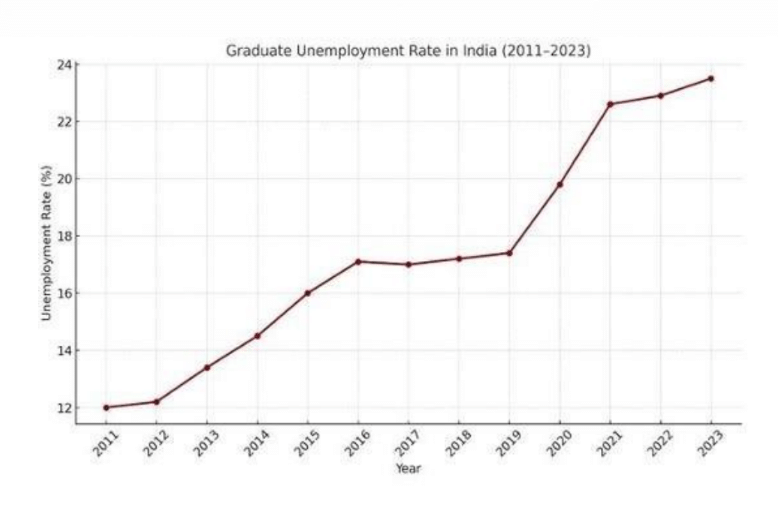
Figure 1.1
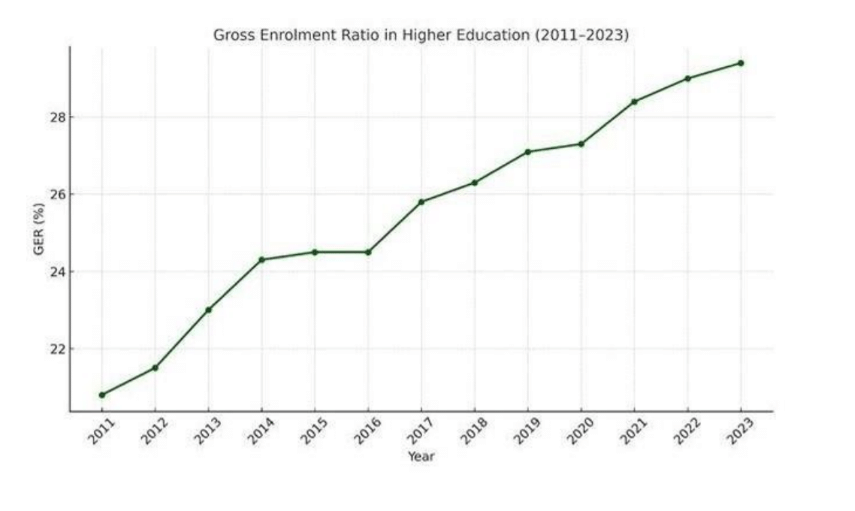
Figure 1.2
The comparative dataset tracks two key macro-educational indicators across identical annual checkpoints (2011–2023):
1. Higher Education Gross Enrolment Ratio (GER %):
Capturing the total enrollment in tertiary education as a percentage of the official age group population.
2. Graduate Unemployment Rate (%):
Capturing the percentage of the labor force with advanced/tertiary education credentials who remain unemployed and actively seeking work.
Comparative Trend Analysis:
1. Steady, Incremental Growth in GER:
The Gross Enrolment Ratio exhibits a consistent, upward linear expansion, climbing from 20.8% in 2011 to 29.5% in 2023 (representing an overall increase of 8.7 percentage points). This confirms successful quantitative widening of higher education accessibility.
2. Accelerated, Steep Surge in Unemployment:
Conversely, the Graduate Unemployment Rate demonstrates a much steeper, aggressive upward slope, rising from 12.0% in 2011 to an alarming 23.5% in 2023 (an increase of 11.5 percentage points). Notably, unemployment grew at a faster pace than enrollment, particularly post-2019 where it crossed the 22% threshold.
3. The Widening Policy Gap:
While GER grew by roughly 41.8% over the 13-year span, graduate unemployment surged by nearly 95.8%. This disproportionate escalation proves that the domestic labor market’s capacity to absorb university graduates has severely lagged behind institutional output.The comparison validates that increasing higher education volume without structural orientation fails to generate employment security. As millions more entered colleges (reaching 29.5%), nearly a quarter of all graduates faced joblessness (23.5%) by 2023. The simultaneous upward slopes in both charts indicate that general degree programs continued toproduce credentialed labor unequipped with the practical competencies demanded by modern industries. The comparison of 2011–2023 data conclusively shatters the assumption that higher enrollment naturally solves unemployment. To reverse the 23.5% unemployment trajectory while maintaining a healthy GER, structural reforms—such as German-style dual apprenticeships and South Korean curriculum agility—must be urgently implemented to bridge the gap between academia and industry.
Evaluating the projected transition from India’s current baseline to the proposed global models reveals significant optimization potential:
1. Reducing the Graduate Unemployment Gap:
India currently records a graduate unemployment rate of 15.3%. By institutionalizing mandatory on-the-job internships modelled after Germany’s dual-training system, structured practical exposure directly addresses the skills mismatch, bridging the gap toward the sub-3.5% unemployment rates observed in Germany and South Korea.
2. Curriculum Flexibility and Market Alignment:
Transitioning from rigid, delayed academic syllabi to dynamic, industry-advised curricula (similar to South Korea’s model) ensures that graduates possess modern computational, technical, and data-handling competencies required by the contemporary labor market.
3. Fiscal Investment and Infrastructure Quality:
Raising public education expenditure from the current ~4% baseline to the targeted 6% of GDP provides the necessary capital to modernize institutional infrastructure, build advanced campus laboratories, and recruit qualified educators to lower the primary pupil-teacher ratio from 33 to under 20. While scaling dual-training systems across India requires deep institutional coordination between universities and private enterprises, pilot programs integrated through national internship portals provide a viable pathway. Increasing public expenditure on education to 6% of GDP is a critical prerequisite for upgrading institutional quality, ensuring that the structural reforms translate into sustainable, long-term employment growth. Adopting international best practices—such as German-style apprenticeships and South Korean curriculum agility—directly addresses India’s 15.3% graduate unemployment challenge by replacing textbook theory with practical readiness. Quality higher education outcomes depend heavily on primary education strengthening, specifically lowering pupil-teacher ratios to build cognitive and foundational skills early. Achieving a globally competitive education ecosystem requires meeting the 6% GDP spending target to fund modern laboratories, digital infrastructure, and faculty expansion
6. CONCLUSION
A degree can create opportunities, but it does not guarantee suitable employment. The relationship between higher education and work depends on several connected factors: whatstudents learn, how they apply that learning, the resources available to their institutions, the opportunities employers provide, and the wider conditions of the labour market. The literature reviewed in this paper suggests that curriculum relevance and practical exposure are important parts of this relationship, but neither can fully explain graduate unemployment on its own. Skilled migration also has mixed effects. It may reflect a lack of suitable opportunities at home, while also creating benefits through remittances, professional networks and knowledge transfer. The country comparison is intended to place India’s graduate unemployment figures in a wider context. However, the numerical results in the current draft need to be checked against the original datasets before firm conclusions can be drawn. In particular, the draft contains conflicting values for India’s gross enrolment ratio and graduate unemployment, as well as inconsistent descriptions of the comparison period. These issues must be resolved and the sources clearly documented. Even when the figures are verified, the parallel movement of enrolment and unemployment would show an association over time, not prove that higher education expansion causes unemployment or that curriculum weaknesses are the sole explanation.The literature and descriptive analysis point towards a more coordinated approach to higher education and employment. Institutions can make practical learning more meaningful through supervised internships, apprenticeships and projects that relate to students’ fields of study.Curriculum reviews should involve faculty, students, alumni and employers, while preserving the broader purpose of education, including critical thinking and independent learning.Partnerships between universities and employers should provide genuine learning opportunities and should not leave students who lack financial or geographic access behind. Better data on employment, underemployment, wages and the match between qualifications and jobs would also help policymakers evaluate whether reforms are working. International examples, including Germany’s structured work-based learning, can offer useful ideas, but they should not be copied without considering India’s scale, regional differences, institutional capacity and labour-market conditions. Pilot programmes and careful evaluation would provide a stronger basis for deciding which approaches can be expanded. Ultimately, the aim should not be to judge higher education only by the number of graduates it produces, but by whether students receive a meaningful education and have fair opportunities to use it. Making the transition from education to work clearer requires action from universities, employers and policymakers together.
REFERENCE
● Dassin, J. R. Brain Drain from Developing to Wealthy Countries and InstitutionalPolicies to Reduce It.
● Deissinger, T. (2015). The German Dual Vocational Education and Training Systemas “Good Practice”?
● Dutta Gupta, D., & Chaudhery, U. (2018). A Study of Job and Work Performanceof Higher Education Sector in India.
● George, A. S. (2023). Analysis of Brain Drain or Brain Gain: Assessing the Costsand Benefits of India’s Manpower Exports.
● Gill, R. S. (2022). India: Employability and Higher Education.
● Iravani. (2011). Brain Drain as a Political, Economic and Psycho-SocialProblem: Classification on a Brain Migration.
● Mahalingam, T. (2024). Bridging the Gap between Academia and Industry: A CaseStudy of Collaborative Curriculum Development.
● Reddy, & Mohan. (2025). Impact of Experiential Learning and Vocational Integrationon Career Readiness of Secondary and Higher Secondary Students in India under NEP2020 and NCF 2023.
● Samundeeswari, & Murugesan. (2026). Internships as a Mechanism to Bridgethe Academic–Workplace Gap and Build Employability and Career Readiness.
● Seah, K. C., Pan, J., & Tan, P. L. (2020). Breadth of University Curriculum andLabor Market Outcomes.
● Singh, R. (2020). Towards Making Indian Universities Relevant and Future Ready.
● Udayanga, S. (2024). Challenges in Navigating the Education-Migration Pathways,and Subjective Well-Being of Highly Educated Immigrants: The Case of Indian Student Immigrants in the United Kingdom.
● Deissinger, T. (2015). The German Dual Vocational Education and Training Systemas “Good Practice”?
● Esperancilla, E. J. D., & Abenes, R. D. (2025). From Theory to Practice: GertBiesta’s Educational Telos in the Philippines’ MATATAG Curriculum.
● Shippee, M. A Globalized Curriculum: The Next Evolution of Curriculum.